Home Blog Page 458

Best comfy spots at SFU Burnaby

0

By: Madeleine Chan, Staff Writer

Picture this: You’re on the mountain. Maybe you’re between classes and want to do some readings — or at least, attempt to. Maybe you want to take a power nap before your next four-hour lecture. Or, maybe you just want to have a nice place to sit while you existentially contemplate your uncertain future. Regardless, you realize that you have nowhere to go. All the spots you know of are taken.

Fear not, weary traveller, for I have searched and scoured SFU Burnaby for the comfiest and coziest spots that the school can provide. These spots range from warm hideaways to calming coves that offer the best environments for restoring your sanity. Best of all, each spot is wheelchair accessible and not restricted to students of certain departments. Look to these recommendations when you’re put on the future SUB nap room’s four-year waitlist or your go-to place is polluted by constant construction noise.
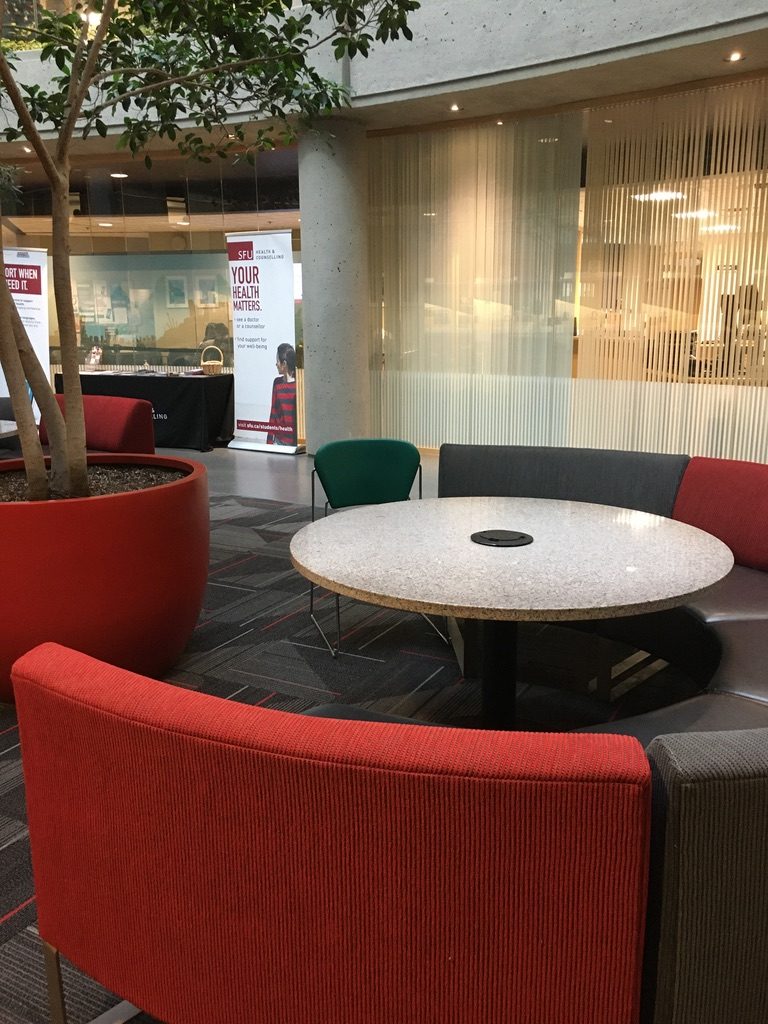
Photo taken by Madeleine Chan

Bottom Floor of MBC

A spot that feels like you’re at the bottom of a fantastical castle spire. Multiple circular, lounge-style chairs are paired with circular tables that dot the lowest floor of Maggie Benston Centre. The decently spongy seats have angled backs, which are great for slouchers like me. The area’s position underneath the stairs also gives it an added sheltered feel. Oversized pots filled with lush trees also create a canopy of comfort. The sunken and hidden feel of the area can sometimes be overshadowed by chatter from the upper levels during busier hours, but overall this spot is a nice, cool place to chill.

Tags: 10/10 forest feel, nine circles of heaven, carpet

Photo taken by Madeleine Chan

AQ 2130: Northwest corner, second floor

The squishiest couches I could find. This large study area is great for studying and napping as it has both single seats and longer couches. There is at least a one-to-one chair-to-table ratio, so there is no need to worry about where to put all of your overpriced textbooks. The varied sizing of the light fixtures is a nice touch that adds warmth to an otherwise concrete-filled space. Its secluded location underneath the main AQ walkway also makes this space the ideal hideaway from the stress of avoiding people handing out pamphlets on your way to class.

Tags: cloudlike chairs, individual space, sleepy

Photo taken by Madeleine Chan

Sixth floor AQ Mini Lounges

These little spots scattered around the top floor of the AQ make for great getaways. The soft SFU-red chairs are placed near wide windows with stellar views of the sky. On nice days, you can even see the mountains and the city below depending on which side of the building you’re on. The windows also let in an ample amount of natural light which increases the calming nature of the area. Considering that not many people go to or even know about the sixth floor of the AQ, you can bet on minimal noise and traffic, which is perfect for lengthy naps on the longer, couch-like red seats. Potted plants also make the spaces feel more homey. These small and snug alcoves are ideal havens for the extrovertly-challenged.

Tags: THE SKY, good save point, calm

Photo taken by Madeleine Chan

The Hangar: TASC2 East Lounge

A hidden gem of a spot. This lounge in the Environmental Science area is a perfect place to escape SFU’s bustling halls and construction noise. It’s nicely nestled at the bottom floor of the building and has a long floor-to-ceiling glass wall which immerses the seating space in natural light. The red cushiony seats that surround large tables are all long enough for napping, but especially the two couches on the ends of the area that are double the size. With a vending machine right beside the area, you could stay here forever and not know that there are flurries of students rushing to get to their next class. The secluded area, large tables, and comfortable couches make this a great study or sleep space.

Tags: nap time, sleeping beauty, no actual planes

Photo taken by Madeleine Chan

Blue couches in the hallway between the Shrum Science Centre Kinesiology and Applied Sciences Building

I know this recommendation is in one of SFU’s many busy hallways, but it’s still a favourite of mine. This place’s cool blue couches and textured floor are a tonal respite from SFU’s onslaught of red. The couches themselves are also very comfy, especially the one in the corner of the hall opposite Renaissance because of its chaise-like extension where you can lay down your legs. In fact, the other seats also have low tables that are a prime place to prop your feet up. To top it off, the wide windows that line the corridor also offer a good amount of natural light and an opportunity to look out to the grassy hillside to contemplate the life decisions that led you to this spot.

Tags: couch city, red-hater’s delight, existentialism
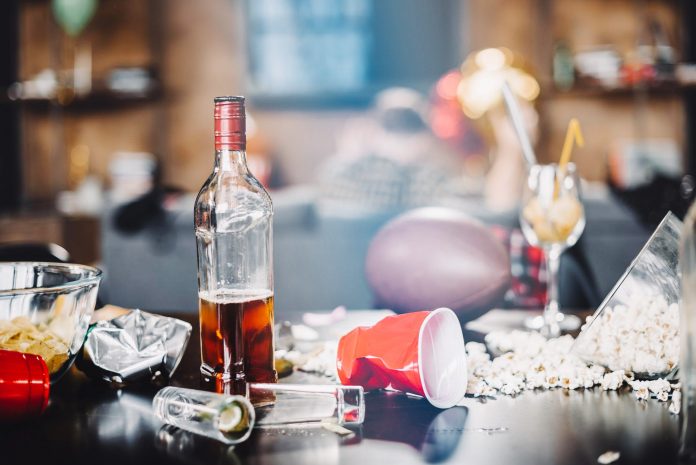
SFU drinking games to kick off (and get you through) the semester

0

I’m Not Drunk, YOU’RE Drunk

A game to play when you’ve had a big Wednesday night out, only to find yourself in lecture on Thursday morning, somehow still incredibly sloshed. The rules are simple:

  • Interact with as many people as possible. 
  • For each person you drunkenly accuse of being drunk, you’re entitled to one bagel from Renaissance.
  • See how many bagel-IOUs you can accumulate before you make enough of a scene for a TA, or even the professor, to throw you out. 
  • Go get those bagels.


BONUS: I’m Not Drink, I’m DRUMK!!

A variation of “I’m Not Drunk, YOU’RE Drunk.” Play this version when you are SO hammered from the night before that you no longer have control over your own words. It has all the same rules, with two special additions. 

  • For each word you DON’T slur, you get ONE dollar taken off your tuition.
  • For each word you DO slur, you get ONE year added to your degree.


The “taking a first year course as a fourth year student” drinking game

  • Take a shot whenever a first year snuggles up to you and says, “Gandalf, is that you?”
  • Take a shot every time a first year calls you an “old, smelly gremlin.” 
  • Take a shot every time the professor gets confused and thinks YOU’RE the one who is supposed to be teaching the class.
  • Take a shot every time a first year makes fun of the rock tablet you’re chiseling your notes into. Also, break their fancy “modern” laptop.
  • Take a shot when you finally meet the only other person in the class that seems to be your age. And honestly? Give them a shot, too.

And REMEMBER: every time you take a shot, a first year loses their virginity. 


Beer pong, but instead of beer, it’s a nice cold cup of coffee, and instead of Solo cups, it’s a half-eaten bag of popcorn, and instead of a ping-pong ball, it’s all your study notes, and instead of being motivated by the cheerful encouragements of your mates at a party, you’re motivated by your own crippling anxiety brought on by your intense procrastination, and instead of being surrounded by friends at a get-together, you’re really just sitting alone at the library

The best drinking game of all time. 


The construction drinking game 

  • Take a shot every time you open your textbook and a bunch of nails and a screwdriver fall out.
  • Take a shot every morning you stand in front of your closet and realize you can’t get to class unless you wear your childhood Bob the Builder costume.
  • Take a shot every time a jackhammer goes rogue and flies through a window in the library, disrupting your peaceful studying.
  • Take a shot every time one of your professors is actually a cement mixer.
  • Finish your drink every time you open your textbook and a lost construction worker falls out.

Your weekly SFU horoscopes: January 13–19

0
An illustration of a girl with long flowing hair. Astrological signs and stars shine around her.
ILLUSTRATION: Marissa Ouyang / The Peak

Written by Zach Siddiqui, Humour Editor

Aries — March 21–April 19

Your brain is quite compatible with rocket science. Just like a rocket, it doesn’t work unless you drink rocket fuel. Make this week the week to suffer responsibly for your academic art. 

Taurus — April 20–May 20

This week, walk out of the vehicle and then keep walking . . . just keep walking. Go missing in the woods beyond campus. Let beautiful missing persons posters of you circulate. Build a new life for yourself out of the stones and the grass. 

Gemini — May 21–June 20

You may feel inexplicably disoriented this week, like your body is not your own. Remind yourself every morning to confirm which timeline you’re in by Googling the spelling of “Berenstein Bears.”

Cancer — June 21–July 22

Save a life this week. Tell a sessional to get their thyroid checked.

Leo — July 23–August 22

You have many divine traits. Purifying the air where you walk is not one of them. Please remember to wear your deodorant this week — and every week thereafter.

Virgo — August 23–September 22

Be honest this week. When you introduce yourself to classmates, warn them from the outset that you are like an IKEA delivery cart: fragile, finicky, and prone to falling to pieces on a random Vancouver sidewalk.

Libra — September 23–October 22

Good news: conflict is in the cards for you this week. That means your socially avoidant tendencies will override your gambling dependencies and force you to put away your deck of playing cards. Your wallet thanks you.

Scorpio — October 23–November 21

Honestly? I have no clue what novel hell you have going on this week. But poisoning people is not the answer. Walk away, Penelope Blossom.

Sagittarius — November 22–December 21

This week, you don’t have any idea where you are. There’s just places and then more places, some of which let you sleep and others of which do not. Just snuggle with yourself until a sweet angel descends from SFU Security to shove you onto the midnight RapidBus, going anywhere.

Capricorn — December 22–January 19

It’s the last week of Capricorn season. And the last week before you start to incur late penalties on your tuition. Coincidence? Or more evidence that society would be so much better off if every day of the year was devoted to you?

Aquarius — January 20–February 18

You are a receptacle for a sacred presence this week. Your actions are morally perfect. But they also aren’t really yours — so be ready to drown in the despair of your impostor syndrome next week. 

Pisces — February 19–March 20

Don’t let anyone take advantage of your cute naiveté this week. And you can trust yourself enough to know that you really won’t. Just because you’re ignorant, doesn’t mean you’re stupid.

Coming Up at SFU: January 14–23

0

By: Ben McGuinness, Peak Associate

Every week there are diverse events, workshops, and lectures available to students across the SFU campuses. We’ve rounded up four upcoming free events that you should definitely check out!

Map the System Challenge Mixer

Map the System is a global competition where students engage with big issues that matter to them, including climate change. Hosted by the University of Oxford, students are encouraged to focus on learning about the complexities of their chosen issue rather than competing for the best proposed solution. If this sounds interesting to you, start by coming to the mixer to learn more and to meet fellow students who just might become your teammates in the competition.

The Map the System Mixer is a free event for all students in any faculty, but make sure to register ahead of time. It will take place at the Surrey campus from 2:30 p.m. to 3:30 p.m. on Tuesday, January 14, and at the Burnaby campus from 5:30 p.m. to 6:30 p.m. on Thursday, January 16.

Multi-Language Café

The Intercultural Engagement Team is hosting the Multi-Language Café, where students can learn some basic words in diverse languages and sample the unique foods of each culture! This time around there will be lessons in French, Vietnamese, Hindi, and Cantonese.

The café will take place at the Burnaby campus on Wednesday, January 15th, from 5 p.m. to 6 p.m. for Hindi and Cantonese, and 6 p.m. to 7 p.m. for French and Vietnamese. The event is free with registration, so visit the event page to find out more and register now!

City Conversations: A City Without Artists

Vancouver is home to many talented artists, yet gentrification has made it harder for them to live in the city and maintain studio space for their work. How do we prevent the demand for new condos and retail space from pushing out the artists at the heart of our culture? The City of Vancouver and other organizations are working to address the issue. At this event, join three individuals involved with the studios, cooperatives, and non-profits that are grappling with the challenge to create space for artists. Attendees are invited to ask questions and provide feedback as they listen to the guest speakers.

This discussion, put on by SFU Public Square, will take place at SFU Harbour Centre at 12:30 p.m. to 1:30 p.m. on Thursday, January 16. The event is free with registration.

Salish Singing and Drumming Workshop

As per the school’s Reconciliation at SFU report, SFU strives to recognise and celebrate the history and culture of the Indigenous peoples whose traditional territory SFU occupies. The Salish Singing and Drumming Workshop is a great way to do that through the powerful medium of song. Attendees will join in traditional Salish singing and drumming while learning about the stories and history that underlie them. The event will be led by traditional Lil’wat singer Russell Wallace.

The workshop will take place at SFU’s Goldcorp Centre for the Arts (downtown) from 7 p.m. to 9 p.m. on Thursday, January 23. Participation is free and registration is recommended.

Both SFU basketball teams win in first week of 2020 portion of season

0
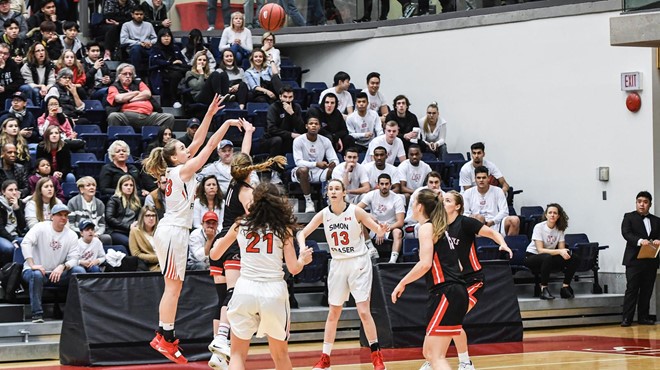
The women’s team scored ten three pointers in their win over Western Oregon. — Photo credit / SFU Athletics

By: Brandon Braich, Peak Associate

Both SFU basketball teams played two GNAC games last weekend to kick off the 2020 portion of their schedules. In an early afternoon start, the SFU Women’s Basketball team won a tightly contested battle against the Western Oregon Wolves by a score of 64–57 to move to 8–6 overall and 3–1 in GNAC play. 

The Wolves held a narrow lead of 25–24 at the half thanks to a stifling defensive performance. The Clan were held to only 33% from the field in what was a defensive struggle for most of the night. 

Western Oregon, with their sights set on an upset, came out of the locker room strong and extended their lead to nine going into the fourth quarter. The Wolves were led by forward Shariah Green, who finished with 17 points on just 11 shots. 

However, with their backs against the wall, the Clan rallied and dominated the final frame, outscoring the Wolves 27–12 in the fourth quarter. SFU’s long-range attack helped turn the game, as the Clan finished with 10 three-pointers, six of which were scored in the fourth quarter. The defence also tightened, which forced the Wolves into 25 turnovers on the day.

SFU was led by Jessica Jones, who finished with seven rebounds and a game-high 22 points. Jones was hot from long range, finishing 4 of 6 from behind the line, including two crucial three-pointers in the fourth to complete the comeback. Claudia Hart also had a standout performance, finishing with 12 points, seven rebounds, and three steals. 

Having now won five of their last six games, the women’s team will look to continue to build momentum as they venture into the thick of their GNAC schedule.

Meanwhile, the men’s team hosted and defeated the Central Washington University Wildcats by a score of 75–57 in what was a dominating second half performance. In front of a crowd of 424, the Clan outscored the Wildcats 41–24 in the second half to move to 10–3 overall and 3–1 in GNAC play. 

While the visiting Wildcats got off to a strong start, keeping neck and neck with the Clan for most of the first half, they could not sustain the effort throughout the entire game. SFU took a narrow one-point lead into the half after centre Julian Roche sank a free throw shortly before the buzzer, and the Clan didn’t look back from there.  

Once the second half started, the floodgates finally opened for the Clan’s powerful offence. With the score 49–48 for the home team, SFU went on a 14–0 run to finally pull away in what had been a back-and-forth affair. SFU shot an impressive 50% from the field, and went 7 for 17 from long range. The victory would have been even more emphatic had the Clan capitalized on their free throw attempts, as the team shot just 57% on 21 attempts. 

Roche led the way for SFU, going 8 of 12 from the field for 17 points and 11 rebounds, while also finishing with a game high three blocks and two steals. Wilfried Balata was a spark off the bench, finishing with 11 points and six rebounds. Balata was aggressive, attacking the basket all game and doing most of his work from the line, where he shot 8 of 11. 

All in all, it was a successful first weekend of 2020 for both SFU Basketball teams. Hopefully for Clan fans, this type of performance has set the standard for a high level of basketball that SFU sports fans can enjoy throughout the semester. 

Revisiting 2019–20 NHL regular season predictions

0
An empty 2020 NHL playoff bracket waiting to be filled. — Photo credit / Pinterest, Gamblers Palace

By: Dylan Webb, Sports Editor

Approximately three months and 42 games ago, in an NHL Hockey-themed Peak Sports Mailbag, I undertook a full slate of NHL playoff predictions. As the All-Star break rapidly approaches, signalling the approximate midpoint of the NHL season, it feels like the right time to revisit and, potentially, refresh my predictions.  

Early in the season, I predicted that the Tampa Bay Lightning would win the Atlantic division and that the Toronto Maple Leafs and Boston Bruins would finish second and third, in that order. So far, unsurprisingly, all three of these teams are at the top of their division. The only change I’ll make to these predictions is the order of finish, as it appears Boston has found a new level of dominance and will likely cruise to a division title. My original predictions also had the Florida Panthers and Montreal Canadiens fighting to the end for a wild card spot. I’ll swap out Montreal, due to a litany of injuries, for the Buffalo Sabres, and keep everything else the same. 

For the Metropolitan, I originally predicted that the Washington Capitals would win the division again, while the Pittsburgh Penguins and New York Rangers would round out the top three. This prediction is proving to be partially accurate, with the exception of the continued success of the New York Islanders. At this point, it’s pretty easy to guess that the Islanders will hold on to a top three spot in the division given their outstanding defensive structure, while the Rangers’ rebuild takes a little longer than I would’ve thought. The lack of respect I showed for the Barry Trotz-coached Islanders is easily one of my most embarrassing mis-predictions from the pre-season, as the team continues to win with an approach that can definitely translate to the playoffs. I originally had the Philadelphia Flyers, Columbus Blue Jackets, and Carolina Hurricanes all missing the playoffs, and this is definitely another one of my glaring errors. The Hurricanes should be a lock for a wild card spot, while injuries will eventually drag the Columbus Blue Jackets out of the race. I’m not sure what to make of the Flyers at this point, but I’m going to stick to my guns and lock in my prediction that they miss the playoffs. 

For the Western Conference, I had the Nashville Predators, St. Louis Blues, Dallas Stars, and Colorado Avalanche all making the playoffs from the Central Division and finishing in that order. Looking back, it appears extremely likely that I’ll be correct on three of four of my Central Division picks, and the order of finish, with the only glaring error being the complete unravelling of the Nashville Predators. I also seriously underestimated the Winnipeg Jets, predicting that they would “crash down to the basement of the Central due to their inadequate defensive pairings.” Instead, they’ve continued to win, and currently occupy a wild card spot. However, while the Jets certainly appear to be safe from a last place finish in the Central, I’m still convinced they will eventually fall out of the playoff picture.

Last but not least, I predicted that the Vegas Golden Knights would run away with the Pacific Division title, and I’m definitely sticking with this one. While the Coyotes are surging, partially from acquiring Taylor Hall, injuries to both of their goaltenders are going to catch up to them really soon. The rest of the Pacific is murkier than ever, with the weakness and parity within the division reducing playoff predictions to pure guesswork. I originally had the Calgary Flames finishing second, and I’ll stick with that despite their lacklustre performance in the first half. Despite key injuries between the pipes, the Coyotes look too strong defensively to completely fall off, so I’ll have them finishing third. This leaves the Canucks and the Oilers to battle with the Jets for the two wild card spots, and I’m going to hang on to my Canucks playoff dreams by predicting both Vancouver and Edmonton for the final two playoff berths. 

While I’ll save a full playoff bracket prediction for later in the season, I definitely have to supplement this revisiting of pre-season predictions with a couple picks for the Stanley Cup Finals. While the St. Louis Blues and Washington Capitals are really hard to pass on when making midseason picks for the championship, I don’t think they’ll make it all the way this year. 

Instead, I have to go with the Boston Bruins, once again, representing the Eastern Conference, while the Colorado Avalanche will return to the Stanley Cup Finals for the first time since 2001 as the Western Conference representative. In an epic battle between two of the best top lines to ever play the game, the Avalanche will prevail in a seventh game to claim Lord Stanley’s mug and send the Bruins home with the bitter taste of defeat in their mouths for the second straight season. 

The Week Ahead in SFU Sports: January 13–19

0
The new SFU Athletics logo — Photo credit / SFU Athletics

By: Dylan Webb, Sports Editor

This week, as students settle into the spring semester, the SFU Basketball, Hockey, Wrestling and Track teams are in action. Unfortunately for fans of Clan sports, only the men’s basketball team and hockey team will play at home. Come out to the West Gym and the Bill Copeland Sports Centre to see our student-athletes do what they do best!

Women’s Basketball:

This week, the women’s basketball team will travel to Idaho and Washington State for a two-game road trip. After a stop in Nampa to take on Northwest Nazarene University at 6:30 p.m. on January 16, the team will travel to Ellensburg to take on Central Washington University at 5 p.m.

Men’s Basketball:

After their longest road trip of the season took them up to Alaska, the men’s basketball team returns to the West Gym this week for a couple of home games. Western Oregon University is in town on January 16, followed by a match up with Concordia University on January 18. Tip off for both games is scheduled for 7 p.m

Men’s Wrestling:

The SFU Men’s Wrestling team will participate in two events this week. First, on January 17, the team will travel to Oregon City to take on Clackamas Community College at 7 p.m. Two days later, on January 19, the boys will be in Forest Grove, Oregon for the Pacific University Boxer Open. 

Track and Field:

For their first event of the year, the SFU Track and Field team will travel to the University of Washington for the 2020 Indoor Preview on January 18

Hockey:

A challenging week looms for the SFU Hockey team as they are slated to take on the undefeated, league-leading Trinity Western University Spartans twice in three days. After visiting the Langley Events Centre on January 16, the teams return to the Bill Copeland Sports Centre for a rematch on January 18. Puck drop for both games is 7 p.m.

How much do you like cheese?

0
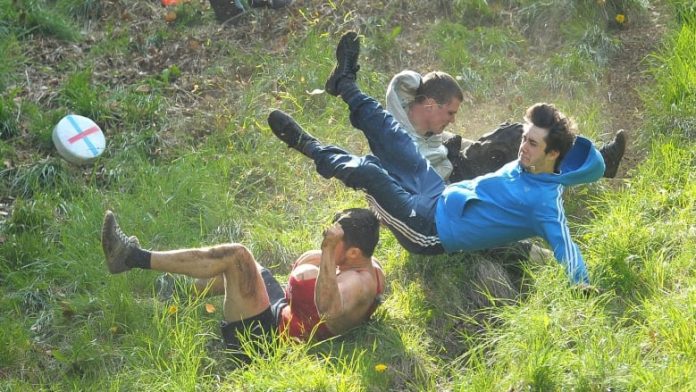
The round of cheese, ranging from 7–9 pounds, reaches speeds of up to 110 km/h — Photo credit / CBC

By: Dylan Webb, Sports Editor

As a food-oriented individual, the idea of chasing food is nothing new to me. I’ve chased food trucks and farmers markets all across the Lower Mainland in search of delicious rewards. On the other hand, as a sports fan, I’ve enjoyed watching races in a wide variety of formats, from running to F1 to horses. So when I first heard about the annual Cooper’s Hill Cheese Rolling event, it struck me as nothing more than a logical pairing of two great things into one awesome event: racing and food. This was all before I actually got the chance to view the race with my own eyes. Once I saw a video of the event, and, more specifically, once I saw the grade of the hill the event takes place on, I realized my passion for food, and racing, pales in comparison to that of the participants in the annual Cooper’s Hill Cheese Rolling. 

Taking place annually on the Spring Bank Holiday at Cooper’s Hill near Gloucester, England, the cheese rolling event has evolved over many years into a four-race tournament including one ladies only race. While the first written evidence of cheese rolling events traces back to 1826, many argue some version of the event has taken place for over two hundred years. 

One of the most notable features of the event is the hill itself. Cooper’s Hill has a gradient of almost 50%, with sections of the hill defined as “almost vertical.” For this reason, it’s almost impossible for participants in the race to remain on their feet, which results in about as much, or more, rolling and tumbling than actual running down the hill. It’s this feature of the event that is largely responsible for its increasing popularity, as viral videos of multiple individuals crashing and banging down a hill in pursuit of a round of cheese have reached the highlight reels of many major sports networks across the globe. 

Of course, all this rolling and tumbling frequently results in injuries — sometimes major ones. Those close to the event report countless injuries per year to both participants and spectators, which necessitates the presence of countless ambulances, volunteer paramedics, and a handful of hospital visits for serious injuries following the event. Surely, in some twisted way, this imminent risk of injury is part of the appeal of the event. On this note, Australian author Sam Vincent wrote that he questioned his own sanity as he stood “crouched on the summit of a diabolical slope” while “awaiting the call to start what is surely the world’s most dangerous footrace.”

So, why does an increasingly large group of people risk life and limb tumbling down a dirty, rock-ridden quasi-cliff every year? For cheese, of course! Though recently the actual cheese being chased down the hill has been replaced by a foam wheel to reduce the risk of injuries for spectators, the reward for winning the race remains lucrative: a seven to nine pound round of double Gloucester hard cheese. Here’s the kicker though: the cheese can never actually be caught, as it’s given at least a one second head start and soon reaches breakneck speeds. Instead, the cheese is awarded to the first person down the hill

Words can only go so far in explaining the unique combination of appeal and ridiculousness the Cooper’s Hill Cheese Rolling event provides. If you’re looking for a new and obscure sport to watch, check out previous races on YouTube or, better yet, travel to Gloucester and chase the cheese yourself (just don’t hold me liable for your inevitable injury).

Peak Sports Mailbag: Spring 2020 Recalibration

0
Photo credit / Amazon

By: Dylan Webb, Sports Editor

Dear readers of The Peak sports section,

My name is Dylan Webb, and I’m The Peak’s Sports Editor. I’m writing to you today to discuss the evolution of the Peak Sports Mailbag that we started last semester.

First of all, I want to thank our readers, questioners, and hosts for their contributions to the 13 different versions of the Mailbag that ran last semester. The Mailbag was one of my favourite pieces to edit each week; it exposed our readers to a wide variety of sports knowledge, and, most importantly, it was an interactive piece that drew on expertise from within the SFU Sports community. All in all, I’m proud of how well the Mailbag did in its first semester. 

Having said all of that, because I want to make sure the Mailbag doesn’t get stale or repetitive, I’ve decided to undertake a partial reformatting of the Mailbag for the Spring 2020 semester. Starting next week, we’ll begin a rotation between the original Mailbag format and what I’ll call the Reverse Mailbag. 

The Reverse Mailbag will consist of three to five reader-submitted responses to a question that will be published at the end of the previous week’s Mailbag. Instead of having a host that answers different questions on a single topic, as we do in the original Mailbag format, we’ll have a single question that is answered by different people within the SFU Sports community. The best part about this is that students that submit an answer to the bi-weekly Reverse Mailbag will be paid $5 for their 100–200 word answer. 

To ensure that nobody goes to the effort of writing an answer that we don’t have room for, I’ll simply ask that readers interested in submitting an answer for the Reverse Mailbag briefly get in touch with me before writing and submitting their answer. Further, to give us time to compile answers, we’ll start next week with a hiking-themed Mailbag in the original format, before moving to the Reverse Mailbag the following week. 

The first question for our inaugural Reverse Mailbag is: Which SFU Sports team is your favourite to watch and why? 

As I mentioned, every other week, we’ll continue to publish a Mailbag in the original format. So if you’re interested in hosting a Mailbag about a sport you love, get in touch! I know now, after a semester of awesome Mailbags, that there’s both curiosity and expertise on our campuses when it comes to SFU and non-SFU related sports, and I’m excited to see that expertise displayed in both Mailbag formats moving forward.

If you would like to participate in future editions of the Peak Sports Mailbag and be entered in a raffle for an end-of-semester prize, here’s what you can send to [email protected]

  • Sports-related questions that our host will answer
  • Weekly theme ideas to guide our questions
  • Short (100–200 word) responses to our bi-weekly Reverse Mailbag (get paid $5) 

Or: sign up to host the Mailbag (and get paid $15)!

Thanks to all of you SFU sports fans for continuing to blow up my inbox!

Next week’s theme is: Hiking (original Mailbag format)

Next week’s host is: Dylan Webb

Send in your questions to [email protected]

How Dungeons & Dragons can help SFU student wellness

0

By: Mishaa Khan, Peak Associate

In a unique twist on therapy, SFU’s Health & Counselling services have combined group therapy with Dungeons & Dragons in the dungeon (or lower level) of Maggie Benston Centre. 

To learn more about the program, Dungeons & Worry Dragons, The Peak conducted an email interview with the clinical counsellor leading the group, David Lindskoog.

Lindskoog explains that “the primary focus is on establishing and maintaining a safe atmosphere so participants can work towards their counselling goals effectively [ . . . ] The other aspects of the group are roleplaying and counsellor-facilitated social interaction — this is the Dungeons & Dragons (D&D) part!”

While this may sound like participants are just playing a game with strangers, Lindskoog explains that the game “provides a safe place for students to ‘face their fears’ about social interaction in a fun and supportive setting.” Additionally, Lindskoog states that this therapy group is ideal for anyone struggling with social anxiety, low social confidence, difficulty connecting meaningfully with others, deficits in social skills, or isolation or withdrawal from challenges such as low mood.

He summarizes the group’s activities by saying that “the roleplaying game is mostly a fun vehicle for us to do exposure therapy,” exposure therapy being a way for people to confront fears, anxieties, or stressful situations and contexts in safe settings. 

“Each participant creates a unique character — an adventurer in a fantasy world — and students participate in the group mostly from the perspective of that character [ . . . ] For example, if a student struggles with low social confidence, they may create a character who shares that same struggle and is working to overcome it, or they may create someone who is bold, reckless, or even over-confident to kind of ‘try on’ this way of interacting with others,” Lindskoog explains. 

Moreover, Lindskoog reports that roleplaying games can improve empathy, non-verbal communication, self- and other-awareness. The game emphasizes creative problem-solving, communication, collaboration, and helps students meaningfully navigate the failures that inevitably may be brought on by the dice. 

“Students are actually building resilience and practicing distress tolerance skills,” he explains. 

According to student reports, “Participants valued having a space for safe interactions with supportive others; taking pro-social “risks;” practicing social skills; developing self-awareness, creativity, and imagination; engaging with the story of the game; and generally exploring other ways of being through role playing their characters.”

Group therapy can be daunting to many, but students who were part of the group found it to be beneficial, and Lindskoog was happy with the outcomes. There was an average 16% improvement on social anxiety symptoms in the three groups that ran in 2019. 

While Lindskoog would like to reach more people, the group size caps at eight participants “so that everyone has an opportunity to participate meaningfully.” Though the group is currently full, Lindskoog says that on rare occasions, there are sometimes spots that open up in the middle of the semester, allowing students to join. If you are interested in joining, you can meet up with Lindskoog for an interview and be placed on a list for next semester’s group.