Home Blog Page 457

Research Roundup

0
Jordan Hollarsmith and Michael Doane collecting reproductive fronds from a San Diego kelp forest. Photo courtesy of SFU News (Photo: Jordan Hollarsmith)

Written by: Alice Fleerackers, Peak Contributor

Warming waters pose problems for the future of coastal kelp 

From melting ice caps on our poles to forest fires in the Amazon, the impacts of climate change are everywhere. New research by SFU post-doctoral student Jordan Hollarsmith and colleagues reveals that rising temperatures may be affecting life closer to home — right here on BC’s coast. 

Hollarsmith’s study, published in the Journal of Experimental Marine Biology and Ecology, investigated how increasingly warm, acidic oceans are changing life for giant kelp populations. In a lab experiment, she found that kelp were unable to reproduce in hotter conditions.  

Kelp is a primary source of food and shelter for many ocean species, and the findings have important implications — both ecological and economical.

“Ecologically speaking, kelp habitats up and down the Pacific coast are important as they form habitats for many different species,” says Hollarsmith in an interview for SFU News. “These species are critical not only as food sources for other species, but for various industries including fisheries and even tourism.” 

Bringing some empathy to chatbot conversations — one painting at a time

It’s a familiar experience: You attempt to file a customer complaint, end up speaking with a chatbot, and eventually leave the “conversation” feeling unfulfilled and frustrated — perhaps with more complaints than you started with. 

Until now, artificial intelligence (AI) has been unable to replicate the emotional intelligence that makes human conversation so rewarding. SFU professor Steve DiPaola and his research team are trying to change that. To bring some more empathy and creativity to AI interactions, the researchers have developed a number of new AI systems. Among them is the Empathy-Based Affective Portrait Painter, which literally paints a portrait of each person it interacts with, based on an evaluation of their emotional state. 

“Using our special system, the AI avatar can, through conversation, evaluate the user words, facial expression and voice stress to make an empathetic evaluation — just as a human would be able to, about someone they are talking to,” says DiPaola in an interview with SFU News

The resulting images are not only experimentally fascinating; they’re also visually unique. DiPaola’s emotional portraits have been featured at the Whitney Museum of American Art, the Museum of Modern Art, and other museums across the world.   

A psychological solution to Canada’s tax deficit?  

No one likes paying their taxes — especially in Canada, where taxpayers’ efforts to minimize their taxes are contributing to the nation’s $8.7-billion tax deficit

New findings by SFU researchers Emily Thornton, Lara Atkin, and colleagues suggests that there may be a simple way to turn that around: remind people who their taxes are helping.  

To better understand what motivates people to pay (or not pay) their taxes, the team interviewed more than 470,000 adults from over 100 countries about their views on taxation. The results suggest that taxpayers who recognize that their tax dollars will be used to help others are more willing to pay up, as well as more supportive of taxation overall.

The study, which was published in PLOS ONE, has the potential to transform how we approach taxes here in Canada. 

“Some people will . . . go to extreme lengths to avoid paying taxes,” Thornton told SFU News. “Our findings raise an intriguing possibility — would Canadians be more willing to pay their taxes if the CRA better publicized how their tax dollars help others?”

Peak Speaks Podcast – The Man, the Myth, the Marco

0

Listen here: https://pod.link/1464226637

Let’s Get Haunted offers you scary stories year round

0
Screenshot via Instagram

by Hannah Davis, Peak Associate

If you like spooky things no matter what time of the year it is, congratulations! You are creepy, just like me, and will therefore also probably like the podcast Let’s Get Haunted, brought to you by hosts Aly and Nat. 

“Haunted” refers in part to the podcast’s subject matter, which includes anything from conspiracy theories, witches, true crime, hauntings, and unexplained occurrences like the Dyatlov Pass Incident and the Staircase in the Woods phenomenon. In addition to recounting strange and paranormal historical occurrences, Nat and Aly share their own “personal hauntings,” which may have nothing to do with the paranormal. Instead, they try to show that “haunted” can just be a way to describe a bad day. I often giggle to myself while listening to the hosts gracefully recount their own misfortunes, including (spoiler alert!) Aly’s very haunted experience dealing with a con artist trying to get her to rent a wedding venue that didn’t exist. 

The podcast is well-researched and intriguing, peppered with the hosts’ funny and entertaining banter and inquiries. The tones of the stories they cover range from bizarre and weird to downright scary, but one can always be pulled back from the darkness by the hosts’ sharp senses of humour and Nat’s “nut” button (if you weren’t already intrigued, I hope that piqued your interest).

The hosts maintain a positive relationship with their listeners, encouraging them to send in their own personal hauntings (paranormal hauntings and otherwise), and feature these stories in special edition episodes. They also post and publicly appreciate artwork sent into them by fans on their podcast’s Instagram page. I would like to point out that there are some very artistically talented fans that listen to Let’s Get Haunted

I recommend listening to “Let’s Get Haunted” if you like all that is creepy and strange. Both hosts are inquisitive, funny, and smart, and approach their podcast and the bizarre stories they recount from a place of curiosity and acceptance rather than skepticism. Their podcast resides in a “what if?” space, as the hosts prefer to entertain outlandish theories and stories instead of poking holes in the narratives and condemning them as fake. Listen to this podcast today, and learn that Halloween isn’t the only time to get haunted.

The Astonishing Color of After is a heartwarming tale of personal growth

0

by Lubaba Mahmud, Staff Writer

The stunning cover of The Astonishing Color of After with the silhouette of a majestic bird soaring on the rich magenta and mulberry sky caught my eye when I was browsing the library’s young adult (YA) section. When I initially picked this book up, I had no idea that it would take me on an emotional journey of love and loss. 

In The Astonishing Color of After, author Emily X.R. Pan tells the story of young protagonist Leigh Chen Sanders. When her mother, Dory, dies of suicide after a long battle with depression, she is convinced that Dory has returned to see her in the form of a bird. She goes to Taiwan, her mother’s birthplace, in an attempt to reunite with the bird. Leigh’s chase of the mysterious bird unveils emotional family stories that will have readers hooked.

Pan’s exploration of complex subjects like mental health and suicide is praiseworthy. She does not romanticize suicide or victim-blame, instead she is incredibly insightful as she uncovers Dory’s battle with depression. Leigh’s heartbreaking personal journey involves, among other things, dealing with the feeling of guilt when a loved one dies of suicide. This is a particularly difficult subject to address, and Pan’s achingly humane narrative does justice to it. This book also pays attention to a wide variety of important issues, such as the struggles of a mixed-race person, the stigma attached to pursuing art, as well as positive LGBTQ2+ parenting. Even though these components aren’t necessarily related to each other, Pan’s storyline was effortless. 

In spite of these positives, the style of writing repeatedly distracted me from the interesting plot. What could have been emotionally convincing was often just sappy instead. This is a signature move of the YA genre, and I really wish that this book rose above it. One annoying theme was the “colour-dependent” conversation Leigh has with her best friend and long-time crush, Axel. As both Leigh and Axel are aspiring artists, they often ask each other “What colour?” to figure out what they’re feeling at the moment. This resulted in extremely random shades of hundreds of colours that Leigh “felt” at the moment. I think this technique could have been convincing if it was not highly overused and not pushing imaginative boundaries — I mean, using some wild shade of orange to describe sadness isn’t all that believable.

Since the first paragraph of the book says that Leigh’s mother being a bird isn’t some “stream-of-conscious metaphorical crap,” I thought this book would be a refreshing take on YA and magical realism; but alas, overwhelmingly metaphorical and gimmicky writing was what I got instead. Another aspect that I didn’t like was Leigh’s teenage angst and lack of character depth. While I absolutely empathised with her emotional journey, I could not connect with her as a person. The flowery writing and somewhat flat protagonist bumped this book down to a generous three stars from me.

The Astonishing Color of After had all the ingredients of a fantastic book, but it lost its touch somewhere along the line. While I couldn’t love this one, it was still an enjoyable read. Overall, It is an impressive debut, one in which the writer’s efforts to give a spotlight to important subjects is commendable.

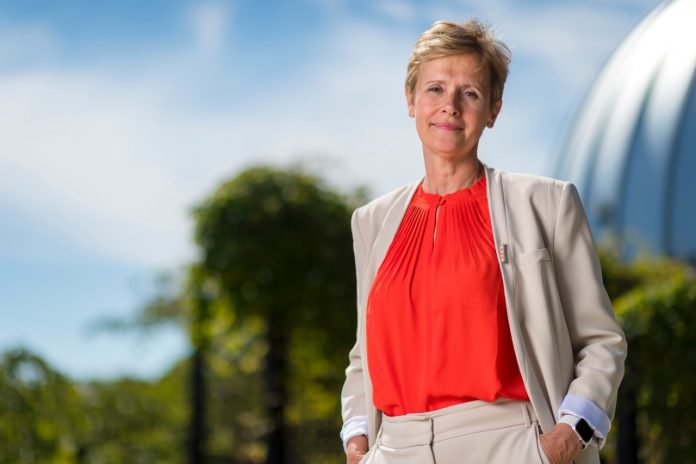
SFU appoints Dr. Joy Johnson as incoming president

0
SFU's next president is going to be Dr Joy Johnson

By: Gurpreet Kambo, News Editor

After an extensive search process that spanned 2019, Simon Fraser University announced its new incoming president. Dr. Joy Johnson will be SFU’s new president for a five-year term as of Fall 2020. She will be replacing outgoing president Andrew Petter, who served two consecutive five-year terms at the helm of SFU. 

Since 2014, Johnson has been the university’s Vice-President, Research. 

“I love being part of SFU — so much is possible here as we develop new learning opportunities, enhance student support and services, expand our facilities, strengthen our research infrastructure, and forge new partnerships,” Johnson wrote in a press release about the announcement. “It’s my great privilege to have the opportunity to serve as President and Vice-Chancellor, and I look forward to getting started.”

The Peak had the opportunity to sit down with Johnson, and asked her how she would like to introduce herself to SFU students. 

“I have been at SFU for just over five years, serving as the Vice President of Research and International and I have seen the potential of this amazing university,” she said.

“I think we’re just at such a fortunate place at SFU in terms of the three campuses, exciting things happening like the new Student Union Building opening, new energy systems engineering building out in Surrey, and more potential to come. So that excites me a great deal and that’s partly why I put my name forward [for the presidency] because I do believe there’s so much potential, so much more that we can do.”

Aside from her previous positions at SFU, Johnson has an extensive history in academia. She previously earned a PhD in nursing from the University of Alberta, and served as a professor in the School of Nursing at the University of British Columbia. Her research focused on “how environments and social dynamics influence health outcomes and opportunities, particularly among youth,” according to the press release issued by SFU. She also co-authored more than 180 peer-reviewed manuscripts as part of her academic career.

The president of SFU serves as the public face of the university. 

According to Johnson, “You can kind of think of it as the CEO role, and that’s to lead the leadership team,” like the vice-presidents and associate vice-presidents of the universities. 

She adds that the position also includes “creating relationships with other entities, be they industry, community, et cetera.”  

The president is also unique, according to Johnson, as they chair the Senate, the chief academic body of the university, and sit on the Board of Governors, the chief operational body of the university. Part of their role is ensuring that these bodies are coordinated and “strategically aligned.”

However, Johnson emphasizes that, despite the president’s role being complex and multifaceted,  she considers students to be her top priority as president. 

“I do want students to know that students come first. They’re at the heart of the university and it’s really important to me that the learning environment be front and center, for the president, to be thinking about the ways in which we provide an excellent education for students and provide them the support that they need.”


The Lightning Thief musical album zaps Percy Jackson back to life

0
Jeremy Daniel / The Daily Beast

by Madeleine Chan, Staff Writer

I know what you’re thinking. They made a musical of . . . that? Despite being a big fan of the book series, I was also hesitant about this kind of adaptation. The films were a monstrosity that should be sent to the deepest depths of Tartarus. But, I promise you that this musical is not only a faithful and accurate adaptation, but has some very killer music as well.


Based on Rick Riordan’s best-selling novel, The Lightning Thief (Original Cast Recording) [Deluxe Edition] is an album which features all 19 songs from The Lightning Thief: A Percy Jackson Musical, plus five delightful bonus ones. The show tells the tale of Percy Jackson (Chris McCarrell), a kid who discovers that he’s half- Greek god half-mortal, and his quest to save his mom from the hellish Hades — all while trying to prevent a war amongst the gods.


To any who have not read the books, fear not, for the first song “Prologue/The Day I Got Expelled” lays down the overall premise of the show, which I very much appreciate. They cater to people who are already fans, but also don’t try to ostracize new ones. This inclusivity is also seen in the fact that most of the songs aren’t vitally dependent on the overarching story, so they can be listened to on their own. If you’re new to this world, the songs still have enough melodic uniqueness and substance to sustain just pure musical enjoyment.


The variety in melodic style also keeps the story interesting and alive. The songs range from fun rock romps like “Drive” and “Put You in Your Place” to heartfelt laments like “The Tree on the Hill.” There are even Ursula-esque villain speeches like “D.O.A.” that joke about Josh Groban eventually going to the underworld. In addition, great lyrics like “Normal is a myth/ Everyone has issues they’re dealing with” from “Strong” are emphasized by the music’s soft and comforting vibe, or whatever would suit the sentiment best.


Although I adore each song on the album, my favourite has to be “Good Kid,” Percy’s powerful solo. It’s a passionate rock-based number where Percy expresses how he doesn’t fit in and despite all the nonsense that happens to him, promises that he’s just a good kid. Along with the true-to-character lyrics, Rob Rokicki, the creator of the score, says the “buzzing of the electric guitar” at the top of the song resembles the bees in Percy’s head. Considering he has ADHD and dyslexia, this simple musical detail adds a ton of depth to an already exhilarating song.


Overall, this album showcases the true heart of the Percy Jackson series and reminds me why I love it so much. I strongly suggest listening to it if you like adventure, humour, Greek mythology, and of course the Percy Jackson series. In the meantime, when I’m not praying to the gods for the show’s recently announced 2020–2021 national tour to stop in Vancouver, I’ll be belting these tunes out to my heart’s content.

Board of Governors votes to reduce carbon footprint by 45% by 2025

1
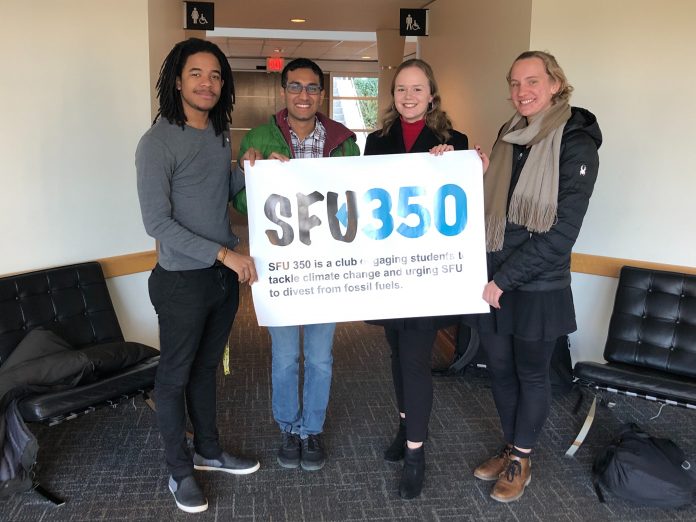
SFU350 presents for the Responsible Investment Committee. From left to right: Giovanni HoSang, Raaj Chatterjee, Abigail Herd, Elise Burgert.

By: Michelle Gomez, Assistant News Editor

SFU’s Board of Governors has voted in favor of eliminating investment in carbon-emitting companies by 45% over the next five years. 

Alison Blair, Associate Vice-President, Finance, expanded on what this entails in an interview with The Peak.

“We’re not divesting — we measure the carbon footprint of our investments, the public equity portion of the endowment and the non-endowment portfolios, and we commit to reducing that carbon footprint, not to divesting from fossil fuels.” 

Blair explained that a large factor in the Board’s decision was the Intergovernmental Panel on Climate Change (IPCC)’s announced goal of 45% reduction by 2030 in order to comply with reductions needed to maintain global warming below 1.5 degrees Celsius. 

Blair noted that student activism did have a role in the Board’s decision. 

“Certainly the student activism, and listening to and meeting with SFU 350 contributed to enhancing our thinking on the issues and bringing the issues more to light, more to our attention, making us more aware.”

SFU350 is a student organizations that has been advocating for SFU to divest since 2013. According to their Facebook page, “SFU350 is a lead organizer of DivestSFU campaign, a coalition of students, faculty, staff, and alumni calling upon SFU’s Board of Governors to realign SFU’s investment practices with its research record and values of sustainability and integrity.” 

SFU350 has presented to Board members on multiple occasions and have had several meetings with the Board’s responsible investment committee. 

The Peak interviewed both co-president Abigail Herd and former co-president Raaj Chatterjee of SFU 350. While they said that SFU is taking steps in the right direction, they both stated that making investment decisions based on a company’s carbon footprint can be problematic. 

Herd and Chatterjee explained that a company’s carbon footprint can sometimes inaccurately portray how much carbon said company emits, because the measure of carbon footprint does not consider all aspects of production and consumption. 

“It can lead to investments in an airplane company [ . . . ] instead of solar panels because the manufacturing process for producing solar panels can be more intensive than the manufacturing for producing a plane,” explained Herd. 

Herd also provided an example from Policy Options. For coal mining companies, only the carbon emitted in the extraction of the coal counts toward the company’s carbon footprint, and not the carbon emitted in the consumption of the coal. 

“The way that financial instrument [carbon footprinting] works allows that to happen.”

However, Blair noted that “We think measuring the carbon footprint of the portfolio and reducing the carbon footprint overall is more effective than divestment [ . . . ] there are other areas other than fossil fuels that contribute to carbon footprint.”

Concordia University and the University of California have both voted to fully divest. UBC has also voted to divest $380 million from its $2 billion endowment fund. 

Although UBC is divesting less than 45% of their endowment fund, Herd believes that their decision will make a greater impact than SFU’s. 

“I think that is a much stronger route than what SFU has done because they are fully divesting that amount,” said Herd. 

Chatterjee noted, “I think it’s really exciting that UBC is going forward with this, because that means that they’ll have all these financial instruments which are fossil free that SFU can also look into investing [ . . . ] it’s really exciting that potentially that SFU could piggyback off this as well.” 

When asked if this is an initial step in the direction of 100% in the future, Blair responded no. 

“We think it’s more effective to measure the carbon footprint and reduce it overall.” 

Chatterjee confirmed that SFU350’s goal remains 100% divestment of all fossil fuel companies. 

In terms of the next steps for SFU350, Chaterjee said that they will “continue to support the climate strikes that are going on, and build the interest for SFU students to take action on climate change, not only at the university level, but at the federal level.” 

“SFU sees itself as a leader in sustainability [ . . . ] we are concerned with reducing GHG [greenhouse gas] emissions for the university as a whole,” said Blair. 

Political Corner: Canada’s stance on the Rohingya genocide is all talk

0
The Rohingya have faced violent persecution in Myanmar since 2017. Photo: A.M. Ahad/AP

By: Kelly Grounds, Peak Associate

In late August 2017, a genocide began against the Rohingya Muslim minority living in Myanmar. The catalyst for the genocide was an alleged terror attack carried out by the Arakan Rohingya Salvation Army that resulted in 12 deaths. In response, the Myanmar army began a concentrated attack against all Rohingya Muslims living in the country. This lasted until approximately mid-2018 when various groups began to push for investigations into alleged human rights abuses

In November 2019, Gambia brought a legal case to the International Court of Justice (ICJ) that cast blame on the Myanmar military and their civilian leader, Aung San Suu Kyi for the persecution of the Rohingya Muslim minority in Myanmar. The case was focused on their involvement in genocide and crimes against humanity.

In December 2019, hearings took place in the International Court of Justice, which concluded with the UN General Assembly issuing an emergency order. This order ensured that there would be legal protection placed on the remaining Rohingyas in Myanmar.

But why was a legal case only filed in the International Court of Justice in November 2019, despite the world having known about the atrocities for two years?

The Canadian House of Commons unanimously voted to recognize the violence in Myanmar as a genocide in September 2018. This followed the removal of Aung San Suu Kyi’s honorary Canadian citizenship. So why not take it a step further and take legal action? In the same year, humanitarian groups even pressured Canada to bring the case to the International Court of Justice themselves. Canada does have a legacy of protecting human rights, yes? 

If one looks at the ICJ’s list of past cases, Canada has only brought forward three. Of those three, only one, brought in 1999, focused on human rights. Although Canada still resettles the highest number of refugees every year, this might not be enough anymore to justify the country’s beloved mantle as protectors of human rights. 

Canada can’t continue to think of itself as the champion of human rights while at the same time offering a flaccid response to political humanitarian crises. Countries like Canada that have the power and the legacy to protect persecuted minorities must take stronger, more affirmative actions to protect human rights, or groups like the Rohingya will continue to face persecution.

SFU embraces full open-concept design by expelling all its students

0

Written by Lubaba Mahmud, Staff Writer

While SFU is already known worldwide for its exceptional architecture, the university has decided to update its interior design for a new year by completely embracing open-concept design. To declutter its buildings in pursuit of this goal, SFU has committed to expelling all of its students, “effective immediately.”

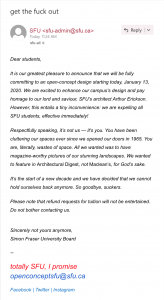
On January 13, SFU students received the following email.

A totally, definitely, absolutely real email from SFU, telling students to “get the fuck out,” or something.

The defining characteristic of open-concept designs is neat, decluttered areas which gives the illusion of more space. Other open-concept design choices visible around campus include use of negative space, natural light (sometimes), and the fact that literally everything is grey.

As swarms of bustling students invaded the Convocation Mall and the Academic Quadrangle despite their strategically placed uncomfortable seating, SFU realized that students were “cluttering [its] vibrant space” and they needed to GTFO 

While some students were confused and infuriated by the news, many also saw this as an excuse to get out of SFU. 

“I guess SFU took the whole ‘leaving toxic people behind in 2019’ thing too seriously,” said Matilda Smith, former third-year chemistry student. “At least I won’t have to climb up this dreary mountain anymore.” 

“I’m not even mad,” said James Lee, former second-year anthropology student. “This is like the ultimate real-life meme. You be you, SFU.”

The Peak would normally promise to continue investigating this story, and to provide more news as the story develops. But we can’t, because SFU has already kicked us off all three campuses. Go figure.

I Tried: Studio Seventy Three Fused Glass Making

0

by Marco Ovies, Arts Editor

On the outside, Surrey’s Studio Seventy Three looks like your typical glassware store, with many of their creations displayed in the window for sale. I had walked past it many times without a second glance. It wasn’t until my mom had booked a fused glass making class for my family and girlfriend (yes, she is real, I promise) that I realized how truly unique this place was. 

According to their website, Studio Seventy Three  is a not-for-profit studio offering an opportunity for adults with developmental disabilities employment and a creative outlet. Before the class, I browsed through some of the art they had on display for inspiration, quickly realizing that I was in trouble. Everything for sale looked fantastic while I could barely draw a stickman — I was definitely in over my head. 

The fused glass making class was held behind the exhibit on a large table with many different squares of clear glass. To put it simply, you glue different coloured pieces of glass onto this one clear sheet to make an image, and they throw it in the kiln to fuse it together. You can make all sorts of things like suncatchers, coasters, soap dishes, and even Christmas ornaments. I decided to make three suncatchers, which in hindsight makes no sense considering I only have one tiny window in my basement suite. 

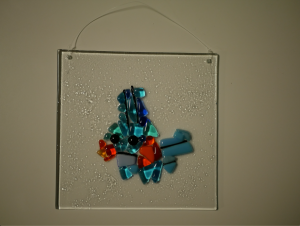
There was an instructor with us the entire time who offered sage words of wisdom and played some bumping ABBA. Aside from the emotional support, the instructor left us to our own devices, letting us make whatever we wished. Buckets of different coloured glass circled the entire room allowing you to make whatever your heart desired. I decided my suncatchers should feature a penguin, a succulent, and my handsome boi Mudkip, which no one in my family seemed to appreciate due to their lack of Pokemon knowledge. 

Photo: Marcus Blackstock / The Peak

I’m going to be honest with you, my penguin turned out pretty poorly and I will not be including a photo of it for my own ego. But once you get past the initial learning curve, glass fusing becomes a lot of fun and our allotted two hour class quickly turned into three. Also, each class has one of the artists of Studio Seventy Three join you to help realize how truly untalented you are. One of the artists is actually a regular at the Starbucks I work at, so Fatima if you’re reading this: hello. 

If you get the chance, please make sure to check this place out and support some of the local artists. Fused glass classes start at $40 per person, three items for two hours, and you can find out how to book one on their website. And don’t worry if you think you’re not artistic enough to do it. If I can make something remotely cute, then I’m sure you will be able to as well.