Home Blog Page 459

Six things that make a good class syllabus

0
Fourth-year me has seen things. Terrible, wonderful things. Photo: Chris Ho/The Peak

By: Gabrielle McLaren, Editor-in-Chief

Syllabus week brings up this primal, inescapable anxiety in me. Maybe it’s my fight-or-flight response activating when faced with a list of incoming shenanigans. Maybe it’s the undeniable excitement of breaking out my coloured pens and annotating the shit out of my agenda. Or, it could also be the absolute horror show of syllabi sins I’ve witnessed throughout my humble time at SFU. It’s only been four years, but I’ve seen things, which is why I have the following criteria for a platonically idealized syllabus: 

    1. Centralize your syllabus. Don’t give me a one-pager of miscellaneous fun facts about modernism, and then send me on a treasure hunt around Canvas to find the weekly reading list or your policy for x, y, or z. When I see a fragmented syllabus I know I’m going to bother a prof with a silly question, or otherwise fuck up. Similarly, don’t make your syllabus too pretty to function. If you aesthetically write down your office hours as “T: 1:30-2:30” I’m going to spend the semester showing up for your Thursday office hours on Tuesdays. Just kill your darlings and your aesthetic — and also please don’t bury your email.
    2. Offer rationale for in-class policies. This semester I was absolutely flabbergasted and in awe to see this on a syllabus. The fact that the prof explained how to ask for content warnings, or justified their extension policy was not only respectful, but also demonstrated that they’d put some thought into how they ran their class. If you upload 17 different journal articles and op-eds on the topic of why laptops in classrooms are bad, I’m not going to fight you on your electronics-in-the-classroom policy. 
    3. Provide a clear and detailed reading list. I live in fear of professors who don’t reveal the entire semester reading schedule ahead of time. It’s a handicap to busy students who may need to work in advance. Similarly, syllabi should mention where to find readings — is article #457 available in the library or did you super legally scan your buddy’s book and upload a chapter on Canvas? Another weird one — especially when reading fiction — is when professors ask students to read “half the novel.” Like . . . do you want me to literally divide the 567 page book in two? Does that count the translator’s note at the end? What if the midpoint is in the middle of a chapter? 
    4. Include instructions for projects ahead of time. If you’re going to have me write up a big project for you and warn me not to write it the night before, you too should be prepared instead of hastily writing instructions mid-semester, Karen. Including instructions for projects, essays, and even clarification details for midterm formats etc. is incredibly helpful for students with anxiety (hi), or those of us with killer schedules and multiple responsibilities (hi again) who may need to work ahead. There’s nothing more awful than getting a list of term paper topics three weeks before the due date as Mercury goes into retrograde, a crunch period appears at work, another essay drops from the sky alongside a student conference, and I write a midterm in another class.
    5. Make preferences known in advance. When it’s essay submission time, do you want hard copies, electronic copies, or both? If you want to see my reading notes, do I need to type them for you, or is scanning handwritten notes fine? What are your thoughts on Google Drive? It’s annoying to find out at the last minute or have to re-do something you thought you’d done properly, especially when professors with Secret Preferences™ clearly had them beforehand. Preferences are fine, but communicating them and setting expectations from the start is helpful. 
    6. Tell me what to do if there’s a problem in your class. Do you only answer student inquiries via Canvas messages? Weird flex, but if so tell me in advance so I don’t send frantic emails into the void about my emergency trip home. If I have questions about a grade, should I talk to you ASAP or do you have a 24 hour waiting period? What’s the latest I can ask for an extension if my roommate gives me strep throat? If you’re assigning any group work, please, please, for the love of all things good tell me how you want me to deal with group members from hell. 


Listen, after this term’s last 16 credits, Dobby becomes a free and convocated elf — so yes, I am trying to keep my head down, get my shit done, and smoothly sail to graduation. Please, I beg of you, give me a syllabus that can help me on my quest.


 

Adulthood 101: Student recipe box, part 2

0
Illustration credit, Tiffany Chan

By: Victoria Lopatka, Peak Associate

In our first recipe box, we featured simple, healthy recipes that any busy student can whip up. But for students who need quicker alternatives, what’s more convenient than the humble microwave? Throughout my time living in residence at SFU, I came to rely quite heavily on the microwave. I often didn’t have a lot of time to cook, so I valued its minimal pre-heating time and quick-cooking abilities. Within minutes, a busy student can have a hot meal. The one downside, though, is that a lot of frozen microwave meals aren’t very healthy and may contain ingredients you don’t want to be eating regularly. After a few initial weeks of eating frozen food in residence, I decided to branch out and research some easy, somewhat healthy, microwave-centric meals. Today’s recipe categories include recipes for breakfast, lunch, dinner, and dessert.

Tasty Breakfast Recipes

First, breakfast; the most important meal of the day! This section includes your classics, like eggs and oatmeal, but also some suggestions for if you want to try something new, like a breakfast “cookie.” 

2 Minute Egg Omelet in a Mug: Who doesn’t like a tasty, quick, and easy omelet recipe to start the day? It can be personalized to suit your tastes and the contents of your mini fridge; try adding cheese, bacon, sausage, spinach, onions, peppers, and more. This omelet only takes a few minutes to make, so it’s perfect for when you want a warm and healthy meal — but only have a few minutes before you have to leave for class.

Breakfast Cookies: Don’t let the label of “cookie” dissuade you from having this for breakfast: this “cookie” is made of bananas, oatmeal, and honey. This recipe is perfect for those that have a sweet tooth, but are trying to cut down on those sugary breakfast cereals.

Chocolate Oatmeal: Instant oatmeal from those little brown packets is good, but this is better: chocolate, nuts, bananas — what more could one want in your breakfast oatmeal? Before discovering this chocolate oatmeal, I never really had oatmeal for breakfast, but this recipe has converted me into a regular oatmeal-eater (an oatmeal-er? an oat-er?).

Banana Bread in a Mug: If you stand in line for 20 minutes at Starbucks every morning to get your banana loaf and coffee, save some time and money with this quick little recipe. You probably have these ingredients sitting around: flour, sugar, eggs, etc. Add some cinnamon and chocolate chips if you want something a little extra!


Easy Lunch and Dinner Recipes

Next, we have our lunch and dinner recipes. Whether you’re plant based or like some meat, a novice cook or a microwave-recipe connoisseur, have five minutes or 15, one of these recipes will surely satisfy you. 

Quick Chicken Fajitas: When I first stumbled upon this, I was skeptical about how I could make chicken fajitas in the microwave — but this recipe is actually a gem, if you have about 15 minutes to spare. All you need is some chicken, spices, wraps, the vegetables and toppings of your choice, and a microwavable container with a lid. Just a quick note: every microwave is different, so double check that your chicken is fully cooked before eating it!

Vegetarian Burrito Bowl: A burrito bowl at Chipotle or Quesada can be expensive, not to mention how it’ll cost you the time you’ll spend walking or on transit, waiting in line, and returning back to your dorm. On the days where you don’t want to spend money and time, but want something warm and healthy to help you survive the cold Burnaby mountain winters, try this vegetarian burrito bowl.

Mac and Cheese in a Mug: So, you’ve just gotten back your final grades and you’re in desperate need of comfort food. You could reach for the box of unnaturally-orange Kraft Dinner . . . or you could whip up this quick mac and cheese. Plus, instead of having to wash a stovetop pot, multiple spoons, and a bowl, your only dishes tonight will be a single mug — which we both know you’ll leave in the sink to “soak”, anyways.

Microwave Risotto: This is the recipe you’ll want to post on your Instagram story to flex on your friends and family — no, you’re not just surviving on instant ramen and whatever food is being handed out in Convo Mall! This recipe includes options to customize the risotto with squash, sage, mushrooms, bacon, kale, or whatever other veggies and spices you may have. As a bonus, white wine is one of the ingredients, which, if you’re over the age of 19, you can sip as you cook.

Baked Sweet Potato: Your mom will be so proud of you that you’re eating a sweet potato. Some yummy possible toppings include: maple syrup, butter, mustard, kale, salsa, avocado slices, eggs, bacon, ginger, arugula, and garlic.


Sweet Treats

If you have a sweet tooth, this next section is for you: desserts and sweet snacks! It’s debatable whether these are “healthy” or not, but probably better than downing a bag of Skittles on your study break.

Chocolate Chip Pecan Mug Cake: Picture this: you’re all warm and cozy in your dorm room, bundled up before Netflix, Disney+, or whatever you watch when you’re procrastinating. Outside, the weather is horrible — as it always is on Burnaby mountain. It might even be snowing! You’re craving something sweet and chocolate-y, but you don’t want to leave your dorm. Enter: this mug cake.

Easy Carrot Cake Mug Cake: This has carrots in it, so it’s most definitely healthy. If you’re feeling boujee, you can put whipping cream, pecans, and shredded carrot on top.

Chewy Peanut Butter Cereal Bars: As I scrolled through the glossy pictures of these bars, I thought “there is no way this is made in a microwave.” Yet, it is. I do warn you, though, there are 15 steps to get to the completed product, so it’s for you elite microwave chefs.

Eggless Blueberry Mug Cake

At this point in this article, I’m running out of interesting commentary to make on microwave-friendly meals, specifically mug cakes. This is a mug cake with blueberries. It does not require eggs. Blueberries are good for you. Enjoy. 

Friendly customer service is not an invitation for physical contact

0
Retail is not a contact sport. Illustration: Kitty Cheung/The Peak

By: Nicole Magas, Opinions Editor

Between the low pay and dealing with entitled Karens, many of us with experience in the service industry have harboured the secret fantasy of being hit by a bus on the way to work, just to avoid the torment. But by far the worst part of working in the service industry is the sheer amount of inappropriate and uncalled for touching. These surprising acts of physical contact take advantage of “customer experience” policies, and essentially make a captive audience of employees in these situations.

I’ll preface the following by mentioning that I’m not big on touch. Giving and receiving hugs among friends and family is about the biggest sign of trust I have to offer. It goes without saying that I have absolutely no tolerance for intentional physical contact given by strangers. The workplace is the absolute last place where I’d expect anyone to touch me in any way.

Which is why it was always such a paralysing shock to have customers overstep that boundary. Most of these instances were innocent holdovers from a previous generation. Older women mostly, who wanted to show their appreciation with a touch to my arm and a smile. I can’t say I understood it, but although it made me uncomfortable, those I could shrug off. Others were not so innocent. Men rubbing my back. Men jumping on me, jokingly asking for a piggy-back ride. Men pulling my obviously resisting self close for a kiss.

I worked alone at my store, so I didn’t have the benefit of coworkers jumping to my rescue. I did, however, report each instance of sexual harassment to security. After giving as accurate a description of the men as I could, I was asked what I was doing before the incident. When I answered that I was laughing at their shitty jokes, I was told not to let it happen again. 

Excuse me? Don’t let it happen again?!

Near the end of last year, several Disney World cast members reported incidences of inappropriate touching while on the job. One woman was injured when a guest insisted on patting her head, causing the headpiece of her costume to slip and strain her neck. Several other women were groped while giving requested hugs to guests. Security was later notified and the guests were detained, but I ask readers to consider the cast members in-the-moment, at their job in the “most magical place on Earth.” Do you think they felt it was in their power to shove these guests away, or do you think they had to endure the harassment until they could slip off and give their reports, all the while with the shameful thought in the back of their heads that they had “let it happen?”

This attitude demonstrates the insidious overlap between consumer culture and rape culture. For service employees, jobs are precarious. Retail employees and wait staff in particular often rely on commissions and tips, meaning the more people buy, the more groceries we can put in the fridge at the end of the week. This means that friendly, attentive customer service is not only demanded by management, but often necessary for economic survival. Unfortunately, it also follows that when customers make service employees uncomfortable — either with verbal abuse or unwanted touching — they have little choice but to grin and bear it. The fact that even security at my workplace did not read my situations as ones of harassment with a clear aggressor shows how little power service employees have in determining their own workplace boundaries. 

The demands of capitalism and neoliberal ideologies require employees — especially those in precarious service jobs — to commit themselves fully to their roles in the company, with little regard for their own safety or comfort. Unfortunately, this means being friendly to aggressive customers even when warning flags and alarms are blaring. It means not causing a scene when a customer refuses to take “no” for an answer on that backrub offer. And at times it can mean trapping employees between a rock and a hard place when fear for their economic security triggers the societal judgement of “they were asking for it.”


Celebrating Vancouver Biennale’s most iconic art around Vancouver

0
Photo: Michael Nugent / Flickr

by Ben McGuinness, Peak Associate

The Vancouver Biennale is a non-profit whose sometimes beautiful, sometimes absurd artworks have popped up all around Greater Vancouver since its founding in 2004. By collecting donations they are able to hire artists to create these breathtaking public art pieces. The current 2018–2020 Exhibition is its fourth thus far in a mission to turn our parks and public spaces into an Open Air Museum.

Given their conspicuously public nature, the Biennale’s works are sometimes only on display temporally — possibly adding to their poetic value. But others have stood for years as iconic testaments to Vancouver’s everyday life — oddities and all. Here are four of these iconic works that every Vancouverite should know!


A-maze-ing Laughter

Artist: Yue Minjun (China)

Where to find it: Morton Park at Davie and Denman

Photo: PxHere
Photo: PxHere

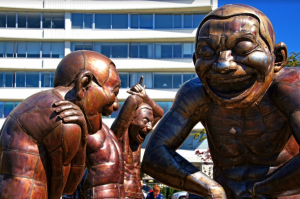
Tourists from around the world have taken home photos of themselves mimicking the eccentric and nearly unsettling statues of A-maze-ing Laughter. This piece from the 2009–2011 eExhibit features 14 sculptures of a squat man — a caricature of the artist himself — in silly poses with the same absurd smile on his face. Drawing from his background in Cynical Realism (a movement exploring China’s rapid urbanization and opening to the West, often with a satirical or humorous tone), Yue combines humour, realism, and repetition to engage viewers with the contradiction of loud images in a still sculpture. The inclusion of ‘maze’ in the title alludes to the perplexity of the subject’s insanely good mood, perhaps encouraging us to reflect on why his laughter is so strange to us.

The piece is well-placed at the heart of English Bay, where beachgoing families and drunken clubbers alike may stumble upon it in the mood to embrace the shameless a-maze-ing laughter of the quiet statues. We dare you to become the 15 statue for your own photo op!


Acoustic Anvil: A Small Weight to Forge the Sea

Artist: Maskull Lasserre (Canada)

Where to find it: Leg-in-Boot Square in False Creek

Screenshot via @VanCityPenguin

At first, the Acoustic Anvil could be mistaken for the type of industrial object one should find by the sea, yet on a double-take you’ll notice how its rusty utility is out-of-place in a district designed for leisurely amusement. It serves as a reminder that the history of Vancouver can sometimes be hard to see under the gloss of modern glass towers and family-friendly public spaces.

Contributing to the current 2018–2020 exhibition, artist Lasserre explains that the anvil’s form, including an instrument’s sound-hole stamped into the middle, captures the ships of Vancouver’s harbours, the shell of the nautilus, and the sound of the sea in a song of both “massive permanence” and “fugitive fragility”. On a sunny day you should walk or bike the seawall of False Creek to see the anvil for yourself and what song it sings to you.


Trans Am Totem

Artist: Marcus Bowcott (Canada)

Where to find it: Chinatown at Quebec and Milross

Photo: Michael Nugent / Flickr

Passengers riding the Expo Line SkyTrain to get downtown are nowadays confronted by the Trans Am Totem, a stack of five old cars teetering on top of a gnarly tree trunk. As silly as it is, there is something alarming about the Totem, which almost seems to demand your attention as you go about your day. Bowcott’s piece serves as a stark reminder of the instability of our materialistic way of life and our responsibility to account for its byproducts — including the millions of cars that one day become waste.

The choice to place the cars on a wooden pedestal and name the sordid piece a ‘totem’ asks us the uncomfortable question of what it is we idolize and how that impacts the natural world Vancouverites claim to cherish. Emerging from the 2014–2016 exhibition, the Trans Am Totem stands a block away from Science World where it’s sure to catch you at some point and beg the question: are you okay with this?


Giants

Artists: Gustavo and Otávio Pandolfo (Brazil)

Where to find it: Granville Island

Photo: Flickr
Photo: Flickr

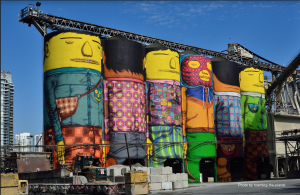
Possibly the most iconic Biennale piece yet, Giants transformed the silos of Ocean Concrete on Granville Island into a vibrant row of yellow and orange dudes wearing trippy clothes for the 2014–2016 exhibition. You can’t help but snap a picture when you come across it and think that there’s a lot of potential for art all around the city, making it an excellent case for the Open Air Museum.

The artist duo OSGEMEOS wanted to find a three-dimensional space for their piece where it could form a dialogue with the landscape and with the people who frequent it. Giants creates an optimistic meeting place between industry, art, and the mundane, turning silos that once interrupted the touristed waterfront into one of its most exciting sights. In the true spirit of public art, don’t make plans to go see it; plan a trip to Granville Island or a ride on the Aquabus and let Giants surprise you with a spark of inspiration.


Schedules and programs don’t determine the worth of a degree

0
It’s not the size of the course load that matters . . . Photo: /The Cord

By: Encina Roh, Peak Associate

In the words of Kermit the Frog, it’s not easy being green. And it’s definitely not easy coming from a family of staunch, math-breathing engineers when you are a social sciences student. My grandma was a chemical engineer, my mom was a computer engineer, and I’m a political science major. So you might understand the frustration of trying to explain to them that, yes, my major is difficult. 

A few semesters ago when I was loudly stressing over some exam, my mom rolled her eyes and muttered, “Do you know Carol ah-yi’s son is doing nine courses for his engineering degree?”

I stared at her. That’s one question you really don’t want to direct at a student who does not remember the last time she woke up without using three alarms. But because I’m pretty collected (or more likely the fact that she would get rather terrifying if I talked back to her), I calmly replied, “You know, my classes are four hours long and Bill’s are an hour, mom.”

I also wanted to add that as a full-ride student and law school hopeful, I had to keep my GPA above 3.9. I wanted to remind her that I held a law internship and worked three other jobs. (If my own mother isn’t going to level with me about how much I’m taking on and brag about it a little, I should just do it myself.) 

However, before I could say all this, my mom asked the one question that will send a social sciences student into an unparalleled rage.

“Isn’t your degree just reading and writing?”

Well. Sure. Kind of. Except the readings total up to at least four hundred dense and esoteric pages every week and professors often expect students to exceed the 15-page essay minimum to get high marks. 

Did I mention the topic is typically something like discussing the international response to the environmental costs of transglobal mass production and outsourcing in central Asia? Or exploring the complex relationship between gentrification in Vancouver’s queer and Chinese spaces? These aren’t topics you can just sit down and write about off the top of your head.

In reality, there is no fixed formula for interpreting who has it more difficult in a given semester or in a certain major or course. The student juggling two jobs and taking three courses shouldn’t be seen as less competent than the student with no job and five courses. 

Comparing the number of courses that students take or the degree they’re working towards as a measure of their ability is honestly kind of offensive. How dare someone insinuate that some of us are less sleep-deprived and stressed? We’re all in this together, and we’re all suffering equally — just in different ways. I choose to cry over a 20-page essay and Bill chooses to endure doing math that has more letters than numbers almost every day of the week. 

So, mom, if you’re reading this please stop comparing me to future software engineers. My course load is just as undesirable to me as it is to them.


Musing on my experiences in BC as a French exchange student

0
Image courtesy of Pixabay

By: Noé Baudouin, SFU Student

“Good morning passengers, we’re now 24,000 feet above ground on our way to Denver,” exclaims the pilot through the microphone. It is 11:35 a.m. and I am on my way to France to celebrate Christmas with my family. It’s funny to see Vancouver shrinking through the window of the airplane. What has been my playground for the past four months gradually fades away: Burnaby Mountain, Surrey, downtown Vancouver’s skyscrapers. Eventually, the whole of British Columbia vanishes as we enter the clouds. 

It is on this plane that I am writing these words. Seeing Vancouver from above makes me reflect upon the discoveries and experiences of my journey at Simon Fraser University. I am Noé, and I am an exchange student from France. I arrived in Vancouver in August, driven by a personal quest of identity. I was born in Québec City, but I grew up mainly in the French Alps. 

I believe that being French and Canadian has given me a unique perspective on my journey here. A French ‘eye’ allows me to observe Canada as an outsider. A Canadian ‘eye’ allows me to go deeper in my reflection, beyond common Canadian clichés. 

One thing that never gets out of my head when I explore differences and compare Canada and Europe is the difference in scale. Let me explain: here in BC, the plates, glasses, dishes, plastic bottles, and a lot more everyday items are bigger and thicker than they would be in Europe. But it is also true for nature! Walking around on Burnaby Mountain made me realize that even the average Canadian tree is impressive compared to those in Europe, and that goes for the mountains as well even though I come from the Alps.  

The distances are also different: commuting for an hour to get somewhere in Vancouver seems to be normal. In France, only people in Paris would have to commute for an hour to get somewhere else in the city. 

But what I love most is how wide the sky seems. Whether you believe me or not, the sky here is different. The shades of blue, pink, orange, and yellow that the sky takes daily (when you can see it, of course) are astounding — it seems like the sky stretches beyond the limits that the European sky is bound to. 

SFU’s Burnaby campus has been an experience in itself. Is it just me, or does it feel like the whole campus is just a giant starship that landed on the mountain? There are massive buildings with concrete alleys, secret doors, and multiple levels. Convocation Mall looks like it is covered in an iron and glass canopy. I am not saying that the Burnaby campus is beautiful, far from it. But evolving at SFU on a daily basis makes me feel like I am part of a space fleet standing on top of Vancouver, and my ultimate goal is academic pleasure and success. 

I also came to love what seems to be the Holy Trinity of style in SFU students: the red athletic SFU Nike backpack, slippers, and Mira refillable bottle hanging on the side. The SFU style is intensely debated amongst the international student community: for example, some believe that slippers are inappropriate in a study environment. I personally like how it mixes modernity, sportswear, and comfort in a way that would not be seen in France or Europe. 

Another delightful observation during my time in Vancouver so far has been the public transportation strikes. I might sound weird, but being French, I’ve experienced loads of public strikes! In France, a strike goes on for ages; they are recurrent and often long. While I am writing these words, France is breaking its own record in history with more than 30 days of striking against the government changing pension plans. French people, therefore, learned to live with strikes, to be resilient, and to cancel events at the last minute. For example, I am supposed to go to Paris at the end of December to celebrate Christmas at my grandparents’ home. But with the massive strike going on right now, we’ll only know on D-Day whether we can join our family or not. 

You can imagine my surprise when the TransLink bus strike that was supposed to occur between the 27th to the 29th of November was cancelled November 27th at midnight! Announcements were made saying that an agreement had been found between Unifor and the Coast Mountain Bus Company. I loved the way everyone got crazy about the potential strike on social networks. Do you remember that one SFU student who said that he would hire a private charter bus to go up and down the mountain? For a French person, a population getting really worried about a strike and managing to find a solution before the strike feels like fiction! I think that this says a lot about the great ability of everyday citizens to discuss and find cooperative solutions. This is something that French society should envy.

But my time in Vancouver has also been shaped by less exciting, unpleasant and yet major discoveries. On my way to Pholicious, my favourite lunch place in front of SFU’s Vancouver campus, I left my bag in the library. I bet you can guess what happened . . . Once my bag got stolen with the most precious electronic devices and official documents, I had to discover the process of going to the Vancouver Police Department and the Canadian administration. You can guess that I’d rather have not learnt that! But it is part of the experience, I guess . . .

As I look upon the clouds from the window of the airplane, one last thought comes to me. I am thankful for the SFU community for welcoming us exchange students from everywhere. Being an exchange student also means leaving your family and your friends from your hometown. It can sometimes be difficult. But here in BC, I never felt abandoned, never felt out of place. 

Now I can’t wait for when I come back this semester for the ski season!

Six tips to make the most out of your next art gallery experience

0
Illustration: Maple Sukontasukkul / The Peak

by Kim Regala, Staff Writer

With the abundance of art galleries scattered all across Vancouver — and on each SFU campus — there are plenty of places to check out. So whether you’re looking to visit one for the first time, or are already an avid goer eager to attend the next, here are some tips I’ve learned from my own art gallery adventures that will hopefully help you make the most out of yours.


  • Brochures and maps are your best friend. 


While it’s most important to create your own interpretations of art, it definitely helps to have a framework that guides the process. Thankfully, galleries provide plenty of resources both in person and online that offer information about the artists, as well as themes addressed in the exhibition. Brochures are commonly found near the entrances, while titles and short descriptions typically accompany each piece. On some occasions, galleries even have numbered maps, giving you a clear direction as to how to navigate around the space.


  • Bring a friend.


Visiting an art gallery by yourself is no foreign concept, but being somewhat shy, my biggest challenge was overcoming this fear of attending a public event on my own. If this sounds like you, then I definitely recommend having someone to keep you company. Taking a friend to an art gallery is a great way to relieve some of this anxiety and even create a cute bonding moment for the two of you. At the same time, a lot of value can come from a second perspective when viewing art. By having someone to converse and bounce back ideas with, your experience of the event becomes more engaging and insightful.


  • Take as little or as much time as you need per piece of art.


Whenever I visit a new exhibition, I always feel insecure that I’m not spending enough time looking at a specific piece. However, I’ve learned over time that there really is no right or wrong amount of time needed to admire art. I’ve seen someone take merely five seconds to glance over a painting while another patron stood still, staring at it for nearly 15 minutes. Some artwork will catch your eye more than others, so feel free to take as little or as much time as you need for all of it to sink in.


  • That being said, don’t feel pressured to LOVE each artwork.


It’s crucial to appreciate and have an open mind about every piece that you see. But, coming into an exhibition with a fixed mindset that you have to love every single one only blurs your judgement. Furthermore, it makes you less critical of what is really striking to you. It goes without saying that art is subjective, so naturally, not everything in an art gallery will be your cup of tea. Instead of forcing yourself to have a deeper connection to every work, spend more time admiring the ones that effortlessly gravitate towards you.


  • Focus on the bigger picture instead of nitpicking over tiny details.


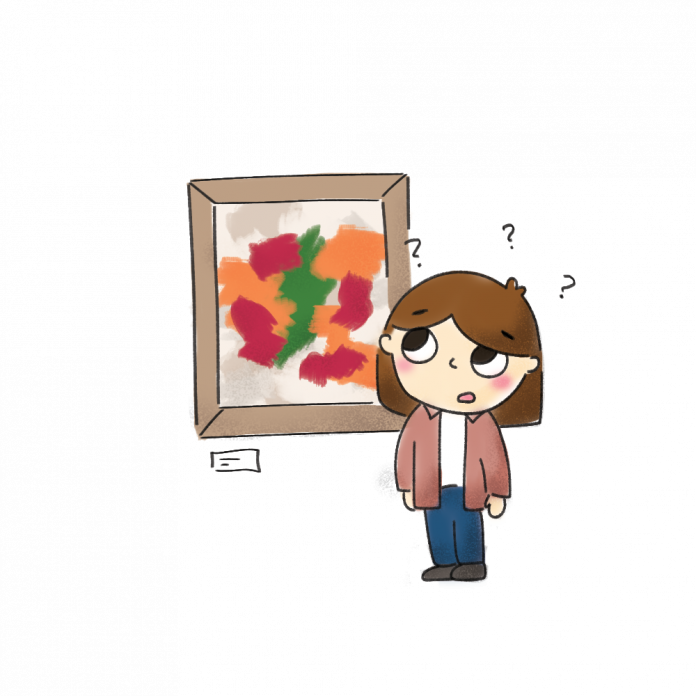
One of the biggest misconceptions, especially when trying to understand modern art, is feeling as if every detail of a piece has a deeper and more complex meaning. But sometimes, it really can be just as simple as a banana duct-taped to a wall. Instead of placing all of your attention on the physical material itself, consider why the piece exists in this particular setting (instead of somewhere else), how it communicates with its framed environment, and how it engages with the other pieces surrounding it.


  • Talk to artists or curators if they’re around.


This advice would have been especially helpful when I frequently attended opening nights of art galleries, which artists and curators also attend most of the time. Keep in mind that as the creators of the exhibit, they are probably the most excited in the room to discuss what you’re seeing and expand on their ideas and inspirations. One of my favourite gallery experiences was a conversation with Minahil Bukhari, at the Audain Gallery’s previous exhibition Currents. She openly shared her sentiments with me about the injustices she saw in her own family lineage, as the stories of women were frequently missing. It’s personal stories such as these that offer us new perspectives that move beyond written descriptions.

I hope that this list encourages you to check out some of the future art exhibitions that are sure to come your way. Regardless, you can definitely see me at one of the many SFU galleries opening this semester.

An Inside Look At The Media and Makers Commons

0

The Graduate Student Society welcomes four new directors after high voter turnout

2
The GSS held a winter 2019 election to fill several positions

By: Paige Riding, News Writer

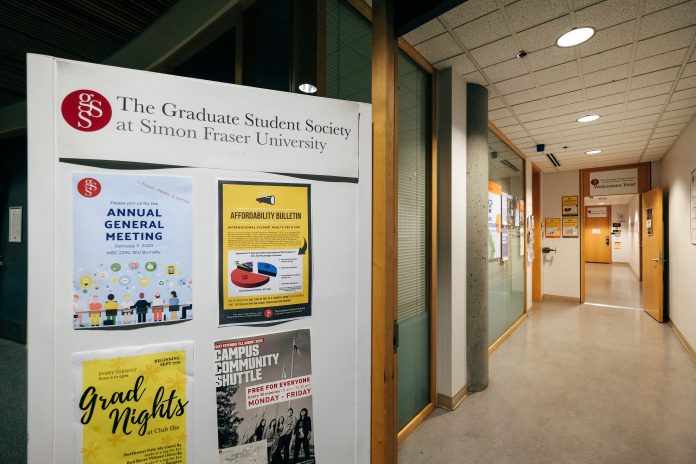
Following the Graduate Student Society’s (GSS) election in the fall of 2019, the GSS welcomed four new members to their board of directors. 

The Director of Student Life’s seat on the board was filled by Lulu Li with 241 total votes. The position had two other candidates. Li is an international master’s student in political science whose online introduction notes that she “strongly believe in giving back to the community and [is] an active volunteer in community organizations on and off campus.” Li hopes to hold events on campus to build “long-lasting and deeper connection within our diverse student society.” Li’s elected position involves making the grad student experience as good as it can possibly be, through planning events, overseeing community development, and working to engage graduate students through “non-academic resources.” 

The Director of Finance position found itself in the hands of Farina Fassihi with 168 votes. Fassihi, who ran against three other candidates, is pursuing a master’s degree in Urban Studies. Fassihi’s profile notes that they have “been involved with several non-profit organizations and groups, working on a range of issues related to health and social services. These endeavours have helped [Fassihi] to hone [their] leadership and team building skills.” The Director of Finance oversees the creation of the GSS’ budget and annual audit, among other investment goals. 

Finally, Rahil Adeli, running unopposed, was elected to the Director of Academic Relations position with 383 votes. A master’s student in Urban Studies, Adeli’s platform mentioned how they believe that “the university should play a more decisive and active role in professional development for all graduate students.” The Director of Academic Relations, previously called the Director of University Relations, is the arm that connects the GSS to other parts of SFU’s community including SFU administration and the SFSS.

Matt McDonald, Director of External Relations for the GSS, who spoke to The Peak via email, stated that a fourth director was appointed to their position for the Spring term. Mona Mehdizadeh became the Director of Graduate Services for January through the end of April. This position was appointed to a shortened term, rather than elected, because of the board “[moving] around the terms of two director positions,” wrote McDonald. The four new directors began their terms at the start of the new year.

McDonald noted that the amount of candidates running were “historically quite high,” as was the voter turnout of 565 voters. McDonald wrote that such a turnout “shows [how] the advocacy campaigns and events held by the GSS are becoming increasingly visible to students in the last year or so, leading more of us to realize we can have a positive impact on the university community and graduate student issues if we get involved.”

These three candidates will work their term until the final day of 2020. During the Spring semester, another three Directors will be elected for the Society: Director of External Relations, Director of Internal Relations, and Director of Graduate Services. Election information will become available as the term progresses on the GSS website later this month. 

Full vote counts for all positions and opposing candidates can be found on the GSS website