Home Blog Page 225

Jonas Worth brings his sports psychology background to SFU’s men’s soccer team

0
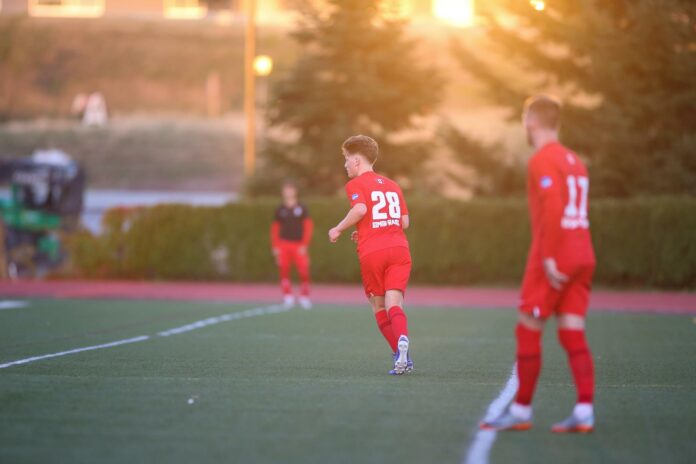
Photo of SFU defender Aaron Colbourne mid-game.
PHOTO: Paul Yates / SFU Athletics

By: Natalie Cooke, News Writer 

Whether you’re an NCAA athlete, olympian, or a beginner at a sport, mentality can influence your performance. Through the collegiate and professional levels of soccer, Jonas Worth, SFU men’s soccer goalkeeping coach, discovered how much mentality contributed to his gameplay. “People will anecdotally say it’s 90% [mentality]. I’d say it’s sometimes closer to 99%  — the brain controls everything.”

Worth, who has a master’s degree in sports psychology, emphasizes the importance of letting go of mistakes to his athletes — a lesson he struggled with as a player. “You have to live in the moment. That really negatively impacted my own personal performance and career. I was always looking towards the future.”

Playing a sport can become draining if athletes obsessively replay what they could have done differently in their heads. In this case, spending too long dwelling on the action of making a mistake, rather than how they are going to make the appropriate corrections.

“Most athletes struggle with living in the past, even if that past was five seconds ago when you made a small mistake that doesn’t necessarily impact the game. But, it impacts your perception of how you’re performing,” said Worth. 

Aaron Colbourne, a defender on the men’s SFU soccer team, knows how relevant a person’s mindset is when it comes to results on the field. Colbourne uses the glass-half-full approach to practice Worth’s teachings about moving beyond mistakes. “Always pushing past mistakes and focusing on positive aspects of my play help me be the best I can be,” he told The Peak. 

For SFU men’s goalkeeper Jordan Thorsen, a positive mindset starts before stepping on the pitch. “Trying to put myself in a good mood in the days and hours leading up to a game helps me not only enjoy my time on the field far more, but allows me to more effectively move past mishaps when they occur.” 

That being said, stress can be a good thing. Stress promotes adrenaline, which allows more energy to be exerted by your brain and muscles. That’s why pregame routines are all about finding the right method to learn how to transform impairing nerves into encouraging ones. It’s why coach Worth believes “Everyone needs something different on game day.” 

In Colbourne’s case, it’s music. For Thorsen, it’s visualization. When you mentally rehearse your movements and skills, you’re making them more automatic. While we may not see the physical work at hand, your brain is like a muscle. The more you use it, the stronger its connections become. That’s why so much preparation takes place off the pitch. It’s best to do the least amount of thinking when you’re playing. Analyzing and picking apart each second of a game can cause athletes to second-guess a routine play. With how fast the game moves, a slight hesitation can leave enough room for an open player to become guarded. Practicing visualizing these split-second decisions helps reduce any anxiety when athletes come face to face with these moments in a game, which can be a matter of “winning” and “losing,” according to Thorsen.

“Utilizing mental rehearsals and visualizations effectively gives athletes the ability to practice certain specific movements without moving a muscle,” he said. “The same parts of your brain are active when you rehearse a movement, even if you aren’t physically performing it.”

In the last several years, sports psychology has become more recognized. Worth said at the 2018 NCAA Convention, mental health was the number one topic of discussion. NCAA departments are now hiring more than mental performance consultants, but full-time mental health staff, such as PhD-certified sports psychologists. Just a year ago, the NCAA released mental health resources as part of its Task Force to Advance Mental Health Best Practice Strategies. Schools were gifted with a care model with tips about creating better environments to support athletes’ mental health. 

While most of the current NCAA measures offer oversight into the challenges an athlete faces, having a former player with a sports psychology degree like Worth, makes sure athletes are working on the mental side of the game just as much as the physical. “Once athletes achieve a certain level of performance,” Thorsen said, “those who continue to progress and become great do so in their heads, not on the field.” 
Vancouver protest speaks out against oppression of women in Afghanistan

0
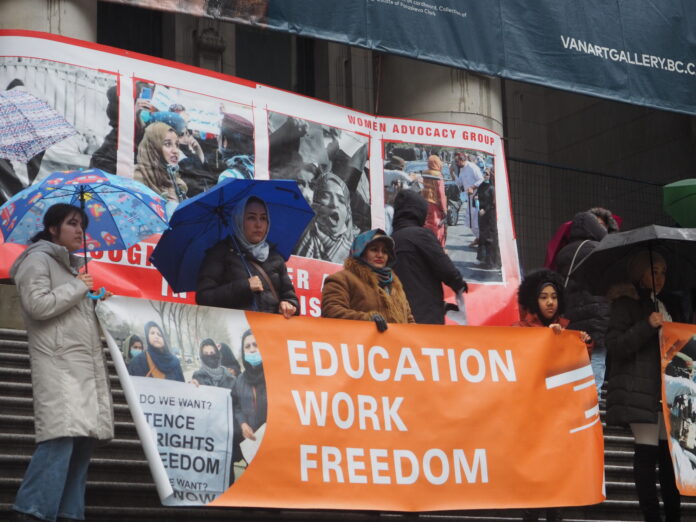
This is a photo of the protests outside of the Vancouver Art Gallery. The protestors are standing on the steps, holding a microphone, looking out to the crowd.
PHOTO: Olivia Sherman / The Peak

By: Olivia Sherman, SFU Student

Activists and allies gathered on the corner of Georgia and Hornby in Vancouver on January 8. The protest at the Vancouver Art Gallery was organized by Afghan activist and journalist Humaira Saqib, in partnership with Canadian Women for Women in Afghanistan.  

Saqib looked at the crowd, and said, “Everywhere is silent [ . . . ] We should scream!” Saqib then led the crowd in a series of cheers: “Recognize gender apartheid in Afghanistan! Sanction Taliban!”

A large gathering of people had rallied to show support for the women of Afghanistan. After America’s military withdrawal from the decades-long war in Afghanistan, the Taliban took over the government in 2021. Since then, women’s rights in Afghanistan have steeply declined: women are forced to cover their faces at all times, are required to be accompanied by a male escort, and are not permitted to get a job. In December 2022, the Taliban banned women and girls from attending school. “Women’s rights are human rights, and human rights are women’s rights,” declared Saqib.

Dr. Lauryn Oates is the executive director for Canadian Women For Women in Afghanistan, an organization that provides outreach for vulnerable families and women. The Taliban claimed their new regime was different from regimes of the past, and that women’s freedoms would remain intact. From 1996 to 2001, the Taliban ruled with extremely strict mandates of sharia law. When the Taliban returned to power in 2022, scholars noted their effort to improve their public image, although they have ultimately not changed their fundamental beliefs. Mandates against women’s rights quickly began rolling out, as well as the enforcers of these mandates. “The Taliban literally want women to disappear. They want them to have no visibility in public life whatsoever,” said Dr. Oates, who worked in Afghanistan for many years providing outreach and educational opportunities.

Many protestors called for solidarity and support from non-Afghans. “This is not just a woman’s problem. This is not just a feminist issue, a gender equality issue. It’s not an Afghan problem. It’s not a Muslim problem. It’s a human problem.” Dr. Oates continued, “You don’t need to be Afghan to stand with Afghans, you just need to be human, and to recognize that other humans, just like you, are in need right now.”

The protest was also calling on the Canadian government to intervene and further sanction the Taliban. According to Open Canada, the Canadian government spent $18 billion on warfare in Afghanistan, and over 40,000 Canadian troops served from 2001 to 2014. Canada’s sudden withdrawal after two decades of action proved catastrophic for women’s rights. This protest called for more action from the Canadian government against the Taliban. 

“To the Taliban, violence, misogyny, hate, oppression are not a means to an end. They are both the means and the end,” said Oates. “They don’t care about the statements of condemnation, they don’t care about the finger-wagging [ . . . ] The silence of the world has been absolutely deafening.” 

“We cannot forget what is happening in Afghanistan, because the humanitarian catastrophe that is taking place in Afghanistan will only get worse,” said Taleeb Noormohamed, BC’s first Muslim member of parliament, who showed solidarity at the demonstration. He noted, “It will only get worse if the Taliban are allowed to continue to behave as they are, to act as they are.” 

Activist and poet Sahar Maqsoodi read an original poem at the protest. “Do not take my identity. I am a woman. I know who I am and what I deserve,” said Maqsoodi.

Dr. Lauryn Oates concluded, “That’s what human rights are about, that’s what agency is: the idea that you can do anything, and believing in one’s self. That every human being, everywhere in the world, deserves to have the right to have those dreams. To do whatever they want.” 

SFSS Council protests student facing deportation

0
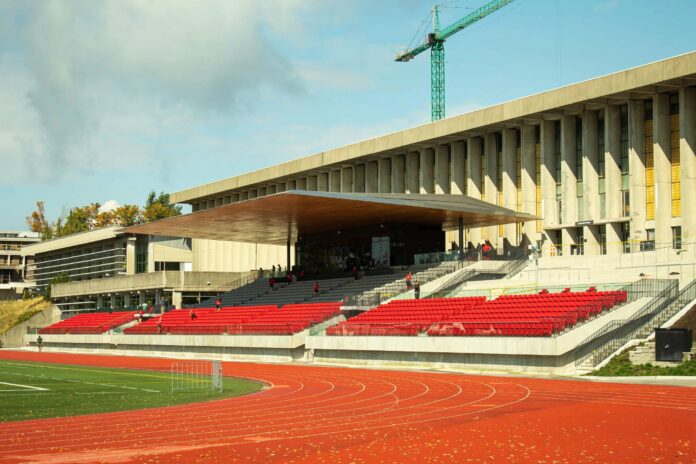
This photo is of the SFU stadium at the Burnaby Campus. The stadium is empty but it is a sunny day.
PHOTO: Krystal Chan / The Peak

Editor’s note: Previously, The Peak reported Zain Haq “has been in hiding.” This is not the case, and Haq was released by CSBA a few months ago. The piece has been updated to correct this. 

By: Natalie Cooke, News Writer

The Peak attended the Simon Fraser Student Society (SFSS) Council meeting on January 11. The highlights from the meeting include an SFU student facing deportation and preparation for the students’ federal lobby trip. 

SFU Student Facing Deportation 

Zain Haq is a third-year international student at SFU studying history. Haq is the co-founder of the Save Old Growth campaign and after a series of non-violent highway blockades across the province of BC, Haq is now facing deportation. 

Due to his activist work, Haq has been asked to go to the Canadian Border Services Agency (CBSA). The CBSA has a duty to remove “all foreign nationals and permanent residents who violate the Immigration and Refugee Protection Act,” according to Dawson Creek Mirror. They report, “Some conditions for obtaining a study permit include obeying the law and the absence of a criminal record.” Haq believes his actions should not be considered illegal because the government is failing to act accordingly towards the climate crisis. Previously, several lawyers suggested he go into hiding as CBSA will attempt to detain him. However, he has since been released and will “report to CBSA twice a week,” according to Haq in a follow-up email to The Peak.

The petition to support Zain Haq notes, “Deportation is an undue punishment for someone who has no arrest record other than being engaged in non-violent civil disobedience to raise awareness for the urgent climate emergency.”

Since 2020, Haq has been arrested 10 times for attempts at civil resistance which involves non-violent protest methods such as strikes, boycotts, and protests. He is also “currently facing five charges of mischief.” 

The SFSS Council explained Haq initiated the hunger strike that led SFU to a full divestment in fossil fuels. “Zain is a huge part of our SFU community and we have a duty to care about our community, especially when we are fighting to protect [students’] rights,” said councillor Eshana Baran, vice-president external and community affairs.

The Council noted the executive committee will address this again in a following meeting in hopes to support Zain Haq. 

With the intention of deportation from the federal court, more than 1,000 people across Vancouver have come together to stop this action. They are pressuring Sean Fraser, minister of citizenship, refugees, and immigration, as well as Prime Minister Justin Trudeau to revoke the current proceedings. 

“The attempt to paint a 21-year-old, non-violent university student as a risk to public safety, and bar him from completing his education, is obviously racist and Islamophobic,” said the petition to stop Haq’s deportation.

To support Zain Haq, sign the petition on Open Letter.  

Students Federal Lobby Trip

The SFSS vice-president of external and community affairs, Eshana Baran, is preparing for a federal lobby trip in February 2023, to advocate for SFU undergraduates. 

Under the jurisdiction of Prime Minister Justin Trudeau, individuals have the ability to lobby for issues such as expanding grant funds for public sector universities and plans to address inflation. To lobby is to work with governmental officials on making changes to legislative policy, financial benefits, or governmental regulations, among other things. Previously, the SFSS has been successful with federal lobbying for the elimination of interest on federal student loans. 

The SFSS’s current demands include addressing the high cost of living affecting students. 

  • Addressing inflation by increasing policy regarding students 
  • Increase financial support for students, international students, and students with families 
  • Enact a tuition freeze
  • Addressing student food security 

Baran said, “I am looking forward to meeting with the Canadian Federation of Students [ . . . ] It is really cool to create those relationships. ” 

Horoscopes January 23–29

0
An illustration of a girl with long flowing hair. Astrological signs and stars shine around her.
ILLUSTRATION: Marissa Ouyang / The Peak

By: Isabella Urbani, scathing Sagittarius hater and proud Leo 

Aries 

According to the ethereal Star girlbosses, we are supposed to be soulmates. In that case, you’re gonna Have to change the spelling of your sign name. Why do we call you AIR-reez, when you can’t even spell “air” correctly? Power to you for being a feminist though, having a uterus as your sign’s symbol is totes empowering. 

Taurus

Leos kind of just pretend you don’t exist. But how can we when Dwayne “the Rock” Johnson has a tattoo of your star sign, the noble bull, on him? And you call us self-centered? Sure. Your symbol literally looks like you started drawing a stick person, gave up half-way through, and Tried to sell it as “abstract” by flipping it upside down. Plus, it looks like a wedding ring. Possessive, much?

Gemini 

Of course you didn’t know this, but the name “Gemini” comes from the oft-used Leo phrase, “Gem, aren’t I?” You know, cause Leos are gems? Anyway, I broke this Ethereal being’s heart at this little bridge crossing, which is why your sign symbol looks like that btw, and they passed it off as their own invention. Wicked, right? Too bad I stole it from Sagittarius first. 

Cancer 

Gosh, I can’t stand Cancers. They’re right behind Sagittarius on my shit list. I had A Cancer brother, and he would always pretend to be so right and just. Like, “Isabella, set a good example for the humans.” “Isabella, do this and that.” So you know where he is now? Sleeping with the crabs, or whatever you people call it. 

Leo 

You stay exactly how you are because you’re PER-FECT. 

Virgo 

It’s no coincidence that your sign name basically sounds like vertigo, because you make me nauseous. What’s up with the “M” in your symbol too? Plus, your Goddess is totally obsessed with wheat and stuff. She Is always trying to get me to go on a health kick with her. Like go ask Sagittarius, they like silly ideas. 

Libra 

Did you know you’re like Leo’s sidekick? Who do you think named you LEE-bra? You’re an amazingly good friend. Always Typing out the horoscopes for us, while we Leos, provide all the most-needed advice. But now that our ruler, the sun, is like Taking a break or whatever and chilling in Alaska, we can finally say what the other signs really need to hear. 

Scorpio 

I mean, you’re named after an Arachnid. You’re kind of the emo sign of the bunch. I don’t mind it, anything to distract me from the awful sound of a Sagittarius speaking. You could tune it down on stinging people. You realize you aRen’t actually a scorpion? 

Sagittarius

Immediately no. 

Capricorn 

Never trust a word a Capricorn says, it’s in their DNA, or should I say, astrological name? You’re kind of capping. I know humans can’t digest corn, but your ethereal beings really screwed you up by naming you after the vegetable you’re allergic to! Can you believe all Capricorns are allergic to corn? Now that is messed up. And a TRUE fact, certified from your beloved Leo.

Aquarius 

Leos may be fire signs, but we dig water, like a lot. And your rUlers live in an aquarium, which is pretty rad. Plus they throw the best parties. We all know the party doesn’t start until the Leos show up. And for that to happen, there can’t be any Sagittarius people around. 

Pisces 

The water Signs just know how to do it right. Your symbol has this cosmic moon thing going on, which is why you rock this wild mystique. The signs can never guess what’s on your mind, probably because you spent centuries trying to hide that all Pisces are hydrophobic. 

Reasons you should drop this class

0
Illustration of a student staring at a laptop. The laptop displays the myschedule website.
ILLUSTRATION: Raissa Sourabh / The Peak

By: Maya Beninteso, Peak Associate 

Dear pitiful student enrolled in CLAS 101,

Greetings, my name is Maya. Goodness, would I hate to be you. I’m not quite sure if you’re aware, but this course puts the “ass” in CLAS(S) 101. Have no fear, today is your lucky day. I’m privy to insider knowledge — knowledge that will inevitably possess you to drop the class (definitely not because I took the class before . . .  and have to retake it). 

#1 The class is in-person
Hear me out. PLEASE. I HAVE BEEN ON WAITLIST POSITION 1 FOR THE LAST THIRTEEN DAYS. Yes, having an in-person class provides you with “face-to-face” instruction, but it also means being face-to-face. Let’s be honest here. There’s nothing more brutal than having to go to class, sitting down for up to three hours, and attempting to scribble down everything the professor is saying. That requires effort, attention . . . and care. Why on earth would you commute all the way to campus only to go to class? Why waste time commuting and, further to that, putting effort into looking like a presentable human being? Do yourself, and your confidence, a favour and save your #CuteFits for people that care.

#2 The seats in the lecture hall creak
Trust me, there’s nothing more embarrassing than adjusting your seating position and having the chair creak so loud the entire lecture hall is staring at you. Of course I have. Every. single. seat. fucking. creaks. ALL OF THEM. There is no escaping it and, if you take this class, it is coming for you, too. Because you’re young and think you’re invincible, you might just believe it won’t happen to you but — spoiler alert — it will. However, if you happen to not be ridden with social anxiety (lucky, you), then might I point out how annoying hearing a cacophony of creaks during lecture will be? Shall we do the math? 

There are 150 students enrolled in the course (but only 120 will attend lectures, let’s be honest here), which means there will be, at least, 120 instances of creaking because no one sits entirely still for over two hours. Imagine you’re trying to listen to the prof — creak. Imagine you’re trying to write down an explanation that isn’t on the slide — creak. Imagine you’re trying to remember your questio — creak. I think you get it no — creak

#3 The class is 2:30pm–5:20pm
This is, in my opinion, the worst time to have a lecture. Why, you may ask? Because, it is too early in the day to do anything productive before class, and finishes too late to do anything after class. Don’t you want to get a head start on your day, like a productive person? Don’t you want the same life as those people that wake up at the crack of dawn to go to a sweaty commercial gym and drink your sludgy protein shake in those annoying shaker tumblers? Don’t you want to embody the “that girl” aesthetic? I know it’s too late for New Year’s resolutions, but it’s never too late to be that girl. I want to be that girl too . . . ANYWAYS, imagine all of the free time you’ll have in the evening. Whether you just want to kick back and watch a movie, or actually go out with your friends who you never see. 

I never do see them.

#4 The professor curves the class
Oh my goodness! They actually curve the class up, what a nice professor . . . right? Wrong. You want to know what’s disheartening? Getting a raw 80% and being curved down to a C because the average grade was a 95%. If you do end up taking the class (and taking an L, in my opinion), look around when you’re in lecture. Those people are your competition. May the odds be ever in your favour, because your grade will be dependent on how well you do in relation to the class, not based on how well you do as an individual. Do you want all of your hard work to be for nothing . . . More importantly, do I want all of my work to be for nothing?

#5 There is a 4-page paper
Believing shorter papers are easier is the number one mistake you can make. Shorter doesn’t mean less work, it means being more concise . . . which ends up being more work. If the paper is longer and you’re below the word count, there are hacks and phrases to increase your word count. Unfortunately for you, there aren’t any “hacks” to decrease your word count. You simply hope that you cut out the less relevant information, while keeping the important information. 

Wait . . . everything I’m saying is true. This class is horrible, in more ways than one (five, to be precise, but who bothers to count things.) I don’t want to commute to class on a crowded bus that’s rarely reliable. I’m talking to you, R5

I want to see my friends in the evening and be that girl in the morning. I don’t want to be compared to others and, most importantly, I want to be able to ramble with bullshit on an 8-page paper (because who wants to edit a small paper over and over.) You can have your seat in CLAS 101 because I’m taking a different class this semester and it’s called METIME101.

Look what you made me do,

Maya 

Creative Corner: Acrylic pour reignited my creativity

0
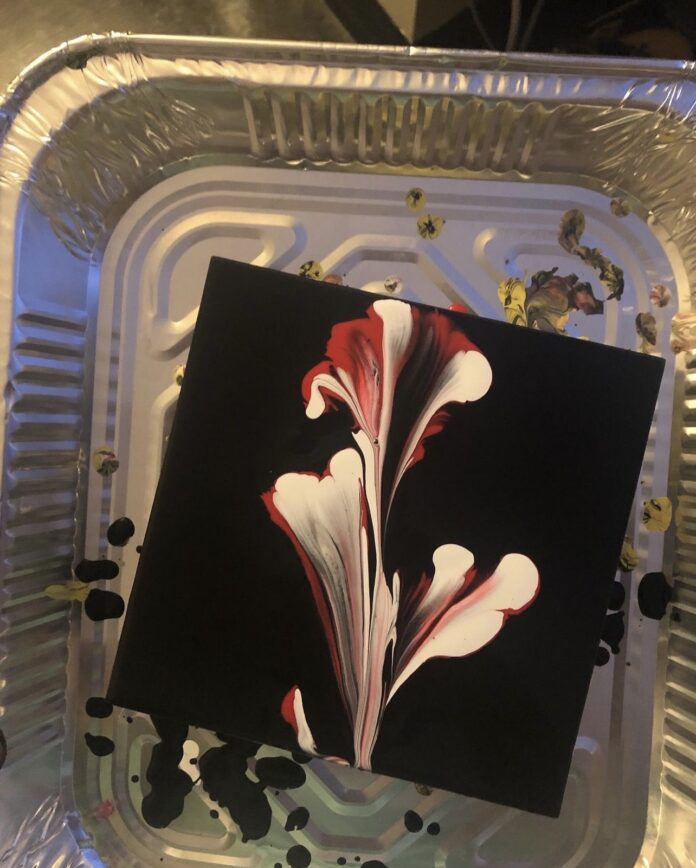
A white and pink flower on a black canvas background made using acrylic pour method.
PHOTO: Farah Messan, SFU Student

By: Farah Messan, SFU Student

At the height of pandemic restrictions in 2020, I had become consumed by loneliness and felt an insatiable thirst for excitement and exploration — all of which seemed, at the time, impossible within the confinements of my four walls. Being isolated and miles away from my family had taken a toll on my mental health. I searched for comfort on Netflix and YouTube, but quickly grew bored. I decided to seek it elsewhere and that was when I remembered my passion for creating art. 

Though drawing and painting in particular had never been my forte, upon coming across a 10-second acrylic pour video on my Instagram discovery feed, the simplicity and beauty of the pouring process intrigued me. While it seemed expressive, it also seemed feasible (as a novice painter). I quickly watched several tutorials on YouTube to better understand this form of art and get myself started: The ones that helped me most were beginner guides from the channels Tiktus color Art and Kristen // K.becca

Without hesitation, I ransacked my room for materials. The only items I needed were small tubes of acrylic paint, small cups to hold the paint in, 10×10 size canvas, and a tray to pour the paint over, all of which I had purchased at a dollar store. 

My very first project was a red and white flower over a black canvas, followed by an abstract multi-coloured pour. Since then, I have made other acrylic pours as gifts for my friends and family, but I keep my very first ones hanging in my living room, as mementos of having found light during a dark time. 

For the floral pour art, I started by painting the entire canvas black. Then, I made a tiny string out of some worn-out clothes and dipped it into the white paint, before carefully placing it on the painted canvas in an “S” shape and pulling it downwards to create a floral shape. I repeated this step for a variety of colours. For the abstract art piece, I chose five acrylic paint colours and collected them into the cups. I placed them on top of the canvas in a quick motion, one after the other, and removed the cup from above the canvas. Once all the paint was poured onto the canvas, I simply moved around the canvas to ensure it was completely covered in paint. The best part about this technique is how “messy” yet beautiful the outcome is. Not to mention, it’s extremely fun to play around with paint!

The joy I felt after my first pour was reminiscent of what I felt during my high school days when I used writing as an outlet for my feelings and emotions. Looking back, I realized my coping mechanisms largely revolved around creating art. Whether it was through journaling or writing short stories on Wattpad, pouring out my emotion in a creative way is a form of escapism for me. I always found that letting my feelings out of my head and into art gave me more clarity and level-headedness, which in turn allowed me to better address situations I was going through. Needless to say, I remembered at last how journaling and writing short stories were a tremendous help during rougher periods of my life and acrylic pour helped me reignite that side of me.

GradCOLA protests against the student funding crisis at SFU

0
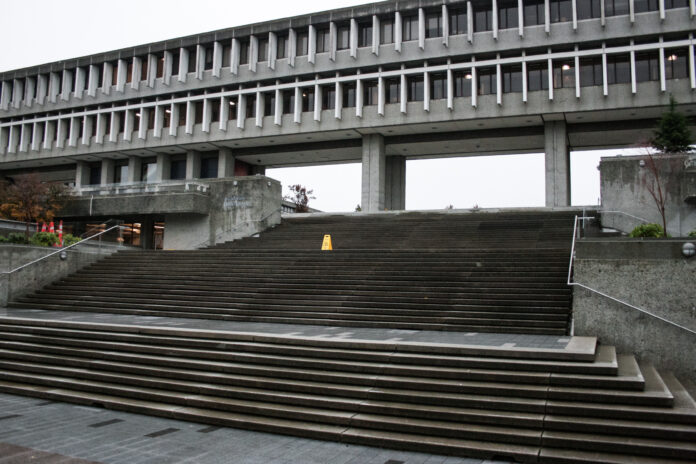
This is a photo of the SFU Burnaby campus. The outdoor staircase into the convocation mall is shown. The sky is dark and cloudy.
PHOTO: Gudrun Wai-Gunnarsson / The Peak

By: Natalie Cooke, News Writer 

On December 12, 2022, the SFU Graduate Student Society (GSS) and Teaching Support Staff Union (TSSU) organized a noise demonstration in response to the funding crisis that many students across North America face. Most graduate students rely on the income they receive from teaching or departmental scholarships. The precarious nature of these jobs does not offer stability to the many graduates paying off student loans. According to Statistics Canada, roughly half of graduate students have student debt upon their graduations.

The Canadian Federation of Students reported in 2019 the average debt for bachelor’s and master’s students was $28,000 and the average debt for doctoral students was $33,000

GSS and TSSU formed the GradCOLA coalition and the noise demonstration initiated the beginning of the GradCOLA campaign, which now has a list of demands for the university. Their demands include offering a minimum of $32,000 to graduate students doing research-based work, freezing tuition increases, paying graduate student research assistants the equivalent to teaching assistants, and increasing SFU’s budget for research and academic work.

Angela Wilson, senior director of media relations and public affairs, said in a statement to The Peak, “We recognize the increasing cost pressures students are facing with inflation, the rising costs of living, and limitations in grant funding. SFU continues to look for opportunities to address student affordability challenges. Student affordability is also something that the university continues to address in partnership with student groups and our government partners.”

Economic pressures and financial issues with housing and access to food have led to poor mental health among students. GradCOLA claims SFU has not properly responded to the crisis and needs to address the rising costs of tuition, campus housing, and establishing funding standards. 

Sina Falakian, an SFU graduate student in the physics department, explained the pressures graduate students face in an interview with The Peak. “All the graduate students who are supporting themselves are facing financial problems. Their income simply is not sufficient to pay for rent and living costs. Therefore, they have to live in cheap rooms that are not safe, have financial stress, have to work outside of the university, and some are facing depression because of these pressures.” Falakian said SFU is not supporting these issues. They added SFU needs to increase student income as living costs increase in Metro Vancouver. 

SFU guarantees all graduate students an income of roughly $25,000, depending on the program. The funding is from a combination of scholarships, teaching assistant positions, and research stipends. Falakian mentioned the GSS and TSSU want to adjust the minimum income for graduate students to $32,000 per year. “This change will help students to have less financial stress and focus more on their research. I would also like to mention the very high cost of living for grad students on the campus which needs to be addressed.” 

For a single person living in Metro Vancouver, the average cost per month is approximately $1,300, not including rent. Further, the average cost of rent is roughly $2,500. The annual cost of living would therefore be $45,600. 

Other GradCOLA demands included removing an artificial cap on student income, where more work should be rewarded with more pay. A study conducted across North America found that 76% of graduate students felt the most challenging part of their degree is the cost of living crisis they face. This forces many students to take on extra work, on top of their research. 

“SFU is one of the few Canadian universities that offers support to international students through bursaries. Over 800+ scholarships, awards and bursaries are offered to undergraduate and graduate students (including international students),” said Wilson. “In 2022, more than $2.6 M was raised to support graduate students and there were 421 grad students who received financial support.” 

Wilson encouraged “SFU students who need support to contact the Financial Aid and Awards Office to discuss available options.” She noted SFU is currently developing and implementing their 2023–2028 Strategic Research Plan, which is working to define “ a university-wide minimum funding level for research graduate students.”

New anthology explores how Vancouver’s support structures can guide us through precarious times

0
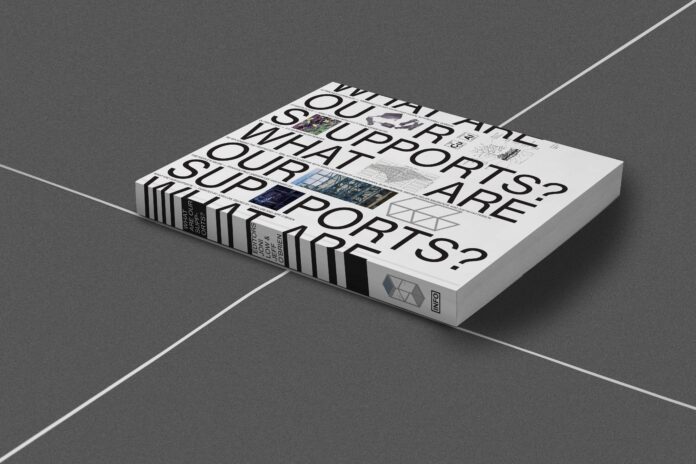
What Are Our Supports? co-edited by Joni Low and Jeff O’Brien, and co-published by Information Office, Doryphore Independent Curators Society, Richmond Art Gallery, and Art Metropole. Book is laying flat on a grey surface.
PHOTO: Information Office

By: Saije Rusimovici, Staff Writer

In the midst of a global pandemic, climate change, and economic instability, What Are Our Supports? provides a unique look at the ways artwork can inspire human connection. The anthology, which was published on January 21, recognizes how support structures offer a sense of solidarity and togetherness through difficult times. Over 20 contributing artists bring attention to social issues: racial injustice, the Vancouver housing crisis, and the climate crisis through local projects designed to invoke a sense of community. Through artists initiatives such as public art installations, commissioned poems, and essays, What Are Our Supports? explores the need for social connection now more than ever before. 

The book features art installations from What Are Our Supports? curated by Low in partnership with Or Gallery and Richmond Art Gallery. The project, which occurred during 2018, was “a series of artists’ projects in public space exploring the supports that bear, create and sustain contexts for artistic production, communities, and collective space.” This book expands on the project to demonstrate how the sensory experience of art can guide us through uncertain times. 

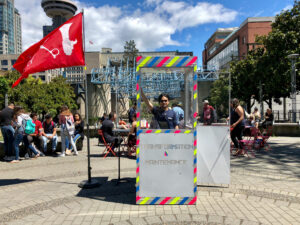
Co-editor Joni Low draws attention to the project H&M: Home Made Home Boothy, created by contributor Germaine Koh. The boothy is an adaptable structure that could either be used as an object or container for several purposes, from an artist’s tool to alternative housing. Koh refers to the container as a threshold between object and building, allowing users to create the spaces they need. Working to open up conversation to address housing needs in unaffordable Vancouver, Koh considers these forms of mutual care necessary for the good of the community, brought to life by artists. For this reason, Koh urges for the recognition of artists as essential workers. 

“The twin crises of the pandemic and racialized violence have highlighted urgent need to cultivate practices of care in our daily lives, from recognizing the indispensable caregiving provided by essential workers, to the rising call of the BLM movement,” Koh quotes British curator Yesomi Umolu, author of The Land Grant: Forest Law.

Germaine Koh and Aron Louis Cohen stand inside Home Made Home Boothy, as part of Afterlives (currency) by Koh, Cohen, and Russell Gordon, 2018.
PHOTO: Photo by Joni Low. Courtesy of the artists.

Another piece that stood out in the book was the art installation, un/settled. It’s a tribute to Breonna Taylor and Black womanhood, featuring the portraiture by Chantal Gibson accompanied by a poem written by SFU’s 2020 writer in residence Otoniya J. Okot Bitek. The depiction of a Black woman clutching an armful of braids, In Lieu of Flowers (for Breonna), celebrates Black creativity during a time of ongoing systemic violence against people of colour. According to SFU News, having this art piece positioned in the windows of the Belzberg Library at SFU’s Vancouver campus in 2021 was meant to engage the local community in a meaningful way in the midst of the COVID-19 pandemic. 

Low said that when it comes to activism, there is not necessarily a “nuts and bolts, how to, or policy manual of answers.” According to Low, the drive for social change begins with our senses. Art allows us to “tune in,” using our intuition to figure out what issues are important to us, then move to take action. We must integrate this sensorial agency into everyday practice as a guide to determine what is important to us, and how to support.

What Are Our Supports? is a beautiful compilation of stories told through different modalities of art. Art inspires not only a shared connection to humanity, but opens our eyes, minds, and hearts to our community.   

Order What Are Our Supports here.

Spirit of British Columbia flips out for Instagram flop outs

0
A stock photo of a sinking ship with a frowny face doodled on top.
PHOTO: Isaac Struna / Unsplash ILLUSTRATION: Kelly Chia / The Peak

By: Clarence Ndabahwerize, Staff Writer

SAANICH Shortly after departing Swartz Bay at 7:00 p.m., the Spirit of British Columbia put out a distress call signalling that it was sinking. Rescue boats were on the scene shortly after, and no fatalities were reported. Questions were raised however, about how this had happened. Interviews following multiple reports revealed that the suspicious scuffle on the sun deck turned out to be passengers running from port to starboard seeking the perfect sunset picture “for the ‘gram’.” To the North was the Georgia Strait and Gulf Islands, and to the South was the alluring and towering Mount Baker. Passengers on the sun deck simply wanted both pictures, and in the process, became akin to wild Canadian geese. 

Jean-Jacques Rousseau, from Saguenay, Qué, was just eating his unholy combination of clam chowder and poutine when it happened. “They were like a swarm of bees, the photographs being the queen they paid worship to! J’ai le feu au cul!” he said. Calls from the bridge to stop all this hubbub were ignored. When the captain and stewards tried to calm the situation themselves, they too were struck by the trance and joined in on the fun. As the situation evolved, the merry folks took turns gatekeeping the sun deck as everyone clamoured for the perfect picture. No one is quite sure if the frenzy happened on the lower decks, but if the ferry capsized, surely, nothing can be ruled out! Transport Canada, Health Canada, the RCMP, and the Umbrella Corporation will soon hold a joint press conference to reveal more information.

One of the standout stories of this treacherous evening was the connection between human and animalkind (other animals, that is)! Especially when a few passengers from Nova Scotia — whose connection with the sea is notoriously remarkable — summoned a few orcas to graciously take them ashore. 

Residents of Swartz Bay have unfortunately been left to deal with several car alarms still going off aboard the sunken vessel. They have taken to putting out ads in the Times Colonist to get their owners to scuba dive, or something. They of course proceed to disable the alarms by locking their vehicles, which is of course the only thing you can do. 

Horoscopes: January 9–13

0
An illustration of a girl with long flowing hair. Astrological signs and stars shine around her.
ILLUSTRATION: Marissa Ouyang / The Peak

By: Hannah Kazemi, Staff Writer, extremely judgemental

Aries
This is your year to be AGGRESSIVE, Aries. Start using periods in those texts and assert your opinions without cushioning it with uncomfortable laughter because you are unsure. You are always right! The Stars see you, and are behind you 100%! Punch a cloud to display your newfound confidence.

Taurus
It’s time to get real, Taurus. Stop promising yourself you’ll actually make decisions when your friends ask what you want to eat. May we suggest resolving to get outside more? Touching grass might be good for your brain cells and inspire you to become decisive.

Gemini
For once in your life you’ve set a realistic goal: stop spending all your money on Chipotle. But fear not! You’ll likely spend that money on sushi instead, putting to use any dollars that might have had a chance at being saved. You’re all about maximizing your money, Gemini. The Stars aren’t sure if you understand how saving money actually works, but it’s still adorable to watch.

Cancer
You made a resolution as soon as the clock struck midnight on January 1, but you enjoyed yourself too much and can’t remember what it is. Happy days, Cancer!

Leo
You spent New Year’s Eve wracking your brain for a resolution that you’ll actually be able to stick to, and you finally landed on eating less cheese for some fucking reason. The Stars regret to inform you that this resolution is not advised due to the fact that cheese is delicious, and without it, you’ll die.

Virgo
You’ve never been inspired to set a resolution until this year. You decided to finally cancel your gym membership and start walking more. You realized that the money you’ve been spending on the gym could be spent walking around the mall shopping for jewelry you don’t need instead.

Libra
You’re stumped on what your goal should be and it’s the middle of January already, which means 2023 is off to a bad start and you still can’t think of anything and, and, and . . . My dear Libra. It’s all good! You’ll find your goal as you go.

Scorpio
Get your shit together and admit that setting a goal to “drink more water each day” just isn’t going to happen. Unless iced coffee counts towards hydration . . . In that case, you’ve already well surpassed your goal. Go you, Scorpio!

Sagittarius
Your resolution is to “treat yourself more,” which the Stars assume means ordering a macchiato whenever you want without feeling guilty and watching more shitty reality TV. Bravo has a new number one fan and it’s you, babe!

Capricorn
You stopped making resolutions years ago because you realized that they’re bullshit! Good for you.

Aquarius
You set a resolution to put yourself out there more and give dating apps a shot. Unfortunately this means that you have to struggle bus through “hey whats up” and “not much hbu” convos until your head explodes. The Stars believe in you, Aquarius. Just keep trying, I guess?

Pisces
Every year, your resolution is to slay each day, and every year you meet that goal. You never fail to let yourself down, even if the goal can’t actually be measured and what constitutes a “slay” isn’t clear. Like, at all. But the Stars consider that a win anyways. Keep slaying, babe!