By: Petra Chase, Features Editor
Content warning: mentions of sexual violence.
While the turn of 2026 triggered widespread 2016 nostalgia, this period was, rather, a harrowing reminder of genocide and ongoing struggle for the Rohingya community, the world’s largest stateless ethnic group. In late 2016, Myanmar’s national military began its intensified ethnic cleansing of the Indigenous Rohingya population, forcing nearly one million Rohingya into neighbouring Bangladesh. Today, many remain there, at the largest, most densely-populated refugee camp in the world. While humanitarian aid is unreliable, confined residents have developed informal economies to achieve basic needs, like food, shelter, and education. Many others seek status, livelihood, and belonging in other precarious environments around the globe. The smallest few have been able to resettle in other countries — there are around 1,000 in Canada.
But 2026 also rang in hope for a path towards justice. In January, Rohingya survivors testified at the International Criminal Court to convict Myanmar of genocide. Yasmin Ullah is a BC-based Rohingya human rights activist, poet, and author who served as part of the Rohingya representation. She’s been a crucial force in the case since it was filed in 2019. Results await. In the fall, The Peak had the privilege of meeting Ullah at a local coffee shop for an interview.
Introducing herself, she says the “artivist” label suits her well. “Part of it is rebuilding and preservation of culture, but the other side is expressing pain and agony of surviving a genocide and having to witness your people going through it.”
In addition to poetry, Ullah has also published a children’s book. Hafsa and the Magical Ring tells the story of a young Rohingya girl living in a refugee camp in Bangladesh. Hafsa fondly recalls memories from her homeland, like her mom’s weaving of the region’s bountiful screw-pine into toys, baskets, and other items. Her mother tells Hafsa and her brother a Rohingya kyssa (folktale) passed down from ancestors, set in ancient Arakan. Located in Rakhine State in Myanmar, Arakan has a long, rich history of cultural exchange.
Ullah’s childhood has similarities with Hafsa’s. In 1995, at three years old, she fled from Arakan with her mother. “She decided to leave because she wanted my life to be different to hers,” Ullah says. She explains that the genocide has been ongoing since 1942. “The ‘90s were marked by many different waves of violence, and that displaced about 200,000.”
For Ullah’s mother, the decision to leave was based on witnessing her society “regressing into protection mode.” Rohingyas were systematically stripped of citizenship in 1982, leading to apartheid conditions. The constant presence of military men meant “women were pushed further into homes because that was supposedly safer for them to not be seen or visible. But that was only riling up or enabling fuel for the genocidal campaign.”
She continues, “[The military] wanted women to be kept as property, which was not the case pre-genocide for the Rohingya people.” Anti-Rohingya sentiments, especially peddled by Buddhist nationalist extremists, are largely fueled by racism and Islamophobia. “They have been able to mobilize the entire country against us because they have more resources, and they are able to pivot and position themselves as a protector against this ‘illegal alien outsider.’”
As a baby, Ullah was carried by her mother across waters and jungle, safe from threatening military men on a boat. They crossed into Northern Thailand where Ullah and her family lived for 16 years without status, constantly evading police. “Some countries don’t even have a language for refugees,” she says, especially in Southeast Asia. “They categorized us as illegal migrants.” Despite there being 150,000 refugees from Myanmar living along the Thai border, the idea of asylum isn’t often understood. Several ethnic groups indigenous to Myanmar have lived there in limbo for decades, evading armed conflict, basic human rights violations, and ethnic cleansing operations in their homelands.
It was due to her parents’ sheer innovation that they were able to make a livelihood despite not having access to legal employment, Ullah was able to attend school, and she was sponsored to settle in BC in 2011.
While intuitively Ullah always wanted to return home, she was initially reluctant to embrace her heritage. Growing up as a refugee, she learned to speak Thai and not acknowledge her Rohingya identity. “Being displaced over and over again has a variety of negative impacts on the psyche,” she explains. Genocidal narratives were another barrier, with leading Myanmar Buddhist scholars claiming the Rohingya, and other ethnic minorities, aren’t actually indigenous. “I can’t trace my ancestors to anywhere else. Am I a mushroom?” she laughs, describing having to encounter this disinformation repeatedly as an activist, now with steadfastness. “Myanmar actually has not existed before the Rohingya.”
Ullah recalls learning of the 2016–17 massacres and mass exodus in her own village as a turning point: “I remember breaking down and sobbing for, like, four days straight. I still had to go to work!” It hit her that if she wanted to return to her homeland, she had to take an active role in fighting the failures of the “international protection mechanism.” She got involved in advocacy; speaking with journalists, organizing protests, and joining the Rohingya Human Rights Network, where she was president for some time. In 2018, Canada declared Myanmar’s actions as genocide and announced thanks to their lobbying. Ullah was also involved in the US Holocaust Memorial Museum, which led to the US’ statement in 2021.
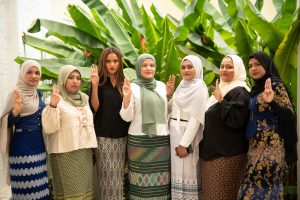
Now, Ullah studies political science, works in a dental office, and is executive director of Rohingya Maìyafuìnor (Women) Collaborative Network, a Rohingya women-led human rights organization advocating for Rohingya refugees across the board — teaching Rohingya who they are, and where they’re from. Connected across the globe, they have raised funds to travel to Rohingya communities abroad, bringing humanitarian aid, political advocacy, empowerment, and community. The team continues to grow, enlisting younger generations of women who Ullah sees herself passing the baton to eventually.
“There’s definitely a gap in the Rohingya community in terms of equal representation,” the most basic principle, says Ullah. She explains there is resistance within the community for women to take leadership roles, despite survivors of the 2017 crackdown being majority women and children.
In the face of oppression, “the version of faith that [many Rohingya have turned to] is very hostile to women,” Ullah explains. She says that the increasing use of face coverings and burqas are not always forced onto women, but “reclaimed as a protection mechanism” so that they could participate in society and speak freely without being identified or targeted. Rohingya women used to wear decorative belt buckles and bangles. “That tells me women were visible, in ways that they could actually express themselves.” Grandmothers have also always had high status in communities, and are sought for consultation and knowledge keeping.
Ullah believes women need to be at the centre of the movement, to combat sexism and high rates of sexual violence. Trans women and other queer Rohingyas also “tend to be on the receiving end of the worst kind of treatments,” she emphasizes.
“After 16 years of living as a refugee with no protection, being detained as a refugee child for having no legal status, I can now sip coffee and eat a cookie in peace after a long day of advocacy for other Rohingya children who have no one to protect them,” Ullah wrote in a recent social media video. While dehumanization campaigns against Rohingya persist online, the group uses the handle @rohingyawomencollaborative on Instagram and TikTok to combat disinformation and stereotypes, and spread awareness for the cause. And of course, immortalizing hate comments of online trolls — the account puts their comments on blast.
“Genocide does not end with massacre. It ends with a narrative — that a group of people is so unlovable, so much of a villain, that they need to be eradicated. And there are so many justifications that will help bring that narrative together, into a consciousness,” says Ullah. The same story that was used in Myanmar, demonizing a people as less worthy and hostile, “is being used in other parts of Southeast Asia, and India, and Bangladesh.” She notes that some of this stems from the frustration of not having enough funding and resources to support the Rohingya, especially in Bangladesh. However, the blame is misdirected. “When politicians need a political boogeyman, they point to Rohingya, and there comes a moral panic.”
Most recently, the Rohingya Women Collaborative flagged a petition in Malaysia asking the government to expel Rohingya refugees from the country, for supposedly taking jobs and causing crime. It received about 150,000 signatures in five days. “People do not understand that Rohingya are fleeing a real genocide. They would often compare us to Palestinians and say, ‘Palestinians stay and fight.’” Nevermind the thousands of Rohingyas who have been killed on ancestral land, where they are currently facing a targeted hunger crisis. Regardless, whether or not a refugee stays or flees, everyone deserves basic human rights. Xenophobic nationals refer to Rohingyas as “too demanding” for doing so. This is often after treacherous sea journeys from overcrowded camps and hope to eventually resettle legally elsewhere.
She continues, “People often call the Rohingya out as people who don’t integrate. I want to tell them, ‘How do you think we’ve survived all this time?’” Most of the team speak one or two Southeast Asian languages, on top of the native language and English, evidence of how much harder they’ve had to work to survive. “I only speak three!” Ullah says, as if that’s a modest amount.
What keeps Ullah motivated most is the Rohingya sisterhood she’s built, and the “unbreakable human spirit” she sees in her community and people.
June 20 is World Refugee Day. Donate to help support food and education for Rohingya refugees at gofundme.com/f/emergency-relief-for-rohingya. Watch two short documentary videos of the Rohingya Women’s Collaborative on the YouTube channel Altsean Burma, including “Resisting Hate” and “The Journey of Love,” their trip to a refugee camp in Indonesia.