Home Blog Page 224

No, queer curriculum in schools isn’t “grooming” students

0
PHOTO: Gudrun Wai-Gunnarsson / The Peak

By: Bhavana Kaushik, SFU Student

Despite years of progress on LGBTQIA2S+ rights in Canada, the last couple of years have seen a resurgence in naked bigotry towards queer people. One of the most dangerous tactics used to demonize the community has been to reduce teachers to “groomers,” with bigots condemning the involvement of queer narratives in the classroom as being tantamount to pedophilia. 

Before we talk about such an important topic, we need to establish a legitimate definition of grooming. According to a 2001 Criminal Code provision, “preparatory” steps taken to “groom” children under 14 is considered a criminal offence, even before an actual sexual crime is committed or attempted. Grooming is when a person builds a relationship with a child for the purpose of future abuse. It’s a real phenomenon that, especially online, has been on the rise in Canada.

What grooming is not, is education that includes the mere mention of queer people. 

In the past few years, the idea that issues around gender and sexuality shouldn’t be taught in school has been gaining steam in far-right circles. In Florida, the so-called “don’t say gay” bill forbids educators from teaching anything related to sexual orientation or gender identity in kindergarten through third grade. Florida’s Republican Governor and conservative allies have accused opponents of the bill of being “groomers,” themselves. 

Canadians aren’t immune from this demonization of queer narratives in schools; during the 2022 municipal elections in BC, the Parents’ Voice party ran, partly, on a platform opposing the inclusion of LGBTQIA2S+ topics in school curriculum. During that election, three of the party’s 28 candidates were elected to school boards, where they now serve, contributing to critical decisions about inclusive curriculum. 

An inclusive curriculum is critically important. As of 2021, 4% of Canadians aged 15 and older identify as members of the LGBTQIA2S+ community. Growing up, that population having a curriculum related to sexual orientation and gender equality will help them feel safer and valued in their learning environment. It also helps students outside of the queer community. Students who grow up learning about what it’s like to be a member of the LGBTQIA2S+ community do a better job at being there for students and adults who are different from them. And early, age-appropriate sex-ed discussions make all students safer from actual grooming. 

The LGBTQIA2S+ community and its allies have fought for decades to create a safe space for queer Canadians. But for this to continue, any notion of a link between an inclusive curriculum and the terrible practice of “grooming” has to be shut down before it causes more damage to the LGBTQIA2S+ community.


Connect the Lingo

0
Illustration of a character connecting the words “connect the” and “lingo” with a pencil.
ILLUSTRATION: Alyssa Umbal / The Peak

By: Natalie Cooke, News Writer

Word Bank: goalkeeper, airball, shank, 19th hole, double dribble, muff, cut shot, bunt, meet, nutmeg

  1. When a player stops dribbling and then begins again, or dribbles the basketball with two hands, they commit a ________ dribble.
  2. This soccer player usually wears a different colour than their teammates on the field.
  3. Time to relax and grab some lunch at the ________. 
  4. When a football player makes contact with the football without successfully maintaining possession of it. 
  5. When a softball batter chooses to tap the ball instead of swing.
  6. A volleyball attack where the player spikes the ball “at an extreme angle across the court, making it nearly parallel with the net.” ________
  7. The libero received the serve but their pass was a  ________. The ball flew out of bounds!
  8. You ________ an opponent in soccer when you kick the ball through their legs, instead of trying to go around them.
  9. She tried to make a three-point shot, but instead hit an ________. 
  10.  Another word for a swim competition.


Answer Key

  1. double
  2. goalkeeper
  3. 19th hole
  4. muff 
  5. bunt 
  6. cut shot 
  7. shank 
  8. nutmeg 
  9. airball 
  10.  meet

Public universities should be free

0
Letter blocks spelling “school”
PHOTO: Oleksandr Pidvalnyi / Pexels

By: Victor Tran, SFU Student

In Canada, the cost of higher education has become a topic of increasing concern. In response, the question of whether Canadians have the right to access higher education has come to the forefront. In recognition of universities’ fantastic benefits to society, it’s time to eliminate their greatest barrier to higher learning: tuition.  

Education is one of the best strategies for raising people out of poverty. Reducing the cost burden associated with higher education is a critical part of levelling the playing field among students from all income levels

In Canada, lower-income teenagers are less inclined to attend universities. According to a report by Statistics Canada, only half of 19-year-olds from low-income families’ decided to participate in post-secondary education, compared to almost 80% from higher-income families. 

This trend is a barrier to financial stability. Statistics Canada reports that 73.3% of people with a bachelor’s degree had a job in 2022, while only 53.7% of those with just a high school diploma were employed. This leads to massive differences in average income over a long-term period. By age 35, Canadian men with a bachelor’s degree are earning an annual average of $64,000, compared to $44,000 for their high school graduate counterparts. At age 35, Canadian women with bachelor’s degrees are earning an annual average of $37,000, compared to just $20,000 for high school graduates. Removing the financial burden posed by tuition will increase the attendance rate among all citizens and help more Canadians break out of a cycle of poverty. 

Austria is a prime example of the benefits of free public universities. In 2008, the Austrian government erased all education fees for EU citizens; by 2015, the university attendance rate reached 81%, from 51% before the education reform. The resulting increase in bachelor’s degree holders should contribute significantly to the economy. The same is the case for other regions; the University of Minnesota’s graduates contribute $8.6 billion to annual GDP, while the University of Illinois’ graduates contribute $9.5 billion. In 2008, Austria’s GDP reached $432 billion — a 28% increase within 2 years of providing free education. 

Before we get too enthusiastic, we have to consider the potential pitfalls, starting with the problem of paying for free public schools. Free public school is not “free” the cost is borne by the taxpayer. Germany,  which provides free university education for national and international students, has a 49.4% tax wedge, which means an average worker in Germany has to give up half of their income. Canada, on the other hand, has a tax wedge of only 31.4% in comparison. 

It’s not easy to raise taxes as a politician. To fund free public education, the government could face enormous backlash when raising the tax bracket. But public education pays back. It’s one of the best investments a country can make, fueling competition, innovation, and economic growth. An educated population is a benefit, too. University graduates are more likely to vote and less likely to subscribe to conspiracy theories. It’s a great investment, but we have to be patient. 

Free higher education in Canada might seem far-fetched despite its outstanding benefits, but other countries are making it work. It’s time for Canada to join their ranks and prioritize its citizens’ development. 

Vaccine misinformation is alive and well — and more perverse than ever

0
ILLUSTRATION: Raissa Sourabh / The Peak

By: Robert Sim, SFU Student

The last year has seen a terrible new trend in misinformation; the spreading of false news stories tying sudden deaths among young people to vaccine side effects. It’s perverse and dangerous.

COVID-19 vaccines are amazing. They were developed at lightspeed, tested by researchers all over the world, and are effective at protecting people from severe COVID-19. They’re also associated with a mild rise in the risk of myocarditis, which, in rare cases, can result in death. It’s most likely to occur in men aged 1825, though out of every 100,000 who receive the vaccine, up to two men are likely to be affected. Ironically, COVID-19 is more likely to produce myocarditis than the vaccine. 

It’s particularly prevalent when an athlete dies, seemingly suddenly. Conservative activists seem to love these events. On January 17th, 2023, Buffalo Bills safety Damar Hamlin suffered a sudden cardiac arrest. The far-right leaped on the incident. Fox Entertainment host Tucker Carlson noted that “young athletes are collapsing at alarming rates since COVID-19 vaccines became widely available,” according to NPR. Other far-right figures advanced the same narratives. Actor Kevin Sorbo directly attributed Hamlin’s cardiac event to the vaccine, tweeting, “it’s the jab.”

This isn’t new, either. And it’s not just the pundits. Republican Senator Ron Johnson of Wisconsin became an early adopter of the narrative last year, saying, “We’ve heard story after story. I mean, all these athletes dropping dead on the field, but we’re supposed to ignore that.” Johnson, who was recently re-elected, has been a long-time anti-vaxxer

Myocarditis can lead to cardiac arrest and technically, the COVID-19 vaccine can — in very rare cases — cause sudden cardiac arrest. However, in 2021, the CDC found “that myocarditis occurs more frequently among COVID-19 patients and that there is a 16 times higher risk of myocarditis among individuals with COVID-19.”

But anti-vaxxers haven’t let those numbers sway them. 

This conservative movement, which seeks to generate awareness of Sudden Adult Death Syndrome (or SADS), is perverse. For starters, it’s hypocritical to watch those who were up in arms about a subreddit tracking the deaths of COVID-deniers suddenly turn around and exploit the health emergencies of others for their political platform. But more importantly, the lie is damaging to public discourse and safety. Fewer and fewer Canadians are feeling any zeal for vaccination and boosters, despite COVID-19 still being very much a threat.  

There isn’t a plague of vaccine victims. There just aren’t. But spreading these stories keeps the doubtful from getting vaccinated. The data is in; vaccines reduce the chance of getting COVID-19, and present little risk to one’s health. But that data isn’t reaching everyone. In some circles, discussion of conspiracies like SADS is sowing more doubt in vaccines, despite those claims having been fact-checked, again, and again, and again

Anti-vaxxers leaping to claim strangers’ medical emergencies as evidence of their conspiracies is a new low. In response, we need to adopt the practice of spreading valid strategies for public health as an ongoing project by everyone who accepts the science behind vaccines; we need to spend just as much time and energy sharing and repeating good information as anti-vaxxers do when they spread flagrant falsehoods.

Dr. Andrea Reid discusses Indigenous fisheries approaches

0
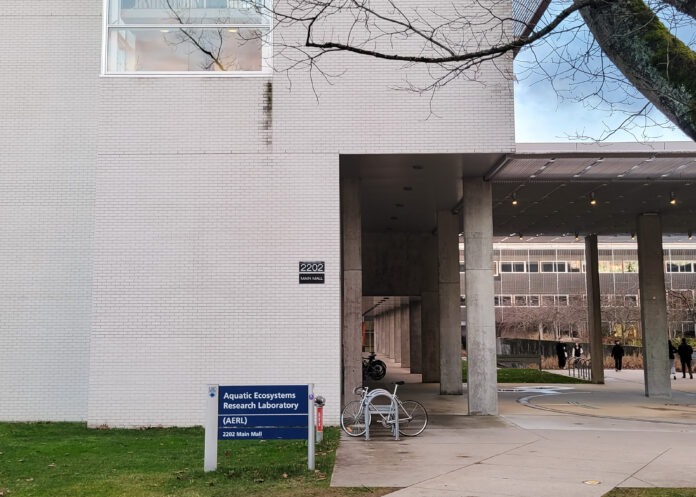
This is a photo of the outside of the Institute of Fisheries and Oceans at the University of British Columbia.
PHOTO: Amirul Anirban / The Peak

By: C Icart, Staff Writer

Dr. Andrea Reid launched and has been leading the Centre for Indigenous Fisheries at the University of British Columbia for the past two years. She took time to have a virtual conversation with the Georgia Straight Alliance. The Peak attended the talk, where she spoke about the various roles of fisheries and Indigenous fisheries approaches for sustainable fishing solutions. 

Reid is a citizen of the Nisga’a nation and opened her talk in Nisga’a, a language she is currently learning. She shared what drew her to this topic: her love of Lisims. Lisims is the Nisga’a name for the Nass river in northern British Columbia — she described it as the “home of my nation.” 

Reid used the figure of the gramophone to symbolize Indigenous resistance and resurgence. She saw one in the Nisga’a museum in Laxgalts’ap in the living rivers exhibit. When she inquired about it, she was told when the Canadian government banned potlatches from 1884 to 1951, “Our people would gather in homes or in halls under the auspices of gathering for a Bible study and they would loudly play hymns over the gramophone while they would quietly go about their business and discuss the particulars of the fishing plan.” 

Fishing in Lisims has been important to the Nisga’a nation since time immemorial, according to Dr. Reid. “Fisheries are so much more than just food [ . . . ] They are also our livelihoods, economies. They sustain our health and well-being. They are foundational to our cultures, our peoplehood, our identities.” 

The Indigenous fisheries scientist has joined forces with Rena Priest, Amy Romer, and Lauren Eckert. “Together, we’ve been tackling a long-term collaborative project called Fish Outlaws with a grant from the National Geographic Society. It seeks to tell stories that, to us, are really symptomatic of this historical amnesia coupled with the still-existing and deeply racist policies.”

Colonial forces introduced unsustainable fishing methods while creating legislation prohibiting Indigenous nations from fishing. The Federal Fisheries Act, first introduced in 1857, is one of the oldest pieces of Canadian legislation to exist and has repeatedly been used by the Department of Fisheries to argue “that Aboriginal rights to fish had been extinguished,” according to Dr. Reid.

Reid felt it is important to have “a remembering of so-called ‘outlaw fishing’ as well as a remembering of what Indigenous fisheries are and could be for a more socially and ecologically just future.” Fish Outlaws is a multimedia project “documenting the criminalization and dispossession of Indigenous fisheries around the Salish Sea.” The team draws on archival research and community consultation to uncover these stories. 

During her post doctoral research, Reid interviewed close to 50 elders “to hear from them how access to fishing and thereby their relationships with salmon have changed and continue to change. And to learn about fishing ethics that for long have kept us in good relations with salmon.” 

Many of the fishing methods used by Indigenous fishers and subsequently outlawed because of their misuse by colonial forces are now being brought back. For instance, “Fish traps offer a prime example of the real potential of gear misuse.” Salmon canning corporations adopted the highly efficient practice and used it to overharvest since the late 1800s. “This eventually led to traps being banned from Oregon all the way up to Alaska throughout the mid 1900s. But now we see colonial governments turning towards reviving these traps and evaluating the feasibility of them for selective harvest,” said Reid.  

“As we watch this tremendous uptick in interest in Indigenous ways of knowing and being here where many of us now live. We’re beginning to see greater acceptance for and interest in these methods and approaches.” 

However, Reid noted before bringing these methods back, it is important to consider the specific places, contexts, and ecological changes exacerbated by colonization. The conditions are not the same as when these methods were first implemented. Adapting to new situations may include developing new indicators to know when and where to fish. She encouraged the resurgence of Indigenous fisheries’ and the prioritization of passing down knowledge from generation to generation. 

For more information on Dr. Reid’s work visit the Centre for Indigenous Fisheries’ website at www.cif.fish.

Top ten ways to receive sweet, sweet academic validation

0
Very calm, very cool. Nothing wrong here. Illustration: Siloam Yeung / The Peak

By: Hana Hoffman, SFU Student

  1. Go around campus on Halloween week

Well, if you want something sweet, then get it on Halloween week. No matter where your grades are at, you’ll find sweet rewards everywhere. Who cares if it’s unrelated to academics? If you can satisfy your sweet tooth, then your job is done.

2. Showing up to class is already a W

There are so many things that could’ve stopped you . . . sleeping through your alarm, missing your bus, realizing your assignment failed to upload on Canvas the night before, or simply lacking the motivation to go. By attending class, you are proving how responsible you are as a young adult. This is something to be proud of.

3. Lower your expectations

This is probably the most valuable life hack. Why do people feel the need to achieve success at such a high level when they can achieve success at a low level? You save time, energy, effort, coffee, phone battery . . . you name it. Just make an easy goal and reach it! Grab the “meeting expectations” line on the grade spectrum and drag it wherever you want. In the immortal words of DJ Snake, “Get low.”

4. Lie about your grades

Let’s say you and your classmates are chatting and you tell them you got 98% on your final paper. The benefits! They will be so impressed and compliment you, wishing they could be as successful as you. This will (fakely) boost your self-esteem. The risks! What if the prof announces that the highest mark in the class was 95%? What if you leave your laptop unattended for a minute and your classmate sees your mark? What if you’re a bad liar? They’ll know you’re lying. Oh well! Then you’ll learn to grow as a person, and all is good!

5. Present yourself professionally

By having a professional appearance every day, your instructors and peers will assume you’re a highly qualified student. You know the kind of students who dress maturely, sit at the front of every class to interact with the prof more, always prepare a ton of notes, and walk around campus carrying a textbook or two. Be like them and maybe that’ll help! You know what they say: fake it until you make a Beedie student proud.

6. Change your meaning of academic validation

I don’t know what academic validation means to you. Maybe it means receiving academic-related compliments, feeling proud of yourself, or simply being enrolled as an SFU student and having an ID card for proof. Or maybe it’s just a popularity contest to see who’s the most favourited in the class. I advise you to tweak the definition of sweet academic validation and make it your own. 

7. Show progression — start bad, end great

If your effort level remains the same throughout the semester, no one will notice your progression. However, if you start the term as a problematic student who struggles with school and later show how smart you actually are, then everyone will be surprised and impressed by your fast and incredible progress. We all love a comeback story!

8. DIY validation

Here’s an at-home DIY validation grabbing method: Ask your trusted siblings if they would say great things about your work in exchange for chocolate. This fake validation will eventually give you the courage to push through the schoolwork!

9. Just be a hardworking individual and gain respect from that

Look, if people notice that you’re at least trying to get the answers right in class and attending office hours to get extra help, they will have respect for you no matter where your grades are at. As long as you haven’t been a jerk during your time at SFU.

  1. Get outstanding grades

In reality, receiving sweet, sweet academic validation is not complicated. You only need these five words: Ace every exam and assignment. Then you’re all set! Stop wasting time looking for ways to avoid work. Instead, study harder! Clearly, your efforts are what you’ve been missing all along! [Runs away into sweet validation valley.]

Cross country scoring explained

0
Photo of runners in the midst of a cross country race.
PHOTO: Leah Hetteberg / Unsplash

By: Simran Sarai, Sports Writer

Ah, cross country! The sport of running as fast as you can over multiple kilometres of outdoor terrain, navigating massive puddles, treacherous hills, and the ever-present feeling of your legs being on fire. It’s a sport loved by and competed in by athletes worldwide. High-stakes cross country competitions exist at every level, from elementary school park races to world championships attended by the best of the best.

While you’d assume the rules for a sport that’s essentially an ultra-competitive version of a children’s foot race would be pretty straightforward, cross country throws some scoring curve balls. Ironic, because there are no balls involved. Unless we talk about the balls of your feet, anyway, I digress . . .  

Albeit an individual sport, there’s a very strong team component to cross country. In addition to receiving awards depending on the place they finish, athletes receive points that contribute to their team’s final score. The number of athletes that can make up a team varies, but it’s very common for teams to be made up of seven runners, with the first five finishers from each team having their points counted towards the team’s total. 

Unlike other team sports where the goal is to score as many points as possible, cross country is much more like golf, where the team with the lowest number of points wins. The better a runner finishes, the fewer points they earn. For example, a first-place finisher will earn one point, a second-place finisher will earn two points, and so on.

Although the points of the sixth and seventh runners are not counted towards a team’s total, their performance on the course is still important. If the sixth and seventh runners on a team place better than the athletes from opposing teams, they increase the number of points that the other teams receive. It’s important to note that the scoring rules for each competition will vary slightly depending on the region and level of competition. However, teams will always be striving to earn the lowest number of points in order to declare victory. 

Voilà! Just like that, you are now an expert on how cross country scoring works. If this brief dive into the world of cross country has you wanting more, you’ll be excited to know that the 2023 World Athletics Cross Country Championships will take place on February 18 in Bathurst, Australia. Tune in to watch the world’s best compete!

Is AI painting a bright or bleak future?

0
ILLUSTRATION: Hailey Gil / The Peak

By: Daniel Salcedo Rubio

Artificial intelligence (AI) has the potential to revolutionize many industries, from healthcare to finance, and yes, even art. However, as with any new technology, there are also concerns about its potential misuse. There are many present ethical issues on the use of AI, from copyright infringement to repetition of human bias and discrimination, and even privacy. 

AI is here to stay, it’s going to remove trivial and repetitive tasks and will automate activities from many different industries. For example, AI-generated code can be used to automate the process of software development, making it faster and more efficient. Similarly, AI has the potential to analyze images and improve the accuracy of clinical diagnosis. In the entertainment industry, AI can be used to create realistic special effects or upscale image quality in movies and video games. 

Not only has AI revolutionized consumer-related industries, but it is also starting to aid urbanism, ecological conservation efforts, and even everyday life. AI can be used in transportation systems to improve them in a variety of ways. AI can be used to optimize logistics and delivery routes to improve efficiency and reduce costs. In environmental monitoring and conservation, AI can be used to monitor and track whole ecosystems, including wildlife, climate, and natural resources. This data can then be used to identify patterns and trends and make informed decisions about the conservation and management of natural resources.

However, there are also concerns about the use of AI-generated products in these industries. One of the biggest concerns is the potential for AI to replace human jobs. This is especially true in industries where AI-generated products can be used to automate tasks that were previously done by humans. For example, if AI-generated code can be used to write software, it could lead to job loss for software developers. This isn’t something far off in a post-apocalyptic world, these issues are currently happening. In my previous workplace, a whole job class was replaced by AI automation. The job included documentation review and archiving, and became automated by the company’s AI. Some of the people holding that position were relocated to different departments of the company, many were laid off.

Another concern related to AI-generated products is the potential for misuse. For example, AI-generated images can be used to create deep fake videos, which can be used to spread misinformation or propaganda. Just last year a deep fake video of Ukraine President Zelenskyy was spread on social media, urging Ukrainians to surrender. Similarly, AI-generated papers can be used to create fake research or plagiarize the work of others. Another example — probably one of the most debated at the moment — are AI-generated images and the use of AI-generated art, specifically the use of artists copyrighted material for AI training without proper permission or compensation. Artists and photographers have expressed concern that their work could be used without their permission or proper credit. This could lead to the devaluation of their work and the erosion of their rights as creators.

AI is also promoted as an alternative for certain processes to remove human bias. For example, screening through applicants’ resumes could potentially level the playing field, yet, AI has been shown to replicate human biases, and even more dangerously, some might even look at them behind a fake lens of scientific objectivity.

These concerns make it clear that there is a need for regulation of the use of AI and AI-generated products. This regulation should aim to protect the intellectual property of individuals, and increase transparency of decision and product making. 

Possible solutions include requiring companies and organizations that use AI-related products to disclose their use of AI and take accountability for any potential misuse. This could include requirements for transparency, such as disclosing the source of AI-generated images, papers, and even decision-making processes where AI is involved. It could also include measures to prevent the use of AI-generated products for nefarious purposes, such as deepfake videos and copyright infringement. If the use of AI might replace human-managed jobs, we need to ensure there’s a way to provide a secure income for those affected. 

The moment to set up guidelines and regulations for the fair use of AI is now. Governments and organizations should establish adequate, well thought guidelines for the deployment and use of AI. From setting-up standards that AI systems must meet in order to ensure the safety, reliability, and transparency of AI systems to even developing auditing and testing plans from independent oversight bodies to ensure such guidelines and regulations are being upheld. While these tasks will heavily rely on the government and other regulatory bodies, we should ensure public participation and education on AI systems. AI is here to stay, and whether we fail to successfully adapt to its arrival will probably lay in our hands and the actions of regulatory agencies and legislators.

SFU announces “SF-uper BFF” app to curb anti-social reputation

0
A photo of two students in blazers holding up phones showing the Bumble app.
PHOTO: Manmeet Sagri / The Peak

By: Hannah Kazemi, Staff Writer

SFU is known to be a commuter school with a reputation for being a difficult place to make friends. In an attempt to improve this reputation, SFU admin has announced the launch of a new app. The Peak sat down with SFU president Joy Johnson for an interview to learn more.

The Peak: What inspired SFU to build and launch this app?

Joy Johnson: Here at SFU, we pride ourselves on our vibrant campus community. We’re aware of our reputation that our students are “anti-social” — which we don’t personally agree with since SFU was found to be Canada’s most “engaged” university by The Peak — and hope that by connecting with the youth using a method they are familiar with, we can help foster and facilitate connections within our thriving and bustling campus community.

P: Give us the rundown of the app’s basic functionality, special features, and what SFU hopes students gain from using it.

JJ: SFU wants to dispel any rumours that it is difficult to make friends and long-lasting connections on campus. The app basically looks like the interface of the popular dating app called Hinge,” wherein students will upload fun pictures of themselves along with answers to questions that are meant to inspire conversation. Some of the prompts include, “My favourite study spot is . . .”, “I chose SFU because . . .”, and, “My best SFU memory is . . .” We encourage photos of students meandering across campus, studying, and participating in extracurricular activities. Students can also “Give a Gold Star” if they come across a profile of someone that they are very interested in and want to meet.

P: Walk us through the creative process. How do we know it’ll work?

JJ: We started by doing research into apps that already exist — Bumble BFF is the obvious one. We also know of Tinder, Hinge, and other apps that are meant to pair individuals together with the intent of entering a romantic relationship. While this is not our goal with “SF-uper BFF,” we looked at the profile-building aspect of these apps and integrated certain prompts into our development. We asked members of SFU’s admin team, executive, and faculty to test the app, and it was highly successful. 

SFU’s vice president academic, wrote to me in an email that “SF-uper BFF is the best idea administration has had so far; far better than any efforts to expedite work on the gondola or find ways to cut tuition costs and fees. It is sure to be successful in having students become best BFFs with each other. We just want everyone to be happy and get along like they did in high school.” We were able to see each other and match based on common interests. After creating profiles on the SF-uper BFF, two faculty members put in requests to take a sabbatical at the same time — they’re going to Paris together to do research, as I have been told. I don’t know what type of research they could be doing in Paris. But you get the point; connections are certainly being made.

P: Have you done a test run of the app? What do students have to say about it?

JJ: We have rolled out the app to students living in campus residence, and it has been very active. We have seen matches being made, and I believe that we have seen some matches going on “dates” together — as friends, of course. I do have to say, though, that I got a message from a student testing the beta version of the app. The message said “hey JJ wyd,” and when I responded, “Hello! Nice to meet you :)” they sent “dtf?” I don’t quite know what that term means — I haven’t had a chance to Google it yet. But I would say that the app is going to be a hit!

To learn more about the SF-uper BFF app, visit www.sfu.ca/sfuperbff

This week at SFU

0
Photo of an SFU women’s basketball player trying to get a shot off against an opponent.
Photo: Wilson Wong / SFU Athletics

By: Simran Sarai, Sports Writer

Home Games

Thursday, January 26: men’s basketball vs Western Oregon at 7:00 p.m. (West Gym)

  • Filipino Heritage Night: Shameless Buns, DJ Danglez & Poster Giveaway

Saturday, January 28: men’s basketball vs Saint Martin’s (Washington) at 7:00 p.m. (West Gym)

  • Lost to Saint Martin’s, 94–81, last month 

Saturday, January 28: men’s hockey vs Logan Lake Miners at 3:45 p.m. (Bill Copeland Sports Centre)

  • Last regular season game

Away Games

Thursday, January 26: women’s basketball vs Alaska Anchorage at 8:00 p.m. 

  • 0–1 against Alaska Anchorage this season 

Friday, January 27: track and field at UW Invitational (all day)

  • Four athletes named as finalists for the BC Athlete of the Year Awards

Friday, January 27 until Saturday, January 28: track and field at John Thomas Terrier Classic (all day)

Saturday, January 28: women’s basketball vs Alaska Fairbanks at 12:00 p.m.

  • Beat Alaska Fairbanks, 89–78, last month 

Sunday, January 29: men’s wrestling at Clackamas Community College Open (all day)

  • Last competition before the NCAA Super Region 6 Tournament