Home Blog Page 132

Introducing the Vancouver Albion

0
Vancouver Albion fans holding team scarves above their heads while watching the game
PHOTO: Dean Petriw

By: Kaja Antic, Sports Writer

Editor’s note: some quotes have been edited for clarity.

The Vancouver Albion is an emerging youth-led supporters’ group for the Major League Soccer (MLS) Vancouver Whitecaps. Albion is the first youth-centric supporter group for the team, originating in 2020 when some friends created a team in the FIFA 20 video game so they could play together during the early days of lockdown. The FIFA name randomizer had given the group the name “Vancouver Albion” and it stuck, something Albion president Tobyn Rootman says resembles their light-hearted nature compared to more senior groups.

“We realized that Albion meant a group or club in the United Kingdom, which obviously doesn’t make any sense, but it kind of connects to how our group is now,” Rootman explained in an interview with The Peak. “We’re a lot less formal than the other supporter groups.”

The original FIFA group began hosting Whitecaps watch parties as COVID-19 restrictions slowly lifted and the team wasn’t back to playing in BC Place with a crowd. “We’d go in my backyard and we’d watch games. It was a pretty fun way to still support the club and spend time together when it was really difficult to.”

The teenagers gathered to watch the MLS is Back tournament, which took place in a quarantined Walt Disney World complex in the summer of 2020. After the Whitecaps left the tournament, there were games played without spectators at BC Place against Canadian teams. The Whitecaps would play their remaining home games against American opponents at Portland’s Providence Park.

Kicking off the 2021 season, their home stadium was Real Salt Lake’s Rio Tinto Stadium until the MLS allowed the three Canadian clubs to return to their home stadiums. The Whitecaps played their long-awaited first match back in BC Place with spectators on August 21, 2021, resulting in a 2–1 win against LAFC — and the first official game attendance in Albion history. 

Since then, the group has grown from a young group of friends in 2021 to a recurring group of 200 in BC Place’s general admission section. Rootman noted this rapid growth is largely due to their relaxed recruitment process for new members. “The vast majority of our new members have been recruited just through casual conversation, and a lot of it outside of Whitecaps games.”

Before the first COVID-19 lockdown, Rootman was part of a now-defunct adult supporters’ group. “I was always met with, ‘You’re 12 years old, why are you trying to join a supporter group?’ All I wanted to do was become a supporter because it looked like so much fun.”

With the Albion, younger fans now have a community for supporters with similar experiences and interests. This new group is also not meant to denounce the grown-up groups that came before them, as the age differences don’t create any bad blood between supporter groups. Rootman recounted a recent game where the Vancouver Southsiders support group allowed the Albion members to use the megaphone and try out some of their new chants.

“We’re all chasing the same goal. We all want the team to succeed and we all want to build a better atmosphere at BC Place.”

The Albion has shifted in recent years from strictly a youth group to a youth-led group open to all. Elected positions such as president or council have the decision-making power for the group, and those in charge have to be under 21 at the time they are elected. Older members are still welcome to join and attend games, but the group’s official representatives will still be symbolic of the youth-driven origins. 

“We don’t want to put any restrictions on becoming a member of our group because, ultimately, a big part of our group is inclusivity and making everyone feel welcome.” 

Albion members gather both at the front of BC Place’s general admission section and through Instagram. “That’s kind of where we built our base,” Rootman told The Peak. “I think it’s something special about our group. You don’t see many groups of this size in anything being run solely off of Instagram. But it’s worked so far and definitely keeps the social aspect of our group outside of games alive.”

The Whitecaps begin their 2024 season at home in BC Place with the Vancouver Albion planning on further expansions to their rapidly growing team. With many big names coming to Vancouver this year — including Lionel Messi and Inter Miami CF — the Albion look to be there, cheering from kick-off until the final whistle.
This week at SFU

0
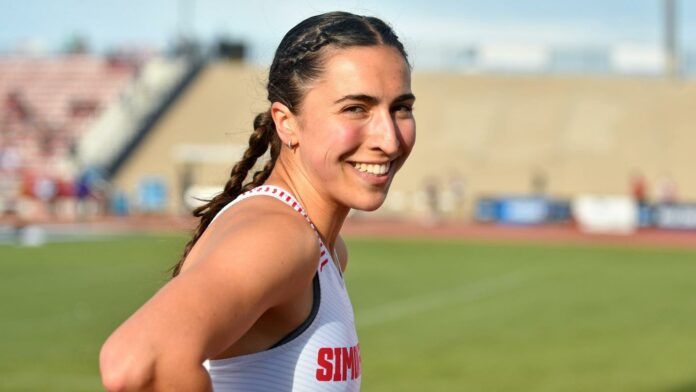
SFU track runner Marie Éloïse Leclair smiling at the camera on track
PHOTO: Wilson Wong / SFU Athletics

By: Isabella Urbani, Sports Editor

Away Games 

Thursday, March 7–Saturday, March 9: women’s basketball at the conference championships 

  • Entering the tournament as the fifth seed 
  • Lost last season in the opening round to Central Washington, 88–62

Friday, March 8: softball vs. Northwest Nazarene (Idaho) at 11:00 a.m. 

  • Game one of day one’s doubleheader 
  • First game against a conference opponent this season 

Friday, March 8: softball vs. Northwest Nazarene (Idaho) at 1:00 p.m. 

  • Final game of day one’s doubleheader 
  • Lost all four games to Northwest Nazarene last season 

Friday, March 8–Saturday, March 9: women’s wrestling at the national championship 

Saturday, March 9: softball vs. Northwest Nazarene (Idaho) at 11:00 a.m. 

  • At the time of writing, sophomore Cassidy Affeldt leads the team in home runs with three
  • On average, SFU outscores their opponent by 10 runs in the first inning 

Saturday, March 9: softball vs. Northwest Nazarene (Idaho) at 1:00 p.m. 

  • At the time of writing, senior Megan Duclos is tied in fourth for the conference lead in hits
  • Final game against Northwest Nazarene (Idaho) this regular season 

Sunday, March 10: track and field at the Div. II indoor championships

  • Men’s team finished fifth and women’s team finished third at the conference championships 
  • Then-sophomore Marie-Éloïse Leclair placed fifth in the women’s 200-metre to become the highest-placing conference athlete in that event. She also placed seventh in the 60-metre, becoming the conference’s first athlete to sprint in that event’s final

SFU’s sports archive

0
PHOTO: SFU Athletics

By: Isabella Urbani, Sports Editor

Men’s basketball 

  • SFU took on UBC for the first time in any sport at West Gym on November 26, 1965, winning 61–51 in front of 2,200 fans.
  • Coach John Kootnekoff made the inaugural 1965 team give each other piggy-backs up Burnaby Moutain during preseason training. 
  • During SFU’s 32-year tenure in the National Association of Intercollegiate Athletics (NAIA), the team recorded their best season by win percentage in 1972–73 (21–8). 
  • SFU’s best NAIA-era playoff finish was a conference final loss in 1996–97.
  • In their final year in the Canadian Interuniversity Sport (CIS), which they operated in from 2000–10, SFU recorded their best conference record by win percentage (14–4), and went their farthest in the playoffs, losing to Central Washington in the finals.
  • In the present-day National Collegiate Athletic Association (NCAA) era, SFU’s best playoff finish was sixth with current head coach Steve Hanson in 2018–19.
  • Out of all the conference opponents SFU has faced this season, they’ve lost the most in history to Alaska Anchorage. In 26 meetings dating back to 2011, SFU has only won two: the last being in 2020. They’ve beaten Alaska the most (11 wins in 26 games). 

Women’s basketball 

  • The women’s team’s first season was in 1972–73
  • In 19 seasons in the NAIA, they qualified for the national championship 11 times. 
  • From 1990–93, the team never lost a conference game, winning 48 in a row.
  • In their final two seasons in the NAIA, SFU lost in the championship finals to the same team, Oklahoma City. 
  • In 2001–02, current head coach Bruce Langford took over from six-time Coach of the Year, Allison McNeill.
  • McNeill was the first coach to lead any team at SFU to the national championship tournament. She was inducted into the SFU Hall of Fame in 2012, and finished her coaching career at the school with a 363–79 record.
  • SFU finished first in their conference eight out of 10 seasons in the CIS, winning five championships — including their first season with Langford. 
  • SFU posted perfect seasons in 2001–02 and 2004–05, with a record of 35–0 and 38–0, respectively. 
  • In the present-day era, SFU’s best playoff finish was an appearance in the NCAA round of 16 in 2012–13 and 2016–17.
  • In 2012–13, the team had a perfect record at home (9–0). 
  • In 2010–11, junior Anna Carolsfled earned conference academic honours after finishing with a 4.11 GPA as a health sciences major. She did the same the following season as a senior. 

Cross country 

  • The women’s team won 10 team titles while competing in the NAIA, including four consecutive championships from 2003–07
  • The men won their only NAIA team championship in 1982
  • In the present-day era, the women’s team has won two conference championships, once in 2014 and another in 2021
  • The men won their first conference championship in the NCAA-era in 2021.
  • In 2021, senior Olivia Willett and Aaron Ahl were the first two SFU racers in the NCAA-era to win an individual race at the conference championship. 
  • The women’s team won the regional championship in 2014 and 2021

Football 

  • The team debuted in 1965 with coach Lorne Davies, who the Lorne Davies Complex is named after. 
  • In 1970, the team went undefeated (8–0). 
  • Twice SFU went on a three-year stretch where they didn’t win a single game: 2005–07 (0–22–2), and 2015–17 (0–29). 
  • Coach Chris Beaton spent 23 seasons at SFU, becoming the longest-serving and winningest coach, from 1983–2005
  • Football alum Doug Brown was the first SFU graduate to sign with an NFL team. He played 20 games for Washington and signed with Buffalo, before playing 11 seasons for Winnipeg.
  • Five players have been drafted first overall in the Canadian Football League (CFL): Wayne Holm in 1970, Brian Donnelly in 1971, Orville Lee in 1988, Sean Millington in 1990, and Nick Mazzoli in 1991.
  • 1n 1986, Lee became the first Canadian NAIA Player of the Week. On October 18, 1986, he set seven SFU records in a single game. 
  • Football alum Lui Passaglia is the CFL’s point-leader. 
  • On October 5, 1985, SFU combined for three touchdowns in just over 90 seconds to beat Central Washington, 42–35.
  • In 2009, SFU had two wins revoked for using ineligible players. 
  • On September 11, 2021, Kristie Elliot became the first Canadian woman to play and score in a NCAA game. 
  • The 57-year-old football program was disbanded in 2023 after SFU was unable to find a conference to play in, following their contract with the Lone Star Conference ending. 

Dil Ka invites audiences into the intimacy of a heated kitchen

0
A Pakistani family with quirky expressions surround a young woman holding a pot who looks concerned.
PHOTO: Emily Cooper, RUBY SLIPPERS THEATRE

By: Petra Chase, Arts & Culture Editor

Writer and filmmaker Lee Nisar sums up her first full-length play as combining “the power of buzzcuts and biryani into one unapologetically queer story.” Dil Ka has been years in the making, with its world premiere set for March 22–31 at the Presentation House Theatre in North Vancouver.

Dil Ka, meaning “of the heart,” is about a young Pakistani woman, Zahra (Talia Vandenbrink), preparing the traditional dish biryani to serve her latest arranged marriage candidate, chosen by her family. However, Zahra is more interested in Jaz (Tanaz Roudgar), her “friend and gay crush” with whom she shares some intimate and giddy moments. As the evening progresses and the ingredients of the flavour-loaded rice dish come together, Zahra steps into her truth and power.

Nisar chose the kitchen as the main setting of the story as a significant place for many brown women. “Kitchens have served as places of gossip, connection, and — in this play —  confession, allowing for honesty outside of the realms of patriarchy,” they explained. 

The 24-year-old emphasized the support she’s received from everyone involved, including the director Tricia Trinh, RUBY SLIPPERS THEATRE, and Blackout Arts Society. “It’s really amazing to have so many talented storytellers working on this piece and seeing it come from the stage reading to the workshop to now have been such a dream,” they said.

“[Queer, brown, and Muslim] identities do not have to be exclusionary but, rather, inform each other in the most incredible ways.” —Lee Nisar, playwright of Dil Ka

They’re especially excited for the “little details” the crew put into bringing the set to life, from an elaborate spice rack and wall decor, to fabrics and patterns that will resonate with South Asian audiences, including “beautiful and ornate” traditional Pakistani garments. Audiences will even have their senses treated to the delightful aromas and tastes of biryani’s herbs and spices.

You can expect hilarious dialogue alongside tender emotions, like the tension of bond in a family, exploring gender identity, and “the joy of messing up your hair with your friends.” Ultimately, Nisar hopes audiences take a lot of “fun and joy” from the story. 

“A lot of the stories we get about being racialized and queer can be really sad,” Nisar told The Peak. While sad experiences do unfortunately exist, they explained that connecting with the queer brown community in Toronto has changed their outlook. They want audiences to see the importance of “sharing culture together and sharing in both the struggles and joy.”

To the “aunties and uncles” in the audience, Nisar hopes they “take away a new perspective [ . . . ] that maybe they’re not as attuned to.” Growing up, Nisar frequently encountered older people in her community claiming “‘you can’t be brown and Muslim and gay” and queerness was often viewed as a “western thing.” This is why Nisar set out to write her characters as each having their own individual relationship to their faith, reflecting the reality.

She hopes audiences can look at the “richness” of queer brown history and “how these identities do not have to be exclusionary but, rather, inform each other in the most incredible ways.”

Dil Ka will be playing from March 22–31 at Presentation House Theatre (333 Chesterfield Ave, North Vancouver). Shows are Thursday–Saturday at 7:30 p.m. and Saturdays & Sundays at 2:00 p.m. Tickets are pay-what-you-can ranging from $22-34. Find more information at rubyslippers.ca/dil-ka.

Decolonizing my laughter

0
ILLUSTRATION: Andrea Choi / The Peak

By: Sude Guvendik, Peak Associate

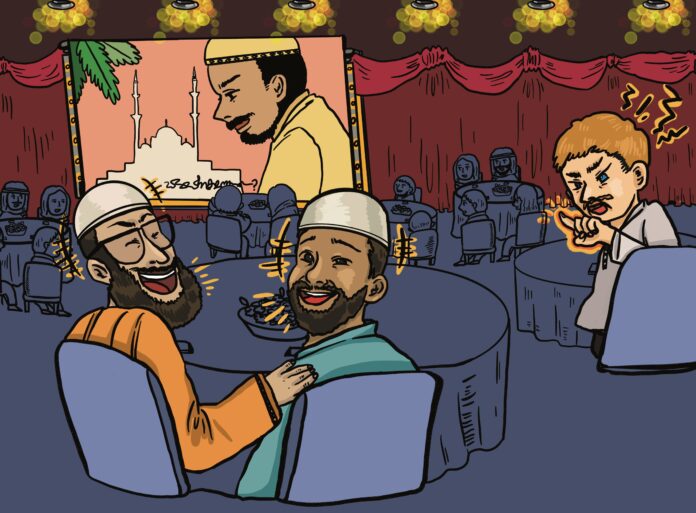
My stomach churns with a peculiar sensation, a rebellion within me that threatens to strangle itself against the walls of my guts. I navigate through a sea of judgment and misplaced glances, feeling like an alien in my own skin. This incident at the Middle Eastern & North African Film Festival is a vivid memory — a stark reminder of the power dynamics at play.

Amidst a celebration of Middle Eastern culture, a white man chose to unleash a passive-aggressive tirade against my brother and I as we giggled at a joke in an award-winning film. “Come on, guys, you’re loud; this isn’t comedy,” he bellowed, his hands in the air, oblivious to the shared laughter in the room at a joke in a language foreign to him. The irony struck hard — the festival designed to honour our heritage became a stage for his repressed frustrations.

Why did he feel the need to turn around and create a scene when our laughter was no louder than others? It was a mere giggle; not disruptive in any way. He had arrived with two Middle Eastern friends before the film commenced, enthusiastically professing his love for Middle Eastern cinema, especially singling out A Separation as the only film he seemed to know. 

What compelled him to attend, and why did his Middle Eastern friends go to great lengths to assure him of their Canadian upbringing? They emphasized their lack of fluency in Arabic, their strong connection to Canada, and their sense of being more “Canadian” than anything else. It seemed as though they were trying to comfort him, reassuring him that they had seamlessly integrated into Canadian culture and were not to be perceived as outsiders. The shame radiated from those who should’ve been allies — the internalized embarrassment of association with the “other.” I felt their gaze, an unspoken plea for us to conform, to be civil in a theatre, to stop any rudeness that might be perceived as remnants from our so-called “savage” ancestors. But at that moment, I refused to be silenced. I wanted to laugh for the ones who could not, those who had not even heard their own laughter, whether due to cultural norms or for fear of challenging the status quo.

The system is tailor-made for those who fit the mould, and don’t pose a threat to the established order. I yearned to defy him and laugh in Farsi, Turkish, Arabic, Azeri, Kurdish, and Armenian. Instead, I found myself sinking into my seat, pondering the thoughts of those around me. It wasn’t just an isolated incident; it was an assault on my identity, and an exclusion from a space meant to celebrate me. So, I made a vow to claim my space and reclaim my laughter — laughter that echoed through languages and generations, that transcended the barriers imposed upon me.

The festival became a battleground between the mind and the heart — a place I tiptoed around to avoid the shards of my shattered identity.

In the silence that the aggressor sought, I found my voice. I crackled with laughter, perhaps uncontrollably, at the serene waves of the Levantine Basin on the screen. I broke the silence that had bound me for too long, questioning why I had kept quiet. As tears threatened to spill, I wiped away the frustration and embraced the discomfort.

My laughter evolved into a symbol of rebellion — a vibrant red war flag, a resolute declaration of my existence and agency as the “other.” I take delight in embracing this identity, welcoming gazes that question my choices, religion, ethnicity, ingredients of my accent, and the distinctive features of my appearance, such as my exotic eyebrows and the curvature of my nose. In this defiance, I find pride. Palestinian American theorist Edward Said would commend this act of self-affirmation. I catch the echoes of remarks like “You’re not in Iran; you can take it off, free yourself!” and “Where are you from, from, like your parents?” or “You look traditional, more cultured.”

I occupied that seat, that room, more than anyone who sought to silence me. The unfamiliar sensation of being the centre of attention didn’t deter me; it fueled my resolve. My brother nudged me to stop, embarrassed by my defiance. But it was more than just a moment of laughter; it was a statement. I had attached profound meaning to my impulsive act — it was me being resilient, reclaiming my space, and confronting the power imbalances that lingered in the room. When questioned about my seemingly dramatic response, I unraveled the layers. It wasn’t just about that man; it was a retaliation against all those who had sought to colonize my space, mind, body, spirit, and laughter.

From the lady who judged my choice of clothing to the man who cast disgusted glances my way, I laughed for every moment of oppression, reclaiming control even if only illusory. In that laughter, I found joy, an antidote to anger and frustration. It was a proclamation that I existed, unapologetically, in a place I can’t call home.

Wash your goddamn water bottle

0
A red water bottle covered in stickers on a table next to a tent.
PHOTO: Paul Esch-Laurent / Unsplash

By: Olivia Visser, Copy Editor

Heeeey, you. You know who you are. You’re the one who believes you only have to wash me once a month, and believe me — we can all tell what’s going on. It’s time for an intervention.

What’s that? You only fill me with water, and therefore don’t see how I could get dirty? Have you ever heard of bacteria? (Spoiler alert: it exists, and it likes water.) Have you ever even bothered to smell me, by chance? No seriously — give me a good whiff and tell me I smell like roses, because I can assure you I don’t. Every time you twist off my lid, I’m tempted to warn everyone with a crisp, “get out my swamp!” And yet I don’t, because I love you. 

I can’t entirely blame you. No one wants to wait for the dishwasher to finish cleaning a device they use all day, every day. That being said, hygiene applies to water bottles, too! I can promise you that when you open me up, alllll your friends can smell that stale aroma. Not a good look (or smell). 

I’ve been nothing but good to you. I let you drag me along on every walk, hike, and commute you have. I even let you stick a fancy carabiner on me, just for you to shove me in your backpack instead of putting that pricey aluminum to good use. I have to admit — it’s lonely in there. I want to see the world, not have it plastered all over me in the form of fancy $10 vinyl stickers. 

Maybe you’re worried all your “the mountains are calling” stickers will peel off if you run me through the dishwasher. That’s fair, and to that I grant you this idea: handwashing. For the love of god, just do something!

Please give me a bath. Soon.

Love,

Your beloved (and forgotten) Nalgene bottle

My Stanley and I (a toxic relationship)

0
Blush pink Stanley tumbler.
ILLUSTRATION: Victoria Lo / The Peak

By: Saije Rusimovici, Staff Writer

Dearest Stanley cup,

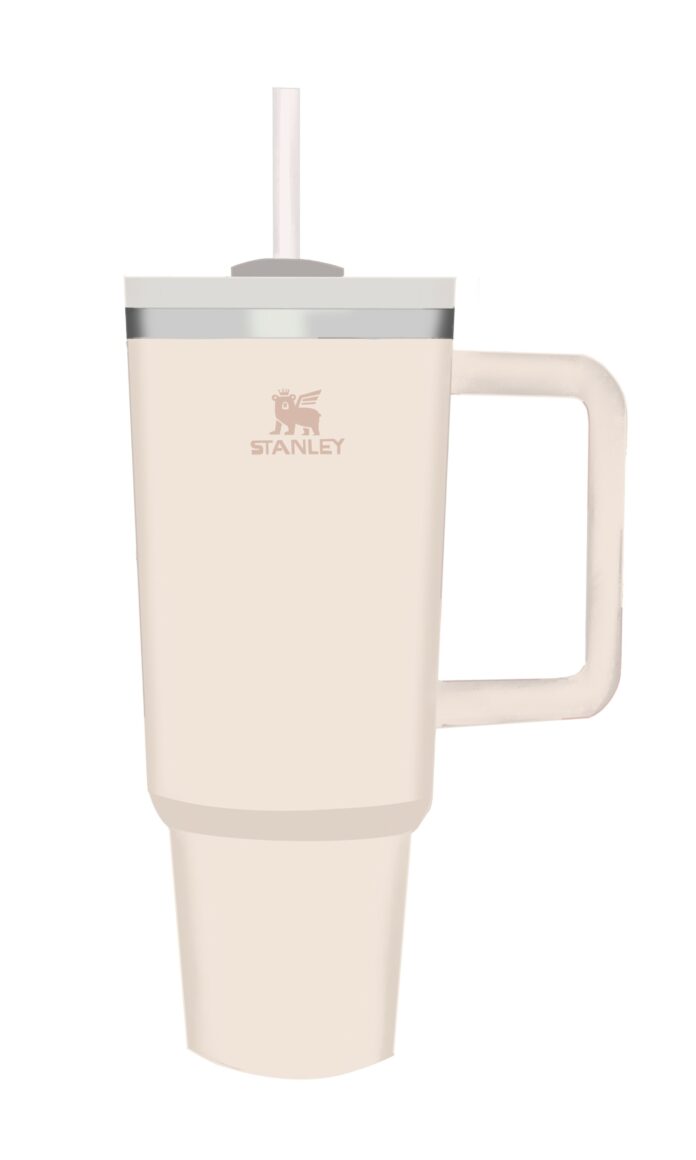
Despite the fact that people say you’re obnoxiously large, you fit me perfectly. I would carry you from the car (really, you should have your own seat), to the classroom, to the gym, and back. I love spending time with you, and I love the way people stare at us as we walk into the room (no, they’re not judging us, they’re just jealous, clearly).

You and I are so alike — so misunderstood. We navigate this world walking a fine line between what is convenient and what for some reason just makes us feel cool. To be honest, sometimes, you can be uncomfortable to hold — I just want to pretend you feel perfect. And, well, some water might spill (even though I can’t figure out where the spill is coming from.) You barely fit into my work locker, yet you still come with me every single day. The water just tastes better drinking from an $80 straw. Owning a Stanley is the epitome of the placebo effect. 

My other water bottles collect dust in the cupboard, long ago forgotten and replaced by you. It makes me sad to think about all I’ve left behind, but I will do anything for you. 

But here’s the thing. Do I really need to be lugging around that much water every day? Sure, it fits nicely in my car’s cupholder (I drive a Fiat, so this is honestly quite a win). Sure, the water keeps colder (placebo effect #2) and I definitely don’t have to fill it up as often. Wait, can water become stale? Nah, I’m sure it’s fine. 

Take from this letter what you will, but above all, I want you to know I had a great time with you. Even though you made it just that much harder to balance a heavy tote bag on one shoulder and my keys on the other, you’ve been by my side through every midterm. You’ve hung out with me at work when no one else did. You are indeed my favourite water bottle I ever had.

But what’s that thing they say? All good things must come to an end. Well, this isn’t the end for us, but I think it might be time for a break. I need a bottle that really gets me. I think it’s time to dust off the Owala bottles and put you back on the shelf for a while. This isn’t the end for us, and in time we will come together again.

Sincerely yours, 

Stanley stan since 2023

Former SFU mascot candidate grilled by hiring manager

0
McFogg in an office looking super serious. Outside there's a line of mascots waiting to be interviewed to be his replacement.
ILLUSTRATION: Dan Kinanti / The Peak

By: Izzy Cheung, Staff Writer

I sit down at the table, its surface cold against my trembling hands. The smooth papers rustle beneath my palms, my fingers pressing deep wrinkles into the material. I shouldn’t be nervous — I’ve gone over every scenario in my mind and prepared myself for any possibility. I’ve studied this for years, and I know that I’m qualified. But as I stare across the table, at the face that I know will be judging me more than I’ve ever been judged in my entire life, I know that my nerves are justified. 

His stare is sharp, laced with a façade of kind understanding, but clearly tormented deep under the surface. Those eyes have seen horrors over the years that no one could speak to but him. It’s ever-so indicative of the immense pressure that comes with a position like his. 

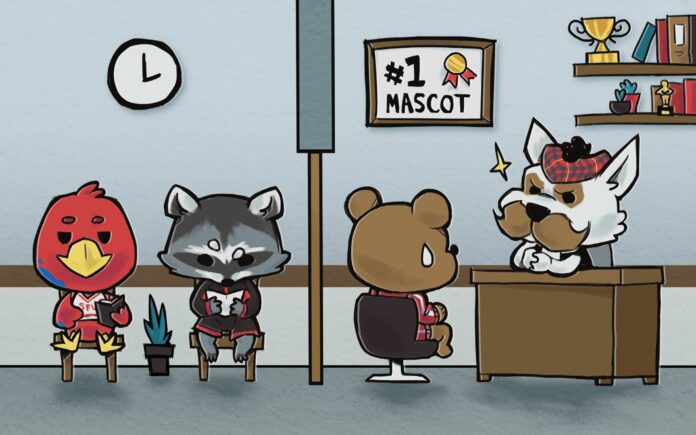
He watches me, gently tipping his red cap as if attempting to say hello. It’s a gesture that welcomes and threatens me: “You’re permitted here, but only if I like what you have to say.Actions like these are only the tip of his commendable iceberg. 

As we sit in silence, his eyes dart from my face to the sheets of paper that are now laid out on the table. A headshot of my face sits in the corner of the page, along with a blurb about my life and some of my greatest accomplishments. He seems to gloss over all of those, instead searching for different information. 

“So,” he finally speaks, his voice gruff and tinted with a Scottish lilt, “You’re looking to replace?” 

“Absolutely not, sir,” I correct him, shifting my hands beneath the table so he can’t see how much they’re trembling. “No one could replace you. I’m only hoping to bring my talents to the community in the same way that you do. I would never regard myself as your replacement.” 

His thick brown eyebrows furrow, matching the downward curl of his moustache. “How do you think you can serve this community when you don’t want to replace me?” 

“Nobody wants to take your place,” I plead. “We all respect you so much. There’s no way we would be able to meet your standards—” 

“If you claim to not be able to meet my standards, then you shouldn’t even be here,” he cuts me off abruptly. “I know you have the potential. I know you have the talent. But if YOU don’t even think you can take my place, nor can you properly show me that’s the case, then I don’t see why you’d even bother trying to come here in the first place.” 

Dread seeps through my skin. “Mr. McFogg, please—” 

He shakes his head, pinching the bridge of his nose. “None of you candidates take this position seriously enough. All of you walk in here with your tails tucked between your legs in fear of the fact that I’m going to yell at you. Why do you think it’s been so long since I retired? Why do you think no one has taken my place since then?” 

McFogg flings his arms out suddenly, and my chair screeches against the floor as I jolt myself backwards in anticipation. “I was enjoying my much needed time off before I was called back to help find my replacement.” He rants, his voice now at the pitch of a yell. “This school, it’s like a ball that I’ve been chained to for years, and I can’t be set free until I know that the community is taken care of. If you cower when I yell at you, I know you’ll never be able to handle the pressure that comes with this position. I need the best replacement possible, and I sure know that it isn’t you.” 

I can’t take any more of it. The chair crashes to the ground in a heap as I stand up, the form of McFogg blurring through the tears in my eyes. I hear him grunt a gruff “good riddance,” before I take off, pushing through the door and past the rest of the mascot-hopefuls who will also inevitably have their dreams crushed the minute they sit down in front of the dog. 

Video games that helped me cope with health anxiety

0
A moody illustration of person with long disheveled hair in a dark purple-lit bed room playing a game on a console, things sprawled on the floor and star-themed decor on the wall.
ILLUSTRATION: Sandra Cao / The Peak

By: Abbey Perley, Assistant Production Editor

Content warning: mentions of illness and death.

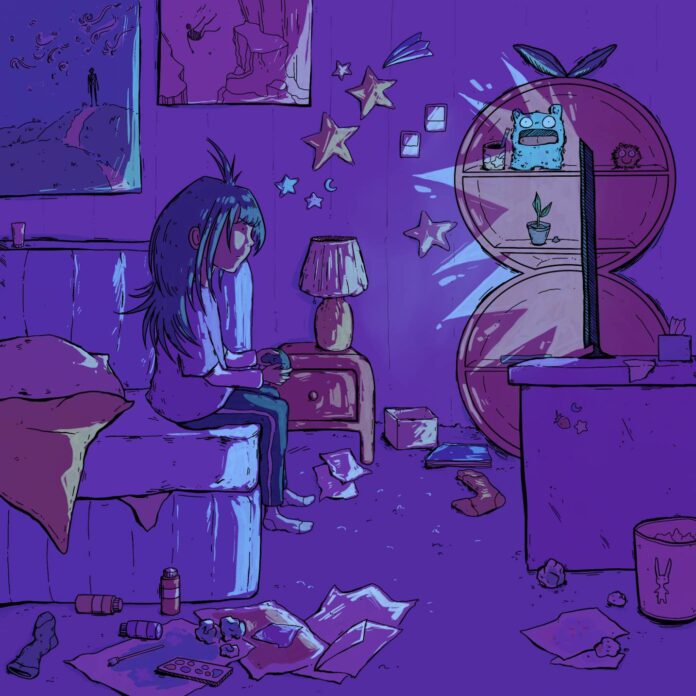
Illness anxiety, previously called hypochondria, is a type of anxiety where the affected person constantly believes they have a serious medical problem. For me, every new freckle signals cancer, and the common cold will kill me. This thinking defines large chunks of my life by rendering me physically and mentally weak for days or weeks in a row, despite how unfounded my worries are. It can even create new physical symptoms that I never had to begin with to convince me that I’m seriously ill. 

When these periods began, I turned to video games as distractions, and accidentally stumbled on my greatest coping mechanism: games that made me think about myself. Here are two single-player games that helped me reflect on my relationship with health anxiety, and how they’ve contributed to my healing. 

Celeste

Celeste is a 2D-platformer released in 2018. The story follows Madeline, a girl who wants to scale the fabled Celeste Mountain to combat her own depression and anxiety. Soon into her climb, Madeline discovers Badeline, a ghost-being that embodies what she considers to be her worst qualities. Badeline haunts Madeline through her entire climb, aggravating the environment and discouraging her from continuing. Slowly, the subject matter transforms from a game about climbing to the journey of a girl struggling to accept all parts of herself. Through dialogues with NPCs, we learn about Madeline’s relationship with mental health and see her grapple with what will ultimately allow her (and the player) to reach the top of the mountain

I found myself wrecked over Madeline’s tumultuous relationship with Badeline. Bundled in elegantly saturated pixel art and melodic original soundtracks was the relationship between the part of me that had health anxiety, and the part of me that wanted it gone. I’d never understand that these two beings were supposed to be united as clearly as I did while playing Celeste. Although not directly related to health anxiety, the journey up the mountain showed me that I should stop trying to destroy what I didn’t like about myself. Instead, I should speak to the fears that created my anxiety, and work with them to fulfill their needs of keeping me safe. 

Spiritfarer

As stated by the developers, “Spiritfarer is a cozy management game about dying” (released in 2020). They’re right; you play as Stella, the grim reaper in a world made up of stray islands on a vast colourful sea. Her job is to house spirits on her boat and help them fulfill their last wishes before sending them to the afterlife. To do this, you as the player complete quests, cook food to feed the spirits, and build them cabins to sleep in while they travel with you. 

Something that hit me quickly was that each character I met and cared for was already dead. Does that mean I didn’t care about them, or thought they didn’t matter? No; it was the opposite. Whether I learned they died old or young, or to dementia, or cancer, the process of housing them on my ship until they were ready to pass on comforted some of the fears that probably created my health anxiety in the first place. The game’s soft-hearted quests, gentle piano soundtracks, and meticulous 2D animation nurtured the first positive feelings I’d had about death in years. Admittedly, this game was difficult to play due to the subject matter, but when I was forced to send my spirits to the afterlife, I was reminded that their beauty and richness in death mimicked how they led their lives, and that I should live life proudly, too. 

Commissioner of Indigenous Languages discusses importance of language preservation

0
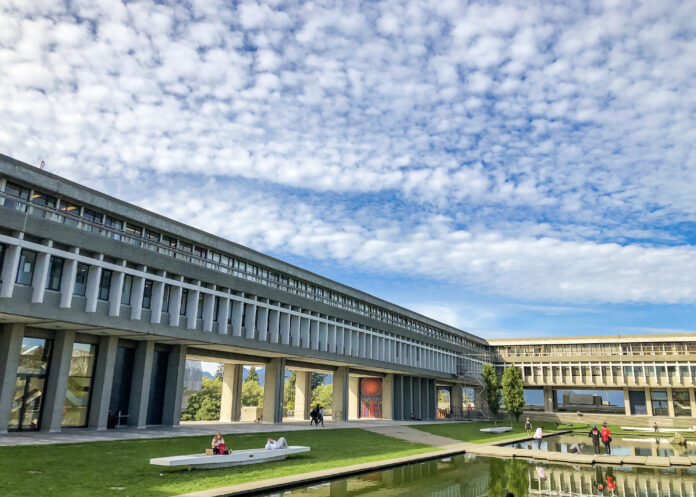
This is a photo of the SFU Burnaby Campus’s reflection pond and the academic quadrangle building surrounding it.
PHOTO: Allyson Klassen / The Peak

By: Olivia Sherman, News Writer

Content warning: mentions of residential schools and anti-Indigenous racism. 

After Canada’s implementation of the Indigenous Languages Act in 2019, aiming to support the reawakening of Indigenous languages in Canada, the Office Commission for Indigenous Languages was founded. The first Commissioner of this independent organization, former Stsmél̓qen ((Skeetchestn) Chief, Dr. Ronald E. Ignace, gave a keynote address at SFU to discuss the importance of this initiative. His lecture started off SFU Multilingual 2024, a yearly week-long festival to uplift and celebrate diversity and language. 

“Canada has a history now known to the world as cultural genocide,” Ignace said, referencing the history of Indigenous languages being systematically repressed by colonial powers. These acts “gave rise to our Indigenous languages being silenced, oppressed, and stigmatized by colonial policies, legislation, and systemic, racialized abuse.” Through the implementation of residential schools across Canada, many Indigenous children were separated from their cultures, heritage, languages, and identities. 

“These are purposeful acts. By targeting our languages, they are targeting our identity,” he said. While the colonial powers’ goal “was to take the Indian out of the child,” Ignace stated the Commission’s initiative is to “put the Indian back into the child.” 

According to UNESCO, there are over 70 Indigenous languages spoken across Canada. Every Indigenous language spoken in Canada is considered at risk due to a lack of speakers. Yet, since 2016, speakers of Xa’islak’ala (Haisla), Halq̓eméylem (Halkomelem), Haíłzaqv (Heiltsuk), and Michif all increased by over 33%. “It is through language that children receive their cultural heritage,” Ignace said. 

Among numerous initiatives, the Commission is working on research for a language directory. This “research involves determining what are root languages, versus dialects versus regional variations.” 

Ignace is the former Chief of the Stsmél̓qen Indian Band, leading the community for more than 30 years. He also served as Chairman of the Secwépemc (Shuswap) Nation Tribal Council and president of its cultural society. “It is the truth of the struggle of Indigenous Peoples and survival, especially over the past 30 years that have led me here today,” he said.  The objective of the Commission is “to assist Indigenous people across the country, to breathe life back into our Indigenous languages.

“I think it’s important that we understand each other’s rights so that we can make proper space for our languages to be properly honoured and respected,” Ignace stated. “All languages are sacred languages.

“There’s hope, and it’s in the Indigenous Languages Act and the precedent it sets. It took 30 years of struggle to get to the promulgation of that act.”