
Go back

New anthology explores how Vancouver’s support structures can guide us through precarious times

By: Saije Rusimovici, Staff Writer

In the midst of a global pandemic, climate change, and economic instability, What Are Our Supports? provides a unique look at the ways artwork can inspire human connection. The anthology, which was published on January 21, recognizes how support structures offer a sense of solidarity and togetherness through difficult times. Over 20 contributing artists bring attention to social issues: racial injustice, the Vancouver housing crisis, and the climate crisis through local projects designed to invoke a sense of community. Through artists initiatives such as public art installations, commissioned poems, and essays, What Are Our Supports? explores the need for social connection now more than ever before. 

The book features art installations from What Are Our Supports? curated by Low in partnership with Or Gallery and Richmond Art Gallery. The project, which occurred during 2018, was “a series of artists’ projects in public space exploring the supports that bear, create and sustain contexts for artistic production, communities, and collective space.” This book expands on the project to demonstrate how the sensory experience of art can guide us through uncertain times. 

Co-editor Joni Low draws attention to the project H&M: Home Made Home Boothy, created by contributor Germaine Koh. The boothy is an adaptable structure that could either be used as an object or container for several purposes, from an artist’s tool to alternative housing. Koh refers to the container as a threshold between object and building, allowing users to create the spaces they need. Working to open up conversation to address housing needs in unaffordable Vancouver, Koh considers these forms of mutual care necessary for the good of the community, brought to life by artists. For this reason, Koh urges for the recognition of artists as essential workers. 

“The twin crises of the pandemic and racialized violence have highlighted urgent need to cultivate practices of care in our daily lives, from recognizing the indispensable caregiving provided by essential workers, to the rising call of the BLM movement,” Koh quotes British curator Yesomi Umolu, author of The Land Grant: Forest Law.
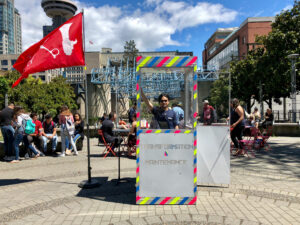
Germaine Koh and Aron Louis Cohen stand inside Home Made Home Boothy, as part of Afterlives (currency) by Koh, Cohen, and Russell Gordon, 2018.
PHOTO: Photo by Joni Low. Courtesy of the artists.

Another piece that stood out in the book was the art installation, un/settled. It’s a tribute to Breonna Taylor and Black womanhood, featuring the portraiture by Chantal Gibson accompanied by a poem written by SFU’s 2020 writer in residence Otoniya J. Okot Bitek. The depiction of a Black woman clutching an armful of braids, In Lieu of Flowers (for Breonna), celebrates Black creativity during a time of ongoing systemic violence against people of colour. According to SFU News, having this art piece positioned in the windows of the Belzberg Library at SFU’s Vancouver campus in 2021 was meant to engage the local community in a meaningful way in the midst of the COVID-19 pandemic. 

Low said that when it comes to activism, there is not necessarily a “nuts and bolts, how to, or policy manual of answers.” According to Low, the drive for social change begins with our senses. Art allows us to “tune in,” using our intuition to figure out what issues are important to us, then move to take action. We must integrate this sensorial agency into everyday practice as a guide to determine what is important to us, and how to support.

What Are Our Supports? is a beautiful compilation of stories told through different modalities of art. Art inspires not only a shared connection to humanity, but opens our eyes, minds, and hearts to our community.   

Order What Are Our Supports here.

Was this article helpful?
0
0

Leave a Reply

Block title

Dining workers speak to poor working conditions

By: Lucaiah Smith-Miodownik, News Writer On October 7, a Reddit user posted to r/simonfraser concerning the possibility of a dining worker strike across SFU’s Burnaby campus. The message, which is from Contract Worker Justice (CWJ) @SFU, asserted that SFU “hasn’t budged on insourcing workers and is now trying to walk back its commitments to living wage.” The post also mentioned “a very heated labour environment on campus with several possible strikes and actions for precarious workers upcoming.”  The Peak corresponded with Preet Sangha, a UNITE HERE Local 40 union representative, who spoke with two dining hall employees and forwarded their responses to us via email. Local 40 “represents workers throughout BC who work in hotels, food service, and airports.” Names have been changed to protect their...

Read Next

Block title

Dining workers speak to poor working conditions

By: Lucaiah Smith-Miodownik, News Writer On October 7, a Reddit user posted to r/simonfraser concerning the possibility of a dining worker strike across SFU’s Burnaby campus. The message, which is from Contract Worker Justice (CWJ) @SFU, asserted that SFU “hasn’t budged on insourcing workers and is now trying to walk back its commitments to living wage.” The post also mentioned “a very heated labour environment on campus with several possible strikes and actions for precarious workers upcoming.”  The Peak corresponded with Preet Sangha, a UNITE HERE Local 40 union representative, who spoke with two dining hall employees and forwarded their responses to us via email. Local 40 “represents workers throughout BC who work in hotels, food service, and airports.” Names have been changed to protect their...
Picked For You

Today’s Top Picks,

For You

photo of Skytrain expo line

TransLink’s fare enforcement blitz is a terrible idea

By: Yagya Parihar, SFU Student In my lifetime of using public transit, I only remember having been fare checked three times. All three times were in BC while exiting SkyTrain stations in late 2024. I tapped my pass on the fare gate, and the transit cop asked to see my…

This is a photo of an empty SUB hallway that features the “SFSS Admin Offices” room. Next to the room is a big bulletin board with about 30 neatly lined-up posters and a big red number 3 to indicate the level of the SUB.

Five SFSS full-time union staff receive layoff notices

By: Corbett Gildersleve, News Writer and Hannah Fraser, News Editor The Simon Fraser Student Society (SFSS) has initiated staff layoffs, with five out of eight full-time union positions affected as of July 25. All the positions either support student activities or the SFSS’ operations, and do not include SFSS executives.…

This is a photo of the SFU Surrey Engineering Building from the inside. There are numerous levels to the building, artificial trees, and a wide staircase in the photo.

TSSU speaks on latest updates to IP policy

By: Corbett Gildersleve, News Writer As recently reported by The Peak, the Senate reviewed and discussed a new draft version of its intellectual property (IP) policy solely focused on the commercialization of inventions and software. Based on community feedback, they split the IP policy into two: one for inventions and…

Block title

Dining workers speak to poor working conditions

By: Lucaiah Smith-Miodownik, News Writer On October 7, a Reddit user posted to r/simonfraser concerning the possibility of a dining worker strike across SFU’s Burnaby campus. The message, which is from Contract Worker Justice (CWJ) @SFU, asserted that SFU “hasn’t budged on insourcing workers and is now trying to walk back its commitments to living wage.” The post also mentioned “a very heated labour environment on campus with several possible strikes and actions for precarious workers upcoming.”  The Peak corresponded with Preet Sangha, a UNITE HERE Local 40 union representative, who spoke with two dining hall employees and forwarded their responses to us via email. Local 40 “represents workers throughout BC who work in hotels, food service, and airports.” Names have been changed to protect their...

