Home Blog Page 760

SFU alumni Dimitri Filipovic runs the numbers so teams can score big on the ice

0
Photo courtesy of Dimitri Filipovic

Corsi. Fenwick. To people who don’t follow hockey, they sound just like regular names. But to those who are invested in the game, they have come to symbolize a revolution in how hockey is thought of and played.

Dimitri Filipovic, an SFU alumni, is at the forefront of this as one of the leading minds of the analytics movement. Filipovic, and others like him, use numbers to give an objective and evidence-based take on the sport.

When talking to Filipovic, it is very clear that he looks at the game from a completely different viewpoint than the one you would get watching Coach’s Corner on Saturday night.

“I was in first year at SFU,” said Filipovic on how he got involved in the world of hockey analytics. “I was in my kinesiology undergrad and I liked what I was doing, but I wasn’t passionate about it as everyone else in my class seemed to be. The reason I went into kinesiology in the first place is I thought I wanted to be a physiotherapist coming out of high school. But that was 2010–2011 and that was the year the Canucks made the [Stanley] Cup Final.

“I would always meet up with my friends and watch the games and talk about these pet theories we had. And at one point me and my best friend were like, ‘Why don’t we just start a blog about this, and maybe some other people will be interested in what we’re saying?’”

Filipovic stressed that you don’t have to be a math whiz to get into the field.

“I had no math background, no stats background,” he said. “Which is why I always laugh when people say this stuff is super nerdy or way too intense. It’s all pretty relatable. I started from scratch, it’s not like I have a PhD or anything.”

After those humble beginnings, Filipovic starting writing for the popular blog Canucks Army — eventually becoming their managing editor. After that, he was hired by a NHL team as a part-time consultant. Although he wasn’t allowed to name the team he worked for, he was able to elaborate on the experience.

“I was brought in as an extra pair of eyes and maybe someone to kind of vet some of these ideas. And since I wasn’t working with them on a day-to-day basis could work on bigger projects,” said Filipovic on his role with the team. “If they had questions, such as, ‘We’re looking at these two players, what do the numbers say or should we be playing this guy ahead of this guy in the lineup?’ Stuff like that. Then I could provide my input on it and they would weigh it as a piece of the puzzle.

“It was a bit trying at times, because you’d spend hours and days working on something and you could kind of tell it was not really considered. I feel like the team I was working for kind of thought that by indulging me, they were appeasing this idea that you have to have someone on staff working on analytics.”

As Filipovic explained, some teams as of this moment are not interested in this new data available. It is still very much an old boys club in terms of who makes the decisions for NHL teams.

“I think most teams right now are reluctant to at least publicly say stuff like that, because they know they’re going to be raked over the coals by people,” he said. “You can sort of look at their actions, they speak louder than words. You can look at moves a team makes and if, over time, they’re making head-scratching moves, you can kind of tell what’s going on there.”

However, two teams that have made their intentions pretty clear on how they view analytics are the Toronto Maple Leafs and the Florida Panthers, for very different reasons.

“MLSE (Maple Leaf Sports & Entertainment, the company that owns the Leafs as well as the Toronto Raptors and Toronto FC), has such deep pockets that they really should have been doing this the entire time, but they were run by guys such as Dave Nonis and Randy Carlyle who didn’t see the value in it,” said Filipovic on the Leafs. “Once Brendan Shanahan came in and he hired Kyle Dubas, he realized that we should be using some of these deep pockets to kind of work on some of this stuff.

“The Panthers are another. They’re more interesting because they sort of realized their limitations as a non-traditional hockey market. They couldn’t necessarily spend with teams such as New York or Boston. They realized we need to extract every single penny of value. If we’re signing a guy, we need to make sure we’re spending our money correctly. Or in the draft. We need to corner the draft market and draft as well as we can because we know the advantage of having these guys for three years under their entry-level contract and RFA rights, it’s just such a good advantage for a cash-strapped team.”

In the future, it wouldn’t surprise Filipovic if more teams started adopting what the Leafs and Panthers have done and hire a full-time analytics staff.

“I’d love to see that,” he said. “I understand the limitations that not every team can sign six full-time guys to supplement their scouts, assistant GM, and GM. But, I mean, that’s what you see in baseball. All these teams have six or seven guys who are working together, and that really is the key. [. . .] Having people who you can bounce ideas off of and who can tell you ‘I disagree for this reason’ and can actually have a logical argument why, that helps you grow as a hockey mind and as a person.”

Now in his role as a writer for Rogers Sportsnet, Filipovic uses advanced statistics to take deep dives into topics such as how we evaluate defencemen. He also does the same on his popular podcast, The Hockey PDOcast.

“I do think there is some appetite for some smarter dialogue in podcasts,” said Filipovic. “I’m actually doing my homework and I’m actually trying to provide a more thoughtful intelligent discussion. [. . .] But at the same time, I try to keep it pretty relatable. I’m not just pulling out a spreadsheet and reading off a series of numbers. No one wants to listen to that.”

In terms of how analytics are changing hockey, the effects can already be felt.

Very few teams employ enforcers anymore — players whose role it is to fight and police the game, electing to go with players who have more tangible skills that can be measured by these new statistics. Teams are going more with four forwards on the powerplay instead of the traditional three forwards and two defencemen setup, to try and extract as much as possible from the man advantage.

But despite all that, hockey still lags behind sports such as basketball and baseball in terms of the willingness of people within the game to use it and give it a chance.

“We’re still quibbling a lot about shot attempts,” he explained. “That’s the stuff that makes me laugh because I think every quote unquote “hockey person” would agree that shot attempts are important — and that it’s kind of a signal that you have the puck more often than not.”

“So everyone agrees, but as soon as you start throwing out terms such as Corsi and Fenwick, whatever names we’ve given them, you can instantly start to see people’s eyes glaze over. That’s why I try to say shot attempts whenever possible because I think everyone agrees that’s important. Once everyone gets on board with that, then we can start getting some more intense stuff.”

People like Dimitri Filipovic are trying to change that. Perhaps not next month, or next year — but eventually someone like Filipovic will have more say within NHL front offices as we see with the Maple Leafs and the Panthers. And perhaps one day, we could see someone like Filipovic calling the shots for an NHL team as a general manager.

Student’s concerned over SFU official transcript conversion

0

Brandon Gill didn’t expect to have trouble converting his grades from his transcript after graduating from SFU in 2016. “I feel like going to SFU puts me at a disadvantage when I try to apply to these grad schools because we are so different in how we grade and how our transcripts look,” he said.

If you have never ordered an official transcript before, you may not know that SFU’s transcripts do not display a final percentage in a course, only a letter grade.

Gill explained that this can become problematic when other post-secondary schools begin to examine your transcript when applying for graduate schools, as each of these post-secondary schools use different percentage-to-grade equivalencies. “For me, I am going to be, at minimum, losing five to eight percent in every single one of my classes,” depending on which grading scale is used to convert his letter grade.

While Gill has questioned why only his letter grade could be displayed on his transcript, SFU registrar and executive director, Rummana Khan Hemani, explained that only official letter grades can be displayed on an official transcript.  

In a statement to The Peak, Hemani stated that, “while percentages may be used to determine a final grade, they are not part of the official grading system. This means that only letter grades, and not percentages, can be assigned as final grades. As such, only letter grades and their equivalent grade point values appear on the transcript.”

Gill is not the only student who has questioned why his percentages in each course cannot be displayed on his transcript. SFU student Mandie Dhesi added, “I’ll be applying to law schools within the next year and one of the issues that goes against me as an SFU student is SFU’s grading scale. When you’re applying to law schools, not just within British Columbia, but in the whole of Canada, SFU’s grading scale doesn’t convert equally.”

She also stressed that in contacting law schools across Canada, many have explained to her that they will take the “lowest percentage in that letter grade” range in order to calculate a percentage.

“It’s instances such as these where letter grades are too ambiguous. And as a student, I’m working to obtain a certain percentage in a letter grade; it should be shown,” said Dhesi.

Gill added that, because SFU’s grading scale is different from many universities across Canada, which may require a B or B+ average to apply for graduate school, not providing a percentage attached to a letter grade “creates a vagueness. If I get any letter grade, whether it’s an A or a B, it’s vague as to determine how [I] actually did.” Dhesi agreed with the statement.

Hemani also stated that “the reverse side of the official transcript explains how the SFU grading system works to prospective post-secondary institutions students may be applying to.”

The Peak contacted the University of Victoria’s law admissions officer, Janet Person, and in a statement she explained that “for the purposes of evaluating law school applicants from SFU, we take the letter grades as reported on the transcripts and convert to the 4.33 grade point system exactly the same way that SFU does.”

However, the University of British Columbia minimum admissions requirements require “a minimum overall average in the B+ range (76% at UBC) in third- and fourth-year courses.” According to their website, however, it is not specified whether SFU’s B+ (80-85%) will be converted to such a range, or based on a 4.33 grade point system like SFU’s.

While students are frustrated that their work may not be adequately represented on their transcripts, Hemani also stated that “in July 2016, in consultation with the University Senate, which includes student representatives, SFU redesigned the official transcript in order to more clearly reflect a student’s academic career and achievements at SFU.”

“Some of the changes were to ensure SFU students fare well with students from other post-secondary institutions for further studies and external competitions. For example, the new transcript indicates the class average for each course a student has completed. This change was designed to partially address the concern of conversion from one scale to another and to provide more detail about a student’s academic performance,” she added.

While changes may have been made to SFU transcripts as of July 2016, Dhesi’s and Gill’s problems reflect similar concerns as students on SFU’s Reddit thread in 2014, which expressed further problems in applying to law school at UBC, “[…]in an email with a UBC Law admissions officer they said themselves that their admissions process converts SFU GPA to a percentage which is then used to calculate admissions. Their FAQ page even indicates a percentage (and not letter grades) as the thing to strive for precisely because the relation between percentage and letter grade is subjective.” [sic]

Suspension of SFU Spanish program met with outrage from students, TSSU

0

SFU student Karlie Tessmer was excited about joining SFU to study a bachelor’s degree in sociology and a certificate in Spanish. However, following her enrolment in an introductory Spanish class this semester, she soon realized her certificate would not be possible — at least for now.

“I’m in the introductory Spanish class right now. About a few weeks into the class [was] when we found out you could no longer enrol in the certificate program,” says Tessmer.

Upon discovering that Tessmer could no longer enrol in Spanish courses in upcoming semesters, she rallied more students together through social media. The Facebook page “Save the SFU Spanish Language Program” states “Spanish is the second-most spoken language in the world, and as such, it is imperative that we have the opportunity to learn the necessary skills to speak this language.” It also features a Change.org petition to save the program, which has received 80 signatures so far.

The Teaching Support Staff Union (TSSU) chief steward, Derek Sahota, explained in an emailed statement to The Peak that the union “was profoundly disappointed to hear that the SFU administration has chosen to effectively close the Spanish Language Program without proper consultation or review with affected instructors and students.”

Research has demonstrated the critical importance of language in increasing critical thinking skills, increasing adaptability and delaying the effects of aging. Providing students with opportunities to further language skills results in those benefits and also meets SFU’s mission of engaging the world. While the SFU administration has given us excuses on that there are new research priorities, we hope the SFU administration will recommit itself to language training, including Spanish, as a critical component of a university education,” Sahota added.

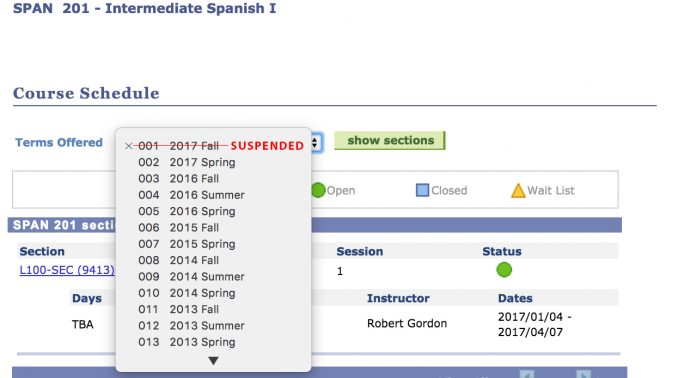
The Peak reached out to SFU vice-president academic and provost Peter Keller to find out the reasoning behind the suspension of the Spanish program. In a statement, Keller explained that the program suspension was approved on January 9, 2017 by the Senate, where “this program, like other language programs offered by or through the Language Training Institute, is under review for curriculum coherence, student demand, and the sustainability of allocation of instructional resources in light of low and declining enrollments. The program has not been terminated.”

“I have spoken to some students who are in upper-level course[s] who have now stopped taking upper-level courses because they have limited when they are available.” – Karlie Tessmer, SFU Student

While students currently enrolled in the certificate may be worried about not being able to complete the program, Keller added, “The review seeks to ensure access to language programs and models of delivery that have a broad appeal to our students. Existing students registered to take the Spanish Language Certificate are guaranteed completion, and the 100-level Spanish classes are continuing for general enrollment.”

Indeed, SFU student Claire Christie described to The Peak that she would have not been able to go on exchange to the Pontificia Universidad Calica de Chile: “You must have a B2 Spanish level and can prove you have completed four semesters of Spanish at your home university. It is not necessary to have completed the certificate for exchange purposes, [but] without those courses, I would not have passed the language requirement for exchange.”

She further stressed the importance of having some Spanish knowledge for others who may attend exchanges in other Spanish-speaking countries. “Other universities, such as a few in Mexico, do have courses [that are] taught in English, so there is no language requirement. However, I have talked to students who would not have felt comfortable going to Mexico had they not had the opportunity to learn some Spanish in advance.”

While it is clear that the program has not been terminated, both Tessmer and Christie have observed the slowing down of the university’s commitment to the program. Tessmer explained her feeling in regards to enrolling in upper-division Spanish courses. “I have spoken to some students who are in upper-level course[s] who have now stopped taking upper-level courses because they have limited when they are available. [They did this] to, in my mind’s eye, limit the amount of enrollment,” she said.

“It is very clear that during the past couple of years they made the program so inaccessible to force the numbers down, so it would appear that the program had less interest than it does because they do not want to keep putting money into it,” said Tessmer.

However, Keller assures that “the faculty of arts and social sciences remains fully committed to language instruction as a key part of an undergraduate education at SFU. The faculty offers courses in many languages including French, Mandarin, Japanese, Punjabi, Farsi (Persian), Arabic, Greek, German, Italian, and Latin, as well as Spanish.” Still, Tessmer is disappointed that she cannot continue with further Spanish courses after taking the intro course this semester.

She added, “I’m a mature student, and coming back to school for me, I chose SFU for a couple of different reasons. One of them is because of the opportunities that they have for traveling and doing study abroad, and the other one is the fact that they have the Spanish certificate.”

Back-to-back SFSS election debates see almost no attendance

0

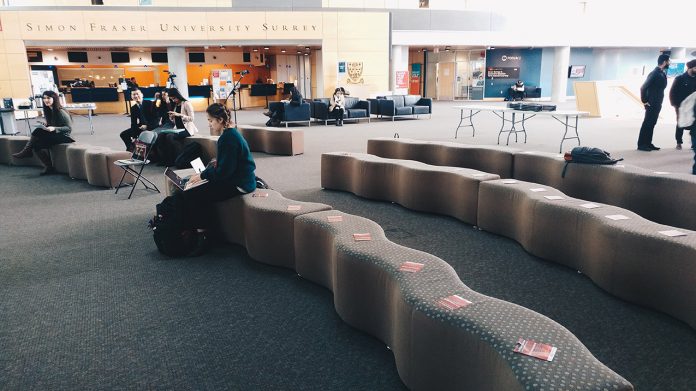
With the Simon Fraser Student Society (SFSS) general election on seemingly one of their tightest schedules in years, the debates came and went on March 16 and 17— and if the attendance is any indication, not many people knew about or prioritized it.

The amount of students who weren’t associated with a candidate, the Independent Electoral Commission (IEC), or the media never cracked more than 25. That’s about one-thousandth of the undergraduate student body who are eligible to vote in the upcoming election.

There were only two debates this year, as opposed to the usual three. The reason that the debate on Vancouver campus wasn’t conducted was based off a review of the past IEC Vanna Lodders, who said the cost of the debate wasn’t worth it for the campus with the consistently lowest turnout rate.

The debates took place on back-to-back days for the first time in recent memory, as in the past they have occurred in separate weeks. The final debate wrapped up 10 days before voting is set to open.

With several of the positions — including five of the six executive positions — running unopposed, there was limited debating. Instead, a lot of it felt like a Q&A period, which hopefully informed voters to the choices they’ll be making soon. The majority of those questions came straight from the IEC, as without a large audience there weren’t many questions the candidates had to field from the crowd.

HIGHLIGHTS

The biggest debate with the at-large representatives was over the Highland Pub, as candidate Robert Hanson is running primarily on the platform of saving the pub. While this isn’t traditionally the role of the at-large representative, it became the biggest issue the at-large candidates who did show up the debate had to face.

Education representative Jamie Zhu — who is running unopposed for the spot on the Board of Directors — did not show up to either debate.

Speaking of attendance, only two of the nine non-executive positions had all their candidates  show up to both debates. Those two were business representative (with candidates Gini Kuo and Braeden Peterson) and health sciences representative (with candidates Natalia Gretskaia and Aarushi Sharma).

The only executive position that did not have all candidates show up to both debates was vice-president (VP) finance, as candidate Tawanda Masawi missed the Burnaby debate. Both of his opponents — Baljinder Bains and Archit Bansal — and every other executive candidate made an appearance.

Alam Khehra, — candidate for VP student life — when asked about making sure all SFSS events would be physically accessible, said that the pub had an elevator. He then shifted to accessibility needs for Surrey and Vancouver students getting to Burnaby instead of addressing the questions asked over Twitter about the physically disabled.

Once again, there were questions about SFSS Chief Executive Officer Martin Wyant and the rest of the SFSS staff, including questioning about having a yearly governance audit. Presidential candidate Hangue Kim said an external auditor of the SFSS has just been hired, and they are still waiting for results.

For more in-depth coverage of the debates, please check twitter.com/peaksfu. A reminder that voting is open to students from March 27–30, and the results will be announced March 31.

World News Beat

0

Norway Norway named the happiest place on Earth

Much to Disney’s surprise, the World Happiness Report named Norway the happiest place on Earth, taking the coveted title from former first-place winner Denmark. The World Happiness Report measures “subjective well-being” — how happy the people are, and why. Denmark, Iceland, Switzerland, and Finland round out the top five. Canada came in at number seven. The United States didn’t even crack the top 10. The release of the World Happiness Report is meant to coincide with the United Nation’s International Day of Happiness, which took place on March 20.

With files from BBC News and WorldHappiness.Report

US Sesame Street Welcomes Muppet with Autism

Sesame Street is bringing more character diversity to the small screen by introducing Julia, an autistic character who will arrive on screen in April. Although autism exists on a spectrum, Julia will demonstrate some common characteristics. The other muppets tell Big Bird, who thinks she does not like him, that “[Julia] does things just a little differently.” Instead of ignoring Julia, they create a game where they all play together. Stacey Gordon is Julia’s puppeteer and her son is autistic. She told 60 Minutes, “Had my son’s friends been exposed to his behaviours through something that they had seen on TV. . . they might not have been frightened.”

With files from CBS News and BBC News

Peru Flooding in Peru Causes at Least 72 Deaths

Natural disaster has struck in Peru where intense rain and mudslides have led 811 cities in the region to declare emergency. The death toll has since risen to 72. Lima, Peru’s capital, has been without water services since early last week. The abundance of rain has caused the formation of pools of water in the streets, which attract disease-carrying mosquitoes. As a result of the crisis, food prices in the region have jumped by as much as 5%.

With files from CBC News and BBC News

Somalia Vine Star Creates Movement to Deliver Aid Amidst Famine in Somalia

In Somalia, severe drought has pushed the nation to famine. Now, more than 5 million Somalis are in immediate need for assistance. Last week a Vine star, Jérôme Jarre, created a GoFundMe page called the “Love Army for Somalia,” which has, to date, raised two million dollars with the help of celebrities such as Ben Stiller. Jarre’s creation of a public movement has brought awareness to the unfolding crisis, where Turkish airlines, the only place to currently fly directly to Mogadishu, the Somalian capital, stepped in to deliver the aid.

With files from Fox News, BBC News, and Al Jazeera News

Students hassled by unwelcome solicitors

0
Photo courtesy of SFU Student Central

There has been a recent spike in occurrences where students are being approached on campus and asked to donate money to different charitable causes.

On the SFU2016 Facebook page, which is dedicated to helping first-year students to connect with one another, there have been multiple posts where students describe being approached and asked to donate, and when students politely decline or provide any kind of reasoning, those that are soliciting the donations continue to push the issue. Sometimes this results in harsh words being exchanged.

Victoria Lee is one of the many students who have reported being asked for donations. In a statement to The Peak, Lee says that she was at the SFU Surrey campus with her friend on their way to the library when she was stopped by a man, described as a small Filipino man in his mid-20s, who was asking for donations for his charity. Despite politely declining, the man became angry, calling her friend (who is also Filipino) “white washed and unwilling to help [his] kind” and calling Lee “spoiled and ungrateful.”

Frank Wu, another student, witnessed such an incident when he saw a student withdrawing money from an ATM to satisfy the solicitor’s request. Having been approached by these solicitors before and after hearing about how they could be potential fraudsters, Wu decided to inform the student of this.

“The lady [. . .] was quite displeased with my interaction with the student and attempted to hit me with her scarf,” Wu said in a statement to The Peak. After calling campus security and informing them of the lady’s location, it took 10 minutes until security did show up. “I was upset that the school did not seem […] to prevent situations like this from happening [. . .] I hope [SFU] will continue to put in more effort to protect the students from being victims of fraudulent activities.”

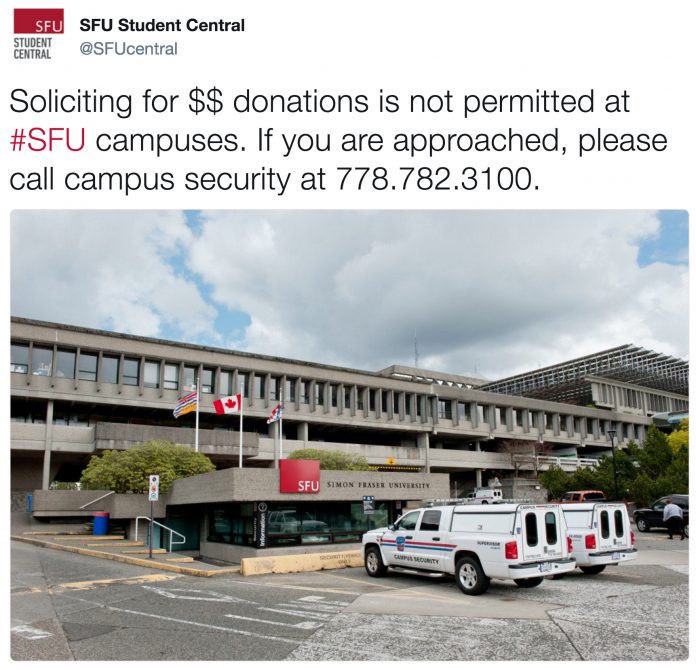
Steven MacLean, senior director of campus safety and security services, told The Peak that “SFU campus security is aware of reports of people soliciting students for donations, at times aggressively so,” and that “[t]his type of solicitation at any SFU campus is not authorized.”

Despite the fact that only a few formal complaints have been received and the fact that campus security officers have not yet physically encountered the people who are engaging in this activity, MacLean maintains that campus security “is taking proactive measures by heightening [their] profile in high-volume areas, particularly during meal hours and between classes.”

As mentioned in numerous posts via social media, SFU Student Central further emphasized the need for students to contact campus security at 778-782-3100 if they are approached by these people. Then they can provide campus security personnel with details of the incident as well as a description of the person(s) that are soliciting for donations. At the same time, students are reminded to remain vigilant of their surroundings as well as aware that this is not permitted on campus grounds.

SFU university communications was contacted with a request for statement, but The Peak received no comment by publication time.

SFSS art expo showcases student talent

0
Photo courtesy of Aritra Mukhopadhyay

A collaboration between a student club, ArtNet, and the Simon Fraser Student Society (SFSS) led to a student-initiated art expo called Becoming. It was hosted on the cloudy evening of the March 21 at the Diamond Alumni Centre at the Burnaby campus. Becoming was an open invitation event aimed at encouraging student engagement in various forms of art.

The event served food and had a cash bar for all attendees, which cozied the event’s atmosphere. With more than 10 art pieces spread across the room, students gathered around, sharing food and thoughts about all the pieces.

ArtNet’s vision — “To engage the SFU community and to create an art community that will inspire, educate and excite art enthusiasts” — echoed at the event as the artists and observers conversed. One of the artists, Rajdeep K. Grewal, expressed, “I did a poetry piece and I think it’s still raw, but I’m so excited that they chose to include it in the expo.” Grewal contributed a poem called “Post-Graduation Blob” under the literary art category. “The poem is a rendition and a compilation of my experiences, achievements and anxieties through my undergrad,” (s)he stated. Grewal recently graduated as a psychology major and stated that ArtNet genuinely fostered student creativity.

Becoming consisted of visual art, digital art, literary art, and art installations which was assembled on the day of — a multidisciplinary effort. The collaborators from SFSS’s Board of Directors, namely president Larissa Chen and at-large representative Mudi Bwakura, took active interest in the proceedings of the event as well as its organization. Chen explained why working with ArtNet on this event was one of a kind: “It’s about highlighting and empowering students groups to host events and projects by themselves, rather than [the] SFSS organizing campus activities; grassroots approach and internal initiatives are always better.”

Adding to Chen, Bwakura explained how Becoming came into being. “The beauty of this event is that the organizer pitched the idea of an art expo to [the] SFSS, and we ensured that it was plausible financially — realistic in regards to the scope and expectation of the event. Most importantly, we made sure that we delivered an event that stayed true to its concept as well as SFSS’s mandate.”

He elaborated, “The Society is slowly steering towards such collaborative, proactive engagement with students where we can meet mid-way. However, there is always more response when the Society makes an effort as well; my email flooded with art submissions for today’s event.” Chen stressed, “When students reach out to us, we will do everything in our ability to support everyone.”  

ArtNet’s founder, Theo Lekan, is one of the main driving forces behind the vision and the student who reached out to SFSS about Becoming. When asked about the purpose of the art expo, Lekan said, “There wasn’t life at Burnaby in terms of art. I feel art adds more life to an environment and we wanted to foster an art community through ArtNet.”

ArtNet has organized other events such as Life Figure Joy, where students practiced drawing and sketching. Next semester, a printmaking workshop is underway, but Lekan stressed the importance of the art expo. “It emphasizes how students from different backgrounds and degrees could exist in one room and contribute to art,” he said. Contributors included a math student, a chemistry student, an athlete, and several other non-arts-related students.

A first-year IAT student, Aritra Mukhopadhyay, painted an art piece called “We are One” specifically for the expo overnight. He detailed how Becoming reminded him to embrace the artist within him, “I want SFSS and ArtNet to host more events of this nature so that I could get a platform to showcase my work constantly.” Mukhopadhyay’s work was a visual art piece of a Buddha wrapped in a leaf symbolic of enlightenment and as Buddha becoming one with the nature.

Lekan explained that such professional spaces boost a student’s confidence in pursuing their inner artist. Becoming centred on a perfect balance of student-based and student-led event that strengthens the SFU community and everyone open to it.

NDP Leadership Race Gets Underway

0

By: Benjamin Mussett

As the federal Conservative leadership race grows increasingly contentious with name-calling and allegations of cheating, the federal New Democratic Party (NDP) leadership contest has begun in somewhat more affable terms. On March 12, the NDP held their first debate, a bilingual affair, in the nation’s capital. Four competitors were present: Charlie Angus, Nikki Ashton, Guy Caron and Peter Julian, all current Members of Parliament (MPs) within the House of Commons. Indeed, it seemed like the four leadership hopefuls spent more time agreeing with each other than bitterly debating the party’s future. However, Jeff Hannah, a student at SFU studying Math and current president of the SFU NDP, was happy with what he saw.

“So far I would say that each of the four candidates would make an excellent leader, [though] at this point it is still very early on,” said Hannah.

The party, which currently has 44 seats in the 338-seat House, is looking to replace their current leader Thomas Mulcair after a 2015 election which saw the New Democrats lose 59 seats and give up their Official Opposition mantle to the Conservatives. Many in the media attributed the NDP’s disappointing showing to the party’s cautious campaign style as well as their decision to move the party rightward in hopes to gain greater support.

Eager to show that New Democrats were not wild-eyed spenders, the party embraced small-bore proposals based on a commitment to balance the budget,” wrote Evan Dyer of CBC News immediately following the election. The party’s promise to balance the budget indeed bore greater resemblance to the ruling Conservatives than to the party’s past proposals or the platform offered by the ultimately victorious Liberals.

“Ours is the most progressive platform in this election,” Justin Trudeau was often heard saying during the campaign. In fact, as Dyer points out, the Liberal leader had reason to say this. The Liberal platform “pitched a tax hike on the top one per cent of income earners, an aggressive infrastructure plan financed by deficits, means-tested child benefits and the legalization of marijuana.”

Hannah, too, expressed disappointment with how the 2015 campaign proceeded. “I think a lot of our campaign became lost in the balanced budget promise, and some of our more bold policies were forgotten,” said Hannah. “I think that the party needs to not be afraid of standing behind its bold ideas.” It is true that the NDP platform did feature some bold, progressive proposals including promises to “lower prescription drug costs by 30%” and repeal the controversial Bill C-51.

The NDP’s centrist approach in 2015 may help explain why the leadership candidates appear to be returning to the party’s leftist roots. At his campaign launch, Angus, a five-term MP from Timmins, Ontario, emphasized his working-class background offering a populist message although one that is decidedly inclusive and which touched on indigenous issues. Ashton, a young MP from Manitoba, has delivered a similarly populist vision. “We need strong leadership to stand up to the elites in Canada and the elite politics […] that are holding us back,” said Ashton at her own campaign lunch. A major advocate for indigenous and women’s issues, Ashton gained some notoriety after she personally campaigned for Senator Bernie Sanders in last year’s Democratic primary despite being a sitting MP.

Caron, a former labour economist and MP from Quebec, entered the fray with a promise to “replace social programs with a basic income for all Canadians.” It’s an unlikely fiscal policy for the Conservative party to get behind — however, it now appears that the NDP is again targeting those left-wing voters who were wooed by the Liberals in 2015. “Progressives recognize basic income as an important tool in fighting inequality and levelling the economic playing field,” said Caron.

Lastly Julian, the first to put his name in the race and an MP representing New Westminster, has said that, Canadians need a government that prioritizes inclusivity, clean energy, and education for all.” Julian has specifically proposed eliminating tuition at post-secondary institutions, phasing out Canada’s use of fossil fuels and a greater commitment to affordable housing. All proposals which would be welcomed by the country’s political progressives, many of whom have felt let down by the Liberal government’s broken promises on electoral reform, the environment, and Indigenous issues.

“It’s not enough to simply be left-wing. Our next leader has to be able to communicate to Canadians that the NDP’s platform is in their best interest, and that the NDP is the party that will have their backs,” said Hannah. This sentiment identified another weakness in the NDP’s 2015 showing: Mulcair had trouble connecting with voters. The current NDP leader thrives as a rousing debater in the House, yet Mulcair sometimes appeared awkward and stiff on the campaign trail. Trudeau, however, who has now reached international rockstar-dom, excels in these types of public situations.

There is a long time before party members go to vote for their new leader in the fall and the deadline for candidates to enter the race isn’t until July 3. Expect more to throw their hat in the ring. And while future debates won’t be as friendly as the first, it can be guaranteed that the main target of all competitors will likely be Justin Trudeau’s Liberal Party. “We played it too safe. We let the Liberals out-left us,” Ashton said at the debate, in reference to the NDP’s 2015 campaign.

With files from CBC News, the Globe and Mail, the Toronto Star, Huffington Post, the National Post, Maclean’s Magazine, National Observer and Windsor Star.

SFU men’s golf finish in sixth place at Cal Baptist Invitational

0

By: James Matthews


In a season that’s growing with promise each tournament, SFU men’s golf continued their upwards trend this week. March 20 and 21 saw the Clan travel to Corona, California to take part in the California Baptist University Invitational. The team finished 27-over-par, good enough for a spot at sixth on the team leaderboard. The Clan appear to be distancing themselves from an ugly 19th-place finish at the Stockton Cactus Thaw in February.


As was the case in last week’s Notre Dame de Namur Invitational, the field shot two rounds on the first day of the tournament. BYU-Hawaii flew home with a first-place finish. They are first team not named California Baptist University to win a tournament in which the Clan appeared in this spring.


For the Clan, Kevin Vigna paced the team in day one He paired a season-low one-under-71 with a second round 75 on day one. His two-over scorecard had him 11th on the individual leaderboard, the highest finish of any Clan teammate. Those teammates all finished with scores in the mid to high 70s. This consistency was vital for the Clan to stay in contention at seventh place on the team leaderboard.


“Everyone contributed and all five players showed up on the leaderboard,” said coach Matt Steinbach. “We stayed calm, we stayed patient, and overall, we did a really good job.”


By all accounts, however, it was an uncharacteristic first day from Chris Crisologo. This made day two even more memorable as the junior signed off on the tournament’s best scorecard. Crisologo’s four-under-68 put him into a tie for the individual clubhouse lead for the day.


“When you can manage a tougher round and keep it under control that’s the sign of a great golfer. In day two, he had that look in his eye, and we could all tell he was going to have a great day.”


Also of note was Craig Titterington. He responded from dual seven-over (79) rounds in day one with a team-second-best one-over (73). “It’s a difficult course and he had played well the day before, but he played a very solid round.”


Next tournament: The Clan must pay close attention to their map as for the first time this spring, the team will play in a tournament outside of California. Instead, it will be Idaho where the Clan tees off with day one of the Northwest Nazarene Invitational set for March 27 in Nampa.

SFU softball drop both games against Central Washington

0

With numerous weather delays and cancellations to start the season, SFU softball is now in the thick of things in the regular season. After splitting the doubleheader against Saint Martin’s to start the homestand, the Clan wasn’t able to make it three wins out of four over the weekend, as they lost both games to Central Washington 112 and 101 respectively.


In the first game, SFU came out sluggish, as Central Washington came out to a 40 lead after the top of the third inning. A Taylor Ferleman single to centre field scored two runs, while a Kayla Ellis sacrifice fly scored another. The Clan managed to claw two runs back, as Taylor Gillis batted a single to score one run in the bottom of the third, while a Robyn Mogavero infield fly scored Hailey Gearey to bring the score to 42.


After that though it was all Wildcats. Kayla Ellis drove in one run with two outs in the bottom of the fifth to make it 52. Three straight two-run home runs two of which came in the sixth inning made the final score 112. Alia Stachoski got the start, giving up 10 hits and seven runs in 5.2 innings of work while striking out three batters.


SFU didn’t fare too much better in the second half of the doubleheader. After Central Washington made it 10 in the top of the first, the wheels completely fell off for the Clan. Taelor Griffin scored two off a pitcher’s error, and Rachael Johnson’s single scored one.


It got worse. A Kailyn Campbell double to right-centre field cashed in two runs, before the Wildcats tacked on two more to make it 101 after the top of the fifth. SFU’s Meghan Malkowich got the Clan’s lone run of the game after a solo shot to left field before the mercy rule was enacted. Tori Belton took the loss, giving up 14 hits in five innings.


“You never miss an opportunity to take advantage of a crisis and today’s games gave me an opportunity to play a bunch of kids and some of the kids had good outings,” said coach Mike Renney on the tough day out to SFU Athletics. “It was good for them that they got the innings they needed to get and it’s an investment in the future.”


The loss leaves SFU 69 on the season, and 24 in the conference good enough for seventh place although they have played significantly fewer games than other teams.


Next Game: SFU will take on Northwest Nazarene this Tuesday in another doubleheader. The Crusaders are currently 44 within the Great Northwest Athletic Conference, putting them in fifth place. They currently have the second-worst ERA in the conference with 5.46. Last year, SFU went 22 against Northwest Nazarene.


The first game is scheduled to start at 1 p.m., while the second game will start after at 3 p.m.