Home Blog Page 761

Tim Woinoski taking his swimming career the extra mile

0

Tim Woinoski’s swimming endeavours were destined to occur at SFU, given that Woinoski’s history with SFU goes way before his freshman year. Woinoski started swimming competitively in grade 10 and practiced swimming at SFU ever since. “I didn’t look at any other place except SFU when I [was] searching for universities to swim for,” Woinoski said. Currently in his third year, the swimmer dove into his beginnings in the sport.

Prior to grade 10, Woinoski wasn’t serious about the sport, but soon enough he started competing within BC through Swim Canada and ended up in the pools of Lorne Davies Complex longer than he had expected.

“Cory Beatt, my current coach, besides coach [Liam] Donnelly, has been training me ever since I joined the club team in high school,” he explained about the deeper ties Woinoski has to SFU. Fast-tracking to first year of varsity, Woinoski recollected his first training camp which added to his new experiences. He thoroughly enjoyed it with a familiar person such as Beatt around him.

“In my first year, you realize that it’s a different type of competition and get nervous. But I personally felt more relaxed and excited about swimming during dual meets,” Woinoski expressed.

Dual meets last approximately for two hours as compared to swim meets, and freshman Woinoski revelled during dual meets as he was entirely new to them. “It felt like you were swimming for something,” he said. One of the dual meets was hosted in California where Woinoski tasted the competition level as he swam against Division I competitors. He further said, “The team atmosphere is different as everyone starts to care for each other genuinely as you watch them compete in races. There’s an entire ‘team’ aspect to it that makes dual meets appealing.”

Besides dual meets, swim meets, or peak meets, SFU swimmers are mainly training for NCAA championships. Prior to the NCAAs, a swim meet enables goals at the beginning of every year. “These goals are tough and I was unable to meet my goals,” briefed Woinoski about his first-year trials for the NCAAs.

So, for the second year, Woinoski pushed harder on the same goals to try and be faster at his sport by training over summer. In trying, Woinoski scored a faster time on an 800m freestyle, but didn’t succeed in achieving his own goal in the 1,500m; but he qualified for the NCAA Division II national championships, regardless.

Competing in the NCAAs meant almost a dream come true for Woinoski. However, he added, “It made me remember why I swim. Meeting faster competitors really leaves you inspired.” However, Woinoski’s swimming trajectory has never been smooth, as he underperformed in certain swim meets while excelling in others.

Despite the uncertain ride, he qualified a second time for the NCAAs in his third year. His goal this year was to enlist himself as an all-American within the top eight as he had previously been placed at 10. Woinoski laughed, “It might sound corny, but it was a dream that I managed to achieve,” in regards to his overall wins.

A swimmer’s journey never stops as they continuously have to train and live on a routine. “We practice nine times a week for two hours and, sometimes, I double on Mondays, on Wednesday, and Fridays; getting up at 4 a.m. on most days,” explains Woinoski. The only days that Woinoski gets off are Sundays when he admittedly tries to sleep in. “There is no stopping to this,” Woinoski asserts, “as, from September to the middle of August, I’m required to train with only four weeks in between to relax.”

Despite the meticulousness of being a swimming athlete, Woinoski only wants to take things the extra mile. “I wish I could go to Mexico and compete in open waters, but time and money are constant constraints for me.” Woinoski liberally shared with The Peak his passion for swimming and beyond.

Time is a pressing concern for a student athlete. When asked about his technique for balancing school and swimming, Woinoski said, “You don’t. You just choose your battles.” A very particular and honest outlook from a student athlete, Woinoski explained, “I do not mind getting a B if that means more time to train and practice.”

Woinoski’s prompt answer left no doubt that opportunity costs are the bravest costs students take up. “Every athlete has to struggle between this tug of school and sports, and it’s definitely something we have to act upon with dedication,” he stated. As an engineering student, Woinoski stated that it would be very difficult to keep pushing himself if he didn’t love swimming as much as he does.

Fun Fact: What are your hobbies outside of swimming?

“I just sleep mostly, when I have the time.”

News Beat: Kinder Morgan Protest

0

On March 24th, A protest about the Kinder Morgan tank farm and pipeline was held at Gaglardi and Burnaby Mountain Parkway

Defeat of the far-right candidate in Dutch general elections

0

By: Manon Busseron

Prime Minister Mark Rutte’s party won the general elections held in the Netherlands on Wednesday, March 15. These elections were particularly important in the current European context, marked by the migratory crisis and the rise of far-right parties.

A measure of far-right movements’ popularity

Dutch citizens went to the polls to elect their new House of Representatives. 28 parties were competing for 150 seats. The voting process used is proportional representation, which means that if no party reaches a majority of 76 seats, the main parties will form a coalition and choose the candidate of the leading party to become Prime Minister.

This election was perceived as a way to measure the rise of far-right parties in the European Union. Indeed, the Freedom Party, led by Geert Wilders, was aiming to become leader in Parliament. His anti-immigration, anti-Islam, and anti-European opinions have echoed the discourses of Marine Le Pen (French leader of the National Front) and Frauke Petry (German leader of Alternative for Germany), when presidential and general elections are to be held in both countries.

The defeat of the far-right party

Prime Minister Mark Rutte’s People’s Party for Freedom and Democracy (centre-right) won 33 seats at Parliament, which means Rutte will probably remain in office after having formed a coalition with some other parties in the next weeks.

Although Wilders did not lead in the polls, he still reached second place with 20 seats, clearly behind the VVD, but winning 5 seats more compared to the last elections in 2012.

Christian Democratic Appeal (Christian-right) and Democrats 66 (centre-left) arrived in third place with 19 seats per party.

The other surprise of these elections was the rise of GroenLinks (green-left) led by the popular, “Dutch Trudeau“ Jesse Klaver, which won 16 seats — four times more than in the 2012 elections.

A victory against populism?

Many European countries welcomed the results with relief. German Chancellor Angela Merkel praised “a very pro-European result,” whereas European Commission President Jean-Claude Juncker considered that Dutch voted for “free and tolerant societies in a prosperous Europe.”

However, Wilders’ defeat should be treated cautiously. First of all, every other party refused to form a coalition with him, which means that Wilders would have been isolated even if he had led the elections. His becoming Prime Minister would thus have been very unlikely without a coalition to support him —unless he had won the majority of 76 seats.

Secondly, even if he failed to reach first place, Wilders managed to impose the themes of Islam and immigration during the campaign, promising “fewer Moroccans” in the Netherlands, the closure of mosques, and the ban of Qur’an (which he compared to Mein Kampf, Adolf Hitler’s autobiography). Dutch national identity was also a major theme in the campaign. Indeed, as a way to attract far-right voters, Prime Minister Rutte published an open letter to Dutch citizens, saying that those who “refuse to adapt and criticize our values” should “behave normally or go away.”

Nonetheless, these themes were overshadowed at the end of the campaign by the diplomatic crisis with Turkey. Indeed, Turkish ministers seeking the Turkish community’s support in the referendum about reinforcing presidential powers were denied entrance to the Netherlands and the meetings were cancelled. Turkish President Recep Tayyip Erdoğan reacted by calling Dutch governments “Nazis” and “fascists.” Prime Minister Rutte has remained firm and unwavering, which is likely to have worked in his favor for the elections.

Although Dutch electoral outcomes saw the defeat of the rising far-right party, populism is far from behind extinguished in Europe. The upcoming elections in France and Germany might not follow the same path.

With files from The Guardian, BBC, Le Monde, Reuters, and The Telegraph

Stuff We Don’t Like

0
(Elena Hsu / The Peak)

By: Vincent Justin Mitra

Stuff We Don’t Like: MacGyver (2016)

This modern reboot of an 80’s classic would make more sense as anything other than a MacGyver reboot. Starring Lucas Till and That Guy From CSI, the show adds into the mix a sexy hacker, for some reason, and gives MacGyver a roommate that fills all of the ‘black best friend’ stereotypes. Even the absurd “inventions,” a staple of classic MacGyver, are worse in the hands of this adaptation. A perfect example appears in one episode where, to evacuate civilians from a crowded hotel, Mac mixes some broom closet chemicals into a bucket before adding a wad of tinfoil to make some allegedly harmless smoke to set off the fire alarm. He could have also, y’know, pulled the fire alarm. In short, the new MacGyver reboot is, like his inventions, convoluted and unnecessary.

Stuff We Don’t Like: Powerless

This DC Comics comedy show has several recognizable faces. Abed from Community! The girl from High School Musical! The pilot from Firefly! Others! So it is surprising that the jokes are as obvious and predictable as a Disney Channel tween sitcom. It doesn’t have a laugh track, so that’s a plus, but that’s about it. The main character is perpetually cheerful, the co-worker is constantly abrasive, the boss is always incompetent; the clichés go on and on. Overall, Powerless has a super cast but civilian writing, and its biggest crime is that it is ‘sort of okay’ at best. And, in today’s world of blockbuster, five-star, spoil-the ending-and-our-friendship-is-over television, ‘okay’ is not a passing grade.

The Art of Having a Conversation About a Netflix Show You’ve Never Even Seen or Heard Of

0

We’ve all been there — faced with the question of, “Ohhh, have you seen [insert obscure name of show here]?” Yet you have not a fart-in-the-wind idea of what they’re talking about. But don’t worry, you have choices to escape the crossroad of feeling completely uncultured or just downright indifferent.


APPROACH 1
The Eager Beaver

This approach is for those good days when you’re feeling inquisitive, engaged, and patient. It usually begins, “No, I’ve never seen it, but what’s it about?” Then the dragon comes out of its cage. You could be in for a personal recital of a short novella about the show’s plot, character descriptions, and IMDB page of the director. . . but you asked. We’ll check back with you later.


APPROACH 2
Throw Me a Bone

You’re a nice person — but that doesn’t mean you want more than a simple drop of the show’s title and maybe a genre label. So you ask for a little help, something along the lines of, “No, I’ve never seen it. Is it similar to anything?” Well played, my friend. This way you can grasp onto something concrete that will actually help you remember to Google it later. . . or not.


APPROACH 3
The Judge Judy

You value your time. It was because of people like you that review websites were created and food critics exist — all time savers. If you wanted to waste your time trying new things that you potentially may or may not like, you’d be like everyone else . . . and you’re not into that. Your main interest in this mysterious series is  “How many seasons does it have?” “What else has the director worked on?” “Are the actors well-known?” You’re searching for a show to land you some serious cultural capital or bust.


APPROACH 4
The Polite Polly

You see their mouth moving, but you totally zoned out five minutes ago when they said the plot was “hard to explain.” You’re stuck. Questioning things further will only lead to them sending you funny GIFs from the show later and the expectation that you’re going to sink your teeth into all 48 seasons that night. Thankfully there’s an out! Tested and approved by a bitter research team of former BlockBuster employees comes the best response for when you have become oversaturated with information, “I’ll add it to my list of things to watch.” Just like that you’ve slipped blissfully out of the Netflix conversation and can piggyback onto [insert topic of your choice here].


APPROACH 5
The Game Over

This is when all the day’s energy has been spent and your inner demons collect to present your response as a greasy and blunt, “Nope.” The End.


SFU has been engaged so long that other schools start to worry

1

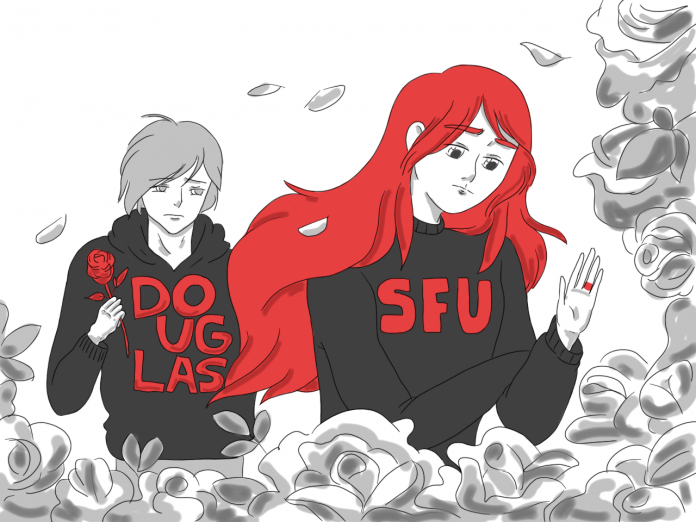
It has been five years since Simon Fraser University became the engaged university, and its friends are reportedly starting to fear that the wedding will never happen — the school will remain just a bridesmaid, never a bride.

Douglas College has gathered other friends for an intervention, and they want the university to commit to being more than just ‘engaged.’

“We saw the Facebook notification back in 2012, and we were so happy when Simon said they were engaged,” said Douglas College. “That was back when Kony was our biggest threat, when the whole world was going Gangnam Style.”

“But now, the school just turned 50 last year; they aren’t getting any younger. Are they gonna tie that knot?”

They aren’t the only ones who are concerned, and Capilano is suggesting there might be a bigger issue here.

“Whom are they even engaged to? We’ve all heard it, ‘Oh yeah, SFU is engaged, yes it’s totally real,’ but they’ve never once said whom they’re engaged to. Is it some kind of mysterious partner that lives in Finland? Did they just meet online and are gonna get married once they fly over here? Oh my god, is SFU getting catfished?” asked Cap.

Simon Fraser University has been reported to be ‘hostile’ and ‘oddly defensive’ when asked about their engagement.

“I don’t understand why people can’t take my word when I say something. I would obviously never lie for my own benefit!” exclaimed Simon Fraser University. “Maybe we just want to wait, the economy is in shambles. We’re just going to save up as much money as we can take from students. We’ll commit and take the next step when we know we’re more financially stable than we ever ethically would need to be.”

Douglas College might have an alternate angle, as rumours have been circulating that they have had feelings for Simon Fraser University for a long time, and want to act on it instead of SFU pretending to be engaged when they’re not.

“With the partnership that we see with how many of our students transfer to Simon, we just see so much of ourselves in them. We’ve been close for a while now, and that’s it. Should something happen, that would be nice, but it’s not like we want to be with them. Unless they want to be with us. Did they say something?” asked Douglas College, blushing.

“We know that on the outside, they look brutalist. But when you look deeper, you just see so much potential, you know? Sometimes, all you need is someone special to help you take that leap from turning potential into passion.”

At the time of publication, Douglas College was once again rebuffed by Simon Fraser University for dinner and a movie, with SFU saying they’re spending more time with whomever they are supposedly engaged to.

Artichoke Hearts

0

World News Beat

0

By: Ana Maria Meija-Morales

FRANCE – French candidate charged

François Fillon, candidate for the French presidency has been charged with embezzlement. The charge arrives after weeks of allegations of him paying his wife and children thousands of taxpayer’s euros for fake jobs. Fillon hasn’t stepped down in the presidential race, even after polls show his dramatic descent from front-runner to third place. The presidential race now puts centrist candidate Emmanuel Macron and far-right Marie Le Pen as the favorites amongst the French public. The polls indicate Macron will win the second round, yet analysts warn against early celebration after Britain’s EU exit vote and Donald Trump’s win.

With files from The New York Times and Al Jazeera

MEXICO – Skulls found in Mexico

Two hundred and fifty skulls were dug out in Mexico from what seem to be a drug cartel’s burial pits. The discovery was reported this week, yet the specifics of who discovered the bodies and how long ago are still unclear. Expecting to find more bodies, local authorities continue to dig near the city of Veracruz.

With files from BBC News

NETHERLANDS – Netherlands says ‘no’ to populism.

With populist ideals spreading around the world, the spotlight was turned to the Netherlands this past Wednesday as the Dutch headed to the polls. A relief was felt around the world as Prime Minister (PM) Mark Rutte was re-elected and far-right candidate Geert Wilders was defeated. The PM’s party won 33 out of 150 seats in parliament, making the party the majority. The focus remains in Europe as the French head to the ballots next month, as well as in Germany, where the right wing populist party Alternative for Germany (AfD) is running for seats in parliament.

With files from BBC News

KENYA – Kenya doctors end strike

After 100 days of strike, Kenyan doctors reached an agreement with the government concerning better working conditions and a rise in monthly salary. Doctors will now work for 40 hours per week, previously all doctors were on call, and according to BBC News, will be given an extra $560 to $700 for allowances. Patients have paid the largest toll during this time, many reportedly died due to the strike, and hospitals are now over capacity.

With files from BBC News and Al Jazeera

SFU NATO club makes groundbreaking partnership

0

Last year, The Peak reported on SFU’s first Global Model NATO (North Atlantic Treaty Association) Summit. Since then, SFU students Jazlyn Melnychuk, and Cornel Turdeanu, vice-president and president of SFU’s Model NATO club, with the help of Dr. Alex Moens (a SFU political science professor), have created a field school and partnership with the NATO Defense College.

NATO was created in 1949 at the beginning of the Cold War. Canada is one of the 12 founding members of the political and military alliance designed to protect and secure these countries through military and political means. Melnychuk sums up the current work of the association, stating, “Article five of their treaty states that ‘an attack on one nation is an attack on all.’ Since 2010, they have had core tasks like co-operative security, working with non-member states [by] helping them increase their capabilities, and in Afghanistan, through crisis management.”

The model NATO SFU club works to simulate some of these tasks, where Turdeanu explains, “So, we have 28 different people, each gets a different country . . . so you have to represent your country very faithfully, looking up their position on different subjects like cyber security.”

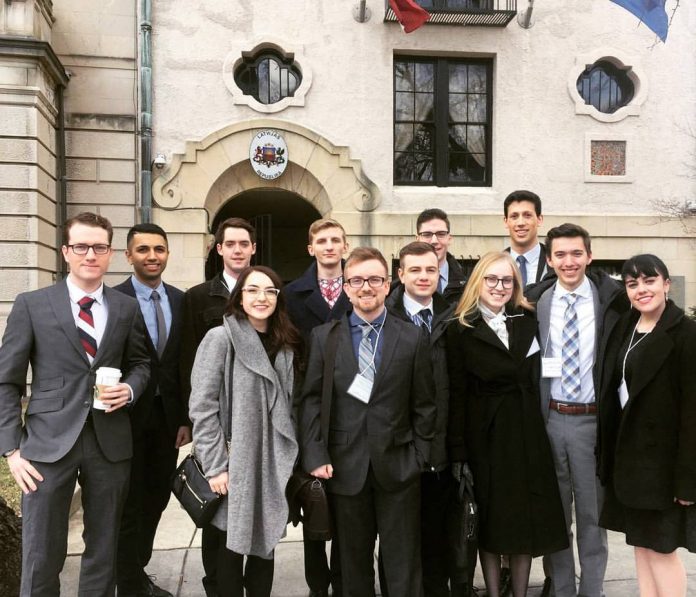
The club has received many awards for their simulations, most recently in Washington, DC for the 32nd annual international model NATO conference. At the conference, Melnychuk and Turdeanu expressed the challenging nature of this prestigious conference, “We knew it would be high level, and it was. There were schools there, including the Royal Military College of Canada and the US Air Force Academy, so these guys really knew their strategy and international relations.” However, 12 members of the society brought home the Superior Delegation Award, along with three other individual awards.

31 SFU students will be heading to Rome and Brussels for the new field school this May and June, learning from diplomats and experts in NATO defense and security studies. “They must think we are the Harvard of Canada or something,” recalls Turdeanu, as he explains the unprecedented partnership with SFU.

The partnership with the NATO Defense College is the first of its kind in which students will be a part of a four-day model NATO simulation. Melnychuk explains the significance of the partnership, adding, “[the NATO Defense College] are the ones that actually teach people who go on to become diplomats in NATO and they run crisis simulations for people who are actually working in NATO. So, we are getting the real experience.”

“I think it’s going to be a historic moment for us as a school and I think it’s going to open the door for a lot more collaboration between SFU and NATO,” states Turdeanu, adding that both himself and Melnychuk have had great opportunities to meet with influential diplomats and generals so far.

Melnychuk adds that she hopes the field school will “set the precedent for actually expanding to other students and other Canadian universities in the future, to engage more students in NATO.”

The club continues their work by meeting once a month and practicing their simulations. More information can be found on their website.