Home Blog Page 759

We need safer homeless shelters, not just more of them

0
EPSON MFP image

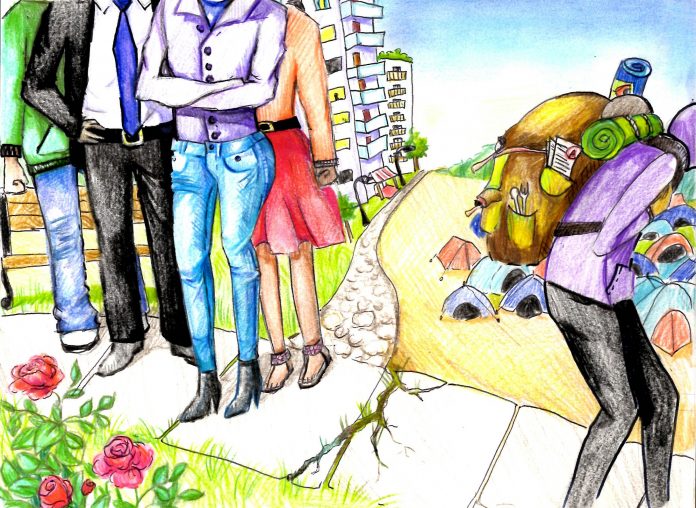
Right now, there are cities springing up within cities. The walls in these spaces are made of nylon and canvas rather than anything like brick, but in some ways, they’re stronger shelters than anything their predecessors have given to their less-privileged denizens.

They’re tent cities, and Vancouver wants nothing to do with them.

A tent city is essentially a gathering of tents as temporary residences set up by displaced people. A little over a week ago, a new tent city at 950 Main Street in the Downtown Eastside caught media attention: its organizers told CBC News that they wanted the parties participating in the upcoming electoral race to take notice and remember the growing homelessness problem in Vancouver.

As it normally does, Vancouver has told the residents of the tent city to leave, and that they’re violating the law. But where would the City of Vancouver like them to go?

We all know Vancouver apparently doesn’t have enough social housing to go around, but an interesting thing to note is this piece of commentary from Stephen Robinson, a resident of a then-recent tent city, seven months ago: as the CBC reported at the time, “He feels safer living in a tent than in a shelter.”

Underneath the struggle to introduce more shelters, there’s a more important battle to fight: making sure the spaces we try to provide people are actually safe places to be. We — and by that I mean both the average person and our governments — need to take notice of this stuff, take the words of those affected by homelessness seriously, and take some action.

Robinson’s is a sentiment echoed by many who’ve lived in shelters, or who’ve chosen to sleep in the streets specifically out of fear of the goings-on at shelters. Besides Robinson’s statements about theft, which often goes ignored by staff, people fear “violent” and otherwise abusive behaviour from other residents.

To an extent, disputes between residents of shelters are unavoidable. But such places should have staff who are properly trained to break up fights, to provide resources for less emotionally stable inhabitants, and to enforce rules that protect residents.

I understand that it’s difficult to navigate such situations, which often come down to “he-said-she-said” scenarios. But it’s absolutely critical to at least try to foster an environment that feels safe enough for someone to choose it over sleeping the streets.

Robinson also commented on the apathy of staff, a criticism true to many forms of shelter and supportive housing in the area. In 2015, a woman in a supportive housing building died alone in her room, and wasn’t found until enough people complained about a “stench” — and even then, the building initially refused to so much as check on the room.

Better documentation of those staying in your building is important, for obvious reasons. We can’t half-ass providing a public service — if we want to help people, let’s go all the way. Make it clear that you actually care who the people you’re hosting are, and answer the concerns of tenants instead of brushing them aside. I get that this requires more staff, and that’s hard, but if a person can lie rotting in a room without anyone realizing it, you have to realize you’re failing to meet a very basic standard.

There’s no point going to a shelter that doesn’t care what happens to you — as many see it, at least outside you know to take care of yourself and to choose who you trust your safety with. In a setting where you don’t decide who you share your living space with, you need the assurance that you will be safeguarded.

The organizers of the 950 Main Street tent city say that they’re calling for the new government to introduce 10, 000 social housing units to the city per year. Let’s make sure those units are worth living in.

Album Reviews

0

Humanz by Gorillaz

Review by Neil MacAlister

It’s been six long years since we last heard from Gorillaz, and the lack of a genre-defying cartoon band has left a noticeable void. In the wake of increasingly volatile political climates in both the US and the UK, Damon Albarn and Jamie Hewlett decided to reunite Gorillaz to soundtrack a party for the end of the world.

The guest list for this party ended up featuring a remarkable assortment of artists, both well-known and esoteric, each of which was reportedly asked by Albarn to “imagine a night where everything you believed in was turned on its head.” The result is a frantic, extravagant, chaotic collection of music. Albarn took a backseat to the featured artists on Humanz, giving space for his many collaborators to show off.

This is probably Gorillaz’s most hip-hop heavy album, with features from Vince Staples, Danny Brown, Pusha T, De La Soul, and Zebra Katz. There’s a significant soul/R&B element as well, from established greats like Mavis Staples and Grace Jones to up-and-comers like Ray BLK, Peven Everett, and Kali Uchis. Albarn has a knack for playing artists to their strengths, and that’s never been more evident than on this album.

The only things lacking on Humanz are more vocals from Albarn himself (his one solo track, “Busted and Blue,” is an absolute highlight) and a general lack of cohesiveness. Humanz works more like a playlist than an album, with little connecting the 26 tracks together. Regardless, Gorillaz managed to curate an excellent project, brimming with ingenuity.


Pure Comedy by Father John Misty

Review by Neil MacAlister

        On Pure Comedy, Father John Misty takes critical aim at everything, everywhere, all at once. If this seems ambitious, it’s because it is: a sprawling, 75-minute album is what it takes for Misty to hold a mirror to the world and laugh at the tragic absurdity. It’s profoundly verbose, and while Misty’s observations seem pretentious and cynical, there’s an undercurrent of hope that keeps Pure Comedy from descending into insufferable ennui.

Each song is its own little diagram of absurdity and idiocy, as Misty admonishes modern society with his signature wit and eloquence. Pure Comedy’s centrepiece, “Leaving LA,” finds Misty taking on not just the absurdity of the city of LA, but the absurdity of Misty himself as “another white guy in 2017 / who takes himself too goddamn seriously.”

Misty’s work tends to be long-winded and pretentious, but like a folk-rock Kanye West, he’s aware of his pretension; luckily for us, his self-righteousness is overpowered by his profundity. Musically, it’s a beautiful album, with a stripped-back reliance on piano and guitar, and subtle string arrangements to evoke grandiose emotions. This is, undoubtedly, one of the best albums you’ll hear all year.

DAMN. by Kendrick Lamar

Review by Naeem Merali

In a society obsessed with robotic perfectionism, Kendrick Lamar presents us with a very human, raw, and honest 14-track LP in DAMN. This album stands out from his previous works as it is intensely more personal and rife with internal conflict. On the songs “HUMBLE.” and “PRIDE.”, Lamar gives us a front row seat to his thoughts on ego and how it affects his life.

On “LUST.”, we hear Lamar talk about how people can get trapped in their daily routines, as well as his thoughts on the recent US presidential election. “FEAR.” is arguably one of the best songs in Lamar’s entire discography, in which he discusses how his fears have evolved through life’s stages of childhood, adolescence, and adulthood. DAMN. is explosive, melancholy, and filled with sharp, expressive lyricism.

Religious themes are also prevalent throughout the record as the phrase “ain’t nobody prayin’ for me” is repeated several times, demonstrating that God and salvation play an important role in Lamar’s life. It would be difficult for anyone to compile their emotions, thoughts, and views on the chaos that is our world coherently, anyone but Kendrick Lamar that is. It’s safe to say he did a DAMN good job.


ALL-AMERIKKKAN BADA$$ by Joey Bada$$

Review by Naeem Merali


On ALL-AMERIKKKAN BADA$$, Joey Bada$$ stays true to his roots of boom-bap hip hop while remaining fresh and exciting. On Joey’s second full-length studio LP, he sounds more mature and experienced, and it’s clear from the opening track “GOOD MORNING AMERIKKKA” he has something to say. ALL-AMERIKKKAN BADA$$ is heavily political, discussing subjects such as police brutality, institutional racism, and the recent US presidential election.

ALL-AMERIKKKAN BADA$$ shows clear improvement in Joey’s writing style and ability to create focused, fleshed-out tracks. Joey Bada$$ also does an excellent job of incorporating sonically upbeat tracks such as “Devastated” to balance out the grimy sonic landscape in which he thrives.

It is also evident from the cohesiveness of the record that the featured artists are meticulously picked. For example, ScHoolboy Q fits perfectly on the hard-hitting standout track “ROCKABYE BABY.” ALL-AMERIKKKAN BADA$$ feels like a coming-of-age for the New York rapper with subject matter that appears to get more relevant as time passes.

The VPD should not be barred from Pride this year

0

In February, the Black Lives Matter (BLM) Vancouver chapter petitioned to have the police removed from the Vancouver Pride Parade. Their rationale is that doing so would be a “‘symbolic gesture’ and actual sign of support for [people of colour] and Black communities, and an attempt to bridge the divide that the effects of institutionalized racism impose.”

A counter-petition was launched to keep the Vancouver Police Department (VPD) in the parade (garnering twice as many signatures by the end of February), elaborating on the 40-plus years of collaboration between the VPD and the community. While BLM’s concerns are fair given the tense relationship between police and people of colour (PoC) around the world, I find myself agreeing that the VPD should not be banned from the parade.

There’s been widespread backlash to the BLM petition from LGBTQ+ activists. Velvet Steele, a prominent trans and sex worker rights advocate, stated that “we’re calling for inclusion” in response to complaints about police appearing in uniforms.

BLM has asserted that the police are “fundamental to the perpetuation of structural violence against Black and brown bodies in North America” and that their inclusion in Pride is “insulting to those who came before us to make Pride celebrations possible, some of who[m] even died for the cause.”

But this logic doesn’t account for differences between the VPD and the callous southern US police departments where police violence seems to be centred. It disregards the 40-year-old collaboration of the VPD and the LGBTQ+ community, from the first Gay and Lesbian / Police Liaison Committee in ‘77 to working with community leaders like Jim Deva and Malcolm Crane.

The cases in Vancouver, like the 2015 mistreatment of an imprisoned trans woman who was refused medical care and frequently misgendered, and the displacement of sex workers from the West End by the VPD in the ‘80s, are terrible moments in history for sure. Yet despite the obvious involvement of Vancouver police, the VPD as an institution is not itself wholly responsible.

The former case was one where a handful of officers acted unprofessionally and heinously; they were representing the VPD, and that institution should be held accountable, but I would hope that based on the previously noted positive history the Vancouver police has with the LGBTQ+ community, this was overall a misrepresentation of the VPD’s general stance rather than a signal of a trend. In the latter, the department was following an order from the Supreme Court, as they are obligated to do — yet we gloss over the political class’ role in these injustices and primarily blame the police.

The VPD’s record with the LGBTQ+ community, while not great, is not as pathetic as some would argue. If its leaders have decided to continue collaboration with the VPD, then that should be respected.

While there’s definitely overlap between Vancouver’s PoC and LGBTQ+ populace, BLM’s leadership is, in a sense, imposing their agenda on an event that isn’t theirs to control. Does the agenda of BLM, in its form as a political movement, mesh with that of Pride?

Unfortunately, evidence indicates otherwise. Last year’s Toronto Pride Parade came to a standstill after BLM activists refused to budge until their demands for removal of all-police floats and booths were met. In doing that, they trampled on another community’s interests a community with which they had no quarrel for the sake of making a statement.

Over the years, Pride has expanded its reach and inclusiveness, which is evidenced by the participation of racial and ethnic minority communities in the parade, which is wonderful. But one must be careful in not blurring the original vision and purpose of Pride. The decision of whether or not to allow our officers at Pride is one that should be left in the hands of Pride’s organizers and those most directly involved.

Suicide prevention means more than a net under a bridge

0

There’s a big gap between the amount of time/money/effort we wish organizations poured into mental health resources and initiatives, and the amount they actually do. A big part of California is hoping to bridge that gap with a net under an awfully literal bridge.

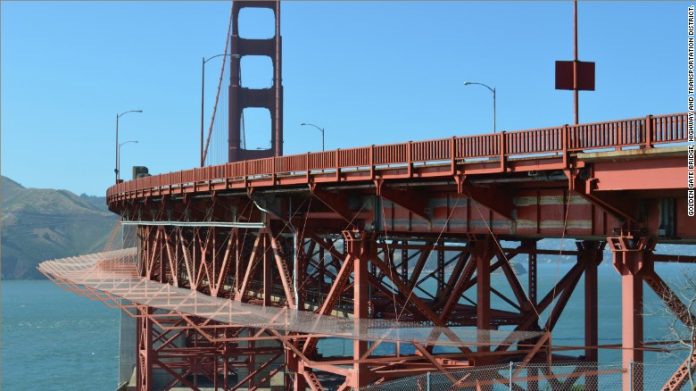
Last month, construction of a “suicide net” for the Golden Gate Bridge began. Each side will have a stainless steel net along its length designed to catch jumpers. They’re likely to survive with injuries, be unable to climb out of the net due to its slope, and get pulled out by a “retrieval device.”

It’ll take about four years to finish and cost about $211 million dollars. Don’t misunderstand: I’m happy that our North American governments are finally willing to make such big investments in protecting people with suicidal or self-destructive thoughts.

I’m just confused. Yes, the Golden Gate is one of the biggest suicide spots worldwide — not a moniker I take lightly. And yes, some studies reportedly claim that bridge barriers as a whole are effective deterrents.

But there are so many better ways to use four years and $211 million to help people before it gets this far. This may be a problem across the border, but it raises questions that are universally relevant.

Couldn’t that money fund research into depression and other mental illnesses? Or psychotherapeutic/psychiatric counselling services? What about advertising mental health services so that people know where to go to find aid in the first place, a surprisingly big barrier? Or, just anything that actually acknowledges and addresses the underlying problem — the mindsets and circumstances that lead to suicide?

All of these questions boil down to one. Why are we still so tied up in the physical act of suicide that it doesn’t occur to anyone that fixing the things leading up to it would be a more respectful and probably more effective preventative measure?

It’s not like California has been particularly on top of mental health. Even if the suicide rate in 2010 was lower than the national average, data from that time shows that about 50% of adults and roughly 65% of adolescents with significant mental health needs didn’t get proper counselling or otherwise have those needs met. That’s something to work on.

While studies performed at the Golden Gate and places like Washington, DC and Auckland, New Zealand support the view that barriers reduce suicides, there are plenty of studies, such as at Toronto’s Bloor Street Viaduct, that contradict this view.

Many of the pro-barrier studies have issues, too — Auckland had inconsistent results about whether or not a barrier changed suicide results, with different outcomes in different years. The DC study included a very small sample size when testing whether precluded jumpers at the Duke Ellington Memorial Bridge would try to jump from one other nearby bridge, without checking whether the overall suicide rate in the city had changed.

Though bridge barriers theoretically help keep people alive long enough to increase the odds of getting them professional aid, they don’t promote this outcome inherently more so than any other prevention method would. Instead, we should be focussing more on getting people help from the beginning.

It’s so, so easy to smile, cut a ribbon, and talk to the public about saving lives, the way figures like Senator Dianne Feinstein and even Nancy Pelosi have done. What we need to do is care about the long-term quality of those lives.

Dr. Sellout’s Whole-Day Miracle Cleanse

0

By: Vincent Justin Mitra

Are you looking to gain and/or lose weight? Do you have too many toxins, dioxins, and xeroxins oozing out of your pores and other orifices? Then try Dr. Sellout’s Miracle Cleanse! Other cleanses promise that their “special” food will push the negative sludge out of your body. Trust me, Dr. Sellout! I’ve been eating things to push other things out of my body for over 20 years! You’ve tried all those other cleanses that promised results; now try the one that promises nothing! It’s a miracle!

Breakfast : Double Hashbrown McGriddle

  • Do you need a quick morning pick-me-up available all day long before 11 a.m.? Look no further than your local McDonald’s! This one’s pretty simple, and you won’t even need your kitchen!

    Just order a Sausage, Egg, & Cheese McGriddle and two McHashbrowns and you’ll be halfway there. This next part, however, is a lesson in portion control, so you won’t run out of one before the other.

    While I’d never recommend either of these individually, what you need to do is alternate taking bites between them, so that they’re both sloshing around in your mouth at the same time. Don’t just stick the hash browns into the McGriddle; that’ll mess up the proportions, and is a total sucker’s move. You’re not a sucker, are you?

Lunch : Day-old Subway

  • Here’s one for you vegetarians. You go to a Subway. You get some tuna. A foot-long honey oat. Cheese and toasted? Yes, please. Lettuce, a bit more. A lot of barbeque sauce — some more. Some honey mustard. (A bit of yellow mustard too, if you’re feeling adventurous.) You get salt, and pepper. You ask them to cut it in half and wrap them separately. They go into the same bag.

    Boom, two meals right there. You can eat one now, if you’d like, but tie up the bag and let the other one sit for 24 to 30 hours. This is key. Any earlier and you might as well not wait; any later and it turns to trash. You’re welcome.

Dinner : Smucker’s Strawberry Jam Chili

  • A good ol’ three-bean beef chili, just like your passive-aggressive grandmother used to make. . . but with a more youthful, sugary addition to help cut the tension.

    The first step is to make some chili. Beef tastes better, but turkey is better for you. It’s up to you. I just don’t see why you’d ask me if you won’t listen to my advice — no, it’s fine. When that’s all set and bubbling away, add around half a jar of Smucker’s Strawberry Jam. We’re eyeballing it here. When I was your age, we had to do without numbered measuring cups, I’ll have you know. Our numbers all had to be melted down to help the war and we were glad to do it.

Dessert : Dorito S’mores

  • This outdoorsy favourite combines a few kitchen mainstays with man’s eighth-greatest invention: fire!

    First, roast a marshmallow over a campfire until the marshmallow turns a nice acorn brown. Use a stick from the forest floor for added flavour. (If you don’t have access to a campfire, a pile of matches or a microwave will do in a pinch.)

    Next, grab two Doritos Jalapeno Cheddar triangles and use them to pull the marshmallow off the stick, sandwiching it between the two chips. Then you eat it! Can’t you just feel the toxins flush out-of/into your body?

The End of an Era

1

Students were shocked to learn that the Simon Fraser Student Society (SFSS) had decided to end their food and beverage services (FBS) forever on June 15. What was more surprising was to hear that the Highland Pub had been permanently closed with little to no warning on April 28. Whether or not you liked the Highland (or any of the other services for that matter), students are having a hard time coming to terms with the SFSS Board of Directors’ decision.

Without Warning
Robert Hanson has been working with FBS for a year now in the Higher Grounds Coffee Shop. He and his co-worker Wilson Adhikari are just two of the many people who will be losing their jobs once the service shuts down.

“I got an email from the manager a day before the public got notified,” said Hanson about the news that FBS was shutting down. “I think it was a huge disappointment, especially a week after the SFSS elections. There was no mention of the closure at all during the elections and then to just drop it on us without any consultation as students was very disappointing.”

Adhikari agreed that the notice to FBS workers was handled in a very unprofessional manner. “For the students who are a lot younger, it’s not as big of a deal, but there’ve been people working there for a decade, you know. People with families, . . . rent, mortgages, whatever . . . And those people got let go on a whim’s notice. We only got, I think it was two weeks, week and a half, notice before the 28th. So it was really short notice . . . they definitely could’ve handled it better, for sure, to say the least.”

Second-year student Meera Champawat was home in Oregon when she heard the news of the FBS closure.

“It seemed really out of the blue and sudden,” said Champawat. “I didn’t feel like we were given any warning and I feel like we, as the students of SFU, should’ve had more of an opportunity to have a say in that decision . . . [C]ause it’s not even them just closing down one or letting us know that they have a plan in place to like make changes . . . [T]o me it just feels like saying, ‘Welp, we’re closing them down.’ That’s it.”

Despite posts saying FBS would be closing in June, the SFSS made a subdued announcement that the pub (and by effect, the Ladle, as they share a kitchen) would be shutting down for good on April 28.

“I remember that the Costings that we were all seeing were saying, ‘We are going to close them permanently, but not until June.’ And that the fact that they’re already closed seems [ Champawat shrugged]. Why say they were going to be open till June?” asked Champawat, a sentiment echoed by many students.

Adhikari said people coming to Higher Grounds are still unaware of the closure and surprised to find that The Ladle has already ceased their services. “They come and they’re like, ‘No soups today?’ and it’s like, ‘No soups forever[,]’” he said. “ . . . It’s like that Seinfeld episode, you know, ‘No soup for you!’”

What did the SFSS do?
It’s no big secret that the pub was failing. Many are aware that the Highland was running a half-a-million-dollar deficit each year, which was a major reason for the summer closure last year.

“It’s not recent; it’s not just the last year where there has been a deficit,” said SFSS President Hangue Kim. “There have been deficits for years and it has ranged from 350 to 500 thousand dollars. The last year’s board just made the decision and said that it wasn’t an efficient use of student dollars.”

“[E]vidently this was a decision that previous boards also wanted to make,” said former SFSS president Larissa Chen, who echoed Kim’s statements. “There’s always been, you know, reports that are released or . . .  features in The Peak where it does talk about the deficit that the pub does face and a lot of the other barriers . . . [W]e had a few interviews during the summer, I believe, and in the fall recently where we did talk about it and . . . multiple presentations from . . . management as well, staff saying ‘Hey, here are the obstacles that we face.’”

The Highland had many issues to deal with thanks to strict advertising policies. “There’s a lot of limitations set up on us as an organization as well based on policies by the university, based on how and what we can market in terms of any pub events happening, or anything like that. So that was a big contributing factor as well,” said Kim. “We did look for ways . . . to improve it. We changed the leadership for the space, we changed menus, we introduced loyalty programs, we tried hosting more events . . .”

FBS manager John Flipse declined to comment on the closure and his time with the organization. Chen also cited declining turnout to events at the pub and the rising cost of food and alcohol as reasons why the pub was suffering. “[S]tudents definitely want to be very . . . fiscally responsible, or at least they try to be.”

Still, it was a hard choice for the board to make.

“It did weigh heavy on the board. It wasn’t an easy decision,” said Kim. “There was a lot of discussion that happened at the board table and what was really important was even for the staff’s sake, we want to say thank you even for the amount of years of service that they provided the student society and the students.”

“Personally, I’m really disappointed, right? The pub was a place that I got to meet a lot of new people, got to go to a lot of student events, and evidently it’s a really important social space on campus for not just students, but like . . . faculty members — staff — to go and utilize,” said Chen.

Chen also stated that there were some student consultations. “I think that one of the key factors for why there wasn’t more consultation, . . . [was that] there was a special general meeting, I believe, in 2015 where it was brought to a vote . . . [T]here’s a question put on the ballot that was asking . . . here’s the amount of money that the pub loses annually year after year, do you still support having like FBS services? And students said ‘yes’ . . . But one of the key factors in that one was, I believe, the union was really involved in it evidently[.]”

Chen acknowledged that this is part of the union protecting its members. “[T]he union was really focused on protecting their employment, as they should,” she said. Ultimately, it came down to the financials, said Chen. “ . . . [W]e do want to provide that social space for students . . . but . . . the board doesn’t believe that students should be the ones paying up the tab when it does go into a deficit[.]”

Despite the best of intentions by the SFSS, students are still outraged by the lack of consultation. “[T]hey [the SFSS] should have done more consultations with the student body before making this decision. And I think that they let us down by shutting down food and beverage services. It’s a very important service for students and for the SFU community and without it, I think it undermines the legitimacy of the SFSS in general to not have the service,” said Hanson.

“Well, the biggest thing is . . . I really believe that they should be more transparent. They should be more transparent with how the administration is run because . . . it’s really easy to abuse a system that [has] been set in place,” said Adhikari. “ . . . [T]hey had a month left in their term and it was done and somehow that was kept secret as well . . . [S]omething as big as closing down a whole department . . . there’s [sic] lots of people losing their jobs. So it’s not like just closing down, like, a small little store or something.”

He also believes that the service is more important than the price tag. “[M]oney should be spent in places where it needs to be, where it can benefit the students and sure, we may lose some, but you know we’re not here to make money . . . it’s just a service[.]”

What did we lose?
Let’s be real here: the Highland was not the greatest food option on campus. The quality was not reflective of the price, and not in a good way. Even the Ladle was lacking options after it moved beside Higher Grounds. So what are students losing?

“[T]he best part of the pub was . . . having this nice space to go and hang out with friends,” said Champawat. “ . . . [T]here aren’t that many community spaces at SFU where you get to, like, hang out with your friends. There are either study spaces or classrooms for the most part, so I’m gonna miss having somewhere to just kinda hang out with friends.”

Chen said that some of the strongest opinions about the closure of the pub have come from students no longer going to SFU. “[T]here’s [sic] also a lot of alumni who had really fond memories of their experiences back when they were attending SFU and coming to the pub,” she said.

Adhikari is concerned for all the first-years who will never get to have a drink at the Highland; a rite of passage for many SFU students. “There’s [sic] so many experiences that are shutting down,” he said.

“SFU Burnaby campus is relatively isolated ‘cause we’re literally on a mountain,” said Champawat. “And there’s [sic] not very many other places around for us to get food or spend time with our friends and so I do think that it could have been handled better and that the SFSS should definitely be making some sort of plan to remedy that situation . . . [T]he library isn’t exactly a place you hang out, you go there to study. So I feel like we as students are losing something and the SFSS hasn’t asked us what they should do about it or what we would like to see done.”

Adhikari also said he’s going to miss the student aspect of FBS. “You’re coming here for service from the students . . . it’s not some corporate image that people have to represent, you know, it’s just everyday people just like you, students . . . [The] majority of the time, they care about the school; they care about what happens.”

What happens next?
“I have no idea,” said Hanson, when asked about what the space will be used for next. “I’ve heard rumours of privatization, but I doubt that’s going to happen.”

Adhikari was also against privatization. “Well, I would think it would be not that great,” he said. “From what I heard, SFU was against corporate chains in the first place which is the reason why shops like Renaissance and stuff were able to . . . open up.”

Kim said there are no official plans for the space as of yet. “ . . . I think that the biggest thing that our new board is going to look into is exploring options for how we can engage with the students again and look for different ways, different avenues to support students,” he said.

Chen encouraged students to still use the space in the interim. “There’s still the space there and there’s still the opportunity for events to be hosted and there’s still an opportunity for another group to come in and, you know, have that space available for students,” she said.

Adhikari hopes the SFSS will consider listening to students more when they make decisions about the space in the future. “[U]ltimately, you know it’s not just the one-year term that you’re here for, that you’re doing this for. You have to think big picture with the decisions that you make . . . how much they’re going to affect the students later on[.]”

With files from Cecile Favron.

SFU plans big changes to campus food options

1
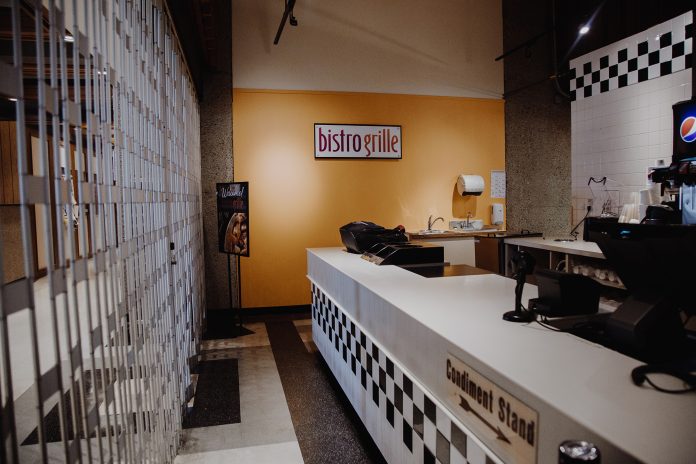
The Bistro Grille replaces Triple O’s on the second floor of the AQ.

Students will notice this semester that major changes are underway for food options on Burnaby campus. SFU has closed Triple O’s on the second floor of the Academic Quadrangle (AQ) and will be replacing it with an in-house restaurant called Bistro Grille. The Tim Hortons Express located in West Mall Centre has also been permanently shut down.

Mark McLaughlin, director of SFU Ancillary Services, told The Peak that SFU will be closing Tim Hortons in a year if the company does not agree to provide fair trade options to students.

The changes are part of a long-term vision for dining services that will see nearly the entire AQ second floor and Tim Hortons space renovated with new restaurants introduced.

“Over the next few years, there will be construction, some interruptions,” said McLaughlin, noting that the renovations will be completed in stages. “We’re really trying to create great spaces for students.”

As renovations to the AQ are expected to start in a year, SFU decided to temporarily introduce the Bistro Grille to avoid paying a sizable franchise fee to Triple O’s. “The Triple O’s area, it’s aging and it’s in need of major renovation,” explained McLaughlin.

McLaughlin intends to enhance the seating area around the West Mall Tim Hortons this summer and start the construction of two new food vendors on either side of the area in the fall.

Earlier this year, SFU announced that it was changing food services operators and had awarded a new contract starting May 1 to Sodexo. The union representing cafeteria workers with past food services provider Chartwells, part of Compass Group Canada, reached an agreement with Sodexo guaranteeing that their contracts would be renewed.

The current contract with Tim Hortons will remain in place until the end of the spring semester next year, by which time SFU has demanded that the company adhere to their policy that requires a fair trade option.

“We’re giving ourselves one more year to lobby Tim Hortons to supply [a] fair trade offering on our campuses, and then if they don’t respond, we’ll be closing the Tim Hortons,” explained McLaughlin. “Sometimes somebody has to draw the line. We did it with Starbucks; we said they couldn’t come onto our campus until they had fair trade.”

SFU became a fair trade campus in 2012, and opened the first fair trade Starbucks in Canada in 2013. McLaughlin said that SFU has been asking Tim Hortons to provide just one fair trade coffee option on campus for years, but their requests have been ignored.

“We didn’t think we were asking for much, but [Tim Hortons] didn’t respond,” he noted. It is unclear what would replace the Tim Hortons if the university decided to close the chain.

McLaughlin is hopeful that the changes coming to food services on campus will improve the diversity of options and make the space more functional for students.

“We’ve taken dining to a whole other level,” he said.

World News Beat: French Election Edition

0

Today, May 7, France will pick from two candidates to elect their new president.

Marine Le Pen, leader of the Front National Party, has run on promises to eliminate the euro and reinstate the franc, follow the United Kingdom in its departure from the European Union, and substantially reduce immigration to France.

Her opponent, Emmanuel Macron, leader of the En Marche Party, promises a pro-European orientation in which the eurozone is strengthened. He also promises to strengthen borders and implement faster review processes for asylum seekers.

Macron led the first vote on April 23 with 23.75%; however, it is still unclear who will surge forward to win the May 7 vote. Either way, this election will be groundbreaking, as the candidates have, for the first time, beat out the two main parties from the final round.

With files from BBC News and The Telegraph.

World News Beat

0

By: Gabrielle McLaren

FRANCE French elections move on to the second round

The first round of votes in the French presidential election were held on April 23. As no candidate won the majority of the vote, the two top candidates will face each other in a second round this month. Emmanuel Macron, of the centrist En Marche Party, gathered 24% of the vote, followed by Marine Le Pen of the far-right Front National Party with 21%. The final vote will be held on May 7.  

With files from The Telegraph and The Guardian.

VENEZUELA Protests escalate as Venezuelan president plans constitution rewrite

Venezuelan President Nicolas Maduro put into motion a decree to rewrite the country’s constitution on May 1, bypassing political opponents with the creation of a constitutional assembly. The country has experienced widespread political dissatisfaction marked by protests in recent weeks and food shortages. The opposition has accused the constitutional assembly of being an attempt to delay the 2017 regional elections and the presidential election scheduled for 2018. Maduro’s opposers have created roadblocks and held demonstrations and the Brazilian Foreign Affairs Minister called the planned constitutional assembly a coup d’état. The current Venezuelan constitution was written under President Hugo Chavez in 1999.

With files from CBC News, Radio Canada, and BBC News.

RUSSIA Reports surface of men murdered for being gay in Chechnya

Human rights groups continue to voice allegations that men believed to be gay or bisexual are being imprisoned, tortured, and, in some cases, murdered by security forces in Russia’s Chechnya region. A spokesperson for Chechen leader Ramzan Kadyrov reportedly denied the persecution to a Russian news source. In addition to the allegations, the BBC reports that ‘cures’ for gay Russians are also common. Homosexuality was removed from Russia’s list of psychiatric disorders in 1999, but homophobia remains an issue in the country. Canada, among other countries, is facing internal pressure to respond while activist groups reach out to the Russian LGBTQ+ community.

With files from CBC News World, CBC News, and BBC News.

USA President Donald Trump marks 100 days in office

As of April 29, American President Donald Trump has officially been in office for 100 days. On May 1, the president’s re-election team aired a 30-second advertisement declaring these first 100 days a success, citing the approval of court justice Neil Gorsuch, increased independence for the US energy sector, and the biggest tax cut plan in the country’s history. However, Trump’s critics have noted that there is a lack of legislative framework for the promised tax cut and the president failed to push through various electoral promises such as changes to health care. The first version of the advertisement was pulled due to concerns that it violated federal law and military policy concerning active members taking part in partisan activity. For example, the video showed Trump shaking hands with the national security adviser while in uniform.
With files from the New York Times and Business Insider.

Three must-see events this month

0
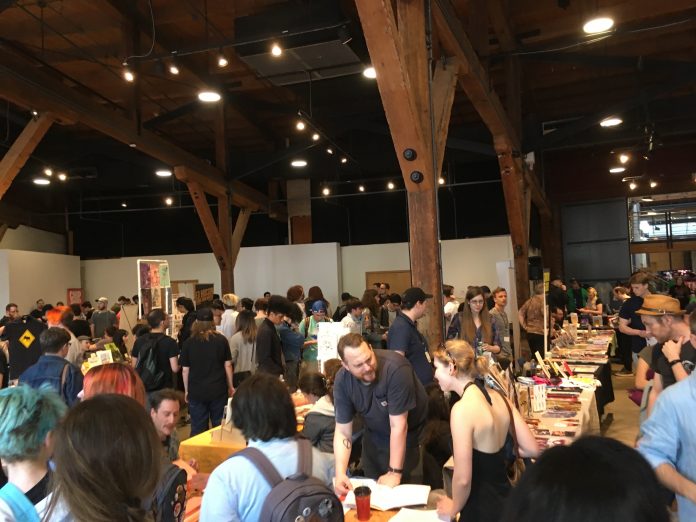
VanCAF, hosted in the Roundhouse community centre is a bustling congregation of graphic novel writers, illustrators, and readers.

May 19 — Existence as Resistance: Two Spirit Cultural Placeholders in Art, Activism, and Kinship: Artists and activists Jamie Lee Hamilton, Raven John, Tyler Alan Jacobs, and Trevor Blackman-Wulff will be discussing what it means to be Indigenous and queer. It is being organized through a partnership with the Queer Arts Festival and the Native Education College. This discussion will take place at the Native Education College from 7 p.m. to 9 p.m. For more information visit: http://queerartsfestival.com/event/existence-as-resistance/

May 20–21 — VanCAF: The Vancouver Comic Arts Festival is a two-day exposition of comics and graphic novels that will feature authors and illustrators from all over the globe. There will also be readings, panels, and workshops. The festival will take place at the Roundhouse Community Arts and Recreation Centre. Admission is free. For more information visit: http://www.vancaf.com

May 31 — The Critical Hit Show: Live improv comedy unfolds as performers play Dungeons & Dragons, the role-playing game. Ages 16-plus due to language and alcohol is available to those of legal age. The show is at the Rio Theatre, doors are at 7 p.m., and show starts at 8 p.m. For more information visit their Facebook page at: https://www.facebook.com/events/1884848981786237/