Home Blog Page 334

Your weekly SFU Horoscopes: June 21–27

0
An illustration of a girl with long flowing hair. Astrological signs and stars shine around her.
ILLUSTRATION: Marissa Ouyang / The Peak

By: Paige Riding, Copy Editor

ARIES: Everyone shuns you for the water containers piling up in your room, but what about the unabashed fake scenarios you fall asleep to each night? Thirsty doesn’t even begin to cut it, but I’m sure you can imagine what might.

TAURUS: Do you press the toaster lever down again in shame when your toast doesn’t toast enough, or do you suffer with slightly crisped bread? Why don’t all toasters toast toast to the same toastiness? Who the hell made toast a verb and a noun? After typing “toast” that much, I’m not even sure it’s a word at all.

GEMINI: Allergies scaring you and others during this pandemic? I’ve heard chasing a double Fireball shot with a snort of freshly cracked black pepper can help clear your sinuses. And your schedule. Because you’ll be dead.

CANCER: They never said falling in love was easy, but neither is mutually raising your eyebrows and trying to reach the outer edge of your bottom lip with your top teeth. Oh my god, with a look like that, maybe it is easy falling in love . . .

LEO: If you find yourself getting distracted during lectures, try buying a little tub of Play-Doh and fiddling with it. You’ll have no idea what your TA said, but you’ll end up with a dragon-turned-snake. Not a failure, but a happy accident. Right?

VIRGO: We’re heading back to school in person during your season. Honestly, I’m so glad it’s yours and not Leo’s. They’re still mad about their lack of Play-Doh skills and I just couldn’t handle more uncertainty about university.

LIBRA: Some guy in an IKEA parking lot once told me, “Love looks not with the eyes, but with the mind.” In your case, love kinda looks like a tall, glasses-endowed hunky cook. It’s, uh, it’s the Colonel from KFC. Maybe close your eyes and turn off your mind next time.

SCORPIO: Make a splash this week, Scorpio! Go to a lake that’s way too cold to swim in, dip one toe in, and then throw Leo’s failed Play-Doh concoction in to make them cry instead.

SAGITTARIUS: In a world full of Times New Roman typers, be an Arial one. Kind of annoying, but not bad enough for professors to really do anything to change you. You’ve broken the code. You’re dismantling higher education’s hierarchical structure as we speak.

CAPRICORN: You’re such a calm and collected sign. If I told you mischievous is actually pronounced “miss-chee-vis” and there is no extra “I,” you wouldn’t bat an eyelid. What if I also told you babies don’t develop tear ducts until three months, so that explains why Pisces is always trying to make up for lost time?

AQUARIUS: Accidentally closing all the tabs you were using is the least of your worries this week. You can restore them all quite easily, but can you now see your nose at the bottom of your vision since I pointed it out to you?

PISCES: The stars are showing me idioms to help you out this week, Pisces. They’re really lending me a hand. But one in the hand is worth two in the bush. But don’t beat around the bush. Also don’t beat a dead horse. But maybe hold your horses.

Top Ten future COVID-19 denier movies

0
Very calm, very cool. Nothing wrong here. Illustration: Siloam Yeung / The Peak

By: Craig Allan, SFU Student

  1. Maskless

Saidie Jennings has been in a long term relationship — with her mask. It kept her warm, anonymous, and safe from COVID-19. After reading a Twitter thread about how masks are choking hazards with microchips installed in them by Bill Gates to bring down NATO, Saidie is ditching her mask and finding out what life is like to go maskless and free.

  1. Vaxxx Attack!

Jenny Schnider thought she would be fine after getting her COVID-19 vaccine. Two weeks after she got her shot, while sitting in a bathtub, she was attacked by the Vaxxx Man! (By which we mean a text that she can book her second vaccine appointment.) Will this thriller end in a second dose of the vaccine or revenge?

  1. Vax Ass!

James Memphis and his out-of-control crew save the world from the dangers of social distancing and masks. They do so through the most gnarly stunts ever brought to the screen. Memphis and his crew go around America coughing, maskless, running through stores saying “COVID doesn’t exist,” and performing their chart-bottoming song “I Will Not Wear it on My Face.” All for the good of America!

This movie is dedicated to James Memphis, who died of COVID-19.

  1. Spitters Always Win

Jeremy Holken and Maria Vega are the operators of Spitoon, the largest competitive spitting competition in the world. However, their jobs are in danger when the government closes them down due to COVID-19. Jeremy and Maria plan to fight back against this terrible law and advocate for  the right to spit in each other’s mouths. It’s a fight against government tyranny and Big Brother. They are so mad, they will spit!

  1. My Imaginary Friend?

The parents of Carlie Short try to prove to their daughter that her best friend Corona does not exist. While Carlie, her teachers, and her pediatric doctor tell Carlie’s parents that Corona is real, her parents will do everything they can to convince her he is not. They’ll try everything — from switching her to home-schooling to ignoring those smallpox symptoms she is developing due to her parents ignoring her doctor’s advice to get the smallpox shot.

Stay tuned for the upcoming sequel My Imaginary Friend 2: Meet Polio! 

  1. The Virus-y Ducks

On their way to a championship, the Ducks peewee hockey team’s season is stopped due to COVID-19. Not wanting to give up on a championship, the Ducks will play against themselves for a championship. With the limited grace that only a group of 11-year-old boys can have, they are determined to fight back against COVID-19 and the league who tells them they can’t win the championship only facing themselves. 

  1. The Denier

After being bitten by a radioactive tweet, Carl Crave goes from a mild-mannered factual reporter into The Denier! With his newfound powers of ignorance and his new power move, The Karen Attack, Carl will go on to fight his various foes including Dr. Vaccine, MASK, and the (socially distanced) Space Man!

  1. The COVID-19 Bears

Cuddles, Hugs, Kisses, Snuggles, and Share are here to teach kids the importance of being close with your friends and families. This quintuple of soft, plush, teddy bears will also teach lessons like “Always greet a stranger with a hug” and “There’s never been anything wrong with an open taco bar!”

  1. No Space

Fearing that his doctor has been overtaken by the awful COVID-19 truther movement on their way to Mars, Sal Garrison is working on a plan to kill the converted doctor and show that COVID-19 is not real. Garrison will show Dr. Hawks that there should never be space between them, only out the window.

  1. Party Down in COVID Town

With his parents in the hospital, Terry Carter is going to throw the biggest rager ever at his house. There will be kissing, tight spaces, and the only people wearing masks will be those weird guys dressed in all black who keep putting their parents’ most priceless items into bags. Will he play tonsil hockey with his love, Alice Jensen? Will he convince the cops that this isn’t a COVID-19 party? Come and find out!

Disabled students deserve an accessible campus

1
Bureaucratic processes to hostile infrastructure make SFU’s accessibility less than adequate. PHOTO: Kriti Monga / The Peak

By: Anonymous, SFU Student

I’m an undergraduate student who lived on campus for two years out of necessity. I live with disabilities that affect my balance and can make walking extra distances exhausting. Even when the campus isn’t a labyrinth of construction, it’s a maze of stairs and broken elevators. SFU is an accessibility nightmare for people like me.

Even before the additional barriers from SFU’s careless choices since the start of the COVID-19 pandemic, the administration was failing to address many disabled students’ needs. With the inaccessibility of the Centre for Accessible Learning (CAL), departments lacking compassion, and a failure to consider disability justice in its planning, SFU already routinely ignored us.

CAL’s accommodation process is lengthy, can include financial barriers, and requires more time and energy than students have between semesters. Even with documentation, accommodations are sometimes inadequate and may be denied altogether. Much of the documentation must be done by specialists, who can take months to see and who may not complete forms in a timely manner or at all.

Even when students get accommodations, SFU’s campus is incompatible with many students’ needs. SFU’s physical access guide has not been updated since 2002. It does not reflect today’s campus and student needs. Our administration should be ashamed. With constant renovations, elevators are often closed off without notice. Even when elevators break unexpectedly, it can take some digging to find where to report issues. 

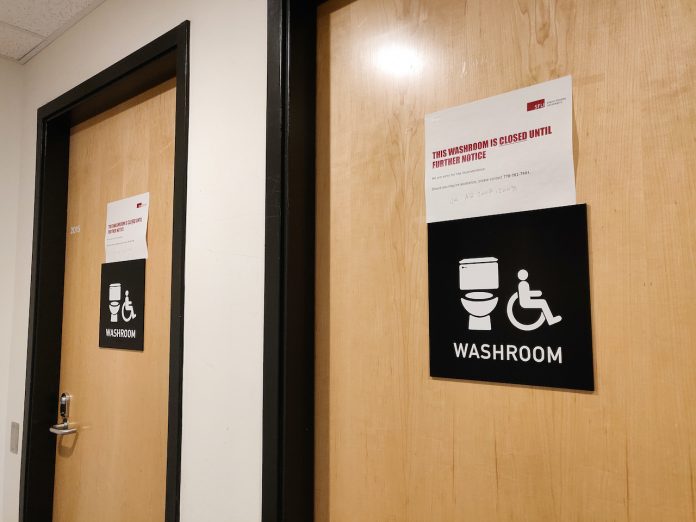
Many accessible washroom stalls and entire single-stall washrooms have been closed for social distancing. For students who use wheelchairs or other mobility aids, it’s especially important to keep these washrooms accessible. I need frequent and urgent access to washrooms, especially with symptoms including incontinence and urgency. It’s frustrating as a non-binary disabled person to lose access to gender-neutral washrooms and have most other stalls closed off. 

Living on campus, I would often make urgent washroom stops when just walking to the store and back, but lost that access when SFU chose to close so many single-stall washrooms during the pandemic. I need SFU to make an effort to prioritize student and faculty needs before they bring more students back to campus, and to communicate changes to the buildings that especially impact disabled people. 

I’m exhausted with SFU’s carelessness when it comes to disabled students, but not surprised. Disabled students are not disposable, and SFU needs to recognize that.

BC raises minimum wage to $15.20 per hour

0
PHOTO: Brian Lundquist / Unsplash

Written by: Jaymee Salisi, News Writer 

On June 1, 2021, BC raised its minimum wage from $14.60 per hour to $15.20, making the province’s base rate the second highest in the country.

In an effort to benefit nearly 400,000 British Columbians earning minimum wage, the provincial government has been annually increasing rates according to inflation by at least one dollar since 2018. 

According to the Government of BC, over 20% of the province’s workers earn below $15 per hour — 61% of that number being people in couples who must provide for their families.

In an interview with The Peak, director of the labour studies program Kendra Strauss said the minimum income needed for a worker to meet their basic living needs in Vancouver amounts to “above $20 an hour.” 

Because of this, she said $15.20 is a good start, but is still not enough to provide minimum wage workers a liveable payment. “The minimum wage [increase] is definitely an improvement, but it is not going to resolve the challenges for people who need to live off that wage.”

The advancement also applies to liquor servers, who were earning below minimum wage at $13.95 per hour in 2020. Liquor servers in BC received lower than minimum wage until the increase because of the tips supplementing their earnings, Strauss said.

She said situations like the pandemic — in which a predictable number of customers cannot be relied on — has highlighted issues associated with lower wage rates. 

“It’s actually immigrant and racialized workers who are often most concentrated in low wage jobs. And they are people who may be trying to support a family on one or two minimum wage jobs within the household.”

She said large companies like McDonalds, Tim Hortons, or Burger King, who pay most of their workers minimum wage “can definitely afford to pay more because they profit from this low wage model.

“When we don’t pay people a living wage, we pay for the costs of poverty in other ways through other kinds of social programs,” such as income assistance.

Strauss said the government’s decision to increase minimum wage rates began as a result of the BC Fair Wages Commission, established in 2017 and previously chaired by SFU professor Marjorie Griffin Cohen

She said the Commission looked at minimum wage in other provinces and found BC “had fallen behind relative to both the cost of living and other provinces.”

To rectify this, the Commission advised the government to match minimum wage with liveable wages and establish timelines which would eventually increase minimum wage to at least $15 per hour.

More information about BC’s minimum wage increase can be found here.

South Asians need a separate liberation movement

0
Asia's diversity means it can't be reduced into one movement. PHOTO: Wachiwit / iStock

By: Meera Eragoda, Editor-in-Chief

I can’t tell you the number of times a white or East Asian person was surprised that I, a Sri Lankan, am also considered Asian. Whenever Asian Heritage Month comes up, I know the majority of representation will go to East Asians, with barely any representation of Southeast and South Asians. This marginalization, along with the different struggles we all face, is part of the reason I think South Asians need a separate liberation movement. 

In the Harvard Kennedy School Student Publication, Dr. Kevin L. Nadal explains, “Since the inception of the Asian American Movement, Filipino Americans, South Asian Americans, and Southeast Asian Americans have consistently vocalized feelings of marginalization and exclusion.” All “describe a common narrative that ‘Asian’ usually refers to East Asians,” leading to feelings of invisibility.

The marginalization of South Asians makes sense when you learn that the Asian American liberation movement was started by East Asians. It only included South Asians after Indo-Americans fought to be included in the term “Asian American.” The centring of East Asians is evident through references to “Yellow Power” and solidarity with Black liberation through signs reading “Yellow Peril for Black Lives.”

These ideas are also in the mainstream through posts such as Sayan Grover’s on (@sgrover484) TikTok. In a recent video, they say, “South Asians should stop trying so hard to be included in the ‘Asian’ label.” They say the label “Asia” is an orientalist construct created by colonists to group together diverse sets of people under one umbrella, erasing the differences in our struggles. They point out the majority of South Asians don’t face COVID-19-related racism, while the majority of East Asians don’t get profiled as terrorists.

When I first came to Canada, there was a civil war in my country. Ignorant white strangers, upon finding out I was Sri Lankan, would ask if I was a Tamil Tiger (insurgents fighting the state). Without understanding the legacy of colonialism or the state-mandated genocide against Tamil Sri Lankans, they reinforced the stereotype of equating Brown people with danger. After 9/11, the first Islamophobic murder was of a Sikh American man, Balbir Singh Sodi, who was perceived as being Muslim. His murderer then targeted a business owned by a Lebanese American and an Afghan home. 

When pandemic-related hate crimes began against the Chinese community and anyone else perceived as Chinese, posts calling to “Stop Asian Hate” began circulating. I had people reaching out to me to make sure I was doing ok, despite sinophobic racism not affecting me. Asian and Pacific Islander heritage month fairly centred around the fight against COVID-19 racism, and it makes sense that it did. 

Though there are similarities between East and South Asian struggles, Dr. Nadal talks about how South Asians feel discriminated against in greater Asian liberation movements for “cultural, religious, and racial/phenotypic differences.” When Crazy Rich Asians first came out, it was seen as a huge win for Asian representation. While it was important for East Asian representation, the completely gratuitous scene of two turbaned guards brandishing bayonets perpetuated harmful stereotypes against South Asians. This reinforces my point that we need a separate movement where we are in charge of our stories and our concerns about racial hierarchies within Asia are centred.

The struggles East Asians and South Asians face are both valid. But it’s clear that, even if there is some overlap, they’re different struggles and need different movements. As Grover mentions, white supremacy hyper-fetishizes East and Southeast Asian women while it masculinizes South Asian women. Growing up, I remember seeing Brown girls mocked for “having mustaches” and non-East Asian men talking about having “yellow fever.” 

While South Asians are not a monolith either, a separate South Asian movement would give us a greater chance to be able to talk about oppression against South Asian women, caste and class-related issues, the “terrorist” stereotype, hierarchies in Asia, and more. 

We can and must work in solidarity with East and Southeast Asian communities, as well as other communities. But we can’t fight for our own liberation if we insist on being lumped into this movement that was never founded with us in mind.

The amount of inequities female athletes face is ridiculous

0
Stephen Curry makes around 194 times more than the highest-paid female athlete. PHOTO: SFU Athletics

By: Maya Beninteso, SFU Student 

Content warning: Mention of eating disorders 

It’s 2021 and, to be completely honest, I am fed up with the inequities faced by female athletes. If you have ever seen the comment section on Instagram accounts of professional female athletes, you know exactly what I mean. As an athlete, I can, unfortunately, attest to the additional financial, physical, and mental challenges that accompany being a woman in this field.

For instance, in Canada, there is a wage gap between cis men and cis women, but this phenomenon is not exclusive to traditional careers. This wage gap is even worse in the world of professional sports. For instance, let’s compare the salaries of the highest-paid National Basketball Association (NBA) player and Women’s National Basketball Association (WNBA) players, respectively.

Golden State Warriors’ Stephen Curry is being paid a little over $43 million for the 2020–21 season. In contrast, the highest-paid WNBA players, like Elena Delle Donne and DeWanna Bonner, made only $221,450 for the 2020–21 season. For those of you who don’t want to do the math, do not fret, I’ve done it for you: Curry makes approximately 194 times more than his female counterparts. Want another number? Curry makes approximately $41 million more than all seven of the highest-paid WNBA players combined (and I rounded that number down). That is ridiculous. 

Additionally, cis women experience issues with body image; according to the Canadian Women’s Health Network, 80%–90% of women do not like the way they look, and being a cis woman athlete only exacerbates this issue. These athletes have to endure an absurd double standard because they are seen as women before they are athletes and are pressured to be dainty and feminine. More muscular women are perceived as “manly,” even if being muscular is needed for their respective sport. 

If female athletes were to conform to a dainty and “feminine” body type, they either would not be able to sustain rigorous training, or their physicality would not be up to their given sport’s standards. This makes for a depressing cycle of never being up to par with one of the aforementioned standards. In short, we can never win. 

Being an athlete as a woman has resulted in some of the most mentally trying times of my life. It has always been a constant battle between listening to my declining mental health or continuing training out of fear of regressing skill-wise. With that said, it is not surprising that mental illnesses have a higher prevalence amongst female athletes. A study of 465 Division I female athletes found that almost 30% demonstrated signs and symptoms of depression. 

Women in sport are not only susceptible to depression, but a myriad of other mental health risks. According to the National Eating Disorder Association, disordered eating impacts an estimated 62% of female athletes in aesthetic (dance, gymnastics, etc.) and weight-class sports (horse racing, wrestling, etc.). Additionally, they are 35% more likely to develop anorexia nervosa and 58% more likely to develop bulimia nervosa. 

Starting the conversation on the pay gap, body image, and mental health of cis women athletes is crucial in making sure they are treated fairly. An athlete’s gender should have no impact on how much they are paid or how they are treated. These conversations are necessary to make sure all athletes, regardless of gender, have the same opportunities. 

If you are struggling with any of the mental health concerns, help is available and recovery is possible. As someone who has gone through the pits of poor mental health, recovery was tough but worth it in every way. 

Mental Health Resources

https://foundrybc.ca/

https://www.nationaleatingdisorders.org/help-support

https://www.sfu.ca/students/health/see-a-counsellor.html

https://cmha.bc.ca/programs-and-services/


Pandemic Throwbacks: The Campus Tour

0


How can we talk about decolonization when SFU is named after a colonizer?

0
Fraser’s account of his travels places Euro-American culture above all others. ILLUSTRATION: Shaheen Virk / The Peak

by Marco Ovies, Features Editor

Editor’s note: It has come to the attention of the editorial team that this piece is heavily plagiarized from another source. While the source was previously cited, we are currently reworking the article to fix instances of improper paraphrasing and include elements of our own analysis. The Peak takes plagiarism seriously, and we regret to have published this as an original article considering the plagiarized sections.

Content warning: mentions of anti-Indigenous stereotypes and violence against Indigenous peoples

Simon Fraser “The Explorer” was born in Mapletown, Hoosick County (modern-day so-called New York), and he lived from 1776 to 1862. In 1792, Fraser entered the fur trade with the North West Company (NWC) — which is a name you might recognize if you ever took a “Canadian” history class. After working his way up the ranks, the NWC asked Fraser to travel westward and find the Columbus River. Instead, Fraser stumbled upon what is now known as the Fraser River. 

During his two journeys on this river, Fraser documented his findings through journal entries and letters sent to his employers. While we don’t have the original journal that he wrote in 1808 about his famous trip to the sea, we have a fair copy compiled by an unknown author of his journey. This has now been widely accepted as “true” BC history, due to Western knowledge valuing written accounts over Indigenous oral history. But if you actually read Fraser’s 1808 fair copy journal, it very clearly places Euro-American culture above that of Indigenous peoples. 

Fraser stated that the Indigenous peoples he met “seemed rather stupid, and not much inclined to satisfy our desires.” These Eurocentric assumptions play into the establishment of huge misunderstandings between settler-colonial and Indigenous relations that have only grown over the centuries. Indigenous peoples were quickly assigned the role of “The Other” in the racial order that placed Euro-American culture above others. 

While most Indigenous peoples were described as “savage” in his accounts, this was not the case for all. Some territories were described as “plentiful” where Indigenous people were “hospitable” and “happy” to see him. In other words, the places that were seen as safe and welcoming were really places that would not get in the way of colonization. Throughout his journal, there is little to no consideration of Indigenous territories, clearly shown by Fraser referring to the land he “discovered” as “New Caledonia” in honour of where his mother was born in Scotland.

Just by giving this territory a European name, Fraser promoted a colonial narrative that ignores Indigenous rights and titles. 

By using Fraser’s biased 1808 fair copy journal, he is elevated to the status of a “hero” rather than a man sent to expand business operations. It doesn’t help that Fraser’s name seems to appear everywhere in our modern age. The Fraser River, Fraser Lake, Fort Fraser, Simon Fraser Elementary, The Simon Fraser Bridge, and, of course, Simon Fraser University are all named after this colonizer. This just reinforces the idea that European expansion was a positive process and completely neglects the historical accounts of Indigenous peoples. 

Yet we still place these colonizers on a pedestal over and over again. We literally have a bust of Simon Fraser on a pedestal in New Westminster along the Fraser River. 

While it is known as the Fraser River, there were Indigenous peoples living along that water long before Fraser was even born. The river has also gone by many different names such as Lhta Koh (which means the confluence of many rivers in the Dakelh language) and the Stó:lô (a Halq’eméylem word for river). It is only now known as the Fraser River because David Thompson, one of Fraser’s NWC colleagues, named it after him. 

It’s great that Canadian governments and institutions want to talk about decolonization, but how can they do that when they still celebrate colonizers that brought so much violence to Canada? More specifically, how can an institution named Simon Fraser University talk about decolonization when it’s named after a colonizer? These conversations seem empty to me when we are still looking up to these colonizers as heroes.

Governments and institutions talk about decolonization in a reactionary way. With the “discovery” of the unmarked gravesites at the former Kamloops residential school, every institution is offering their apology as if they are surprised by Canada’s violent history. But I already see the outrage and despair everyone was feeling start to dissipate as government officials let this fade into the background — just like the rest of Canadian history. It’s time for us to really look around us and actively take efforts in decolonization. And maybe that should start with a name change.

Recognizing what a university degree is and what it isn’t

0
A university degree is not a guarantee for a future job. PHOTO: Mohammad Shahhosseini / Unsplash

By: Jacob Mattie, SFU Student 

A university is not a vocational school. It does not give you a complete set of skills needed by the labour market. The purpose of a university is to impart knowledge for knowledge’s sake. Alternatively, at levels beyond that of an undergraduate degree, it is to pursue original research and compile new arrangements of knowledge. However, universities do not build a fully job-ready individual.

This is in contrast to vocational schools like BCIT which train students explicitly in the skills needed to succeed in a specific field, prioritizing functional ability over theory. 

Together, these academic institutions produce a great majority of our skilled workforce, but there seems to be some muddying of the waters about what can be gained from a certain institution. 

Students seeking employment or a steady job immediately after graduation should not be at a university; they should instead be at a vocational school. The skills gained from a university degree have immense value when complimenting a previously existing set of skills, and help build the habits one needs to pursue their studies.

This manifests itself in the unpleasantly common situation of post-graduate depression, wherein almost 50% of recent graduates report worsening mental health. A decline in mental health after the hellscape of academia is hardly an encouraging concept, and it is often attributed to the feeling of “what now?” that follows graduation. 

Graduates hope to apply their hard-earned skills to the labour market, find a good job, and settle into regular life. However, the rejected job applications pile up, and graduates are forced to take a job that is either irrelevant to their degree or doesn’t require one in the first place. Such a mismatch in education and employment is defined as overqualification and is expected to occur for 20% of graduates, many of whom remain consistently overqualified for the rest of their careers. 

The problem here is that people think a university degree will guarantee them a job, and this is a problem that universities are not trying to fix. More enrolment means more income, and as university rankings are often based on research output, more income allows for more research. This means a higher ranking or drawing in more students accordingly. However, this comes at the expense of undergraduate students who may be expecting a university degree to help them build a life after graduation. 

This is not the case. 

A university will offer career workshops and support, but it is not their purpose to teach these skills. To avoid post-graduate depression, and to understand the motivation behind the assigned coursework, it is crucial to keep perspective on the role that a university degree plays that of a supplement, not a goal in and of itself.

SFU stadium set to open for Fall 2021 term

0
PHOTO: Ahmed Ali / The Peak

Written by: Carter Hemion, Staff Writer

After several delays in 2020 and 2021, the SFU stadium is slated for opening by the Fall 2021 term, according to project manager James Bremner. He did not state reasons for the delay. Previously, another source told The Peak the stadium’s progress was hindered due to increased safety precautions and supply issues caused by COVID-19.

Its use for on-campus activities and events remain contingent on the decisions made by the BC Provincial Health Officer. 

No announcement of the official opening date has been made. Opening depends on public health measures regarding safety at live sporting events and other large outdoor gatherings.

In a statement to The Peak, Bremner said SFU has applied for and received its occupancy certificate

This means the stadium is now certified as a safe and complete structure by the City of Burnaby. This certificate can include inspection of architectural and mechanical integrity, fire safety, and electrical completion, to ensure the structure is sound.

Bremner plans to continue with the next steps to finish the SFU stadium. This will include “preparation work to move furniture and equipment into the stadium in anticipation for its use in the fall.”

The SFU stadium project plans to seat 1,800 people with its sitelines and covered canopy. It will also house booths for coaches, media and broadcast facilities, washrooms, and a VIP and sponsor box. The stadium will be an on-campus home for SFU’s NCAA teams.

The project is estimated to cost between $18–$20 million. $10 million will be funded by students. 

Students can view the stadium via live webcam or keep up with its Twitter and Instagram pages for updates.