Home Blog Page 146

Cancer care needs a revolution

0
Photo of a black stethoscope surrounded by white pills against a grey background
PHOTO: Markus Frieauff / Unsplash

By: Olivia Visser, Copy Editor

Content warning: discussions of cancer, death, and medical assistance in dying.

As of 2019, cancer is the second-leading cause of death worldwide, and the diagnosis rate in people under 50 has increased by 80% over the last three decades. In Canada, cancer is the leading cause of death, with two in five Canadians being diagnosed and one in four dying from the disease. Improving cancer care, which involves prevention, early detection, and treatment, is of utmost urgency. February 4 was World Cancer Day, and while many people’s first encounter with cancer is their own or a loved one’s diagnosis — cancer care begins with awareness, which goes beyond just knowing what cancer is. It’s also not intended to scare or fear-monger. Knowing what to do if you or a loved one receives a diagnosis is important, as is knowing how to mitigate your risks. Given cancer’s prevalence within our increasingly strained healthcare system, one thing is clear: cancer care must be revolutionized.

The deadliest types of cancer typically receive the lowest amount of funding. Research has found that cancer funding is skewed toward cancers such as breast cancer and leukemia, which have high incidence rates and low mortality rates compared to other common cancers. This may be due in part to the utilitarian idea that funding curable cancers is more productive than trying to cure terminal cancers. Yet, considering that many terminal cancers have poor prognoses because they are detected too late, the lack of funding feels degrading and inhumane. Don’t misinterpret the pleas for increased funding as pleas to reduce resources for other cancers, either. All cancers deserve quality treatment. However, brain cancer, for instance, receives less than 3% of total cancer funding. Glioblastoma is the most common type of brain cancer, accounting for just over 50% of primary brain cancers — meaning cancers that originate in the brain. The median survival time for this type of cancer is 14 months, and the incidence rate in Canada is four in 100,000 people. Of these people, only 6.9% will survive five years past their diagnosis date.

One of the major issues with cancer treatment is that each type of cancer is unique and requires its own standard of care. It’s why experts often correct people who speak about finding a “cure for cancer,” as if one singular cure would suffice.

Aggressive cancers, with their lower funding levels, have standards of care that are far from adequate. The standard of care for most cancers typically involves surgery followed by a combination of radiation and chemotherapy, which aims to slow or stop cell division by killing tumour cells. For glioblastoma, treatment may slow tumour growth for a brief period, but advocates have pointed out that this type of cancer requires a different standard of care that is yet to be implemented. A brain cancer vaccine that uses a patient’s unique cells to attack the disease has shown promising results in preliminary studies. However, without enough funding, it could be a very long time before this technology reaches the public.

Among other cancers, pancreatic cancer is also starkly underfunded. The five-year net survival rate for this type of cancer is around 5–10%. One of the main reasons pancreatic cancer is so deadly is that it usually doesn’t produce symptoms until it reaches an advanced stage. However, experts believe it’s potentially curable if caught early. There is currently no standard early screening test for pancreatic cancer, but that doesn’t mean there never will be. Increased cancer funding is imminently needed for aggressive tumours, and this involves both treatment and early detection.

Spending more resources on early detection would drastically reduce cancer death rates and improve survival times. About 50% of cancers are already advanced when diagnosed, which contributes to high mortality rates. Breast, prostate, and cervical cancers are often diagnosed early due to regular screening protocols, but many other cancers don’t receive the same level of proactive care. Researchers are working hard to reduce cancer deaths and provide better outlooks for patients. For example, a new blood test is in the works to detect brain cancer early on. If effective, this would be groundbreaking for detecting brain cancers before they advance to later stages.

One action any individual can take is emailing their local MP to push for increased funding for these deadly cancers. Additionally, if you have a family history of cancer it’s crucial to speak with a doctor about risks and potential genetic testing, as well as early screening services. Mammograms are recommended for any person with breasts over the age of 50, but can be done for people 30 and younger who are at a higher risk of developing breast cancer. The same is true for prostate exams. Pap smears should also be performed every three years for people with vaginas between ages 21–29 who are sexually active. For trans folks who may be uncomfortable seeking out care from their regular physicians, Trans Care BC is an organization with access to trans-affirming sexual health resources.

Coupled with healthcare system strain from the ongoing COVID-19 pandemic, cancer care in Canada is on a downward spiral. In BC, wait times to see an oncologist are significantly higher than the rest of the country. Many patients have been reporting disease progression after having to wait months to see an oncologist. Some have opted for Medical Assistance In Dying because of treatment delays. One woman told CTV News she was given a ten-month wait to receive chemotherapy after being diagnosed with stage four adrenal cancer, which spread during that time. The Canadian government has also been paying to send hundreds of people with aggressive cancers to the US for treatment, as our healthcare system cannot keep up with the number of patients requiring immediate intervention.

The state of cancer care in Canada is devastating for everyone, but marginalized and low income folks receive the short end of the stick. Most working class people cannot afford or crowdfund enough money to travel abroad for better care, and the Canadian government doesn’t cover experimental treatments. A recent Canadian Cancer Society survey also found that the monthly costs for cancer patients are around $300 a month. This is on top of bills and necessities, and can increase significantly depending on the type and severity of cancer.

On an individual level, we should do what we can to mitigate risk. This involves attending regular cancer screenings and reducing our exposure to notable cancer-causing agents, known as carcinogens. The American Cancer Society has a list of “Known and Probable Human Carcinogens,” which is worth having a look at. It’s also important to note that fear shouldn’t be your motivator when it comes to preventative care. Carcinogens usually only pose a major risk to people with high levels of regular exposure or who possess genetic predispositions, but avoiding them to a reasonable degree is a worthwhile effort. Additionally, if something about your health feels wrong and you aren’t being taken seriously by medical professionals — demand a second opinion. Cancer can be preventable and even curable, and self-advocacy is a huge mitigator.

BC Premier David Eby recently acknowledged that the current cancer wait times are “unacceptable,” and vowed to change the system. However, it’s not enough for us to say something needs to change. It’s not even enough to increase the number of oncologists in the province. Cancer cases are rising significantly due to a multitude of factors such as inadequate diets, excessive alcohol and tobacco use, physical inactivity, and environmental toxins. These factors are amplified for marginalized and low income people who cannot afford quality foods, and may work jobs that expose them to carcinogens. Cancer is a systemic issue, and it’s deeply intersectional. One of the biggest ways this country must improve health equity is by vastly increasing funding and support for what is now the leading cause of death — but it doesn’t have to be.

If you or a family member have recently been diagnosed with cancer, BC Cancer offers support such as free counselling, information about financial resources, and more. A list of local MPs and their contact information can be found at www.ourcommons.ca/Members/en/search?province=BC.
Two accounts from writers of the Botchford Project

0
PHOTO: Izzy Cheung, The Peak

By: Izzy Cheung, Staff Writer & Isabella Urbani, Sports Editor

The Botchford Project is a media mentorship program that helps budding sports journalists in the Lower Mainland. This opportunity was created in honour of Jason Botchford, a member of Vancouver’s sports journalism scene, who sadly passed away in 2019. The project, which is now in its fifth year of operation, acts as a way of continuing his legacy through the next generations of sports media professionals. It’s overseen by Jason’s wife, Kathryn, and several Vancouver Canucks media members. 

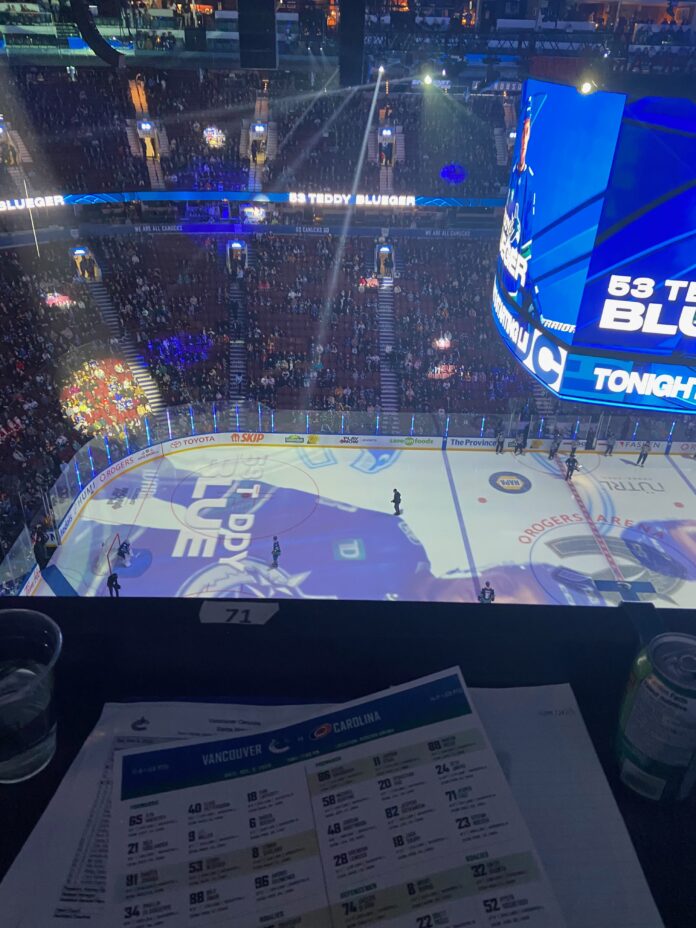
Chosen participants are tasked with pitching a story they will then gather information on by attending a Canucks morning skate, interviewing a player, and watching a game from the press box. From there, participants will write, edit, and submit their stories to the Canucks, who will then publish it on their website as part of the project. The Peak has had two writers partake in this amazing opportunity — here are their stories. 

Izzy’s Project  

My Botchford Project experience started at 11:00 p.m. on a Thursday night, when I first got the selection email from a Canucks communications department representative. From there, it was a frantic dash into my dad’s room to give him the news. The rest of the preparation came in the following days through storyboarding calls, emails, and DMs on X.

The day of the project was a rainy one; it was also the day of a matchup that pitted the Vancouver Canucks against the Carolina Hurricanes. By the time I was making my morning coffee and fretting over whether I should wear lace-up boots or Blundstones, I’d already drafted up the premise of my story. 

Once at the arena, I met my fellow Botchford compatriots as well as our mentors outside the media entrance. Walking through the empty concourse was a vast difference from the hustle and bustle that I’d usually experience in Rogers Arena. If anything, that made it more jarring. 

We only ended up spending around 20 minutes watching the practice before we were shepherded down to the media room, where Canucks head coach Rick Tocchet held his pre-and-post game media. From there, we were brought to the Canucks locker room. The player I was set to interview, Nils Höglander, was already available to chat, so one of our mentors brought me over to him and introduced us. Five questions and five minutes later, my phone’s voice memos app was filled with potential quotes, and I was all set to start writing. 

After all our interviews were done, we sat through Coach Tocchet’s pregame media availability. The first part of the day concluded with a brief tour of the press box, where we were shown the seats that we would be occupying during the game. 

With the practice happening mid-morning and the game not taking place until 7:00 p.m., my project partners and I had a stretch of time in which we could grab lunch. We ended up finding a nearby cafe and grabbed coffee while sharing our respective life stories. Our curiosity eventually got the best of us, and we headed back to the arena very early in hopes of taking in more of the press box. 

Our early entrance into the press box was a fortunate one. We ended up being able to meet Al Murdoch, the Canucks’ PA announcer. As media members began to filter in, we were introduced to more people. Seeing as it was Hockey Night in Canada, the press box was relatively busy, crowded with media professionals from other cities. We got to eat dinner alongside media members before another gentle request resulted in us meeting the current voices of the Vancouver Canucks, John Shorthouse and Dave Tomlinson. 

The game was a nailbiter, ending with a 4–3 win for Vancouver. We got to see a particularly noticeable goal created off a hardworking shift from Brock Boeser and Nils Höglander. We also spotted a Sedin (the three of us were trying to guess whether it was Daniel or Henrik) sitting a couple boxes down from where we were. 

After the game, we were guided back toward the elevators in hopes of being some of the first to arrive at the media room for postgame coverage. With the help of media members, each of my project partners and I got to ask a question during the media session, culminating in a fantastic end to the day. 

Isabella’s Project 

I don’t remember my project with the same details as Izzy. It was two years ago, which with the way time has been moving, could have been five years ago for all I know. What I do remember was being in complete and utter awe, and being called Isabelle throughout the night. I’ll never forget that.

I also rocked a custom t-shirt that had “Bro. Do your dekes.” on it, which was the phrase Jason coined when referring to Pettersson’s nifty moves during his first NHL game against the Calgary Flames. He eventually printed it out on a shirt and wore it, so I did my due diligence to match the font as best as I could, and wear it during pregame skate to pay tribute. My fellow participants and I also visited Jason’s bench outside of the arena prior to the game, and left him his favourite drink, root beer flavoured Beaver Buzz Energy. 

The night itself was a balancing act. I tried to soak it all in, without forgetting to relish the moment. I did my best to not feel like a fish out of water, without appearing as though I wasn’t appreciative — I most certainly was. I tried to contain myself in my seat as the Canucks scored, while media members nonchalantly leaned back in their chairs. I felt rather embarrassed when I had to halt myself mid-stand up from celebrating. Thankfully, I wasn’t at the point of near return where my knees had locked and I was fully upright. Then, I’d owe a shy and probably clumsy apology to the people behind me.

Frankly, I never thought I could make a career out of writing about sports. I had wanted to so desperately. Call me naïve, but I just didn’t think it existed. I didn’t have the media in mind when I rushed to finish all my homework so I could be worry free when I turned in to watch the broadcast at 7:00 p.m. in the living room. But when the idea came to combine my passion for sports and writing, the first person whose work I read was Jason’s

Jason never made media feel imposing for any young journalist. He was an individual without a bone of jealousy or a breath of ignorance. He was someone who was truly happy to be of assistance. I aim to find that level of sureness in myself and my career.

That night, the Canucks won — which wasn’t my overall highlight, but a blessing nonetheless, as I had to wait until after the game to speak to the subject of my article. Goaltender Thatcher Demko was just as tall and dialed-in post-game as you’d expect. As lovely as he was for my first interview with a professional hockey player, the true highlight of my night, by a country mile, was removing my name tag from the table to reveal that I was sitting in Jason’s coveted spot. To this day, I get goosebumps on my arms and tears well in my eyes when I think about this very moment. There’s simply no words. Just an overwhelming warmth in my heart.

In my application, I admittingly told Kathryn that I was looking for some validation at this point in my career — a sign that I hadn’t hastily jumped into this decision because I happened to love sports. It sounds a little silly, as it’s the perfect criteria for the job. But, I felt like I was never going to live up to what I had envisioned for myself. I later wrote in a message to Kathryn that the Botchford Project was the validation I needed.

I knew there would be hardships following that night, and oh boy, were there more than I care to admit. Sports, especially hockey, is still very much a boy’s club, and hostile to women who don’t get the same luxuries or affordances. The moral of the story is life moves on, and so do I, with a vengeance. But true to what I said that night, I already had my validation. I had the strength; I had the nod of support. I’m forever indebted to Jason and his family because that vote of confidence did wonders.

Applications for the project open up each November and close at the end of the month. Alongside the application, which will ask you a few questions about yourself, the opportunity, and any ideas you have, candidates will need to provide some samples of their work. These articles don’t need to come from a publication — they can be written on the fly, as well. For anyone who’s interested in applying, especially those who don’t have any media experience, don’t be afraid! That’s the aim of the entire project. Based on my experience, your passion for sports and willingness to learn is far more important than your past job descriptions — even if you’re not majoring or have majored in journalism or a parallel field of work.  

Black excellence in sports as told through media

0
front cover of Kobe Bryant’s autobiography
PHOTO: Courtesy of MCD Books

By: Hailey Miller, Staff Writer

Content warning: anti-Black racism and enslavement.

Films and Documentaries

Remember the Titans (2000)
Where to watch: Disney+, Amazon Prime Video, Apple TV+

Based on a true story in Alexandria, Virginia in 1971, Black football coach Herman Boone sets out to integrate two high school football teams with fellow coach Bill Yoast. Along the way to finals, the Titans face racial prejudice. The team is discriminated against and seen as unworthy among other teams due to being interracial after many civil rights battles for Black Americans throughout the 1960s. Despite the backlash, they remain at the top of their division throughout the season, and end up at finals. The film focuses on the struggles the players face, the bond they grow, and the change they make in history as an interracial football team.

Glory Road (2006)
Where to watch: Disney+, Amazon Prime Video, Apple TV+

This true story follows the journey of basketball coach Don Haskins and his team as he embarks on building a racially diverse roster for the Texas Western Miners in 1966. Due to the aftereffects of enslavement in the Southern United States, the lineup sparks controversy elicits racist acts from the community in the lead-up to the NCAA Championship. When two Black players on the team — Bobby Joe Hill and Harry Flournoy — begin dominating the court, a dispute raised by the community results in increased racial tension and division. The film explores the challenges the team faces to keep their head in the game and make history.

Venus and Serena (2012)
Where to watch: Amazon Prime Video, Apple TV+

This documentary film focuses on the life of Venus and Serena Williams, and the hardships and challenges — including racism and sexism — they’ve faced throughout their careers despite their unmatched levels of success. The film features real footage of the Williams sisters throughout their lives from growing up to going pro. The documentary explores their successes amid discrimination and racial prejudice as they cement their legacy as two of the best tennis players in history. 

Black Ice (2022)
Where to watch: Crave

This Canadian documentary features stories of Black NHL players, including P.K. Subban, Wayne Simmonds, Akim Aliu, and Matt Dumba, and the racist comments and backlash they received despite their acquired success. The film acknowledges the Coloured Hockey League, which was an all-Black men’s hockey league in the Maritimes that was a safe space for athletes in a predominantly white sport. 

Books: 

Sting Like a Bee: Muhammad Ali vs. the United States of America, 1966-1971
By: Leigh Montville (2017)

This biography follows the journey of Muhammad Ali at the height of his career, and his life and activism both within and outside boxing. This riveting read draws upon the struggles Ali faced as he fought for his rights — and those of other Black athletes and individuals — while shining light in the face of adversity. From refusing to join the military in Vietnam due to his anti-war views, to becoming a heavyweight champion, this biography explores an in-depth portrait of Ali’s life and social impact.

The Mamba Mentality: How I Play
By: Kobe Bryant (2018)

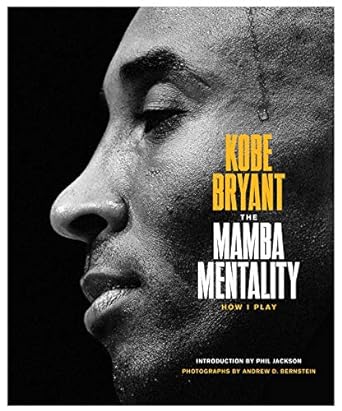
In his memoir, Bryant draws on his personal and professional life, including his career as a Los Angeles Laker. He recalls his time on the Olympic team, and the method he single-handedly appointed to his basketball success, Mamba Mentality: trusting in the process based on the work you’ve put in. Bryant’s autobiography is filled with insight and experiences, from start to finish, as he acknowledges the hard work that resulted in his success. 

How to sabotage a completely healthy and happy relationship (lesbian version)

0

By: Tam Nguyen, SFU Student

Inside an SFU dorm, there’s a girl sleeping on the couch. A YouTube video called “Learn C++ in 15 minutes” is playing on the TV screen. Suddenly, there’s a loud BANG on the door that could easily wake up a whole neighbourhood. Yet, the girl is still deep in REM sleep. She only gets pulled out of her nightmare about her upcoming group project when an RCMP squad shoves through the doors and yells at her that she is under arrest. 

“You can’t arrest me; I’m gay and Asian!” she says. “Wait, and I mean this in a so not suspicious way, but just so we’re all on the same page here. Which crime are you here for?” 

“You have committed a crime against national security. What you have done puts the well-being of all Canadians at risk,” one of the officers answers.

“First of all, I don’t see how that’s possible given that I didn’t raise the grocery and house prices and make having children unaffordable.” 

The police officer pulls out a notebook from her pocket “No, but you invented an algorithm to break up with a completely healthy and happy lesbian relationship, it’s in your diary. Do you still deny the allegation?”

The girl was surprised. “That’s ridiculous! There’s no correlation between lesbians sabotaging their own relationships and national security!”

“Some straight people stole your method, and soon there will be no happy couples left! ” 

“Classic move first Girl In Red and now this. Can we have our own thing just for once?”

“You are responsible for creating such a deadly algorithm.” The police officer starts opening the notebook.

Inside the notebook, we see a fully written page. 

Dear diary, this is how to break up with a completely healthy and happy relationship (lesbian version).

Step 1: Fact Check </b
Make sure that your relationship is completely happy and healthy and your girlfriend is a good person. Do NOT break up with narcissists, because they are hot. Don’t believe it? Go and watch Killing Eve

Step 2: Nitpicking
Consume as much social media as you can, about someone richer, prettier, and more talented and then ask yourself this question “What is the thing that I don’t like about my girlfriend?” 

Preferably something she can improve easily. The easier that is, the tastier it feels at the end.

Step 3: “Is it better to stay or to die?”
To die it is! Do NOT communicate it with your girlfriend. When she asks if everything is okay, you say “Of course babe, everything is, indeed, fine.” 

Step 3.5: The Bestfriend
Find someone who dislikes your girlfriend for no reason, and tell them about your problem. You’re going to have the most eye-opening conversation of your life.

Step 4: Not my fault
Let the problem sink in long enough you start resenting her. It’s her fault that she can’t read your mind. 

Entering a loop condition: 
If you don’t resent her enough:
Go back to step 1.
Start again.
If you do: move on to Step 5.

Step 5: Oscar Nomination 
Keep acting like things are okay. Plan for the future, road trips, and holidays. Continue telling her how much you love her and that she is way too good for you.

For extra fun, let’s ask her to U-Haul (if you haven’t done so after the first date), to marry you, or to adopt a cat. Don’t worry, it’s not like you’re going to do all these things for real, right?

Step 6: Self-care 
Convince yourself she isn’t the one, and you deserve better. She is too . . . flawed! (the flaw that can be easily changed if you tell her in the first place) 

Step 6.5. Almost there
You should probably fall out of love with her at this point, but if you’re not, go back and keep grinding through these previous steps — you’ll get there eventually.

Optional step: You may consider emotionally cheating.

Step 7: Shoot the news 
Once you fall out of love, tell her you want to break up. I suggest sending a breakup text while she is having a night out with friends. Surprise, baby! 

Step 8: Strong woman
Do NOT give her a second chance to fix the problem. How hard did you have to work to NOT tell her in the first place? Are you letting all of these efforts go to waste? 

Step 9: Final Step 
Walk away from your perfectly healthy and happy relationship; convince yourself you dodged a bullet. If she cannot read your mind, that’s not your soulmate. Next time consider dating a psychic! 

The police officer stops reading. “Seriously, who hurt you?” 

“All the pretty girls, I guess,” she shrugs her shoulders, “Happy Valentine’s Day!”

Hate mail for my oral contraceptive

0
ILLUSTRATION: Jill Baccay / The Peak

By: C Icart, Humour Editor

Dear bitch — I mean pill, 

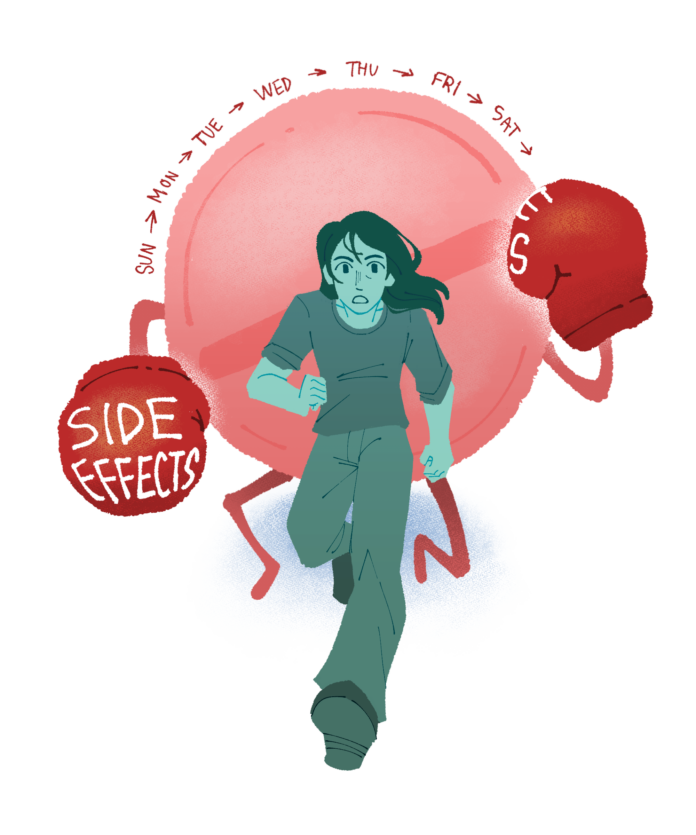
Listennnn, before anyone comes for me for coming for you, I will acknowledge that you don’t screw everyone over. But just because you’re playing nice with other people does not mean I don’t get to call you out for just sitting there in silence while my doctor told me “there’s basically no side effects” to me taking you. You knew that was a lie! I bet you were sitting in your little blister pack giggling, knowing the havoc you were about to wreak on my body. 

When you came home with me for the first time and I made you promise you’d regulate my periods from hell, you had your fingers crossed behind your back. That’s the only explanation! You worked perfectly in the beginning so I would trust you. You’re just a little conniving tablet. I let my guard down and BAM! You hit me with the breakthrough bleeding

I will not stand for this level of backstabbing (or should I say uterus stabbing). In true “girl’s girl who is not a girl” fashion (don’t worry my fellow enbys know what I mean by that), I will be exposing you, so you don’t dupe someone else. I tried to come to you directly to squash this and you convinced me I just needed a higher dose. Well, the lie detector test I secretly gave you determined that that was a lie! 

I wrote your name in my Burn Book and warned everyone about you so no one can downplay the side effects of combination birth control pills to unsuspecting teenagers and young adults ever again.  

Hate you forever,
A girlie who’s tired of 14-day periods

Cleat Cute is the 2SLGBTQIA+ offering to the growing sports romance genre

0
an illustrated book cover of two women soccer players staring at one another on the soccer field
ILLUSTRATION: Courtesy of St. Martin’s Publishing Group

By: Kaja Antic, Sports Writer

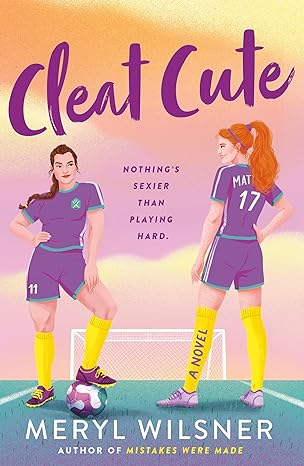
Want a new sports-related book to read this Valentine’s season? Look no further than Meryl Wilsner’s 2023 novel Cleat Cute. Marketed as “Ted Lasso meets A League of Their Own,” this sapphic rivals-to-lovers romcom embraces the drama of women’s soccer in a story that will be sure to win you over. 

The two main characters come from very different backgrounds, but end up at the same US Women’s National Team training camp ahead of international competitions. 

Phoebe Matthews is the rookie, a recent college graduate from rural Indiana who clashes almost immediately with her idol, Grace Henderson. Phoebe is outgoing, chaotic, and a standard class clown — everything Grace isn’t. 

Grace is in her 10th year on the US national team, feeling like her career is nearing its end even though she’s only 26. She debuted at 16 as Phoebe watched from home, only four years her junior.

Focused on making the national team, Phoebe has bigger plans for training camp instead of trying to woo her idol. She heads into her first season with the fictional American Women’s Soccer Association (AWSA) New Orleans Krewe — the team Grace also happens to captain. However, a lost bet forces her to make the first romantic move and kiss Grace. While the kiss ignites feelings between the two, they don’t talk about it

Phoebe moves to New Orleans ahead of the Krewe training camp a month later, preparing for this new chapter in her life as a professional soccer player. Grace is also there early, and is persuaded by Phoebe to show her around the city, as it’s her first time living outside of Indiana.

The two develop a tentative friendship when Grace takes charge as Phoebe’s tour guide, showing her all the places in the city she had already called home for years. In addition to this, the two also begin a friends-with-benefits arrangement, adding more steamy aspects to the extremely entertaining story.

As training camp begins and the American international window grows closer, conflicts arise between the two. Grace is sidelined with an injury early on — missing a key international tournament leading up to the women’s World Cup — and is forced to adjust to life outside of soccer for the first time in decades. Phoebe is assumed to take her place in the lineup for both the Krewe and the US national team.

Grace struggles with this adjustment, and with the support of Phoebe, mends both her injury, and hesitancy toward relationships due to unresolved past conflicts. Phoebe also has her difficulties, from having to hold a part-time job as a waitress at a diner to her pursuit of a permanent spot on both the Krewe and national team lineups.

The queer representation in this book is outstanding, with multiple characters being part of the 2SLGBTQIA+ community aside from Grace and Phoebe. Phoebe’s younger brother Teddy is trans, and her diner coworker Dallas as well as Krewe goalkeeper Ash are both nonbinary. Grace’s sister Harmony is pansexual, and multiple players on the Krewe and the national team fall under the queer umbrella.

There is also a focus on neurodiversity as Phoebe deals with ADHD and the pressures of being in the closet as a professional athlete, even though in the book the sport is largely accepting of queer individuals. Phoebe has been publicly out as a lesbian for as long as she can remember, while Grace is only out to her family and close friends and still struggling with her image in the public eye. 

Even if you aren’t a sports fan, this book is fantastic. There isn’t a lot of previous soccer knowledge required to understand what is going on. If you’re looking for a spicy WLW, happily-ever-after set in the exciting world of women’s soccer, Cleat Cute is a must-read. 

Top 10 television crushes, ranked

0
A person holding a TV remote.
PHOTO: Bermix Studio, Unsplash

By: Saije Rusimovici, Staff Writer 

Ah, young love. Who doesn’t reminisce about our teenage years, living vicariously through our OTP (one true pairing) couples on our favourite CW shows? We scarcely minded that the actors portraying these characters may have been 10 years our senior. We were only concerned about whether or not our favourite ships would make it through to the next season, only to be completely shattered when one of them didn’t, or worse — got killed off for no reason.  

But I’m not just talking about our romantic crushes — our platonic crushes also made us swoon. For me, these were the women characters who inspired me to study hard (whether or not some, ahem, questionable methods were involved), get that promotion (because who wouldn’t want an Emily in Paris-esque marketing job?), or had “that girl” energy we desperately wanted to emulate.

10. Spencer Hastings (Troian Bellisario), Pretty Little Liars

I don’t know anyone who didn’t want to be Spencer when I was in high school. She was the straight-“A” student dating the boy-next-door/sort-of-carpenter (when he wasn’t moonlighting as the illusive “A” of course). If Spencer had it, we wanted it. Even though the show went on for about two-and-a-half seasons too long, we were always ready for Spencer’s next big breakthrough. There’s a reason my go-to pre-exam playlist is called “study like Spencer Hastings.”

  1. Stefan Salvatore (Paul Wesley), The Vampire Diaries

The younger vampire brother earns number nine because even though I’m not the biggest fan, you can’t deny he was one of the biggest teenage heartthrobs of the 2010s (sorry Robert Pattinson!). Stoic yet sensitive (in spite of some bad blood-bingeing habits, IYKYK), he’s too good of a guy to be left off this list. I mean, he’s not bad on the eyes, either. 

  1. Reggie Mantle (Charles Melton), Riverdale

Yeah, totally accurate representation of what a high school sophomore looks like right? #dreamon

  1. Chandler Bing (Matthew Perry), Friends

Chandler was the character that could always bring a smile to my face. Not to mention his adorable relationship with Monica. #relationshipgoals

  1. Damon Salvatore (Ian Somerhalder), The Vampire Diaries 

Major heart eyes for the bad-boy of the two vampire brothers that made me swoon as a teenager. Sexy Damon Salvatore was without a doubt Elena’s epic love (sorry Stefan, you still made the list though!). Sixteen-year-old me couldn’t help but fawn over the shirtless scenes. So, so many shirtless scenes . . .

  1. Barry Allen (Grant Gustin), The Flash

The iconic superhero show, filmed in Vancouver, wouldn’t be the same without one of the most adorable, loving main characters on television (let’s hope he’s not fast at everything he does, if you catch my meaning). 

  1. Jane Villanueva (Gina Rodriguez), Jane the Virgin

What’s not to love about Jane or Gina?! Confident, hilarious, body-positive, and a writer (and in my opinion way too good for Raphael). 

  1. Jackson Avery (Jesse Williams), Grey’s Anatomy

Move over, Dr. McDreamy. Jackson Avery has been one of my top TV crushes ever since I first saw him on Grey’s Anatomy. He was great on that show. Though it could be the shirtless scenes clouding my judgement . . . Relax, it’s not like I still daydream about him, okay? At least, not recently . . . 

  1. Maya Lopez (Alaqua Cox), Echo

BEST. MARVEL. SUPERHERO. EVER! Not only is Maya absolutely badass in combat (cannot wait to see her take down Fisk’s empire), she also is a character that (finally) brings both Indigenous and disabled representation to the Marvel screen — it’s about time!

  1. Simon Bassett (Regé-Jean Page), Bridgerton

Simon Basset is the clear winner of this little ranking. Want to know why? Go watch Season 1 of Bridgerton. You’ll understand. 

Monday Music: The stages of a love affair

0
A person listening to music in a car drawing a heart in a foggy window
ILLUSTRATION: Angela Shen / The Peak

By: Eden Chipperfield, News Writer

“FMF” by Uncle Strut 

Sometimes, that person you’ve been waiting for has been by your side or in your circle all this time. Perhaps it’s the sexual chemistry or the butterflies you get from being next to them subtle glances and smiles that only the two involved can translate. Uncle Strut is a Vancouver indie rock band I had the fortune to see live as an opener for BabyJake this October. Their response and call song, “FMF,” (which stands for Fucking My Friends) brings fun to the topic with the upbeat guitar strumming and grooving rhythms to vibe to.

“What I Need” by Hayley Kikoyo feat. Kehlani

Pop-icon Hayley Kiyoko and R&B empress Kehlani dominate in this pop-layered track that explores queer love, intimacy, and being accepted. Kiyoko and Kehlani lament about not wanting to keep their partner a secret, singing, “What I need is for you to be sure.” Kiyoko explained in an interview with Sway Calloway, “I’m in a place in my life where I need to be with a woman who knows what they want, and I don’t have time to play the games that I’ve literally been playing for 26 years.“What I Need” pairs well with summer nights and rolled-down car windows. 

“Heaven” by Pink Sweat$

The honeymoon phase will be in full force when tuned into “Heaven” by Pink Sweat$. Keyboard notes and samples of angelic harp transport you to an environment where you’ll drift away with thoughts about your lover. Fantasies of forever are laced with the lyrics as Pink Sweat$ promises his suitor, “you know I don’t want no one else.” This R&B track can be reminiscent of first moments together, from long talks to the first “I love you” and all the in-between. 

“Pendulum” by FKA Twigs 

An alluring, slow-burn rhyme sets the tone for “Pendulum” by electronic artist FKA Twigs. The knowledge that someone may not be the right one can eat someone up inside. With processed sounds and mixing, this song conveys being swung back and forth by feelings and thoughts of wanting more than what may be given by a partner. Pulling at heartstrings, “Pendulum” captures that when love loses its momentum, how difficult it can be to admit it to a partner, or even harder, yourself. 

“Confidant” by BabyJake 

Feelings of betrayal and hurt come through BabyJake’s bittersweet lyrics, discussing the end of a relationship when a partner no longer confides their emotions in the artist. Sometimes, as this song insists, the best course of action is to cut contact. BabyJake asserts his self-assurance through lyrics like “I’m not your friend, not your only confidant,” encouraging the subject to find comfort and solace in others. The song soothes with smooth R&B rhythms and hip-hop beats to feed broken souls. 

Listen to the full playlist on our Spotify, peaksfu.

Breaking the cycle of sexual shame

0
woman in black dress standing near white wooden door with her back facing the camera
PHOTO: Hala Al-Asadi / Unsplash

By: Sarah Reynolds, SFU student

Content warning: discussions of sexual trauma.

Yes, I’ve cried after sex, often to me for what seems like no reason. I wasn’t crying because the sex was bad, or I was in pain, or I regretted it. I cried because the sex felt good

I was 21 when I lost my virginity. This could mean something different to everyone, and there is no right or wrong time or way to categorize your first sexual experience. Regardless of what a “first” sexual experience means to you, a plethora of emotions can come along with it. For me, it was a deeply emotional experience that seemed to swallow me whole. I was in a loving, committed relationship with a partner I deeply connected with. And yes, I very much enjoyed the sex. Yet, for some reason I still felt a sense of shame. 

I didn’t expect to feel this way. Consciously, I know sex can be an important aspect of human life, and that it can be very pleasurable physically and emotionally. I spent my teenage years considering myself to be quite sex-positive, talking enthusiastically about sex with my friends, fawning over sex scenes in television shows, and even having open conversations with my mom about sexual health and safety. Despite having been diagnosed with a chronic anxiety disorder, I figured that as long as I was comfortable and in a healthy relationship with a partner I would be the perfect picture of emotional stability when I had sex for the first time.

My subconscious, on the other hand, wasn’t so easily convinced. 

I began to realize I had a lot of internalized preconceptions about sex I never consciously thought about or outwardly projected. Society plays a significant role in shaping our perception of sex. Whether it be pushing us to have it, warning us not to, or labelling the entire topic as “taboo,” social stigma often contributes to our subconscious attitudes. Taneasha White, an author who wrote on sex stigma, explains, “women and feminine-identified folks are often taught their sexuality is something to be hidden and protected,” reinforced by the historical connotations of “virginity.” 

This “sexual stigma” can come from various sources. Dr. Sara C. Flowers notes that internal attitudes or notions can result in “feeling shame about having a period, our body shape or size, being diagnosed with a sexually transmitted infection (STI), or our gender identity or sexual orientation.” But society and our environment also play a significant role in perpetuating sexual stigma. Despite how much I denied that some of these beliefs had no effect on me, they obviously did.

For someone with a chronic mental health condition, it can be even more difficult to navigate intrusive thoughts of a sexual nature while trying to enjoy a healthy sex life. Sexual obsessions can be a symptom of Obsessive Compulsive Disorder. They cause a person to have intrusive thoughts, likely contradicting their moral values. Sexual obsessions are often assumed as taboo in nature. They can occur at any time during or leading up to sex. Sometimes this may contribute to the avoidance of sex altogether, or even compulsive sexual activity used as a response to “disprove” intrusive thoughts. From my own experience, I have triple-checked clearly unbroken condoms and broken down post-orgasm for fear that feeling sexual pleasure meant I was “doing something bad.” This sort of shame not only totally kills the mood for you and your partner, but also increases the risk of further depression and anxiety.  

It’s difficult to break free from the cycle of shame that can, in many cases, severely impact not only our relationship with sex and our partners, but also our relationship with ourselves.

Everyone has different upbringings and experiences that influence the way we perceive sex. With that being said, there is no “one-size-fits-all” approach to escaping the shame that often looms over us when it comes to sex. But what we can do is focus on addressing some of the underlying causes of the shame we feel and use resources to combat this in hopes of eventually adopting sex-positive attitudes within our own sex lives. Some of the strategies I’ve used to break free from some of the shame I experience around sex and sexual pleasure include having open dialogue with my partner, recognizing unhealthy obsessive-compulsive patterns, and practicing all different forms of self-care and self-reflection. While these strategies work for me, those who have experienced a traumatic sexual experience may benefit much more from talking to a professional. Sex therapists can help individuals or couples address obstacles in their sex lives. When we break free from these sources of shame, we can work towards building healthy relationships and pleasurable sex lives. 

Bisexual people are bisexual

0
Photo of the bi flag
PHOTO: Delia Giandeini / Unsplash

By: Cynthia Piña, Peak Associate

Content warning: mentions of biphobia.

Sometimes it feels like bisexuals have to fight multiple battles: the internalized homophobia within themselves, biphobia from society, and the biphobia from those who should be allies. Homophobia and transphobia are both real, distinctive, and intersectional. However, biphobia, for decades, has been brushed off as being unreal. The argument goes that because bisexuals may appear straight — they are privileged — and this erases many of the struggles that are unique to bisexuals. 

Biphobia is rooted in specific myths related to bisexual people. These myths can include the idea that bi people are trying to be trendy or are more likely to cheat on their partner. Some lesbians say they won’t date bisexuals because they’ve “been with men,” they feel concerned that bisexual women will leave them, or just outright wouldn’t date a potential bi partner. Just like we shouldn’t judge straight partners for their sexual past (or lack thereof), queer people shouldn’t judge each other for theirs. Straight people also hold reservations about bisexuals and a 1996 survey found that 40% of straight people rated bisexuals as “less acceptable than lesbians” or gay men. 

The same study quoted a post-secondary student who said, “I feel they are the people who spread AIDS. I think they should be either heterosexual or homosexual.” This isn’t an isolated incident, as this stigma is still being reported on in the 2010s. The reality is that bisexuals aren’t more likely to transmit AIDS, nor does their orientation say anything about whether or not they practice safe sex. While there is lacking recent research on bisexual people in comparison to other orientations, stigma related to bisexuality still persists today. The research that is available shows bisexual people are more likely to be suicidal, more likely to have chronic health issues, and more likely to experience intimate partner violence.

I battled within myself for years to accept that I loved women and would consider multiple genders as a romantic partner. However, part of the reason I stopped coming out to people was gay friends asking when I would date a woman, hearing off-hand comments about bi people not being queer without sexual or polyamorous experience, and straight friends commenting about “how great it must be to have access to threesomes.” It is exhausting, fetishizing, and if straight people know who they love without having to date them, then bi people should be allowed the same affordance. 

Automatically believing that a couple who appears to be straight and cisgender, are actually straight and cisgender, assumes someone’s identity. The reality is that you will never know by looking at two people whether they are queer or not. Maybe both of them are bi. Maybe one or both of them are trans or non-binary. If people say they are bisexual, they are bisexual, and I’ve had enough of listening to both queer and straight people spew their prejudices about bisexual people.  

Continuously, I’ve seen several examples where bi women are either harassed for liking men, harassed for exploring their identity, or “queerbaiting as lesbians.” While I’ve observed this over the years, I’ve noticed a particular spike in this behaviour just at the start of 2024. Unlike what Megan Fox once suggested in 2009, women are not “dirty” for liking men. Lesbians are not “cleaner” or “more pure” than bi women. Similarly, bi women are not “dirty” for liking women or other genders. While my experience centres on being a bi woman, I also acknowledge that bi men can face higher rates of stigma and are seen as “less acceptable” overall. 

Bisexuality is a real orientation. Bisexual people often do face aspects of homophobia, in addition to biphobia. I’m not arguing that one is more oppressed than the other, but that we also face stigma and do not experience life as heterosexual people do. When we say we are facing barriers, please believe us.