Home Blog Page 269

Horoscopes: June 6–12

0
An illustration of a girl with long flowing hair. Astrological signs and stars shine around her.
ILLUSTRATION: Marissa Ouyang / The Peak

By: Max Lorette, Peak Associate

Aries: 

The stars have informed me that it is a good idea for you to stay inside as much as possible this week. The cosmic forecast is calling for a killer sunburn on your horizon, and God knows you haven’t been keeping up with your SPF routine. Maybe try beating your Guitar Hero high score instead of suntanning. 


Taurus:

When was the last time you cleaned your bedside table, Taurus? The number of mugs, bowls, and spoons makes me very concerned. Is that mould growing in your half-empty teacup? Yuck! I promise you will feel much better after you take care of the mess. It might not declutter your overactive mind, but it also couldn’t hurt.


Gemini:

Do you feel as though you’ve been missing something from your life, my dearest Gemini? Do you feel an aching emptiness inside of you? When was the last time you saw your wallet? Or better yet, when was the last time you saw your appendix? I’m telling you, the government is totally harvesting that organ for some reason. I’m onto them. You should be, too.


Cancer: 

The stars are telling me that you have been looking for love in all the wrong places. Have you tried looking under the couch? In the dryer? Perhaps in the back of your closet? Oh wait, I think I got your soulmate mixed up with that pair of socks you lost three months ago. Good luck anyway!


Leo: 

Have you been looking for a new way to be the life of the party this summer? Leo, this season is all about you. Next time you get invited to hang out in a group, the stars advise you to learn how to do the worm. Trust me, it will bring your adoring crowd to their knees. 


Virgo: 

The stars have informed me that this upcoming week is the best time for you to change up your style! Why wait until the new year to be a whole new you? Go buy a cowboy hat! Get a pair of crocs! Go nuts! 


Libra: 

Nature has been calling you! You have been evading nature’s call! They’ve left, like, 10 voicemails now. You’re running out of storage! You should really call them back. Go touch some grass and hug a tree or something. Maybe go smell a flower or two. Change your phone background to some trees, maybe? I don’t know, dude, I’m just the messenger.


Scorpio: 

Next time you’re invited out to a bonfire, whatever you do, DO NOT play “Wonderwall.” The forest spirits have become restless, and the stars have informed me that they are NOT Oasis fans. Instead, try mixing your setlist up with some Taylor Swift. The spirits are totally Swifties. 


Sagittarius: 

When was the last time you did some self-reflection? Take a good, hard look in the mirror. Remember how far you’ve come. Remember to be proud of the person you’ve grown into. You’re doing amazing. Mwah! (Also, I think you might have something in your teeth).


Capricorn: 

The stars have informed me that they are incredibly disappointed that you haven’t been keeping up with your silent reading time! What, do you think because you’ve exited the public school system you can just quit silent reading? Go to a used bookstore, get the oldest looking tome you can and get back to it. The book probably isn’t cursed. 


Aquarius:

Have you been feeling stuck in your music taste lately? Have you tried discovery weekly? If that doesn’t help, maybe try listening to some classical music. I’m pretty sure that blasting “O Fortuna” at full volume while you strut your stuff this summer is the vibe that the stars have in mind.


Pisces: 

Take a deep breath, Pisces. Straighten up that spine, roll your shoulders back, and correct your posture. Your back literally looks like a lowercase “r” right now. Maybe it’s time to visit a chiropractor again. Crack my bones, Posture Daddy.

When homesickness feels a lot like grief

0
A girl with short black hair stands with her back turned. She is wearing a winter jacket and holding Mukmuk, a Vancouver 2010 winter plush mascot who resembles a beaver, in one hand and a Filipino flag in the other hand. In the distance is a scene of a busy street in Manila with people socializing and laughing.
ILLUSTRATION: Jiamin Bai / The Peak

By: Alyssa Victorino, SFU Student

I learned what it meant to be homesick when I was nine. 

My family and I packed up everything we owned, said heavy goodbyes to family and friends, and boarded a plane from Manila. Our destination was Vancouver where we became permanent residents, and later, Canadian citizens. I left behind my sari-sari store toys and replaced them with the Vancouver 2010 Winter Olympic mascot plushies (my favourite was Mukmuk). I traded in my tank tops and flip-flops for rain jackets and snow boots and got used to the deafening silence at home. There was no more playful banter among extended family members in the house. 

During the first couple of months, family friends kept asking me if I ever missed the Philippines. I think they expected whatever disorientation I felt to dissipate quickly as I adjusted. But even after 12 years, the sting of homesickness lingers. 

When you experience a deep longing for something you know you can’t get back, you start to lose yourself in fantasy and memory. Every few months, I get an itch to go through photo albums, old journals, playlists, and past school projects to immerse myself in the comfort of simpler times. They bring back memories of Sunday dinners at my grandparents’ house where the grandkids would fight over who got the last KFC fried chicken. I can still hear the never-ending bustle in the kitchen where family members would cook, clean, and gossip; they were excellent multitaskers.

In The Year of Magical Thinking, Joan Didion describes the grief she felt after her husband’s death: the fruitless waiting for the past to show up at your door and the subsequent realisation that there is only forward — things change whether or not we are ready. My life has been riddled with a similar yet different kind of grief for the last decade, lost in the memory of another version of myself that got to stay home. I struggle to reconcile the reality that I will never be able to find out who she would’ve turned out to be, and I fear I will always feel split between two lives. 

And it isn’t just about me. My family lost our village. My mom, who had loads of friends unafraid to let out full-belly laughs in quiet restaurants, had to learn how to navigate her first winter alone with three kids. My dad, who once played the guitar and sang Filipino folk music freely, was bogged down by work, travelling for months at a time. My sisters, too, had to navigate university and high school alone, learning for the first time what it’s like to have to search for a piece of home to hold onto. I grieve for them, the versions of my family members who remained proud and sure, whose senses of belonging remained intact. 

In elementary school, I used to count the number of Filipino students in each of my classes to anchor me and took every possible opportunity to make projects about Filipino culture. In grade four, I made a “Guide to the Philippines” handbook for my class, listing traditional Filipino clothing, games, and cuisine. Today, I flood my parents with questions at the dinner table about what their lives were like back home. I look up recipes for Filipino dishes — Filipino spaghetti for birthdays and arroz caldo for when it rains (needless to say, I have arroz caldo a lot). I make sure to watch cheesy Tagalog romcoms when they come out on Netflix like Isa Pa With Feelings and Love You to the Stars and Back

Most significantly, I decided to study social justice in universit and took every chance to centre my assignments on memory, colonialism, or immigration. At some point, the grief turned into a deep curiosity for everything that I had lost and everything that I was feeling; the whys and hows of my being here. 

But I soon found it’s difficult to study economic inequality, globalisation, and racism as an immigrant in a western institution. I see my childhood unfold in some of the case studies — the unemployment and low wages, the degrading process of the immigration point system. Learning about the structural forces behind my immigration story — the greed behind poverty and the centuries of colonialism behind the desire to be in proximity to whiteness — brought with it a transformation of grief for land and community. I grieve in classrooms, among my peers. I leave classes with an empty feeling wondering, “Now what?” 

My mom still asks me if I would move back to the Philippines out of fear that she and my dad made the wrong decision by moving us all here. It used to be an easy answer: of course not. There are better opportunities here, more choice and freedom, and easier access to nature. For a long time, I felt so much pressure to just be happy and grateful to live here. Of course, I am, and I acknowledge my privilege in this. But I can’t ignore the constant waves of sadness and struggle I feel in trying to reclaim my cultural identity. I hate not knowing the places that my parents talk about when they reminisce, having family members’ names feel foreign on my tongue, and asking what certain Tagalog words mean. I should know all of these things. I should have gotten the chance to know these things.

Home is something that I had to define for myself. It is not a place, but a feeling. I experience it now as fleeting moments that feel familiar: barbeques by the lake, loud Christmas parties with titos and titas you don’t know, and the warm and inviting smell of summer air. Losing the familiar to the unknown so suddenly 12 years ago taught me to cherish and live in these small, beautiful moments whenever they come along. 

And so, if someone were to ask me today if I’d move back to the Philippines, I’d want to say yes, if only to feel whole again.

The hybrid learning landscape at SFU

0
An image of a brown woman professor trying to command the attention of the in-person class in front of her and the zoom class behind her and looking calm but holding her hand out questioningly
The pandemic has highlighted existing accessibility concerns that were not widely considered until they affected the majority of the population, igniting questions of how to move forward. ILLUSTRATION: Angela Shen / The Peak

By: Olivia Visser, Staff Writer

What does the future of post-secondary teaching look like? Hybrid learning has been a hot topic since the transition towards temporary online learning due to COVID-19 and the subsequent return to in-person studies. Some have felt that pushing for permanent hybridization would be unreasonable or unfair to staff, while others believe in the practice yet critique its execution.


Pro-hybrid learning

Between January 11 and 22, the Simon Fraser Student Society collected survey responses about returning to campus in the midst of the pandemic. According to their results, nearly 80% of over 5,300 respondents desired some level of remote instruction. On top of that, 66% of respondents reported different degrees of discomfort regarding the return to in-person learning, and 94% reported they would benefit from having recorded lectures. 

The SFU Disability and Neurodiversity Alliance (SFU DNA) also released a statement criticizing the return to campus in Spring 2022. They said forcing all students to return to in-person instruction is “deeply ableist and ageist” as it puts vulnerable community members at risk. SFU DNA writes online learning increases accessibility because of captioning and lecture recordings. It also allows students to avoid “physically inaccessible campuses” while providing “more flexible lecture and assignment schedules.” This is particularly important for disabled students, but can benefit many other groups. 

Their statement pointed to a report from the Stronger Together Party which found hybrid learning was the most desirable course option for respondents. This opinion is also reflected in the multiple petitions created in favor of hybrid learning. SFU DNA created a list of demands to make the return to campus more accessible. Among the demands were calls to provide a mix of online, in-person, and hybrid classes, assist instructors in providing accessible content, and expand online course selection. 

Proponents of hybrid learning believe it provides the best of both worlds. Those who have long or complicated commutes, are immunocompromised, live with people who are immunocompromised, or have other responsibilities have the flexibility to attend from home. Students who have mental health concerns due to isolation, do not have proper access to the infrastructure necessary for at-home study, or don’t have a great study environment can attend in person. 


Against hybrid learning

While some students have been enthusiastic about incorporating hybridization, not everyone shares these feelings. In a Facebook comment responding to one of the pro-hybrid petitions, one student wrote hybrid would mean paying exorbitant tuition fees for a reduced quality of education. Others have shared concerns about divided attention from professors and the logistics of translating courses that require labs or hands-on learning to a hybrid model.

Additionally, SFU instructors have shared that hybrid learning would increase their workload without increasing pay or resources and make it difficult to organize classes and lesson plans. The mandatory recording the hybrid learning petitions advocate for may make it more difficult to address sensitive topics and add to concerns over intellectual property. Other professors like Orion Kidder echoed that sentiment. Kidder told Tri City News, “Remote learning has put an added burden on instructors and staff.” 

One instructor, posting on a Facebook undergraduate group, wrote that demands for hybrid learning without considering instructors “devalues teacher effort and reduces [them] to unseen, unpaid labour.” A student who had been enrolled in a hybrid class said of their experience: “The poor professor was sitting in front of a computer and trying to engage with students online and at the same time the students who were there in person.” They added they don’t feel hybrid is the “solution to this complex problem.” 


Hybrid learning in action

I spoke with Hannah McGregor, publishing professor at SFU who recently self-hybridized two of her courses, PUB371 and PUB448, to find out more about her experience. McGregor clarified hybrid status can be set by SFU but her classes did not have that official designation.

She made the decision to offer hybrid options to increase accessibility for students who might not be able to attend in-person. For her, this meant giving students the option to attend classes remotely. Her course used Discord for class communications, and took advantage of the microphones and video capabilities that SFU classrooms already have to livestream the class.

For the type of conversation-driven classes McGregor was teaching, a hybrid model “wasn’t ideal.” However, she stressed that lecture style courses can allow for less dependence on in-person attendance: “I don’t understand why anybody would deliver a lecture in person anymore.” 

While the hybrid approach may sound preferable for students, McGregor said this meant “teaching two courses simultaneously.” She added this approach also put stress on in-person students who had to participate in the Discord and in-person discussions at the same time. According to her, keeping the online students engaged felt “really unfair” because it involved more labour from the in-person students. Because of this conflict, McGregor gave up her hybrid group work approach over the Spring semester. She said this resulted in the online students being “a lot less engaged” because they didn’t feel like they were “in a community” with their other classmates. 


Potential solutions

According to McGregor, increasing resources is one of the ways hybrid learning can be expanded fairly into our institutions. Hybrid course delivery “requires some fairly significant redesign of your courses and creation of new materials,” which is a lot of work for instructors. An “ideal hybrid class,” McGregor said, would have two professors to engage the two groups of students. Moreover, before the pandemic, “there were resources in place to help instructors develop online courses, and that was considered to be work that one should be paid for,” she said. Due to the sudden transition to online, staff were expected to do a “significant amount of extra work for free,” she added. 

“We do it because we care about our students [ . . . ] but I would really like to see hybrid course development being recognized as work because it can be done really, really well. You just need time and resources to actually figure out how to create those courses,” she said. McGregor’s experience speaks to the need for resources to facilitate fair course hybridization, which is still in its early phases.


Blended learning: SFU’s alternative to hybrid

SFU’s solution to the hybrid learning debate has been to implement blended learning through the Centre for Educational Excellence (CEE). Project manager for online and blended learning, Brian Lorraine, had some helpful information about the program. 

Lorraine explained hybrid models usually involve the simultaneous delivery of a course to an in-person and remote audience. Alternatively, blended learning offers a set schedule alternating between asynchronous online classes and synchronous in-person classes. Simply put, blended learning reduces the “portion of the regular face-to-face class sessions in a given course,” Lorraine said.

This option offers greater flexibility for students with scheduling conflicts, disabilities, and other considerations. According to the CEE webpage, blended courses are “associated with higher student satisfaction” because they allow for flexibility and community.

As an alternative to full-scale hybridization, blended learning can be effective when thoughtfully designed, he said. Lorraine said the CEE “leads a 10-week blended learning design cohort of instructors every semester, with an offer to collaborate for an additional semester on building course components in Canvas.” 

SFU is “in the early stages of a 2-year pilot of blended learning,” having offered over 30 blended learning courses, Lorraine said. He anticipates “significant growth” the longer the program is in use.


Moving forward

Universities can create a more equitable learning environment by providing choice surrounding in-person attendance. For students with accessibility needs and scheduling conflicts, the flexibility of hybrid learning seemingly offers a viable solution. At the same time, hybrid learning is not a perfect system and adopting it without proper resources can be stressful for instructors. 

Blended learning may be an effective alternative that supports the needs of both students and professors through its intentionally mixed course design. However, it’s not perfect either as it still requires some in-person learning. 

Another solution may be increasing the number of remote courses available.

Online learning is a new and evolving field, and many of the practices we adopt will be through trial and error. While SFU students, administrators, and instructors have different perspectives on hybridity, a need for resources for students and professors should underline the continuing conversations about online learning.


Five exquisite ways to luxuriate in the dark academia aesthetic

0
ILLUSTRATION: Kelly Chia / The Peak

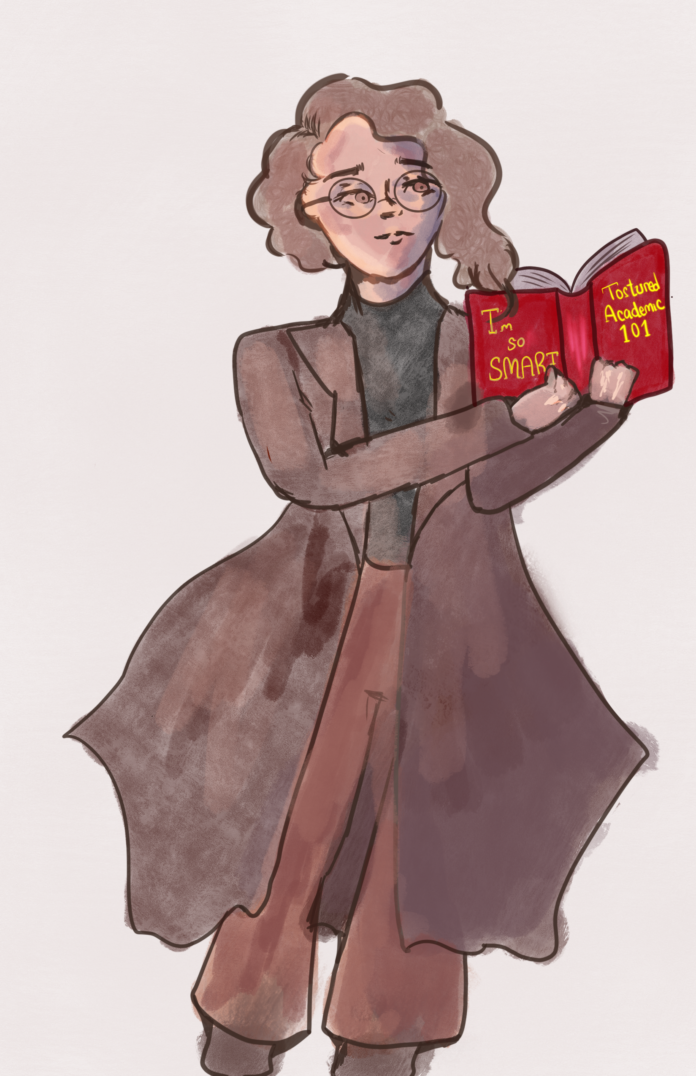
By: Max Lorette, Peak Associate and Portrait Holder of Dorian Gray

Have you recently finished reading The Secret History by Donna Tartt? Has the slow ascension of summer made you yearn for the cool breeze of autumn? Do you revel in enforcing your superiority complex over your fellow scholars? Then you may be swept up in the warm embrace of the dark academic aesthetic. I implore you to ask yourself, “Is this the right aesthetic for me?”

Allow me to assist you in achieving such an esteemed lifestyle. I insist you forget that this movement is deeply rooted in classism, colonialism, and western-eurocentrism. There is little use in dwelling upon . . . unpleasantries. We do not believe in personal analysis here.

Embark with me upon a riveting journey in caffeine overload, tweed jackets, and academic burnout! You don’t need to attend a gothic university in order to achieve such a curated aesthetic. Read on and discover how best to live a prep school-esque lifestyle from the comfort of SFU! Who needs classical and gothic architecture when you have a style of architecture commonly compared to a prison?


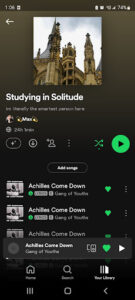
  1. I hope you feel honoured that I am divulging my greatest secret to you: my study spot. I urge you to study ONLY in the catacombs of the RCB. There is little as inspiring as the endless labyrinth of blood-red floors and melancholic concrete walls. Remember, if you have a cell phone signal, you aren’t deep enough. Though I, too, struggle with romanticizing such bland architecture, the perfect study playlist will surely assist you in immersing yourself in your studies. May I suggest my own curation of symphonies? Of course you would like to listen.
Spotify playlist screenshot. Playlist titled, "Studying in Solitude" and captioned, "im literally the smartest person here" by Max. All the songs in the playlist are "Achilles Come Down" by Gang of Youths.
SCREENSHOT: Max Lorette

Indulge your ears here on my highly curated Spotify playlist.

2. Upon submitting your written masterpieces to your professor, be certain to put some thought into its material presentation. Tea stains and coffee cup rings will make it appear as if they received a document from an academic straight out of the 40s! Better yet, type everything out through a vintage typewriter! Frankly, it is my firm belief that Microsoft Word is the single utmost inhibitor of creativity, and that analog is the best method forward. If your professor complains, you’re probably more intelligent than them anyhow. 

3. My dearest pupil, take it from me. The simplest way to assert your academic dominance over your peers is through constantly making unfounded and often irrelevant literary references! Don’t know any? Make them up! Attribute any and all quotations to the likes of Shakespeare, Gandhi, John Lennon, and Karl Marx. Want to appear well-read? Reference Greek mythology (naturally, the endallbeall of ancient civilizations)! Don’t know anything about the Hellenic period beyond what you read from Percy Jackson? Me neither!

4. Never be seen without a yellowed book in your clutches. It is essential that people never forget how well-read you are. As quoted from a little-known book, Norwegian Wood by the unsung literary genius Haruki Murakami, “If you only read the books that everyone else is reading, you can only think what everyone else is thinking.” Thus, I have made it my mission to provide you with my favourite underground novels to assert your intelligence over all those around you. No need to thank me!

The Illiad by Homer Simpson

Pride and Prejudice by Britney Spears

Animal Farm by Elon Musk

The Grapes of Wrath by Rihanna


And of course…

War and Peace by Meryl Streep


5. Finally, perhaps the most vital way to achieve the dark academia lifestyle is to have a thesaurus beside you at all times. Are you struggling to find the perfect word to fabricate the facade of intelligence? Choose a synonym. It doesn’t need to make sense. As long as it’s long, you will appear all the more intelligent. Make it sound as though you are trying to hit the word count in real-life conversations. No, I haven’t been doing this the whole time I’ve been writing this article and I am frankly insulted that you would insinuate so!

This is a way of life that is as beautiful as a rare volume, as intricate as a Baroque fresco, and as sustainable as a dual-ended candle burning into itself. And I sincerely hope to further indoctrinate you all, dearest readers, into my exclusive academic cult club.


Re: Are they incomplete assignments or just boundaries?

0
A girl biting her pencil, staring at her laptop
“The stress from your class is not it.” / PHOTO: Pixabay

By: Maya Beninteso, Peak Associate

Dearest Professor,

Thank you for your email. While your message says I haven’t completed the assignment, I counter that I’m merely asserting an emotional boundary. I don’t claim the assignment’s due date. I didn’t consent to that due date, and I should’ve been directly consulted since it affects me. 

Further to that point, stop gaslighting me by saying that I was “informed of all due dates at the beginning of the semester” and “would’ve known this information had [I] attended a single lecture.” You should learn to communicate better. I have a life, too, you know. It mostly consists of chugging iced coffee and contemplating the meaning of life, but it’s still a life. I would like to communicate to you that I haven’t felt validated by you at all throughout this process. I just thought you would like some feedback, too. Consider this my course evaluation. You, and your class, deserve a failing grade. 

First of all, my therapist, Richard, expressed that asserting boundaries is essential to my mental health. Accordingly, I refuse to do the assignment. I hope you can come to appreciate my boundary-setting as this is what I need to heal my inner child. Could you just forget me like how I forgot the assignment, or how my mother forgot me at the mall when I was a child? 

Moreover, I noticed the angry tone in your email and I don’t claim that negative energy. Your reactivity is giving unhealed trauma and maybe you should get that checked out. If you’re a fan of strong reactions, might I suggest an occupation in the field of chemistry, instead? Perhaps the abysmal paragraph at the bottom of your syllabus entitled “Health and Counselling Resources” should be consulted . . . by you. You have incited much reflection in me over the past few days since your email. 

In the wise words of Britney Spears, “Don’t you know that you’re toxic?” Although I try to convince myself that obstacles are “good for the plot,” I’m not currently in the right headspace to tackle your toxicity. I hope you can respect my decision to cut you, and this ridiculous assignment, out of my life as it’s causing undue distress. I need to reclaim my #girlboss energy and, frankly, you’re inhibiting my ability to do so. 

Most importantly, what would possess you to make an assignment due a measly 13 days after This Love (Taylor’s Version) was dropped? I need time to recover. I’m, in fact, still recovering from the 10-minute version of All Too Well,” so you should have some consideration for my emotional needs. This burden doesn’t belong with me

If you have a problem with me asserting my boundaries like a healthy and well adjusted adult, take it up with Richard.

In the meantime, since I’m such a generous human being, I thought I would share some resources since you clearly need help. I sincerely hope you can become as self-aware as I am one day.

Peace and love on planet Earth, 

Maya Beninteso (she/her)
B.A. in Humour Mechanics without Distinction 


SFU too often takes credit for achievements by progressive student movements

0
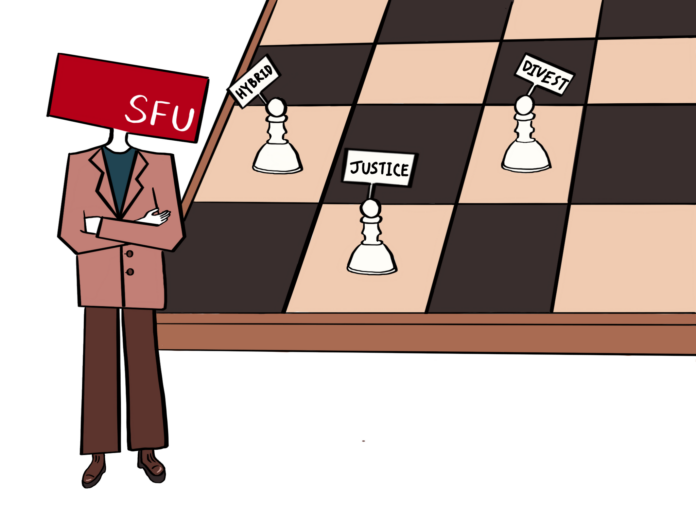
Professionally-dressed person with an SFU logo for a head standing in front of a chess board facing the reader. Chess board extends towards the reader, half off the page. 3 small chess pieces of protestors holding signs reading "divest," "hybrid," and "justice." The SFU logo-head has their arms closing in on the protesting students/chess pieces.
Stop with the passive aggression, SFU. Credits: Amy Guo / The Peak

By: Luke Faulks, Opinions Editor

Here’s something that never fails to be a crowd-pleaser: powerful institutions claiming to be progressive after being shamed into progressive action. And what’s even better? When that same institution fakes good cheer when thanking the activists that held its feet to the fire. Many thanks for double-dipping on all that, SFU. 

Last year, SFU350 got the school to fully divest itself of investments into planet-warming, emissions-intensive industries. That’s great! After eight years of protesting, and after having been threatened for an inoffensive mural on Convocation Mall, a student-advocated policy change was underway. 

Except you wouldn’t know it from the school’s self-congratulatory press release. The divestment announcement overconfidently talked up the school’s “strong record of increasing commitment since 2014” an assertion that, if true, would have negated the need for SFU350’s ultimately successful divestment movement. More to the point, the release then proceeded to bury the group responsible for applying progressive pressure by mentioning SFU350 at the bottom of the page, towards the end of a lengthy list of organizations. Plus, I kid you not, “SFU350” is styled incorrectly. And of course, this isn’t a one-off. 

Last year, SFU’s Senate approved the hiring of 15 Black tenured professors in a huge step forward for representation on campus. In quotes to The Peak and CBC, SFU president Joy Johnson celebrated the Senate’s approval of the motion. When speaking to The Peak, she said, “The motion approved by the Senate is an important step forward as we work to ensure Black faculty, staff, and students feel included.” But, again, the movement is the result of tireless work toiling on the part of Black folks to get the motion across. 

And then when groups are explicitly thanked, it either reduces the work of the group, or it’s mentioned in passing. Listen to this one when SFU announced a plan for responsible investment:

“The university would like to acknowledge and thank these individuals, student groups, and SFU350, for advocating for responsible investment and divestment over the past eight years.” 

Advocating against your program. Advocating for better than what you gave them. And yes, “Eight years.” This after they felt they had to go on a hunger strike because you didn’t listen to them. “Eight years.” It’s an admonition unto itself. Why celebrate your policy shift when your own press release slights the group that demanded the shift had to fight for nearly a decade to get it passed? 

Listen up, school. We all feel bad when we’re called out on bad behavior. But if you don’t want to be made to feel crappy about your policy missteps, don’t wait so long that students have to spend years advocating for positive change. Just go ahead and do it yourself.

The government of Canada invests $15.2 million in clean technology

0
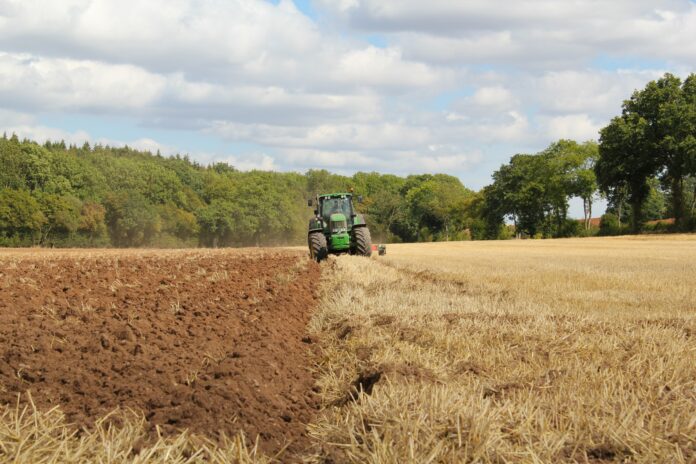
A tractor is seen tilling a field. One half of the field is dry-looking dirt and the other half is yellow grain. There are large trees surrounding the field.
Air pollution is expected to reduce by two megatons by switching fuel and decreasing consumption. PHOTO: Richard Bell / Unsplash

By: Karissa Ketter, News Editor

The government of Canada invested $15.2 million into the Agricultural Clean Technology (ACT) program. The minister of agriculture and agri-food, Marie-Claude Bibeau, made the announcement on May 24, 2022. 

The ACT press release notes the investment will support farmers in adopting clean technology in 47 projects across Canada. Their goal is to use new technology to reduce greenhouse gas emissions. The press release reads, “Farmers have long been responsible stewards of their land and their actions are key to reaching Canada’s climate targets.”

Taleeb Noormohamed, Vancouver Granville’s member of parliament said in the press release, “Taking immediate action against climate change is key to exceeding Canada’s 2030 emission reductions target and setting the foundation for a net-zero emissions economy by 2050.

The government of BC reports greenhouse gas emissions can be reduced by updating livestock and manure management, soil carbon sequestration, and energy conservation.

Carbon sequestration — when agriculture ecosystems draw carbon dioxide from the atmosphere and store it in the soil — can be achieved by reducing tillage, increasing crop cover, and implementing rotational livestock grazing. 

The government anticipates the ACT program will reduce current pollution levels “by up to two megatons as a result of fuel switching and decreased fuel consumption.”

The press release writes the investment will support farmers with “grants of at least $50,000 for 50% of the cost of grain dryers or barn heating systems.” 

Alongside supporting farmers, the government will use ACT to fund research to support clean technology innovation, research, and development. They are seeking to expand markets of green energy, green efficiency, precision agriculture, and bioeconomy. 

Bibeau said in the press release, “The fight against climate change aims to not only reduce Canada’s greenhouse gas emissions, but also to help producers innovate and adopt more sustainable agricultural practices.”

To bodly go: We don’t need a fully-stocked bookstore anymoreWe don’t need a fully-stocked bookstore anymore

0
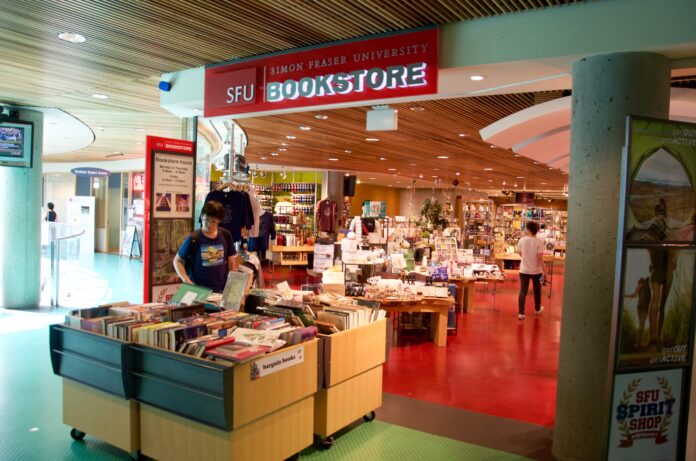
SFU’s bookstore on Burnaby Campus
Paper!? Where we’re going, we don’t need paper! The Peak

By: Nercya Kalino, Staff Writer

In the beginning, there was paper. But times have since changed. Books have lept beyond paper copies to the digital, and so it’s time for our bookstore to reflect the possibilities of 21st century learning. 

Let’s start with this: A bookstore is a monument to the death of the environment. Statistics aggregator The World Counts suggests 42% of all global wood that is harvested is processed for paper production. In technologically advanced societies, the facilities to shift this resource fully online is available. And let’s face it, we’ve all been doing it for years. Who hasn’t pulled up chapters using SFU’s digital collection rather than go fetch the paper copy from the bookstore?

Now, for a bibliophile like me, this is a complicated idea. I admit it definitely hurts to imagine a world without full book shops; I love the smell of congested bookstores and freshly printed newspapers. 

However, there are also some technological hurdles here. Some places still need paper copies. Take my home country, Malawi. As a nation, the personal devices necessary to enable an all-digital bookstore aren’t widespread. Access to internet and affordability of requisite devices is something for any digitally-curious bookstore to consider. SFU, though, has (mostly) steady internet, and many students are probably equipped with the requisite electronics. 

We can also look to schools that have already lept into digital-first bookstores. In 2016, American University brought about this change by removing books from the store and guaranteeing access to digital books or used books that students can order. The store still allows students to order the used and new books they want, they just don’t stock any in-store. 

An emptier bookstore opens up a world of possibilities for the space. At the very least, students will probably feel safer not having to go into a small, crowded space to search for textbooks during a pandemic. If we want to keep the space as a provider of student jobs, we could fully transition the space into an SFU merchandise store. Alternatively, using the floors as space for student clubs would surely be popular for SFU’s wealth of roomless student groups. 

Bookstores piled with textbooks represent a moment in time. Digital or orderable used textbooks represent a new moment. Let’s give students more choice, slightly reduce our environmental impact, and use the bookstore space to better serve SFU students.

Public Reparations: SFU is concerned with its image, not Black students

0
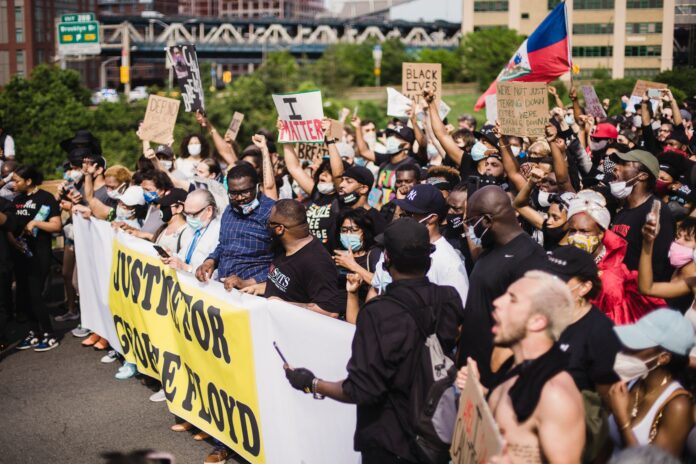
A large Black Lives Matter protest
SFU needs to do better when no one is looking. Credits: Life Matters/ Pexels

By: Chlöe Arneson, News Writer

In 2020, after violence against Black citizens produced intense public pressure, universities across North America leaned into equity and diversity initiatives. SFU, for its part, has issued statements of support and announced a partnership with Resilience BC Anti-Racist Network. That’s all great; however, SFU is stuck playing catch up when violence against its Black students occurs, rather than pre-empting racist incidents out of a sincere desire to protect its Black students and staff. 

That’s not to say that SFU hasn’t made significant strides in listening to its Black students and staff in recent years. At the start of 2022, the school created a new position for vice president equity and inclusion at the recommendation of student activists. 

Despite the new position, it’s worth noting anti-Black racism in academia is deeply intertwined with the university’s most basic structures. Professionalism standards and human resources practices that deal with misconduct or conflict are often unfairly targeted toward Black employees and do not consider the role race plays in the workplace. The university system itself thrives on exclusive excellence, giving ample opportunity for racial bias and discriminatory admissions processes to contribute to the underrepresentation of BIPOC students we see in Canada today. 

Black students, already facing those systematic barriers, suffer from a system and locale intrinsically linked with white supremacy. When SFU does act on student concerns, it’s largely in response to a surge in public attention on the problem. Case in point, on December 11, 2020, a Black alum was tasered and pepper-sprayed on campus by a Burnaby RCMP officer before being taken into custody. While a third-party investigation ordered by SFU followed proper policies, it remains an incidence of excessive violence towards a Black member of the SFU community. In response, SFU Health and Counselling opened up a space for Black students to discuss racism and receive support. 

For Balqees Jama, president of SFU’s Students of Caribbean and African Ancestry, it points to a larger trend. At a public anti-racist symposium earlier this month, she said,It seems like conversations surrounding Black students, supports, and implementation only seems to progress at a reasonable pace when there is Black trauma involved and white guilt.

 “We’ve been asking for Black health and counselling forever, when did that happen? The conversation started Summer 2020, but it took another case of Black trauma where there was a case of actual police brutality in December 2020 to even get the ball rolling.”

Waiting to see high-profile violence against Black people before implementing important support programs is bad enough, but even when SFU does move forward with promising programs, they require the beneficiaries of those endeavors to bear too much of the cost. There’s still only one Black counsellor on the clinical counselling team. While I’m sure Tricia-Kay Williams is an exellcent counsellor, how can one person be expected to heal the entirety of the Black student body? Ebony Magnus, SFU Samuel and Frances Belzberg Library’s head librarian, criticized the reality that university protocols are ultimately designed to protect the institution from seeming racist, and not to protect Black community members. Systemic issues can’t be fixed with counselling.  

“Campus safety operates as protection against the liability of the institution more than the commitment to the dignity of Black people. Campus safety staff dismissing racist verbal assaults against Black staff members as non-violent because there was no act of physical violence is not mutuality,” Magnus said.

SFU needs to listen to its Black students, not just when the public is outraged about racist violence, but all the time. Jama was involved with the campaign to hire 15 new Black faculty at SFU to better represent the Black student body. The problem, she said, is that in discussions about Black students, “white administration and institutions make it about themselves.” Instead, she argues, the solution lies in representation at the highest levels. “We need Black admins,” she concluded.

Policies and protections made within the university are shaped by its inherent realities of upholding white supremacy. The school needs a change. And it can start by keeping its ear to the ground when they think no one is watching.

Minutes – May 2022

0

Peak Publications Society Board of Directors Meeting Agenda

Wednesday, May 18, 2022

Zoom


Chair: Kelly Chia


In Attendance


  1. Le (Yuri) Zhou (Board Secretary, non-voting)
  2. Emma Jean (Collective Members Representative)
  3. Kelly Chia (Employee Members Representative / Chair)
  4. Angela Wachowich (At-Large Representative)
  5. Emma Dunbar (At-Large Representative)
  6. Michelle Young  (Editor-in-Chief)


Agenda

  • Call to Order

9:39am

  • Approval of Agenda

Emma Dunbar, Emma Jean
All in Favour

  • Approval of Past Minutes from April 25, 2022

Emma Dunbar, Emma Jean
All in Favour

  • Financial Updates

  • Membership Report

78 members

  • PEAK lease updates 

Revised version by our lawyer has been approved by SFSS on April 27 meeting

Under signing process currently 

  • Discussion of the letter sent by Craig Allan

             In-Camera

  • Discussion of Peak plan in summer 

Michelle leads a conversation 

  • Discussion of writer compensation policy 

Michelle leads a conversation
To add a section to the Editor-in-Chief job contract detailing compensation for written content in emergency circumstances, discuss further at next meeting

  • Adjournment

11:06 a.m.


Peak Publications Society Board of Directors Meeting Agenda

Monday, April 25, 2022

Zoom


Chair: Kelly Chia


In Attendance


  1. Le (Yuri) Zhou (Board Secretary, non-voting)
  2. Emma Jean (Collective Members Representative)
  3. Kelly Chia (Employee Members Representative / Chair)
  4. Angela Wachowich (At-Large Representative)
  5. Emma Dunbar (At-Large Representative)
  6. Michelle Young  (Editor-in-Chief)


Agenda

  • Call to Order

1:04pm

  • Approval of Agenda

Angela, Emma Dunbar
All in Favour

  • Approval of Past Minutes from March 21, 2022

Angela, Emma Dunbar
All in Favour

  • Financial Updates


  • Summer Budget Review

  • Membership Report

75 members

  • PEAK lease updates 

Postponed to May meeting

  • Discussion of the letter sent by Craig Allan

             In-Camera

  • Discussion of Peak plan in summer 

Postponed to May meeting

  • Adjournment

              2:11pm