Home Blog Page 170

Evolve E-Bikes make their way to SFU Burnaby campus

0
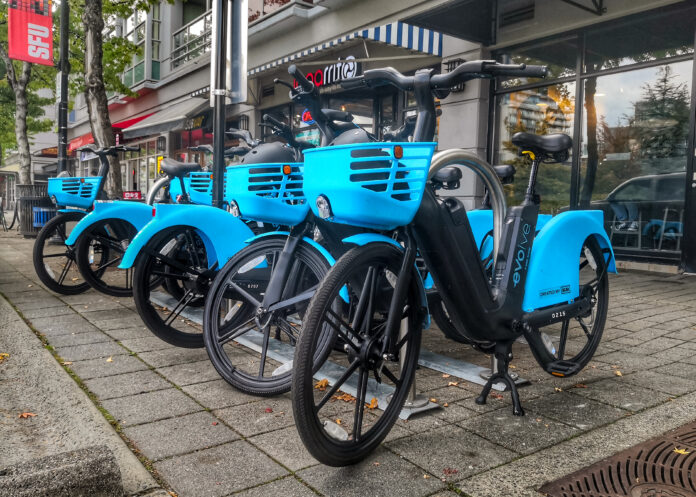
This is a photo of the blue Evolve E-Bikes outside of the SFU Burnaby campus. A row of Bikes are lined up. The bikes have baskets in the front where helmets and safety information sit.
PHOTO: Afsaneh Keivanshekouh / The Peak

By: Eden Chipperfield, News Writer

On August 28, a new transportation option rolled its way onto the SFU Burnaby campus. 30 new electric pedal Evolve E-Bikes are now available in various spots across the mountain for the SFU community to enjoy. The bikes will be available 24/7 for pick-up and drop-off, from the Dining Commons Patio to University High Street. 

The Peak connected with David Agosti, Parking and Sustainability Mobility Services director at SFU, to discuss the conception of the Evolve E-Bike program. 

The program’s purpose is to encourage a “zero-emissions mobility option” for all who find themselves around SFU Burnaby, said Agosti. “It was an idea spurred from SFU’s 2025 sustainability goals related to reducing greenhouse gas emissions from transportation.” 

As part of SFU’s Strategic Sustainability and Climate Action Plan, the introduction of the bikes is a way for SFU to reach their goal to reduce Scope 3 emissions by 2025. Scope 3 emissions are the emissions that are not produced by SFU directly, but rather emissions that occur from their business activities. A key example of this is the student club SFU350’s call on SFU to divest their money from Scotiabank, which is the second-largest funder of fossil fuel projects in Canada.

The hope is that having the E-Bikes available will aid in accomplishing the goal “to reduce Scope 3 emissions from 2019 levels by 25 percent.” Agosti added, “The bike share program can help us meet that target.” 

The Evolve E-Bike initiative is a conception of BCAA, which owns and operates Evo Cars. Their car share program has been in place around SFU since 2016. The Evo app will include the Evolve E-Bike locations to enjoy around Lhuḵw’lhuḵw’áyten (Burnaby Mountain) with its various bike lanes and paths. 

The E-Bikes include helmets for riders and “access to safety information, riding tips, and advice on the [Evo] app.” The helmet and information are included on the front of the bikes. Pricing ranges from “$0.35 per minute, or $12.99 per hour, plus an additional $1.25 unlocking fee per trip.” Alternatively, the bikes can be accessed through a subscription for $9.99 monthly. 

The bike pick-up and drop-off stations are located at the northeast transportation centre, southwest transportation centre, town & gown square, University High street, Fraser International College, Dining Commons entrance, Dinning Commons patio, Courtyard Residences, and water tower. “The location of the nine designated parking zones was chosen in consultation with various SFU departments looking at proximity to start-of-trip destinations, proximity to end-of-trip destinations such as Nesters grocery store and Fraser International College, and proximity to existing approved cycling pathways and infrastructure,” explained Agosti. 

To celebrate the establishment of the Evolve E-Bikes on campus, the SFU community can register for a “free Evolve E-Bike Share membership” using the code HELLOSFU for 15-minutes of free riding, exclusive to new members. 

For more information on the Evo E-Bikes, download the Evo app on the App Store or Google Play

The AI revolution in sports

0
PHOTO: Amirul Anirban / The Peak

By: Sude Guvendik, Staff Writer

Athletes, coaches, and fans are witnessing the fusion of technology and artificial intelligence (AI) usher in a new era of innovation in the realm of sports. From precision analytics to virtual reality training, AI is making its mark across the sporting world.

Performance Enhancement through Data-Driven Insights

AI is revolutionizing the way athletes prepare and perform in their respective sports. One of AI’s most significant contributions in sports is its ability to analyze vast amounts of data and provide actionable insights. Athletes now have access to in-depth performance analytics that were once unimaginable.

Take, for instance, professional basketball. SportsVisio, a sports analytics start-up, is funding AI-powered cameras and sensors to track every move on the court, collecting data on player positioning, ball movement, and shot accuracy. This data is then analyzed to identify patterns and trends, enabling players to make necessary adjustments during the game itself.

In tennis, AI is helping players fine-tune their strategies. AI algorithms analyze historical data to predict an opponent’s playing style and weaknesses, providing valuable insights for match preparation. With the ability to simulate different game scenarios, players can practice more effectively and strategically.

Coaching Strategies Reinvented

Coaches are also reaping the benefits of AI. They can now access a wealth of information to optimize training regimens and game plans. AI systems can process video footage to dissect player techniques, offering coaches an in-depth view of their strengths and weaknesses.

Athletes can immerse themselves in virtual training environments that replicate game situations. This allows them to practice and refine their skills in a risk-free setting. Coaches can monitor progress and provide real-time feedback, ultimately accelerating the learning process. Furthermore, AI is contributing to injury prevention. By monitoring player movement and biomechanics, AI can detect signs of overexertion or improper form, helping coaches tailor training programs to minimize the risk of injuries.

Revolutionizing the Fan Experience

AI is not limited to benefitting athletes and coaches — it’s also enhancing the fan experience. In stadiums, AI-driven cameras and sensors provide spectators with unprecedented insights into the game. Augmented reality overlays can display player stats, highlight key plays, and offer interactive experiences through mobile apps.

For viewers at home, AI-powered broadcasting is transforming the way we watch sports. Automated cameras with AI algorithms can track the action and select the best angles in real time, creating a dynamic and engaging viewing experience. AI-driven commentary systems also provide instant analysis and insights, adding depth to the commentary. 

Fantasy sports have seen a surge in popularity thanks to AI. Algorithms help players draft the best possible teams, analyze player performance, and make in-game decisions. This adds a new layer of strategy and excitement for fans.

While AI is revolutionizing sports in countless ways, it also presents challenges and ethical considerations. Privacy concerns arise as AI collects and analyzes personal data. There are questions about fairness when AI is used to gain a competitive advantage. Transparency and responsible data usage are essential to address these concerns.

AI is changing how athletes and players can engage in data statistics, but it has always been an area of interest in sports. Prior to AI, teams of data analysts were running programs and simulations, crunching numbers to relay to athletes and teams. None of these processes have entirely gone away with the implementation of AI. What has changed is the degree of what can be analyzed. At the end of the day, stats are rendered useless if you make a decision outside of the algorithm. Data analysts are necessary to decide if what the data is proposing is the best course of action.

As AI continues to evolve, its impact on sports will only grow, pushing the boundaries of what’s possible in the pursuit of excellence on and off the field. However, it’s essential to navigate the ethical considerations and challenges that accompany this AI revolution to ensure that it benefits athletes, coaches, and fans alike while preserving the spirit of sportsmanship and fairness. 

Canada’s agricultural worker program violates migrants’ rights

0
This is an image of a worker in a field of vegetables. They are carrying a box over their shoulder filled with the goods they have gathered, as they walk away from the camera. There are other workers in the distance who are also gathering vegetables.
PHOTO: Tim Mossholder / Unsplash

By: Andreea Barbu

On September 8, The Peak attended a talk discussing Canada’s Seasonal Agricultural Workers Program (SAWP). The panel was hosted by the SFU School of International Studies. The talk was moderated by professor Gerardo Otero and joined by a panel of experts, including David Fairey, from Labour Consulting Services; Evelyn Encalada, from the SFU Labour Studies program; and Ana Berenice Díaz Ceballos, Consul General of Mexico in Vancouver. Their aim was to address the program’s impact on workers’ health and labour relations, as well as on workers’ families in Mexico.

The talk began by presenting an overview of the labour environment for food and agriculture workers. There are roughly 11,830 foreign workers in BC, with 6,000 being SAWP workers. The program was adopted by BC in 2004, although SAWP in Canada has been bringing in Mexican workers since 1974. It is a program that responds to Canada’s role in being the world’s fifth largest exporter of agrifood and seafood products worldwide. Within the SAWP program, “Canadian farm employers [can] hire workers from Mexico and the Caribbean on temporary visas when employers are unable to hire local workers to fulfill their labour demands.” Due to the temporary nature of the positions, workers are in precarious working conditions where they have no protections. 

Over the course of the last seven years she has been in BC, Berenice has visited 350 farms out of 550 that have SAWP workers. “Around 60–70% of the conditions of the housing were substandard. That creates a lot of problems,” as precarious housing can increase the workers’ vulnerability, Berenice said, recalling her visits to these farms. 

“The government needs to be much more involved in the process. I always try to stress what is really [ . . . ] the problem: monitoring.” Berenice explained how monitoring, supervising, and having preventive inspections is “one of the most important things.” She pointed out employers need to get approval from the Labour Market Impact Assessment, and one of the requisites is that they need to provide all the right conditions for their workers. Monitoring and conducting inspections into the working conditions workers face is a key part of enforcing healthy working conditions. 

Fairey echoed Berenice’s critique of these working conditions: “The SAWP program is a program that permits a high degree [ . . . ] of exploitation and discrimination of migrant workers.” In Fairey’s opinion, the program “should therefore be abolished, or at the very least, radically changed. The SAWP violates the rights of migrant workers in several ways according to the United Nations International Convention on the protection of the Rights of Migrant Workers.” 

Fairey listed some of the ways employers’ are able to exploit and mistreat their workers: lack of ability to choose housing, the lack of flexible work hours of work, lack of overtime provisions, the exclusion of statutory holiday pay, and the ability for employers to summarily terminate the employment of migrant workers without calls or the right of appeal, to name a few. “Migrant workers in Canada should have the same rights of employment as Canadian workers do, and the reality is that temporary foreign workers do not have the same rights as domestic Canadian workers. This is a fundamental problem.”

Encalada added more nuance to the discussion by calling attention to the role of climate change in exacerbating working conditions, and the increased vulnerability of women in particular. “This program not only discriminates against workers in terms of their status as temporary foreign workers [ . . . ] but also there’s gender inequity [and] racial inequity,” she said. “Of course, women need to feed their children too.” While there are a very small number of women workers who are part of SAWP, they face increased hostility from employers. 

Despite the criticism surrounding SAWP, Berenice clarified that many Mexicans have expressed to her appreciation of the program. “This has helped them to create their own business, [and] to send their children to university,” Berenice said. “That’s a game changer for them.” However, she stresses that this has been the experience for Mexicans with good employers and with good practices. 

What Grinds Our Gears: Going to Costco

0
A warehouse style grocery store
PHOTO: Sean Lee / Unsplash

By: Michelle Young, Opinions Editor

I absolutely hate Costco. Specifically, I hate the shopping experience at Costco. Do not, for the love of god, start lecturing me on what “good deals” they have because I have heard enough from everyone and their grandmother about the “amazing” things Costco has to offer. If it was up to me, I would never step foot in that awful grocery-warehouse crossover if you paid me. 

Now hear me out: Costco seems to bring out the worst in everyone. It’s like people forget how to behave in this store. Everyone is bumping their carts into you or standing so close that you can feel their breath down your neck. Get your sweaty hands off me. People are knocking things from the aisles onto me and my partner, and giggling about it. Families are leaving their carts abandoned, rolling down the aisles. The lines are horrendously long, and why do half the families line-up horizontally? 

Before you tell me I just need to go during the “off hours” — the parking is a mess at every hour of every day, and there are plenty of other reasons I refuse to step foot in this store. 

First, what’s up with the lighting? It is somehow both way too glaring and also too dim to see anything properly at the same time. The whole store is a sensory nightmare. This store is trying to do too much. They want to sell clothes, but they have no fitting rooms. This doesn’t stop people from stripping in the middle of the aisle. There are socks littered on the floor. Listen, I know Costco’s whole thing is “cheap bulk products,” but I don’t need bulk products. Like, ever. I live in a household of two. All the food is going to expire by the time we get to it. I am begging, stop trying to convince me to go to Costco — I would rather go anywhere else.

Are my devices allergic to Mr. Wi-Fi?

0
Angry man holding and yelling at a laptop.
PHOTO: Bermix Studio / Unsplash

By: Hailey Miller, Staff Writer

Nothing irks me more than the good ol’ Wi-Fi signal fading in and out just as I’m about to log in to my Canvas account and prepare for class on campus. Mr. SFU Wi-Fi sure loves to keep me on my toes, and his Computer Brain friends never know whether he’s going to show. As his girlfriend, it’s unbelievable that he treats me this way. His hazy lines disappear faster than they ever appeared as faint arc-shaped wisps escaping into the computerized abyss. To make matters worse, the entire campus-worth of students bog down his system like the stress that already lives rent-free in our heads. It’s a wonder that the school site doesn’t crash every two seconds between tens-of-thousands of students and my Wi-Fi man playing an endless teasing game of tag, enticing devices with every screen reload. 

Mr. Wi-Fi and I are really on again, off again. Sometimes, his parts work fine, and sometimes, they don’t. The guy’s really got a mind of his own, you know? He chooses which majors really turn him on and shies away from the spots on campus that are covered in layers of cement and concrete towers. He’s really not one for comfort or cramped spaces. Forget all the busy places around town, because Mr. Wi-Fi isn’t making the slightest flash of an appearance anytime soon. Abracadabra and he’s gone with the wind! I chase his signal like a ghost creeping through the night, light on my feet, and holding my breath with every move. Wi-Fi Guy’s favourite time to disappear is right as I’m about to write a quiz or study late into the night. I just love an unsaved quiz response that tanks my grade, thanks to Mr. Unreliable! 

On the other side, Mr. Wi-Fi’s next-door neighbour, the Computer Brain, is just not having it. I don’t know why I ever think that just because my Wi-Fi man isn’t into my laptop means that he’ll be turned on by my phone or iPad, because he isn’t . . . although, sometimes, he is. Believe me, I’m just as confused as all the Computer Brains out there. It’s an endless guessing game, but who am I to play cat and mouse with Mr. Wi-Fi’s stubborn signal? Just kidding; I am an elite Wi-Fi-tracker-downer. Such slithering skills come alongside the expertise of my degree, with a concentration in wasting my time reconnecting to the web. 

Mr. Wi-Fi comes to play on the Burnaby campus but doesn’t mess around when he’s downtown. Am I getting the wrong signal or what? I thought that would be worse for my guy — all those cement buildings in the city give “concrete campus” a run for its money. For whatever reason, Mr. Wi-Fi clearly likes the artsy school vibe because he sticks around a little longer, obviously faking his reliability just to show off. How theatrical! 

I really don’t know what the guy’s problem is, but he’s got some kind of issue with connecting to all his supposedly helpful computer neighbours and tech friends. He cheats on me as if I couldn’t see the signs. One minute, he’s in a relationship with Mr. Laptop, and the next, they’re “on a break.” Yesterday, he was besties with the iPad in Vancouver, but as soon as his Apple friend took him on a detour to Burnaby, he said “au revoir!” and gave poor iGuy the cold shoulder. Regardless, I thought the two of us were going pretty strong until he decided not to show up for our scheduled hot date of reading 200 pages on the first day. Clearly, Mr. Wi-Fi is not my man. So, yeah, we’re on a break now, too, but no doubt I’ll see him around soon. Ugh. What a way to reconnect.

Hidden Gems: Local bookshop havens

0
A shelf in a book store.
PHOTO: Pooja Singh / The Peak

By: Alex Ileto, Peak Associate

Nooroongji Books
Location: 1666 Johnston St, Unit 6, Vancouver
Hours: Monday–Sunday, 10:00 a.m.–6:00 p.m.

Named after the Korean word for scorched rice at the bottom of a pot, Nooroongji Books on Granville Island seeks to find community across cultures and be a haven for multilingualism. As soon as you enter, you’re greeted with warm lighting, relaxing instrumentals, and a sofa where you’re encouraged to sit and enjoy a book! In addition to its extensive book collection focusing on multiculturalism, design, philosophy and more, they also have a great selection of puzzles, and other gifts like postcards.

Orange Crush Velvet Vintage and Books
Location: 611 12th St, New Westminster
Hours: Sunday and Tuesday–Friday 12:00 p.m.–6:00 p.m., Saturday 12:00 p.m.–7:00 p.m., closed Monday.

Refresh your wardrobe, replenish your bookshelf, and visit Orange Crush, a used clothing and bookstore tucked away in New West. Expect shelves filled with interesting titles and racks filled with tasteful thrift finds. For a curated vintage shop, they have excellent prices for high-quality garments. As for their book collection, expect to find a diverse plethora of stories about demons, horror, and heroines. Orange Crush is the definition of a cool bookstore.

Wendel’s Bookstore and Café
Location: 9233 Glover Rd, #103, Fort Langley
Hours: Monday–Sunday 7:30 a.m.–10:00 p.m.

Wendel’s is the perfect combination of cozy ambience — a welcoming café and a calming bookstore. Nestled in Fort Langley, Wendel’s has a knack for understanding exactly what their customers want, whether you’re a coffee aficionado or an avid reader. Not only do they serve high-quality coffees and pastries, but they also have a great selection of titles that appeal to a vast range of readers. Stop by Wendel’s if you’re in need of a good reading session.

Tanglewood Books
Location: 2306 W Broadway, Vancouver
Hours: Monday–Saturday, 10:00 a.m.–6:00 p.m., Sunday 12:00 p.m.–6:00 p.m.

Tanglewood Books makes you feel like you’re the main character of a cute romantic comedy in New York. With a charming mix of new and used books at reasonable prices, casual perusers are bound to discover titles that spark their interests. The overflowing shelves of organized chaos demonstrate the store’s grand collection and add a certain magic to the shop’s enchanting atmosphere. Tanglewood Books is the friendly neighborhood bookshop of your dreams!

The Bright-er Side: Romanticizing autumn

0
A forest with yellow and orange leaves
PHOTO: eberhardgross / Unsplash

By: Eden Chipperfield, News Writer

It’s that time of year when we’re bidding farewell to summer. The rain has slowly started to come back, leaves are turning dazzling colours of red and orange, and slowly but surely, we’re beginning to see pumpkin flavours return to menus everywhere. 

I, for one, have never been summer’s number-one fan. Don’t get me wrong, I enjoy warm days, hot summer nights, trips to the beach, and camping, but something makes my heart sing when I realize autumn is on the horizon. 

Since I was a child, I loved fall; I did all those classic storybook activities like jumping in piles of raked leaves, going to the pumpkin patch, ogling my mother’s baked pumpkin creations, and daydreaming over what Halloween costume I would don that year. 

I adore fall fashion and its endless possibilities. Instead of deciding what pair of shorts I’ll wear that day, I can now snuggle in layers of sweaters, jackets, beanies, and my favourite fall item: Blundstones. Nothing feels better than being on a walk when you’re all warm and cosy. In the summer, my legs become patterned with bug bites and awkward tan lines, but all those first-world problems melt away with fall fashion. 

Find comfort in romanticizing the cold weather while sipping on a pumpkin-flavoured beverage. Snuggle in a blanket, make yourself a hot drink, and listen to the sounds of girl in red as the leaves fall around you, embracing you in the beautiful new season we call autumn. 

SFU students take to the skies with Harbour Air ePlane project

0
This is a photo of the Harbour ePlanes. The small sea plane is taking off from the ocean. The small plane is a bright, electric green colour.
PHOTO: Harbour Air

By: Eden Chipperfield, News Writer

Students from SFU’s Management of Technology (MOT) degree are taking to the skies with the first electric commercial planes. This project is part of an ongoing venture with Harbour Air Seaplanes, a company based out of Vancouver, Richmond, and Pitt Meadows. 

Students from SFU’s MOT program were tasked with analyzing planes and researching how the new expansion would impact business. Since 2019, over 70 tested flights have occurred with the ePlanes through Harbour Air. With the help of SFU MOT students, assessments such as “electric aviation sector, gauging market dynamics, competition, technological innovations, and pinpointing potential challenges and opportunities” were addressed. 

Professor Carlos da Costa, an associate professor from the Beedie School of Business, saw this as a way to capitalize on the MOT program at SFU and prepare “students to tackle complex business and technology challenges.” He noted, “The students brought proficiency from diverse domains, including aerospace, venture capital, software development, robotics, and telecommunications.”

Pollutants from aircraft are greatly associated with the gradual worsening of climate change. CO2 emissions from fossil fuels are a significant problem for the climate, but also “strong warming non-CO2 effects due to nitrogen oxides (NOx), vapour trails, and cloud formation triggered by the altitude at which aircraft operate.” Non-CO2 pollutants such as methane and NOx “contribute twice as much to global warming” as CO2. Since air travel has been a significantly growing method of transportation since the 1990s, the concern about aircraft-related pollution is only increasing.

According to the Harbour Air website, they became a “fully carbon-neutral airline in 2007.” Now, the business wants to strive toward becoming carbon-zero. The company expressed they knew about planes’ environmental impacts and wanted to help create a “big difference for our planet.” 

Greg Hatton, a representative for the SFU MOT program, applauds Harbour Air on their incentive to create ePlanes and the “beginning of the electric age of aviation.” The introduction of ePlanes also aligns with Prime Minister Trudeau’s goal for the country to attain “net-zero carbon by 2035.”

The ePlanes are planning to begin operation by 2024.  

CONFESSIONALS: I can’t stop puzzling

0
Someone standing in a large pile of colourful puzzle pieces. Only their head is sticking out.
ILLUSTRATION: Sandra Ngyuen / The Peak

By: C Icart, Humour Editor

There was a time, not too long ago, when I was oblivious to the joys of puzzling. I spent my free time watching TV, running, and hanging out with friends. I was so lost. Until my friend asked me to do a jigsaw puzzle with them, and suddenly everything was different. I was (no, I am) a changed man. This is my testimony. 

I got bitten by the puzzle bug. I eat, sleep, and breathe puzzles. That’s not a problematic relationship to have with puzzles because puzzles are life. If you don’t currently puzzle, you should get a life (AKA, get a puzzle). Every single resource on puzzling strategies is a sacred text. Every surface in my home is just waiting to be blessed by a puzzle. 

This is not another hobby I will sink a bunch of money into and abandon for something else after I get bored. I know this because I was chatting with my 1,000-piece puzzle last night, and we both promised to be there for each other forever. We roleplayed for a bit, pretending we were in the puzzle-prohibition era. It was a dark time in our nation’s history where instead of passing violent, transphobic resolutions, the Conservative Party set its eyes on another made-up threat. All forms of puzzles were banned. 1,000-piece was hiding, waiting for me in the speakeasy. I arrived fashionably late, looking like 1,000 bucks (which was a lot back then). 

I locked eyes with the “librarian” — the speakeasy is in a secret room under a library, please keep up. I handed her a completed crossword puzzle. She looked back at me, pleased, and said she had a brain teaser she thinks I would like. I followed her; she moved a particularly inconspicuous-looking shelf, and suddenly I was in. I was finally reunited with a beautiful 1,000-piece. I solved her, clandestinely sorting by colour and shape while surrounded by other puzzlers also engaging in illicit activity. 

When not engulfed in these tantalizing fantasies, I try to recruit others to join me and start their own puzzling journey. That is actually why I am writing this today. I am facing great injustice. My TA is trying to give me a zero because they didn’t like the idea of having to piece together my essay so they could mark it. As an act of resistance, let’s all attend their office hours and solve puzzles. Regardless of whether or not you feel ready to join the movement, never forget that everything can be a jigsaw puzzle if you carry scissors around. 

The ABCs of budgeting in Vancouver

0
PHOTO: Diane Helentjaris / Unsplash

By: Hailey Miller, Staff Writer

Vancouver has been ranked as the second most expensive Canadian city, and inflation just keeps getting higher. How are we supposed to get by in a market that’s overflowing with increasing expenses in all aspects of everyday living? Here are some tips to keep on top of your finances and budget accordingly as a university student in this ever-changing market.

Allocate amounts for all expenses.

A simple way to start budgeting is by allocating specific amounts for each related expense. Every month, set aside appropriate amounts for things like groceries and essentials, rent, tuition and school expenses, phone and other monthly bills, transit and/or gas, going-out costs, financial contributions, utility costs, miscellaneous costs, and unexpected expenses. Writing your budget down on paper, in a spreadsheet or a budgeting app, or using tools like SFU’s online budget estimator, helps to keep everything organized. Most banks and credit unions offer online budget calculators, too. Once you’ve established a set amount per category, you’ll have a better sense of how much you spend per month on each expense. The remainder that you have left can go towards savings.

Buy for quality, not for quantity.

Whether it’s fashion, essentials, household items, or other goods, cheap makes don’t last forever. These products not only waste materials and are a major cause of environmental exploitation, but they also empty your pockets and waste your hard-earned cash. Online stores such as Shein and other big-box conglomerates advertise the idea of huge discounts, when in reality you’re just wasting your money on cheap products that won’t last. You will find that the quality of a single high-quality item goes a long way compared to that of multiple poorly-designed products. 

Let’s not forget the poor working conditions for workers employed by these conglomerates. If you buy into these products, you’re supporting the lack of workers’ rights and contributing to the problem. So, avoid fast fashion and mass-consumerism as much as possible. Instead, save up for good quality items while shopping local and supporting small businesses. But, if you trully can’t save up, or simply can’t afford products beyond that price point, my suggestion would be to look for well-reviewed items. Pay special attention to reviews on the quality of clothing. Spending money just for the sake of scooping up a sale is still an added expense. 

Create a budget routine.

Knowing when certain expenses are due to be paid is a great way to help set aside allotted amounts at the appropriate time. Be aware of when your monthly bills and expenses are due — including rent, phone bills, subscriptions, car insurance, etc. — so you don’t fall behind on payments, later having to pay interest or fees. Not paying your expenses on time flips your budget plan backwards, causing you to pay more than you originally would have in the first place. This can lead to more financial stress and lower the wiggle-room in your budget. If you’re overwhelmed by all your monthly costs, consider which are most important, and which you might be able to eliminate. Plan accordingly and set reminders to pay on time.

Don’t shy away from discounts.

Don’t be ashamed of a good discount, as long as you’re not spending aimlessly (re: tip two). Use student discounts to your advantage for things like online subscriptions and platforms (such as Amazon Prime, and premium accounts for YouTube and Spotify), because we know our precious discounts won’t last forever. If you’re absolutely in need of new items, do your best to get things on sale, but remember, quality over quantity. This may be difficult when most sale items and discounts are applicable to products in high demand from big-box stores and corporations, but when it comes down to financial need, if you absolutely need a product, go for that discount and keep your eye out for sales and coupons. Thrifting is a fantastic way to save money and help the environment at the same time. Facebook Marketplace and your local Free Groups are essentially the online version of thrift shops these days — another great way to scoop up used items for a better price, and often for free. Some local, small businesses will have discounts on items, too — especially if they’re clearing stock. 

Engage in conscious spending. 

Avoid buying things “just because” you think you might need or want them, or because it’s a trend or fad — trends fade, and fads go out of style faster than they appear. Do you really need to dip into the latest fashion trend? Why not start your own? Do you actually need a new phone, or is it just because your contract is coming up? Think twice. Are you wasting your money on subscriptions you never use and shows you never watch? Cancel those unused subscriptions for a while; you can always re-subscribe later. Do you really need useless gadgets and miscellaneous items, or is it just because a random influencer told you to do so? Forget wasting your money, the planet is wasting away, too. That’s not to say you should never treat yourself, but be mindful of these things and the costs you accumulate.

Factor in unexpected expenses.

No one likes an unexpected expense, but it’s always good to set some cash aside for a rainy day in case you ever need it in an emergency. Whether it be a leaky roof, a broken appliance, or an uninsured health cost, factoring unexpected expenses into your budget is one of the smartest financial moves. This allows for more flexibility in times of need, and helps reduce financial stress in an already difficult situation.

Grow your savings.

How are you expected to grow your savings when there’s barely enough to pay for the everyday expenses, you ask? Well, by dividing up monthly costs and prioritizing the importance of each category, you’re able to see what you spend your money on, and what you have left over to put into savings. Savings should be factored in from the get-go — essentially, they should be another category in your budget. Set aside an appropriate amount that you can contribute to each month. This way, you’ll be able to see how much your savings are increasing. Any leftover income or cash that you have at the end of the month can either be factored into more savings or an expenses buffer for whenever you may need it. If you’re strategic, investing money can be a good way to increase your savings, but remember to invest appropriately!