Home Blog Page 148

Elf on the Shelf causes post-holiday chaos

0
Elf on the Shelf wearing a robe surrounded by birthday cards.
PHOTO: Nik / Unsplash

By: Saije Rusimovici, Staff Writer

The attack of the oat milk foam, 9:02 a.m. 

I woke up to the sound of my Nespresso machine whirling. It was recently gifted to me under the name of “Santa,” which I decided to take as a whimsical gesture from my partner’s mother, who never quite gave up her sense of childlike wonder. Usually, the drip drip sound of the caramel-scented coffee and the satisfying spin of the milk frother would stimulate my brain with the promise of caffeine. The thing is, though, I live alone — I did not turn on the coffee machine. 

Stumbling into the kitchen, I was flabbergasted by the disaster that awaited me. It was almost comical: espresso pods scattered all over the counter and floor. A half-full mug had tipped over and dripped down the cabinets, leaving perfectly frothed oat milk foam on the linoleum. I don’t know what I was more upset about: the mess I had to clean up, the hours of sleep I had lost, or the fact that there was now a chip in my favourite One Direction mug (right across Niall Horan’s face). 

Then, I heard it. The tinkle of jingle bells, the high-pitched, menacing giggle of a troublemaker I knew all too well. 

Elf gone rogue, 9:30 a.m.

I had neglected to put my holiday decor back into their respective places in the storage closet, which I now realize was a big mistake. My elf on the shelf was most certainly not in its packaging, meaning it was hiding out in the house somewhere. My landlords were going to have a rude awakening if it somehow managed to get upstairs. 

It was time to catch the little bugger and ship him off to the North Pole (aka the big bin labelled “decorations”). 

Setting the trap, 11:30 a.m.

By the time I had cleaned up the disaster in my kitchen and brewed a new coffee, which I drank black (I didn’t have the heart to use more oat milk), I had come up with a Home Alonestyle booby trap to catch the elf. It would involve a trail of candy canes, a lot of powdered sugar (those little tricksters run off the stuff), and the last three shortbread cookies I painfully set out on a dish by the fireplace (I’m convinced Santa doesn’t even eat the cookies, just takes them back to the North Pole for the elves). Once the trap was set, I found my butterfly-catching net from my aspiring days as a seven-year-old ecologist and waited.

Caught sugar-handed, 1:30 p.m. 

YES! Sure, it squirmed a little bit, but after a gentle talking to, I managed to coax the little guy back into the box. I would now be safe from all of its shenanigans — until next year, that is. 

New year, same old hateful me

0
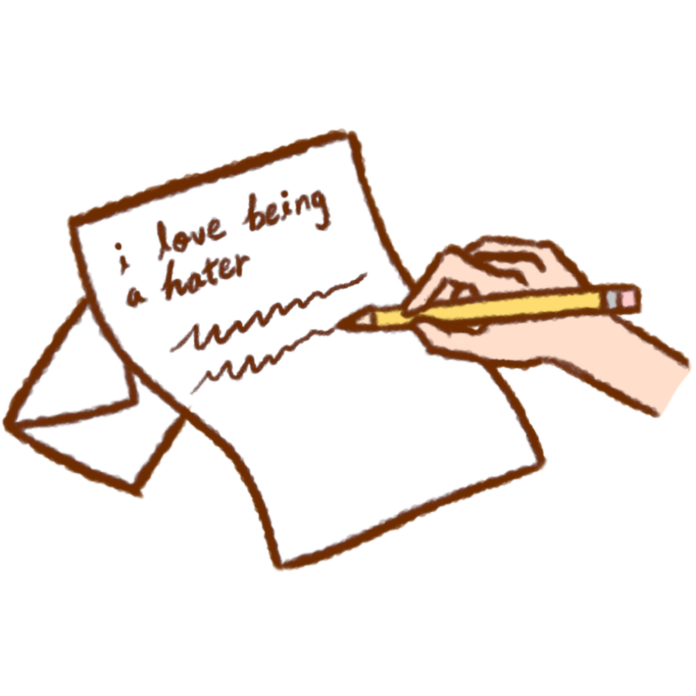
A hand holding a pencil writing a letter. The letter reads “I love being a hater.”
ILLUSTRATION: Emily Xu / The Peak

By: Cam Darting, SFU Student

Roses are red, violets are blue, I hate everything, why don’t you? Dear readers, as I lay in bed this whole winter break, the beautiful poem mentioned before played harmoniously throughout my head daily. It reminded me of all the things I hate. I hate cats, birthdays, loud cars, water, when Freddie never said “one” in iCarly, and snakes. The list can go on and on. I then asked myself, why do I hate so many things? I kept asking my brain, hoping it’d give me this profound answer that would create world peace, but it refused. Of course, my brain has so much to say when I want a clear mind, but the one time I need it to talk, it’s silent. If my brain wouldn’t give me an answer, I thought the best thing I could do was a good old-fashioned rewire. 

With the new year coming, I thought this would be the perfect time for a mindset reset. 2024 was gonna be the year where I hated less and loved more. WRONG. Right when it hit midnight on New Year’s Day, hate filled every ounce of my body. I was reminded of how much I hated the sound of party poppers and the rainbow confetti they were filled with. 

The next day, I pondered again while sipping a mango Bubly in my heather gray Aritzia sweatsuit, as one does, when my brain finally answered. Do I remember the answer? No. Do I care? No. What’s important is that I realized my brain is annoying. How are you going to make me think I should be less hateful, yet still fill my mind with hate? It makes just as much sense as why Bloom was the main character in Winx Club, and not Stella. IT DOESN’T. 

Anyway, this is a message to my brain. I realize you’re the one trying to get me to hate less because YOU’RE the one who wants me to think more positively, but guess what? No. I refuse to let my brain control me. To this, here are two hateful people who are amazing. I hope this will fill you, my brain, with hate as you read this.

Starting off strong we have Jade West from the hit Nickelodeon show, Victorious. Pretty, talented, scissor enthusiast, and more importantly, hateful. She was so hateful that if you were to look up the word, “hateful in the dictionary, her name would be a synonym. The reason why her hateful ways are superior is pretty self-explanatory. 

Next up on the list is Wednesday Addams. Everything about her is a slay. She loves black, she has a dark aura, she’s morbid, pessimistic, grim — what isn’t there to like? Clearly, she’s doing something right because her hateful ways landed her her own hit Netflix show. Do better, Pugsley . . .

To conclude, new year, same old hateful me.

Need to Know, Need to Go: Upcoming performances

0
an illustrated calender that says "Need to Know, Need to Go"
ILLUSTRATION: Courtesy of The Peak

By: Petra Chase, Arts & Culture Editor

The Firehall presents Pants
When: January 17–20, 7:30 p.m.
Where: Firehall Arts Centre, 280 E. Cordova St., Vancouver

Tara Cheyenne Friedenberg, artistic director of her self-named performance company and experimental dance veteran, uses comedy, dance, and theatre to explore what makes a simple garment so contentious: Pants will take audiences outside of the gender binary by crawling “inside our ‘packaging’” and asking “what happens to one’s flimsy identity, built on blending, when one’s offspring sheds the binary before recess?”

PuSh Festival
When: Various times from January 18–February 4
Where: Various art centres around Vancouver

The annual international performing arts festival (PuSh) features  “edgy, controversial explorations of the new frontiers of performance in the blended arts.” Highlights include Dear Laila, an immersive experience by Basel Zaraa recreating his home in a refugee camp, and L’amour telle une cathédrale ensevelie, which “tells the story of exiled Haitian families through opera-theatre.” Youth passes are available for audiences up to 24 years old for $20. Explore other options, including a digital pass, on their website.

Lunch poems: 
When: January 17, 12:00 p.m.–1:00 p.m.
Where: Online

Two poets will perform readings of their work for the SFU community for this intimate event. Pushparaj Acharya is a poet and literary scholar born in Nepal. His poetry collections are in Nepali and English. Gillian Sze is a Montreal-based poet and childrens’ book author with multiple award-winning poetry collections under her belt, including Peeling Rambutan and Redrafting Winter. She’s currently an instructor at Concordia University and just published her latest childrens’ book, I Drew A Heart. Lunch Poems is a monthly recurring event that happens on the third Wednesday of every month, so if you miss this one, you can still make the next one!

Poetry for Peace is SFU Slam Poetry’s project for Palestine and beyond

0
A photo graphic that reads “Poetry for Peace in the occupied territories of Palestine and all occupied people” with an illustration of a watermelon and a microphone icon beside it.
ILLUSTRATION: Courtesy of SFU Slam Poetry

By: Sude Guvendik, Staff Writer

Content warning: mentions of genocide.

In response to the ongoing humanitarian crisis in Palestine, SFU Slam Poetry organized a powerful event titled Poetry for Peace on December 1. The event aimed to provide a platform for students to express their sentiments and solidarity through spoken-word poetry. The Peak sat down with Sumaiya Tufail, the club’s president, to delve deeper into the inspiration behind the event, its impact, and future plans.

Tufail unveiled that the inspiration for Poetry for Peace originated from the reality of the genocide in Gaza and the West Bank. Confronting the documented atrocities on social media, Tufail, a poet herself, felt a moral obligation to create a sanctuary for the student community. 

The event evolved into a gathering to collectively stand against injustice. Emphasizing inclusivity, Tufail stated, “When I made the title Poetry for Peace in Palestine, I included all occupied lands and territories, so that I could show the community and the students that you don’t have to be Palestinian or be directly impacted by what’s happening in Palestine. She added, “If you come from another place that is facing persecution, genocide, human rights abuses, that you can also recite poetry in this event and that’s exactly what happened.”

The result was a diverse array of voices, including a community member addressing human rights abuses in Kashmir and another connecting the Sikh genocide in India to the occupation in Palestine. This diversity showcased the universal pain and healing inherent to the human experience.

Tufail highlighted the diversity of participants, spanning both students and non-students of different ages, backgrounds, and professions. She reflected, “It was really amazing, because most of the poets weren’t even Palestinian. And it just showed how unifying this type of event — even just the Palestinian cause is, that everyone can see that what’s happening is wrong, and it’s an atrocity, and we all can feel the pain of other human beings and that’s essentially what connects us.”

The most moving part of the event was when students courageously shared their personal stories. They opened up about their connections to the Palestinian cause and their experiences in Gaza. Tufail, who led the event, highlighted the power of poetry for processing pain, saying “I use poetry as an outlet to express my emotions and what I feel and my voice.

In addition to these stories, there was a soothing meditation session during the event led by Tiara Cash, an African American and Indigenous Cherokee SFU student and fellow TEDxSFU speaker (like Tufail). Cash guided a meditation circle to help the event attendees ground themselves, recognizing the healing nature of poetry.

Tufail shared a special moment from the event with The Peak: there was a performer who was Palestinian and had never performed a poem before. Her poem was about what it means to be asked, “Where are you from?” and what it’s like to say, “I’m from Palestine.” The emotions in the room were intense — people in the audience and even the performer herself were crying. The event was a safe space where everyone could share their feelings without judgment or shame. This is why poetry is so powerful — it brings people together, helping them understand each other and stand together in tough times.

Tufail explained the event’s success and her desire to continue its impact inspired her to create a zine, which will compile the poetry performed or written by community poets. Tufail shared, “We’re currently in the process of putting it together, and we hopefully are looking to have it printed in the next month. It’ll be free, and we’re looking for people, faculty members, and club members who are interested in distributing these poetry books.

The zine, expected to be available this spring semester, is poised to extend the reach of Poetry for Peace beyond its initial performance. Tufail encouraged interested individuals to follow SFU Slam Poetry on Instagram @sfuslampoetry for updates on the zine’s release, and contact them to get involved.

Tufail hinted at potential collaborations with other colleges and universities to broaden the impact of Poetry for Peace. The launch event, a follow-up to the zine’s release, promises to be another opportunity for the community to come together in support of social justice through the medium of poetry.

Being aware of my creative self

0
In a gym-style room, multiple people are training with brushes, painting, and musical instruments
ILLUSTRATION: Alyssa Umbal / The Peak

By: Daniel Salcedo Rubio, Features Editor

If you asked me over the past six years if I consider myself creative, my answer would have probably been “no.” Before that, though, I defined myself as a creative person. I grew up surrounded by art, from learning to play a couple of musical instruments to picking up brushes, paints, and a canvas. I’d just paint whatever came to mind. The thing is, being involved in the arts and being creative are two different things. A lot of us are conditioned to think of creativity as a mysterious force that creates art — a mystical entity that only a few are blessed with. The reality is creativity isn’t quite that straightforward.

There are thousands of ways to define creativity. The more utilitarian and structured definitions assert that “creativity is novel and useful, is a description of a product.” The more spiritually inclined definitions tell us that creativity allows us to “experience your spirit through your six senses.” Whatever your definition is, it can most likely be broken down to a tool or skill used to create something novel, or from which novelty and change arises. At its core, creativity is not a mysterious force that some have and others lack: it’s a skill, and as is the case with any other skill, you can train to be more creative. 

I think I was a pretty creative kid, but that creativity didn’t arise from nothingness. I was a very active kid; I used to play tennis and go swimming with friends on the regular. I also enjoyed playing video games and studying the flowers in my grandma’s garden. It’s no surprise that my sketchbooks were filled with pretty flowers and different renditions of Link from The Legend of Zelda doing different activities I enjoyed (also no surprise that I’m a gay biologist now). While original to my creation, my sketchbooks were filled with information my little child brain absorbed from its environment. My environment was filled with information I could pull from, full of images and moments of reflection, even if at that moment I didn’t see them that way. The reality is, I was privileged as a kid, and I had an optimal environment to be creative. Now, let’s focus on my ever-exhausted, sun-deprived, and creatively-depleted self. Yes, university made me busier, as I wasn’t exposed to the same environment as I used to be. Then, there was my first corporate job, with traffic jams, cubicles, and the office coffee machine. These were the only creative inputs I was getting for 12 hours a day. It’s true and natural: with growing up comes more and more taxing responsibilities, and you might not be able to expose yourself to that same environment rich in creative nutrients. However, creativity doesn’t die with age, it dies without a conscious effort to keep it alive.

When I was a kid, my mother did a great job of making sure I exercised enough; tennis, taekwondo, and swimming lessons were my day-to-day. Today, with far less time and far more responsibilities, I’m at my best physical health. That’s mostly because I make a conscious effort: I allot the time and track my progress. I never thought of having this same approach to my creative self until I stumbled across The Artist’s Way by Julia Cameron. I have to clarify, I haven’t read the entire book, but I know it serves as a kind of a guide to train one’s creativity through exercises. Exercises? For creativity? While it might sound a bit unconventional at first, there’s merit and actual research behind this approach. The book itself does mention exercises, but its emphasis lies on what Cameron calls the morning pages — a form of reflection and meditation done first thing in the morning, every day — and the artist date — a weekly form of reconnecting with those creative nutrients. While I can’t yet speak to the effectiveness of either of these exercises, what I can say by experience is that consistency is key. Cameron’s book is one of many examples of creativity training. A quick search of “creativity training” on Google Scholar shows over five million results, ranging from neuroscience concepts for creativity training to creativity training for nursing students

While approaches to creativity training in the form of exercises vary widely, a thing that might not vary as much is the science behind it. Brain imaging experiments have given us insight into which regions of the brain activate during certain creativity tasks. Having objective measurements to how our brain approaches creativity can also help us better design ways to train for it. For example, we know that the anterior cingulate cortex is associated with divergent thinking: an unstructured, problem solving-oriented way of thinking when we’re in a good mood. Things like having a gratitude practice, mindfulness, exercise, and a good rest are also directly related to our brain’s creative health, which is no wonder why I felt so creatively depleted when I grew up. A full night’s sleep, as a university student? Exercise, mindfulness, and a gratitude practice? How would I fit all that in when my day-to-day was going to work at 5 a.m. and not coming back home until sometimes 10 p.m.? 

We are creative selves by nature and depleted of it by the business of life. Sometimes, life can be too much, and more often than not, we end up stretched so thinly that we don’t have the energy to consciously give time and space to our creativity. And while it’s true that for some it might be impossible to give time for their creativity to materialize in paintings, novels, or whatever we commonly associate with creative individuals, the importance of conscious creativity practice can’t be understated. Start with unfiltered journaling or give a shot to the morning pages, build your practice little by little and trust that your creativity will pop up in unexpected ways and you will feel better for allowing it.

Council Chats: SFSS motion to call for permanent ceasefire in Gaza

0
This is an illustration of a graphic that reads “Council Chats.” The image also has two text boxes to symbolise messages being sent.
ILLUSTRATION: Andrea Choi / The Peak

By: Eden Chipperfield, News Writer

On January 3, The Peak attended the Simon Fraser Student Society (SFSS) bi-weekly Council meeting via Zoom. The adopted agenda touched on crucial motions, including a vote for SFSS to call for a permanent ceasefire in Gaza and a notice of motion to strike the Issues Policies. 

Vote to call for a ceasefire in Gaza passes
Joining the January 3 Council meeting were various undergraduate students who spoke about Israel’s genocide of Palestinian people, as well as the ongoing occupation in Palestine. 

SFSS president Liam Feng read the society’s motion to call for a ceasefire. Many councillors and SFU students disapproved of the motion that would call for a ceasefire and to end the siege and genocide in Gaza. 

Councillor Sam Killawee proposed to the Council that the motion should be amended to add more information to the call to action. “I would like to add some of the words that the Canadian government used in this to help frame our argument and also make it very clear, as per Issues Policy (IP) 10, that while we support Palestinian liberation, we do not support antisemitism or attacks on Jewish people,” said Killawee. Following the suggestion, Killawee posted a revised motion in the chat box that condemned the treatment of hostages as well as the immediate release of captured individuals and said, “Israel must respect international humanitarian law.” 

The majority of attendees voted in favour of the ceasefire motion. However, a few individuals spoke out against the SFSS getting involved in politics. One councillor described how “as a student society, we shouldn’t talk about this because conflicts are complex. Conflicts are politically complex; that’s not our place.” However, the Council decided the amendment of the motion proposed by Killawee should be reviewed and discussed further; thus, the original motion was struck and a new amended one was reviewed. 

The Council then moved to vote on the amended motion for the SFSS to call for a permanent ceasefire, which passed. A referendum to establish this at the SFSS membership level will be submitted and put to a vote at a later time.

Notice of motion of removal of Issues Policies stricken

President Feng submitted a notice of motion suggesting the SFSS remove all IPs, arguing that an “Issues Policy may inadvertently introduce bias or preference towards specific political stances, potentially compromising the society’s commitment to impartiality.” The motion also discussed that it is a way “to safeguard the student union’s commitment to inclusivity and fairness by eliminating any potential sources of bias or partiality arising from the Issues Policy.” 

The suggestion to remove IPs caused concern among the Council members, especially those representing constituency groups and undergraduate students attending the meeting. Vice-president of equity and sustainability, Priyanka Kaur Dhesa, commented, “Many of these Issues Policies were born through consultation with or through groups and concerns they raise.” 

The ten listed IPs dedicate their support for reproductive rights, Black History Month, tuition affordability, disability justice, living wages and union rights, climate justice and sustainability, Indigenous inclusion and reconciliation, anti-racism, police and militarization, and Palestinian liberation. 

An executive with SFU350, Ally Soriano, explained to the Council how removing IP 6 would be detrimental to the clubs and all the work done to raise awareness about the climate crisis. “I would hate for years of student activism and solidarity to be undone by just one action. And one motion, quite frankly, will lose trust in this organization completely,” said Soriano. “I do want to emphasize as it is a student union, and a portion of our tuition funds this organisation’s operations. If I’m paying you to represent me and my peers’ interests, please do so. Striking these Issues Policies is anti-student.”

A past executive and current member of DNA (SFU Disability and Neurodiversity Alliance) stated that removing IPs was “political action against human rights, against equity, against justice.” The past executive also added, “as a student, I am frankly disgusted we are having this conversation. I expect better from my representatives.”

Several concerns were raised regarding the motion to remove the 10 IPs, especially on a day where the SFSS’ call for a ceasefire was listed. A student who wished to remain anonymous spoke up about this coincidence, “This policy protects students in their advocacy for a free Palestine, which means an end to the Israeli occupation of Palestinian territories, an end to the oppression of Palestinians by Israeli forces, and an end to the genocide that is currently happening in Gaza at the hands of the Netanyahu government and IDF forces, in which Canada as a state is complicit.” The student expressed that removing IPs impacts everyone, from affordability to climate justice, regardless of how someone identifies. 

After many students and councillors discussed their views and criticisms, the Council voted to strike the motion. Therefore, the SFSS will retain their 10 IPs.

Unhoused residents of Vancouver parks subjected to discrimination

0
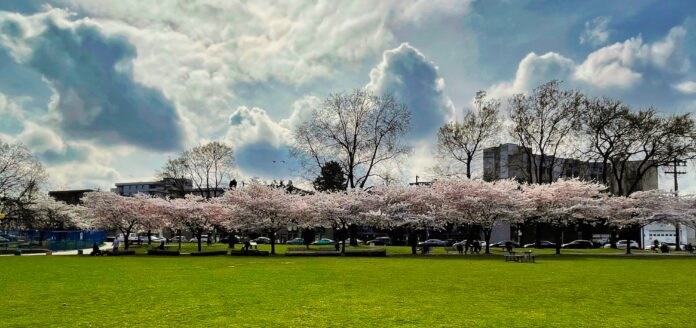
This is a photo of Oppenheimer park in march. The Cherry Blossom Trees are blooming, and there are pink flower petals sprinkling the area.
PHOTO: Ted McGrath / Flickr

By: Olivia Sherman, News Writer

Since 2018, Fiona York has dedicated her time to advocating for some of Vancouver’s most vulnerable populations. Unhoused residents of Vancouver parks, such as CRAB Park and Oppenheimer Park, are subjected to street sweeps, exposure to the elements, and discrimination. In an interview with The Peak, York discussed these acts of injustice and the human rights complaint against the City of Vancouver.

On December 18, the BC Human Rights Tribunal (HRT) agreed to proceed with a complaint against the City of Vancouver and the Parks Board, voicing concerns over unfair treatment of residents of Vancouver’s parks. In a December 14 letter, the HRT states both the city and the parks board “discriminated in Services [ . . . ] based on Indigenous Identity, Race, Colour, Ancestry, Place of Origin, Physical and Mental Disability, Sex and Age.” The inadequacies include “insufficient washroom and showering facilities, no shade in summer, insufficient electricity, and a lack of comprehensive sanitation of public facilities.” 

York seconded the statements made in the letter, saying, “none of these amenities have been [provided] in a consistent manner, and when they’ve been provided, it’s usually too little and has been taken away again.” 

In January of 2022, the BC Supreme Court granted a section of CRAB Park available for 24-hour camping, allowing residents’ tents to remain standing all day. As the unhoused population in Vancouver grows, more tents spill into the non-designated areas, breaking the city bylaw. The BC government is set to impose a seasonal moratorium on evicting residents from CRAB and Oppenheimer Park in the winter months. A seasonal moratorium involves the temporary suspension of certain laws or regulations. Advocates for residents call to postpone the eviction to spring, when the weather warms. In a correspondence with Global News, the Vancouver Board of Parks and Recreation stated, “this is not a decampment. We’re not asking people to leave, we’re asking for people to comply with the bylaw.”

However, York noted, “If there was a real interest or desire to provide those services, there would be, or should be, some means of doing that.” For York, “It’s not a matter of not being able to provide these services, it’s a matter of making the decision not to provide these services.”

Residents of park encampments are often subjected to street sweeps. The Belongings Matter report analyzes current laws and how they’re enforced against vulnerable populations and their belongings. The treatment of people’s personal belongings differs depending on where they’re located, such as city property, a park, or elsewhere. The reality for unhoused people who face street sweeps is often having their property destroyed or disposed of. York says this is “part of a bigger belief system that [unhoused] people dont deserve to have belongings,” which is “negating the very humanity of people.” 

2023 — A Year in Review

0
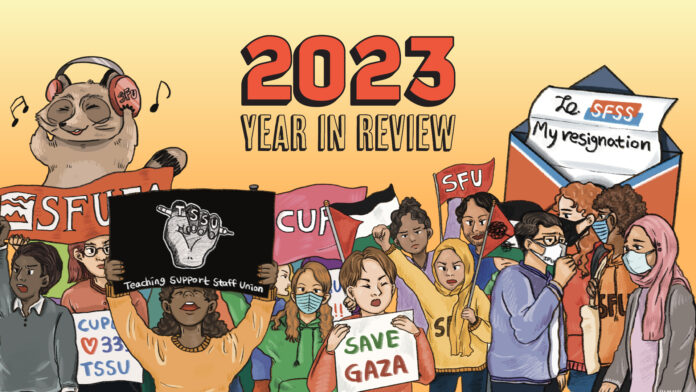
This is an illustration of SFU students engaging in protest. Many are holding signs in support of Palestine and TSSU. Some are wearing masks.
ILLUSTRATION: Andrea Choi / The Peak

By: Eden Chipperfield & Olivia Sherman

  1. TSSU Strikes for improving working conditions, June–October

Learn more:

Beginning in June 2023, teaching assistants (TAs) at SFU engaged in a strike following the expiration of their collective agreement with SFU and worsening working conditions. TAs were asking for an increase in wages to keep up with the ever-growing cost of living, as well as updated compensation policies to account for oversized classes. While the strike officially started in June, it wasn’t until early July that strike actions took place. Actions included a full work stoppage and picketing at all three SFU campuses. The Peak spoke with Teaching Support Staff Union (TSSU) member and spokesperson Dalton Kamish on a number of occasions over the course of the job action. “We have seen some minor, but not insignificant [ . . . ] movements since we began strike and job actions, like picketing,” they said. 

Starting on September 28, SFU hired a private investigation firm, Lion’s Gate Risk Management (LGRM), to survey and monitor picketers at all SFU campuses. Kelvin Gawley, a TSSU organizer, spoke about this surveillance: “This is how they choose to treat members of their own community, who have the audacity to demand a fair contract. I don’t think that’s something any of us will ever forget.”

After public backlash, SFU retracted their contract with LGRM on October 11. By October 19, the work stoppage and strike officially ended. A tentative agreement was signed between the university and the employees, and the 2022–2025 collective agreement was renewed. 

  1. SFU community shows loud support for Palestine amidst ongoing genocide, November 28

Learn more: 

In a letter to SFU, staff and faculty from the university called for a public condemnation of Israel’s actions in the ongoing crisis, which many have described as a genocidal bombardment of civilians in Palestine. The SFU community urges the university to uphold the tenets of anti-racism, anti-oppression, and equality by committing to actions stated in the letter. Actions include affirming support for free speech and academic freedom for those who choose to “speak out against the Israeli apartheid, the occupation of Palestine, and the genocide in Gaza,” to immediately divest from war contractors and financial relationships with Israeli companies, and to “not be silent about genocide.” 

Over 20 student groups and over 700 student advocates signed an open letter to SFU, calling for an “end to SFU’s silence on the ongoing genocide of Palestinians in Gaza and the West Bank, and to call for an immediate ceasefire and termination of the siege on Gaza.” The letter was published by SFU Students for Justice Palestine, Palestinian Youth Movement, Independent Jewish Voices Youth Bloc, and other aligned groups. Up to 150 people attended a protest in response to SFU’s silence on the conflict, and a vigil in recognition for Palestinian civilian lives lost. 

  1. SFSS councillors resign en masse, citing workplace harassment, January 30 

Learn more:

Early 2023 saw many Simon Fraser Student Society (SFSS) members resigning en masse, including former president Helen Sofia Pahou, former vice-president Judit Nagy, vice president university and academic affairs Nicole Kirigin, and both executive officers. 

The replacement process for the vacant seats was by nomination. At the time, the acting vice president university and academic affairs Chloë Arneson noted the “election was a surprise.” After Pahou resigned, former vice president finance and services Abhishek Parmar took over as acting president, serving until March 18. “As you can probably tell from the historically quick turnover rate, this job is far from easy,” Arneson continued. 

The mass resignations were reportedly caused by numerous internal issues within the SFSS, such as severe burnout from members, overworking, and a culture of bullying. On her resignation, former vice president, Judit Nagy, told The Peak, “at the SFSS, rules don’t apply uniformly to everyone, so had I said half of what others did, I would have gotten into serious trouble — I expect I still will.”

Nagy voiced concerns over her replacement vice president, Peter Hance, who she described as “unqualified and untrained.” Hance refuted these allegations, saying Nagy has refused to contact him to engage in the on-boarding process, “The previous vice-president was very uncooperative with me. I tried multiple times to contact them in-person, they kind of walked away.

“These kinds of things hurt the entire student society and student body as a whole,” said Hance. 

Since the mass resignations, the new SFSS council for 2023–2024 was elected in February. 

  1. Vancouver’s drug policies still not doing enough, February 21 

Learn more: 

To combat the ongoing drug crisis in Vancouver, BC made plans to decriminalize the possession of illegal drugs from January 31, 2023–January 31, 2026. The exemption allows adults in BC to carry a certain amount of illegal substances for personal use without facing criminal charges, confiscation, or arrests. The drugs permitted in this three-year long exception include powdered cocaine, methamphetamine (meth), MDMA (ecstasy), crack cocaine, and opioids such as heroin, morphine, and fentanyl. The total amount a person can carry without confiscation and criminal charge is 2.5 grams. 

In February, The Peak spoke with David Hamm, a member of the Board of Directors for the Vancouver Area Network of Drug Users (VANDU), an organization of current and former drug users fighting against stigma for drug users. Hamm said the amount a person can carry in this new exemption is inadequate, and a limit of 4.5 grams would be more effective than the current 2.5 grams. “The reason people have larger amounts on them is because they only want to go out as little as possible to get their substances and also because [ . . . ] if you get more of it, then you get a better price on it,” he said. VANDU continues to work toward improving drug policies and stigma against people who use drugs. 

  1. Community supports SOGI 123 curriculum and 2SLGBTQIA+ community, October 24

Learn more: 

Many people watched as an extensive crowd of protestors flooded the streets of Vancouver throughout September, protesting against the progressive SOGI 123 (Sexual Orientation and Gender Identity) curriculum that is implemented in public high schools. 

The 1 Million March 4 Children is backed by far-right and controversial groups such as the Freedom Convoy, who protest teaching young people about gender expression and sexual orientation in schools. The goals of SOGI 123 teachings are to encourage further conversations and education around gender and sexuality, explain diverse family structures, and to support those who are transitioning. Ultimately, they aim to create space for children to ask questions and become educated allies for the 2SLGBTQIA+ community. 

The anti-SOGI protesters were met with a robust response from those who support the curriculum’s implementation, the 2SLGBTQIA+ community, and local allies. The support for diversifying education has been fierce and continues to push back against the harmful rhetoric of the 1 Million March crowd. 

  1. COVID-19 Measures in 2023, ongoing

Advocacy group DoNoHarmBC made their voices heard by organizing a protest outside Minister of Health Adrian Dix’s office. Calls to action from DoNoHarmBC included reinstating universal mask protections in healthcare environments. This came after BC announced masks would no longer be required in healthcare settings as of April 2023. Alongside those who attended the rally, thousands of postcards were sent to Dix’s office to support the campaign and share the stories of those affected by the lack of masks in healthcare. Dr. Sanjiv Gandhi, a former pediatrician and heart and lung surgeon at BC Children’s Hospital, criticized the government’s pandemic response and the lack of education provided to the public. Dr. Gandhi’s central message is that COVID-19 is ongoing and needs to be addressed with evidence-based measures. In September, Dr. Bonnie Henry, BC’s provincial health officer, and Adrian Dix announced that masking would once again become mandatory and re-established in healthcare environments beginning in October. The push for the return to masking is credited to individuals like Dr. Gandhi and advocacy groups like DoNoHarmBC and ProtectOurProvince with their push for increased safety measures in healthcare. 

  1. City of Burnaby calls for ceasefire in Gaza, November 28

Learn more: 

On November 6, Burnaby became the first municipality in Canada to officially call for a ceasefire for the ongoing genocide in Gaza. As of December 2023, over 21,000 Palestinian civilians have been killed, and 1,200 Israeli civilians have been killed. Mike Hurley, mayor of Burnaby, and the Burnaby Council, wrote a letter to Prime Minister Justin Trudeau in condemnation of Canada’s inactions and insufficient support for the people of Gaza, who are under Israeli occupation. Hurley and the Council of Burnaby have also publicly condemned acts of anti-Semitism, Islamophobia, and anti-Palestinian racism. These acts of prejudice have increased globally since the conflict attacks on October 7. 

Burnaby Councillor Daniel Tetrault, who is of Jewish descent, introduced the motion to call for a ceasefire. Tetrault expressed his personal condemnation of the violent acts toward the civilians of Gaza, which have been described as genocidal. “When my grandparents spoke of this time as survivors of concentration camps, they always said, ‘Never again. Never again can we allow this to happen to anyone,’” Tetrault said. 

Despite a $60 million fund for humanitarian aid for Gaza, Canada has also sold hundreds of military weapons to Israel. 

  1. Student Funding Crisis and Increasing Financial Hardships, January 23 

Learn more: 

In 2022, a partnership between SFU’s Graduate Student Society (GSS) and the TSSU arose in response to the funding crisis many students attending post-secondary education in North America face. Graduate students rely heavily on income from teaching positions or department scholarships. SFU physics grad student, Sina Falakian, described how the pressure of the funding crisis is demoralizing and difficult. The cost of living in North America is skyrocketing, making life increasingly stressful. Statistics Canada reported that about half of graduate students will be saddled with debt as they cross the stage to graduate.

Falakian also called out SFU, saying the university needs to be aiding graduate students and addressing the increasing cost of living for students in the Metro Vancouver area. A North American study found that 76% of graduate students found the living crisis the most difficult part of their studies. Students must often take extra work alongside their research to afford the cost of living. GradCOLA demands that the cap on student income should be removed and that more work should equal more pay. 

Angela Wilson, SFU’s senior director of media relations and public affairs, encouraged students who may relate to the crisis due to financial stress and pressure to contact the SFU Financial Aid and Awards office to discuss their options. 

  1. SFU Alumni Association is Dissolved, February 20 

Learn more: 

A decisive vote occurred on February 15 to determine if the SFU Alumni Association would remain a legally separate council or be merged into an internal SFU presence, including appointing Council members. Voters included all registered Alumni Association members to approve or disapprove of the changes. The vote concluded that the independent Alumni Association would dissolve. SFU president Joy Johnson will appoint Alumni Council members. The Alumni Council members will take the place of the dissolved Alumni Association. 

A statement made by the director of media relations and public affairs for SFU, Braden McMillan, announced that the vote was to “align SFU’s alumni program with industry best practices and modernize the governance model, which remained largely unchanged since its inception in 1969.” According to McMillan, only about 10% of SFU’s alums are registered members of the SFU Alumni Association. Before the dissolution, the Alumni Association had to finalize their funds, event organization, and more. In an interview with The Peak, an anonymous alumni believed the vote was a way for SFU to “handpick alumni” that the university wants to represent them, rather than care about alumni engagement as a whole.

  1. SFU350’s Divestment Campaign, ongoing

Learn more: 

SFU350 partnered with Climate Justice UBC Vancouver and independent UBC Okanagan students to end RBC’s presence on campus. The Banking on Climate Chaos report, published in April, outlined how RBC sits at the top of the list of global banks that finance fossil fuel companies. RBC reportedly gave $38.1 billion USD to fossil fuels investments in 2022. Some of RBC’s practices include violating Indigenous land rights and funding projects which increase biodiversity loss. Currently, one RBC ATM is located on the SFU Lhuḵw’lhuḵw’áyten (Burnaby Mountain) Campus in the AQ on the 3000 level. 

Natasha Ivkov, an organizer with SFU350, discussed the Halloween campaign the club initiated to educate SFU students on who they may be banking with and the investments they make. The petition hopes to garner student support to get RBC off campus, explained Ivkov. The SFSS has been involved with SFU350’s mission and has created a list of demands for the future of banking on SFU campuses. The demands include not having an RBC on-campus branch and ending SFU’s relationship with Scotiabank, another large fossil fuel financer. It also includes refusing to have the top five Canadian banks hosting, co-hosting, or sponsoring student union events. SFU’s response to the protest against RBC stated that SFU is committed to sustainable practices and “is targeting full divestment of all endowed and non-endowed funds by 2025.”


20 Things I Wish I Learned Before My 20’s

0

I bet you thought this would be a hairytale

0
Man getting his hair dyed at a salon.
PHOTO: John Diez / Pexels

By: Mahla Rae, SFU student

You only remember me when you want a bright new hair colour to make you feel cool, or a touchup to your contrasting roots to hide your true look. I know what you think of me. The labels you all put on me — “temporary,” “one-use,” and “hair-dye.” I notice how you treat me, shoving me in the dark of your medicine cabinets until you decide I’m useful. You live your life until one day, you have an exam to study for, and suddenly you just need to change something, so you decide to take me out. You allow whatever sudden burst of boredom that comes along to dictate what happens to me. 

You think you can just use me when you want to, and throw me away when you’re done — that my sole purpose is your personal gain. I exist only to enhance your appearance. Well, I know two things you’ve never thought of: I won’t dye without a fight, and this red looks terrible with your cool undertones.

If you think you can just use me and wash me away with ease, then you’re living in black and white, and I vow to fill in the colour. You may choose to put me in your hair and watch me fade down the drain, but I will not be so “semi-permanent.” Anything your hair touches, I touch, and I will never let go. I will get my revenge if it is the only thing I do. 

You will never forget me. I will haunt you until you can afford new sheets. Become part of everything you own. Colour your towels, tint your bathtub, and dye your shirts. You want to use me so badly, so I will make myself useful. If you want your hair to look like me, then so will your fingernails, robe, and pillows. Let me fall on the floor or spill me in the sink, and I will become your new interior decor. I may be temporary in your hair, but I will be permanent in your life. Everywhere you look, you will think of me and remember your decision and how bad it looks on you. 

No matter how hard you try to use me, your true colours will always show through. You can wash me out of your hair, leaving yourself with unfortunate spotty, bleached, faded split-ends, but you cannot wash me out of your life. Your friends may lie and say you look good, “cool,” “unique,” or “alt,” but I will stay here forever to remind you that this colour never complemented you.