Home Blog Page 126

Where the Light Meets My Shoulder centres Black curls in sunlight

0
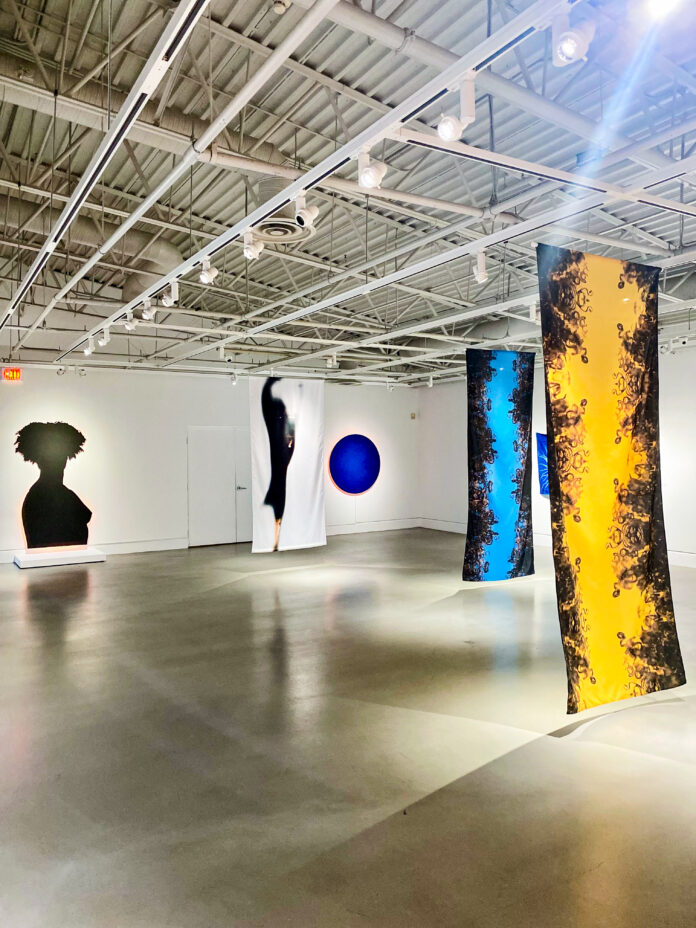
A gallery room with white walls, lots of empty space, and fluorescent lights. There are multiple large canvases of photographs featuring silhouettes of curly hair.
PHOTO: Pooja Singh / The Peak

By: Sofia Chassomeris, SFU Student

This week, I had the pleasure of viewing and experiencing the exhibit Where the Light Meets My Shoulder by local artist Rebecca Bair. The exhibit is available until February 11 at Evergreen Cultural Centre located next to Lafarge Lake-Douglas SkyTrain station, and admission is free! Bair is an accomplished interdisciplinary artist currently based in Vancouver, where she teaches at Emily Carr University. Making use of several different mediums, including “ephemeral materials like shea butter and sunlight,” the lens-based exhibit features symbolism of the sun, circles, shadows, and her hair.

I have a profound appreciation for Bair’s ability to captivate her audience’s attention, as I found myself drawn to the intricate lines of beautiful, curled hair centred in the exhibit. My favourite pieces were two cyanotypes — prints created using a process that involves exposing them to ultraviolet light and washing them in water to create a gorgeous deep blue colour. Opaque objects are arranged on top before exposure to UV light, leaving behind negative images that the light is unable to reach. Understanding the process of creating cyanotypes is important to Bair’s work as she emphasizes sunlight and shadows to depict her experience as a Black woman. Quoting Zora Neale Hurston, an American author and anthropologist, Bair resonates with Hurston’s depiction of the “voluptuous child of the sun” in her 1934 essay.

“I think of this often — referring to the Black body as the child of the Sun,” Bair wrote in response. “Rather than it being infantilizing, it opens doors to consider the ways in which the melanized body is possible because of the sun — that our heritage and connection is through its light. When I ‘collaborate’ with the sun, I am calling upon and collaborating with ancestors — those melanized before me.”

The two cyanotypes previously mentioned consist of imagery of the artist’s hair. The first features hair extensions that reach outward from a centrepoint, the circular shape created by the strands of hair reminiscent of the sun’s rays stretching across a blue sky. The second piece is a long braid of hair, coiled into another circle. This piece is reflective of Bair’s cultural symbolism of hair as a site of connection for family and community members, the braid representing the time and love put into its care. Both of these pieces are especially powerful when coupled with Bair’s assertion that Blackness is not simply darkness, and not at all an absence of light, but rather the absorption of it. We do not see the hair itself in these pieces, but an abstract representation of it, highlighting the equal importance of what is visible and what is not.

I highly recommend visiting the Evergreen Cultural Centre before the exhibit is over, as Bair’s work is both deeply touching and visually stunning.

I’m not a first-generation immigrant

0
Steamed dumplings on a steamer
PHOTO: Pooja Chaudhary / Unsplash

By: Izzy Cheung, staff writer

I’m not a first-generation immigrant. 

I was born and raised in Vancouver — this city is all I know. Both my parents grew up in Canada, learning English in school and Cantonese in households made tense with love. My grandparents only ever spoke Cantonese and Cantonese-muddled English, their pens scratching characters that don’t always resemble an “I,” a “love,” or a “you.” They were first-generation immigrants, the ones who fought more than just the rough waters of the Pacific Ocean to give their descendants better lives despite already being deep into their own. They were first-generation immigrants, but so is my dad, who moved to Vancouver with his parents at the age of ten. If that’s the case, then what am I?   

I’m not a first-generation immigrant. I wasn’t fast asleep when the keys jingled as my parents opened the front door for the first time since they’d left for work, the open-and-shut in a rapid motion that refused to disturb their child’s slumber. As a kid, while my mom was off crunching numbers in a cubicle, I stayed at my grandma’s place. There, my Paw-Paw would attempt to teach me basic words and phrases in Cantonese while feeding me homemade yu bing (fishcake). At the start, I obliged, paying no mind — food was food, and while it took me a while to consume it, I’d digest it all the same. As I grew slightly older and started to develop more of a mind of my own, I began to develop a distaste for some of the foods of my culture. I didn’t like the taste of fish, and even now, it’s still something that makes me gag. It’s just not something I can control. Because of that, grandma’s lovingly-made har gow (shrimp dumplings) lunches became egg and cheese sandwiches. Neither meal lacked love, but there was still a clear favouritism. It took me until recently to realize that these lessons weren’t meant to change me — they were an effort to preserve the culture while it was still alive. 

I’m not a first-generation immigrant. Understanding the words of those who came before me is like trying to solve a puzzle while blindfolded. It’s different: growing up being spoken to in a language, compared to speaking a language growing up. I have a Chinese name, but I’ve never actually been called that name by anyone other than my parents on the day I was born. It’s like that, in a way, trying to understand what you’re being told. You can try all you want, but recognizing cheong fun (rice noodle roll) as a dim sum dish is different from being able to order it the way your father does. Only eating sauceless rice and plain chow mein at dim sum is also different from the way your father enjoys this rich and bountiful culture. It turns you into what relatives may call a hoeng ziu (banana), a term known all-too-well by Asians who find more comfort in mac and cheese than lo mai gai (sticky rice chicken). Listening is different from understanding. 

I’m not a first-generation immigrant. It was shocking to my parents when I devoured xiaolongbao (soup dumplings) at dim sum one day. “You’re eating something other than chao fan (fried rice),” they remarked, equally as surprised as they were pleased. There were still staples of Chinese food that I enjoyed, of course, but they often didn’t extend out of that tiny bubble I created. They were specialty items that I didn’t eat often outside of Lunar New Year celebrations and the occasional family dim sum gathering. Like placing a drop of ink in a vat of water, it was a small change with an immediate impact. It’s indicative of a shift, the volta in the poem of my life. While the home of mine and my family’s culture becomes less and less of a home to me as time keeps me confined, there are still small actions I can take to push myself back across the Pacific Ocean towards where my family is from. Guilt is an elixir that poisons the user. 

I’m not a first-generation immigrant. I’ve always thought my parents were. Their lunches with friends were burgers and fries, while their dinners were made up of sticky rice and soup dumplings. As I watch them now, finding comfort in takeout dim sum dishes and sharing secrets in the mother tongue (one I can only ever hope to understand), it hits me — they weren’t first-generation immigrants either. The conditions of their upbringing, while different from mine, reflect my conflicts in reconnecting with my culture. Except, unlike myself, they’ve successfully integrated their lives in Canada with faded photographs of a country that none of us have truly ever known. Understanding comes with experience, which is something that can’t be manufactured by someone who hasn’t been there. As much as I try, it’s hard to truly grasp the culture that was once so prevalent within my bloodline. It’s a bittersweet feeling, having story after story published in newspapers in English when I know that it’s a different language that brought me to where I am today. 

BC’s pandemic budget may “wind down” in 2024

0
This is a photo of a person wearing a mask. The photo is taken very close to their face, so only the mask can be seen.
PHOTO: Charlotte May / Pexels

Editor’s note: A previous version of this piece misspelled Dr. Karina Zeidler’s last name as “Zeilder,” but has now been corrected. 

By: Michelle Young, Opinions Editor

BC’s budget and fiscal report covers a “three year fiscal plan” for housing, sustainability, and healthcare. The report states, “As the funding for pandemic contingencies are set to wind down by the end of 2023/24, it is anticipated that the Ministry of Health will wind down or integrate any services into ministry operations, as appropriate, to support the ongoing health and well-being of British Columbians.” 

The report did not elaborate, and The Peak reached out to the Ministry of Health for more information, who said they “will have an update to share following the release of the 2024/25 budget at the end of next month.” 

DoNoHarm BC, who advocates for safer COVID-19 protections in the province, is concerned about the effects a potential budget cut could have for residents and provides a series of recommendations. 

Dr. Karina Zeidler and E.S. Lee, members of DoNoHarm BC, spoke to The Peak for more information. “In principle, I support integrating COVID-19 measures as a fundamental part of programs and services, rather than as a temporary response measure. But I don’t see how that happens effectively if BC cuts all the funding,” Lee explained. “If our government has a plan to ensure proper continuity, I’d be thrilled to see it. It’s not promising that Interior Health now directs symptomatic healthcare workers not to test themselves for COVID, even as BC encourages healthcare workers to work with respiratory symptoms,” Lee added.

Their recommendations include renewing “a three year-plan for economic recovery,” creating “a Clean Indoor Air Act with an Indoor Air Quality (IAQ) advisory council,” and adding more support for people with Long COVID and “complex chronic illnesses.” DoNoHarm BC noted their concerns around the provincial budget come at a time where “fluctuating COVID levels, new variants, fall/winter disease surges, and hospital outbreaks underscore the need for ongoing health management.” COVID-19 continues to circulate, with hospitalizations for respiratory illness reaching an all-time high in early January “since the start of the pandemic,” according to The Globe and Mail

“By continuing to fund things like vaccination and testing, making PPE more accessible, and cleaning the air we share, we’re supporting better health for all British Columbians — not just people who can afford it,” Zeidler said. 

“I hate to frame human tragedies in purely financial terms, but since we’re talking budget, we need to face the fact that widespread sickness incurs massive costs,” Lee said, noting that “absences from illness” puts a strain on workers, creates labour shortages, and Long COVID “threatens to take a far bigger economic toll.” An estimated one in nine adults in Canada “have experienced long-term symptoms from a COVID-19 infection,” with the majority of these symptoms persisting for months or years. According to Statistics Canada, 66% of patients “reported not receiving adequate treatment, service, or support for any of their symptoms.” Earlier this year, BC closed its in-person Long COVID clinics, but hasn’t implemented a long-term solution for patients who need care. Due to the complex nature of Long COVID, which can damage multiple organs and the vascular system, many patients require in-person assessments and testing, explained Zeidler.  

“Canada’s Office of the Chief Science Officer issued recommendations that included everything from creating standardized assessments and clinical practice guidelines, to developing diagnostic codes for Long COVID, to scaling up prevention strategies like clean air while raising awareness with the public. We already know what needs to be done. Now, policy-makers need to do it,” Lee said. 

Prevention strategies focus on the prevention of COVID-19 infections and the reduction of transmission, as any infection can lead to Long COVID and negative health outcomes, and the risk is multiplied with each infection. Vaccination and general health alone does not significantly reduce risk of Long COVID. Prevention focuses on “clean air,” which refers to increased ventilation and filtration to lower the concentration of COVID-19, which is airborne. Prevention strategies also include safety measures like universal masking and systemic support for those infected to stay home and isolate. 

“When it comes to public health costs, the numbers speak for themselves. Research shows clean air can reduce illness at a benefit-cost ratio of up to 100 to 1. Tools like N95 masks are cheap and effective — meanwhile, an average hospital stay for COVID costs $23,000” for hospitals, Zeidler added.

“Without evidence-based COVID prevention we have more hospitalizations, and prolonged stays with higher morbidity and mortality due to hospital-acquired infections. More healthcare workers get sick, some for prolonged periods and some who do not recover enough to return, which adds to critical staffing shortages. On top of that, unchecked COVID spread drives the evolution of the virus and can create dangerous new variants — something our own government has identified as one of BC’s main fiscal risks,” she added.

Further, DoNoHarm BC explained that COVID-19 is intricately tied to concerns surrounding equity: “Although everyone is at risk from COVID and Long COVID, SARS-CoV-2 disproportionately harms people who already experience systemic barriers.

“We know the pandemic continues to hit low-income neighbourhoods the hardest. We know BIPOC communities face worse outcomes, as do elders, disabled people, pregnant people, unhoused people, immigrants, and essential workers among others. Long COVID rates are also higher in BIPOC, as well as for women and gender minorities — in fact, trans people have the highest rates of Long COVID,” Zeidler explained. “Unchecked COVID spread causes more marginalization. Without clean air and consistent safety practices, public spaces exclude many immunocompromised and high-risk people. COVID itself causes long-term health damage and disability — and forces many people into poverty due to job loss and soaring medical costs,” Lee added. 

“It’s nothing short of shocking that our government wants to ‘wind down’ its already minimal public health programs for SARS-CoV-2. We need to make decisions based on the data — and that means addressing COVID, because COVID is still here. Public health shouldn’t be more focused on saving money than saving lives,” Zeidler said. 

DoNoHarm BC encourages anyone who is concerned “about sustainable community health in 2024” to email their MLA.

New study examines expenses of mental health care in BC

0
This is a photo of the outside of the academic quadrangle building at the SFU Burnaby campus. The square building is concrete with many large windows.
PHOTO: Gudrun Wai-Gunnarsson / The Peak

By: Hailey Miller, Staff Writer

SFU health sciences professor Sonya Cressman conducted a study on the costs for British Columbians to seek mental health care for major depressive disorders. The results found that financial costs are high for people seeking treatment, especially in the first 12 weeks where expenses are the highest. These expenses decrease if treatment is successful, but remain high if a patient’s depression doesn’t go into remission. The Peak spoke to Cressman to find out what needs to be done to reduce barriers and costs of mental health treatment. 

Cressman explained how in order to reduce many of the expenses related to mental health care and treatment, the first step is to help prevent mental health problems in the first place. Cressman stated that treatment is most effective if people “get treatment as quick as possible.” Treatments for depressive disorders most commonly include counselling and prescription drugs such as antidepressants. 

Cressman noted not every method of treatment will be effective for every individual, as each case is unique. If access to treatment is efficient and effective, the amount of mental health care costs is reduced — both for the patient, and the healthcare system. However, this is not always the case. To combat this, Cressman said genomic tests can determine “whether or not a patient is likely to respond to a certain antidepressant.” A match can be predicted earlier on in the treatment process, hence reducing overall costs. 

Financial burdens can arise if people have to pay out of pocket or if they cannot work due to their mental health conditions, which can also present as physical challenges. Out-of-pocket costs can increase between 215 times greater than that covered by the healthcare system, which equates to an added cost of about $735/week for individuals seeking treatment.

According to Cressman, reducing financial barriers for students seeking mental health treatments through university funding is an important step. This includes using the counselling and mental health care apps that are offered, and keeping conversation open between students, professors, and peers. University funding and supports are just one step that needs to be taken, but Cressman said these resources are a good start. Cressman explained that “taking that initial step” to see a therapist is often the hardest when seeking support. She stated that a supportive culture is most helpful to combat these challenges. 

Cressman noted the importance of prevention is the key to reducing mental health care costs, as early treatment and detection of mental health is a preventative measure that leads to successful outcomes. 

You can read more about Cressman’s study and results on BMC Health Services website.

Try your hand at trial week

0
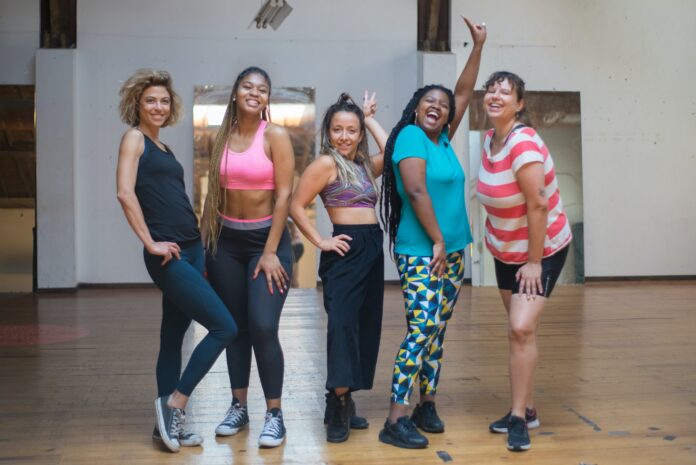
Group posing in athleisure inside a gym.
PHOTO: Kampus Production / Unsplash

By: Isabella Urbani, Sports Editor

SFU Recreation is hosting this spring semester’s trial week from January 15–20. Trial week is a five-day free of charge look at some of the recreation programs being held for the rest of the semester. It gives students and members of the community the chance to sample activities they might like before committing to a class schedule and its associated fee. Students who pay the fee for classes before January 22 receive an early bird discount. To participate in trial week, students must register for classes and sign the athletic waiver online.

This semester’s schedule includes 29 classes, including multiple different styles and levels of Pilates to a variety of dance and martial arts classes. Most classes are 50 minutes long, with the exception of the martial art classes. Participants can sign up for classes online using the SFU Recreation website, where they will be directed to the Fusion Membership Portal. Students will sign into the portal using their SFU email. Community members will need to sign up for an account if they haven’t already. 

Walk-ins are only acceptable five minutes before start time for classes whose spots were full online. A list of these classes can be found on the web version of this article. SFU students must have completed their athletic waiver online at goSFU to be able to participate in classes. We recommend doing this days in advance, as it can take up to 48 hours for the change to be processed on your account. 

Monday, January 15 

Barre Classic

  • 10:30–11:20 a.m. in the Fitness Studio (FS)
  • “Low-impact strength workout that enhances your muscle tone, posture, and flexibility in a class that fuses ballet-inspired moves with elements of pilates, dance, and yoga.”
  • Full program cost for students: $84.65 for Mondays; $94.05 for Tuesdays

Ballet 

  • 3:30–4:20 p.m. in the FS 
  • A typical ballet class includes barre and centre work. Barre work includes the use of a handrail, while centrework is performed in the middle of the floor. Dancers may perform pirouettes (turns), adage (slow movements, like leg lifts), and allegro (fast movements, like jumps). 
  • Full program cost for students: $84.65

Restorative Yin Yoga 

  • 4:30–5:20 p.m. in Studio 1 of the Transportation Centre (TC)
  • Integrates “passive stretches from Restorative Yoga for profound healing and balance, while incorporating active stretches from Yin Yoga to enhance tissue elasticity, joint mobility, and stress reduction.”
  • Full program cost for students: $88.20$98.00

Iaido 

  • 6:00–7:30 p.m. on the west side of the Central Gym (CG)
  • Iaido is the “art of sword drawing from ancient Japan. The movements are simple to quickly dispatch opponents in sitting and standing situations. Beginners start with a wooden sword, and progress to an unsharpened metal sword.”
  • Full program cost for students: $93.50

Arnis Kickboxing 

  • 6:30–8:30 p.m. in the Upper Mezzanine (UM)
  • Arnis Kickboxing is a mix of “western boxing, eastern kickboxing, grappling and traditional martial arts with the progressive weapons techniques of the Philippines.”
  • Full program cost for students: $106.07 for classes every Monday and Wednesday. $62.86 for Mondays only; $61.55 for Wednesdays only

Judo Recreational 

  • 7:15–8:45 p.m. in the Multi-Purpose Room 00-9 (MPR)
  • “These classes will focus on developing physical fitness through judo, building healthy habits, learning core judo techniques, developing self-defense techniques and improving athletic abilities.” 
  • Full program cost for students: $117 ($47 for Judo BC Membership and $70 for Peak Judo Membership) 

Kendo

  • 7:309:30 p.m. on the East Side of the CG 
  • “All practitioners wear traditional clothing/armour, and utilize a bamboo sword to strike targets on the opponent’s body.”
  • Full program cost for students: $106.07 

Tuesday, January 16 

Barre Classic

  • 10:3011:20 a.m. in the FS

Tai Chi Beginner

  • 5:006:30 p.m. in VIP Room 
  • “This class uses the most popular, standardized form of Tai Chi – 24 Form Simplified Yang Style. It will help you refine your form and improve your flow of movements.”
  • Full program cost for students: $88

Aikido

  • 6:008:00 p.m. in Studio 2 of the TC 
  • “Studying Aikido teaches one how to resolve conflicts in a peaceful manner by harmonizing with an attacker’s force to neutralize it.”
  • Full program cost for students: $106.07

Hapkido

  • 7:30–9:30 p.m. in the VIP Room
  •  Includes “kicking, striking, joint locks, throws, take downs, control tactics, pressure point attacks, ground fighting and weapons: short stick, baton, sword, knife, rope, and staff.”
  • Full program cost for students: $106.07

Wednesday, January 17 

Bhangra Dance 

  • 5:30–6:20 p.m. in the FS 
  • “This class fuses Bhangra, an energetic Punjabi dance form, with elements of Hip-hop and Bollywood.”
  • Full program cost for students: $94.05 for Wednesdays; $84.65 for Fridays

Karate 

  • 5:30–7:30 p.m. in Studio 2 of the TC
  • “Training sessions cover a broad range of components, including Kihon (basic techniques), Kata (form), Kumite (sparring), fitness exercises, and engaging activities to make learning enjoyable.”
  • Full program cost for students: $55

Iaido

  • 6:00–7:30 p.m. on the west side of the CG

Arnis Kickboxing

  • 6:30–8:30 p.m. in the UM

Judo Recreational 

  • 7:15–8:45 p.m. in the MPR 00-9

Kendo 

  • 7:309:30 p.m. on the East Side of the CG 

Ving Tsun 

  • 7:309:30 p.m. in the VIP Room
  • “The use of proper body positioning enables the practitioner to maximize their attack while assessing their opponent’s strengths and weaknesses.”
  • Full program cost for students: $89.05

Thursday, January 18

Pilates Level 2

  • 11:30–12:30 p.m. in the FS 
  • “This class will progress you into your Pilates fluidity and awareness of movement while working in challenging exercises.” “Increased pace and challenge” from Pilates Beginner or All Levels.
  • Full program cost for students: $88.20–$98

Restorative Pilates

  • 1:30–2:20 p.m. in the FS 
  • “This class moves at a slower pace to accommodate those who are new to Pilates and those who are managing injuries, tiredness or looking to take more time into each exercise.”
  • Full program cost for students: $88.20–$98

Hatha Yoga 

  • 4:30–5:20 p.m. in Studio 1 of the TC
  • Pairs poses (‘asanas’) with breathing techniques (‘pranayama’).”
  • Full program cost for students: $125$175 (pass for all yoga classes)

Aikido 

  • 6:008:00 p.m. in Studio 2 of the TC 

Fencing Beginner 

  • 7:30–9:30 p.m. on the east side of the CG 
  • “Requiring speed and agility, this enjoyable class develops muscle, balance, agility and endurance.”
  • Full-program cost for students: $126.50

Fencing Intermediate 

Friday, January 19 

Bhangra Dance 

  • 1:30–2:20 p.m. in the FS 

Saturday, January 20 

Ballet Techniques 

  • 3:30–4:20 p.m. in Studio 1 of the TC
  • “Strength and conditioning program designed to train motor pathways required in various forms of dance.”
  • Full program cost for students: $94.05

Full classes online 

(first come, first serve five minutes ahead of class, if space permits)

Monday, January 15 

Pilates All Levels 

  • 11:30–12:20 p.m. in the FS

Pilates Yoga Fusion 

  • 1:30–2:20 p.m. in the FS

Vinyasa Yoga 

  • 3:30–4:20 p.m. in Studio 1 of the TC

Kpop 

  • 4:45–5:35 p.m. in the FS

Tuesday, January 16 

Barre Pilates 

  • 11:30–12:20 p.m. in the FS

Hatha Yoga 

  • 12:30–1:20 p.m. in Studio 1 of the TC

Zumba 

  • 5:30–6:20 p.m. in the FS

Wednesday, January 17 

Flow Yoga 

  • 11:30–12:20 p.m. in Studio 1 of the TC

Core Yoga

  • 12:30–1:20 p.m. in Studio 1 of the TC 

Hip Hop Dance 

  • 3:30–4:20 p.m. in the FS 

Friday, January 19

  • 11:30–12:20 p.m. in the FS 

Inside Christine Sinclair’s final match for team Canada

0
Christine Sinclair acknowledging the crowd with both her hands up.
PHOTO: Courtesy of Christine Sinclair's Instagram

By: Kaja Antic, Sports Writer

It was a cool December evening in Metro Vancouver as crowds pooled onto SkyTrain platforms, destined for the greatest sporting event in the city that night. Oh, and Canucks captain Quinn Hughes lost to both his younger brothers, but that was next door.

December 5th, 2023: the night the nation said goodbye to a Canadian legend.

I was one of the tens of thousands in red and white, descending through the downtown core and filing into the renamed Christine Sinclair Place. Lines at the stadium gates seemed to go on forever, a mass of people ready to pay tribute to the greatest international goal scorer of all time. 

Even in the concourse, you could hear the roar of the crowd, with the wide halls packed with eager spectators, grabbing their drinks and snacks in anticipation of the bittersweet farewell. Entering the bowl of the stadium, the roar thundered, with much of the festivities still yet to take place. 

Team Canada, along with Australia’s Matildas, were warming up on the pitch, as video tributes for the retiring legend played on the stadium’s central jumbotron. Messages of thanks poured in from icons, such as Canadian astronaut Chris Hadfield, actor Ryan Reynolds, hockey players Sarah Nurse and Marie-Philip Poulin, and American tennis and women’s sports pioneer Billie Jean King. A multitude of videos displayed Sinclair’s immense impact on everyday Canadians from coast to coast, both on and off the pitch.

This impact was also shown clearly on the stadium’s large turf field, with thousands of onlookers waiting in anticipation of the retirement ceremony prior to kick-off. Before the participating teams, media, and legend of the hour herself, 190 youth soccer players in red Sinclair jerseys — representing the 190 international goals she scored while playing for Canada — walked out of the tunnel. The players stood on the vast pitch for the entirety of the ceremony, a visual representation not only of Sinclair’s record but also of her lasting influence on soccer, nationally and internationally.

Sinclair’s international career was coming to an end after 23 years of inspiring performances and advocacy for sporting equality. She was one of my role models growing up, as I played soccer every weekend in the often rainy weather. While I was not a goal scorer in the slightest and left the sport in my adolescent years, I still looked up to Christine Sinclair like many, recognizing her as a stand-alone legend in the history of soccer.

The retirement ceremonies began with honouring goalkeeper Erin McLeod, who announced her international retirement in January, and Sophie Schmidt, a longtime teammate and friend of Sinclair, who was also appearing in her last international game. Schmidt had initially planned to retire from international play earlier in the year, but was convinced by Sinclair and Canadian team coach Bev Priestman to continue until this grand finale. 

As Christine Sinclair walked onto the field, the crowd responded to the retiring players with cheers and applause, acknowledging both legends in their own rights. Surrounded by the Canadian team — past and present — Sinclair entered the pitch in the maple leaf-adorned kit for the final time, and the tens of thousands in attendance roared for their champion. 

Tears filled the eyes of many across the stadium — including Sinclair herself — as a tribute to the “GOAT” played on screen from her first appearance as a 16-year-old in 2000, to her many, many, goals in the red and white. It was a succinct summary of Sinclair’s international career, though confining a remarkable 23-year career into a five-minute video is an impossible task.

The match itself was low-event compared to Canada’s 5–0 victory four days earlier on Vancouver Island. The 12th minute of the game saw the crowd stand and applaud Sinclair, representative of the number 12 she has worn throughout her career. 

The lone goal of the match was scored by Quinn in the 40th minute. The play began as a corner kick from Jessie Fleming, and was passed around by a few players, including Sinclair, before it was headed by Quinn. 

Sinclair was fittingly substituted off the Canadian field 12 minutes into the second half, removing the captain’s armband and placing it on the arm of fellow retiring teammate Schmidt. The move off the field took nearly two full minutes, as Sinclair was approached by players both Canadian and Australian in congratulations of a job well done and a legacy well cemented. Applauding to the thousands in the stadium renamed for her, Sinclair looked around as she took her final steps off the field as a member of the Canadian national team. 

In her 331st appearance for team Canada, Sinclair had played her 27,601st, and final minute.

The crowd that filled Christine Sinclair Place that night was the largest crowd ever for a “Women’s international friendly match in Canada”, with 48,112 spectators packing the stadium for the icon’s last dance.

The fanfare continued long after the final whistle had blown, with the Canadian team rounding the pitch, throwing T-shirts into the crowd and celebrating with the dedicated fans. The concourse was lively, decorated with “#ThankYouSinc” banners and posters, including a large wall adorned with messages from fans thanking the legend for her contributions to the game, the sport, and the nation as a whole.

The upper ring of Christine Sinclair Place was illuminated with a pattern of the Canadian flag along with the number 12. The visual display honouring Sinclair was seen both inside the stadium and outside along the Vancouver skyline.

Although the crowds returned home, the SkyTrain emptied out, and the stadium was renamed BC Place once again, the echoes of this hometown legend will live on for generations to come. When asked by CBC how she would like to be remembered, Sinclair said as “a proud Canadian that gave their all.”

Sinclair gave everything to this country, and the millions from coast to coast are forever grateful for the legendary number 12.

Czechia sent back-to-back champion Canada home early from World Junior Championship

0
Czechia player on their backhand driving to the Canadian net.
PHOTO: Courtesy of Hockey Canada's Instagram

By: Kaja Antic, Sports Writer

Team Canada made an earlier than expected exit from the 2024 IIHF World Junior Championships, hosted from December 26–January 5 in Gothenburg, Sweden. Canada finished second in the Group A standings during the preliminaries — suffering their only loss to the tournament’s host nation 2–0, who finished at the top of the Group A standings. Canada earned high-scoring results in their three preliminary wins, beating Finland 5–2, Germany 6–3, and shutting out Latvia 10–0

Canada entered this year’s tournament as the reigning champions, winning gold in 2022 and 2023. In last year’s gold medal game, the team defeated Czechia in overtime, after Czechia tied the game at two late in the third period. Unfortunately for the young Canadian players, this year’s tournament did not yield the same results.

Heading into the second period of the quarterfinals matchup against Czechia, Canada was down 2–0. Striking back in the following 20 minutes, Canada tied the game going into the third period, thanks to goals from the Nashville Predators 2023 15th overall draft pick Matthew Wood, and San Jose Sharks prospect Jake Furlong.

The game was poised to go to overtime, similar to last year’s finals between the two. Yet, with 11 seconds left on the clock, St. Louis Blues prospect Jakub Stancl scored to give Czechia the upper hand, effectively eliminating Canada from the tournament. Stancl himself called the game-winning goal a lucky bounce,” as the shot deflected off the stick of team Canada player and Philadelphia Flyer prospect Oliver Bonk, hit the post and went behind Canadian goalie Mathis Rousseau to put Czechia ahead in the dying seconds of the game.

Team Canada’s captain and Vancouverite Fraser Minten described the unanticipated loss as “feel[ing] like the world’s ending a bit.” Much of the current roster — including Toronto Maple Leafs prospect Minten — will be ineligible to play in next year’s tournament due to age restrictions. All players must be 20 or younger by December 31 of the year the tournament ends, as games begin and carry over into the new year. The oldest eligible players at next year’s tournament in Ottawa will be born in 2005.

Czechia went on to the tournament semifinals, losing 5–2 to Sweden. The game was tied heading into the final 20 minutes, until Sweden scored three unanswered goals to seal their spot in the gold medal game. Two of three third-period goals came from tournament MVP and Vancouver Canucks prospect Jonathan Lekkerimäki.

The tournament ended the day later, with the US defeating Sweden 6–2 to win gold. Alongside Lekkerimäki, two more Canucks prospects won silver: Vancouver’s recent round one pick, defenceman Tom Willander, and defenceman Elias Pettersson who shares the exact same name as current Canucks forward Elias Pettersson with no relation

After losing to Sweden, Czechia beat Finland, who lost their semifinal game 3–2 against the US, for bronze. Czechia defeated Finland 8–5, overcoming a 5–2 deficit by scoring six unanswered goals; four in the penultimate minute of the game.

Despite the early exit from Team Canada, it was a good tournament for 17-year-old Macklin Celebrini, who led the team with eight points — four goals and four assists — in five games played. Even though Celebrini missed additional elimination games due to Canada’s quick departure, he ended the tournament in the top 20 for points and was the only player under 18 to score more than two points.

North Vancouver-born Celebrini is expected to go first overall in the 2024 NHL Entry Draft and is currently playing at Boston University, along with his older brother Aiden — another Canucks prospect.

This week at SFU

0
SFU swimmer competing in a backstroke event.
MIAMI SHORES, FL - JANUARY 5, 2024: Barry swimming v Simon Fraser. (Photo by Joel Auerbach)

By: Isabella Urbani, Sports Editor

Home Games 

Thursday, January 25: women’s basketball vs. Montana State Billings at West Gym at 7:00 p.m. 

  • Montana State is first in the conference standings; SFU is eighth 
  • 1–1 against Montana State last season 

Saturday, January 27: women’s basketball vs. Seattle Pacific at West Gym at 7:00 p.m. 

  • Second game of a four-game homestand
  • SFU scores an average of 66 points against Seattle Pacific 

Away Games 

Thursday, January 25: men’s basketball vs. Northwest Nazarene (Idaho) at 5:00 p.m. 

  • First match against Northwest Nazare this season; 0–2 against them last season
  • Team’s last win was on November 18 

Friday, January 26: conference hockey team vs. UVIC at 7:30 p.m. 

  • Second game in a week against UVIC 

Friday, January 26–Saturday, January 27: track and field at the University of Washington Invitational. 

  • Competed at the University of Washington Indoor Preview two weeks ago 

Friday, January 26–Saturday, January 27: track and field at Boston University for the John Thomas Terrier Classic

  • First of two visits to Boston University this season 

Saturday, January 27: men’s basketball vs. Central Washington at 6:00 p.m. 

  • Lost last five meetings against Central Washington; last beat them on January 4, 2020
  • Central Washington is the conference leader in defensive rebound percentage (.760)

Saturday, January 27: swimming vs. UVIC 

  • Last regular season meet before conference championships 
  • Men’s team lost their first meet since November 4, 137–125; women’s team lost 146–116 and finished their California trip 4–2

Saturday, January 27: conference hockey team vs. Vancouver Island University Mariners at 7:00 p.m. 

  • Vancouver Island is first in league standings; SFU is fourth out of five teams

Connect the Lingo

0
Illustration of a character connecting the words “connect the” and “lingo” with a pencil.
ILLUSTRATION: Alyssa Umbal / The Peak

By: Kaja Antic, Sports Writer

  1. ________ league was a baseball term used to refer to minor league baseball teams in rural towns, but is more often used to describe a lack of professional standards and etiquette.
  2. A goalie in hockey is given a _________ cheer by the crowd when they make an easy save after previously allowing multiple goals on not-so-great chances.
  3. While a 0–0 score in sports is sometimes referred to as goose eggs, the MLB uses the term _________ to describe when a team scores eight runs, due to its similar appearance. 
  4. A ___________ ___________ is a dangerous move in hockey when a player lodges their stick between an opponent’s leg and locks them in, rendering them defenseless. 
  5. In entertainment wrestling shows, the ring announcer states the contest is scheduled for _________ __________ to indicate the winner only needs to pin and beat their opponent to a three count once. 
  6. An opponent is _________ in basketball when they get dunked on in such an outrageous manner that it deserves to be framed. 
  7. Each _________ (period) in Polo is seven minutes long. 
  8. A ________ is an illegal shot in table tennis when a player hits the ball prior to it dropping on their side of the table. 
  9. In cricket, the person closest to the batsman is called the ________ ________.
  10.  The term _______ originated in horse racing and refers to a more talented horse or rider illicitly swapped into competition.

Word Bank

can opener
chukka
Bronx
one fall
Bush
ringer
posterized
volley
snowman
silly point

Answers 

1.) Bush 
2.) Bronx
3.) Snowman
4.) Can opener 
5.) One fall 
6.) Posterized
7.) Chukka
8.) Volley 
9.) Silly point 
10.) Ringer

Red Leafs hockey hold off No. 2 Boston University to shootout

0
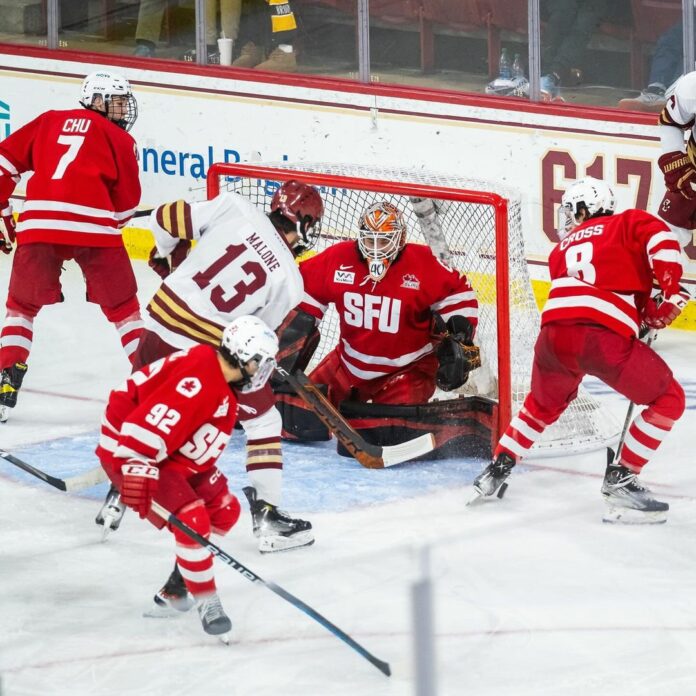
Boston College player at the front of the SFU net with SFU players surrounding him.
PHOTO: Courtesy of SFU Red Leafs Hockey Team Instagram

By: Kaja Antic, Sports Writer

The non-conference Red Leafs hockey team started 2024 with big ambitions, playing three exhibition games in as many days against top-rated NCAA Div. I hockey teams. 

The road trip kicked off on January 5 against the Boston University Terriers (BU), who were ranked the second-best college team heading into the matchup. BU has since dethroned their state rival, Boston College (BC), to become the best team in college hockey, after finishing first in back-to-back weekly polls

BU was missing projected first-overall NHL pick, forward Macklin Celebrini, and the Canucks’ 2023 first-round draft pick, defenceman Tom Willander, who were at the World Junior Championship in Sweden representing their respective nations. Even without the duo, BU had more than enough starpower with 11 of the team’s 15 NHL draft picks in the lineup.

SFU forward Walker Erickson scored the game’s first goal 13 minutes and 42 seconds into the first period, from forward Garrett Hilton and defenceman Tristen Cross, to end the first period with a one goal advantage for the visitors. SFU held the lead for over a period before Buffalo Sabres prospect Gavin McCarthy scored the equalizer for BU on a one-timer at 3:19 in the second period from St. Louis Blues prospect, forward Dylan Peterson, and Los Angeles Kings prospect, forward Jack Hughes. The game remained tied for the rest of the endeavor, despite SFU being short-handed for five minutes in the third period after Cross received a five-minute major penalty, and an automatic game misconduct, for slew footing. 

SFU goalie Kolby Matthews was sensational in net, stopping 46 of 47 shots, including three shots in overtime, while SFU failed to challenge Terriers goalie Max Lacroix with a shot in overtime. Both teams found themselves in another deadlock following two rounds of unsuccessful shootout attempts before BU’s lone goal scorer, McCarthy, scored to prevent a fourth round of shootout, and lifted his team to the victory.

The next night, SFU faced then-No. 1 team, the Boston College Eagles, once more scoring the first goal of the game — this time from forward Logan Bromhead. BC went on to score five goals in the second period, with goaltender Matthews stopping 41 of 46 shots from the Eagles, moving his stop total at the end of two nights to 87 of 93 shots.

Matthews didn’t make an appearance for the Red Leafs in the third and final game of the East Coast road trip, where SFU took on the Providence Friars in Rhode Island for the first time in eight years. Unlike the first two games of the road trip, SFU gave up the first goal of the game and surrendered another goal on the powerplay by the end of the opening frame, giving Providence a two goal lead. After having just two shots on net to Providence’s 26 in the first period, forward Jerzy Orchard scored to get SFU on the board in the second period. SFU and Providence exchanged goals less than three minutes apart before the Friars notched a power play goal with 14 seconds remaining in the middle frame to restore the two goal lead.

In the final frame, SFU generated five shots on net — the most of any period. However, seven penalties kept SFU shorthanded for much of the period, and allowed Providence to notch their third power play goal of the game to extend the score to 5–2. Red Leafs goaltender Andrew Henderson stopped 56 of 61 shots from the Friars, while SFU was only able to get ten shots on goal through 60 minutes. 

This is still the first year for the non-conference squad, as the program adjusts to accommodate both BCIHL competition and exhibition against fellow schools. Despite the losses, the Red Leafs powered through this road trip, showcasing their capabilities against top-rated Div. I programs — especially the gritty shootout result against BU. Though the trip was a short three days, it was a valuable teaching moment for the hockey club against formidable NCAA opponents, and a bid for future Div. I considerations.