


by Meera Eragoda, Staff Writer
Tucked into a corner on Findlay Street off Commercial Drive lies an unobtrusive bookstore which has its roots in SFU. Spartacus Books is a breath of fresh, radical air in a suffocatingly capitalist world. It’s a non-profit, entirely volunteer-run bookstore and resource center that strives to be as inclusive and accessible as possible.
Spartacus Books got its start in 1972 as a booktable at SFU, moving to a storefront on the Downtown Eastside in 1973. It has faced more than its fair share of adversity, from a fire that destroyed everything to a renoviction as a result of increasing gentrification. For over 45 years, it has preserved and rebuilt, showcasing the power of working as a collective. Spartacus operates under an anti-oppressive, anti-colonial, and anti-capitalist framework to reject hierarchies and binaries. This unites people through the spirit of struggle, as they believe all oppressions are linked.
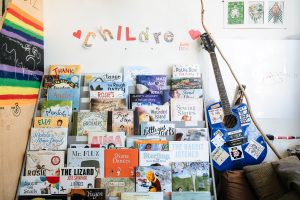
The store itself is fairly small, but can hold gatherings of up to 30 people. During my last visit, an accordion group of about 12 people were using the space to practice. It is packed with adult and children’s books, magazines, pins, patches, comics, and other merch featuring anarchist, Indigenous, queer, feminist, Black, and immigrant content — and more.
Everywhere you turn, posters such as “Sex Work is Real Work”, “A Riot is the Language of the Unheard”, and “Smash Fascism” greet you. There is a cozy corner of the store where anyone is welcome to free coffee, tea, and whatever other goodies await. A couch featuring a colourful throw, along with other seating, gives the space a home-y feel where anyone can play board games, read, peruse zines, play an instrument, or just hang out.
Alexander Daughtry, the longest-standing member of the collective, joined in 1976. He first discovered Spartacus while it was a booktable at SFU. When The Peak asked what inspired him to join, he said, “I loved that it was doing an important function of getting all this information to people who it would not otherwise be available, but I also loved that it was non-sectarian, and was a working group of anarchists, Maoists, social democrats who could all work together which was unusual in the 1970s.”
As to why he’s stayed so long, he says, “I think we still have a very important function worth continuing especially as bookstores are all disappearing.”
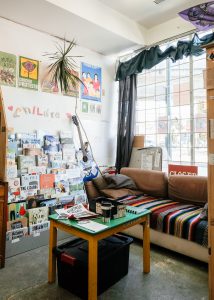
Spartacus is more than just a bookstore. It is a safe space for community gathering and organization. They hold free events such as movie screenings, craft nights, jam sessions, and book clubs. I’m told by collective member, Alexander Kirby, that the Spartacus Book Club will be restarting on January 30 at 6:30 p.m. with Capitalism Realism by Mark Fisher (a short 90-pager), and that more details will be published on their Facebook page shortly.
Staying true to SFU’s roots involves helping radical, inclusive spaces both on and off campus flourish. As Spartacus’ inception can be traced back to SFU, I would encourage anyone curious about inclusive social change, alternative worlds based on unity, or challenging the status quo, to pop by this oasis.
Spartacus Books can be found at 3378 Findlay St, Vancouver, BC and is open from 10 a.m.–8:30 p.m. on weekdays, and 11 a.m.–7 p.m. on weekends.


