Home Blog Page 763

SFU women’s basketball shock the NCAA by defeating Alaska Anchorage 80–70

0

At the end of the first half, the game was going as most people probably would have expected.


The Alaska Anchorage Seawolves were leading, but the SFU Clan was hanging around keeping it close and by no means out of it.


What happened next, however, would have shocked nearly the biggest optimist.


SFU came roaring out of the break, outscoring Alaska Anchorage 257 in the third quarter. That proved to be the main difference, as SFU ended up winning 8070 in front of a shocked home crowd for the Seawolves.


The magnitude of this win cannot be overstated. Alaska Anchorage was the number one seed in the West Region, and the number two ranked team in all of Division II women’s basketball. They had lost only one game before this all season and went the entire Great Northwest Athletic Conference schedule unbeaten, and was considered by many to be a pretty good bet to win the national championship.


Oh, and they made it to the final last year. Not only that, they were playing at home in this one, where they had only loss once all year but that was against the University of Portland, a Division I program.


In fact, you have to go back to last season to find the last time Alaska Anchorage lost at home to a Division II program. Funnily enough, that was against Simon Fraser in the last conference game of the season. They didn’t have Meg Wilson available to play in that one either.


If we were to use a professional sports analogy to try and summarize this, this was like the Golden State Warriors blowing a 31 series lead all condensed into one single 40-minute game.


At the start of it, the Clan gave up 12 straight points after getting an early lead. It looked like this would be a long night. However, SFU answered with eight points to put them within one.


Although the Clan kept it close in the second, the Seawolves always seemed to have an answer. Every time SFU seemed to get some momentum going, Alaska Anchorage was able to come back and stop it right in its tracks.


At least in the first half.


SFU was able to score seven points before Alaska Anchorage got on the board in the third quarter. The Clan was making nearly every shot in contrast, Alaska Anchorage couldn’t get one to fall. By the end of it, they had a 12-point lead.


That lead shrunk to six halfway through the fourth before Sophie Swant and Ozi Nwabuko made back-to-back layups to put the lead back to 10. They didn’t look back after that.


Not only did SFU outscore Alaska Anchorage 5335 in the second half, they were dominant doing so. They looked like a completely different team than the one that lost to Central Washington just over a week earlier.


In that loss, SFU shot just 27.1% from the field, way below their season average. In the two wins since, they’ve shot 39.7% and 45.6% dramatically better performances.


A lot of that has to do with their three-point shooting. In the loss against Central, they shot a measly 15% from long range. Since then, they’ve shot above 40% both times. For a team that has built its reputation over the past couple of seasons as being great at three-point shooting, it’s a welcome addition back to their arsenal of weapons.


Leading the way with another dominant performance was Sophie Swant. She once again led the Clan in scoring with 18 points, breaking her previous season-high of 17 points set the game earlier. For all the concern following the injury to Meg Wilson, SFU seems to have found perhaps a replacement in the sophomore from North Vancouver.


Ellen Kett had a brilliant all-around game, finishing with 14 points, six assists, and two steals all while playing the entire 40 minutes. Rachel Fradgley nearly had a triple double, recording 10 points, 10 rebounds, and six assists. Freshman Tayler Drynan was a perfect four-for-four from the field, including going three-for-three from behind the arc.


Next Game: SFU will now play in the West Regional Final against the California Baptist Lancers. The Clan will be looking to advance to the Elite Eight for the first time in the program’s NCAA history.


California Baptist is the second ranked team in the west region, and have arguably had just as dominant a season as Alaska Anchorage. Like the Seawolves, they also went undefeated in conference play, and have lost only twice all year. In fact, since losing to UC San Diego on November 12, the Lancers have won 30 straight games.


These two teams actually played each other earlier in the season. In the first game for either side back on November 4, the Lancers came away with an 8477 victory. Rachel Fradgley led the way for the Clan, scoring 20 points and snagging six boards in just 22 minutes of game time.


It’s another tough task for SFU. But after this game, I’m not ready to count them out until the final buzzer.


Tip-off is at 8:00 p.m on Monday.

SFU hockey ousted from BCIHL playoffs

0

For the second year in a row, the season for SFU hockey came to a premature end.


After a 63 loss to the University of Victoria on Friday night, the Clan needed a win to keep the season alive. In that game, SFU had a 31 lead before giving up five straight goals to lose 63. If they stood a chance of bringing the series to a third and deciding game, they would need to limit the Vikes’ opportunities to score.


Unfortunately that didn’t happen. The final score was 53 for UVic, sending the visitors to the BC Intercollegiate Hockey League (BCIHL) final against Trinity Western.


SFU came out roaring to start the game, scoring two quick goals within two minutes of each other to take a 20 lead. It was another two-goal lead like the night before, but the Clan looked to be in control.


However, that’s when it started to unravel. Defenceman Jayden Piatelli was assessed a 10 minute misconduct for a check from behind. UVic scored on the ensuing power play, then added a late goal with the man advantage to tie it at two.


The second featured two more special teams goals for the Vikes, including a back-breaking short-handed goal that gave them the lead. In the third, Jack Palmer scored to make it 52 for the visitors before graduating senior Jesse Mysiorek scored one late to give SFU three goals on the night.


Special teams were undoubtedly the difference in this one. UVic went three-for-four with the man advantage, and scored short-handed as well. SFU, in contrast, wasn’t able to score on three power plays. This was also in contrast to the night before, where except for an empty net goal, all of UVic’s goals came at five-on-five.


Over the series SFU gave up 11 goals an uncharacteristically poor defensive performance.


The Clan also outshot the Vikes 4722 in the game a nearly two to one advantage but wasn’t able to beat goaltender Zach Wear for more than three goals.


It’s another bitter pill to swallow for SFU after ending their season in the same way last year. They improved in the standings by five points this season, and finished with two more wins. They scored 12 more goals and, more impressively, conceded 31 less goals. Yet it was the same result come playoff time.


Perhaps the silver lining is that the vast majority of this lineup will be returning next season. Offensive players such as Adam Callegari and Brendan Lamont, captain Brandon Tidy, defensive stalwarts Mathew Berry-Lamontagna and Darnell St. Pierre will all be highly motivated come next season.


And with both Jordan Liem and Lyndon Stanwood back as well, the team’s defensive shell should be intact.


Unfortunately, we’re going to have to wait nearly a year to see if next year’s edition is any different. Because like it or not, their success will likely solely be judged on how far they can make it in the playoffs.

SFSS approves the creation of a stadium (this time for real)

0
This was the scene of the Board Meeting when the stadium was cancelled. The room was calmer today as the SFSS approved the project they originally scrapped.

It’s like the saying goes: if at first you don’t succeed in building the stadium that students voted for and have already started paying for, try, try again.

With a unanimous vote, the Simon Fraser Student Society (SFSS) has decided to move forward in approving a new version of the Build SFU stadium, a project which was originally cancelled seven months ago when its budget estimate was triple what they were expecting.

“On August 11, we cancelled the project for the reasons we mentioned before. The cost estimates were too much, and SFU wasn’t willing to contribute anything more than the million dollars,” said Arr Farah, vice-president (VP) university relations for the SFSS. “Athletes came and spoke about how the university had made a commitment and said that they would be able to cover the costs of the stadium and finance the project, which, to some degree, was news to us.”

With that contribution from SFU, the project — which is now more economically-friendly than the $30-plus million stadium originally tabled — had a better chance of succeeding. It took a lot of negotiating between SFU and the SFSS, but eventually the new plan was agreed upon.

“We kind of had [those conversations] throughout September and October. November and December were kind of a wash, because the university has a lot of VPs and people who need to be in the room for all these conversations, and they travel the world all the time for some reason,” said Farah. “But when we got to January, that was when the heavens were moved and things started to happen. And that was when SFU said they would be able to give us the $10 million without any sort of financing agreement, which would save us.”

Farah said he was sure students would want to know how the costs were reduced, and wanted them to understand some of the processes they went through.

“I think the biggest thing to note in that original cost estimate we got: the roof was $7 million. That’s, like, half of the cost of the new project, which is insane. There are things like the press box which are over $2 million, and these are huge extravagant items which made that cost go up so high,” he said. “It may not look as great as some people wanted, but it helps.”

Olivia Aguiar, the president of the Student Athlete Advisory Committee (SAAC), was also present in the room for the vote. She’s been present ever since a horde of student athletes stormed an SFSS meeting to voice their displeasure over the stadium being cancelled. In a word, she felt relieved at the steps taken today.

“I’m excited that since summer we’ve gotten to this point, because there were some pretty rough times in between. It’s nice to see that everything we had discussed had been taken into consideration, and that those discussions have occurred and now we’re back in a position where we’re up and running,” she said.

However, with how tumultuous everything has been, she isn’t willing to fully celebrate until she physically sees something happening.

“I think once I see the trucks on the field digging the hill and I see that ribbon being cut, I think at that moment I will realize this is actually happening,” she said, laughing.

Now it is SFU’s to approve, and that will take place at their next Board of Governors meeting which is currently scheduled for March 30. Should they approve it, a written agreement will come into place on April 3.

Pro Day a step towards dreams of professional football for SFU alumni

1
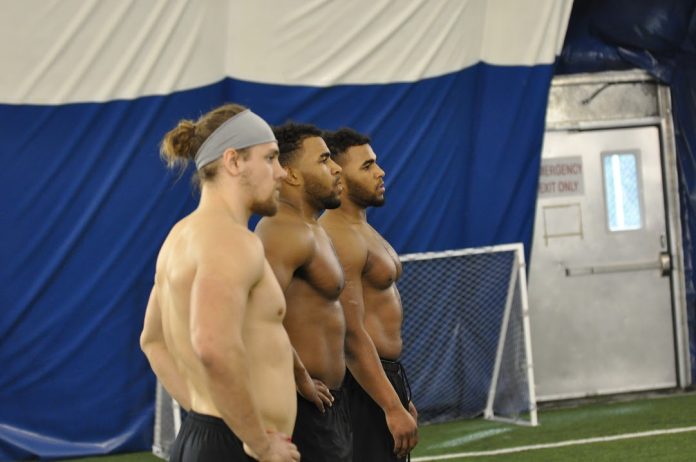
Running back Ante Litre next to linebackers Jordan and Justin Herdman. After declining an invite to the CFL Combine initially, Jordan will be heading there after all. Austin Cozicar / The Peak

For Jordan Herdman, it seemed like it was all on the line Friday afternoon.

Having initially declined an invitation to the upcoming CFL Combine on March 23-25 — a decision that didn’t seem to sit well with Geroy Simon, who was watching in official capacity as a BC Lions scout — this would likely be the last physical testing before the NFL Draft in April.

“Me and my agent came up with the decision that we felt like pro day was all we needed, so if you wanted to come see me, you would have to come out to my pro day,” said the two-time GNAC defensive player of the year.

It was a bold move, and one that could certainly backfire with a poor performance and with the message it sends CFL teams.

So it would come down to one pro day at the North Shore “Bubble” Complex in front of representatives of six teams, two of them NFL — the Atlanta Falcons and the Arizona Cardinals — and four CFL teams — the BC Lions, Calgary Stampeders, Montreal Alouettes and the Saskatchewan Roughriders. He, along with his brother Justin and fellow recent SFU alumnus Ante Litre, would be tested on a variety of combine drills.

So how did it go?

The results were mixed — at best — for Jordan. While he shot for a result between 4.6 and 4.7 seconds in the 40-yard dash, he put up a time of 5.03 seconds.

All three players struggled on the three-cone drill.

By Monday, the final test was no longer final. It seemed like the bold move had backfired. Jordan had reconsidered his decision, and was added to the list of players attending the CFL Combine.

The appearance at the time, however, was that the scouts were aware that Jordan and his brother show much better on game tape than they do in combine drills — they’re better in-game.

“These guys are not great testers, but their film and their testing numbers don’t really match up. The testing can’t be the only thing you look at with these guys. They’re not great testers, but when you see them on the field, they look fast, they play fast, and they play physical,” said the former BC Lions great, who is now working with the team in charge of Canadian scouting.

“Jordan and Justin, I’m sure they’ll tell you, that some of their testing numbers aren’t what they wanted them to be, but that’s sort of the way they are,” said SFU head coach Kelly Bates, who coached the Herdmans for two years. “What they are is when you put them on the field in a middle of the game is their speed changes, their anticipation, their instincts take over and that’s what makes them ball players. It’s nice to have these testing numbers, and it’s nice to do these testing events, but at the end of the day, the film doesn’t lie.”

And while it’s hard to get a read on what teams think, with the Atlanta scout — Shepley Heard, who is the Falcons’ western regional scout — running much of the drills and the day, it would seem that they must have had some legitimate interest before the event.

Now, Jordan will have one more chance to show that he can test well.

For Justin, however, the Pro Day was always intended to be just the first test.

“I just feel that I need to get my name out there and I just need to show whoever’s watching that I can play at a high level, that I’m just ready to compete,” said Justin. “Definitely need to work on my three-cone, need to work on that, noticed I stumbled. Definitely clean that up before the CFL Combine.”

Both of the Herdmans seemed to do better and feel more comfortable in the linebacker drills — the drills testing their ability in positional situations, rather than straight speed.

“I wanted to leave them with my positional drills, my movement skills, just the linebacker drills, because that translates most to what we do on the field,” he explained. “To leave them with that last impression that I can move well and I can explode [is important].”

All three players impressed on the bench press, with Jordan and Litre putting up 23 reps, and Justin putting up 20.

But the guy with the most to gain was probably Litre.

Litre was the only player of the three not invited directly to the national combine, but instead to the western regional combine on March 23 where he’ll have to perform well to earn an invite to the national.

With Jordan’s spotlight bringing NFL attention to the Lower Mainland, it was a great opportunity for the 5’11 running back — one he flew with.

Putting up a 4.63 second 40-yard dash, he seemed to leave an impression on the talent evaluators.

“Ante ran a little better than I thought he would,” said Simon. “He caught the ball well, you could see his natural skills as a running back. I’m not sure he’ll play running back in our league, but he’ll have an opportunity, I think, in this league.”

For Litre, it was the culmination of his work over the past few months. He had planned out his schooling so he would graduate in the Fall to dedicate his time to training, so he could make a full effort at chasing his dream.

“I knew I wanted to pursue a professional career, so that’s why I made those plans, why I made those arrangements, and saved up some money so I could train. That’s all I have been doing. I haven’t been in school, not focusing my energy on a job, because I basically got eight weeks to make my dream come true,” said Litre. “So I put all my effort, everything I can, so if it doesn’t work out, on my deathbed I’ll have the satisfaction that I gave everything.”

And he came in confident, knowing what to expect after attending an NFL Regional Combine in February, where he had felt he left a good impression.

“I didn’t make a single drop,” he explained. “I went to the guy running the regional combine and asked if I could take reps at receiver because the running back drills were done and he let me. So I got to work out in two positions, and overall, I think I stood out.”

For the Herdmans and Litre, it’s a long process to realize their dreams to become professional football players. And it means a lot of drills, and a lot of testing — a lot of not just focusing on football, but the combine. But it’s that work that will make or break their careers.

“Once this is all over, we’ll go back to football,” said Justin. “I can’t wait.”

Testing:

Jordan Herdman
Weight: 234 lbs.
Height: 5’10.6”
Hand Size: 8.2”
Arm Length: 30.25”
Wing Span: 74.25”
Vertical Jump: 28.5”
Broad Jump: 9’4”
40-Yard Dash: 1.60s/ 2.84s/ 5.03s (10yards/20/40)
Pro Agility: 4.67s
3-Cone: 7.69s
60-yard shuttle: 12.55s
Bench Press: 23 reps

Justin Herdman
Weight: 229 lbs.
Height: 5’10.6”
Hand Size: 8.0”
Arm Length: 30.25”
Wing Span: 74.25”
Vertical Jump: 28.5”
Broad Jump: 8’10”
40-Yard Dash: 1.65s/ 2.90s/ 5.09s (10yards/20/40)
Pro Agility: 4.77s
3-Cone: 7.63s
60-yard shuttle: 12.37s
Bench Press: 20 reps


Ante Litre
Weight: 220 lbs.
Height: 5’11.7”
Hand Size: 9.5”
Arm Length: 30.75”
Wing Span: 72.25”
Vertical Jump: 36.5”
Broad Jump: 10’2”
40-Yard Dash: 1.60s/ 2.65s/ 4.63s (10yards/20/40)
Pro Agility: 4.47s
3-Cone: 7.31s
60-yard shuttle: 12.09s
Bench Press: 23 reps

Français: SFU reçoit Le Printemps de la francophonie pour célébrer la francophonie à Vancouver et a l’étrangère

0

Le Bureau des Affaires Francophones et Francophiles (BAFF) à SFU est heureux de présenter leur 7e événement annuel, Le Printemps de la francophonie. L’événement a commencé vers la fin février et va continuer jusqu’à la fin du mois de Mars.

Le Printemps de la francophonie est composé d’une série d’événements incluant des conférences, des tables rondes, des projections de films, des activités culturelles, des rencontres informelles et des soirées. Le but de l’événement est de célébrer la culture et la langue française chez Vancouver, au Canada, et à l’étranger.

Le BAFF et SFU espèrent que les francophones et les francophiles de la communauté universitaire pourront célébrer la langue, la culture, et l’héritage national à travers de ses événements. Les activités auront lieu au campus SFU Burnaby et dans la région de Vancouver.

Jusqu’à date, il y avait des professeurs d’autre universités Canadiennes qui ont discuté des relations internationales, des relations autochtones, du hockey, et de la langue française à l’extérieure du Québec.

Pour trouver la liste des évènements qui auront lieu dans les prochaines semaines, visiter le site web BAFF.

English: SFU proudly hosts month-long event to celebrate francophonie

0

SFU’s Office of Francophone and Francophile Affairs (OFFA) is presenting the seventh annual Le Printemps de la francophonie. The event started late February and will continue until the end of March.

Le Printemps de la francophonie is a multi-part series that includes a speaker series, roundtable conversations, film viewings, cultural activities, casual gatherings, and parties. The purpose of the event is to celebrate French culture and language at home and abroad.

OFFA and SFU hope that francophones and francophiles alike will be able to celebrate language, culture and heritage throughout the speaker series and activities. Events are taking place at SFU Burnaby, as well as other venues around Metro Vancouver.

So far speakers have been notable professors from a variety of Canadian universities, who have lectured on issues such as international relations, Indigenous relations, hockey, and the role of French outside of Quebec.

For a list of upcoming events visit the OFFA website.

Gender disparities in engineering and computing science at SFU and its effects on female students

2

The contrast in male and female representation in some SFU programs is starker than many students might have thought.

For Melissa Mah, a fifth-year student in electronics engineering and co-president of SFU’s Women in Engineering, the disproportionate gender distribution in her program is most visually apparent in the classroom. “To this day, I’m still shocked walking into lecture halls or tutorial rooms and being able to count the number of females on my fingers. There are times when myself and another girl are the only females in the class,” she told The Peak.

Female enrolment in the faculty of applied sciences has been on the increase over the last few years, most recently peaking at a fifth of all students in engineering, according to data from the SFU’s Institutional Research and Planning. However, that still leaves the number of females in the faculty at only 20% in engineering, 18% in computing science, and 11% in mechatronics.

Students in engineering are not the only ones who have noticed this trend. Dawn Chandler, one of two co-presidents of Women in Computing Science, is a third-year computing science honours student. She expressed that being female in a male-dominated program can make the atmosphere uncomfortable when her classmates do not share her perspective.

“The lack of women in SFU’s [computing science] program creates an environment in lectures, labs, office hours, and clubs that is silently unwelcoming to female students,” Chandler said. “As someone who does not come from a mathematics or programming background, this alienation can feel especially strong.

“Some women don’t see that it’s a problem that there are so few females in computing science and they don’t feel uncomfortable or isolated, but obviously some of us do,” she noted.

Feeling like an outsider

Female students enrolled in the engineering and computing science programs at SFU describe problems they encounter being some of the few in their field, ranging from feelings of inadequacy to subtle discrimination at the university.

“Whether we choose to acknowledge it or not, there is still a stigma surrounding females in engineering,” Mah said. These societal messages can often mean that females feel that they are not living up to the standards of the industry and, based on their experiences, Mah and Chandler noted that this seems to be a prevalent issue.

For another third-year student in computing science, Camille Janicki, this is only compounded by her experiences in the classroom and day-to-day student life. Janicki, who is also involved with Women in Computing Science, felt student groups in the program were often dismissive of the call for increased diversity. “What is tough is that a lot of males in computing science don’t find it a problem,” she said.

“As a minority, you [are] forgotten about and shoved in the corner.”

The comments made by professors and students often make the women in the room feel excluded, according to Janicki. A lot of the time, she said, females in the class are ignored or feel they do not have any friends in the room, which affects project contribution and class participation.

Her male peers will frequently make jokes at the expense of women’s abilities in computing science, Janicki reported. “[It] was a joke, but it still has an effect because you have been told that you don’t belong in computer science,” she said. “I would say it affects me every day.”

According to Janicki, a number of her female friends have dropped out of the program as a result of feeling so unwelcome.

Slow to change

In recent decades, there have been a variety of initiatives aiming to support and encourage females in science, technology, engineering, and mathematics (STEM) fields. At SFU, one of these initiatives is an organization that operates through Westcoast Women in Engineering, Science and Technology.

SFU engineering professor Lesley Shannon is its chair, and told The Peak that steps have been taken to increase the inclusion of females in these fields. Part of her work includes reaching out to high school students and creating inclusive opportunities for professional development.

“What I am noticing is there is a better consciousness that we are doing a disservice to young women to not point these careers out to them coming out of high school,” she said, noting that skills such as engineering are in high demand. However, recruiting students to the program is not where the challenge ends.  

“We’ve done a lot in the Women in Engineering group and the Women in Computing Science group to build up support systems [because] when you lose women, you tend to lose them because they feel isolated,” Shannon continued. “If you think you are the only person in the room with your perspective and your issues, you tend to feel very alone and you don’t connect.”

The number of female students in the applied sciences has been trending slightly upwards at both the undergraduate and graduate levels. In the 2012–13 academic year, only 16% of computing science students were female, as were engineering students. In mechatronics, that number was only 9%.

However, the faculty of science has been faring well otherwise, with the number of females enrolled often narrowly outstripping that of males. Chandler speculated that this has to do with the culture and expectations that surround students.

“If you follow what your friends go into — depending on your demographic, whether you are male or female, what ethnicity your parents are — you will end up in approximately the same place,” she said.

For males that are good at math and sciences, it is likely that they will be encouraged to enter engineering, but females who are good at those things might be more likely to take biology along with their other female friends, Chandler continued.

“I think the big problem is girls just don’t see themselves doing [applied sciences] and, obviously, one reason for that is they lack role models,” she cited. The female representation among faculty members and lecturers is even lower compared to student enrolment in the applied sciences, based on information from the SFU website.

Transforming the demographic

Perhaps surprisingly, it was not always this way. The role of computing numbers was traditionally viewed as women’s work in North America and therefore women played an important role as computer technology emerged, Shannon recounted. Founder of the Women’s Studies program at SFU in the 1960s, Margaret “Maggie” Benston was also a professor of chemistry and computing science. However, the number of females entering computing science dropped around the time that computers began to be manufactured for home use.

Nowadays, a recent Statistics Canada report found that Canadian males exiting high school with lower math marks were more likely to enter the STEM fields than women with comparably higher marks. This, according to Shannon, comes down to the perceptions people have of traditionally male-dominated fields.

“What becomes the challenge is trying to change that messaging and that messaging is everything from parents to teachers to marketing and that leads us to where we are now,” she said.

“I just want everybody to feel confident and comfortable that they are making informed choices about what they go to study and that they will be welcomed into those programs and have successful careers because nothing about who they are is going to be prohibitive. And that sounds obvious. Unfortunately, we are not there yet.”

Compared to the industry, Shannon speculated that the university is slower to bring more females into fields such as engineering and computing science. In the field, female employees in the business side of technology and engineering companies often inflate their overall voice, but it takes time in academia for people to go through the extensive training required, she continued.

Regardless, she does feel that progress is being made. For students in these programs, it seems to feel like this progression is much slower.

Janicki said that the administration has not been doing enough to address the inclusion of female students at the classroom level and needs to work on discriminatory attitudes among the faculty.

For Chandler, the perception still exists that young females do not have the skills necessary in math or as logical thinkers to enter computing science. Similarly, they are often not pushed to try programming or engineering and simply do not realize that the opportunity is available to them.

To address these issues, the women’s groups in engineering and computing science run introductory programs on the applied sciences to help prospective students “realize that they are capable of studying it,” Chandler explained.

As for the work that Mah and her co-president Pooja Mahesh Kumar are doing with younger generations, they both believe that it is making an impact. “I see there being a rise in [the] female population within engineering programs in the future,” Mah said. “It’s very inspiring to know that the work you’ve done can impact and change the futures of others.”

In addition to cultivating support networks for women in their respective programs, the groups also aim to assist students — regardless of gender — through their initiatives. All this, they hope, so that the gender distribution in the applied sciences will gradually even out.

“Things are being done and the percentages are not as bad as they were 10 years ago, but progress is still very very slow,” Chandler noted.

Driverless cars may be in our future

0

By: Alex Smiciklas

With the recent announcement of Uber coming to Vancouver in as early as a couple of months, new opportunities also bring a changing landscape for the future of Vancouver’s transportation.

These changes were discussed at the ninth annual UBC SCARP symposium last month, where a particularly audacious standout was a session on transit and autonomous vehicles (AV), where employees of TransLink, Uber, and the City of Vancouver came together to discuss the excitement, fear, and unknowns about AV technology in our not-so-distant future.

According to The Future of Driving, a 2016 report from TransLink, fully-automated vehicles use sensors, communications, and computing to perform all the functions of driving. These vehicles operate without a driver in all conditions. The Society of Automotive Engineers produced a sliding scale, with level 0 being no automation and level 6 being fully automated to show how AV technology has and will continue to evolve.

At the highest levels, it’s said that complete automation would reduce the number of crashes and driving-related deaths, as well as remove the variables of disability or driving age. And while it wasn’t long ago that only the science fiction of the Jetsons could imagine a world of driverless vehicles, many experts are now saying we can expect them on our streets in under five years.

Paul Krueger, planner at the City of Vancouver, is concerned with the impact that this will have for cities. In the fall, the US government released a comprehensive policy document on self-driving cars that included safety, data sharing, and privacy, as well as developed jurisdictional boundaries for streamlined use across states. Canada is hot on the trail, and the province of BC is waiting for federal administration before giving the green light to putting AV projects on the ground.

“What’s missing is that there is nothing to discourage sprawling car-oriented communities or to encourage good urban planning. Cities and other levels of government will have to step up and fill the void,” Krueger said.

Some of these things, Kreuger imagines, would include higher emphasis on pickup and drop-off zones, encouraging a shared approach to AVs, and reallocating road space to make cities more vibrant and livable. “You might see fewer or narrower travel lanes, fewer or no on street parking,” he said. “This leaves more space for civic priorities like walking, biking, and public space, and smart infrastructure so everything can operate seamlessly together.”

Of the many trends in the automotive world, car sharing is at the forefront. Vancouver is a global leader in this field, with a quarter of all adults in the city holding at least one membership to programs such as Car2Go or Evo.

James LaPointe, senior planner of mobility and innovation at TransLink, points out that while AV technology will initially be a luxury few people can afford, he believes that the market will eventually drive down the price, and will be amplified further through these car sharing programs and ride-sourcing services such as Uber and Lyft.  “Mobility is becoming a commodity, the number of different forms of services coming to market, increasingly enabled by technology, are transforming mobility as we currently understand it,” LaPointe said.

Looking to shake up the roads is Uber, the ride-source tour de force which has finally announced plans to start rolling out its service on Vancouver streets by the end of the year. While the provincial government is promising policy to create a level playing field with existing taxi services, there is concern that Uber will be at an unfair advantage, and could even see the end of Vancouver’s robust transit system.

“Ride-sharing is complementary to public transit,” said Michael van Hemmen, Uber’s public policy manager of Western Canada. With the increase in reliability and outreach to city suburbs, van Hemmen believes that Uber serves as the first and last mile in someone’s travels. “We’re filling a gap in the transportation system, because most of these trips are taking place when transit service isn’t readily available,” he said.

There is also public concern over Uber’s ability to provide accessible service to all riders. “In Vancouver, taxis play a really big role in providing accessible transit service for people who have a mobility impairment. Taxis fill the gap for a lot of people,” said Krueger. A high percentage of available taxis in Vancouver are equipped to handle mobility impairment, and the drivers have received that training. When it comes to accessibility, van Hemmen doesn’t see Uber as a problem. “We don’t look at taxis as competition; we want to replace you driving yourself.”

In the end, AV use comes down to ownership. If Uber used AV technology on UberPools, which allows you to share rides with other passengers who are going in the same direction and split the cost, there would be fewer cars on the road and lower greenhouse gas emissions. Van Hemmen points out that cars sit unused 96% of the time, which takes up a lot of valuable space. AV could be beneficial to transit, too, as buses could be enhanced to improve safety and focus more on customer service.

One of the biggest concerns about this new technology is zero-occupancy vehicles.There’s a dystopian fear that zombie car fleets will wander the city, waiting for their owners to call them back to the grocery store where it dropped them off. Kreuger hopes that cities will implement mobility pricing, to discourage urban sprawl and longer trips with low occupancy rates. Likewise, But Van Hemmen believes there will be a collaborative solution to the inefficiencies of AV technology. “There will be a basin with human drivers for a very long time still,” he said, which will allow both ride-share services and transit to see the impact before integrating the AV technology in the most efficient manner.

While there is both unbridled enthusiasm and concerned skepticism with the not-so-distant future of AV technology, there are still many questions to be answered. One thing for sure, is that the City of Vancouver will work with transit and ride-share services to integrate as seamlessly as possible. “Our role as a transportation authority is to ensure that a lot of these services don’t hinder traffic congestion or price gouging,” said LaPointe on behalf of TransLink. AV technology and ride-share companies have the opportunity to provide ground-breaking new services to fill a gap where the government cannot. All it needs is for all parties to get along.

Green Party at SFU welcomes party leader Elizabeth May

0

By: Olivia Roberts

This past Friday, the SFU Greens hosted Green Party leader Elizabeth May, who is also the Member of Parliament for Saanich-Gulf Islands.

May discussed many topics, including: the organizational structure of the Green Party, her opinions on partisanship in politics and the resultant negative consequences for Canadians, electoral reform, and the recently approved Kinder Morgan pipeline — a pipeline that would notably flow dangerously close to the SFU Burnaby campus.

The Green leader also talked about the organizational structure of the Global Greens, the Green Party of Canada, provincial Greens, as well as Green parties all over the world. She emphasized that, while there was no legal binding between “Green organizations,” they were linked by their common six core values from the Earth Charter, “an ethical framework for building a just, sustainable, and peaceful global society in the 21st century,” initiated by the United Nations Commission on Environment and Development.

The six core values are: non-violence, sustainability, social justice, ecological wisdom, participatory democracy, and respect for diversity.

May then went on to address her concerns of the increasingly partisan political system in Canada; she suggested that while these concerns were amplified during the Harper government, they still remain today.

She echoed sentiments that she had described in her memoir, “Who We Are,” saying that former prime minister Stephen Harper viewed all “suggested improvements to legislation [as] partisan attempts to wound him,” a sharp contrast to what May described in her early years in government under the Mulroney government as “government, when government was working well.”

Addressing the “broken promise of electoral reform,” May called to attention Canada being one of the last modern countries to practice first-past-the-post electoral systems.

She asserted that many of Canada’s shortcomings in government were a result of the electoral system — the root cause of government hyperpartisanship, and tactical voting (which ensures that Canadians are unable to vote for the individuals they would prefer, but rather the candidate most likely to defeat the candidate an individual most dislikes).

May went on to endorse proportional representation, promoting mixed member proportional representation and single transferable voting.

As for the Kinder Morgan pipeline, May addressed the scientific and economic reasoning behind her opposition to the pipeline by declaring that not only would the pipeline be devastating for Canadian ecosystems, but would cause a net loss in Canadian jobs.  

She explained that while bitumen (a derivative of petroleum distillation), the resource that the Kinder Morgan pipeline would be transporting, is stable in its natural state, it is also solid, and thus cannot be transported via pipeline. Therefore, to transport via the Kinder Morgan pipeline, it must be mixed with a carcinogenic and flammable diluent, in order to flow in pipelines.

At the end of the pipeline, the diluent is removed, and the solid bitumen is shipped overseas for refining into crude oil, thus effectively moving jobs overseas that could easily be done in Alberta, if only there was a refinery.  

May argued that former premier of Alberta Peter Lougheed’s plan for a refinery (dating back to the 1980s) would not only cap global emissions, and curtail land disputes but also add many more jobs to the province than a pipeline ever would.  

As for what student activists can do to engage in the political landscape, May says to donate to environmental groups, and show up at protests, arguing that social media activism isn’t enough if we aren’t applying it to real world actions.   

Says Ian Soutar, Green Party BC candidate for Coquitlam-Burke Mountain, of the meeting: “If you’re sick and tired of being told that millennials are uninvolved and apathetic, this is exactly the kind of stuff that will prove them wrong.”

Talking fair trade at SFU

0

SFU has been a fair trade campus since 2012. This year, SFU Ancillary Services and the Canadian Fair Trade Network (CFTN) is hoping to educate students to be involved in the fair trade movement.

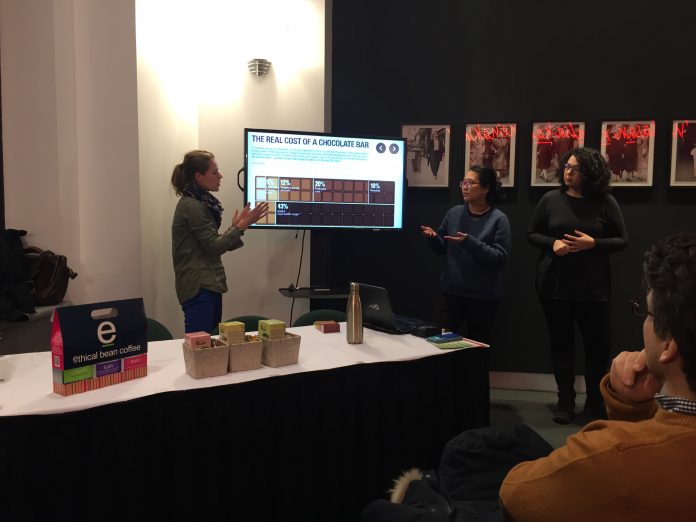
In order to further engage students on the topic of fair trade, students who were sponsored by SFU and the CFTN to visit some of the fair trade farms in Costa Rica last year led a conversation to discuss the future of fair trade at SFU Harbour Centre on Monday, March 6.

As The Peak previously reported, coffee, tea, and chocolate are some of the fair trade items that can be found on campus. The Starbucks franchise is one of the partnerships with fair trade on campus which provides fair trade espresso and one fair trade filter coffee, however, Tim Hortons at SFU has yet to provide a fair trade option.

Director of ancillary services at SFU, Mark McLaughlin, expressed at the fair trade event that SFU is currently working to change that, in the hopes of Tim Hortons providing at least one fair trade item such as sugar or coffee.

Students Sarah Heim, Prodpran Wangcherdchuwong, and Joana Bettocchi, who visited Costa Rica last year, presented some of their findings and conversations they had with some of the fair trade farmers while travelling the country for six days.

Wangcherdchuwong explained that fair trade “is not charity, they’re not saying, ‘Oh, you’re so poor, let’s give you money,’ but they are actually exchanging with them on a fair and equitable basis.”

Bettocchi added that fairly traded projects all have different standards, “but the movement is adapted to respond and assess those needs to make sure that in fact everyone is being treated equally.”

Heim explained from her analysis of the fair trade system that the process is very “democratic,” where each farm is not owned by a corporate company, but rather “farmers who own their land together and decide on where they’re money should go. . . they know best how to keep their land renewable and sustainable.”

Throughout the Teck Gallery at Harbor Centre, images from the students’ trip to Costa Rica expressed some of the positive aspects of buying fair trade products. Many images showcased families who are affected by fair trade and portrayed examples of farmers giving back to their communities.

The night ended with a discussion of the ways in which SFU could improve its fair trade initiatives on campus.

“So now we’re back,” said Wangcherdchuwong. “The reality is, what is a fair trade campus? That is something that we need to ask ourselves: what we are and what we can be” at SFU.

“All of the the dining services locations offered by SFU serve fair trade coffee, tea, and one chocolate bar option, if they have chocolate in that venue,” said Torrye McKenzie, fair trade programs coordinator for the CFTN. She added that the network is currently drafting new requirements for fair trade campuses, including silver and gold statuses which would include providing fair trade fruit and sugar at the silver level. “Fair trade cotton T-shirts at the bookstore and really engaging franchises such as Tim Hortons [and] Starbucks” would be at the gold level.

McLaughlin added that “we also need to ensure that we educate and mentor” students about fair trade to further ensure that students are making conscious decisions on the food and beverages they purchase on campus.

Nationally, McKenzie added that a new fair trade ambassador program is currently being developed with the CFTN and Association of Fair Trade which would “train anybody on the ground who’s interested in getting involved with fair trade in any capacity. . . anybody at any point in their life who is interested in getting involved.”

At SFU, McKenzie explained that SFU is also looking at sending students on another fair trade origins trip to Ecuador “where students can visit co-operatives for coffee, cocoa, etc. So if you are interested in travelling and getting a more enriched experience while you travel, it is definitely something to get involved with.”

While the night reminded the audience of the importance of understanding where their food comes from as part of a global movement, it also addressed that hired labourers for those who own fair trade farms may not be paid quite as fairly and equitably as the owners themselves. Sean McHugh, founder and executive director of the CFTN stated, however, that “there are new standards in place as a result of this criticism. . . It’s very challenging, a lot of these places are very remote, it’s a work in progress.”

Despite this pitfall Heim stated, “You can’t look at fair trade through a vacuum. If you look at fair trade next to conventional agriculture and our ways of buying and consuming, fair trade is one of the better options we have.”