Home Blog Page 757

Book of the Week: Half of a Yellow Sun by Chimamanda Ngozi Adichie

0

It is hard to know where to begin with this one. Chimamanda Ngozi Adichie is an extremely talented writer. She conveys the emotions and thoughts of each of her characters in a very real and relatable way; it is impossible to stop reading her stories once you get into them because you feel like you know the characters. Half of a Yellow Sun is a particularly good book that showcases her skills as a writer and the deep emotions she is capable of evoking. 

“Half of a Yellow Sun provides a deeply human perspective into the grey morality that often emerges during times of strife.”

Set primarily in Nsukka, Nigeria during the Nigeria-Biafra War (1967–70), the book follows several characters and tells multiple stories without becoming unwieldy. The primary characters are Olanna, a daughter of a well-connected man, who studied in England and lives with her boyfriend, Odenigbo, the university lecturer; Ugwu, the houseboy of Odenigbo; and Richard, a British man who came to Nigeria to write a book.

Half of a Yellow Sun is based on the real events of the war and while the characters are not real, they are based on real people. The book deals with themes of unity, division, nationalism, colonialism, love, genocide, war, and redemption. Not only does it provide an Igbo perspective on the Nigeria-Biafra War, but it provides a deeply human perspective into the grey morality that often emerges during times of strife. This book is for anyone interested in historical fiction and if you haven’t read a book by Chimamanda Ngozi Adichie, then I recommend you start here.

AHFOMAD is a festival with something for everyone to enjoy

0

The African Heritage Festival of Music and Dance, also known as AHFOMAD, is a festival featuring traditional, as well as contemporary, arts, music, and dance from cultures across the continent. Their vision is to create a sustainable platform for African-Canadian artists to exhibit their creations and grow in a progressive and productive multicultural environment. AHFOMAD presents their Spring Outreach Concert and Dance on Sunday, May 21 at the Metro Hall, 759 Carnarvon Street, New Westminster.

“The festival is not one-note by any means, and features all manners of art.”

The evening will include food for all palates, music, and dance. It will also feature one of Africa’s most successful musicians Alpha Yaya Diallo and his band Bafing. In addition, Afrobeats’ DJs — DJ Rossco and DJ Mario — will provide all-night dancing. Furthermore, Afro.ditie, an emerging local company that produces streetwear, will be showcasing their designs through an interactive fashion show.

The theme of Afro.ditie’s fashion show is “IAMAFRICAN” and their aim is to “give the opportunity to express the uniqueness of the individuals and not just the stereotypes.” After meeting with Afro.ditie to discuss their presence at the event, they shared with us their vision: “we plan on using our apparel as a platform to create space for creative expression for people of African descent.” Their fashion show will not only consist of models wearing Afro.ditie clothing, but will also include poetry, spoken word, songs, and interpretive dance. The festival is not one-note by any means, and features all manners of art.

Regardless of whether you’re attending AHFOMAD’s Spring Outreach Concert and Dance for great food, music, dance, or fashion, you’re bound to have a phenomenal time. This event aims to add the missing link and a touch of vibrancy to the arts presentation scene in British Columbia, as well as provide a space for artists of African heritage to celebrate their cultural identities.


There will be further celebrations taking place from August 25th-27th, for more information you can visit their website.

University: draining us financially since 1965 – Part Two

0

If you read The Peak’s article yesterday, you know that with bills stacking up, it can be hard to afford the necessities, let alone the fun stuff. While you may have heard of, or even use a lot of these methods, it’s still always good to try and get as much tuition money as possible.

Talk to a Financial Advisor
Did you know SFU has financial advisors? They can help you find out what kind of aid you are eligible for and provide you with different resources. Financial aid services are located at all three campuses, just check their website for location and hours.

Get a Student Loan
Student loans can be a bit messy, they are a loan after all. However, they can still be a great resource for students. These loans don’t start having interest until 6 months after you finish your degree. So, if you’re a student who can afford most if not all of their tuition just not in one lump payment, this may be the perfect way to get through the beginning of the semester. Head to your provincial government website to start the process.

Apply for Scholarships
Scholarships aren’t just for high-schoolers! There are tons of financial awards that are available to undergraduate (and graduate) students. Both SFU and the federal government has websites dedicated to helping students find different scholarships. You could also do some of your own research and find other scholarships you might be eligible for through organizations you’re apart of or because of the program you’re in.

Work a Part-Time Job
Maybe not the most lucrative option, but it has the added benefit of providing some work experience. Restaurants and stores are always a good option, if you don’t mind working weekends and holidays. Another option is to work on campus. Check out myInvolvement SFU for different on-campus opportunities. There are also SFU’s job postings that often have job opportunities open for students, too. You can also apply to the Student Temporary Pool and provide coverage for SFU employees. And, of course, you could always write for The Peak.

Look into Getting a Bursary
A cross between a scholarship and student loans, bursaries are awarded to students who demonstrate financial need. While you don’t have to pay them back, they are not guaranteed income. Still, it’s worth giving it a shot even if you’re only receive the money for one term. You can apply for bursaries through go.sfu.ca, but check the application timeline through SFU’s financial aid website first.

Apply for a Work -Study
This option is a lot like having a part-time job, but it’s run through SFU. Again, you must demonstrate financial need and can apply through go.sfu.ca, but check the application timeline first. Work-study hours are designed to work around your school schedule and all placements are on campus. The best part is that all hours show up on your co-curricular record: an official university document that shows different opportunities you took through SFU during your degree.

SFU union holds referendum on Israel boycott

1

This week, TAs and TMs at Simon Fraser University will weigh in on an issue that has a stake in a decades-old, bitter conflict.

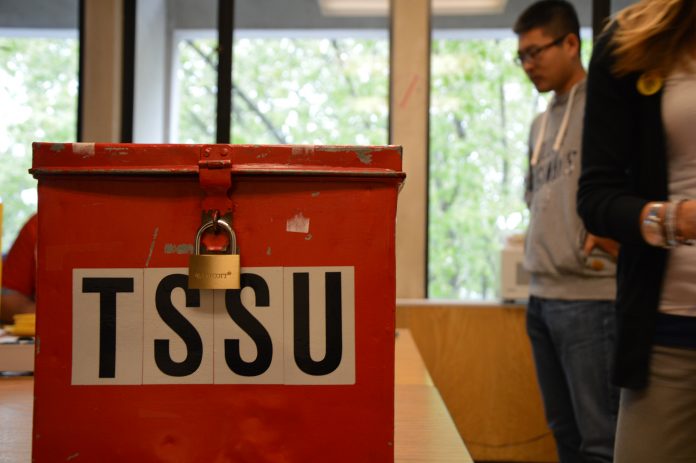
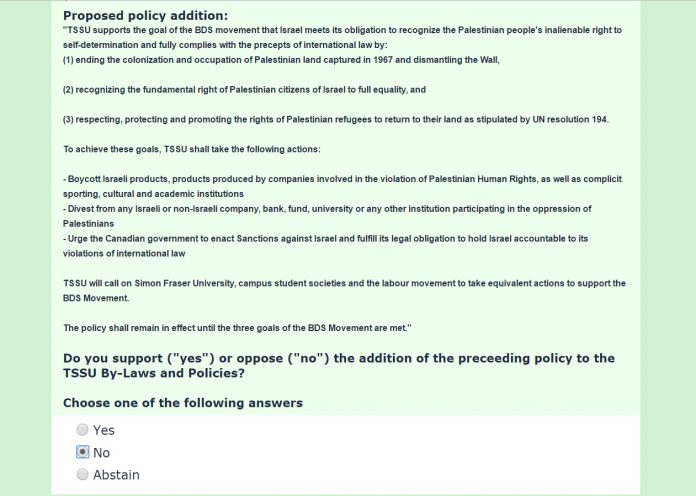
The Teaching Support Staff Union (TSSU) is holding a referendum May 15–19 on whether to adopt a policy to actively endorse and participate in the Boycott, Divestment, and Sanctions (BDS) movement against Israel. TSSU members will decide via electronic vote if the union will adopt a policy requiring it to support the movement.

BDS got its start in 2005 after Palestinian organizations called for nonviolent pressure on Israel in response to the occupation of Arab lands and discrimination against Palestinians.

The policy that the TSSU is proposing would boycott Israeli products, divest from Israeli companies and others that oppress Palestinians, recommend that sanctions are enacted against Israel by the Canadian government, and call on SFU and other campus associations to adopt these measures.

Late Monday night, an email was circulated to graduate students at SFU and advertised an open letter gathering signatures against the policy.

In recent years, tensions have risen in the Israel-Palestine conflict due in part to the progressive Israel settling of the Palestinian West Bank. Earlier this year, Israel legalized thousands of controversial settlements, citing that they were established without knowledge of existing claims to ownership.

The United Nations Secretary-General Antonio Guterres condemned the legislation as a “contravention of international law.”

In support of adopting the BDS policy, the TSSU explains on their website that they have “always been an internationally focused union” and have participated in many other campaigns that involve social justice.

They also clarify that the vote will only govern how the TSSU will interact with Israeli enterprises, and not apply to individual members.

In letters submitted by non-members and published on the TSSU website, critics of the policy draw attention to how BDS singles out Israel among many countries with poor human rights records. There have also been reports of violence committed against anti-BDS groups, although the identity of the perpetrators has not yet been determined.

It is unclear whether the vote taking place needs to have a certain number of participants for it to be held valid.

The TSSU is the latest organization in a long list that have grappled with the BDS movement. Earlier this year, UBC students voted to reject a similar motion put forward by their Alma Mater Society and McGill’s student society experienced a similar outcome last year.

Canada has also grappled with this movement at the federal level. In early 2016, parliament passed a motion to condemn the BDS movement as “demonization and delegitimization of the State of Israel,” although the UN does hold the Israeli settlements as illegal.

With files from Al Jazeera, BBC News, McGill Reporter, Metro News and The Globe and Mail.

UniverCity population expected to double

0
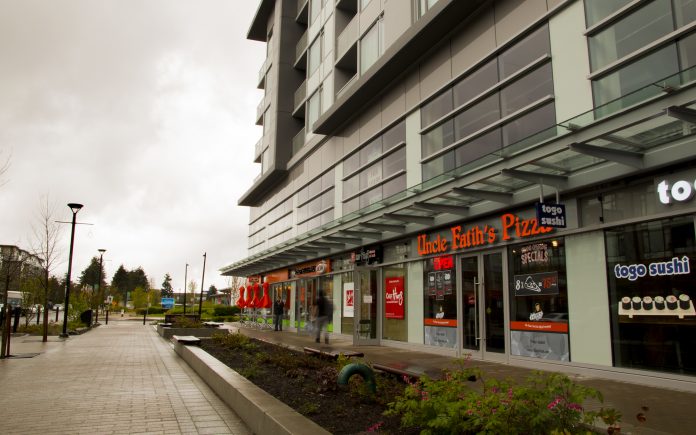
New restaurants have recently opened up in the community.

UniverCity, the community adjacent to Simon Fraser University’s Burnaby campus, is over halfway to being completed, according to the SFU Community Trust which oversees its development.

The community, boasting over 5,000 residents this year, has seen new businesses open up in recent weeks. It is forecast that the area will reach a population of up to 10,000 by 2021, based on the official community plan.

“As soon as you start having a significant number of full-time residents in the community, you have the numbers to generate business and business opportunities,” said Dale Mikkelsen, vice-president of development with the SFU Community Trust.

“You’re seeing more food services, which are very popular for students and for the community,” he continued. “What you will also hopefully see [in the future] is increasing community-based services.”

A $3.9 million expansion is planned for the University Highlands Elementary school, with construction on an additional eight classrooms scheduled for the coming months.

According to Mikkelsen, the trust is also in negotiations to open a medical centre on the mountain. They are exploring ways to increase the capacity of the community and the medical clinic would provide an opportunity for seniors’ housing, he said.

“At this point we’ve constructed all of the infrastructure [. . .] so we are at a point now where we’re really focused on delivering the remaining homes as well as the remaining elements of building a community and we expect all of it to be done by about 2021,” Mikkelsen explained.

The latest community survey showed that nearly half of the 5,000 residents have a direct connection to SFU either as faculty, staff, or students and families make up over one-third of the population. The trust has tried to accommodate the demographic and is considering establishing an additional daycare facility, said Mikkelsen.

“More services means more reasons to stay in the community,” he said.

The trust is also seeking to establish an affordable rental housing program in a year or two. The idea is geared towards graduate students at the university with children. “Our hope is that in the near future [we can] support people who are seeking affordable, larger rental units,” Mikkelsen noted.   

“Relatively speaking [. . .] we remain a reasonably affordable community in the Lower Mainland, that’s a big draw.”

According to Mikkelsen, the residents are looking forward to the potential for a gondola linking the Production Way-University skytrain station with the campus, a project now in the hands of Translink.

The trust is also seeking to increase the research connections between SFU and developments in the community in order to better integrate the neighbouring areas.  

“Over the next five years we do really hope to continue and increase our engagement with the student body,” Mikkelsen said. “And really start making stronger connections with Simon Fraser University so this isn’t a community that is just beside it.”

However, UniverCity still has many years of growth ahead.

“The ultimate vision for us is when the community is built out, we, as the master developer on behalf of Simon Fraser University, can walk away from the project and know [. . .] that this [became] a very satisfied community,” said Mikkelsen. “That they’re left with all the services that they need.”

TSSU motion is discriminatory and a threat to academic freedom

0

By: Rachel Altman, SFU Professor

During the week of May 15–19, the Teaching Support Staff Union (TSSU) will vote on whether to amend their bylaws to adopt Boycott, Divestment, and Sanctions (BDS) principles. You don’t need to understand the entire Israeli-Palestinian conflict to see that this proposed policy change flies in the face of SFU’s culture of anti-discrimination and academic freedom.

BDS principles are entirely one-sided, demanding the boycott of Israeli products and academic institutions and other sanctions until Israel makes significant, unilateral concessions to Palestinians. Neither Palestinians nor other players on the world stage are held accountable for determining a just solution to the conflict — or even recognizing Israel’s right to exist.

Currently, the TSSU bylaws address issues such as membership, elections, and strikes. They do not list concerns about any nation or group. If the referendum passes, Israel will therefore be the only entity in the world that the TSSU sees fit to condemn.

Is Israel deserving of criticism? Absolutely. Gaza and the West Bank form the intended future state of Palestine, yet Israel controlled the former from 1967 to 2005 and still controls much of the latter.  As a matter of human rights, Israel needs to prioritize the creation of a viable Palestinian state and Palestinians’ right to self-determination.

But is Israel the only nation deserving of criticism? Absolutely not. The Israeli-Palestinian territorial dispute is but one of over a hundred worldwide, and conflicts in Syria, Nigeria, Afghanistan, and elsewhere are far deadlier. Palestinians in Arab countries other than Jordan are denied citizenship and many basic rights. In contrast, Israel treats all of its citizens, about 21% of whom are Arabs, equally under federal law.

So why is the TSSU, whose mandate is principally to protect the rights of its members in their relationships with their employer, choosing to take one side in a foreign conflict that is by no means the most extreme in a world replete with injustice and unsettled land claims?

One possible answer is that BDS is a convenient, feel-good package. The solution to the Israeli-Palestinian conflict is laid out in just half a page of simple text, and the sole villain is clearly identified. How much simpler to adopt this viewpoint than to develop a nuanced understanding of a centuries-long, fearsomely complex conflict!

Although BDS targets Israel, not Jews, understanding the fundamental connection between Israel and Judaism is critical to understanding the impact of BDS on Jews. Specifically, almost every Jewish prayer contains a reference to Israel, and the language of Jewish Israelis (Hebrew) is the language of these prayers. The stories of the Tanakh (the Jewish Bible) are centred around Israel. Many Jews living around the world have family in Israel. It’s a place of refuge for Jews escaping persecution and hate crimes, crimes that, in Canada and elsewhere, are higher than for any other religious group.

Therefore, I, like most Jews, experience the selective targeting of Israel as personally threatening. And when SFU organizations support the BDS movement, a movement whose co-founder openly states that “we oppose a Jewish state in any part of Palestine” and whose leading proponent admits that “the real aim of BDS is to bring down the state of Israel,” I can’t stand silent.

President Andrew Petter wrote, “SFU is an institution whose strength is based on our shared commitments to diversity, equity, and inclusion.” Students at UBC, McGill, and Waterloo all recently voted down BDS referenda in the name of these values. Likewise, the list of SFU faculty and staff who have signed the open letter in opposition to the TSSU referendum is growing. If you are a TSSU member, I urge you to do likewise and VOTE ‘NO’ in the TSSU referendum.

The food and beverage closures show why you need to watch what you’re funding

0

Before I started writing for The Peak, I admittedly paid very little attention to student politics. When I voted for my preferred Simon Fraser Student Society (SFSS) candidates, I read their blurbs and made the decision without giving it too much thought. How much could my vote influence things at SFU? What difference would that make to my experience on Burnaby Mountain?

When the SFSS shuttered the food and beverage services (FBS) in April, I was suddenly struck with the realization that they can do a whole lot.

FBS, which includes the Highland Pub, on-campus catering services, and the Ladle, has long since been hemorrhaging money. Since 2008, the enterprise has lost over $800,000, so it’s natural that the decision was made to close it. How that decision was communicated and rolled out, however, makes me nervous that whatever underlying causes led to the huge deficits haven’t been addressed.

For example, when the SFSS made the announcement in early April, it wasn’t immediately clear that the staff that worked at FBS were notified in advance. Job-ending news isn’t exactly something you want to learn from reading a tweet or even a news article. So, it was pretty natural, then, that many FBS staff started calling in sick en masse.

Later that month, the molecular biology and biochemistry department was having their annual conference, which brought together researchers in the department to present their work. The plan was, like in previous years, to host the dinner social at the pub. However, since the SFSS bungled their announcement, the organizers had to scramble and make a backup plan last minute because they couldn’t count on the pub being open until its actual closure date.

What is particularly frustrating is that the SFSS has a history of doing good work with student money. The ubiquitous U-Pass, a venture between the SFSS, the Graduate Student Society, and Translink, saves students as much as $1,500 a year in transit costs. Students can also take advantage of the health and dental plan, which can sometimes be the only cost-effective way for students to access dental care. The SFSS also distributes student money to incredible organizations like the Women’s Centre and Out on Campus.

Then there are also signs that the SFSS needs to really focus on getting their act together, like with the Build SFU campaign that reneged on their promise for a new sports stadium and then reversed their decision again. But I digress.

I’m not trying to argue against the merit of closing FBS; I’m glad that something tangible was finally done about that huge waste of student money. But at the same time, it serves as a reminder that how the SFSS operates can actually change things on campus. Their annual budget is about $2.7 million, and with that kind of money comes complications and all sorts of mistakes.

As we pay that kind of money to students that are working on our behalf, we need to pay attention to their actions and make sure they step up to the plate.

Peak Speak: Which Summer Movies Are You Looking Forward to Watching?

0

On this week’s episode of Peak Speak, we ask students what movies they’re looking forward to watching this summer.

Guardians of the Galaxy Vol. 2 gives viewers more of what they want

0

By: Vincent Justin Mitra, Peak Associate

Guardians of the Galaxy Vol. 2 is the sequel to the quirky, nostalgic 2014 film, and is the latest theatrical instalment in the Marvel Cinematic Universe (MCU) media mega franchise. The film brings with it new and old characters, more vintage tunes, and is just as delightful as the first while also managing to be a tad heftier than expected.

“The film covers much of the same ground as the first, but does so in a larger way.”

Vol. 2 sees Peter Quill (Chris Pratt) settling into his role as the leader of his band of misfit heroes. The initially stiff and distant Gamora (Zoe Saldana) and the comically literal Drax (Dave Bautista) have each loosened up, while Rocket (Bradley Cooper) the abrasive science racoon has taken to enjoying Peter’s retro Earth music. The ever-adorable Baby Groot (Vin Diesel) continues being super adorable.

The film covers much of the same ground as the first, but does so in a larger way. The explosions are bigger and the space fights are livelier, but it also puts more time towards character development.

Just like the first movie, Vol. 2 centres on ideas of family, whether it is one by blood or one by choice. Throughout the film, each of the characters is given space to work through their tragic backstories in order to grow individually as characters and together as a team.

Even the villain is more fleshed out than the one from the previous movie, or even many other recent Marvel films. While the villain of the first film could be described as a stock angry warlord with a hammer, the villain of Vol. 2 is given a rather specific set of goals and desires and, even more impressively, a personality.

Like its predecessor, Vol. 2 is largely disconnected from the core MCU Avengers storyline. This is true not only of its location, but also from the timeline of the recent films, with Vol. 2 taking place only a few months after the previous Guardians movie. This means that, while it is the fifteenth MCU film overall, for viewers looking for a breather from the densely interwoven franchise plot, Vol. 2 could just as effectively be considered as the second film of a standalone series because of how indirectly it contributes to the larger MCU story.

Also, in a grander sense, this film is not positioned as well as the first. The first Guardians film came after the dark thriller that was Captain America: Winter Soldier which changed the landscape of the MCU. There the first Guardians film brought a contrast that was a welcome bit of levity to cheer people up. Vol. 2, however, arrives on the heels of Doctor Strange, a film which was pretty standard in terms of tone. This less pronounced contrast, combined with the slightly less goofy plot, means that Vol. 2 doesn’t surprise viewers in quite the same way as the first. But that’s fine.

Some films try to reinvent themselves with their sequels, often with little success. Vol. 2, however, gave me exactly what I was looking for when I walked into the theatre. Is it a dark and gritty conspiracy thriller like Winter Soldier? No. Is about evil space elves like Thor 2? Of course not. But it’s a barrel of fun and it’s got a lot of heart. It’s got jokes, ‘70s pop music, and Groot. It’s a Guardians of the Galaxy movie, and a damn good one.

University: draining us financially since 1965 part one

0

What would you do with $27,000?

I would probably travel, and put some of it away in a long-term savings account to help me with living expenses once I’m done my education just in case I’m not be able to find a job right away.

Wait, sorry, I got it backwards.

What would you do if you owed $27,000? According to a recent report by the Canadian University Survey Consortium, that’s the average amount Canadians owe on their student loans at the end of their degree.

This feature, borne of a real need to understand how students are expected to succeed despite incredible financial pressure, will take apart that huge number. It will also help figure out where we can cut corners and trim the fat to make sure we can get through our degrees without going bankrupt.


Lodging

Unless you’re planning on camping out in the woods near SFU, you’ll need some sort of lodging arrangement. But that foundational necessity isn’t trivial to find in this community.

As I reported on in 2016, renting in Vancouver is incredibly difficult and horrifyingly expensive. Average rent was $909 for a one-bedroom suite, and the vacancy rate is about 0.7%. According to the Rental Housing Index, which aggregates data across Canada, more than 54,000 units are needed to make up for the shortfall in the Lower Mainland alone.

Sure, you can find a roommate or some other sort of shared-rent situation, but that doesn’t come cheap either. Add other expenses like utilities, houseware, and laundry, and that number starts creeping up.

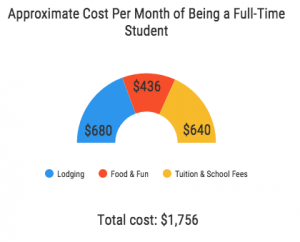
For our sake of argument, we’ll estimate our living-based expenses at $680 per month.


Food and other necessities

This issue is particularly close to my heart. I didn’t quite understand how expensive food was on campus until my editor asked last-year me to try eating on $5 a day for a week. You can count on one hand how many places would sell you some sort of food for that little money, and it’s likely so little food that you’d cannibalize your roommates within an hour of getting home.

Also, in our age group, we love to go out. We spend a lot of money on food and drink that we don’t strictly need, but is part of socializing and maintaining our mental health.

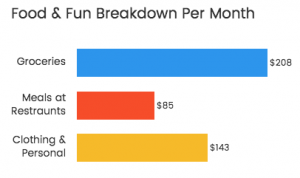
British Columbians spend a little more than the Canadian average for food, and the total per household comes out to about $9,200 per year. Of that, about $2,700 is from restaurants. We also need to buy clothes and other random things, which works out to $4,475 per household.

But since we don’t usually pool our food spending with a few other people, it’s more useful for us to think in terms of per person. I did some simple math and the numbers break down like this:


Tuition

The biggest sign of being a real university student: panicking every four months when we suddenly owe thousands of dollars to the university. For the average British Columbian university student, that cost is $5,534.

We sort of knew what we were signing up for, since university has never been advertised as the ‘budget’ option for post-secondary education.

As it stands right now, SFU charges $180.94 per credit for domestic students, and a mind-blowing $734.85 per credit for international students. For a degree (which is 120 credits), that means we’re looking at $21,712.80 for Canadian students and $88,182 for international students.

Jeez, that’s going to be an expensive piece of paper.

Tuition rates have also been on the rise; each year, the tuition cost itself and the compulsory fees we have to pay to the SFSS, SFU Rec, etc. increase by about 3% on average.

So, for a full-time student at SFU, their costs associated with attending university are something like $640 per month. A lot of our medical expenses are also wrapped up in this number thanks to the health plan that we get through the SFSS.


Bringing it all together

Being a university student is expensive. Vancouverites are uniquely hit by a three-pronged attack of expensive food, rent, and tuition. But by putting a number to our task of getting a degree, we can start to think about how we’re going to fund it, and just how much debt we’re going to be in afterwards. Costs vary across different programs, so be sure to check that these numbers apply to you.