Home Blog Page 756

Action group probes SFU data on animals in research

1

A campus action group seeking data on the number of animals used for teaching, research, and testing at Simon Fraser University is speaking out after being told that the university will not release any records.  

The Wild Salmon Creative Action group, under the umbrella of the Simon Fraser Public Interest Research Group (SFPIRG), sent the request to the University Animal Care Committee in March. However, earlier this month, the group received the university’s decision that it is not required under the provincial Freedom of Information Act to create a public record of the data.

“I wasn’t entirely surprised. I wasn’t expecting the [University Animal Care Committee] to just hand over their records to me, but I guess the part I was surprised about was that I didn’t get anything back, not even a redacted response,” said Mia Nissen, who submitted the request for Wild Salmon Creative Action.

‘Not required to create a record’

In the decision obtained by The Peak, the university said that the database contains some of the information that was requested, but the data columns also contain “additional information” and the information pertaining to the request “would need to be extracted and tabulated from the other data in that column.”

“As a result, creating a responsive record would unreasonably interfere with the operations of the University,” the decision read. “Accordingly, in the circumstances of this case, the University is not required to create a record.”

Nissen asked that the data on the total number of animals used in research be broken down by species, category of invasiveness, and purpose of use.

In a statement to The Peak, Chris Kennedy, director of SFU Animal Care Services, explained that “SFU does not keep aggregate totals of the numbers of animals used in research as it fluctuates based on individual research programs over time.”

When presented with this information, Nissen was shocked that the university does not keep such data.

“To me, that just seems wrong,” she said.  

Taking action

The request came as part of the work done by the Wild Salmon Creative Action group, whose basic principles include a dedication to “the liberation of all beings.” According to Nissen, a group at Dalhousie University in Halifax was recently able to obtain a portion of the records on animals used in research from their institution.

“I think SFU’s kind of been under the radar in terms of their animal research, and with other universities like Dalhousie releasing some records, I just thought, well, maybe it’s time for SFU to step up and have some transparency around this issue,” Nissen said.

Nissen’s concerns around the number of animals used for teaching, research, and testing are two-fold: both on the level of institutional transparency and animal suffering.

“From our standpoint, Wild Salmon Creative Action would like to see the practice [of animals used in research] discontinued 100%. While we see animals used in research as an ethical issue, there are also very strong scientific arguments against animal experiments,” she said.

For the action group, obtaining the data held by the university is the first step to understanding the scope of the practice and the different uses for animals in research. Due to the fact that research done on animals varies in its level of invasiveness, Nissen would like to learn “what tests are being done and on what levels and [find out if] all of these studies [are] really necessary.”

“We’d like to learn more and possibly challenge the university once we have a better picture of what’s being done to these animals,” she said.  

Strict guidelines

Kennedy confirmed to The Peak that the faculties at the university that use animals in research include health sciences, applied sciences, environment, arts and social sciences, and science. The types of animals used at the university include mice, rats, guinea pigs, finches, chickens, fish, and amphibians.

“The research programs associated with the faculties are wide-ranging, including immunology, genetics, behavioral, observational, medical, physiological, and wildlife studies among others,” he said.

When using animals in research, the university adheres to guidelines set out by the Canadian Council for Animal Care (CCAC) as well as university policies.

SFU does collect some data which must be reported to the CCAC. According to the latest report by the council, over 3.5 million animals were used in certified institutions for teaching, research, and testing purposes in 2015.

‘Contaminated data’

In the Freedom of Information request decision, the university noted that it did gather information on species, category of invasiveness, and purpose of use — though the latter employed different terms than the request by SFPIRG.

However, the data was mixed with other information and records were inaccessible prior to 2013 due to a technical problem.

“The database used by Animal Care Services is not set up to search and pull specific species data, category of invasiveness etc [sic] and would have required modification to the software as well as significant additional staff time and resources to do this,” Paul Hebbard, coordinator of Information and Privacy, told The Peak in a statement.

“Additionally, it’s important to point out that the database contains proprietary research information which is outside of and exempt from being publicly released,” Hebbard noted.

“I think the important point is that there is information that can be released to the public, but they’re saying data cannot be manipulated in that way,” Nissen said of the university’s decision. “There [must] be someone who can extract this data.”

Wild Salmon Creative Action has 30 days from receiving the decision to make an appeal, which the group is preparing to do, according to Nissen.


Album Reviews

0

By: Tiffany Chan, Eva Zhu, and Rita Ovis

Harry Styles by Harry Styles

Harry Styles is making a strong comeback with his self-titled, solo debut album. As a fan of the British vocalist, I was eager to hear the new tracks. Would the vibes be similar to those performed with One Direction? Will it contrast with and veer away from mainstream pop? It was, in fact, the latter, and I took an instantaneous liking to Harry Styles.

The album consists of slower-paced songs with up-tempos seasoned nicely throughout, primarily telling narratives of ‘the one that got away,’ a wistful feeling that will leave you contemplating your current situation or expressing admiration for a certain someone. This includes the emotional rock number “Sign of the Times” and ballads such as “Ever Since New York.” Styles notably takes on a more serious persona. That being said, the existing fans will be in for a pleasant surprise with his new sound. – TC


After Laughter by Paramore

After four incredibly long years, Paramore finally released their fifth studio album, After Laughter on May 12. Instead of the the pop-punk/alternative rock sound of their previous releases, this album has an ‘80s new wave and synthpop groove to it. It’s quite refreshing.

The lead single “Hard Times” is a boppy jam with catchy guitar riffs and unsuspecting pop hooks that are genre-bending. It follows the recipe of what Paramore does so well: a cheery melody accompanied by sad lyrics. The second single, “Told You So,” isn’t the most impressive track, but the simple repeated bridge will get stuck in your head quickly. The lyrical content on this album is also incredibly hard-hitting. Tracks such as “26” and “Fake Happy” speak of doomed love, and depression, respectively.

All in all, After Laughter is an extremely well-produced album that is definitely worth more than one listen. – EZ

Pleasure by Feist

Leaving fans yearning for more after the indie-rock masterpiece of Metals which came out in 2011, Leslie Feist has teased audiences with a six-year hiatus. She makes a successful comeback with Pleasure — which is truly a pleasure as it combines her soft jazzy roots with new indie rock influences. The title track “Pleasure” opens the album with pleasing harmonies, showcasing Feist’s unique, fluttery voice with jazzy and catchy instrumentals, setting the tone for the rest of the album.

Some songs on the album are more rock-inspired such as “Any Party” or “Century” which offer a quicker pace and are reminiscent of her previous album Metals. Other songs, such as my personal favourite, “I’m Not Running Away,” settle into slow, groovy, jazzy beats and elongated vocal melodies. These showcase a more mature, darker side of Feist’s musical range. Nonetheless, the listener is hooked into Leslie Feist’s mesmerizing voice through her earthy tones, enticing falsetto, and her ethereal harmonies. – RO

Firing of FBI director prompts calls for independent investigation

0

Just when you thought the contentious political climate surrounding our neighbours to the south could not get any worse, we find ourselves looking into another Trump scandal.

US President Donald J. Trump fired Federal Bureau of Investigation (FBI) director James Comey last week, citing the unfair treatment of then-secretary of state Hillary Clinton during an investigation into her private emails.  

However, the firing came just a month into the FBI investigation into Russian efforts to disrupt the presidential election, and possible ties between Trump associates and the Russian government.

Trump took to Twitter on May 10 to discuss the “loss of confidence” in Comey, who “[lost] the spirit and prestige of the FBI.

The scandal has added to calls for the need for an independent investigative counsel, separate from the state and free from punitive actions such as those taken against Comey.

Republican Senator John McCain agrees with these calls, according to The New York Times, claiming that he was “disappointed in the president’s decision” and it further encourages the idea “for a special congressional committee to investigate Russia’s interference in the 2016 election.”

As political pundits and concerned citizens alike voice their anxieties regarding the timing and reasoning of this firing, some worry that this impediment to the investigation is contributing to the threat to democracy in the United States.

Parallels to the Nixon Watergate scandal leave many wondering if Trump’s interference with an ongoing investigation is grounds for impeachment, as it erodes many of the checks and balances in place to prevent misuse of power. However, the president claims he and US Attorney General Jeff Sessions decided together to relinquish Comey of his duties.

Members of the US Senate are voicing their fears about this action, including the democratic vice chairman Mark Warner who said, in an interview with The New York Times, “that means the Senate intelligence investigation has to redouble its efforts, has to speed up its timeline, because we’ve got real questions about the rule of law.”

Barely a week after this firing, Trump’s decision is the subject of much scrutiny, leaving many wondering what this hindrance of the investigation means for Trump, and for the foundation of democracy in the United States.

With files from BBC News, Business Insider, and The New York Times.

New Music Friday

0
(Linda Shu / The Peak)

By: Edna Batengas, Sera Akdogan, and Neil MacAlister

“Sorry for Now” – Linkin Park

Sera Akdogan: Wow . . . is this really Linkin Park? This is pretty soft for the LP I used to know and love as an angsty teenager. Their new song sounds like sticky-sweet pop mixed with some weird EDM funk that I can’t quite relate to. Fifteen-year-old me would be disappointed with this sorry excuse for a comeback.

Edna Batengas: Really enjoyed this song, it was sweet and heartwarming. The EDM instrumental complements this track.

Neil MacAlister: There was a time when Linkin Park personified ridiculous, adolescent angst, and performative aggression. Now they’re making EDM pop. I never thought I’d say this, but I miss the old Linkin Park.


“Bad Liar” – Selena Gomez

SA: Why is Selena Gomez singing like she has a British accent? Does anybody else notice this? Aside from this minor annoyance, this is probably one of the worst new songs I’ve heard today. Even if Ms. Gomez could actually sing properly, I feel like this song would still fail.

EB: It’s very different to what we are typically used to hearing Selena sound like. Then again, Selena has gone through so much growth in her music career. It’s so mellow, yet at the same time extremely catchy. You go, girl!

NM: Wait, is this a Talking Heads sample? Does David Byrne know Selena Gomez is singing over “Psycho Killer?” Somehow, it actually works perfectly. This is one of the best Selena Gomez songs I’ve heard to date.


“Strip That Down” – Liam Payne, Quavo

SA: I like how this pulls you in right away. It has a catchy bass line and Liam Payne has a sexy voice. Not my style of music, but I think it would be a lot of fun dancing to at a club, after a round of cheap tequila shots. Disclaimer: this song might make you want to strip. You’ve been forewarned.

EB: Liam, Liam, Liam . . . One Direction was holding you back. Who would’ve known?! Loving this one, such a dance jam and also loving the new version of Liam Payne. He’s definitely talented. Looking forward to seeing what he comes up with next. Oh, and Quavo, always a pleasure. Bravo!

NM: If your single doesn’t have Quavo on it, did it really happen?


“Swish Swish” – Katy Perry, Nicki Minaj

SA: Katy Perry has lost it,in my opinion. This may have happened shortly after she created a song asking us if we ever felt like a plastic bag. I’m not sure if she’s running out of good songs to sing, or her voice has just lost its way. This sounds like one of those fast-paced repetitive songs they play in Urban Planet in order to get you to buy more. Sorry, Katy, even Nicki Minaj can’t help you out of this disaster.

EB: Am I the only one tired of Katy Perry? Never thought she had a great voice. Could’ve been a better song if she wasn’t singing it. And Nicki, what are you even doing on this track? You’re too good for this. Abandon ship, abandon ship.

NM: Katy Perry’s pathetic attempt at a diss track here is laughable, but Nicki Minaj is in full form for this. Katy doesn’t even need to be on here, this beat sounds tailor-made for Nicki.


“Dig Down” – Muse

SA: Muse needs to stop making music. Seriously. I knew it was Muse before Matt Bellamy even started singing and that’s not a good sign. Literally all of their songs sound the same and it’s killing me to listen to his dragged-out vocals for the nine-hundredth time.

EB: LOL. Sounds so futuristic and now that I think of it, it’s also kinda creepy. Hey, but maybe I just don’t appreciate alternative rock music? Disclaimer: I loved that one song from the Twilight soundtrack, “Supermassive Black Hole,” but this one not so much.

NM: There was a time in high school where I thought Muse’s nouveau-prog sound was the coolest thing ever, and while I’m really over their whole gimmick now, this actually isn’t bad. This could easily have been on The Resistance.


“Strong Swimmer” – Vistas

SA: This song really speaks to me because I, too, am not a strong swimmer. Also, I’m happy to finally listen to something that sounds like actual music I’m used to no autotune, synthesizers, or bass drops, just some good old-fashioned guitar, drums, and vocals. Reminds me of the Arkells a little bit because it’s really peppy and fun, in an indie-rock kind of way.

EB: This sounds like it belongs in a Disney movie soundtrack. Like the ones that your little sister or brother drags you to, makes you buy on Blu-ray, and, every Saturday night for as long as you live at your parents’ house, makes you watch over and over again. But that doesn’t mean it’s a bad thing. I mean, like who doesn’t love Disney?

NM: Wow, is this Ireland’s answer to the Vaccines? I’m into it. This is solid.


“OK” – Robin Schulz, James Blunt

SA: I’m not sure why I initially liked that one James Blunt song (“You’re Beautiful”) because I realize now that his voice is actually terrible. Not only that, but the electronic backdrop (courtesy of half-decent DJ Robin Schulz) showcases Blunt’s voice in an unflattering way. The collaboration just doesn’t sound right to me.

EB:  I actually feel that everything’s going to be OK once I mute this song.

NM: James Blunt sounds terrifying with his voice pitched up. Other than that, this is fine.


“No Love for the Wild” – HAERTS
SA:This song gives me Enya feels, mixed with a sprinkle of Weyes Blood. Strong female vocals, with a delightfully earthy synth-pop sound. I’m definitely going to check out more of HAERTS, and you should, too.

EB: Oooh, I’ve got chills now. There’s definitely an appropriate time and place for this song. Those sad, long transit commutes. Got me feelin’ some type of way.

NM: I feel like I’d like this song better if it had the slightest bit of variation in it.


“Switch” – Iggy Azalea, Anitta

SA: Oh no, Iggy is back? This makes me so mad because I honestly believe that she is a talentless, racist, phony individual. Besides her shady character, she will never be as good as Nicki Minaj in the female rap game. The song itself is awful; I mean, she’s singing about stop lights. Why is she still trying?

EB: Not even going to bother. BYE IGGY.

NM: Please, God, keep this woman out of my ears. This might be the weakest song in her atrocious discography.


“Nara” – Yaşar

SA: I only like this because I’m Turkish, but I wouldn’t actually listen to this at home I’m not that Turkish. Yaşar is a talented singer, though, and he makes me long for Istanbul. I’m curious as to what the other Peaksters will make of this one.

EB: I really wish I knew what he was saying. He sounds so passionate!

NM: I feel like I’m at the most lit European wedding ever.


“Coolverine” – Mogwai

SA: I really enjoyed this song, and I do like Mogwai. Sometimes a powerful instrumental speaks more than lyrical ballads do think This Will Destroy You or Explosions in the Sky. If you made it through the full 6:16 minutes without getting bored, I’m proud of you. You did a good thing today.

EB: I’m not sure why this is even on the list this week. And it was way too long.

NM: Digging the slow buildup, this has a really cool atmosphere and I love the way the drums come into it, but I think my favourite part of this song is the title.


“The Last Refugee” – Roger Waters

SA: I liked the old clip intro and how the song slowly consumes you as it goes on, like dramatic waves, pulling you in deeper and deeper with each chord progression. I’m a huge Pink Floyd fan, so it’s no surprise that I listened to this song and allowed myself to close my eyes, imagining that I was on a desolate beach somewhere, and not in the SFU library.  

EB: I literally almost dozed off right onto my keyboard. ‘Nuff said.

NM: Roger Waters is 73 and this sounds like an outtake off The Final Cut. He’s one of those singers who’ll never lose their voice. This is everything I’d expect from a Roger Waters song in 2017.

SFU football players drafted to CFL teams

0
Photo courtesy of SFU News

By: Alexander Kenny

When the Canadian Football League (CFL) draft rolled around earlier this month, the work of four SFU Clan football players came to fruition as they were selected to take the next big step in their football careers.

The Calgary Stampeders selected SFU running back Ante Milanovic-Litre 28th overall and offensive lineman Felix Gacusana 43rd overall. Justin Herdman, an outside linebacker, landed 54th overall with the Toronto Argonauts and middle linebacker Jordan Herdman was chosen 60th overall by the BC Lions.

Only two Clan players were drafted to CFL teams last year, up from one the year prior. Head coach of the SFU team Kelly Bates noted that these recent successes re-affirm the strengths and abilities of both his players and SFU’s football program as a whole.

SFU is the only Canadian university that participates in the National Collegiate Athletic Association (NCAA). Though the SFU team did not win a single game last season, Bates touted the level of competition within the NCAA’s second division as beneficial to his players.

“[Competing in the NCAA] probably gives you the least amount of jump to the next level,” he explained. “[It] brings validation to the fact that we are playing in a very tough conference, in a very tough division.”

Milanovic-Litre, who is bound for Calgary, said that the whole experience is still sinking in for him, with the abundance of training and camps that led up to draft day.

Despite struggling with injury for the first time, Milanovic-Litre was selected in the fourth round, and Bates believes strongly that he will get a solid opportunity to prove himself at the Stampeders training camp.

“His contribution in his first year, if he is able to make the roster, will be as a special teams player, he knows that, and that’s where he’s going to have to build the foundation of what he’ll be as a professional football player,” Bates said.

When asked about his plans for the start of the new journey, Milanovic-Litre said he will be taking a day-by-day approach as he gets ready to join the Calgary Stampeders training camp. He said that he intends to handle each new opportunity as it comes to him and to not get ahead of himself.

He also believes that having fellow Clan teammate Felix Gacusana with him at the Stampeders camp should help with the transition.

The talent doesn’t end there for SFU’s draftees, as Bates also noted that Jordan and Justin Herdman are high quality football players and that they “have an extremely good work ethic both on and off the field, [and,] to me, the fact their foot is in the door is all they need, and anything they do or accomplish in football will not surprise me.”

“[They are] students of the game, they’re very coachable. They have instinctual habits that you can’t coach,” Bates explained. He also stated that Felix Gacusana is “very gifted,” especially noting his skill, athleticism, and football IQ.

Milanovic-Litre credits his time at SFU with allowing him to grow on and off the field. The experiences also extended to his handling of adversity during the time he spent injured. These are lessons that Milanovic-Litre hopes to put to good use, in the case that injury should reappear in his pro career.

The draft of the latest quartet of players brings the number of SFU footballers drafted to the CFL since 1985 to 97 in total.

The rise of Emmanuel Macron in the French presidential elections

0

The 2017 French general elections saw the defeat of the two major parties of France and the emergence of two new personalities.

On the one hand was the pro-European, centrist, former investment banker who had never held elected office before — Emmanuel Macron. His contender was the far right, anti-establishment, anti-globalization, and anti-EU candidate Marine Le Pen.

Post-Brexit and in the midst of the growing anti-globalization wave that had started to spread across Europe, the election was being viewed as a decider for the future of the European Union.

On May 7, French citizens went to the polls to cast their votes in the second round of the presidential election, overwhelmingly electing Macron to lead the country. He was sworn into office on May 14.

One of the primary reasons for the emergence of non-establishment candidates Macron and Le Pen was the significant anti-incumbency factor, wherein incumbent President François Hollande had a mere 4% approval rating, and the presidential candidate of his Socialist party received only 6.35% of the vote. The last time the left party witnessed such a poor performance was in 1969.

With the decline of the left, the centre-right wing parties were the favourites to win, evidenced by the initial popularity of François Fillon, a former prime minister. This was before “Penelopegate” — allegations that his wife and children were paid with public money for non-legitimate parliamentary work.

The political vacuum left by the established parties on the left/centre was captured by Macron, and the right gravitated towards Le Pen. In the first round, Macron just had a 2.7% lead over Le Pen. Interestingly, in the head-to-head contest of the second round, Macron received 66.1% of the vote and Le Pen 33.9%.

Part of the reason for his win was luck — the initial front-runner was brought down by a scandal and the lack of support for the Socialist front-runner. Macron’s political acumen also did wonders for him. He didn’t seek a ticket from the Socialists, instead he chose to replicate the emerging European movements like Spain’s Podemos and Italy’s Five-Star Movement.

Additionally, Macron’s strategy was primarily grassroots campaigning, like Obama’s 2008 campaign. He held massive rallies like the ‘Grande Marche’ and reportedly carried out 25,000 in-depth interviews of potential voters across the country, apart from knocking on 300,000 doors.

Lastly, the French voters seem to have gravitated towards Macron’s positive messaging over Le Pen’s anti-immigration, anti-EU attitude. Le Pen was also bogged down by her having to shed the baggage from the previous avatar of the National Front under her father. She failed to re-construct the party’s image to the required extent.

As for global implications of Macron’s win, Brexit comes to the fore. He has ruled out a “hard” Brexit and advocated for strengthening the EU. It can also be argued that his victory has made Theresa May’s stance weaker in the upcoming Brexit negotiations, due to the resurgence of a pro-EU Franco-German nexus acting as a counterweight.

With files from BBC News, CNBC, The Economist, and The New York Times.

SFU professor wins $100,000 for innovative mathematics program

0
Photo courtesy of Peter Liljedahl

By: Aliocha Perriard-Abdoh

SFU professor Peter Liljedahl was awarded the $100,000 Cmolik Prize last month by the faculty of education for a revolutionary new approach to mathematics education. The Cmolik Prize for the Enhancement of Public Education in BC is awarded biennially to individuals whose work focuses on innovations in public schools in the province.

After 10 years of research, Liljedahl is being recognized for his work in the classroom. His Building Thinking Classrooms program has sought to implement problem-solving exercises in mathematics classes.

“Since the project has culminated to the Building Thinking Classroom[s] framework, it has been enacted in every single type of class in school,” he said.

Liljedahl first noticed a need for a new approach to mathematics following his experiences in K–12 classrooms. “I was observing two sorts of troubling things: one was that students were spending the majority of their time not thinking — not thinking in critical, creative, thoughtful ways. It was more automatic work that they were doing,” he explained.

“The second thing that I observed is that teachers were planning their teaching on the assumption that students couldn’t or wouldn’t think. So from that was born this issue, this project to try and find ways to help teachers initiate thinking.”

According to professor Liljedahl, these classrooms stand out. “If you’re walking down a hallway and you walk past one of these classrooms it would catch your attention,” he said.

What is so extraordinary of a ‘thinking’ classroom compared to the traditional classroom? Is it that students are no longer sitting at their desks in neat rows? That students are no longer just taking notes as the teacher gives simplistic instructions to guide the students through the course content?

The main difference is that the students are all standing up and working on whiteboards. They are talking amongst each other so the classrooms are significantly louder and more lively as the level of interaction between the students increases, according to professor Liljedahl.

The amount of direct instruction by the teacher decreases and students begin their own problem-solving almost instantaneously, he continued.

The program is in action here in BC, as well as in Alberta, Manitoba, and Ontario, and ranges as far as Australia, Sweden, and Chile. Professor Liljedahl has his sights set even further.

“The nice thing about [receiving] the award is that I think it might get the word out and get even more impact happening and more spread,” he concluded.

SFU students score top prize at Oxford Global Challenge

0
Photo courtesy of the Oxford Global Challenge

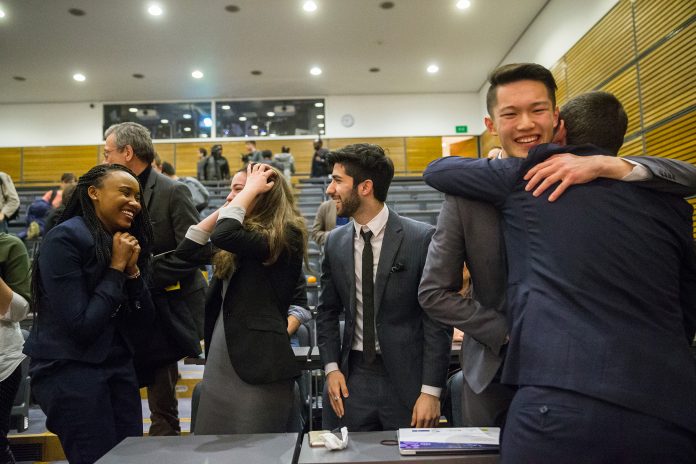
A team of SFU undergraduate students earned first place at the Oxford Global Challenge, an international social innovation competition, earlier this month for their research on reducing medical waste.

The trio — science students Iman Baharmand and Alec Yu, and business student Kimberley Venn — beat out 14 other teams from around the world.

“The experience at the international championships was very encouraging,” said Baharmand, who is in third year biological sciences. “We met individuals from around the world who had passionately devoted time to researching a problem that had impacted their communities.”

The students took home a prize of over $5,000 and tickets to two global conferences from the championship held in Oxford in the United Kingdom on April 30 and May 1.

“Winning first place was so much more than just a prize or a placement for us,” Venn, a second year business student, noted. “[A]s it truly represented the hard-work and dedication that so many members of the SFU community and the healthcare community put into our project.”

The trio was already friends prior to deciding to join together to tackle the project.

“Our team formed through an interest about the research focus and because the problem of medical waste is very interdisciplinary we were each able to apply new perspectives to the project,” Baharmand explained.

The team noticed that the vast majority of medical waste produced is non-hazardous and due to hospital overstocking and excessive packaging. They felt compelled to address the issue.

“Our research dug into the roots of these issues and discovered why they were so persistent,” said Yu, a third-year student in biomedical physiology. “We also mapped the current landscape of private and non-profit solutions to this problem, both nationally and internationally, illustrating their strengths and gaps while laying a path for effective new interventions.”

The team achieved the opportunity to represent Canada at the international competition after excelling at the national finals held in Calgary in March. They were encouraged to enter the competition thanks to RADIUS, a Beedie School of Business social change lab. According to Yu, the trio was intrigued by the Global Challenge because, rather than focus on the implementation of a business plan, it offered a rare chance to explore the issue in depth.

“We felt this approach to be especially productive, particularly in the healthcare landscape, as each problem tends to be exceedingly complex with no straightforward cure,” he noted. 

Baharmand, Venn, and Yu are looking forward to expanding their research in the future and conducting more studies on the amount of waste produced in the hospital setting.

“In the process of doing field research for this project, we were overwhelmed by the amount of support we received from the healthcare community here in BC,” Yu said. “We hope to […] change public opinion on medical waste, and perhaps even develop interventions with the help of partner physicians.”

Album Reviews

0

Everybody by Logic

Review by Neil MacAlister

With Everybody, Logic outshines the corniness and repetitiveness that plagued his last two projects by playing to his biggest strength: his ambitious, cinematic approach to album-crafting. Everybody tells the story of a man who is chosen by God to be reincarnated until he’s lived the life of every human being.

Through the perspective of 12 of these reincarnations, Logic addresses ideas of race, sexuality, suicide, and, ultimately, the utopian ideals of equality and understanding. The guest features are incredible (especially Killer Mike’s aggressive sermon and J. Cole’s uncredited outro), and the production is some of his best to date. But Logic’s variety of complex flows and impressive writing are the highlights.

His experiences of being biracial and dealing with his conflicting ancestries provide some of the album’s most emotional moments, and he uses both personal and imagined experiences to craft a powerful, inspirational project. Everybody’s ambitiousness tends to get away from itself, but fans who return to Logic for his quality of writing will find a lot to appreciate.


Just Like the Movies by Kami

Review by Neil MacAlister

Chicago’s SaveMoney is one of rap’s brightest collectives. They are a group of rappers, singers, and producers, (helmed by unofficial leader Chance the Rapper), who are establishing a unique brand of jazz-influenced, neo-soul hip hop.

Artists like Chance, Vic Mensa, Joey Purp, and Towkio have grown to much-deserved acclaim in recent years, but the latest SaveMoney release comes from one of its lesser-known artists: Kami. Though he started attracting attention as half of Leather Corduroys (with Joey Purp), he’s gone off on his own to craft an exciting project that injects elements of ‘80s pop and rock into hip-hop. The phrase “just like the movies” is repeated like a mantra throughout the album, as Kami portrays the world through a cinephile’s eye.

Kami draws inspiration from Kubrick, Tarantino, and John Hughes, mixing cinematic songwriting with synth-laden, ‘80s-inspired neon production from Knox Fortune. Multiple members of the SaveMoney crew have standout features on Just Like the Movies, which is the latest innovative album to join the ranks of Chicago’s remarkable discography.


Satan’s Graffiti or God’s Art? by Black Lips

Review by Andrea Renney

Atlanta’s bad kids, Black Lips, reinvent their garage rock ‘n’ roll sound with their eighth studio album, Satan’s Graffiti or God’s Art?, released May 5 on Vice Records. Produced by Sean Ono Lennon, Satan’s Graffiti or God’s Art? marks a shift in the band’s nearly 18-year-long career. With two new members comes a new sound that’s more chilled-out and full of swagger and saxophone. The individual tracks’ instrumentals and themes all seem to follow a similar concept, and the tracklist even includes an overture, interludes, and a finale.

Genres the band has always cited as influences are explored more blatantly: “Crystal Night” and “Wayne” evoke memories of ‘50s doo-wop, and “The Last Cul de Sac” and “Rebel Intuition” are throwbacks to when country music was taken seriously. Overall, Satan’s Graffiti or God’s Art? alternates between dreamy psychedelia and distorted nightmare. These are the types of tracks that give you something new with each listen.


Mass Effect: Andromeda is a promising, but not perfect, sequel to a beloved series

0
Mass Effect Andromeda attempts to recreate the rich, alien experience of the initial trilogy.

If you had the chance to start over in an entirely new galaxy, would you make the most of it? Or would you make the same mistakes you made before? For Mass Effect: Andromeda, the answer is a bit of both.

Coming out five years after the conclusion of the original Mass Effect trilogy, which saw fans fall in love with Commander Shepard and their universe, Andromeda follows the Ryder twins on their adventure out of the Milky Way galaxy and into the titular Andromeda galaxy. There, the player gets the experience of the “Pathfinder,” the new protagonist of Mass Effect, who tries to settle a new home.

“The game hits a few unfortunately repetitive notes that make this new galaxy feel a little less new than it should.”

Just like the previous games, you have the option to choose to be either male or female with consequently appropriate gameplay. However, unlike the previous games, the character you don’t choose still exists in the game. The Ryder twins — Sara and Scott — are fraternal and whichever twin you don’t choose falls into a coma early in the game and is tied into the story, which is a fun twist by developer Bioware.

The Pathfinder and their team left the Milky Way before the conclusion of the events of the original trilogy, giving Bioware a pretty neat loophole to continue the story after effectively closing any future to those games with its controversial Mass Effect 3 ending. You begin the game by crashing into one of the potential new homes in the Andromeda galaxy, and you quickly learn that the one-way trip to spread out across the stars won’t be as easy as the original mission intended.

While there are dozens of hours’ worth of gameplay that are both fun and challenging, the game hits a few unfortunately repetitive notes that make this new galaxy feel a little less new than it should. For one, the game only really introduces two new species of alien to interact with, after giving us such a rich diversity in the original trilogy with around 20 to meet and about which to learn. Speaking of those 20, only the Asari, Turians, Salarians, and Krogan join you on your mission to Andromeda, leaving out the rich, fan-favourite species like the Elcor, Drell, and Quarians, to name a few. The lack of diversity here is certainly a letdown.  

It also feels like a re-tread to have an ancient species’ looming technology (the Remnant) be such an important plot device after that exact story took place with the Proteans. Andromeda at times feels very similar to the original Mass Effect, which leads me to hope there will be at least one sequel. At the very least, it could have a better payoff for many of the moral decisions I agonized over that had little to no effect in the long run. Those moral decisions are part of the core of the Mass Effect series, so to see weight lifted from them is puzzling at best, and a disappointment at worst.

For those critiques, though, the game is definitely addicting and very fun. While it doesn’t justify its $90 price tag for the deluxe version, if you can score it on sale in the coming months, it will definitely be worth your time. The game can hit the high thrills of the original trilogy, it just has a few more valleys than it should. The story in the Andromeda galaxy isn’t finished yet, and while Mass Effect: Andromeda isn’t the most graceful first step, it isn’t stumbling either.