Home Blog Page 655

World News Beats

0
By: Nathaniel Tok, Peak Associate 


The other royal wedding

During an interview with Romanian news platform Digi 24 TV, Nicholas Medforth-Mills, the grandson of Romania’s King Michael, affirmed that he will be marrying PR consultant Alina-Maria Binder. The ceremony will be held in an Orthodox church in Sinaia, the late King Michael’s hometown, on September 30. Medforth-Mills is a well-liked Romanian royal, attributed to his friendly nature. Binder first appeared with Medforth-Mills at King Michael’s funeral last year.

With files from AP News.


Chinese co-pilot survives being sucked out of plane during flight

A Chinese co-pilot for Sichuan Airlines was nearly sucked out of the plane after the windscreen blew out mid-flight. The windscreen of the Airbus A319 cracked and blew out without warning while the plane was cruising at about 32,000ft in the air; the plane rapidly descended to roughly 24,000ft. Windscreen cracks are relatively common, although the loss of the entire screen is not.

     While the co-pilot was saved by his seatbelt and dragged back into the cockpit, they sustained a sprained wrist and some cuts on the face. Captain Liu Chaunjing, the pilot who pulled his co-pilot back into the cockpit, made an emergency landing at Chengdu, and all 119 passengers were unscathed. For this accomplishment, Chuanjiang was commended as a #ChinaHeroPilot on social media.

With files from BBC News.


Texas high school shooting

10 people were killed in a shooting at Santa Fe High School near Houston, and 10 others were wounded. Various explosives were also found in the area, including pressure-cooker bombs like those detonated in the Boston Marathon attack. A 17-year-old male, believed to be a Santa Fe student, has been detained as a suspect by police. He has been charged with capital murder and aggravated assault. During the shooting, a substitute teacher activated a fire alarm in an effort to warn and evacuate the school after seeing the gunman. Students were able to meet their parents at another location after being evacuated from the school.

With files from CBS News.


Mark Zuckerberg apologizes to the European Parliament

Facebook founder Mark Zuckerberg apologized to the European Parliament for the harm caused by a failure to secure users’ data, as well as a failure to prevent the spread of fake news. His livestreamed testimony in Brussels was part of an apology tour following the reveal of Facebook’s role in the Cambridge Analytica scandal. Zuckerberg was invited by the European Parliament after Facebook said that 87 million users may have had their data used by Cambridge Analytica. Zuckerberg is due to meet with French President Emmanuel Macron as well.

With files from Global News.


Album Reviews

0

By: Youeal Abera and Eva Zhu

Joyride by Tinashe

Tinashe is a rare artist. As her ability to produce music is self-taught, Tinashe has been able to make music that pushes the traditional outlines of R&B. With Joyride, she does just this.

     The album opens with “Keep Your Eyes on the Road,” a track that asks her listeners to prepare for a unique auditory experience. As the album progresses, it subjects listeners to an array of sounds and narratives. For instance, on the Offset-assisted track “No Drama,” Tinashe shakes off the vexing confines her critics place on her music, ensuring for her listeners that her music is sonically controlled by her and her alone.

     “Me So Bad,” featuring Ty Dolla Sign and French Montana, is an Afrocentric banger that shows Tinashe trying — and succeeding at — an island-inspired song fit for any summer playlist. Further, “Stuck With Me” (featuring the Swedish band, Little Dragon), provides a low-key, melodic earworm, mostly due to its infectious chorus.

     Although Tinashe’s still residing in the beginning stages of her musical career, her catalogue shows that she possesses and prioritizes a strong sense of penmanship and distinctive artistry. As evidenced by Joyride, she seems to be on the right track. – YA

Tell Me How You Really Feel by Courtney Barnett

Courtney Barnett isn’t the hero we asked for, but she’s the hero we need. An incredible left-handed guitar player and vocalist, Barnett’s second solo studio album, Tell Me How You Really Feel, is a near-perfect blend of indie and alternative rock.

     Compared to her last LP, Sometimes I Sit and Think, and Sometimes I Just Sit, Barnett seems to have figured out the formula to perfecting her craft. Each song transitions so effortlessly into the next for a head-bopping, chair-dancing listening experience. However, the punk track “I’m Not Your Mother, I’m Not Your Bitch” was out of place on such a mellow album; it felt like an unnecessary punch to the face.

     Standouts that I would blast for an eternity are “Need A Little Time,” “Nameless,” “Faceless,” and “Walking On Eggshells.” Overall, if you’re ever bored, check out Barnett: you definitely won’t regret it. – EZ

Board Shorts

1
Irene Lo / The Peak

Board decides on process to decide new name for SUB

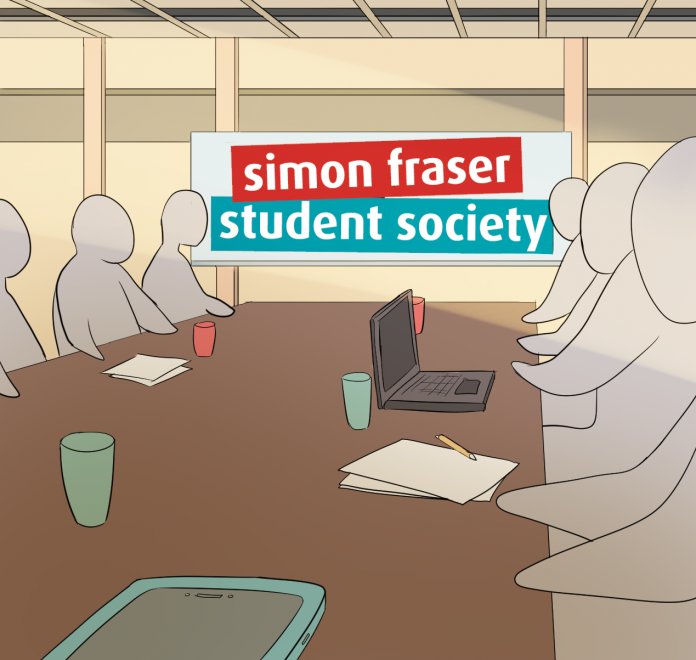
At the Simon Fraser Student Society (SFSS) Board of Directors meeting held on May 25, SFSS communications coordinator Sindhu Dharmarajah presented the Board with the idea of renaming the Student Union Building (SUB) set to open in fall 2018.

     “Right now [the name is] not really creative, it’s boring,” said Dharmarajah. “And it’s inaccurate, because we want something that goes beyond just the union and something that reflects all student groups on campus, general membership, and something that reflects our membership statement.”

     She went on to outline a set of guidelines for a suitable new name for the SUB — that the new name should encompass a sense of community and the student experience, and “it should not be named after a person.”

     The Board was presented with various options regarding different combinations of which groups — from Board staff, an SFSS sub committee, or the general student population — should be entrusted with suggesting potential names, creating a shortlist of names from the suggestions, and making the final decision on the new name.

     The Board ultimately voted on a process which would involve all SFU students being given the opportunity to suggest names, a Board subcommittee responsible for shortlisting the suggestions to a list of suitable candidates, and all SFU students participating in a final vote for the new name.

     “I feel like, with the shortlisting, that’s enough for Board approval,” said vice-president finance Matthew Chow during the discussion that preceded the vote. “So it would be nice for the students to say, ‘I decided on this name together, as a majority.’” The shortlisting process was deemed necessary to avoid what environment representative Russell Dunsford called a “Boaty McBoatface situation.”

     The process of selecting a new name was slated to begin the following week.


Board discusses university’s proposal to change parking fees and tickets

After meeting with the Sustainable Mobility Advisory Committee (SMAC) as a student representative, vice-president external relations Jasdeep Gill communicated to the SFSS Board the university’s proposal to increase parking fees and tickets on campus. The proposed changes would increase parking fines from $30 to $50, the hourly rates in some parking lots from a minimum of $3.50 to a minimum of $5.00, and the daily rate from $13 to $25.

     As reported by Gill, the justification for these proposals was because Burnaby campus was experiencing an increase in traffic, which was partly attributed to the Port Mann bridge no longer having a toll. The increase in parking fees and tickets are aimed to encourage high turnover — to get more students to leave the campus faster, and to make more parking spots available. “Myself and another student obviously raised the concern that this would be working counterintuitive to student engagement because students would have to spend more money to be up here, so they’d be leaving faster or deciding not to come on days that they maybe want to,” said Gill.

     Business representative Jessica Nguyen echoed Gill’s sentiments, saying “I think raising the price on the idea of trying to push people off the campus is exactly the opposite of what we’re trying to do.” Vice-president university relations Jackson Freedman drew parallels between this situation and the MECS catering at SFU: “I think this is similar to the catering issue. I think SFU outsources their parking to another external company, Concord, and they’re gonna have probably a lot of influence in pushing this decision based on the profit margin increase they’re going to get from this so I think it’s going to definitely be a difficult negotiation or a difficult advocacy initiative.

     “But just hearing from other students on the impact this can have, especially the student engagement point, I think it’s definitely worthwhile to get some sort of advocacy together,” Freedman added. He proposed the idea of a parking survey that would allow SFU students to provide feedback on the proposed changes, which the SFSS could then present to the university.

     The next SMAC meeting to get these changes approved the university will be held in two months. The Board reached a consensus to take on this issue as one of their initiatives moving forward.


At the Orpheum

0
Photo courtesy of Michael Thoeny

By: Hannah Davis

Ambience: A

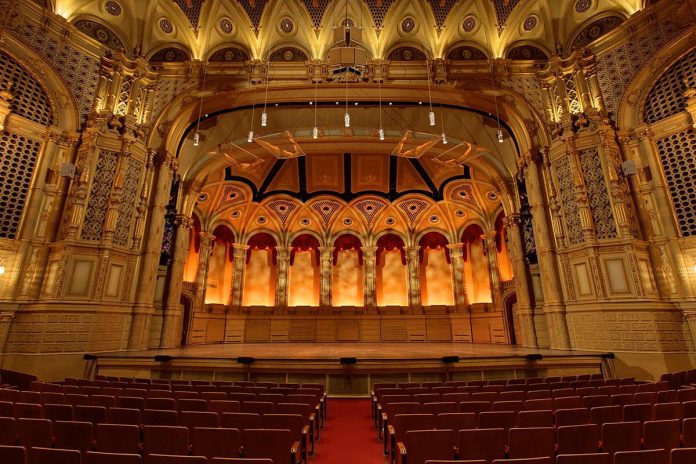
The Orpheum was built in 1927, and it shows; the venue has character that seems to hint at the history the building holds. I have been to more than one show at the Orpheum, and it is one of my favourite venues, simply due to its ghostly and antique aesthetic. The architect seems to have had a penchant for staircases, archways, and semi-hidden hallways, which give the theatre a somewhat haunted vibe.

     My mum, sister, and I are here at the Orpheum for the X Ambassadors concert. We arrive when the PA system warns us that the show will start in 10 minutes. Though I want to hang around in the lobby a little longer to stare at the walls covered entirely in mirrors, the swirling crown moulding, and the once-luxurious red carpet, we need to hurry to our seats.

     On our way into the theatre, we stop by the bar, where we purchase drinks and a Kit Kat to share. We also pass a booth selling X Ambassador water bottles. We learn that the band’s piano player, Casey Harris, is blind, and so the band partnered with the Canadian National Institute for the Blind (CNIB) to raise money for the organization. The proceeds of each bottle sold will go to the CNIB.

Accessibility: C

The Orpheum seems challenging, and perhaps even impossible, for someone in a wheelchair to try to navigate. I am unsuccessful in spotting a reduced-mobility entrance or an elevator, but after doing some online sleuthing, I discover that there is a wheelchair entrance off of Smithe Street, along with an elevator. I am unsure if this elevator reaches all of the floors that there are to explore. There is also wheelchair seating inside the theatre, and a wheelchair-accessible washroom on the main floor. There is both a women’s, men’s, and trans-friendly washroom, indicated by a printed sign taped to the door.

Music: A

The show begins with SHAED, a trio who performs their own alternative-electronic pop songs. They have adorned their performance space with a small pink neon sign reading “SHAED,” which helps me remember their name.

     The second opening act is London-based Jacob Banks. His voice is rich and stirring, and his music is moving and full. The bass is so low that I feel it resonate in my chest. I had to download a couple of his albums to my phone.

     The X Ambassadors come on stage after a brief intermission, and the crowd erupts. I am impressed at lead singer Sam Harris’s range, and Casey’s sheer skill on the keys. They play my favourite song, “Joyful,” and I watch a couple who are seemingly so moved by the music that they dance together in the aisle.

      Their performances are periodically punctuated by touching speeches from Sam, acknowledging the injustices people face each day for simply being themselves, and encouraging all of us to support and accept each other.

Other things you can see at the Orpheum:

  • A 1921 film projector, located on a sort of balcony on one of the upper floors.
  • Ornate gold carvings inlaid in the walls.
  • Borderline spooky photographs from some of the earlier events held at the Orpheum.
  • Multiple balconies to peer into the crowds on the main floor.

Overall: A-

I am giving this venue an A- for its history, antique beauty, spooky vibes, and for introducing me to some great new musicians.

ChangeSFU protests against government bailout of Kinder Morgan pipeline

1
(Photo Courtesy of ChangeSFU)
By: Srijani Datta, Assistant News Editor


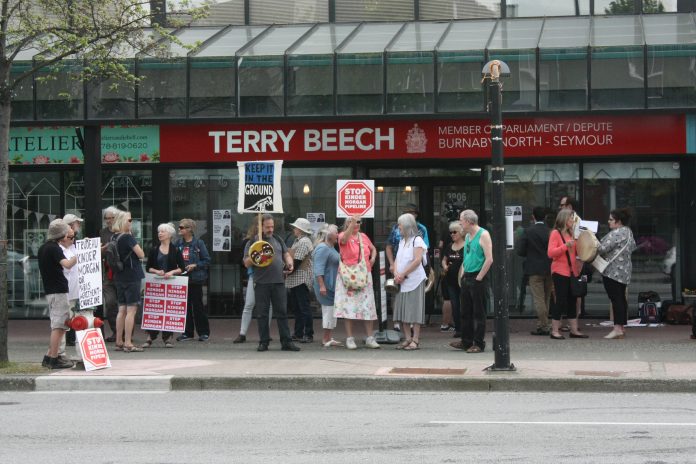
On May 8, SFU’s student-run environmental activism group, ChangeSFU, organized a casserole rally at the constituency office of Terry Beech — the MP for Burnaby North-Seymour — to demonstrate opposition to a Kinder Morgan bailout. The post on their Facebook page read, “Come with your signs, pots and pans and we’ll make sure they hear us from Ottawa!”

    The latest development in the Kinder Morgan pipeline issue is the attempt of the Trudeau-led Liberals to bailout the company with $10 billion of taxpayer money. The amount, when broken down, would cost each taxpayer approximately $405. In early April 2018, Kinder Morgan halted all “non-essential construction and related spending” in BC due to increasing opposition against the project. If the situation does not improve by May 31, talks of completely stopping all work in BC have begun. The purpose of ChangeSFU’s rally was to demonstrate opposition in response to the federal government’s announcement to provide financial security to Kinder Morgan.

    Maitland Waddell and Aaron Siebenga, both undergraduate students at SFU and the key organizers of the rally as members of ChangeSFU, discussed the popular concerns, sentiments, and goals behind the protest via an email interview with The Peak.  

    Waddell wrote to The Peak, “The aim behind the event was to make it clear to Liberal MPs that there will be real political consequences to the Liberal’s decision to spend massive amounts of taxpayer money on a pipeline that runs roughshod over Canadian Indigenous rights, the democratic process, and the spirit of the Paris agreement. [. . .] We hoped to communicate the message — loud and clear — that if the Liberals decide to move forward with the KM pipeline, Terry Beech will not be winning his next election.”

    The protest was strategically hosted outside of Terry Beech’s office. Siebenga explained that the motive was to make Beech hear the discontent of his constituents and hopefully bring it to Ottawa. Referring to the lack of Beech’s responsiveness, Waddell stated, “It was clear to me from the number of horn honks that stopping KM is an incredibly important issue for Burnaby residents, and yet Terry Beech has failed to communicate the magnitude of Burnaby residents’ opposition to Trudeau and his Liberals. “

    As Beech was not in his office on the day of the protest, the protesters delivered a petition to his office. When Burnaby Now reached out to him via text Beech responded with, “I’d thank them for attending… And let them know I’m more than willing to meet when I’m not in Ottawa.”

    When asked if the goals of the protest were accomplished, Siebenga stated that the short-term goals of getting a good turnout, spreading awareness, and getting media coverage were all met. But, in his opinion, the long-term goal of carrying the voices of the people to Ottawa now rests with Terry Beech.

    However, Waddell felt that the goals of the protest were “not quite” achieved yet as the Liberals have decided to move forward with Kinder Morgan. She continued, “We still feel that applying political pressure is a legitimate strategy — if Terry Beech won’t stand up for the values of Burnaby North residents, then we’ll vote someone in who will.”

    The protest saw a turnout of 30 to 35 people and significant press coverage by Burnaby NOW, ZeeTV, and BCIT’s student newspaper. According to Siebenga, the protest was attended by a lot of members from BROKE (Burnaby Residents Opposing Kinder Morgan Expansion) and some from Wilderness Committee. But most of the attendees were concerned residents of Burnaby. Another source of support came through car-honking passersby.

    In terms of student participation, the protest was lacking, confirmed Siebenga. He pointed out that, other than him and Waddell, there may have only been one or two other SFU students present. Both organizers stressed the importance of increasing student knowledge about the issue.

    Siebenga described SFU as “ground zero for Kinder Morgan.” As both SFU and the Burnaby firefighters have released reports expressing the threat the pipeline poses to the SFU Burnaby campus, Siebenga believes the pipeline is a significant issue for the SFU student community. Maitland also expressed deep concern over Kinder Morgan’s delay in releasing the information required by SFU to design a safety evacuation plan in case of a tank farm explosion. She continued that, “this information won’t be released until after the pipeline has been constructed and the tank farm is operational! It makes you wonder, what kind of information could KM possibly have that would prevent them from allowing SFU to create a safety plan?”

    Siebenga believes the probable causes behind the low student turn out could be either because students are “uninformed about the issue, too focused on their studies, or nihilistic regarding their chances of beating the pipeline by themselves.”

    For students who belong to the final category, who question their ability to beat the pipeline alone, Siebenga proposes that they can join forces with on-campus organizations that are fighting the issue such as ChangeSFU, SFU350, or Embark. ChangeSFU mentioned that they were planning to organize more events targeting Kinder Morgan in the near future that students could get involved with. Siebenga also mentioned off-campus organizations which could help unite students against the Kinder Morgan project as well, such as BROKE, 350.org, LeadNow, Dogwood, Wilderness Committee, and Council of Canadians.

    To help concerned students Siebenga suggested that the easiest and most direct route of involvement would be to call or email their local MP and express their concerns about the pipeline and tank farm. He mentioned that an SFU student could contact Terry Beech even if he is not their MP, as SFU lies in his constituency.

    Siebenga reiterated that their aim is to spread awareness and information about the situation, and to get more people engaged about this issue in order to get to the larger goal, “to put as much pressure on the Liberals as possible to hopefully get them to ditch this pipe dream.”


With files from BNN Bloomberg, Times Colonist, CTV News, and Burnaby Now.


How SFU ruined my summer

0
Illustrated by Marissa Ouyang

By: Jennifer Low

The absolute destruction of my summer vacation began in one of the most unexpected ways imaginable: the sun came out.

There is nothing quite like summer at the Burnaby campus. Gone are the constant dark clouds, and for the first time, the sunshine is actually visible. It’s the time when SFU students claw their way out of their dark lecture halls and sneak outside to enjoy the warm sunny weather without getting rained on.

I, myself, had big plans of going outside to get that perfect profile pic to celebrate the start of summer vacation. I thought I had just found the perfect spot to capture the photo when a crane insisted on photobombing my every shot. Not to be discouraged, I moved on, but the closest I could get to a gorgeous selfie with the city skyline in the background was one that also featured about a dozen construction workers in hard hats. It was mildly annoying, but I wasn’t going to let that get to me.

After the days of walking across campus shivering in the freezing cold and getting off at the bus stop near Saywell Hall just to stay warm, I was glad to at least be able to break out my summer wardrobe. Did you know that SFU is fully equipped with enough strangely sticky, or scorching hot, chairs to make you wish you never let your bare skin make contact with the evil plastic? Take it from me, if you think you’re being smart and sit on one of SFU’s couches, you can rest assured that you will feel the crumbs of every single lunch that has ever been eaten there. Disgusting. I suppose that, with school out, I could finally wear my yoga pants every day… who am I kidding? I’ve been wearing those since September.

I tried to enjoy a pleasant walk through the courtyard, but between the constant jackhammering, banging, and whirring of construction and my flip flops falling off my feet every time I struggled to walk up yet another flight of stairs, it would have been way more enjoyable to sit at home and watch Netflix.

Now we’ve all had that same fantasy about sitting on the grass with a group of friends having a picnic lunch on the mountain like they do in those college movies and university ads. Worst. Idea. Ever. Let me just say this: if the raccoons are smart enough to figure out the automatic doors at West Mall to seek out a trash receptacle, you can bet they are smart enough to overpower a tired student with a lunch bag.

So whether you’re developing a migraine from the glorious symphony of jackhammers or realizing that you now consider it a personal success when you get off the bus not looking like you just ran a marathon on the surface of the sun, enjoy your summer while you can, because sooner or later, SFU will find a way to ruin it for you.

Bus drivers: the most feared creatures in the animal kingdom

0

By: Tiffany Chang

In the campus biome, within the confines of the all-too-familiar giant blue vehicles, lurk the deadly bus drivers perched atop their operating seats. You quickly reach for your Compass Card to tap in, watching as they observe the other students pile in and doing your best to avoid the ominous stare of their infamous, beady eyes — an indisputably common feature amongst the transit-kind. Some call them majestic. Others may describe bus drivers as the most powerful creatures in the animal kingdom, invariably feared by all university students.

I, for one, dare not approach. I refuse to risk being chewed up and spat out any time I find myself nearly too late to catch the 145. The drivers also possess great strength in their vocal cords because of all the squawking, behaviour that is perfectly normal in their natural habitat. Frequent sounds these creatures make are: “Please move to the rear!” or “Please move to the back of the bus!”

Oh, but there is one more. One I am normally unwilling to speak aloud, because it brings back horrific memories . . . A chilling cry meant to establish dominance: “CLEAR THE DOORS!”

What a bus driver typically does while shrieking is quickly release the steering wheel and whip around in their seat, face red from pure anger and frustration that the living beings beneath them in the food chain are not obeying their commands. In order to have even a slim chance of thriving as an SFU commuter student, one must prevent this cry from being uttered at all costs.

Take my advice. Saying “thank you” is extremely important — both getting on and off the bus. Get on their good side. Your status as a public transit rider is all about survival of the fittest.

For those who are freshmen, I urge you to heed my warning: do as you are told, or else you will not live to see your second year.

The Hastings Warehouse deserves its fame for delicious dive-bar food

0
Photo courtesy of The Warehouse Group

By: Winona Young

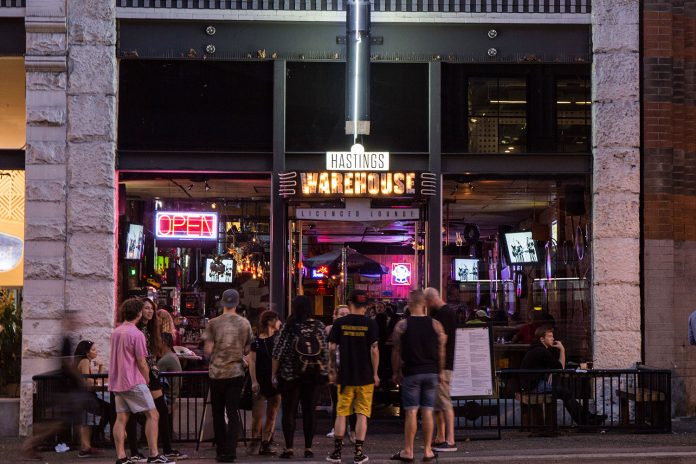
Located right beside the 95 B-Line bus stop at 156 West Hastings, the Hastings Warehouse is home to satisfying bar food, booze, and a bumping ambience.

     This place is the definition of student-friendly prices, with all dishes costing $5.95. The drinks, sadly, are not, but they are reasonably priced. Be sure to bring cash or credit (Visa or MasterCard); they don’t accept debit.

     The food more than makes up for the inconvenient payment system. Unlike other dive bars, the food you get here isn’t greasy or over-fried. It’s clear that the Warehouse has mastered the art of making a simple meal well. For instance, the Works Burger is a classic, satisfying dish with a deliciously juicy patty that can fill any hungry student up. While this place isn’t vegan-friendly, many vegetarians would love meals like the balanced, fruity, and crisp Quinoa Salad.

     As for drinks, I recommend the Pink Lemonade, which is a sweet, fizzy drink that’d give anyone a nice buzz. Sadly, the portion sizes for food vary to an inconsistent degree. While some starters, like the Fingers and Fries (highly recommended!), can be big enough for a whole meal, other dishes, like the Soft Tacos, are of a measly size, and a customer would require a second order to satisfy themselves.

     Speaking of customers, the Warehouse is crowded on most nights. While you won’t be waiting too long for a table, it will take you longer to get the attention of your server. Frankly, the Warehouse looks understaffed, so waiting for them can quickly become a frustrating experience. While they do eventually get back to you, seeing them breeze past you to other customers can put a damper on anyone’s night.

     However, the ambience of the Warehouse can help make your night. One word that comes to mind when I think of the Warehouse is loud. As soon as you walk in, music blares through the speakers. The music selection is hip since the playlists include top hip-hop tracks, nostalgic old-school bangers, and bops galore. With its casual vibe, the Warehouse is great for a good hangout or casual date. That, and it’s perfect for any sports fan who wants to catch The Game™ (I wouldn’t be able to tell you which sport — maybe all of them? Is it clear that I don’t know sports well?)

     The Hastings Warehouse is a fun spot for comforting bar food that isn’t too greasy. It makes for a great night with a rowdy crowd or a one-on-one date. While it can be too loud, and the servers definitely take a while to get to you, it is worth it to stop on by and grab a bite.

Pro-tip: Avoid sitting at the bar. While you may think you’re slick by avoiding lines for a booth, you’ll have a higher chance of being ignored by your server, and the music is especially loud. This will make even the rowdiest party animal want to tap out at 9:30 p.m. because of a headache.

Six recommendations to the existing SFSS 2018 Elections Report

0

Written by Corbett Gildersleve, SFU Alumnus

In last week’s article, I talked about the SFSS 2018 Election Report and some concerns I had with it. Included in that report were eight recommendations for ways to improve future SFSS elections. However, the independent electoral commissioner’s (IEC) recommendations don’t always make sense without further information and context. This information would normally be included in two other sections of the election report — sections which are absent from the 2018 report. However, even without those sections, many of the recommendations touch on important issues with SFSS elections. Here, I will be talking about recommendations 3–8, with the IEC’s recommendations paraphrased and followed by my own commentary. (Check out the online version for my commentary on recommendations 3, 6, and 8.  Let’s dig in!

Recommendation 3: The IEC’s working hours

Issue: The IEC had to work extra hours due to demand.

IEC Recommendation: No IEC member should work more than 15 hours per week, and the limits this places on how much the IEC can do in a given timeframe should be communicated to candidates.

Corbett’s Commentary: Since this report does not list the expenses, it’s hard to know how excessive the hours were in total. But the hours worked by an IEC and the amount of pay required to match the time worked is directly related to how long the elections cycle can run, because the longer it runs, the more work the IEC has to do and the more expensive it gets to pay them.

In any case, the fact that our elections happen during March in the lead up to final projects and tests probably causes more harm than good. The IEC is made up of students too and they also have academic commitments. I’d rather have the election period be more spread out than this “just get it over with” system we have now, or alternatively, the entire election could happen before reading break when students have more time for these things. Those that win would then have two months to shadow the current board and receive training before they take over.

Recommendation 4: Over reliance on the Communications Office and Copy Centre

Issue: The Communications Officer and the Copy Centre were overworked during the election, in the former’s case because they assumed roles and duties that the IEC should have taken.

IEC Recommendation: The IEC should handle more of the election-based tasks such as social media and bookings, and the candidates should send in their campaign materials by or before the last Friday of the nomination period.

Corbett’s Commentary: The main takeaway from the elections policies that were passed on April 24, 2017, was that it makes staff handle a lot of the heavy lifting. You can read about my views on this in a previous Peak article.

In the past, the IEC did handle the majority of the elections work from advertising, outreach, room bookings, and even running some of the AV equipment. I can’t see the SFSS accepting the IEC recommendation as they’d have to rollback a bunch of policies.

As for the Copy Centre working overtime to meet candidates’ printing requests, that’s nothing new. It’s not acceptable, but when you have over 30 people each wanting to get hundreds of posters printed in a very short span of time, it puts an undue burden on the staff and system. As an aside, the by-law reform attempt in 2017 would have added at least another 20–30 people running for Council seats, assuming at least two people ran for each of the 15–20 available positions. Imagine all the posters, debates, etc. that that would have added onto everyone’s plates.

It might make more sense to have a prep period between nominations and campaign periods to give everyone time to work on their campaign materials, which would include answering questions about their platform. This benefits not only the candidates but also the students who are interested in the election. Ideally, this would allow everyone to be on equal footing at the start of the campaign period.

Recommendation 5: Slates

Issue: The IEC “erroneously” allowed slates, resulting in a “toxic electoral atmosphere.”

IEC Recommendation: Candidates should be forbidden from forming slates.

Corbett’s Commentary: Is this the IEC’s first time paying attention to an election? It feels like they have a very specific expectation on how elections should happen and how people should act in them. However, that expectation doesn’t match our history.

People make elections toxic and dirty regardless of whether they organize themselves into slates or not. Elections during the periods where slates were banned had issues too. The IEC didn’t make an error in permitting slates. Slates are not banned in the election policies (they’re barely mentioned) and the IEC doesn’t have the authority to just make up new policies, merely recommend policy changes to the board after each election/referendum.

Recommendation 6: Infractions and Campaign Expense Limits

Issue: There’s no way for the IEC to enforce monetary infractions on candidates who do not provide their receipts and/or only spend money on printing.

IEC Recommendation: Monetary Infractions should be eliminated, and Campaign Expense Limits policies must be re-evaluated to solve this issue as the current IEC has no solution to this dilemma.

Corbett’s Commentary: Financial penalties are unenforceable in a number of ways, and it’s been like that for a long time. Read the 2015 and 2016 election reports to get an idea of the challenges surrounding this issue. I don’t believe the SFSS can assign fines through goSFU without an agreement with SFU. The general office can also only do so much if the fined candidate lost the election. So, why do we have these fines? The SFSS by-laws require them.

The by-laws restrict each candidate’s budget to only $50 on campaign materials, (as seen in by-law 15-14)  and that all printing must be done at the SFSS Copy Center. The IEC can issue up to a $100 fine for violating the by-laws or election/referendum rules, as per by-law 15-8. But in the world of social and digital media, why bother spending money on posters?

Future election by-law and policy reform will need to tackle things like in-kind donations, volunteer campaign teams, and endorsements from alumni and other stakeholders.

Recommendation 7: Endorsements

Issue: Candidate endorsements “ran amok in the elections cycle,” despite being “highly unethical,” and the IEC received a large number of complaints about them.

IEC Recommendation: The IEC should pay no attention to candidate endorsements, since the IEC has no obligation to “protect the reputation of the SFSS.”

Corbett’s Commentary: It’s not the IEC’s job to protect the reputation of the SFSS but rather to run the elections as fairly as they can. However, it’s unclear why endorsements are “highly unethical” and that they “ran amok in the election cycle”.

It would be nice if every student spent the time to look into each candidate and make an informed individual choice, but that’s not reality. You could make an argument that board members should not make endorsements, both because they are in a position of power during the election and because it could be a conflict of interest. But they are also students, and therefore have a right to engage in the political process. How do you balance those two issues?

Recommendation 8: Candidate Nomination

Issue: Various candidates’ behavior toward each other and the IEC which include harrassment, slander, sexual harassment, bullying, etc.

IEC Recommendation: “Like any other job posting,” candidates should have to provide three “academic, work, volunteer or character references” before they can run.

Corbett’s Commentary: The IEC recommends that each candidate submit three references as part of their nomination. I assume this is to help weed out candidates with “antisocial behavior.” It might work, but there are many bad people out there, and I bet all of them had great references.

The greater problem is that the IEC is not well-equipped to investigate and handle a whole range of issues including accusations of harassment, slander, sexual harassment, bullying, etc. during an election. I have no meaningful recommendations, as I’m not knowledgeable enough in this area, but a discussion needs to be had on this topic.

These are my takes on the recommendations. Some make sense, some can’t be implemented, and others will probably just be ignored. That’s the SFSS, regardless of which board is in power.

SFU researchers investigate how technology can be used in healthcare

1
(Photo courtesy of Supportive Guru)
By: Nathaniel Tok, Peak Associate


SFU computer science professor uses data mining to improve healthcare

SFU Computer Science professor Martin Ester is using data to help prevent adverse drug reactions (ADRs), such as death and disabilities, in patients undergoing cancer treatments.

Young cancer patients face a much greater risk of ADR, with 42% developing “disabling or life-threatening ADRs from cancer treatment.”

Ester’s research team, headed by Dr. Bruce Carleton and Dr. Colin Ross, is based in the B.C. Children’s Hospital, and is studying how genetics influence how patients might respond to drugs. They received a $9.9 million grant from Genome Canada for the research.

Within the team, Ester is using machine learning to data mine the clinical and genomic dataset, collecting DNA samples and recording reports of drug use and ADR outcomes.

According to Ester, “this [technique] will help us identify new connections between genetic variation and ADR” to help predict the probability of ADR during cancer treatment and allow for personalized treatments to prevent ADR.

The team is looking at ways to apply their findings in the medical world. The hope is that their efforts will allow for accessible pharmacogenomic testing to improve individual and population health.


How do researchers use social media?

The research group led by SFU professor Juan Pablo Alperin in the Master of Publishing program is investigating which social media platforms are the best for distributing academic research to local and international populations, and how language plays a part in information distribution.

In a paper published earlier this year, the group looked at the Zika virus outbreak event in 2016 as a case study to examine the communication of academic scientific research to various populations, and how the research was discussed locally, nationally and internationally.

Upon collecting Zika-related Tweets and Facebook posts in the first half of 2016, the group used an algorithm to determine that the majority of the posts were written in English. 90% of the Twitter posts and 76% of the Facebook posts were written in English, despite the Zika outbreak being located in Brazil. In contrast, only 7% of Facebook posts and 1% of Twitter posts relating to Zika were written in Portuguese, Brazil’s national language. The authors of the paper used this finding to conclude that “scholarly findings about the Zika virus are unlikely to be distributed directly to relevant populations through these popular online mediums.”

The group also found that the probability of non-English social media posts falls when more researchers speak English.

However, between platforms, the group found that Twitter was better in reaching international audiences while Facebook was better when talking to local populations. “Our results suggest that Facebook is a more effective channel than Twitter, if communication is desired to be in the native language of the affected country,” concluded the researchers in the paper.