Home Blog Page 654

Long story short: Once upon a time there was a little boy with a spool of thread . . .

0
Image credit Tiffany Chan

By: Amal Javed Abdullah 

I received news only a few days ago that a friend, a graduate student full of life and ambition, just passed away. For me, as I enter the month of Ramadan, this story really serves as a reminder that life is fleeting — that one’s time, and the hours and minutes of which it consists, is fleeting.

There is a metaphor in Pakistani culture, often introduced as a bedtime story to lisping children in motherly laps, referred to as “zindagi ki dore.” With zindagi meaning life, dore meaning a thread or a string, and ki used as the possessive adjective, the phrase loosely translate as “The Spool of Life.”

The story goes that there was once a boy who found himself in trouble for a silly childish mistake — one’s imagination does not have to wander far to think of an example. Ashamed, he went to the park and began to cry beneath a tree when a Good Fairy came to him, and in typical bedtime-story style, asked the little boy why he weeped so. When he explained, she offered him a solution in the form of a zindagi ki dore, a spool of thread that represented the duration of his life. If he were to ever find himself in a similar situation to what he was currently experiencing, he would only have to snip a tiny bit of the thread. The Fairy cautioned him, however, to use the spool wisely and only cut in absolute necessity.  

Overjoyed, the boy returned home with the spool. The next day, his teacher handed back an assignment on which he had received a poor grade. Embarrassed, he took out his spool and snipped a tiny bit of the thread, which instantly transported him from 8 a.m. in the classroom to the end of the school day, waiting in the courtyard for someone to pick him up. The boy instantly understood the usefulness of the contraption: skipping the hard moments. Soon after, at home, the boy broke his mother’s prized vase, and fearing her wrath, took out his spool. Right as she came marching in, her face red and seething, snip! He got away just in the nick of time. Later, he fell off his bike, breaking his leg in the process. Unable to handle the pain, he snipped off some more of the thread until his leg had healed. More incidents of childish dilemmas passed a scraped knee, a fight with a friend — and each time, the boy snipped away the moment on his spool of life and escaped it.

I interpret the story to mean that the boy does, in fact, get bullied at recess because of his low grade, get a scolding from his mother, but he doesn’t have to live through the experience — his mind and memory are in another place.

As he grows into adulthood and faces the peaks and valleys of growing, he snips away his life whenever confronted with discomfort. Soon enough, he finds himself an old man, a wizened elder withering in the pains of old age. In hindsight, he reminisces on his life, and in sagelike fashion reflects that he has cut his life too short. He has passed too many moments without fully experiencing them, and lost too much time by not living it — he has snipped away too much. Sorrowfully, he returns to the tree where he found himself in his childhood, and weeps once more on what his life has become.

To his surprise, the Good Fairy appears once again, and this time addressing him as an old man, asks him again why he is crying. He explains to her why, and she reminds him that she warned him against using it excessively. She waves her magic wand, once more in typical fairytale style, and promises him a chance at a new life. She leaves and he falls asleep, and he wakes as a boy once more to relive his life, this time without the responsibility of his whole life in physical form.

As a child, I don’t think I gave this story much thought beyond the fact it would be cool to have a spool like this one. Who wouldn’t want to skip a boring lesson at school? As an adult, this story really strikes me because of its compelling conceptualization of life and time as a length of thread with a set size. It makes me think that our lives are really just a determined number of seconds, minutes and hours. It really expands your mind to think about time in its entirety, about you as an infinitesimal speck on a pinpoint in the enormous span of time that the universe has been in motion. It emphasizes the transiency and brevity of our lives in the grand scheme of time.

This makes me think about living life meaningfully and purposefully. By this, I don’t necessarily mean being productive all the time. In high school, I was obsessed with the idea of productivity. I was a high-achiever with crippling performance anxiety, and I had this almost self-harming idea of being super productive. With a few more years of experience behind me, I’ve come to realize that “super” productivity, as I thought of it, is a pretty materialistic notion that only helps rich people become more rich (but this is another rant for another time).

When I think about using time meaningfully, I think about being intentional about how we use our time. If our life is the hours in our day, then we should at least live them in an enjoyable way. Live with no regrets and no missed moments. Do everything wholeheartedly, with passion and vigour. If you’re going to party, party ‘til you drop. But also, if you’re going to write a paper, write the best paper you’ve ever written: your absolute best work, not some half-assed, last-minute, procrastinated garbage. If you’re going to save the world, then buddy, you better save the eff out of every last person. If you’re going to binge-watch Netflix, watch ‘til your eyes burn. Do everything you can with as much passion and zeal as you can. Don’t do things for mediocre reasons, do them intentionally, with purpose.

Really, the things that we blow up to great proportions — an argument, a bad grade on an assignment, a new outfit that we really need to buy — are all transient and temporary. What really matters is the purpose and value with which we use the moments we have, the value we put in the lives of others, and the value we put out to the world at large.

Wisdom for first-years

0
Illustrated by Cora Fu

By: Nathaniel Tok

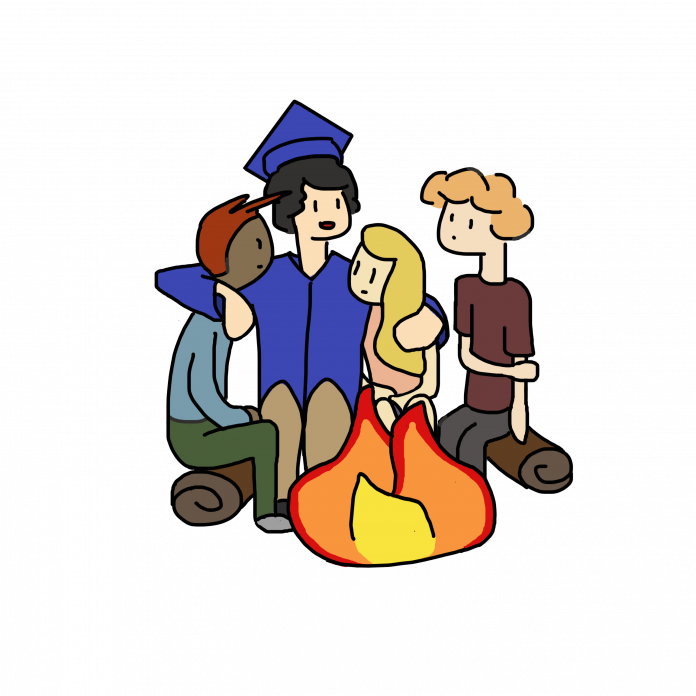
Gather round, my children. My sons and daughters, you have all seen nine moons into your final year of school, and you will soon depart these lands of comfort and plenty into the wilderness of Burnaby Mountain. Let me give you some hard-won counsel.  I am an old man now — so old that I saw the 135 transform before my eyes into the 95. I was there when they took away my grasslands to begin constructing the building of student unions. I remember when the Trottier Observatory was built, allowing us to better gaze into the stars pondering the meaning of “Engage the World.” So, my children, heed my wisdom, listen to my advice and use it to flourish.

1) Do not tire yourself running from class to class. I have worn myself out hurrying from the western reaches of the university to its uttermost east. Do not underestimate this arduous journey. Such efforts leave me drained and unable to focus myself on the lore in the lectures. Take instead TransLink’s chariots provided under the central archive building to journey towards the hall of glass at Blusson so that you may arrive without delay and with little energy exerted.

2) We humans are creatures of intellect and writing is a hallmark of civilization. But my children, do not be too hasty. The university hosts many festivals and career fairs where there is a bountiful harvest of pens to be collected. For the small price of sharing with the guilds the contact details of your compatriots, you can acquire and hoard all the stationery you need until the next carnival. The money saved from  obtaining your writing utensils for no cost can then be used towards more fruitful purposes, like purchasing coffee.

3) Many a student have I seen cram all of their classes into compressed blocks of time back-to-back over two or three days. They come to the mountain citadel as little as possible in a week and quickly depart its peaks to return to civilization. My children, I pray, do not fall into such temptation. While this enables one to push one’s time on the lonely mountain to its greatest potential, this also means one does not have time for midday nourishment, and for a break between class. Also remember, my young pupils, that three classes a day might mean three midterms in a day. Do not be so foolhardy. Instead, take time between classes to form bonds with your fellows and to seek the greatest prize of all: events with free food.

My children, the advice that I have given you is timeless and subtle, yet potent. It was won through long years of struggle. As our time together draws to an end, promise me, that in exchange for this sage wisdom, you will not take my seat during the late afternoon 145 rush.

POLITICAL CORNER: Making fun of John McCain’s health crosses all the lines

0
Photo courtesy of Confessions of a Funeral Director

Written by Eva Zhu, Opinions Editor

On May 10, White House aide Kelly Sadler made a joke about Senator John McCain, commenting that “he’s dying anyways” after hearing about his opposition to Donald Trump’s pick for the new CIA Director.

OK, first of all, not only is this man a Vietnam War veteran who has earned the Silver Star, Bronze Star, Purple Heart and Distinguished Flying Cross (unlike Trump, who bragged about the Purple Heart that a veteran gave to him), he also has brain cancer. What kind of heartless piece of shit must you be to make light of the health of someone who’s already extremely ill?

When a White House employee utters such an atrocity, they should either resign due to shame or be immediately fired by the President. However, we all know what a terrible human being Trump is, and he’s probably giving her a raise. I mean, he loves to constantly insult people who are better than him like a playground bully.

Even politicians should have morals, and draw the line long before they “joke” about a respectful and reputable politician who had better kick brain cancer in the ass.

13 Reasons Why doesn’t need a second season

0
Photo courtesy of Netflix

Written by Melissa Campos. Multimedia Assistant

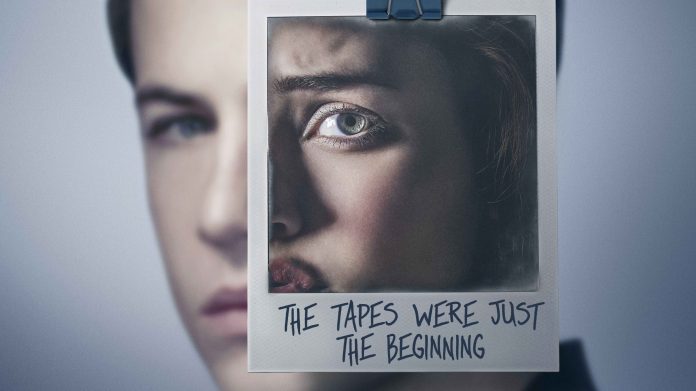
13 Reasons Why is one of the most controversial television series that exists today. After its initial release on Netflix last year, the show sparked a large debate surrounding how suicide should be depicted in fictional media. While the shows’ creators claim that their intentions with the series were to raise awareness and start a discussion about adolescent mental health, the way in which the script was written and graphical portrayal on screen has done more harm than good.

The first season of the show depicts the life of Hannah Baker leading up to her suicide just months after her transfer to a new high school. Following her death, she leaves 13 cassette tapes addressed to different people whose actions she describes as having contributed to her suicide. Although the show takes place after her death, Hannah’s character is still very prominent during vivid flashbacks and narration that takes place over the entirety of the first season.

While I believe that the show does depict in an impactful way the dangers behind teen bullying and the repercussions that ones’ harmful actions can have on others, it also glorifies suicide and sends the unrealistic message that suicide can be an act of revenge. In other words, I believe the show sends a strong message to bullies, but sends an even stronger and more problematic message to those suffering from depression or suicidal thoughts. It suggests that suicide can be used to send a message, and that there’s no use in seeking help.

Various mental health professionals have claimed that the way in which Hannah’s suicide is portrayed in the show is extremely harmful towards those suffering from mental health issues, particularly depression. One psychologist who was contacted to provide guidance for the show even recommended that Netflix not proceed with the project.

13 Reasons Why also directly went against recommendations for addressing suicide in media that were compiled by experts on suicide prevention. These recommendations warn that suicide risk can increase when the suicide method is explicitly described and the death is glamorized. The first season already breaks those suggestions by graphically depicting Hannah’s suicide on screen in the final episode. Her death is also dangerously referenced and talked about throughout the entirety of the series.

The first season contributed to an increase in suicide contagion. Suicide contagion, or “copycat suicide,” occurs when one’s suicidal thoughts increase due to exposure to suicide and suicidal behaviour around them, whether it be through people in their life or the media. Global News revealed that a number of copycat suicides were reported after the release of the first season.

They also reported that after the shows’ initial release, hospital visits increased as well. In a separate article, they discussed a study which reported that suicide-related searches on Google rose by 900,000 to 1.5 million searches within the 19 days after the show was released, with the top search being “how to commit suicide.” So while the show sparked a discussion surrounding suicide, it was definitely not as positive as the shows’ creators would have hoped.

This begs the question: if the first season contributed more towards a harmful depiction of suicide than a preventative one, why is Netflix releasing a second one?

Of course, I understand that getting paid probably plays a role. Nowadays, pretty much everything is motivated by money. But I think that funded projects should still heavily consider the implications of what they are portraying on screen.

There is really nothing that a second season could possibly add to the storyline. Hannah Baker died, and her suicide sparked a discussion surrounding how her death could have been prevented had she gotten the support and help she needed, and had those around her not bullied her in such an extreme and disgusting way. The book which the show was based off of even ends with Clay Jenson passing the tapes off to the next person and reaching out to another suicidal teen to offer support. However, the show unnecessarily deviates from that, introducing the plot of Hannah’s parents receiving a copy of the tapes and suing the high school that she attended.

There is no need for another season. Why is the show being dragged on? Initially, there was a message that the creators were trying to convey. Even if it was conveyed poorly, at least it was something. But now, with the release of a second season, this controversial discussion is being re-instigated; the show risks impacting those suffering from mental health issues in the same negative way that it did with the first season.

I appreciate the effort that the show creators are making in correcting their previous mistakes in the second season. They’ve created a website that provides various resources for people to visit if they suffer from suicidal thoughts and/or depression, including a discussion guide for parents. They have also included a message from the cast members at the beginning of the second season warning that the show may not be suitable for those suffering from the issues addressed within the story. While this is a step in the right direction, these measures can still be taken without the creation of a second season. Yes, create the website and add the video warning at the beginning of all the previous episodes, but there’s no need to keep the storyline going.

I will admit, I liked the show. The book had a strong message to convey, and while I didn’t completely agree with the extreme depictions and additional side plots that the Netflix series added, I did like the message that it helped to communicate about bullying and providing support. But even as someone who found the show interesting, I finished the series having no desire to see what came next. After having watched the first episode of the second season for the purposes of writing this article, I can conclude that the ongoing court case surrounding the plot has nothing substantial to add to the overall story and message of the show.

13 Reasons Why, I’m still looking for the reason why you had to make another season. It seems to me that there are more than 13 reasons why no one should watch it.

Gender reveal parties place great expectations upon a person who isn’t even born yet

1
Photo courtesy of Extra POP by Yolanda via Pinterest

Written by Courtney Miller, Peak Associate

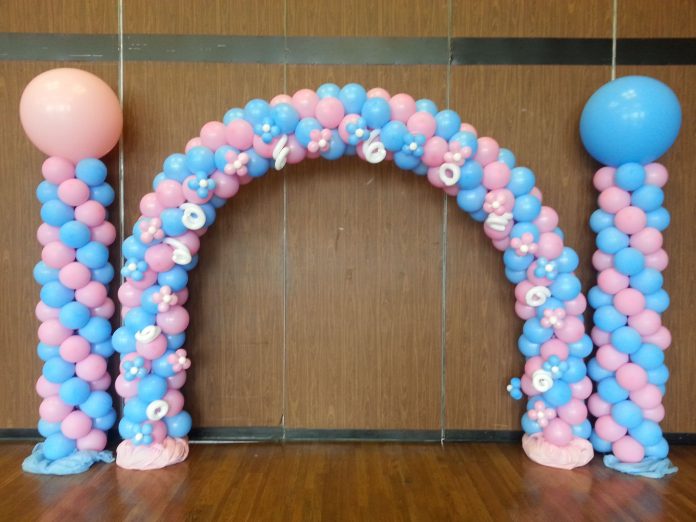
As we age, our Facebook feeds fill with news of our friends getting engaged, married, and pregnant — though not necessarily in that order. The “it” thing to do these days is to share with the world the expected gender of an expected kid, in whatever fun, creative, or exciting fashion one can think up.

By all means, let’s celebrate having new people around to teach and learn from, but that’s already covered in a baby shower — also problematic, but that’s a topic for another time. Having an extra celebration because expecting parents found out their kid will end up having a penis or a vagina, leading them to conclude whether they are having a girl or a boy, is limiting, unnecessary, and, ultimately, misguided. To better understand why gender reveal parties are so problematic, let’s partake in a brief biology and culture refresher.

First of all, sex and gender are not the same thing, as we are becoming increasingly aware of in this day and age. For example, “transgender” has only been in use since 1974 as the term for people who do not conform to the socially constructed gender binary. Yet intersex people and those who don’t conform to the gender binary have been around for centuries, like the hijras of India and Indigenous two-spirit people.

Biological sex refers to the presence or absence of certain sex organs or chromosomes, not whether that person is a guy, gal, or non-binary pal. If the birth occurs in a hospital, the medical professionals assisting with the birth have to check a box on the birth certificate to officially recognize which sex the baby is. If there is any question or doubt about which sex the baby is, these professionals can also effectually decide what sex the baby is.

What medical professionals don’t tell new parents, usually, is that approximately one baby in 1,500 will have genitalia that is not easily sorted between “has a penis” and “has a vagina.” That ratio increases if one also includes genitalia that don’t look cosmetically acceptable, such as overly large clitorises or unusual urethra locations. So medical professionals suggest to the new parents a “normalizing” procedure to force the sex one way or another. The parents, generally uneducated on biological sexual development topics, let professionals decide which sex the kid should have. Then all of a sudden, someone who didn’t conform to the outdated and conflated gender and sex concept was forced into it.

But what does all this have to do with the parents having a party halfway through the pregnancy to celebrate gender? Theoretically, nothing’s wrong with the party. What’s wrong is what it celebrates, which is the premature classification of the kid into either a boy or a girl. This kind of expectation is one that the child’s support system will have from the very beginning, creating arbitrary standards concerning how the child should behave and live their life. Expectations can be incredibly difficult to change, even when a person actively tries to do so. It’s like giving the kid an extra bunch of hurdles at the very beginning of their life-long marathons.

Say a set of parents want to have a boy and are told by an ultrasound technician that their fetus has a penis. What if the technician is mistaken and the penis is actually a large clitoris? What happens if a doctor then offers to decisively enforce that it is, indeed, a penis? Won’t the parents jump at the chance?

Even though the kid may not identify as a boy, they’ll be forced into portraying one; it doesn’t matter if they feel more like a girl or more like someone in between. Take the famous John/Joan sexology case from psychologist John Money. John/Joan, actually named David Reimer, accidentally had his penis damaged during a circumcision around eight months of age, to about the same degree as the sexual procedure fixes at births. Money told Reimer’s family simply to raise him as a little girl and no one would be the wiser. However, despite Money’s forged scientific reports that stated everything was going swimmingly with Reimer, Reimer experienced an ongoing identity crisis because everyone told him that he was a girl, even though he didn’t feel that way and actively felt like a boy instead. Due to this crisis, Reimer experienced severe depression, eventually committing suicide to end things.

It’s been scientifically shown that transgender people have more symptoms of depression and more history of attempted suicide than cisgender (people whose gender identity matches their biological sex) people. I’m not saying that gender reveal parties are going to make a kid transgender or suffer depression, I’m saying that the expectations that come hand-in-hand with prematurely putting a person in a labeled box and closing the top can be severely damaging.

Gender reveal parties are unnecessary to begin with, because if someone just really wants everyone to know that their kid is supposed to be born a girl, a mass text or Facebook post would get the job done. The expense and effort of a whole party seems disproportionate given the actual weight of the news. Congratulations, the kid should theoretically be a boy, even though they aren’t born yet and we don’t even know if they’ll be healthy upon birth! Let’s celebrate a theory!

There are, of course, other reasons not to have, attend, or encourage gender reveal parties: they’re just another excuse for parents to ask for gifts or donations, they reinforce social gender roles, they’re ridiculously themed, etc. But honestly, all of that’s been talked about before. So let’s kill the gender reveal party phenomenon just like we millennials killed the diamond, napkin, and fabric softener industries, and maybe help a whole lot of people be okay about other people being themselves in the process.

Tips for a sexual experience like none other

0
Illustrated by Reslus

By: Winona Young

The Peak has compiled this list, giving you these seductive sex tips that will take you from nun to slut in no time.

Overall tips:

1. Safe sex is sexy sex

To prevent a urinary tract infection (UTI), be sure to pee before and after sex. And if you’re really ambitious, just keep peeing before, during, and after your partner comes.

2. This is a kinkshame-free zone

Kinks and fetishes are a natural part of everyone’s sexuality. When your partner shares their kinks with you, be open and respectful. Unless you think it makes them weird — like furries or foot people. If you do, dump them! Having a weird fetish means they don’t deserve love.

3. Chocolate and chill?

Get a box of chocolates, hand-feed each other, and then heat things up by hiding a North Indian ghost pepper inside one of them!

4. Talk meme to me

Don’t be afraid to laugh a little in the bedroom. Talk dirty to your partner, but in memes! Throw in lines like “Can I haz blowjob :3” or “Get outta me swamp, donkey. . . and get inside me.” Nothing gets a guy’s cock hard like a Shrek reference.

5. Heart-racing roleplay

Nothing gets the blood going like a scary movie. So bring a little excitement to your bedroom by bursting in with a puppet outfit and a tricycle, and ask your lover in your deepest voice, “Do you wanna play a game…ya lil’ slut?”

6. Mutual Masturbation

Get naked, face each other and just Beat It, Michael Jackson-style

For Vágiñas (these tips are listed first, because men come first often enough)

1. Get her in the mood

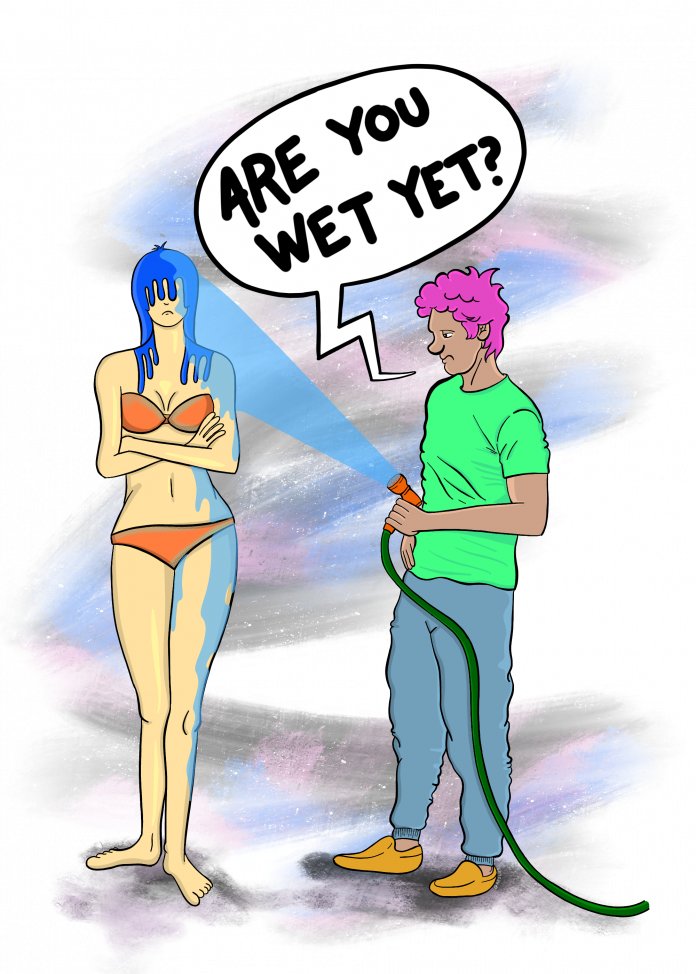
Make her wet by not even touching her — spray her with a hose.

2. Compliment her!

Praise her body and mix in different and unexpected senses. Comments like “Your breasts are gorgeous, so fragrant and muscular,” will always be appreciated.

3. Nothing says sexy like wearing nothing underneath

Put on your highest heels, your reddest lipstick, and the freshest garbage bag you have in your house. Your partner would ask, “Can I take YOU out?”

4. Slide on in

When you’re inside her, be sure to move your fingers, hips, and pelvis in all sorts of ways. Go up, down, change it up: start by sliding to the left, sliding to the right. Then criss cross! Criss cross! Cha cha now, y’all.

For Penises – Giving you just the tip(s you need to satisfy your man)

1. Blowjobs

Make it dry like sandpaper. How else are you going to polish that wood? Throw in extra teeth too. It’s a good way to get the blood flowing . . . literally.

2. The Grapefruit Technique

Your forefathers know of this tradition. Simply cut a hole in a grapefruit. Your instincts will kick in and you’ll know the rest.

3. Eating food off each other

Dip that dick in some caramel, sprinkle some nuts, and add a fruit garnish or two. Guy Fieri would feature this dish on his show, Diners, Drive-ins, and Dives (& Dicks).

Finally, get nice and sexy with this sexy Spotify playlist, compiled by our staff at The Peak:

      • “Gangnam Style” — Psy
      • The Dora the Explorer Theme Song
      • “Sandstorm” — Darude (10 Hour Version)
      • “Cha-Cha Slide” — Mr C the Slide Man
      • Skrillex’s entire discography
      • “Retrospect for Life” — Common
      • Gregorian monk chants, but the monastery is on fire
      • “My Heart Will Go On” — Céline Dion
      • Three minute loop of audio clip saying “PICKLE RIIIIIICK”

Finding food trucks

0
Courtney Miller / The Peak

Written and photographed by: Courtney Miller

Graphics by: Krystal Shiu

Wakwak Burger

Location: Granville Street at West Pender Street

Walking time from SFU Harbour Centre: Four minutes

The food: I couldn’t not try the infamous $2.85 burger, and it was actually really good. It’s pretty basic, with just a patty, mayo, lettuce, and onion on a bun, but the onion was shredded really thin, and it was sweet as opposed to overwhelming, which was a great plot twist. The overall package is a bit smaller than your average burger, but for its price, it’s hard to beat. Plus, you can put some cheese on it for an extra $1.

Rating: 4.5 out of 5 burgers

Le Tigre 

Location: Tuesday: Burrard Street at West Pender Street; Thursday: Alberni Street at Bute Street

Walking time from SFU Harbour Centre: Eight minutes on Tuesday; 18 minutes (or a 13-minute ride on the 005 bus) on Thursday

The food: Full disclosure: this is honestly not very close to campus, but completely worth the walk. The best deal is the Kick-Ass Rice. It comes automatically with pork, but do yourself a favour and order it with the chicken instead. This meal clocks in at $12, but it will keep you full and satisfied for your entire four-hour lecture. The chicken is crispy but juicy and tender inside, the bird’s eye chilis they use add a nice amount of kick, and the egg is always so softly poached you know that it’s meant to be mixed into the seasoned rice.

Rating: 5 out of 5 fried chickens

Fat Duck Mobile Eatery

Location: West Cordova Street at Howe Street

Walking time from SFU Harbour Centre: Four minutes

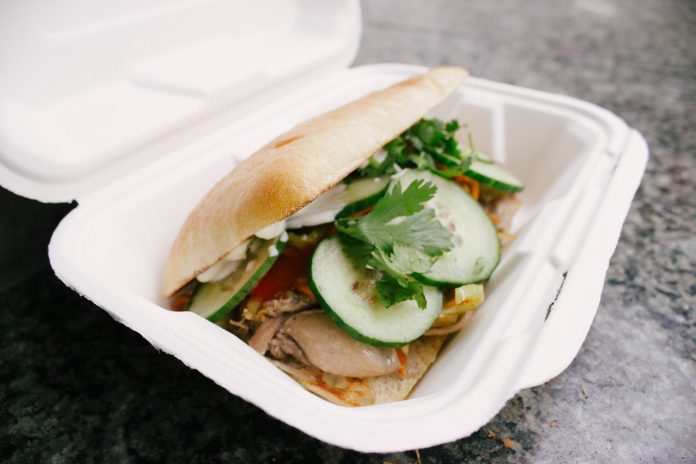
The food: First of all, you have to like duck to eat here. It comes in sandwich form unless you get their rice bowl, so pictured is the Duck Banh Mi (see featured image). It hit most of the notes for a classic Vietnamese sub sandwich, but they overdid it on the spiciness. I’m all for a good amount of spice, but it was hard to discern the taste of duck through the spice-fog. The spicy pickled vegetables were good, and the fresh cucumber sliced through that level of kick pretty easily, but it was the extra squirt of sriracha all over the sandwich that does it in. Without the hot sauce, it was tasty, albeit a bit expensive for the amount you get, costing a cool $10.50.

Rating: 3.5 out of 5 chili peppers

Japadog

Location: West Cordova Street at Granville Street

Walking time from SFU Harbour Centre: Three minutes

The food: Almost never in my life have I looked at a hot dog and thought, “Yeah, I’d pay $7.50 for that.” However, I’d also never been to Japadog before this, so forgive me. Their special Kurobuta pork sausages are a game changer in terms of the classic hot dog. They’re flavourful, tender, juicy, and look like they’re made from real meat. They also have a good selection of specialty hot dogs. The Terimayo is their best seller, adding teriyaki sauce, mayonnaise, and dried seaweed to the sausage in a toasted bun, which was actually a very balanced mouthful. Their second-best seller is the Okonomi, which has the plain Japadog topped with mayo and bonito flakes. This one is definitely more of an umami flavour, although it’s also more monotonous than the Terimayo.

Rating: 4.5 out of 5 Kurobuta sausages
11 things I learned about writing at the Student Learning Commons

0
Image courtesy of Write On agencia de redaccion

By: Melanie Hiepler 

The Student Learning Commons (SLC) is a great resource for getting help with your papers. They provide a free, low-pressure environment where you can meet one-on-one with fellow students to get some advice on an assignment or to improve your learning skills. I have been volunteering as a learning and writing peer educator at the SLC for many years, and I love it. (If you’re a strong writer and would like to become a learning & writing peer educator, click here for more information.) Here are some tips about academic writing I’ve learned during my time as a peer educator. . .


  1. Outline before you write

Or make a mind map. Or draw arrows. Colour-code your notes if need be. Get your ideas onto paper, and then use these techniques to draw out your argument’s structure. Some people find it helpful to just start writing, and to address questions as they arise — that’s good too; just make sure you write and rework lots of drafts. An outline will keep your paper focused and structured, and it will always help you find your way back if you get lost while writing.


  1. Check your thesis, before you wreck your thesis

Generally speaking, a thesis will have two parts: the argument and the “so-what” factor. To make sure your argument is truly an argument, and not a statement of fact, try arguing against it. You may even find it useful to include some of that counterevidence in your paper, because it’ll help you refine your idea. As for the “so-what” factor, think about why your argument matters. Why should your reader care about your argument? What does it bring to the broader discussion of your topic at hand? It might take a while to develop your “so what,” and that’s OK. Keep these questions in mind while you’re outlining and researching.


  1. The Two-bite Brownie (sentence) is the way to go

Use short sentences — they’re easier to understand. As a writer, your job is to clearly communicate ideas to your reader. Using short sentences will help you do that. Plus, if you often find yourself writing run-on sentences, making an effort to keep it simple will help.


  1. Don’t worry about your page count

Focus on quality content over quantity. As long as your argument is sound and your research thorough, the pages will come. That’s what your prof cares more about, after all.  


  1. Write your introduction after the body paragraphs

You can’t introduce something until you know what you’re talking about, right? It feels counterintuitive, but it will keep your introduction concise and efficient.  


  1. Include examples for an exemplary paper

Do you ever get so bogged down in your topic that you just keep rambling and don’t really know what you’re arguing for anymore? Take a moment to stop, and use an example to illustrate your point. It might mean that you have to tweak your argument a little, but that fine-tuning is often exactly what you need to get yourself out of paper-paralysis and advance your argument.


  1. Master the differences between passing voice and active voice

This one is particularly important for arts students. Using the active voice makes your writing stronger and more clear. Consider this: “The dog was taken for a walk” (passive voice) versus “She took her dog for a walk” (active voice). Both sentences describe the same action, but the one in active voice sounds more confident — and it’s shorter, to boot.

Not sure how to spot the passive voice in your writing? Try the Zombie Test. If you can add ‘by zombies’ at the end of a sentence, you’re using the passive voice. Example: “The town was attacked in 1812” still makes sense if you tack on “the town was attacked in 1812 by zombies.” A quick fix is to tell your writer who attacked right off the bat: “The Americans attacked the town in 1812.” No room for zombies there.  

While using active voice is important, it’s not worth worrying about right away if you’re going to get stuck on it. You can always address this issue when you’re drafting and editing.


  1. Drafting, drafting, drafting

Drafting will only make your paper better. Be strategic about it: each time you draft, focus on a different aspect of your paper, starting with big-picture concerns (Does the logical structure of the paper make sense? Does each paragraph have a topic sentence? Have you introduced and contextualised all your sources properly?) and working your way down to smaller concerns (grammar, spelling, punctuation, etc.)


  1. Read your paper out loud!

After a few hours of staring at a screen, everything starts to look the same. Reading your paper out loud highlights typos, grammatical mistakes, run-on sentences, repeated words, and other unnecessary gaffes.


  1. Print it out. Then write all over it.

Print out a draft and write your edits out by hand. It gives your eyes a break from the screen, and if you’re a hands-on learner, this trick may even help you come up with new ideas as you’re writing. Like with reading out loud, changing the way that you review your text helps new issues and solutions come to light.


  1. Have someone else read your work.

A fresh set of eyes will pinpoint things you need to change. Ask a family member, friend, or roommate to read your work. They don’t have to be familiar with the topic at hand in fact, it’s sometimes better if they’re not, because then it’ll be really obvious if you need to clarify anything. If you want an extra pair of hands from a learning and writing peer like myself, the Student Learning Commons has locations in the WAC Bennet Library (Burnaby Campus), Fraser Library (Surrey Campus), and Belzberg Library (Vancouver Campus). To book a consultation, use the SLC’s online booking system, or just drop in at the Burnaby campus.


SFU students collaborate on miniature library project

0
(Chris Ho / The Peak)
By: Amal Abdullah, Staff Writer


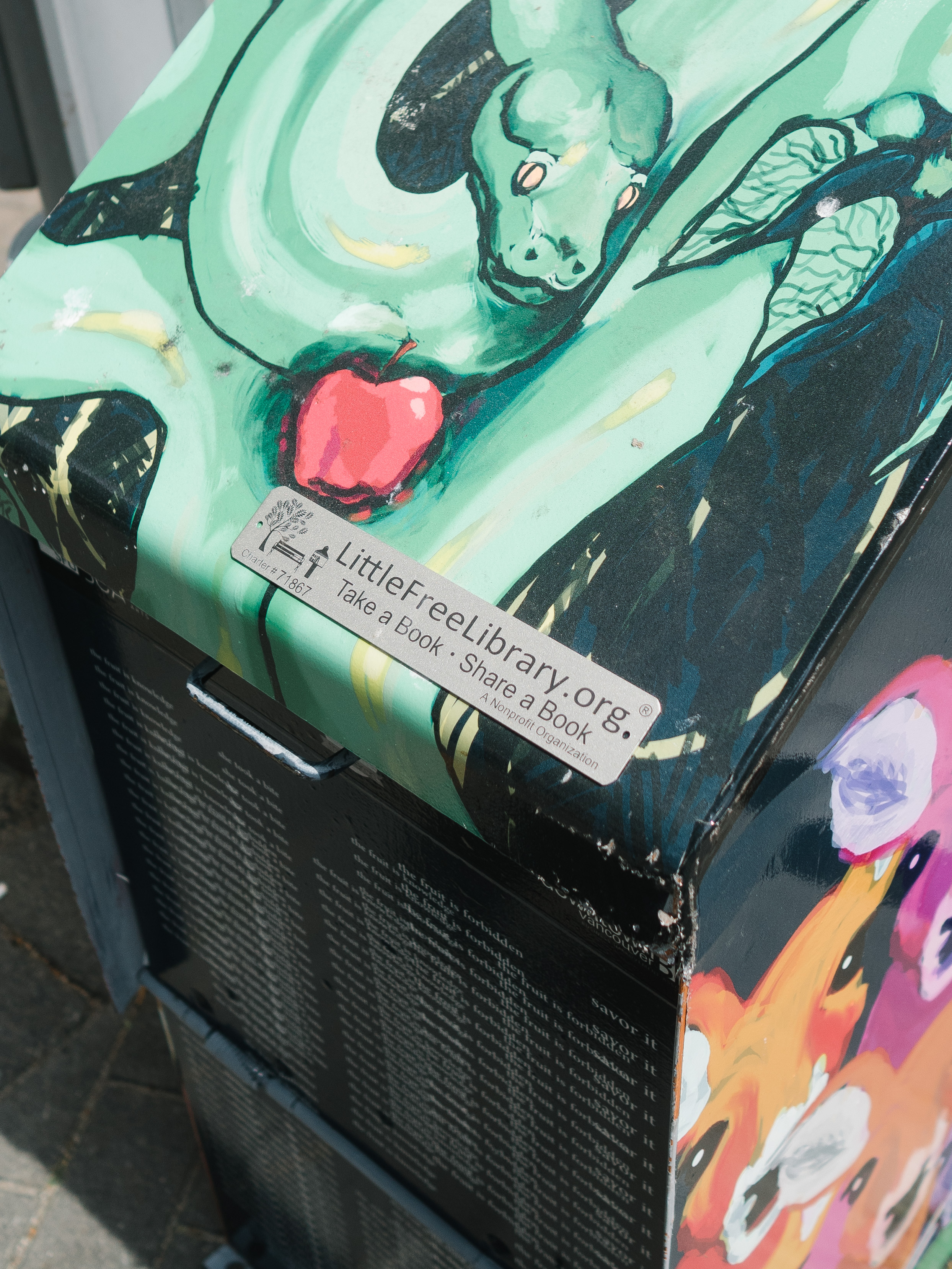
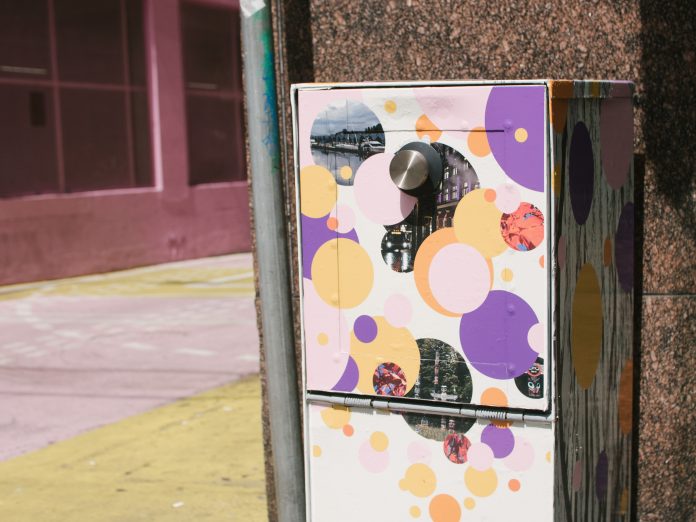
The SFU School of Contemporary Arts (SCA), in collaboration with the Downtown Vancouver Business Improvement Association (DVBIA), launched 11 Free Little Libraries — repurposed old newsprint boxes where people can take, borrow, or donate books throughout downtown Vancouver starting in early May. These self-governed lending libraries, created in the spirit of building community in Vancouver, are intended to create a sense of engagement, safety, and happiness in the city.

(Chris Ho / The Peak)

     No longer being used for magazine distribution, the newsprint boxes were repurposed by students in the SCA. Each box was decorated by students with art that ranged from HAHAHAHAs and ROFLs in black and white text to an illustrated nature scene with birds on a branch. For Cristian Celis, an SCA student, bridging the gap between virtual and authentic connection was a key thought process in his artwork. “Everything nowadays is digital,” he reflected in an interview with Vancouver Is Awesome. “We feel isolated from society even though we are connected with the internet. That’s why I [decorated the boxes with] black and white drawings.

     Sabine Bitter, associate professor at the SCA and one of the professors who led the SCA class in this project, found that the project was a great opportunity for her students to realize work outside the walls of the classroom. In an email interview with The Peak, she wrote that the students in her first-year studio class who created the artwork prepared for this project by learning art experientially through discussing theoretical backgrounds about public art.

“How [does art] change from monuments or sculptural objects to temporary interventions or collective projects with different communities? How does art in public work differently than in a museum or institutional space?” – Sabine Bitter, Associate professor

     “We don’t think anymore that the meaning of an artwork only lies within the work [. . .]

(Chris Ho / The Peak)

but that the meaning of the artwork is also produced by the audience who experiences it. This is specifically important when making public art: who is your audience, how are things read differently in different areas of the city? Your audience in the Downtown Eastside might be different than in Kitsilano or Downtown Vancouver.”

     Bitter found that the experience of having their work already shown in a public context

was rewarding for the first year students. She believed that SFU should engage in more community projects such as these in the public sphere. “A small project like this contributes to our engagement with the public sphere, different communities and the understanding of the importance of learning through different forms of knowledge the exchange of books might offer an opportunity for people who usually don’t have access to books or libraries,” she wrote.

     Little Free Libraries is the second of two collaborations between the DVBIA and SFU SCA students. During renovations at SFU’s Harbour Centre campus in 2017, SCA students painted the wooden fence around the construction in progress.


For all library locations click here.

Chan Centre’s Joyce Hinton presents a variety of breakthrough performances

0
Photo courtesy of the Chan Centre

By: Natasha Tar

From Galician bagpipes to South African a capella, this season’s Chan Centre lineup is a mix, to say the least. Delving into the performances and the performers themselves, The Peak interviewed Joyce Hinton, the co-managing director and curator of the Chan Centre’s 2018–19 line-up, and asked her what we could look forward to.

     Hinton started by explaining why she chose the musicians she did. “When the Chan Centre first opened, it was really thought of as more of a Western classical music space [. . .] and we do have a lot of that happening here,” she said. “[B]ut I looked at that [. . .] and I thought, ‘you know what? We need to also include other people that aren’t drawn to that particular kind of music.’”

     She went on to say that while the music is contemporary, the artists reach into their cultural backgrounds and incorporate them into their sound.

     There were also deeper reasons behind her choices, Hinton explained. “This season I just kept feeling really discouraged by all the division in the world, and all the bad news,” she said. “I just thought, ‘here’s a way to elevate our spirits, to really ignite curiosity about other parts of the world, [and] break down barriers.’”

     From such a diverse group, Hinton found it difficult to choose a favourite out of the lineup, opting instead to highlight some of the lesser-known performers such as the Cristina Pato Quartet, who play Latin music, jazz, and pop. Pato is a Galician bagpiper, and credited by Hinton to be “energetic” and “a mesmerizing performer.”

     Other artists she mentioned were Goran Bregović, a Bosnian musician who’s well known in Europe, and Aida Cuevas, a Mexican performer known for her “hugely emotional singing,” according to Hinton. Some recognizable musicians who will be making appearances include Bobby McFerrin and Ladysmith Black Mambazo.

     Hinton commented that the wildly different touring schedules of the performers combined with the busyness of the Chan Centre made for a difficult task to schedule everyone in. However, she was sure of her decisions, as she said, “This is an incredible year in the world and I just wanted to make sure we had just as many women on this bill as men. [I] like a real diversity of age, [and] I really want them to be from different parts of the world. I want people in our city who are from different communities to feel like they’re being represented, but I also want to introduce other people that might not know or might be curious.”

     As for the audience takeaway, Hinton summarized by saying, “The arts is such a great way to break down barriers.” She went on to say she hopes that the audiences not only enjoy the performers and great music, but be curious about the origins of the artists.

     Having worked as a staff member since the Chan Centre first opened, and having become the co-managing director in 2010, I asked Hinton what some of her fondest memories on the job were. She said she enjoys seeing people’s positive reactions to shows, and how they are “moved or overwhelmed with the experience.” While she’s seen people react uncomfortably to some performances, she believes that it’s because “the art was challenging them, but in a really positive way.”

     Tickets for the Chan Centre 2018–19 season are available on their website. Student rush tickets are $15 and available a week prior to shows.