Home Blog Page 628

Vancouverites rejoice as burning wreckage of BC no longer blocks their view of the sun

0
Image courtesy of Frontera.net

Written by: Aaron Richardson, Humour Editor

VANCOUVER, BC – With over 500 wildfires burning throughout the interior of British Columbia, and thousands of people evacuated from their homes, this summer has been one of the most devastating in BC history. Although the fires have been raging for months, the true tragedy began in mid-August, when the smoke from the wildfires began to fill the Vancouver skyline and block the sun.

Multiple sources reported that for a couple of weeks the smoke emanating from the smouldering remains of forests across BC was making it more difficult for Vancouverites to tan.

“The beach was so much more depressing,” reported Sarah, 22, born and raised in Vancouver. “We’d go out there, but we wouldn’t be able to play volleyball for more than 20 minutes before the smoke started to hurt our lungs.”

Many Vancouverites were seemingly unaware of the fires raging across the province until the smoke began to obstruct their view of the mountains.

“One of my favourite parts of SFU is the view we get here,” Charles, just starting his ninth year at SFU, told reporters. “It’s part of why I came here. On one side, you can see the city, and on the other, you can see the mountains. Normally it’s so beautiful. But with the smoke you couldn’t see anything. It really put a damper on my day.”

Thankfully, due to the recent changing of the wind, the smoke has now drifted away from the Vancouver skyline, making it once again possible for Vancouverites to put the wildfires out of their minds for good.

“I’m so glad it’s finally gone,” said Jeremy, a lawyer at a downtown law firm. “I had to postpone my weekly tennis match due to the smoke. You never really believe that something like this can happen to you. It’s a big world, and it seems as if bad things happen to other people. But I think if the smoke has proved anything, it’s that no one, and no place, is immune to tragedy, not even Vancouver.”

If you walk the streets of Vancouver, you’ll see a spring in the step of most people out and about. Conversations with strangers frequently involve how great it is that the smoke from the scorching ruins of BC is now bothering someone else’s eyes.

Although the smoke-filled sky was truly a hardship for the people of Vancouver, many report that this shared experience has created a sense of community among Vancouverites.

Jessica, a native Vancouverite, told reporters, “It was a tough time. But we made it through. There’s nothing like a tragedy to bring people together. We’re just glad it’s finally over.”

SFU Volleyball looks to get back into NCAA Tournament in 2018

0
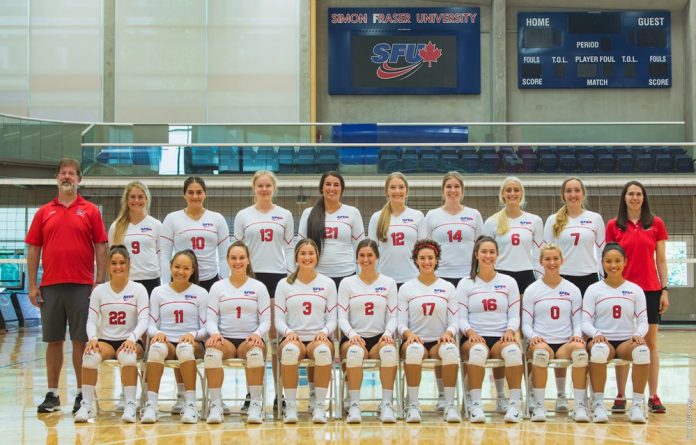
Depth was one of the key strengths for the Clan this season. (Photo courtesy of SFU Athletics)

After having their pre-season tournament in Hawaii cut short with two games cancelled due to Hurricane Lane, the SFU Volleyball team will travel to California this weekend before beginning Great Northwest Athletic Conference (GNAC) play on Thursday, September 6 against Saint Martin’s University at home.

The team will be looking at getting back into the playoffs this season after narrowly missing out last year, due in large part to a tough start to the season. 2017 saw the Clan finish with a 12–8 conference record, placing them fifth in the GNAC behind Western Washington, Northwest Nazarene, Central Washington and Alaska Anchorage.

Things are looking up for this season, however, and the Clan was picked to finish third in the conference in the GNAC Preseason Volleyball Coaches Poll. When asked about this by The Peak via email, SFU head coach Gina Schmidt said, “I think the GNAC coaches saw how our team was playing at the end of last season and respect the fact that we have a large group of key players returning this season.”

The two teams picked above Simon Fraser are the unanimously favoured Western Washington Vikings (who finished with a 19–1 conference record last year) and the Central Washington Wildcats. Since the top four teams in the conference make the playoffs, we can expect the SFU Volleyball team to be playing beyond the regular season this year.

Despite this, the path will not be easy for the Clan, with Alaska Anchorage and Northwest Nazarene both looking to make the playoffs again this season. The best thing for Simon Fraser will be to get off to a hot start. With a core group of players returning and six of the team’s first eight conference games being at home, there is no reason for the Clan to struggle out of the gate as they did last season.

When asked about how the team hopes to get off to a better start this year, Schmidt responded: “With the majority of our team returning this year, the learning curve is not as steep and our players have a much better understanding of their roles and responsibilities. Already we are seeing much smoother play on the court compared to last preseason so we are hoping that continues into our upcoming matches.”

After being named an All-American last season, Senior Middle-Blocker Tessa May will be looking to lead the Clan to a fifth-straight winning season. Last season saw her lead the Clan in both hitting percentage (.366) and blocks (111), and she will more than likely be a force for SFU in her final year.

While May is surely one of the keys for the Clan’s season, one of the team’s biggest strengths is its depth. As stated by Schmidt, the team has a lot of options on offence and will look to keep other teams off balance with its versatility. Players like Kirsten Pinkney, Betsie de Beer, and Lauren Fridman are all poised for strong seasons as Outside Hitters and will look to terrorize opponents from the get go. Schmidt is also excited in the prospects of defensive specialists Katerina Dolguikh, Jayme Bratsberg, and Bianca Te, “who will anchor the defence and serve receive.”

Another one of the Clan’s biggest strengths is their record at home. Last year saw the team win 80% of their games in Burnaby (8-2 overall), and they were one of the highest attendance-drawing teams at Simon Fraser University last year. With a large amount of home games to start the GNAC season, it will important for them to build momentum early.

There are heavy expectations in place for the SFU Volleyball team this year, set both by the team itself and by the rest of the conference. When asked about the team’s goal for the season, Schmidt responded with, “Our goal is to improve on our finish from last season and make it back into the NCAA tournament. We have the depth and experience for this to be a very attainable goal.” It is very difficult to disagree.

Board Shorts

2
Irene Lo / The Peak

Written by: Amneet Mann, News Editor with files from Alex Bloom, Editor-in-Chief


Board set date and appointed planning committee for AGM

The Simon Fraser Student Society (SFSS) Board of Directors resolved to host their annual general meeting (AGM) on Monday, September 24 at the Leslie and Gordon Diamond Family Auditorium at 1 p.m.

Another motion was passed to appoint SFSS president Jas Randhawa, vice-president external relations Jasdeep Gill, vice-president student services Samer Rihani, and applied sciences representative Kia Mirsalehi to the AGM planning committee to organize the meeting alongside SFSS administrative supervisor Karen Atara.


Board added special resolution to AGM agenda and discussed procedure for adding resolutions

The board passed a motion adding the impeachment and removal as president and as a director of Randhawa as a special resolution on the agenda of the AGM.

When the special resolution motion was read out, Randhawa questioned what differentiated this motion from the one that been passed at the previous Board of Directors meeting which also resolved to impeach Randhawa. Rihani responded that, as the impeachment motion was not a normal agenda item, it must be added on via board majority.

Randhawa rebuked the claim that board majority is required to add an agenda item onto the AGM, referencing the stadium project which was passed at the 2015 AGM.

In response, Mirsalehi referenced By-Law 11 from the SFSS Bylaws saying that, to add any business other than the six points mentioned in the first point of the by-law, “you must get it approved by the board or council, or members of the society — members of the society obviously being a petition that requires at least five percent of the members in good standing, council being anything that’s passed at council, and board being what we’re doing here today.

“So according to our by-laws, to have something put on the AGM that’s separate from the six items specifically required and noted, we have to pass this motion here. So this is part of our due process; we’re putting any motion within the actual AGM,” said Mirsalehi.

Build SFU general manager Marc Fontaine commented on the general process by which resolutions may be added onto the AGM agenda: “At the AGM, students at large can bring forward ordinary resolutions — those that require 50% approval plus one voter. But special resolutions are required for an impeachment situation, and special resolutions are defined in the Societies Act and require a specific timeline of notice to be given to the members before the meeting happens; it’s 21 days’ notice. Special resolutions need to be put on the agenda, therefore, in advance of the meeting by the board, or council, or students via petition,” he said.

“Members of the society does not refer to five percent of the student vote, it refers to any member in good standing, and I’m a member of good standing,” replied Randhawa. “I can therefore add motions onto the AGM. The AGM is a public meeting and any board member can add on agenda items and bring forth motions as well. [. . .] I’m going to argue that students can put on motions onto the agenda, I am putting this on in advance, this is 21 days in advance, my agenda items will be added onto the AGM.”

By-law 11 refers to any business other than the six listed points as “any other business proposed by the Board, Council or members of the Society.”

Randhawa did not specify what his agenda items were, but mentioned that he had sent them to Atara the morning of the meeting.


Board appointed at-large representative Mohammed Ali as new chair for fall 2018

The election was an extension of a motion passed at the previous board meeting in which Ali was appointed as board chair for the remainder of the summer.


At-large representative Wareez Ola Giwa removed from Board of Directors

The removal of Giwa as a director was preceded by his absence from two consecutive board meetings.

“This is completely a process thing,” said Mirsalehi. “The by-law specifically states that we need to declare that position vacant and so that’s the reason why we’re doing it. This isn’t a decision to remove Ola, it is just that he missed two meetings and [. . .] this is the way that we have to proceed.”


Board contributed $75,000 to keep.me SAFE mental health student support pilot program

According to Rihani, SFU has agreed to match the SFSS’s contribution to the program.

“We’ve already agreed ahead of time that the $75,000 is already been pretty much put on the table,” said Rihani. “It’s a program that is a flat fee so it’s not gonna be continually added to payments that students have to make.”


Board discussed SFSS representation at the Week of Welcome

A discussion on which SFSS representative should speak for the society at the Week of Welcome saw a divide between the president and the rest of the board.

“We’ve had a bit of conflict around this point,” Rihani noted at the beginning of the discussion. “I think it is good to get some round table discussion as to sorting out who this speaker is going to be.”

“Regardless of what the consensus here is [. . .] it states in the by-law that I will represent the society on all formal occasions so I will be speaking at the Week of Welcome,” responded Randhawa. “If there is some stuff you want to help out with, Samer, I’m sure we can figure something out offline.”

Randhawa had sent in a written confirmation to the organizers of the event, stating that he would be speaking at Week of Welcome.

Science representative Natasha Birdi followed up on Randhawa’s point, saying, “So the next line of that by-law policy saying that you represent us also says that if we choose to have someone else represent us, the board can do so [. . .] so I’m just wondering why you’re disregarding what the rest of your board is saying.”

“I think the bigger question is that for the next month and a half you’re still our president and we still need to work together,” Mirsalehi told Randhawa. “I think this is a board discussion item on who the board wants to speak on Week of Welcome, and whether the president wants to override them and let himself speak. And then moving forward, [a discussion of] if we want to have some sort of group process on how we deal with issues like this — because it might come up again — to avoid the next one.”

Randhawa mentioned that he felt the board supporting someone else speaking on Week of Welcome was politically motivated.

Rihani responded: “The speech is not anything to me that matters. [. . .] If you’re going to be overriding us discussing with each other and sending out emails to SFU administration without acknowledging us, at the end of the day, whether this is political or not, I think you’re just disrespecting your board. I know you have the power to override, but at least inform us ahead of time on to what your decision will be.”

“I was not informed when someone randomly dropped into the group conversation that Samer was speaking in my place,” said Randhawa. “You guys had been well aware that I was going to be speaking at the Week of Welcome. No one actually mentioned to me that someone didn’t want me to speak here, no one communicated that to me. People just went ahead and said someone else will be speaking, and I felt disrespected as well.”

A straw poll, from which Randhawa abstained, revealed a unanimous vote from the rest of the board for Rihani to speak at Week of Welcome.

“So I would be willing to work with Samer offline if he would like to. To find a way that we can both speak on the Week of Welcome but other than that [. . .] I will override the decision,” said Randhawa.

Rihani commented that he would not be following up with Randhawa.

“ I think the board has made its decision clear that no one vote is stronger than the other. Unanimously we voted that they wanted me to speak. But again if you’d like to exercise your right to override the board as a sole individual just because you are president, you are more than welcome to speak at the event. But thank you for the offer,” said Rihani.


Board approved up to $4,017 for transportation to Welcome Back BBQ

The allocated funds are to be used for busses to transport SFU students to UBC to attend the AMS Welcome Back BBQ being held on September 14.

Masawi mentioned that the location from which SFU students would be picked up was still under deliberation, and that only one-way transportation would be provided.

SFSS has partnered with AMS Events to help host the event after the Fall Kickoff concert was cancelled earlier in the summer.


Board proposed changes to Clubs Days’ organization and execution

The changes ranged from charging a fee to any groups who no-showed to their tables to changing the name of the event.

SFSS communications coordinator Sindhu Dharmarajah presented the changes that the communications division had been working on alongside vice-president student life Tawanda Masawi to the board.

Dharmarajah noted that one of the proposed changes was “moving away from dedicated space for a business zone and rotunda groups.”

“We’re still keeping zones for the SFSS table and for recreation and for student unions though, but that might change in the future,” she said.

Other changes were aimed at holding groups more accountable for attendance and

presentation, such as requiring groups agree to terms and conditions prior to booking a table, and implementing a fee for groups who don’t show up to their booked tables.

“Since this event isn’t just for clubs, we have an idea to change the name of this event,” said Dharmarajah. She noted that the top choice from the communications division at the moment was “community days.”

Fontaine suggested that a better time to implement a name change could be when the SFSS moves into the Student Union Building as “there could be an opportunity to hold smaller versions of Clubs Days over a longer period of time such as maybe the first few weeks of the semester.”

Board passed motion to amend food and beverage services partial lease surrender agreement

The amendment extended a provision in the August 2017 agreement in which SFU took over operation of SFSS food and beverage services. The provision maintained that the SFSS may book the pub for a period of 10 years following the surrender time. The motion that was passed amended this provision so that the 10-year period would only begin once the pub is opened.

“We had an agreement that was signed last year on the surrender of the space, anticipating that the pub would be open sooner,” said Fontaine. “It’s been a year and it’s still not open and the intent here is to extend that ten-year period to start when the pub actually opens so we don’t end up with only a nine-year effective period to use the pub.”


Board approved up to $1,222.48 for Global Talent Night 2018

Masawi noted that the event was a collaboration between the society and SFU, with the society’s contributions being used towards covering the production costs of the event.


Board approved up to $4,589.35 for Sexual Violence and Prevention Awareness Campaign

According to Gill, the allocated funds will be spent on consent toolboxes, safe sex supplies, and t-shirts for the campaign.

The awareness campaign will be held in collaboration with Women’s Centre and Out on Campus.


Board approved up to $4,266.25 towards Society of Arts and Social Sciences Frosh event

The grant was given on the condition that the proposal align with SFSS policy as the Student Union Resource Office was not able to provide sufficient funds for the event.


Board approved up to $9,000 for student engagement items

The allocated funds will be used towards items such as SFSS t-shirts, pins, stickers, and pens.


Board approved up to $1,000 for SFSS pancake breakfast on September 7


Board approved up to $1,273.88 for Surrey Campus Committee pancake breakfast on September 4

The buildup to the motion to impeach SFSS president Jas Randhawa

1
The 2020 SFSS Election debate was held on Wednesday March 20

Written by: Gabrielle McLaren, Features Editor


On August 8, The Peak received an email from Simon Fraser Student Society (SFSS) president Jas Randhawa reporting that he was under pressure from fellow members to resign from his position.

Attached was a scanned copy of a resignation letter allegedly drafted by fellow board members, a press release written by Randhawa, and a recording of a meeting between Randhawa and the SFSS board of directors’ vice presidents.

“On August 1, 2018 five executive VP SFSS Board of Directors invited me into a room for a pre-planned meeting. Without any prior notice, verbal or written warning/communication they brought me in and handed an ultimatum [sic] to either resign on the spot or face impeachment,” Randhawa’s letter reads.

“This ambush meeting was recorded without informing me or asking for my consent throughout the entire meeting. The recording was later shared in a Slack group chat with all directors excluding myself. This entire process was carried out without any consultation of board faculty representatives.”


The meeting among executives enclosed in the recording

The recording reveals board members confronting Randhawa over control of information flow within the board, non-adherence to proper process and procedure, failure to accept constructive criticism, and issues concerning Randhawa’s character. Board members encouraged Randhawa to resign as president of the SFSS or face impeachment and the long-term consequences that would entail.

When The Peak reached out to the SFSS, the rest of the board was unaware that Randhawa had approached The Peak or provided a copy of the recording.

“This was for us; this was supposed to be something that stayed off the record,” said vice-president (VP) student services Samer Rihani, speaking on behalf of the other SFSS directors involved in the meeting. He noted that some of the recording’s content was confidential in nature during an interview with The Peak.

“The members who are all involved agreed to do this recording more in the sense of being worried for our safety,” Rihani continued. “There have been some concerns about safety in the board office and some discussions about Jas and whatnot led us to believe that if anything went wrong, even worst-case scenario, we’d have that recording there.”

They also confirmed that Randhawa had not consented to being recorded, though all other board members present did. Rihani went on to say that the file was kept after the end of the meeting to share with other members of the board.

According to Rihani, “Jas actually accessed the computer of another board member and saw messages that nobody had given him permission to access. He then took documents as well as the audio recording without the permission of that same board member, because he had been at the home of that person and Jas accessed the laptop while the individual was sleeping.”

In an email interview with The Peak, Randhawa stated that “the recording and material was sent to me.”

“Samer and the other directors were told I had just coincidently [sic] been working off this director’s laptop because we were afraid VP’s would isolate this director out and bully or make [them] their target as well,” he wrote.

“Given the circumstances, I therefore told this director that it would be reasonable for [them] to state to others that I had just coincidently [sic] been on [their] laptop. There was no coincident or accident of me receiving everything including the recording. Explaining the truth to certain individuals on board would have resulted in more emotional blackmail to faculty representatives.

“I hope to conclude by saying it is important to note that the context of what is in the recording is the crime and not how it was given to me,” Randhawa finished.

The Peak then reached out to the individual board member in question, who responded that “I did not give Jaskarn consent to use my computer. The specific activity that occurred during its possession are not fully aware to me, as such, I am unable to comment on Jas’ actions or intentions. This would indicate that Rihani’s version of events are more accurate.” The board member requested to remain anonymous.

“The concern that I have with this recording going out is that there are other people who are named, and other things in there that have nothing to do necessarily with a conflict between one board member and his fellow board members,” said SFSS CEO Martin Wyant. “Clearly it wasn’t intended to be distributed to anybody.”

According to the board, the August 1 meeting was prompted by “concerns being brought forwards by numerous board members kind of regarding a wide range of issues, mainly in term of his leadership abilities.” They recall ongoing problems with Randhawa’s leadership abilities since the beginning of his presidency, some of which having gotten worse over time.


The rest of the Board weighs in

Following the meeting enclosed in the recording, Rihani mentioned another meeting which took place on August 3 amongst all 15 board members to discuss the issue: “[Randhawa] got feedback from every person, he didn’t acknowledge the issues that anyone mentioned to him and he asked us to speak truthfully and honestly after we spoke to him,” Rihani said.

When asked to comment on the August 3 meeting, Randhawa claimed that certain directors were exercising pressure on other board members to “further everyone on board away from myself in pursuit of their agendas.”

“It was tough to watch individual faculty representatives make statements they didn’t want to,” said Randhawa. “I understand that many faculty representatives are in a tough spot and did not want to be part of a big dispute. After this meeting, I also had five faculty representatives stop by my room and tell me that they did not believe everything they heard or said themselves in this meeting.”

“Additionally, a few faculty representatives were full of tears or struggling to speak their words during the meeting and afterwards as well,” Randhawa added.

The Peak reached out to SFSS faculty representatives regarding Randhawa’s claims that they were being intimidated within the board. The faculty representatives (except for arts and social sciences representative Kailyn Ng, who did not respond by the publication date) all denied feeling intimidated by the executive members of the board.

“I am firmly denying Jas’s allegations that faculty representatives are being intimidated within the Board,” wrote business representative Jessica Nguyen in an email interview. “I find this statement extremely ironic because the Board members that Jas is accusing of intimidation are the ones that have been consistently supporting us. [. . .] The individuals that Jas is accusing are the only ones who have listened to the feedback and concerns of the faculty representatives during this entire process.”

She added, “In fact, the only intimidation I have felt is on the part of Jas who’s behavior and responses to board related questions have been extremely belittling and condescending.”

Communications, arts and technology representative Amrita Mohar and science representative Natasha Birdi confirmed that Randhawa had been unreceptive towards feedback provided to him by faculty representatives. “Despite sharing my feedback personally to Jas, he has not shown any sense of improvement since the beginning of the term,” wrote Birdi.

Education representative Cameron Nakatsu confirmed that the original move towards Randhawa’s resignation or impeachment was not initiated by the faculty representatives on the board. “Although this motion was brought up initially by another group within the Board of Directors, I still confidently agree with their evidence into this decision,” he wrote. “At this time, I do not have confidence in his position to lead the Board of Directors for the remainder of the year”

Applied sciences representative Kia Mirsalehi, environment representative Russell Dunsford, and Nguyen commented that, while faculty representatives were not involved in the August 1 meeting enclosed in the recording, since that meeting all members of the board have been involved as the board moves to impeach Randhawa.

“After this meeting, I followed up with Jas and saw that he did not believe that what the VPs had said came from the entire Board. Instead, he strongly believed that it was certain VPs colluding to get him off the board,” wrote Nguyen. She then proposed that faculty representatives should be given an opportunity to directly provide feedback to Randhawa, which led to the August 3 meeting among all board members.

“Multiple meetings were held after the August 1st meeting where faculty representatives spoke first regarding their concerns in order to make sure no intimidation was done by the executives,” wrote Mirsalehi. “Since the August 1st meeting, the faculty representatives were fully involved in all discussions and conversations regarding the impeachment process and on multiple occasions had all expressed their desire to move forward with the impeachment process.”

“While there were some initial inclusion challenges, I believe they are sorted out and that everyone is confident they were part of the final decision,” wrote Dunsford.

“This entire experience has been tough because Jas and I were friends, but I knew I had to put that aside and do what is best for the SFSS,” added Nguyen. “Since the beginning of this process, Jas has continued to behave in ways that ultimately prove that I made the right decision in asking him to step down.”


Following numerous meetings and a leaked recording

In his original media letter, Randhawa mentioned that political pressure had nearly caused him to resign in the beginning of August. After the meeting enclosed in the recording, Randhawa cleaned out his desk and wrote personal letters for the members of the board. This prompted the SFSS to revoke Randhawa’s access to his SFSS presidential email account on Friday, August 3. Randhawa later asked for his account to be restored as he had not made a final decision regarding resignation.

“People were under the impression, myself included, that this was complete. But it was clearly the wrong impression and I apologized to him,” said SFSS CEO Martin Wyant, who restored Randhawa’s email access the following Monday.

“Regardless of what the assumption may be from Martin, I personally never communicated anything to Martin about resigning,” said Randhawa. To Randhawa, this was a breach of SFSS bylaws as well as an abuse of power from Wyant.

In the August 10 Board of Directors meeting, the discussion surrounding the president’s position was slated to be in in-camera discussion item. When The Peak followed up with Randhawa following the meeting, he stated that “no agenda items were sent to me in advance regarding the matter at hand, I was bothered that there would be attempts to add in last-minute amendments.”

“Surprisingly, during the break before the start of the in-camera session, Samer and Martin had a brief discussion and Martin had requested that Samer withdraw his discussion from in-camera for that day [. . .] I am glad to see that work for students was still carried out in this meeting [in spite of] internal conflict,” Randhawa said.

Randhawa restated to The Peak that he has no intentions of resigning. In his original letter to The Peak, Randhawa ended by stating, “Regardless, of whether I am impeached or not by these directors I will be fighting for a bigger cause in the upcoming months and I believe the CEO and following directors involved in creating a hostile toxic work environment should be held accountable.” Following this statement, he named vice-president university relations Jackson Freedman, vice-president finance Matthew Chow, vice-president student life Tawanda Masawi, Mirsalehi, and Rihani.

At the August 14 emergency board meeting, the board unanimously approved to add a resolution to impeach SFSS president Jas Randhawa onto the agenda of an upcoming annual general meeting or special general meeting.


Board Shorts

1
Irene Lo / The Peak

Written by: Zach Siddiqui, Copy Editor


The board approved a recommendation to impeach president Jas Randhawa to be made at the upcoming annual general meeting, and discussed related matters.


The board approved $1528.07 for an SFSS move-in barbecue at the end of August.

The event is to be held on August 29 at the SFU residence and housing area. Vice-president student life Tawanda Masawi explained that, while the SFSS often “[doesn’t] do much” in residence to welcome the students moving in besides tabling, this year Masawi plans to partner with the SFU Athletic Advisory Committee to put on a barbecue.

The board appeared to support wieners as the food of choice, as they are both less expensive than burgers and safer from a health perspective due to being easier to cook.


The board accepts recommendations made concerning service delivery to FIC students.

In the wake of the SFSS’s recent move to begin supplying services to Fraser International College (FIC) students in addition to SFU students starting in January, SFSS CEO Martin Wyant made multiple recommendations and estimates concerning what the increase in demand for SFSS services is likely to look like as a result, and how the SFSS can prepare for that. In particular, the SFSS will be hiring more staff to account for the higher volume of students which the SFSS will be serving.


Board Shorts

0
Irene Lo / The Peak

Written by: Zach Siddiqui, Copy Editor


The board approved an agreement with the Alma Mater Society (AMS) of UBC regarding the Welcome Back BBQ

Many details of the SFSS-AMS partner event were elucidated through this agreement. SFU students are set to pay $37.50 per ticket, compared to the $35 that UBC students pay and the $50 that non-UBC students pay, according to vice-president student life Tawanda Masawi. Masawi hopes to be able to roll out ticket sales starting this week.

Masawi stated that he is “looking into” the idea of organizing transit vehicles to transport students.

“This is not a replacement for Fall Kickoff,” noted Masawi. The vice-president aims to use the student life budget towards “a bunch of other events on campus.”


The board approved extending the lease agreement of StudentCare

StudentCare, the body on campus responsible for disseminating health and dental care services to students, was set to have their sublease in Maggie Benston Centre terminated on August 31. The SFSS has confirmed that StudentCare will continue to manage health and dental care on campus, and the student union building (SUB) is not yet complete and so cannot serve as a space for them. Therefore, StudentCare’s current sublease is to be extended monthly, until such time as they can move into the SUB.


The board approved the movement of $10,000 to the SFSS emergency aid fund

The SFSS emergency aid fund is in place for “students in significant need, if something happens to them,” according to CEO Martin Wyant. Contributions from the student society are matched by the provincial government; for the 2017–18 year, the SFSS is expected to provide $10,000 no later than August 31, 2018, while the government of BC will contribute $9,982.

Board Shorts: a recap of the SFSS presidential impeachment discussion

6
Irene Lo / The Peak

Written by: Zach Siddiqui, Copy Editor


At the SFSS’s August 14 emergency board of directors meeting, the board approved a motion to  place a resolution to impeach SFSS president Jas Randhawa onto the agenda of an upcoming annual general meeting (AGM) or special general meeting (SGM).

The proposed motion underwent “elaborate discussion with the entire board” prior to the meeting, according to vice-president student services Samer Rihani.

“We’ve looked at all the options that we felt would be best going forward — for the team, for the student society, and for the students,” said Rihani, who submitted this motion. “We felt as if going through with an impeachment is just simply the best option as of right now for us.”

Specific reasons for the move to impeach the president were not made explicit during the ex-camera portion of the meeting. However, while responding to the motion, Randhawa alluded to what he called multiple “accusations of incompetency” having been recently leveled at his work performance.

“I’ve pushed for a better social media strategy, I’ve pushed for more student life on campus, reformation of the very by-laws that we’re arguing for, strong transition into the [student union building], new initiatives like the advocacy support office, and above all, I support everyone individually here on this team,” Randhawa stated.

Randhawa claimed that other directors on the board were guilty of violating SFSS policies and by-laws, as well as the BC Societies Act, due to their conduct throughout their move to impeach him. He also addressed the board’s faculty representatives who were present, claiming that some had “specifically stated to [him] that they do not agree with what’s going on,” but were “still following through with this process of impeaching [him].”

Board members did not respond to these allegations during this discussion, and the board moved to the vote, where the motion to recommend impeachment carried.

As a result, the board is set to make the aforementioned recommendation to SFU’s students at the SFSS’s next AGM or SGM in September. While the date for the 2018 AGM is set for September 24, Rihani mentioned that the SFSS’s financial reports may not be ready by that time. Should that be the case, it is possible that the AGM will be rescheduled and an SGM be called for the same date.

Following this, the board introduced a motion to approve up to $1,000 as funding for any legal counsel the SFSS president may seek in light of the potential impeachment. Rihani added this item to the agenda — however, he noted that Randhawa requested that the motion be removed. Randhawa himself reiterated that he had never indicated a desire for such a motion to be brought forward, and that he does not wish to use the student society’s dollars towards “his own personal legal pursuits.”

The position of chair of the SFSS board, previously held by Randhawa, changed hands earlier in the meeting, and is to be filled by at-large representative Mohammed Ali for the remainder of the summer. When putting his name forward, Ali cited a by-law which allowed the board to appoint a new board chair through a vote.

Randhawa opposed the motion to change chairs when it was brought forward, claiming that the board policies declare that the SFSS president will also be the board chair. Aside from this, he further claimed that to have a director besides the president act as board chair would contradict and infringe upon the president’s power to convene board meetings and council meetings, a power assured by the SFSS’s other by-laws and policies.

Applied science representative Kia Mirsalehi argued against Randhawa’s points, claiming that the president’s ability to convene board and council was separate from the board chair’s power to do so, and therefore that the president does not need to be board chair to retain that capacity.

“There has been a vote of non-confidence discussed by the board in terms of sending out the agenda prior to staff, at least for this meeting [and] Friday’s, as well as proper timely notification of the meeting,” said Rihani, regarding why this motion was being brought forward at this particular time. “Board felt as though there hasn’t been confidence in the way that these meetings have been conducted or sent out [ . . . ] You are allowed to call forward the changing of a chair if you feel as though there’s a movement of non-confidence.”

Randhawa responded, “These meetings have been called on petition, within two days. If there are staff concerns on calling these meetings, I think that there’s a rationale behind that.”

The SFU student’s guide to scholarships

1
Image courtesy of CTV News

By: Jennifer Low, SFU Student

Editor’s Note: Make sure to check the scholarships’ official websites for their exact wording, eligibility, and conditions! Good luck getting rich.


Value: $1,000

Description: This annual scholarship is granted to four students planning on careers related to working with senior citizens. Recipients will be selected based on their submission of a video that effectively captures the scholarship’s theme of “The Value of Seniors in Our Lives and Benefits to Society.”

Eligibility: Must be citizens/permanent residents of the U.S. or Canada, currently enrolled and taking classes in a medical/nursing/social science program at a recognized post-secondary institution (graduate and undergraduate).

How to apply:


  • Submit a cohesive and original 2–3 minute video featuring a story or an interview with a senior/group of seniors that positively impacted your life, and outline the benefit these kinds of relationships have on society. Some prompts and questions are available on their website, as is a full list of requirements.  


Deadline(s):

  • There are four deadlines throughout the year (divided in four “quarters” of entries). The next one is September 30. The scholarship will be awarded by October 12 2018.
  • Applications for the Fourth Quarter are due December 31, 2018. Scholarships will be awarded by January 15, 2019.
  • Another $1000 “Best of 2018 Scholarship” will be awarded by January 30, 2019 to a recipient selected from the previous year’s scholarship recipients.


Value: $2,700

Description: This scholarship is awarded to a well-rounded FASS student with at least 90 units, who demonstrates community involvement and is in excellent academic standing.

Eligibility: Must be a Faculty of Arts and Social Sciences (FASS) student with at least 90 units, is very involved in the SFU or larger community, and demonstrates academic excellence.  Applicant must also fulfill the requirements outlined on the SFU Student Services website.

How to apply:

  • Complete the Student Application: Apply online through the Student Information System (go.sfu.ca).
  • Submit a one-page cover letter describing recent unpaid volunteer/community service in the past two years, and a minimum of one reference letter.

Deadline: Applications run from August 27 to September 14, 2018.   The scholarship will be awarded by the Senate Undergraduate Awards Adjudication Committee by the week of October 22, 2018.

More info: Scotiabank Student Scholarship in the Faculty of Arts and Social Sciences

Note: Scotiabank offers other scholarships to SFU students in other departments.


Value: $1000

Description: This annual scholarship is awarded to an undergraduate student enrolled in a bachelor’s degree program in the Beedie School of Business, chosen based on exceptional academic standing.

Eligibility: Must be a Beedie School of Business student enrolled in a bachelor’s degree program and demonstrating academic excellence. Must fulfil the requirements outlined on the SFU Student Services website.

How to apply: Complete the Student Application through the Student Information System (go.sfu.ca).

Deadline: Applications due August 27 to September 14, 2018. The scholarship will be awarded by the Senate Undergraduate Awards Adjudication Committee by the week of October 22, 2018.


Value: $1900

Description: This annual scholarship is granted to a science undergraduate demonstrating academic excellence and completing their final year of a recognized major or honors degree in Molecular Biology and Biochemistry.

Eligibility: Must be a science undergraduate student who is in the final year of a major or honors degree in Molecular Biology and Biochemistry. Must fulfil the requirements outlined on the SFU Student Services website.

How to apply: Apply online through the Student Information System (go.sfu.ca).

Deadline: Applications due August 27 to September 14, 2018. The Scholarship will be awarded by the Senate Undergraduate Awards Adjudication Committee by the week of October 22, 2018.


Value: $2000

Description: This scholarship is awarded to a Faculty of Education undergrad with particular interest in developing skills for assisting students with reading difficulties.

Eligibility: Must be a third- or fourth-year student who is interested in becoming a teacher for children or youth. Must fulfil the requirements outlined on the SFU Student Services website.

How to apply:


  • Submit a write-up discussing your interest in issues related to reading capabilities in children and youth.


Deadline(s): Applications due August 27 to September 14, 2018. The Scholarship will be awarded by the Senate Undergraduate Awards Adjudication Committee by the week of October 22, 2018.


Value: $3000

Description: This scholarship applicable to students worldwide and in any faculty! It is granted to a third- or fourth-year student to help them save money on tuition costs.

Eligibility: Must be a third- or fourth-year student who demonstrates strong school community involvement and is in excellent academic standing. Recipients are required to maintain a minimum GPA of 3.2 every semester.

How to apply:

  • Complete the required student application form found on the website
  • Submit an original essay that discusses helpful tips on how you can save money in everyday life.

Deadline: December 31, 2018


Some other helpful resources:

https://www.scholarshipscanada.com/, a Canadian scholarship database

Scientists look at communication for education and for emergency purposes

0
(Image assets from Thomas Noble and Twitter, photo illustration by Chris Ho/The Peak)
By: Agnetha de Sa, Peak Associate

SFU scientist examines her Twitter followers

As a conservation and marine ecology professor at SFU, as well as an active user and science communicator on Twitter, Isabelle Côté was particularly interested in knowing “if my followers are mainly scientists or non-scientists – in other words was I preaching to the choir or singing from the rooftops?”

    Côté worked with Emily Darling, a PhD student, and analyzed the Twitter accounts of more than 100 ecology and evolutionary biology faculty members from various academic institutions in 11 countries. By determining if the followers of these faculty members were other scientists, classified as “inreach,” or members from a non-scientific field, classified as “outreach,” Côté and Darling found that around 55% of followers were other scientists.

    However, Côté and Darling also found that when the number of followers went beyond the threshold of around 1000 followers, the fields that the followers were in became more diverse. As Côté and Darling discuss in their article, this in turn would enable the messages of these faculty members to reach a wider audience noting that there is “a lot of room for scientists to build a social media presence and increase their scientific outreach.”


Researchers look into design consideration of video-calling for 911

SFU’s Dr. Carman Neustaedter, an associate professor in the School of Interactive Arts and Technology, took on the challenge of implementing video calling in the emergency response system. Since the 1960s, 911 services have been accessed by North Americans via a telephone call.

    In collaboration with the University of Calgary and Microsoft Research, the team led by Neustaedter explained that “[we] see a huge need but also a really challenging design space.

    “We need to think about emergency video calling along a continuum of visual modalities, ranging from audio calls accompanied by images or video clips, to one-way video streams to two-way video streams, where camera control and camera work need to be carefully designed,” Neustaedter stated.

    By collecting data from three 911 call centres, the researchers were able to observe work practices, listen to 911 calls, and conduct interviews with 911 operators. While concerns about the ability for the 911 operator to control the call and potential work stress and post-traumatic stress disorder arising from viewing difficult scenes were expressed, the researchers also heard that video calling could make it easier for the 911 operator to understand the situation.

    For those responsible for creating the design space for future emergency calls, this research will be very informative.  

SFU’s master plan: A look ahead to the next 50 years on Burnaby campus

0
(Image asset courtesy of SFU, photo illustration by Chris Ho/The Peak)
By: Trevor Steele, Peak Associate


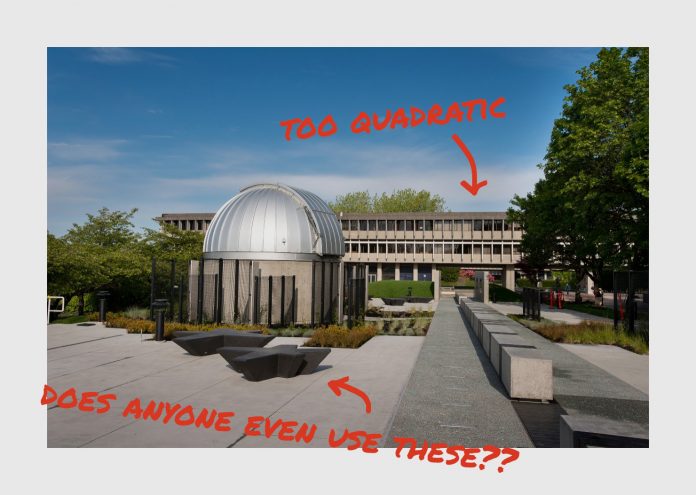
Over the coming years, SFU Campus Planning and Development, along with planning firm Urban Strategies, will be designing a new vision for Burnaby campus, and they are looking for student input.

     The plan, titled SFU Burnaby 2065, will provide a framework for the buildings, landscapes, public spaces, and on-campus movement of the next 50 years.

     The planning process began in early 2018 and will conclude in the summer of 2019. It will involve a series of open houses as well as an interactive survey students and faculty can use to provide their input.

     The survey, which takes approximately 10 to 15 minutes to complete, asks respondents how they get to and around campus, which places they enjoy on campus, and which aspects of the campus should change. SFU faculty, students, and employees are invited to fill out the survey at sfuburnaby2065.ca/survey until August 3. According to Urban Strategies representatives during an email interview with The Peak, there have been approximately 950 responses so far.

     The Peak conducted its own informal survey of two SFU students to see what they liked about the Burnaby campus and what could be improved. When asked what should be changed on campus, fourth-year history student Charlotte Scott replied that the school should implement “a more safe and direct passage from the SFU transportation centre bus stop to the school, one that doesn’t make you cross the street, or go through an underground parking, and more outside seating areas.”

     Her concerns about pedestrian safety were echoed by Urban Strategies, who identified “the Transportation Centre at Gaglardi Way and University Drive; the experience at the edges of the campus along the ring roads; or accessing the campus from parking” as areas needing improvement.  

     Second-year business student Omar Rasheed felt that “more paint and brightness on the university buildings, not just concrete” would make the campus nicer. Both Scott and Rasheed said that the area they liked most on campus was the reflection pond and surrounding area.

     According to Urban Strategies, the plan will address potential transportation improvements on the Burnaby campus by “better supporting the central spine with new secondary connections across campus,” as well as to and from campus by supporting projects such as the long-awaited gondola up Burnaby Mountain.

     While the effects of these larger-scale changes may not be felt by current students, the plan developed by Urban Strategies will also look to address issues that can be improved on a shorter time-scale, such as a lack of spaces for arts, culture, and recreation — “the spaces to support day-to-day community life.”

     SFU’s Burnaby campus design has won numerous awards, including the 2007 Royal Architectural Institute of Canada’s Prix du XXe siècle (20th century prize).