Home Blog Page 593

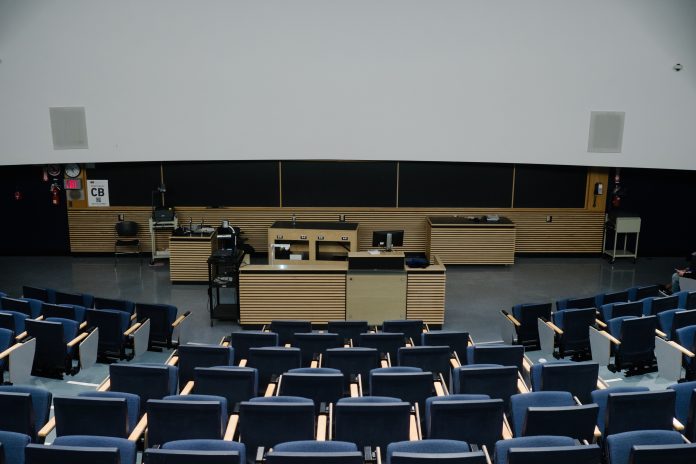
What grinds our gears: Burnaby campus’ constantly imperfect temperature

0
Photo by Azat Bayandin/The Peak

Written by: Michelle Gomez, Staff Writer

Most students would agree that the worst part about winter at SFU is getting off the bus at the top of Burnaby Mountain to temperatures significantly lower than where you boarded it. After walking from the bus to my classes, it’s usually a relief to walk inside a building and be greeted with the warmth of the great indoors. That is, until I walk into my lecture hall and feel like I’ve stepped back outside on the mountain.

It’s gotten to the point where I have spent eight-hour days at school without taking my puffer jacket off once. I don’t know much about the school’s heating system, but somehow the frozen journey feels like it never ends.

Believe it or not, this phenomenon is even worse in the summer. If I’m coming to school on a sweltering 30-degree afternoon, I’m most likely dressed for that temperature. I’m either forced to endure freezing arms and legs for my entire lecture, or bring an entirely different outfit just to wear in class. We all know that blasting the air con isn’t cheap, but it definitely doesn’t feel like our tuition fees go toward keeping us at the right warmth.

Political Corner: Pakistan is surrendering to religious extremists by detaining Asia Bibi

0
Photo by Arif Ali / Getty Images

Written by: Sakina Nazarali, SFU Student

Asia Bibi, a Christian woman in Pakistan, was accused of blasphemy by three women on June 14, 2009 for allegedly making defamatory remarks about the Prophet Muhammad (PBUH). Under section 295-C of the Pakistan Penal Code for defaming the Prophet (PBUH), the guilty party is deserving of a mandatory death penalty. As a result, Bibi has been residing on death row.

However, on October 31 of this year, Pakistan’s Supreme Court acquitted Asia Bibi. The announcement came as a victory for human rights activists, who claimed that religious minorities in Pakistan were frequently targeted with allegations of blasphemy in order to settle personal vendettas. After Bibi’s acquittal, Islamist hardliners like the Tehreek-E-Labbaik Pakistan (TLP) group called for nationwide violent protests.

Though the duty of a country should be to honour the Supreme Court, the Pakistani government went on to negotiate with the TLP, signing a document of surrender which demanded the Supreme Court to review a petition against the acquittal of Asia Bibi. The Pakastani government accepted an apology of the TLP for the damage caused by the TLP to citizens’ businesses and properties. Asia Bibi was then placed on an “exit control list,” preventing her from leaving the country.

By reviewing this petition and restricting her movement, Pakistan has shown that if extremists and hardliners gathering individuals and playing to extreme readings of faith, the state will settle to their demands. It’s frustrating to see its legal system being challenged by its religious leaders to this extent. Pakistan is opening a frustrating door where minorities can be persecuted on issues of faith, rather than fair criminal justice.

Multiple records broken at the Magnus Cup for SFU swim team

0
Many Magnus Cup records that were broken were already held by SFU athletes. (Photo courtesy of SFU Athletics)

From November 16 to 18, the SFU swim team travelled to Cleveland, Ohio to compete at the Magnus Cup. Multiple records were broken at the event, highlighting the importance of the event for qualifying to the NCAA Championships. The men finished in second place out of nine teams while the women finished eighth out of 13. Here’s how it went down.

Day one:

On day one, the men’s team made the 500-yard freestyle their own. With a time of of 4:26.55, Adrian Vanderhelm was awarded first place. That’s not all, however, as the Clan took the first three spots as well as six of the top eight at the event.

The team went on to receive two podium finishes in the 200-metre medley, where Gabriel Lee finished in first with a time of 1:50.16, and Rafik Jiwa finished in third with a time of 1:53.50. As a freshman, this was Jiwa’s first time competing at the Magnus Cup.

The men topped off these strong individual performances with a first-place finish in the 400-yard medley relay and second place in the 200-yard freestyle relay.

The highlight of day one for the women’s team was a fifth-place finish in the 400-yard medley relay.

Day two:

Day two began in exciting fashion, with Rolando Hernandez beating his previous meet record in the 400-yard individual medley. His time of 3:51.90 smashed his 2017 time of 3:55.03, and gave him a first-place finish in the event. Funny enough, teammate Collyn Gagne would’ve also beaten the previous meet record with a time of 3:53.65, but had to settle for second place.

Vanderhelm also got in on the record-breaking with a time of 1:35.60 in the 200-yard freestyle. Teammates Matthew Fuller, Mackenzie Hamill, and Kyriakos Papaggelis took home second, third, and fourth place, wrapping up a dominant display.

The men then worked together to break another record, and did so convincingly. Hernandez, Fuller, Lee and Vanderhelm combined for a time of 6:37.01 in the 800-metre freestyle relay, more than six seconds faster than the meet record they set last year.

On the women’s side, Jessie Gibson, Kaleigh Sharkey, Kristen Olvet and Sara Wheelen combined for a second-place finish in 800-metre freestyle relay with a time of 7:27.48.

Sharkey added on to this by getting an SFU record in the 100-yard butterfly, edging out Gibson’s previous record in the event by a one-hundredth of a second with a time of 53.82.

Day three:

On the final day of the event, the SFU swim team wrapped things up in style.

The men got the ball rolling by taking five of the top six finishes in the 1650 yard freestyle, highlighted by Hamill winning the event with a time of 15:23.8.

Vanderhelm decided he could do better, and set an all-time SFU record, as well as a meet record, with a time of 1:45.5 in the 200-yard butterfly.

Another SFU record was broken by Antonio Marino in the 200-yard breaststroke, who swam the event in exactly two minutes, 1.2 seconds faster than the time set by Julian Monks in 2012.

The team then combined their efforts to finish first in the 400-yard freestyle relay. Hernandez, Fuller, Lee and Vanderhelm combined for a time of 3:00.2.


Despite the fantastic performances, the men’s team finished the meet in second place, trailing only the hosts, Cleveland State University. The SFU women’s team went on to finish in eighth place. The University of Akron finished in first for the women.


“Best season ever” continues for SFU cross country at West Regional Championships

0
Look for top ten finishes from the Clan at this year's National Championships. (Photo courtesy of SFU Athletics)

This past weekend, the SFU men and women’s cross country teams travelled to Montana State University Billings to compete in the West Region Championships. Despite fighting harsh weather conditions, including snow, both Clan teams were able to place second. This marks the first time since 2014 that both the men and women’s cross country teams will be competing together at the National Championships.

“It was inspiring, for sure,” said head coach Brit Townsend when interviewed by The Peak. “We haven’t been able to qualify both teams [together] in the last four years [ . . . ] so this was pretty special.”

It certainly was. For the men, Junior Pierre-Louis Detourbe (31:06.36) led the way with a sixth place finish in the 10km race. Seniors Sean Miller (31:06.93) and Rowan Doherty (31:23.88) finished seventh and 12th respectively, while Junior Carlos Vargas (31:35.05, 17th) and Sophomore Aaron Ahl (31:40.81, 21st) wrapped up the top five runners on the men’s side.

All five runners finished within 37 seconds of each other, which is exactly the type of finish the Clan were hoping for, according to Townsend. The sixth and seventh runners were also important to the Clan’s success, even though their times didn’t count towards SFU’s final score. Sophomores Chris Sobczak (32:06.06) and Thomas Gallagher (32:19.20) both had top-50 finishes, which may have displaced the fifth runner on competing teams.

This strong finish by the men’s team, according to Townsend, motivated the women’s team to their second place finish. The team was not expected to finish as high as second, but despite the adversity, came up with arguably their best run of the season when it mattered most.

As has been the case all year, Sophomore Olivia Willet (21:18.31, fourth), Freshman Sophia Kaiser (21:26.04, seventh), and Senior Addy Townsend (21:41.21, 13th) led the way for the women in their 6km race. Junior Chelsea Ribeiro (21:58.97, 28th) and Senior Sophie Dodd (22:10.75, 33rd) wrapped up the top five finishes for the Clan. Impressively, all five runners finished within a minute of each other.

The team managed to narrowly defeat Chico State for the second-place finish, who were ranked #1 in the West Region for the majority of the season. The impressive finishes by Willet, Kaiser and Townsend were the difference, as all five Chico State runners finished in the top 22, but none finished in the top 13.

“We’re just local athletes working really hard,” said Townsend, noting the perseverance of the team despite the harsh weather. The team made a goal of making nationals back in training camp, and they were not going to let anything stop them. “It does feel like a best ever season, overall, at least since we’ve been in the NCAA.”

What’s next:

The Clan will regroup and prepare for the National Tournament in Pittsburgh, Pennsylvania on December 1. Coach Townsend has set top ten finishes for both teams as a realistic goal, but believes that both teams can do better, especially the men. “I think the men honestly have the ability to come in the top six if they do everything right, and that would be their best ever [finish]. That’s what we’re looking for – the best ever.”

New study finds universities depending more on contractual labour

0
(Chris Ho/The Peak)

Written by: Srijani Datta


The Canadian Center for Policy Alternatives (CCPA) released a report concluding that around 53% of all faculty appointments in 2016–17, made in different universities across Canada, were contractual.


Contract U Study

The study, Contract U, was released on November 1. It is the first ever data-driven investigation into how many contractual faculty jobs are offered by Canadian universities, where those jobs are, and which academic departments are tied to those jobs. Contract U found that in 2016–17, within the pool of contracted faculty, almost 80% of these faculty contracts were part-time.

The study was co-authored by Chandra Pasma, senior research officer with the CCPA, and Erika Shaker, a senior education researcher with the CCPA.

Appearing in the top eleven post-secondary institutes in terms of contracted hires were BC universities such as Emily Carr, with 74.48% of labour being contractual, and Capilano, with 69.75%.


Confusion with SFU data

In its first report, Contract U projected SFU at the top of the list of contracted faculty users with 78% of hired staff being contracted. Following the initial release of the report, SFU publicly commented on SFU News that the data in the report did not accurately reflect SFU’s hiring procedures.

“It seems that the data previously provided to the CCPA included categories of staff that are not faculty and did not include continuing faculty in non-tenure track appointments,” read SFU’s statement.

After the university reached out to the researchers, Pasma revised the findings, stating SFU used 28% contractual labour.

Pasma stated that the study is based on university’s responses to freedom of information requests, and that SFU had originally sent incorrect data.

“They included categories that should not have been included including tutors and markers. They did not include other faculty categories. It is very clear that number is wrong,” said Pasma to The Vancouver Sun.

Peter Keller, SFU vice-president, academic and provost for SFU, stated that SFU has contract faculty as a way to train doctoral students as educators, cover for faculty members taking leave, and bring professionals with hands-on experience in their field into the classroom.

Pasma also added that, barring SFU, no university has contacted her or Shaker to report any inaccuracy.


Study findings

The study concluded that the hiring of contractual faculty was mostly “a choice that is being made by the administration of universities,” and it is not significantly affected by other causes such as changes in the labour market changes, decline in public funding, or refusal of tenured professors.

Pasma informed The Vancouver Sun that “this is a permanent, long-term way of filling positions on a temporary basis.” Highlighting the decreasing security of university teaching jobs, Pasma continued to note that “this isn’t about short-term needs. It’s not about filing temporary absences of permanent professors. It’s not about quick responses to sudden changes in the market such as enrolment demands.”

Pasma stated that based on the data collected for the study, contract labour seems to be a cornerstone of faculty-hiring practices on university campuses.

Pasma highlighted some issues that over-dependence on contract faculty creates for the faculty themselves. She explained that while it is hard for universities to fire tenured professors, firing contracted faculty only requires that the university not renew the contract.

The study further stated that “when instructors are only informed a few weeks — and in some cases, only a day or two — before the semester begins that they will be teaching a course, it is difficult for them to ensure that course material is up-to-date and that all necessary resources, such as textbooks, are in place for students.”

Contract U also emphasized some of the negative impacts contractual hires can have on students, including the difficulty of getting reference letters from contracted professors. As contracted faculty often lose their email accounts after their contracts end, students looking to get reference letters from them are at a disadvantage.

Pasma acknowledged that the present report was limited as it did not include information from every post-secondary institute in Canada. Nonetheless, in the wake of the report, both authors recommended addressing conditions such as poor labour laws and declining public funding.


With files from The Vancouver Sun, Canadian Centre for Policy Alternatives and SFU News.

World News Beat

0

Written by: Sakina Nazarali, SFU Student


New drug proves itself a 99% effective cure for HIV/AIDS

After the first clinical trial of the drug Gammora, results indicate that in four weeks, it can destroy up to 90% of the human immunodeficiency virus (HIV) within four weeks. Upon being mixed with another antiretroviral treatment, the drug was then shown to eliminate 99% of the disease within another four weeks.

The study was conducted by researchers from Zion Medical, which is a biotech company from Israel, and the Hebrew University of Jerusalem. The head of development at Zion Medical, Dr Esmira Naftali, said that Gammora’s impact was assessed at Ronald Bata Memorial Hospital in Uganda. The test  involved randomly assigning different dosages of the drug to nine patients, over a period of four to five weeks.

The study shows that Gammora destroys infected cells while leaving healthy cells intact. Previous drugs used to treat HIV, known as antiretroviral drugs, cannot do this; instead, they stop the virus from spreading to more cells.

Gammora comes at a time when 36.9 million people live with HIV globally.

With files from PR Newswire, Daily Nation, and Pulselive.co.ke.


Armed men abduct students in Bamenda, Cameroon

In a boarding school in the west of Cameroon, 78 students, along with their principal, were kidnapped on November 4.

As of November 7, the kidnapped students were released, although the principal and a teacher are still being held captive.

There is confusion with regards to the identity of the abductors. Authorities of Cameroon have made allegations against Anglophone separatist militias. These groups are supposed to be fighting for English-speaking regions in Cameroon to secede and form an independent state called Ambazonia.

However, the Ambazonia International Policy Commission (AIPC), which is an Anglophone group, has denied the involvement of any separatists in the kidnapping.

With files from New York Times and The Telegraph.


In Beijing, Bill Gates beholds a jar of poo

Billionaire and Microsoft founder Bill Gates stood in front of a crowd at the Reinvented Toilet Expo while carrying a jar of human feces to showcase reinvented toilet technology.

“I have to say, a decade ago I never imagined that I’d know so much about poop,” joked the billionaire, who has since spent over US$200 million on researching the field.

The expo hosted many kinds of innovative sanitation technology, each designed to partition liquid and solid waste while removing harmful byproducts.

According to the World Health Organization (WHO), 2.3 billion people in the world are lacking basic sanitation facilities — resulting in public defecation.

“And that’s what kids when they are out playing, they are being exposed to all the time, and that’s why we connect this not just with quality of life, but with disease and death and with malnutrition,” noted Gates.

Deadly diseases linked to poor sanitation include cholera, dysentery, and diarrhea. To emphasize the uncleanliness and dangers of unfiltered feces, Gates looked at the jar and stated that it could contain “as many as 200 trillion rotavirus…20 billion Shigella bacteria, and 100,000 parasitic worm eggs.”

According to the United Nations International Children’s Emergency Fund (UNICEF), the annual cost of poor sanitation amounts to the deaths of about half a million children under the age of five and US$200 billion a year in healthcare costs and lost income.

With files from The Irish Times and BBC News.


Japan sees suicide rates amongst young people hit a 30-year high

Child suicide rates in Japan have been deemed the leading cause of death amongst young people in the country.

    In the 2016/17 fiscal year alone, 250 children ranging in ages from elementary to high school reportedly took their own lives. This number is the highest it has been since 1986. A larger percentage of these students were students of high school age.

In 2015, a study held from 1972–2013 found that national child suicide peaked massively on September 1: the start of the second term of the Japanese school year. Academic pressure has been determined as one of the possible causes of increased suicide rates, among others such as bullying, family problems and social anxiety.

Overall suicides in Japan in 2017 accounted for 21,000 deaths — about 58 per day.

If you are experiencing emotional distress and would like to reach out, you can contact SFU Health and Counselling through 778-782-4615, or drop in in-person at Maggie Benston Centre, Room 0101, at the bottom floor. A 24/7 calling line is also available at 1-800-784-2433 (in relation to suicide) and 310-6789 (no need to dial area code) for emotional support, information and resources specific to mental health provided by BC Provincial Health Services Authority.

With files from BBC News and Japan Today.

SFU’s newest accredited sport: professional transiting

0
Illustrated by Marissa Ouyang

Written by: Dhruv Taware

Since its inception, SFU has been the undisputed best university to ever be located on top of Burnaby Mountain. One of the main reasons for this popularity is the university’s association with sports; the school is popularly known as “Canada’s NCAA University.” However, more often than not, only a small fraction of the university’s students care very strongly about our sports teams. In order to eliminate this distance, SFU Athletics is planning to accredit a new sports team for 2019: public transiting.

Professional transiting (PT) is a New Age millennial sport which is taking metro cities by storm. It is hard to pinpoint its origin, but some say it has been around for decades, and they attribute its newfound place in mainstream awareness to recent spikes in gas prices and parking rates.

Illustrated by Marissa Ouyang

PT is an individualistic strategy sport; the primary objective of the sport is to get from point A to point B as fast as possible. The players are judged based on multiple categories: time taken, elegance, and number of transfers (nobody likes to switch).

Just like most sports, PT players are rewarded when they show some panache. Players usually do this by showing competence in balancing, awareness, and intimate knowledge of their local transit system. PT players generally compete during rush hours, as this tests their ability to find a vacant seat or balance between the narrow aisles without intruding on anyone’s personal space.

Illustrated by Marissa Ouyang

The sport has a lot of potential, and it is gaining traction in the international community. Some are even calling it “Parkour but less flamboyant and easier.”

Given the number of students who will now be able to apply for sports scholarships, it is clear that SFU is investing in the future. Students applying to the team said they have been practicing very hard.

“I take the B-95 from SFU to downtown everyday at 4 p.m,” said one student who is clearly in it to win it.

The inaugural world PT championships are just around the corner, making this sport one to keep an eye on.

Grad Minutes

0
Illustration by @Reslus

Written by: Youeal Abera, Staff Writer


Revisions in the cards for SFU’s practices relating to research personnel

At the latest Graduate Student Society (GSS) Council meeting, Council spoke with members of SFU’s senior administration about students’ frustrations towards SFU’s policies on research personnel.

Two administrators spoke at the meeting: Dugan O’Neil, SFU associate vice-president, research, and Sandi de Domenico, SFU associate vice-president, human resources. They highlighted that SFU’s current employment practices make it so that there are 1,700 grant-funded research personnel. These personnel, instead of being employed by SFU, work under principal investigators, who are the leading researchers of university grant projects and holders of institutional-provided grants. Grant-funded personnel cannot have their contracts extend beyond a year, and they lack a number of SFU’s employee benefits, such as access to the university gym.

Due to this policy, SFU has fallen behind 13 of the U15 Group of Canadian Reseearch Universities, a group of prestigious research universities, as 71% of those post-secondary institutions employ research personnel directly, allowing them access to their school’s benefits and resources.

Dugan and Sandi suggested a number of solutions to remedy this policy.

Firstly, they proposed that the R50 — Research Personnel — policies be revised so that 1,000 research personnel are employed by SFU and provided with access to the school’s benefits.

Secondly, it was proposed that the principal investigators be supported through guidance, similar to how SFU guides supervisors. This involves helping them adhere to clearly established obligations that they must maintain for their employees (such as informing their employees of the services and benefits they have access to at SFU).

Lastly, Dugan and Sandi proposed that all research personnel be better informed on what rights and services are available to them and what obligations they have as staff.

Dugan and Sandi noted that they had already spoken with a number of groups who hope to receive assistant in bringing their propositions into fruition. Currently, they expect that the plan to reform SFU’s research personnel employment practices will be executed by September 2019.


Students express concern over proposed tuition increases

Madison Harvey, a member of the SFU Psychology Graduate Caucus, voiced a concern on behalf of many students within her department regarding SFU’s proposed tuition fee raises.

“We have just had a couple of questions from those in our department about how we can pass on our concerns about the new budget consultation — specifically, how we may be able to do that anonymously,” said Harvey.

Harjap Grewal, GSS advocate and policy advisor, responded that a method for students to provide discreet feedback about the suggested budget was currently under development.

Grewal mentioned that further information on the proposed budgets and student feedback would be posted on the GSS website before the final budget is approved.

“We sort of got this timeline until about February where we’re expecting the final approval of this budget,” said Grewal.

Grewal noted that the decision to solicit feedback online was made to let students raise questions and concerns anonymously.

Grewal also mentioned that disseminating information and receiving feedback through a website would allow the GSS to gather data regarding how many questions are being asked about the proposed budget consultation, as there is currently no such indicator.


Budget for new printer

Pierre Cenerelli, GSS Executive Director, stated that the GSS is looking to purchase a new printer. The 10-year-old GSS printing machine was within close proximity of being rendered obsolete, he said.

Cenerelli announced that the budget for the new printer was $5,000 and that the Council was aiming to buy a used machine.

Quran’s “Blacks for Trump” Twitter scam is far more hilarious and justified than your standard online deception

0

Written by: Youeal Abera, Staff Writer

The online world is deeply unsafe, and it’s important to be skeptical of what you read on social media. After all, the Internet is filled with liars, scammers, and catfishers. However, depending on who the circumstances and victims are, this isn’t necessarily a horrible thing.

This past week on Twitter, a young African-American woman named Quran has created one of these  example of this by tricking a number of Trump supporters into giving her a huge amount of money before refunding it.

On October 27, Quran tweeted an image of herself wearing a Make America Great Again hat with the caption, I will not hide any longer, the left has made us feel as if us black republicans should hide!! but not anymore!! #BlacksForTrump #WalkAway #MAGA”. Four days later, she made a follow-up tweet claiming her parents had kicked her out and stopped giving her money, and requested donations through a GoFundMe page to help her with tuition.

However, Quran wasn’t really kicked out of her parents’ home. As a matter of fact, she isn’t even a Republican.

She later put out a video explaining what she’d done and tweeted about her actual opinions on Trump and the US Republican Party. She claims to have only made around $200 through it, but she managed to get quite a lot of attention. Afterward, she refunded the money she had made through the page, saying in an interview with New York Magazine, “I just felt really weird about taking their money. This could go south really fast, I just decided to refund everyone and give their money back,” which she did.

Admittedly, I find it both humorous and impressive that Quran has managed to pander to these Republicans on Twitter simply by pretending to be just like them. Nevertheless, upon thinking about her actions, I realized that it’s important to ask if what she’s done is anything different from the countless other deceptions of online scammers.

The difference here is that she did this to make a fool out of an extreme and disrespectful political group. She didn’t aim to make a living out of this deception, just some laughter at the expense of people on social media.

However, even if Quran did keep the money to go on a shopping spree or if she decided to splurge at a fancy restaurant, I don’t think this would be that bad given how she deceived them in the first place. Quran could have easily published a disgusting and immoral story that fabricated the status of her health or the death of her loved ones, but she simply asked for help with her college fees (something she really did need help paying for). The lie she chose to tell in this venture is not significant enough to me to feel malicious.

Outside of those she deceived, though, her Twitter antics can also be appreciated for how they exemplify how truly easy it has become to make a quick dollar on the Internet.

Long gone are the times where we would receive emails from “Nigerian Princes” asking us to donate money so they could save their kingdoms from distress. Especially as a result of fundraising sites like Gofundme, it has become so incredibly easy for social media users to ask for money without sufficient oversight to prevent people from lying to get it. By not taking the money, Quran has managed to teach a relatively harmless (though vivid) lesson in how much trust we can give to people online.

Say what you want about Quran, but you can’t question her intelligence or creativity with this act. As college students, I think we can all appreciate this.

Save “The Resistance” as a title for those who are actually resisting

0
Photo illustration by Stephen Gregory / Maclean's

Written by: Gabrielle McLaren, Features Editor

I am such a specific brand of nerd that one of my most bumpin’ group chats is solely dedicated to Canadian history and political trivia. Boy, were we excited when the Maclean’s December cover was revealed, showcasing old white male conservatives banding together with an edgy, controversial title.

In case you missed it, the Maclean’s cover features a group of five middle-aged white men wearing suits and ties in various shades of blue. If you’re familiar with Canadian politics, you’ll recognize them as a variety of Conservative party leaders: Saskatchewan’s premier Scott Moe, Alberta’s United Conservative Party’s leader Jason Kenney, national Conservative Party leader Andrew Scheer, Manitoba Premier Brian Pallister, and Ontarian Premier Doug Ford.

Emblazoned over their chests in blue are the words: ”The resistance: A powerful new alliance of conservative leaders is taking a stand against the Liberals’ carbon tax plan. Welcome to Justin Trudeau’s worst nightmare — Yes, that last part is literally bolded.  

Since its publication, the cover has led to quite a bit of entertainment. Vice ran a list of alternative cover-text ideas — such as “When you think Swiss Chalet is ‘ethnic food’” and “So who here is going to fuck my wife?” — a group of feminist Ontarian MPPs parodied it by recreating the photo with themselves, and parliamentarians were joking in the House of Commons about being called “the resistance.”

But in the midst of all of this, I think it’s important to consider that the Maclean’s cover, laughable as it is, is actually co-opting minority language to legitimize political privilege. The idea of “resistance” in today’s politics evokes Pride, Black Lives Matter, or the March for Our Lives movement. In other words: people whom our current system oppresses and silences, not people who happened to lose an election.

The piece itself is not as bad as this ridiculous cover made it sound. Its actual title (“A carbon tax? Just try them”) is far more representative of the writing, and the piece overall is a lot more balanced than I anticipated.

But the thing about covers is that they’re supposed to give your readers insight on the piece. This cover does quite the opposite: it acts more as deception and praises these men more than they deserve, in the piece and in general.

Scott Moe made the point in an interview with CTV Regina that if this story ran a year ago, the Maclean’s cover would’ve featured fewer voices. He’s not wrong: Doug Ford, for example, only just came to power in Ontario over the summer and has since pulled the province from the cap and trade market, a regulation deal that limited how much pollution companies could generate.

This movement to oppose a carbon tax plan is certainly worth covering because it’s absolutely making waves in politics and our planet’s health. But is it worth calling “the resistance”? I’m sorry, but these people aren’t out here stealing Death Star plans. This has been a long-running discussion, not a looming threat that needs to be “resisted.” Liberals have been talking about instating a national carbon pricing plan since 2015, and at the time, 56% of Canadians supported a federal carbon taxing program.

Plus, the public opinion regarding the carbon tax is becoming much more nuanced over the years, as stances currently vary from province to province. Liberals compensated for this back in 2017 by being clear that this tax plan wouldn’t apply to provinces who already had their own similar policies in place, such as British Columbia. This isn’t a battle of good and evil in a way that would garner a “resistance”; it’s a greatly different issue depending who you talk to, and where they’re from.

While relationships between provincial and federal governments are complicated, the fact that the 2019 deadline is coming up doesn’t give opponents of carbon pricing the right to play victim and embolden themselves with titles like “the resistance” because they played deaf. “Resistance” speaks to digging your feet into the ground against injustice: not against what a democratically elected government is doing as per its electoral promises.