
Silent protest takes over SFSS Meet and Greet event
Written by: Gabrielle McLaren, Editor-in-Chief and Gurpreet Kambo, News Editor
Photo: Chris Ho // The Peak
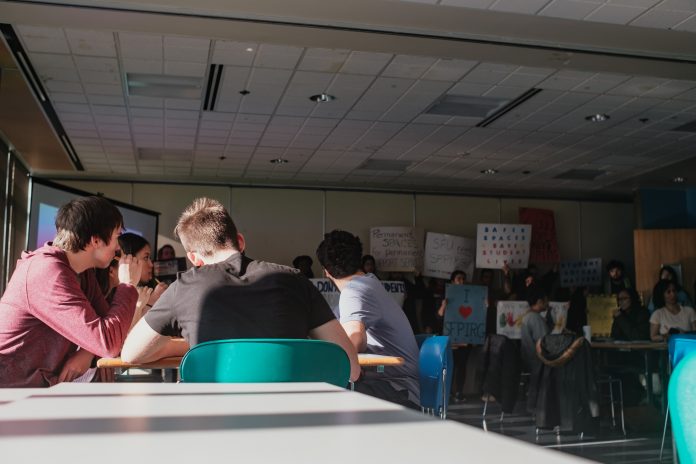
On Friday November 22, the Simon Fraser Student Society (SFSS) hosted a Meet and Greet event for Club executives. Silent protesters arrived in reaction to the Board defeating a motion on November 1 to house CJSF, Embark, SFPIRG, and SOCA in the Student Union Building (SUB).
Club executives had a chance to “meet the SFSS staff and Board members while enjoying a free lunch,” and enjoyed “the opportunity the ask to [sic] questions, give feedback, participate in icebreaker games and get more resources,” as advertised on Facebook.
A group of about 15 protesters arrived shortly after the event started and lined the walls of MBC 2294 with posters, boasting slogans such as “Student leaders don’t evict students” and the names of board members who did not support the motion. Protestors outnumbered club executives in attendance, and despite multiple Board members being present, they did not interact with the protestors.
Despite the protestors’ silence, even when they were approached by curious club executives, the air was tense as the event went on as scheduled. The spokesperson for the protestors stepped outside to speak with media on a few occasions.
After the event, The Peak asked multiple SFSS board members for comment on the silent protest, though all declined to comment.
Professors form “OK Boomer” support group as millennial students grow stronger

By: Gabrielle McLaren, Editor-in-Chief
BURNABY, B.C. — SFU Security has confirmed an increasing amount of calls from tenured professors regarding threats to their superiority in the classroom, as early as November 7.
“At first I thought I was just slipping because of the carpal tunnel syndrome I have from years of groundbreaking research and publishing,” economics professor Al Douglas, who has personally placed nine distress calls, told The Peak. “Then I realized I was just as terrifyingly stern and intimidating as always in my lucky tweed jacket. It was the millennials. Something about them had . . . changed.”
“It didn’t make sense at first,” said the first SFU Security employee who would talk that The Peak could find. “The first call came from an ENGL 100 lecture, a class we didn’t even know students needed to attend to pass. And yet the professor sounded scared for their superiority complex.”
When personnel arrived on the scene, they found the professor struggling to explain to a blue-haired student how The Lord of the Flies, a book about a cluster of middle-to-upper class white British school children, offers the sharpest insight into the heart of humanity.
“OK Boomer,” the student eventually shrugged before swinging her pin-studded backpack on her shoulder and calmly following SFU Security out.
According to Douglas, he has been “Boomer’d” three times since the situation began. The first time had been after he’d refused to move a midterm scheduled during a climate march. The second time, he had expressed his deep-set anxieties about political correctness stifling the bulk of his personality. The most recent came after he’d advised the class that a few summers working at the club house could comfortably fund post-secondary education and at least one raunchy spring break trip.
Reportedly, the reporter that The Peak sent to Douglas’ office hours was the first person under the age of 40 to contact him since the incidents began.
“It just doesn’t feel safe to go out there anymore. The kids these days with their ripped jeans and almond milk. . . you can tell they read The Hunger Games or something. Someone told them about postcolonialism and it’s been downhill ever since,” Douglas confided to our reporter. “But I figured that I couldn’t be the only one that this is happening to. That’s how the group got started.”
According to Douglas, a group of tenure professors from multiple faculties have started meeting in an unspecific Burnaby campus location at an unspecified weekly day and time to help each other work through the advent of OK Boomer. While members aren’t sure how to cope with their students’ uprising and can’t figure out how to use TikTok to fight back alone, knowing that they’ll spend an hour without having to challenge their worldviews is a relief.
“We call it White Tower Anonymous. We take turns bringing snacks,” Douglas said. “We spend time looking through the SFU library catalogue for academic proof that trigger warnings are useless — aside from highly specific cases of ageism, such as ours. Last week, someone brought a very well-written op-ed about the millennial victimhood complex. It wasn’t peer-reviewed, but nonetheless made some fascinating observations.”
Douglas shared some additional insights of his regarding how self check-outs were at the root of millennial entitlement, but we ran out of space to print the rest.
CONFESSIONALS: I was the student who reminded the teacher of a deadline

Written by James Conn, SFU Student
Before coming to SFU, I attended Douglas College. On one fateful day, in a political science lecture, our class was eerily awaiting the professor to spring a quiz on us. However, he seemed to have forgotten, until that one student . . . yes, you know the one . . . reminded him. Needless to say, I was pissed.
Unfortunately, semesters later, history would repeat itself.
Only this time, it wasn’t some random student screwing over the class.
It was me.
Yes, I was that student who reminded the teacher of a deadline they forgot.
Recently, I got an email from my professor titled “Tutorial Cancelled.” Fairly self-explanatory. Our tutorial had been cancelled because the TA couldn’t find her way out of the depths of bankruptcy that morning. And . . . for some bizarre reason, I decided to email the prof to remind him that we were supposed to hand in our term paper proposals at that tutorial?
You may be wondering why I made this awful mistake. I think I might’ve been possessed by the spirit of the Douglas teacher’s pet I vowed revenge on. I heard he met an untimely demise that day . . . but that’s another confessional for another time.
Allow me to walk you through the events as they transpired. You see, I set reminders for all my assignments in my phone — reminders which I usually read, snooze, and then ignore. So I received one for the proposal’s due date 24 hours ahead of time, as per usual. I distinctly remember thinking to myself, James, you’ll finish it later in the day, when you have time. Oh, I’m such a good liar . . .
I ended up waking up at 5:30 a.m. the next day to complete the assignment before my 11:30 a.m. tutorial. I cooked up the best work my sleep-deprived brain could manage, and I was ready to hand it in — when I received the email from the prof at 11:07 a.m.
Hi everyone,
Your TA is unable to come to campus today. She’s gone missing somewhere in the depths of bankruptcy again, and the school has yet to extract her. Sorry for the late notification. This is just what happens when you engage in labour disputes, I guess.
Enjoy your weekend.
Best regards,
[redacted]
I remember my fingers moving, my skin faintly glowing. The ghostly entity possessing me was writing back.
Hey [redacted],
Thank you for the notification. However, today our tutorial was supposed to hand in our term paper proposals. I would hate to have to postpone this till next week. I strongly encourage you to uphold the sanctity of our assignment’s deadline for the benefit of the whole class.
Thank you,
Totally, for sure, definitely James
Almost immediately after this, he emailed the whole class back . . .
Hi everyone,
Apologies for forgetting about our assignment’s due date! Luckily, a heroic student reminded me. Therefore, I will be down there at 11:30 a.m. Please bring your assignments as originally planned. 🙂
Best regards,
[redacted]
Immediately after receiving this troubling news, I felt devastated. After all, it was I who had inflicted this upon myself and my classmates.
Yes, I had been possessed by a spirit who was purest evil long before I had, um, vowed revenge on him and later heard rumours that he’d coincidentally died an untimely demise hours later. But. If I had not experienced that momentary lapse in control, I could have saved our whole tutorial the hassle of handing in our term paper proposals. I was just too weak: too much salt, not enough holy water.
If anyone from the tutorial is reading this, I sincerely apologize. I only hope that my mental anguish, spurred both by my guilt and by the screeching of the damned currently living inside me, offers you a modicum of peace.
Disney+ makes an impressive debut with its extensive and diverse catalogue of content

By: James Conn, SFU Student
Watch out Netflix — another contender for the top streaming service has arrived in the form of Disney+. The highly anticipated streaming platform launched on November 12, and according to reports, it has already surpassed 10 million subscriptions on the first day of its launch.
With that in mind, you may be wondering if Disney+ is worth it. And the answer is simply: yes. If all you’re looking for is a glowing endorsement of this service, then you’ve definitely found it here. Additionally, if you also need some convincing of its value and its available content, keep reading.
Although Disney+ does not boast the same extensible size as Netflix’s library at this point, it makes up for it with considerable fanfare due to the nostalgic Disney brand and their vast array of recognizable franchises. Here is what Disney+ offers at launch:
When first delving into the platform, navigationally the layout is clean and its titles are showcased clearly. The main screen highlights different categories, each with their own movies and TV shows. These categories are Disney, Pixar, Marvel, Star Wars, and National Geographic.
National Geographic contains nature series and documentaries such as Gordon Ramsay: Uncharted, The World According to Jeff Goldblum, and the Oscar-winning rock-climbing documentary Free Solo.
The Star Wars category of course includes most of the Star Wars films and TV series. Additionally, The Mandalorian, the first live-action Star Wars show created specifically for this platform, is featured prominently.
The Marvel category offers many of the Marvel Cinematic Universe (MCU) films, including the recently-released Avengers: Endgame and Captain Marvel. Worth noting is that the Sony-produced Spider-Man: Homecoming and Spider-Man: Far From Home are excluded due to legal reasons. However, 16 of the 23 MCU films were available at launch. Numerous animated and live-action TV series made throughout the years are also available to stream, such as X-Men: The Animated Series (1992) and the Spider-Man (1994) animated series.
Moving on to Pixar, most of the films are here and ready to be (re)watched. Almost everything from Toy Story to Coco is available. Additionally, Pixar shorts like Jack-Jack Attack and Bao are here to make you laugh and cry. Brand new Pixar originals are also included on Disney+, available exclusively on the platform.
Finally, Disney+ will obviously contain a lot of well-known Disney movies and television shows. There is also a lot of content that people might not necessarily associate with the Disney brand such as The Chronicles of Narnia, Freaky Friday, The Simpsons, and Pirates of the Caribbean. A large variety of contemporary Disney Channel original movies and TV series are also available, including High School Musical, Camp Rock, Hannah Montana, and The Suite Life of Zack and Cody. Old school films from the Disney Vault like The Lion King, Aladdin, and Beauty and the Beast were probably at the top of a lot of viewers’ Disney+ wish lists, and they’ll be happy to find them here under the Disney category.
It is important to note that titles not seen on the platform at launch will be rolled out over time, in addition to new releases being added after they’ve been released on home video. Most notably the eight highly anticipated Marvel series and the three new live-action Star Wars series created specifically for Disney+ will be coming later on down the line. Newer movies such as Frozen 2 and Star Wars: The Rise of Skywalker will be available on the platform after their theatrical and home video releases.
All of this may be very impressive, but it’s worth mentioning that the platform has experienced a number of bugs and glitches, with many users experiencing error messages. Although these errors are no doubt frustrating, it is not unforeseen for a new service to be introduced with some flaws.
When it comes to the “streaming wars” between Netflix, Amazon Prime, HBO On Demand, and countless other services on the way, some will rise to the top, and others will sink to the bottom in this over saturated market. Disney+ will undoubtedly prove itself to be a strong contender in the race due to its brand recognition, its vault of content, and its recognizable titles. For Disney fans, a Disney+ subscription is definitely worth the cheaper-than-Netflix price. Throw in the Marvel and Star Wars content that you know and love, as well as all the new original content on the platform, and this is clearly a valuable package to supplement — or even replace — your existing streaming services.
Dog Therapy helps stressed students during exam period

By: Jess Dela Cruz, News Writer
“Woof woof! Arf arf arf!” said Beatrix the dog in an exclusive interview with The Peak. “Grrr, woof woof arf!”
Beatrix was one of many dogs present at SFU’s regular Dog Therapy event, hosted by SFU’s Health & Counselling Centre at Surrey campus on November 12 and 13.
Typically held around exam season, Dog Therapy is a two-hour therapy session that provides students the opportunity to wind down and de-stress by cuddling puppies and senior dogs. In partnership with St. John Ambulance, volunteers brought their dogs for students to interact with to help them calm down during this ruff time.
Sarah Saghah, the Marketing & Communications Coordinator at SFU Health & Counselling, recounts the history of Dog Therapy in an email interview with The Peak. It began in 2012 where the Director of Health & Counselling at the time brought his dogs to SFU’s Indigenous Student Centre; this received a highly positive response from staff and students there. Following this occurrence, the seed was planted for what is now Dog Therapy. According to Saghah, the purpose of the event is to “gather students together in a positive environment where they can spend time with fluffy friends (dogs).”
St. John Ambulance’s website explains that “Therapy Dogs can help meet the need for physical touch, as stroking and touching a dog has been proven to lower blood pressure, calm people who are agitated and refresh the mind of those who are confused.”
Beatrix’s mom Elise McKenna volunteered to bring her dog to participate in the event. After retirement, Mckenna decided to do volunteer work with St. John Ambulance. She believes dog therapy is not just beneficial for students, but for volunteers and animals as well. She sees the positive impact dog therapy has on Beatrix, her standard poodle.
“One thing for poodles is that they are very intelligent,” McKenna explains. “So, having different stimulations is very good for them. She’s going to be exhausted over this. She has to think, she has to smell, she’s paying attention.”
The Peak asked students in attendance the reasons they felt compelled to attend the event.
Katrien Jacobs says: “I’m here because I love dogs a lot. I have a dog back home which is in a different province from here. And I haven’t seen my dog in so long [ . . . ] so I miss them so much and being able to interact would bring so much happiness to me.”
Therapy dogs not only attend events like these, but also visit senior homes as well — like one of the volunteers Sylvia Smoliga and her three-year-old French Bulldog, Fern. For Fern, the training never stops and she is constantly learning.
“The more regularly you do this, the more used to it the dog gets,” Smoglia explains.
As Smoliga speaks with The Peak, the sounds of high-pitched “aww”s and “oh my gosh, she’s so cute” fill the Dog Therapy space. As these dogs are well-trained, you don’t hear many barks or see them chase one another. In a safe and controlled environment, these dogs are extremely well-behaved and capture the attention, hearts, and Snapchat stories of students.
Smoliga continues, “Sometimes they have a tendency to just get overly excited. It depends on everyone else’s energy, but ultimately you want to keep them as calm as possible, as the handler. So you always have to keep control of the dog and make sure they are not scared, skittish, or anything like that, that process is ongoing – it never stops.”
She adds that, “as soon as [Fern] puts on her little bandana and collar on, it’s like she knows she’s working.”
10-year-old Havanese, Oliver, tried his darndest to get into The Peak. He stood on his two hind legs, twirled, and told The Peak excitedly, “Yip! Yip!”
But when asked to give paw, he stayed silent, ignoring the treat on offer and went looking the other way, as this trick was rather beneath him even to get into The Peak. “It’s not like it’s Rolling Stone or something,” he appeared to say, to The Peak’s disappointment.
The next dog therapy will be at the SFU Vancouver’s Teck Gallery Lounge on November 26 & 27 from 12:00 p.m. to 2:00 p.m.
SFU Research Assistants successfully unionize after three month campaign
By: Gurpreet Kambo, News Editor
Research assistants (RAs) at Simon Fraser University have successfully unionized with SFU’s Teaching Support Staff Union (TSSU). Though RAs are an important part of virtually every research university in Canada, SFU’s RAs are the first in Western Canada to form a union.
Previously, the TSSU represented teaching assistants and graduate facilitators of the Student Learning Commons (SLC). The campaign to unionize RAs was publicly announced in November of 2019, as previously reported by The Peak.
The successful campaign ensures that the approximately 1,500 RAs at SFU will now be formally represented by TSSU. The campaign required 45% of RAs at SFU to sign a union card by November 20, after which the BC Labour Relations Board would hold a secret-ballot vote for RAs to vote on unionizing. Over 900 of SFU’s RAs signed on to support the initial step towards unionization.
A joint statement issued today by SFU and TSSU stated that SFU would voluntarily recognize TSSU as the official union for all RAs, allowing them to skip the requirement to hold a vote.
According to a press release issued by TSSU: “RAs at SFU are often denied formal, written contracts and struggle with inconsistent pay, job insecurity, overwork, and substandard or dangerous working conditions. RAs have regularly reported being required to work 50+ hour weeks in addition to their academic commitments.”
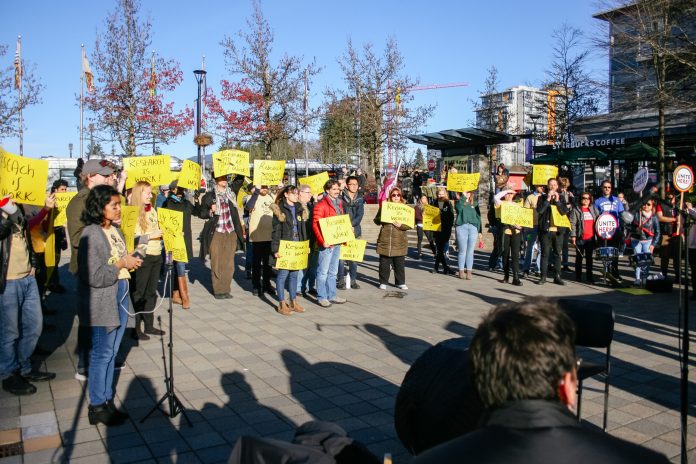
On Thursday November 20 at 1 p.m. a victory rally was held at Cornerstone on SFU’s Burnaby Mountain to celebrate the campaign. There were many speakers at the event, including Vancouver City Councillor Jean Swanson, Simon Fraser Student Society President Giovanni HoSang, fourth year First Nations Studies major and RA Alison Wick, TSSU Coordinator Alicia Massie, TSSU Organizer Jade Ho, representatives from BC Government and Services Employee Union, and Unite Here. HoSang led the large crowd in chants, and there was later drumming and a saxophone being played to celebrate the historic win.
A pamphlet for the unionization campaign described the benefits of unionization as: “Protect[ing] good working conditions and relationships; advocat[ing] for vulnerable and overworked RAs; improv[ing] the working lives of every RA at SFU.”
“Research is work,” says RA and TSSU organizer Jade Ho, “We believe all workers at SFU should be granted basic employment rights, and it is only by unionizing that we as RAs can guarantee these rights for ourselves.”
SFU Pangrams to Test your Fonts
Written by Lubaba Mahmud, Staff Writer
We all know the classic sentence which uses all 26 letters of the alphabet: “The quick brown fox jumps over the lazy dog.” But this is too damn generic. Sure, there are several other pangrams floating around the Net — “sphinx of black quartz, judge my vow” recently got 15 minutes of Twitter fame, despite having lived on Wikipedia for a while — but those don’t quite scratch the Simon Fraser itch. Here’s five SFU-themed font testers to celebrate our very apparent school spirit.
- Students throw extra BBQ party after SFU vows to replace McFogg mascot with Zajoon the chonky raccoon.
- Xejpah loves SFU Residences for its QUALITY meal plan, BEAUTIFUL construction views and KING-SIZE rooms.
- A SFU XMAS wishlist: shiny gondolas, nap pod to catch some Zs, and quick java, bruh.
- Students hijack university with iClicker after realizing that popular science req BPK 140 is full next term — even before enrollment begins.
- Criminology student drops out after boring professor Jacquez reveals that The X-Files and Sherlock will not be shown in class.
I visited all the bathrooms on every SFU campus so you don’t have to
By: Marco Ovies, Staff Writer
As someone who suffers from lactose intolerance but still eats an insane amount of dairy, I consider myself a sort of bathroom connoisseur. I visited every (men’s) bathroom on all three SFU campuses and compiled a guide of the nine best and three worst places to take a load off (if you know what I mean).
The Best Bathrooms: The good, the great, and the gorgeous
- Fifth floor of the Academic Quadrangle (AQ) (Nearby: AQ 5009)
This is probably the nicest bathroom you will ever visit on Burnaby campus. It features gorgeous open windows which offer natural lighting and provides a view of the AQ pond. You can watch the first years run to their classes while you do your business in a stall that has barely been used. Visit early in the day for the best experience as this bathroom sees slightly more traffic after lunch hours.
Tags: Poo with a view, squeaky clean, wheelchair accessible
- Harbour Centre’s all genders bathroom (Nearby: HCC 1260)
This is probably the most modern bathroom on the entire list. There is a full-length mirror to take all the selfies you could ever want and each stall is accompanied by a full door, meaning no awkward gaps for people to sneak a look. The toilets are clean enough to actually sit on, and there are even cute little plants as decor. To someone who is not used to using an all genders bathroom, it might be a bit shocking — once you get used to it, this is an amazing bathroom experience.
Tags: Full door who needs more?, accessible, inclusive
- Sustainable Energy Engineering Building (Nearest location: EB3001)
I was excited about trying this bathroom out since it’s new. And let me tell you, it did not disappoint. Its white and futuristic design perfectly matched the aesthetic of the entire building. The lighting, plus the full-length mirror, was perfect for showing off my amazing fit for that day. In addition, this bathroom included the fancy new Dyson sinks with the hand dryers on the side. It was so efficiently designed that I was in and out of this bathroom in an instant.
Tags: Futuristic, fit-friendly, clean, accessible
- Bottom floor of Robert C. Brown Hall (Near: RCB 4201)
It’s quiet, it’s secluded, and it’s surprisingly clean considering it’s in the mustiest part of Burnaby campus. While there are multiple bathrooms you can visit on the way down (which are all far nicer than your average toilet) it is very much worth your time to head to the very bottom. Though the privacy of this pooping grounds is by far the nicest feature, the bathroom itself is nice as well. It’s always fully stocked with toilet paper and cleaner than most homes I’ve been in. While I don’t suggest anyone eat off of this bathroom’s floor, I’m sure it wouldn’t kill you if you did.
Tags: Squeaky clean, inspirational, must see
- Surrey Campus Mall Bathroom (Near: Central City Food Court)
This bathroom might not be directly on campus, but it is connected to campus so it still counts. The quality of this bathroom is the same as any other Surrey Campus stall, but the ambiance is much nicer. The white tiles brighten the room and lift me out of my seasonal depression, unlike the cold dark walls of other bathrooms.
Tags: Highlighting the lighting, depression suppression
- Blenz Coffee Surrey Campus (Near: Blenz Coffee)
This bathroom is so exclusive that you need to be buzzed in by security. There is a button on the wall you need to press so security can check you out on the camera and decide whether to let you in. While this one is also technically not on the Surrey Campus, it is worth the extra minute of walking for this elevated experience. The only difficulty with this bathroom is that you have to purchase something at Blenz Coffee before using it. But if you ever do end up buying something, take the opportunity to sit on this porcelain throne. You will never have a public bathroom experience as great as this one.
Tags: Pooping Heaven, accessible, Surrey campus’ cleanest
- Right beside Taco Cantina (Near: James Douglas Study Area)
Conveniently right beside the restaurant that gives me the runs, these set of bathrooms are an essential pitstop if you need to drop a deuce. Each of them are designed as an handicap-accessible bathroom so it is just one toilet per room, meaning you can do your business in peace. If you need to do a quick outfit change too, these bathrooms offer plenty of space to move about. The best part about these bathrooms are that they are also tucked away in a little corner. The low foot traffic they see mean they are are well stocked up toilet paper, and don’t often have oddly warm seats when you sit down.
Tags: Taco Tuesday, hidden, accessible
- Across the hall from Renaissance Cafe (Near: AQ Renaissance Coffee)
This one is good if you’re in a rush to get to class but still need to grab your morning coffee. Order your beverage and feel free to run into here while you wait. It’s clean, well stocked, and small enough that you don’t have to worry about too many people crowding it. Avoid this bathroom when classes let out as line-ups can lead to a 10 minute wait time. Editor’s note: Marco was unable to take a picture of this one to confirm the nearby location because a security guard was watching him.
Tags: Reliable, en-route, beware of rush hour
- Second Floor of the Goldcorp building (Near: GCA 2160)
Vancouver is the artsiest of the three campuses and this bathroom reflects that. This bathroom is not only functional, but also fashionable. Be warned, this one is located in a high foot traffic area so expect it to be messy. Regardless, it is always well kept and well stocked on bathroom supplies.
Tags: Artsy fartsy, cleaner than expected, booked and busy
The Worst Bathrooms: The bad, the ugly, and the most horrendous
- All the bathrooms at Surrey Campus
This is very much your average bathroom experience so don’t go in expecting anything spectacular. The overall aesthetic of the bathrooms are nothing too incredible. The lighting overall left me wanting more and each bathroom is coloured in a dark shade of blah. However, the toilets do flush, the toilet paper was stocked, and the floors weren’t oddly sticky. So it does hit everything that a bathroom needs to function, but I would not go out of my way to use these ones specifically.
Tags: Least of a problem child of the three, meh, average bathroom
- The one in Saywell Hall by the bus loop (Nearby: SWH 10655)
This bathroom is the pit stop of students running to catch their bus before it leaves. Therefore, this place is splatter city. People are barely even looking while they aim into the bowl and relentlessly leave toilet paper everywhere. This is a perfect example of a bathroom that in itself is not the worst, but has become bad due to its poor placement. There is no saving this situation. R.I.P. Saywell Hall toilet.
Tags: Beware of splatter, R.I.P. (Rest In Pee-ce)
- The first bathroom in the Education Wing (Nearby: EDB 7550)
I was genuinely scared heading into this bathroom. You have to ascend a tiny staircase in order to get here, meaning it is definitely not accessible. At the time I visited this bathroom, the hallway leading to this bathroom had the lightbulb burnt out, so I had to navigate in the dark praying this was actually a bathroom and not SFU’s ploy to murder me. Inside, there is a weird communal shower area with no curtain. Who would need a shower in the Education wing is beyond me. The tiles are a convenient brown colour, most likely to disguise the stains of bodily fluids. Worst of all, there was no toilet paper. If you love yourself, try and avoid this bathroom at all costs.
Tags: Chaotic energy, frightening, urine trouble if you end up here, not accessible in the slightest
For a more holistic guide on wheelchair-friendly and gender neutral bathrooms, check out the SFSS’ bathroom resource list online (begins page 37).


