Home Blog Page 376

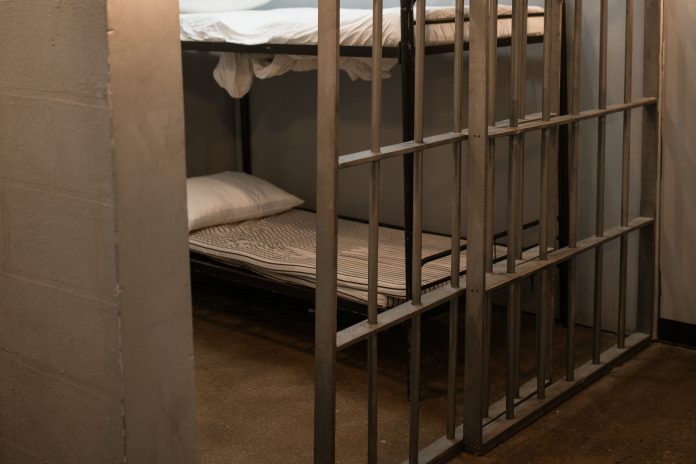
Vulnerable inmates in federal prisons receive COVID-19 vaccines

0
PHOTO: RODNAE Productions / Pexels

Written by: Michelle Young, News Editor 

Canada has begun vaccinating at-risk inmates against COVID-19. Though there aren’t currently any active COVID-19 cases in facilities where vaccines are administered, the 

Correctional Service of Canada (CSC) explained that they chose these facilities “because they’re home to inmates deemed priorities for receiving the vaccine — namely the elderly and medically vulnerable.”

The CSC currently “expects to vaccinate approximately 600 inmates in the first phase” and stated that as more vaccines become available, all federal inmates will receive the vaccine, according to priority guidelines. However, there are mixed opinions on who is receiving priority vaccinations. 

Sherri Maier, who advocates for prisoner rights, stated in Global News that prisoners are more vulnerable because they’re kept in small spaces. She added that “they still have rights and they still deserve to be protected.”

Public Safety Minister Bill Blair also explained at a press conference that those who become seriously ill from COVID-19 use federal resources, such as hospital beds, and it would be best to “deal with those individuals at greatest risk of getting [COVID-19] and at greatest risk of having serious health consequences as a result.”

Others have stated that they feel as if inmates are being used as “guinea pigs.” 

Some Canadian politicians have also voiced concerns — but for other reasons. Opposition Leader Erin O’Toole and Ontario Premier Doug Ford have both expressed their disagreement with prioritizing vulnerable inmates ahead of other Canadians who are at-risk. Ford stated that vaccines should not be given to “the most dangerous criminals in our country [ . . . ] before we give it to our long-term care patients and most vulnerable.” Conservative MP Shannon Stubbs is also concerned with who is receiving the vaccine. She told Global News, “In the reality of limited supply, of scarce supply, what we are saying is that [long-term care residents and frontline health-care workers] should be put ahead of incarcerated inmates.” 

The CSC stated that their vaccination strategy aligns with the guidelines put out by the National Advisory Committee on Immunization and “is consistent with past public health situations, such as H1N1, during which a similar process was followed.” 

Anne Kelly, CSC commissioner stated in a news release that “the health and safety of our employees, inmates, and the public is a top priority for the Correctional Service of Canada [ . . . ] We will continue working with our public health partners, unions and stakeholders to roll out measures that help protect everyone during this public health pandemic.”     

COVID-19 vaccinations can be viewed on The Government of Canada’s tracker.

How TikTok helped me come to terms with my sexuality

0
Illustration courtesy of Washington Post.

By Dev Petrovic, Staff Writer

Growing up, sexuality was not a popular topic of discussion — I was rarely exposed to queer history, events, or content unless I personally sought it now. For this reason, from a young age, I’ve always felt cornered into traditional, cultural, and marital expectations. 

It wasn’t until I occasionally stumbled upon LGBTQ+ representations in television and film that I even started to question the possibility of not being straight. Even then, however, there’s only so much that can be conveyed through shows where a straight person is playing the role of a woman-loving-woman. 

Yet, most of my life has consisted of frustrations over men. I would ask myself, “Why am I so picky about who I want to date?” and “Why is it so hard for me to like a boy?” I should have known when I got Tinder and never swiped on anyone, that there was something a little gay going on with me. The onset of a Phoebe Bridgers obsession also should have been a sign. 

I digress. 

When the height of the COVID-19 pandemic hit Canada, I found myself succumbing to hours of mindless scrolling through social media just to keep myself occupied. I found that TikTok seemed to be a good distraction, especially for the relatability of some of the more niche videos. Eventually, TikToks created by other folks questioning their sexuality began to show up on my “for you” page. One thing led to another and soon, I was reading the lesbian master document at 2 a.m. 

For those unfamiliar with the lesbian master document, it is basically a gay sorting hat that goes into depth on common lesbian issues. It includes an explanation of compulsory heterosexuality (how heterosexuality is reinforced by a patriarchal and heteronormative society), and how it creates barriers for queer women and non-binary folk. Essentially, this document is an identity crisis support file for gay people. 

The lack of real-life advice and information from other queer folks was primarily what had left me confused and deeply unsure of my identity. I had always thought that I liked men, but at the same time, it had felt incredibly forced my entire life. Was I actually attracted to men, or was it just compulsory heterosexuality blinding me from the truth? 

For a long time, it felt like a struggle to identify any form of attraction. So when I came across TikToks where folks shared their own stories on discovering their sexuality, I started to realize that I was relating to a lot of the stories of women-loving-women — particularly those who talked about the role of compulsory heterosexuality. 

Since TikTok filters algorithms based on the content users engage with, I was basically being spoon-fed answers regarding my sexuality all at once. It was overwhelming. TikTok was the last source I expected to help me discover my sexuality. It was highly unconventional, to say the least.

I also saw TikToks where creators shared helpful resources — like the lesbian master document — that I otherwise would not have found, as well as shows and films with accurate representations of LGBTQ+ folks. Enthralled with so much new knowledge, I was seeing rainbows, new windows of self-discovery, and also some really bad shows. Couldn’t someone have told me that The L Word is kind of boring? 

I recall several points throughout my teenage years where I knew I was attracted to girls but was always too scared to put a label on it or even fully admit it to myself. There would be instances where I would think, “I definitely like girls,” but would quickly shut myself down because “well, I can’t be gay.” Now looking back, and having heard similar confessions from other queer people on TikTok, I am able to understand that this came from a place of internalized homophobia.

I can reframe for myself many of the aspects of my life that had always felt out of place, such as why I was always such a passionate ally. With this newfound realization, I feel that I can work on actively dismantling the internalized views and external expectations that once tied me down. 

Hearing other people express the same confusion I had battled with my entire life was comforting, finally allowing me to be honest with myself and confront the big questions I had always avoided. Being uncomfortable with my sexuality had always felt isolating and now, suddenly, it wasn’t anymore. An entire internet community began to unravel before my eyes, and although this community consists of other confused strangers hiding behind their phone screens, it was enough to validate how I was feeling. 

While my experience with TikTok and my sexuality has been positive, it is also important to mention that the app can be a platform for bigotry and hate. Since the regulation of the app is significantly poor, there have been instances where I have come across biphobic and lesbophobic content. 

That being said, while I don’t think TikTok is always a good go-to platform for education on queer issues, I do see the value in how it can be a validating place for folks seeking out advice (if it is respectful and taken with a grain of salt). It was helpful for me because I was mostly looking for indirect validation rather than education. Nonetheless, bite-sized videos that normalize aspects of an experience are powerful, regardless of the app that they are found on.

More than anything, it’s really comforting to know that there are internet communities out there that can bring a sense of security to people during these isolating times. This is so important for folks just discovering their queer identities, who cannot rely on in-person connections right now. 

I am much more comfortable with my sexuality now and (surprisingly) I have TikTok to thank for that. While there are always going to be factors that make it difficult to be queer, I know that these aren’t things only I am experiencing — there are support systems out there. Whether it’s on TikTok, Twitter, or a book club, I now know who I am and where to seek out reassurance from folks in similar situations.

Ratatouille the Musical is a TikTok phenomenon that is here to stay

1
ILLUSTRATION: Maple Sukontasukkul / The Peak

By Kyla Dowling, Staff Writer

It started with a TikTok.

Creator Emily Jacobsen was fooling around and created a viral hit of herself singing a ditty about the titular character Remy in Ratatouille. Then, Daniel J. Mertzlufft (the mind behind TikTok’s lesser known production, The Grocery Store Musical) made a musical theatre arrangement of her song, entitling it the “Act Two Finale”. Soon after, TikTok creators began duetting and forming the Ratatousical, contributing anything from lyrics and choreography to orchestrations and playbill designs. The project was picked up by Broadway producers and the months-long project culminated in a one-weekend-only virtual show benefitting The Actors’ Fund. 

The virtual show was evidently a labour of love. With cameos and credits from many prominent TikTok creators such as Gabbi Bolt, RJ Christian, and Blake Rouse, whose contributions made it to the final product, the production avoided the fate many feared — a cease and desist from Disney. The show starred Tituss Burgess from The Unbreakable Kimmy Schmidt as Remy, the rat who can cook. Because the show was only an hour long (despite the movie being nearly two hours), Burgess was burdened with having to give heavy exposition. It’s a testament to his skill as an actor that these frequent monologues were able to keep the audience engaged. 

Burgess wasn’t the only talented cast member. The casting, done by Taylor Williams, was magnificent. Broadway’s Andrew Barth Feldman (of Dear Evan Hansen) starred as Linguini, the human chef who partners with Remy, and he brought brilliant comedic timing and all-star vocals to the role. He, as well as Kevin Chamberlin (Gusteau), were part of the production longer than their castmates — Feldman was recruited by a composer friend to sing as Linguini in a TikTok and Chamberlin wrote the first-act number “Anyone Can Cook.” The cast was rounded out by Ashley Park as fierce Colette, Wayne Brady as Remy’s father Django, Mary Testa as Chef Skinner, Priscilla Lopez as a terrifying old lady, and the formidable André De Shields as antagonist Anton Ego. The terrific leads were accompanied by a strong ensemble, including brief cameos of Twitter’s resident theatre comics (producers Patrick Foley and Michael Breslin, as well as Natalie Walker and Larry Owens) as pop-culture-reference-slinging reporters. 

One of the more interesting casting choices was Adam Lambert as Remy’s rat brother Emile. Donning eyeliner, jewellery, and with a notable lack of rat ears, Lambert attempted to infuse his performance with an edginess and sexiness that just didn’t quite fit the part. It felt as though he decided to play himself, but as a rat. 

It was those sorts of decisions that made the show less than it could have been. The lack of unison when it came to costume choices — such as rat ears, chef hats, and drawn-on whiskers — put a damper on the production. The way of merging each actor’s individual videos together, on the other hand, was quite engaging. As the old lady chased after the rats, she swept left and right, sending the videos of Remy and Emile running off the screen. That scene worked; however, the awkward way that Colette’s solo was backed up with videos of herself dancing did not. Given that the show came from Michael Breslin, Patrick Foley, and Jeremy O. Harris — the minds behind the hilarious and brilliant Circle Jerk, a virtual show that premiered in November, I expected something more cohesive. 

With that said, the incorporation of these portrait-frame videos, as well as special effects, such as a grainy flashback of Gusteau, harkened back to the show’s origins: TikTok. In those flashbacks, Chamberlin’s TikTok handle could be seen on the side of the screen. Other special effects were recognizably from TikTok, such as how some ensemble members, when dancing, were shadowed by replicas of themselves. It’s difficult to critique some of these elements, when the director (Lucy Moss of Six, who is mentioned in one of the many cheeky broadway references) clearly broke form to appreciate the show’s humble beginnings. 

Where the show really shone, however, was in the finale. First, it displayed the Broadway Sinfonietta — a female, majority BIPOC orchestra that is revolutionizing the future of Broadway — before the ensemble shouts “TikTok! Here we go!” What followed gave me the same chills I used to get watching live theatre. So many of the original videos contributing to the musical popped up on screen — videos of choreographers, orchestrators, and even people pretending to be stage managers for the production. Everyone who participated, even if their contributions were not included, was acknowledged and applauded. The bows were particularly wonderful, with the ensemble getting solos throughout a melody of nearly every song in the show, and the original creators of each song getting to bow along with the actor who sang it. 

The message of the show, of course, was that anyone can cook and achieve their dreams, and the production of the Ratatousical musical stood by that. They showed that anyone can compose a song or create choreography or be a part of something. Better yet, by giving all the money from the donate-what-you-can tickets to the Actor’s Fund, the show directly contributed to the dreams of others. Anyone can cook, anyone can perform, and the makers, producers, and even fans of the Ratatousical want to make sure you know that. 

Need to Know, Need to Go: January 18–24

0
Illustration of a blue calendar, with "Need to Know, Need to Go" written on top
Arts & Culture events to catch around the city. Image courtesy of Brianna Quan

By: Sara Wong, Arts & Culture Editor

Artist in Residence: Dory Xu | Our Town Cafe | 8 a.m.–8 p.m. everyday until mid-Feb.  | Free

Located in Mount Pleasant, Our Town Cafe is a coffee shop that’s also home to a vegetarian pop-up restaurant, Plant Me, as well as community arts programs. Their current resident artist is creator of #pantonechallenge2020, Dory Xu, also known as @bigbluetang on social media. In an Our Town Cafe Instagram post, Xu describes herself as “an artist with a love for gouache paint and an uncanny resemblance to Nemo’s friend.” Her work is free to view at the café and is available for purchase.

Hot Chocolate Vancouver | Across Metro Vancouver | Jan. 16– Feb. 14 | Times based on individual store hours | Drink prices vary

Looking for something to sweeten your day during the gloomy winter months? Consider visiting a local bakery or café and trying a Hot Chocolate Vancouver offering. Participating vendors are spread out around the Lower Mainland, each creating a unique selection of specialty hot chocolates. One of the most interesting flavours in this year’s lineup is the Thai milk tea white hot chocolate at Beaucoup Bakery. All of the drinks featured this year are available for takeout. Some vendors are even putting together DIY kits so you can enjoy their creations at home. 

Introducing 221A’s 2021 Fellows | Zoom | Jan. 22, 10–11:30 a.m. | Free with registration

221A, the East Vancouver art gallery turned research facility, is welcoming its 2021 research fellows: artist Christina Battle, curator Zasha Colah, and non-profit organization DOMA. Over a Zoom event, each fellow will be sharing their research projects and the methodologies behind them. Battle, Colah, and DOMA have varying interests, but they all focus on what 221A’s website describes as “progressive initiatives that realign our relationships to land and territory.” To attend the event, you must register with your full name and email address.

SFU announces plans for Summer 2021 semester

0
Photo Courtesy of Simon Fraser University

Written by: Michelle Young, News Editor 

On January 12, SFU’s Vice-President, Academic and Provost Catherine Dauvergne announced via email that Summer 2021 courses will be primarily remote. Dauvergne explained that this is because “it is not possible for anyone to predict the exact course the pandemic will take” and that SFU will only “consider in-person teaching under certain conditions.” 

Similar to the Spring 2021 semester, these conditions include “experiential courses or components of courses such as studios, labs, and seminars, where learning outcomes are substantially compromised by remote delivery” and certain core courses. Furthermore, in-person instruction is being considered for sections of labs and seminars at the graduate level. If courses transition onto campus, students will hear from their faculty in advance. However, Dauvergne stated that “all courses must be able to shift back to remote delivery if needed.”

Dauvergne also said that the “SFU COVID-19 impact scale is currently at H1, the second highest level of restrictions, consistent with public health orders in [BC].” She stated that SFU is planning for the Fall 2021 semester and will announce to students plans for remote or in-person learning as soon as possible. 

“We continue to work with public health authorities to ensure the health and well-being of students, faculty and staff,” she concluded. 

As of January 7, BC has extended the ban on social gatherings until February 5. COVID-19 FAQs can be found on the SFU website. Students are encouraged to email [email protected] for further concerns. 

Musing about dreams at Creative Collective at Home: Your Dream Board

0
PHOTO: Kelly Chia / The Peak.

By Kelly Chia, Peak Associate

Content Warning: Mild mentions of weight

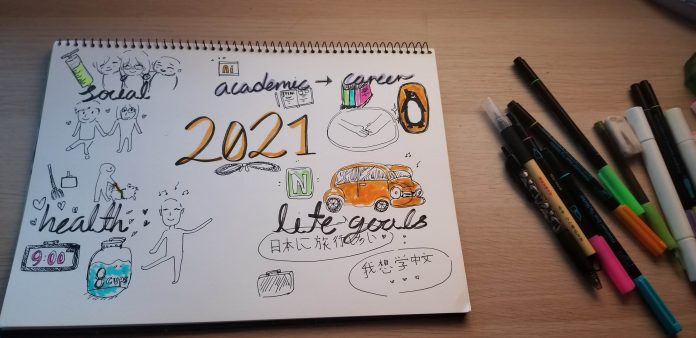
“I’ve never made a vision board or a dream board before,” I think, entering the Zoom room on January 6 with two other people. I relish any opportunity to doodle, and it’s the beginning of the year anyway, so I was curious about how making a dream board would impact me. Today’s dream board session was part of an at-home activity calendar made by SFU Health and Counselling services to inspire people to tune into their creative sides. 

Christy Ho, the host of today’s workshop, greets us enthusiastically. I feel immediately comfortable as we make small talk about our winter break and the things we’d done. After bonding over the anime we have both watched before, Ho explains that this would be chill and freeform, similar to how other Creative Collective activities have been. Armed with a bag of markers and pencil crayons, Ho aims her webcam down at a piece of paper to guide us through the activity. 

She first instructs us to write our ideas for the dream board down, giving us five minutes of silent reflection. As I lay out all of my pencils and markers, I think of the New Year resolutions I had made for myself in past years, as well as how teachers in high school would ask us to create five year plans for the future. 

As I begin writing down my ideas, I realize that it is difficult to ask myself to be vulnerable and acknowledge what goals I truly think would make me happy, not what would make me advance socially. 

Ho advises that it is good to imagine the steps to take in reaching the goals we had in mind, as well as the feeling we’d have when we achieved it. For her own dream board, she sketches out the icon of Adobe Illustrator because she’s hoping to learn it. 

The goals that I really wanted to have somehow either felt too unattainable or too personal for me to admit to myself. But with nobody peeking over my shoulder to look at my dream board and ask about what I had there, I relaxed into the activity. 

“This is for me,” I think, smiling as I doodle myself hugging my friends after taking the COVID-19 vaccine. I thought of holding my boyfriend’s hands, and how happy I know I’d feel being able to see him regularly again. Those are the dreams that first come to mind because they are things that I am constantly reminded of. 

Career-wise, I know I really want more opportunities to work in the publishing industry and expand my writing portfolio, so I draw lots of books and The Peak issues.

However, some goals are difficult to think about especially my health goals. These are goals that without my permission have become tainted and synonymous with what they did to my body. 

I remember one year, I sketched a glum version of myself next to a toned version of me. I realized that despite parroting messages of self love, I never confronted the guilt I feel about being in my own skin. This year, I tried, as Ho suggested, to think about how I wanted to feel.

I read somewhere that everything you are procrastinating can take you away from the person you want to be.This really affected me because I had spent a lot of time in my bed, ironically thinking about how much of my day I was missing. But I didn’t want to feel like that anymore. 

With that in mind, I write down a 9:00 a.m. clock to signify that I want to live my mornings, not sleep through them. I doodle a version of me that is dancing happily, and a version of me driving an adorable yellow Volkswagen Beetle blasting Carly Rae Jepsen. Ho informs us that we have a minute or two left in the session. I carefully lay down my markers, staring at what I made. 

The session was over, and it left me with much to think about.

The most unexpected thing about this activity is that while no one could see my dream board while I was drawing it, I had an itch to do a real version of it. I wanted to perfect it, to make it look like the collages I had seen online. 

But I recalled the ways that setting “perfect” goals had failed me in the past; I always ended up letting these goals make me feel like a failure. 

No matter how much I denied my own progress, here I was at this event trying to visualize a version of myself that didn’t chastise herself for the things she didn’t have. For me, that is a dream that the version of myself from the past would have been grateful to achieve. 

I’m not sure I am a visual learner but having this more freeform look into myself and my dreams was a cathartic experience. Ho was such a friendly and calm host, and while I didn’t expect all the introspection that came with the workshop, I was really grateful to have a quiet space free of judgement to reflect. 

I have never done a dream board and it’s difficult for me to think about my dreams without cynicism but my dream board embodied all the ways I tried to respect my dreams. While doodling, I felt how easily hope came from nonchalant strokes as I thought about the things that made me happy. 

Creating a dream board for me, then, wasn’t a mental checklist of resolutions that weighed down on me but rather an illustration that made me smile and dream. Perhaps I won’t achieve everything here on my board but for the first time in a long time, I don’t think I will feel bad about it.

SFU researchers study patient needs for COVID-19 vaccine distribution software

0
PHOTO: RF._.studio / Pexels

By: Emma Jean, Staff Writer 

A group of researchers at Simon Fraser University are working to identify the most effective roll-out of the COVID-19 vaccine. Led by Full Professor Dr. Diana Gromala and Professor Associate Director Dr. Chris Shaw, the team from the School of Interactive Arts and Technology are interviewing individuals to develop software that will allow them to efficiently time and track their COVID-19 vaccinations.

The SFU researchers are one component of a larger collaboration with researchers, businesses, and health organizations, called Project ABC, whose goal is the “authorization, booking, and coordination of widespread serological testing and immunization.” It is funded by Digital Technological Supercluster, an initiative by the Government of Canada.

Their research consists of analysing interview responses from individuals in British Columbia and identifying their “invisible” needs. For instance, a main factor in their research is identifying the complexities of a person’s living situation, like any caregivers or family, that would complicate factors of effective vaccination. The software developed by their partners in Project ABC integrates these needs and the complexity of the factors in each patient’s health into an interface.

“If there are a million vaccines to be given out, there’s a million people. If you treat them all as individuals, you leave out something very important — which is families with social structures where, if one person is sick, the whole family comes in with them,” said Dr. Shaw in an interview with The Peak. “It’s not just a bunch of individuals individually booking vaccination meetings; it’s all these other complexities,” he added. The researchers are developing the system with an aim to account for these complexities when determining the order of vaccinations.

Dr. Gromala describes their work as part of a branch of computer science called Human-Computer Interaction, which focuses on designing technology to create the most ease for its users with a “prime consideration [to] really put users, or people, at the centre of that.” The intersection of Human-Computer Interaction and public health was key to their previous work with their research on chronic pain, as well as Dr. Shaw’s work on arthritis. This aids their work on COVID-19, as Dr. Gromala has experienced first-hand “how [chronic conditions] can affect a person’s ability to use technology in ways that range from the subtle to the profound.”

Once the software is developed, both Dr. Gromala and Dr. Shaw hope it will be used to improve existing healthcare infrastructure to better accommodate people with chronic conditions. “The software that we’re developing with our partners, after COVID-19, will be really useful in our ability to help people get to their healthcare needs when they’re not in the home.” Dr Gromala added, “I think the most important thing is our ability to track people’s health over time because our healthcare system hasn’t been historically designed for dealing with chronic conditions.” 

Dr. Gromala noted that they believe the current Canadian healthcare system tends to treat the episodes of illnesses rather than the underlying cause of them, and explained that this will especially affect COVID-19 patients experiencing long-term effects of the virus.

Once the software is developed, the researchers aim for its use by local health authorities as a pilot program in its hospitals and in the Downtown Eastside.

Attacking the wrong people takes away from crucial dialogues

0
Social media discourse can focus on the wrong things. PHOTO: Icons8 Team / Unsplash

by Kim Regala, Peak Associate

I recently came across a Tweet from singer-songwriter Shamir that read: “A white boy from Utah who calls himself Ritt Momney getting successful off a cover of a Black woman’s song sounds like violence to ME.” It was a direct attack at up-and-coming indie artist Jack Rutter, who goes by the stage name Ritt Momney. In late April of this year, he released a cover of Corinne Bailey Rae’s 2006 hit single “Put Your Records On.” Since then, the track has risen in popularity and has not only gained him more fans, but also a record deal.

It seems that Shamir’s Tweet is pointing at how white people have continuously profited from the works of Black people. Whether it’s appropriating Black culture through fashion trends, or claiming particular music genres as inherently white, the profitization and exploitation of Black culture is widely apparent. While Shamir’s words are based in truth, his efforts shouldn’t be directed at singling out an artist. By doing this, it takes away from efforts that could instead be placed on more productive conversations surrounding these issues.

I should emphasize that Shamir’s pursuit to open up this topic is not only important, but necessary. History is rife with the whitewashing of Black music in the music industry. One prime example is Elvis Presley’s tune “Hound Dog.” Most people who recognize this song will credit it to the “King of Rock and Roll” himself, without realizing that it belongs to Black female blues singer Willie Mae “Big Mama” Thornton. “Hound Dog” was a deliberate attempt from the music industry to strip away the success of Black musicians. While talented Black artists were writing record-breaking hits in the background, white musicians were given all the fame and credit for being in the spotlight. Not to mention the fact that the “King of Rock and Roll” is a title credited to a white artist, despite the rock genre being rooted in Black culture

Today, the music industry is just as silencing to Black musicians. Although music written and produced by Black artists is heard more often, white people are still largely in control behind the scenes through management of artists and ownership of record labels. We need to be having larger conversations about these structures of power that inhibit true representations of Black music and artists in the industry.

We have seen through the expansion of the Black Lives Matter movement how impactful online spaces can be in bringing people together, educating one another, and holding others accountable. However, while accountability is one crucial step, social media users can often project hostility in the wrong direction. This tends to lead to meaningless and joke-filled social media chatter rather than productive conversation.

I recognise Shamir’s concerns around the idea that the success of a white male artist appears to be coming from the original work of a Black female artist. However, this is not the conversation that has come out of his comments. There is more attention being placed on criticizing an artist, as opposed to conversing in productive dialogues on what this is revealing about the music industry. Many of the Tweet’s replies are aimed at critiquing the cover itself, with little having to do with why placing a white artist’s cover of a Black artist’s song in the spotlight may be problematic.

Focusing on the wrong people can only overshadow and detract from these conversations. Instead of using our platforms to simply criticize artists, we should instead be amplifying the real and ongoing issues for Black musicians. Let’s dive into the role of white supremacy within the music industry that has, for example, removed genres such as jazz and rock from their inherently Black roots. And let’s make sure to have a conversation about how to support Black artists so that they aren’t at the whim of a whitewashed industry.

Council Meeting: December 16, 2020

1
Image: Irene Lo

Written by: Jaymee Salisi, News Writer 

SFSS discusses the arrest of SFU alumnus

On December 16, 2020 the SFSS Council gathered over Zoom to vote on two motions regarding the arrest of a Black SFU alumnus. SFU security stated that the alumnus did not comply with COVID-19 guidelines and they asked him to leave. After refusal, security called the Burnaby RCMP. After several minutes of the officer allegedly engaging in verbal de-escalation techniques, a physical altercation ensued between the alumnus and officer, leading to the alumnus being pepper sprayed, tasered, and arrested. The SFSS expressed their belief that this situation involved racial profiling, citing that “this is not an isolated incident, and racial profiling incidents like this one have occurred many times before on our campuses.” 

Motion 1 proposed that council members, in support of the SFSS’ anti-racism efforts, “sign onto and support a letter by Black SFU staff and allies to condemn the violent arrest of the Black SFU alumnus and call for an apology [of the] escalation that led to this violent arrest.” Motion 1 passed with 34 votes in favour, 3 opposed, and 1 abstained. Council members agreed that SFU should be a safe space for its community. They expressed their support for BIPOC students and the SFSS’ statement stating that “security did not engage in proper de-escalation techniques, according to witnesses.”

Motion 2 condemned the Board for excluding Council from drafting their statement and argued that the SFSS’s statement contained “factual errors and omissions.” This motion called for strong policy changes and responses. It suggested that the SFSS should retract or amend the statement. Motion 2 failed with 23 votes opposing and 5 votes in favour. During this point of voting, several council members had left as the meeting had gone overtime.

Motion 2 was met with controversy as it opposed Motion 1. Most members felt that the information presented was accurate based on video evidence and that the SFSS was justified in creating the statement. 

SFSS President Osob Mohamed, opposed Motion 2 and assured attendees that all information in the SFSS’ statement had been backed up with video evidence and communication with Director of Campus Public Safety, Andrea Ringrose. Mohamed claimed that “there were no factual errors in [the SFSS’s] statement” and that omissions were made only in instances when the SFSS “did not feel comfortable speaking on anything that [they] did not have facts on.” 

Student Union Representative of Political Science, Helen Pahou, expressed understanding for the motion but “[could not] agree that there was misinformation in that statement” due to video evidence of the alumnus being mistreated by campus security.

In favour of the motion, Student Union Representative of Philosophy, Tony Yu assured participants that “nobody wants to say that racism isn’t a problem or that the intention of [the motion was] intent on saying that racism [ . . . ] and threats against BIPOC people aren’t an issue.” Yu explained that the motion aims to “keep a sort of accuracy in [their] accounts of what was going on.”

At the meeting, Joshua Fang shared that he was at West Centre Mall for a portion of the incident and was shocked reading the SFSS statement as it was different from what he saw that night. Fang expressed that although he did not agree with Motion 2, and did not wish to advocate for unnecessary force, he believed that “some sort of increased accountability would be beneficial.”

The council meeting had been extended multiple times, lasting three hours. Scheduled discussion regarding tuition increases, the P/F petition, and the DSU online learning survey were postponed to the next meeting. The next council meeting is to be determined for the Spring 2021 semester.

The full meeting can be found on the SFSS’ YouTube channel.

What Grinds Our Gears: My butter chicken should have chicken

0
Why do meat dishes only come with a couple pieces of meat? PHOTO: Charles Deluvio / Unsplash

by Meera Eragoda, Copy Editor

Here’s the thing with Indian food: It’s delicious and I love it. It’s also pretty expensive (at least in Vancouver). If I’m going to pay $16 for a plate of butter chicken, I would love it if there were more than three pieces of meat. 

That’s not even an exaggeration. Ok, maybe a little one, but there legitimately aren’t more than five chunks per dish. Over the last few years, the number of actual pieces of meat has been going down but the prices have only been going up. Somehow, Indian restaurants think that substituting meat for sauce makes up for the price.

So now I’m drowning in more sauce than I know what to do with. It completely throws off the ratio of meat to naan, making my meal much more disappointing than it should be. 

Vegetarians out there may think this doesn’t affect them, but no one’s safe! They’ve also gotten to the paneer.

Higher prices for less substance — I knew capitalism was bad but did it have to get to my Indian food?