Enjoy the zero proof lifestyle with options like the Red Racer Street Legal beer. Image courtesy of Central City Brewers + Distillers
By: Emma Jean, Staff Writer
One in three Canadians are abstaining from drinking over the month due to the advent of Dry January, but many are also choosing to stay sober in the long run. As a long-term teetotaler myself, I know how it can feel when everyone partakes in cocktails or cracking open cold beers while you pour yourself yet another glass of sparkling water. Thankfully, these local brands have filled the niche for non-alcoholic bar-style drinks, from cocktail mixers to beers to craft sodas. With their help, giving up alcohol doesn’t have to mean giving up your enjoyment.
If you really want to get suave with cocktails, this gin-like drink is the ticket. It’s distilled without any alcohol on Vancouver Island using raw ingredients like grapefruit, juniper, and mint, and there are dozens of recipes on the spirit’s website to shake and stir to your mixologist heart’s content. Its fresh, complex flavour is perfect with just a splash of tonic as well. This isn’t a frugal option, but neither are its alcoholic counterparts; at $36.99 a bottle, it’s an investment comparable to a mid-priced liquor store gin, but without the hangovers and all of the flavour. Lumette! is available at most BC liquor stores and online through their website.
Full disclosure: I don’t like the taste of beer. When I tried this, it tasted bitter and over-carbonated and I couldn’t finish my glass. However, my other in-house taste tester, an experienced beer drinker, loved it and was happy to finish mine off, deeming it “a great, light summertime beer.” The Surrey-made IPA goes through the complete brewing process but contains less than 0.5% alcohol through its final de-alcoholization and, at $10.99 for a four-pack, it’s fairly affordable for a local craft drink. If you like the taste of beer, you’ll likely enjoy this. Red Racer Street Legal is available at most BC liquor stores.
If you just don’t care for the taste of alcohol, you’re in for a treat with this one. This naturally-brewed soda, made in Victoria, has been my personal favourite for years. There are four different and thoroughly enjoyable flavours, including the best, sharpest ginger ale on the market, Spitfire. If the excellent staple flavours like Orange Cream and Root Beer aren’t adventurous enough for you on their own, they also make excellent mixers. If you feel like spicing it up, why not take their Speed King Cola and add a splash of grenadine to make a Roy Rogers? Phillips Craft Sodas are available at many Lower Mainland and Vancouver Island grocery stores.
While this is the only product on this list I haven’t been able to sample myself, a crisp, sweet glass of cider is a treat with or without alcohol, and this drink made from Okanagan-grown fruit seems no exception. It’s received rave reviews for its bright, full–fruit flavours and its reasonable price point of$5.57 a bottle makes it a cider bargain. Picture a clear day, a bright spot in the park, and a popped bottle of sparkling Fresh Peach enjoyed with someone in your bubble; perfect for when Dry January mercifully turns to Dry Spring. Okanagan Apple Essence is available in Nesters Market, Buy-Low Foods, and through their website.
Departmental affiliation: Bachelors of Science in Kinesiology (graduated in 1990)
Hometown: Agassiz, BC
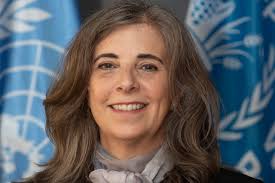
Occupation: Chief, Administrative Services at the United Nations World Food Programme (WFP)
Fun fact: In her spare time, Cynthia enjoys watching science fiction and martial arts films, especially Mulan.
Graduating from SFU in 1990, Cynthia Jones has had a lengthy career working to fight structural issues in the world. While working with an NGO in a war zone in South Sudan, Jones witnessed the United Nations World Food Programme’s (WFP) active role in distributing goods and “fell in love with [the] organization” and their work. Following a year of working in South Sudan, she traveled to Uganda to assist with the WFP’s Southern Sudanese refugee programs.
She worked as a consultant and then was promoted to administer food distribution programs for refugees fleeing Joseph Kony’s Lord’s Resistance Army. She also assisted with the Food for Asset Program, which compensated participants for work such as repairing roads and planting trees with food.
After years of working with the WFP, she eventually became their Chief Administrative Officer and in 2020, Jones and her team were awarded the 2020 Nobel Peace Prize “for [their] efforts to combat hunger, for [their] contribution to bettering conditions for peace in conflict-affected areas, and for acting as a driving force in efforts to prevent the use of hunger as a weapon of war and conflict.” As the world’s largest humanitarian organization, the WFP provided assistance to 100 million people in 88 different countries in 2020.
Providing a Lifeline During the Pandemic
During an interview with The Peak, Jones discussed how the global pandemic exacerbated unemployment and world hunger. Through a partnership with the World Health Organization (WHO), the WFP continued to supply food, water, and personal protective equipment (PPE) to countries in Africa and the Middle East to match the increasing need for food, especially in urban areas and quarantine centres.
This partnership led to the UN Supply Chain Coordination System. Jones explained, “[During] the flight bans, we started up basically a global passenger air service able to get the health workers and the humanitarian workers in some of these countries, mainly in Africa and the Middle East, [ . . . ] to manage the scale-up of the response. We set up these international staging areas that distribute health supplies [and] PPE that were destined to countries. They were flying [both humanitarian workers and supplies] in and then [shipping] them into the different countries.”
“Primarily we’re providing the logistics and the logistical support [ . . . ] to the [WHO] and to governments to be able to get the supplies and the people to where they need to go. We are adapting our country-level programs and targeting patients that are affected by hunger due to COVID.”
Hunger is an Interconnected Issue
Jones spoke on how the issue of hunger is not singular; it exists in connection with others.
“We’re not going to achieve zero hunger unless we also put an end to war and conflict, and [realize they are] really two sides of the same coin, so to speak. Things are even more challenging, because also we have the effect of climate change, and that exacerbates a lot of things. Many people that we are supporting are agricultural communities that are affected by droughts and floods and conflicts.”
The WFP is actively involved in providing food to those experiencing food crises in Afghanistan, the Democratic Republic of Congo, and Yemen. Additionally, Jones addresses the growing need in the Sahara and West Africa as they are “on a fragile line of [ . . . ] people moving into famine.”
The WFP can be supported by playing the game Free Rice in which each correct answer raises money to support various WFP projects. The ad revenue earned from Free Rice is donated to the WFP, which buys food including but not limited to rice. Downloading the Share the Meal app on the Apple App store or Google Play will provide one day’s worth of meals to a child for USD $0.80. Donations to WFP are accepted through their website.
Photo courtesy of SFU Graduate and Postdoctoral Studies.
Written by: Emma Jean, Staff Writer
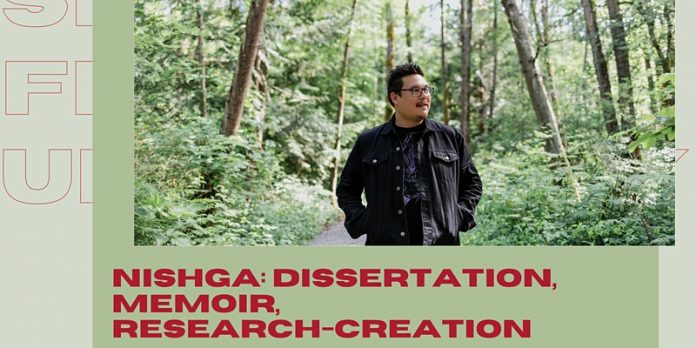
Dr. Jordan Abel, a Nisga’a poet, writer, and professor, doesn’t often get the chance to talk about his dissertation process. As an SFU doctoral graduate himself, he was the first speaker of SFU’s Supervision in the 21st Century series focusing on the future of graduate research, in the event A Conversation with Jordan Abel. He told the audience that he was very “intrigued” to be asked to discuss it and had a lot he wanted to contribute.
Hosted by the Department of Graduate and Postdoctoral Studies, Dr. Abel discussed how he developed his Ph.D. dissertation at SFU to go beyond convention and incorporate photography, poetry, and autobiography to fully capture the complexities of his research and experience. Out of this process grew the book, Nishga.
As someone who finds poetry a beautiful but baffling art form, Dr. Abel’s event intrigued me as he not only understands his craft but has mastered it. I also wanted to hear Dr. Abel’s perspective on higher education as a Nisga’a person in academia, on the West Coast, and in the world at-large. As a settler interested in reimagining higher education, I think it’s necessary to listen to Indigenous voices in this realm.
Joining Dr. Abel in conversation was Dr. Deanna Reder, a Cree-Métis Associate Professor of Indigenous Studies and English Literature at SFU and member of Dr. Abel’s Ph.D. supervisory board.
Telling the virtual audience he was “super stoked” to be joining them from his home on Treaty Six territory, Dr. Abel joked, “[being] in my basement with my X-Files poster behind me is not quite the most professional background [ . . . ] but there you go.”
Since many graduate students were in attendance, both the audience and Dr. Abel were glad to discuss his dissertation process. Drawing inspiration from Natalie Loveless’ book How to Make Art at the End of the World, he discussed how a reimagined version that went beyond writing “books that aren’t books” could benefit not only the research and project itself, but its full accessibility outside of the academic world.
“[Making our research public], whether it be through an academic book or a creative book or an art show, is [something] that allows us to expand our vision of what our research might look like and how we might ultimately present it. It really reminds me a lot of the ways we discuss form in poetry, which is to say that, in poetry, the form and the content should be activating each other.”
Abel continued, “The form needs to respond to the content, and the content needs to respond to the form; just having the form as a [conventional] dissertation is perhaps too narrow to accommodate all of the many ways in which our research may take form.”
Considering Dr. Abel’s body of work, it seems natural that his dissertation would transcend genre. His previous works have taken settler-colonial accounts of Indigenous life as source material, peeling back the layers to make poetry from their words in order to find the meaning and consequences of the original pieces.
For his 2013 book, The Place of Scraps, Dr. Abel used an 18th-century ethnographer’s accounts which attempted to erase First Nations cultures on the Pacific Northwest under the guise of documenting them. In his 2016 book, Injun, which won the prestigious Griffin Poetry Prize, he deconstructed western pulp novels, creating his own poetry out of their words, to call attention to their racist portrayals of Indigenous peoples.
Nishga, however, is structured differently. Set to release on May 18, 2021, the work uses Dr. Abel’s own family as his source material to describe the “afterlife of residential schools” and the intergenerational trauma that it left on his family — his grandparents were survivors of the schools.
“There was no alternative [for] me than writing about [it] personally. I think for other people in other circumstances, [they] could imagine a way to write about [ . . . ] the wake of violence that ripples outwards from residential schools in a way that isn’t personal. For me, I couldn’t even imagine what that would look like.” He continued, “I’ve experienced it in such a particular, embodied way that the only way I could even understand it was to try to understand my own experience.”
As Dr. Reder puts it, looking at one’s own life to find material is “an Indigenous intellectual tradition.
“How else are you going to write about anything without relying on the autobiographical, given the almost absence of Indigenous histories in the academy, but of course, in the world?” she said. “[It’s a] necessary assertion of [saying] ‘Hi! I’m here!’”
While Dr. Abel is now an Associate Professor at the University of Alberta teaching Indigenous Literature and Creative Writing, he says a position like that was far from certain when he began his postgraduate studies.
“When I began my Ph.D., I had no idea whether or not there would be a job waiting for me at the other end and, based on the job market at the time, there might possibly be no job at all when I finished my Ph.D. in my field. That was a moment where I really realized that I have neither the time nor patience to write a book that isn’t a book. I was really hoping that the Ph.D. would be a place where I could do work that was meaningful for me in some way regardless of the form that it took. I think Nishga was a project that really grew out of that discomfort,” he expressed.
In turn, Dr. Abel tentatively sees what grew out of Nishga as his next project: a series of written landscape portraits inspired by those he wrote for his dissertation.
“It’s really strange to write but I’ve been really slowly and steadily working on it for the last few years, and it’s only been the last six months or so that it’s felt like a substantive project that may actually become its own book. I feel like I very often don’t want to say ‘this is my next project’ because you never know whether or not a project will just collapse in on itself,” he laughed, “but his one looks like it might be my next one. I’m spending all my time writing landscapes and thinking about what land looks like in fiction.”
Dr. Abel has an ability to thrive in the “slippery state between genres” to create academic and literary works that defy convention. Exposing the past to illuminate the present in his poetry, and expanding the academic definition of research to create a fuller understanding and display of it in his doctoral studies, makes him a fascinating, deeply insightful, and warm individual. His work will be incredibly worth following for many years to come.
Enjoy these gems of the local art scene! Image: Sara Wong / The Peak
By Alex Masse, Staff Writer
Weather-wise, Vancouver can be extremely dull during the winter. Thankfully, our local art scene is the complete opposite. Although COVID-19 ongoing has caused many events to either be cancelled or moved online, visiting galleries remains one safe activity that those who want to further connect with local creatives can do. Here are nine galleries in Metro Vancouver you can visit, their pricing, along with a notable exhibit to check out at each.
Probably the most well-known on this list, the Vancouver Art Gallery (VAG) is a historic gem that holds works both local and from abroad. VAG is also home to specialized programs such as the Institute of Asian Art, which aims to uplift Asian creatives. With the gallery’s constant changing of exhibits, there’s always something to go back for.
An exhibition of recently collected pieces, Where do we go from here? explores how the art gallery will change in the coming years. After all, 2021 marks 90 years of the VAG being in operation. This exhibition questions how the Vancouver Art Gallery can be better in the future, particularly with representation of Canadian art, which has historically excluded groups like the African diaspora.
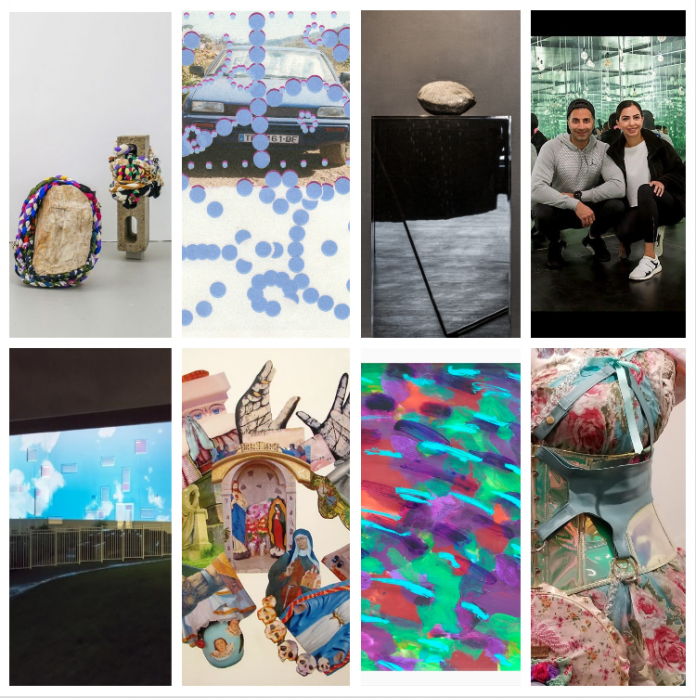
Bundled Objects by Audie Murray. PHOTO: Issac Forsland / Vancouver Art Gallery
The Polygon Gallery is adventurous, vibrant, and inspiring. With a focus on photography and similar mediums, the Polygon seeks to develop and empower all lens-based art. They highlight both renowned and emerging local voices, hoping to represent artists in a way that reflects community diversity.
Everything Leaks is a commentary on modern visual overload by Maya Beaudry and Marisa Kriangwiwat Holmes. The exhibit utilizes images within images, along with a variety of mediums and tactile materials to discuss the 21st century condition. Beaudry and Holmes are both graduates from Emily Carr University of Art + Design.
Car Sports by Marisa Kriangwiwat Holmes. Image courtesy of The Polygon Gallery
The Grunt Gallery was founded in 1984 and remains an artist-run venue today. Alongside gallery space, they offer publishing opportunities and an artist-in-residence program. Grunt is a centre for Indigenous artists, and has ongoing relationships with other creative communities of colour and LGBTQ+ artists. In addition, Grunt is currently working to further its accessibility and anti-oppression practices.
Black Gold is an exhibition by Tahltan artist Tsēmā Igharas examining the natural resource extraction that takes place in British Columbia and Alberta, and the destructive consequences that follow. Igharas spent a summer 2018 residency researching the relationships between the land and oil and mining industries, particularly in her unceded home territory of the Tahltan First Nation in northwestern British Columbia.
Black Gold by Tsēmā Igharas. PHOTO: Katy Whitt / Grunt Gallery
Cost: $19.99 for adults Monday–Wednesday, $24.99 Thursday–Sunday
Location: 432 West Hastings, Vancouver
A new name in town, opening during the pandemic, the Dimensions Art Gallery hasn’t let trying times slow it down. Themed around visual illusions like shrinking, falling from the sky, or moving sideways, the gallery offers a multitude of fun photographic opportunities. Dimensions’ interactive aspect lets visitors become part of the exhibits themselves.
The Infinity Room — Open Thursdays from 2–8 p.m., Fridays and Saturdays from 10 a.m.–9 p.m., and Sundays from 10 a.m.–6 p.m.
The Infinity Room is a room of mirrors, the kind where you can gaze into eternity and take some gorgeous photos! It’s the kind of wonder seen at places like Richmond’s Moon and Back Gallery, with all the selfie potential but with more affordability. Try not to get lost!
The Infinity Room. SCREENSHOT: Courtesy of Alex Masse via Dimensions Art Gallery
For a gallery outside Vancouver, look no further than the Surrey Art Gallery, which offers a number of contemporary pieces and is the second largest public art gallery in the Metro Vancouver region. Alongside its number of online events, the gallery has remained open and free despite the pandemic. It engages with local, national, and international artists in a number of mediums, and hopes to engage the public with the ideas these creatives put forward.
We Are the Clouds is an interactive piece brought forth by Mar Carnet and Varvara Guljajeva, an Estonian creative duo. Using software of their own creation, they turned regular bystanders into dreamy, cloud-like figures. The piece continues to grow as there’s a kiosk available where you can film yourself and join the sky full of silhouettes.
We Are the Clouds by Varvara and Mar. PHOTO: Courtesy of Surrey Art Gallery
Another Vancouver gem, Outsiders and Others highlights artists that don’t get the spotlight particularly often. This includes people who are self-taught, creatives with disabilities, and similar groups. They frequently reach out to various underrepresented communities in hopes of finding creatives that fall into this non-traditional grouping, such as during their UFO Day event last year, which prioritized self-taught artists.
Collage Works features pieces from Valerie Arntzen and Seema Shah. Arntzen, a traveller by nature, creates collages from her own photographs, inspired by what she’s seen over the years on her journeys. Shah, meanwhile, is a self-taught creative in both writing and the visual arts. She follows her intuition, and lets the art make itself.
Reaching Out by Valerie Arntzen. Screenshot courtesy of Alex Masse via Outsiders and Others
Since its opening in 2013, the Mónica Reyes Gallery has prioritized emerging and established artists, both local and international. The gallery has had numerous collaborations over the years, taking part in art fairs from Papier (Montreal) to Texas Contemporary, delivering on its goal of representing a diverse selection of creatives.
Plexus by Canadian artist Tiko Kerr is a multi-medium collection of acrylic, oil, and collage pieces brought to life on plexiglass, a material with a new meaning in the post-COVID world as both a shield and a means of isolation. Kerr has been building his artistic portfolio in Vancouver since the 1980s, and has a number of notable collaborators under his name, from the City of Vancouver to the Vancouver Opera.
Kinetic Typography by Tiko Kerr. PHOTO: Alan Somerville / Mónica Reyes Gallery
Cost: $13 for adults, free for Indigenous peoples and SFU students
Location: 639 Hornby Street, Vancouver
Last, but certainly not least on this list, is the Bill Reid Gallery. Named after the Haida creative, it is home to the Bill Reid SFU Collection, among a number of other exhibits highlighting Indigenous art and culture. The Bill Reid Gallery holds the notable achievement of being the only public gallery in Canada with a focus on contemporary Indigenous art.
Resurgenceis a collection of pieces by four Two-Spirit creatives, curated by Toonasa Luggi. The exhibit highlights the lives and experiences of Two-Spirit people in a colonial society, where ways of looking at gender and sexuality often overlook Two-Spirit identities. In these experiences are stories of resistance and resilience.
Two Spirit Armor by Raven John. SCREENSHOT: Courtesy of Alex Masse via Instagram
With a focus on emerging Indigenous artists, Fazakas Gallery is a hidden gem in the heart of the Downtown Eastside. Fazakas hopes to shed light and understanding on Indigenous art, giving its artists a larger platform for connecting with the public and contributing to an important dialogue.
While the Fazakas gallery has many notable pieces, it’s currently without a main exhibition.
SFU professor and Director of the Children’s Health Policy Centre, Charlotte Waddell, led a study on COVID-19 and its impact on the mental health of children aged 0–18. The research report, published in September 2020, aims to “inform and assist policymakers in planning to support all children in BC during COVID-19 and beyond.”
Waddell recommended that new budgets be put in place to protect kids and “be devoted to effective interventions.” In an interview with The Peak, Waddell suggested investing in cognitive-behavioural therapy to “treat problems like anxiety, depression, and post-traumatic stress [and] prevent these problems from progressing to full-blown disorders.”
She noted that the mental health of youth and children during pandemics and natural disasters was “worse if children were severely affected, say, losing loved ones themselves, but better if children had strong [support], say, from their friends and families.”
Waddell explains in the report that the nature of the pandemic is still recent and unfolding. In order to predict the effects of the virus, the research drew on data concerning the impact that previous outbreaks, pandemics, and natural disasters have had on children. The data showed that after these disasters, children experienced high rates of anxiety, depression, post-traumatic stress and behavioural issues.
“Some groups are [harder] hit than others,” Waddell said. Her research showed that children who were struggling with adversities before COVID-19 will struggle more with anxiety, post-traumatic stress, and depression. The report predicts sharp increases in services such as the Kids Help Phone, both during and after COVID-19. Waddell pointed out that children from low-income families rely on school programs for food provision, so temporary school closures have intensified stress and food insecurity.
The report states that children might be disproportionately affected if they are experiencing socio-economic disadvantage, racism, pre-existing mental health conditions, and developmental problems. It found that children living in Indigenous communities are harmed by the effects of colonialism and experience extreme food insecurity, which has led to being more heavily affected by the pandemic.
Based on a previous study examining the effects of infectious disease outbreaks on children’s mental health, the report finds that 30% of children who were isolated or quarantined “exceeded the clinical threshold for post-traumatic stress symptoms.” Of those children, 33.4% began using mental health services for “generalized anxiety, adjustment difficulties, acute stress, post-traumatic stress, and grief.”
Waddell expressed that BC has “long under-served children’s mental health,” citing that “half of children with mental disorders were not getting treatment even pre-pandemic.” Based on the studies, Waddell asserted that BC policy makers should “prepare to respond by increasing children’s mental health services.”
Waddell recommends that communities support the mental health of youth and those disproportionately affected by the pandemic by “writing to their MPs and MLAs to show this concern.” She also suggests that children in need of mental health services should visit a Child & Youth Mental Health Intake Clinic. The full research report can be found here.
Courtesy of Provincial Health Services via Twitter.
By: Karissa Ketter, News Writer
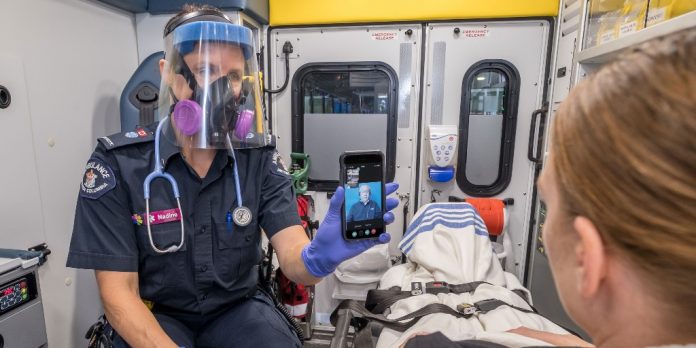
British Columbia Emergency Health Services (BCEHS), the Provincial Language Service (PLS), and the Office of Virtual Health (OVH) have launched an app to increase accessibility for those in the Deaf community. The app was designed to connect BC Paramedics to American Sign Language (ASL) interpreters. “It reduces barriers between our paramedic staff and Deaf, Deaf-Blind, and Hard of Hearing patients, enhancing patient care and safety,” says Sarah Morris, media relations for BCEHS, in an email statement to ThePeak.
According to the Provincial Health Service Authority’s (PHSA) website, the app is necessary to address the accessibility restrictions that have emerged as a result of the COVID-19 pandemic. The current pandemic protocols do not allow an interpreter or support person to ride in the ambulances and masks do not allow for lip reading, which many in the Deaf community rely on to communicate.
The PHSA’s website notes that these unintended consequences of the pandemic have meant “community members [have] raised [concerns] that they sometimes had difficulty communicating with paramedics in emergency situations.”
According to Morris, the app will be installed on BC ambulance iPhones. ASL interpreters can be accessed on demand to translate for patients without charge to the patient or medical department. Some clinical areas already have access to this service.
The PHSA website notes that the interpreters “are trained to accurately convey all parts of a message without changing the content, meaning or tone, reducing errors and enhancing safety.” The PHSA believes that this service will enhance patient safety, communication and allow the patient to “focus solely on understanding their illness.”
Morris noted that this is the first time that an interpreting resource of this nature has been introduced in Canada. According to Morris, despite the app being born out of new accessibility challenges, it “will remain in place after COVID-19” and will add to the pre-existing options offered for the Deaf, Deaf-Blind, and Hard of Hearing community.
Scott Jeffrey, sign language service coordinator with PLS and a Deaf individual, noted that PLS has “created a Community Advisory Group that is made up of Deaf, Deaf-Blind, and Hard of Hearing participants to allow for ongoing engagement with the community.”
This service is provided under the 1997 Supreme Court Ruling which mandates the Medicare Act and Hospital Insurance Act and requires “that sign language interpretation must be provided to Deaf patients in BC to comply with the Canadian Charter of Rights and Freedoms.”
ASL interpreters are available for patient’s interactions with other healthcare workers, private physicians, and other services for medical emergencies and non-emergency situations.
More information on how to book an interpreter can be found online.
I don’t have TikTok. So it says something that I’m still very impacted by the constant innovation that comes from it. Pandemic boredom being funnelled into the app has only illuminated how much talent and creativity youth have to share with the world.
The creation of elaborate narratives, green-screened worlds of wonder, and clever uses of video effects are just a few of the innovations I’ve seen in TikTok videos posted on other platforms. Not to mention that the practice of captioning videos has also grown drastically from these youth who are more mindful of accessibility. The fact that entire musicals are being written, sung, and designed through one–minute videos by these youngsters solidified this trend of ingenuity. One of these musicals being the Ratatouille musical which was recently turned into a one-night, star-studded fundraiser that garnered over $1.9 million in donations.
Don’t get me wrong, TikTok is still a social media cesspool. They’ve removed content from “ugly, poor, and disabled” users, have failed to protect children, and potentially have large breaches in security. Aside from these and other long-contested dangers of social media, the spotlight on creativity from youthstill pierces through any darkness.
The TikTok app itself doesn’t really deserve any credit for this light, in truth. Without it, I’m surethere would be another app, another digital method, that this creativity would seep into. As of now though, it is the platform where youth are making their voices heard and minds seen.
Watching these videos, I imagine these creators are getting into video design, editing, production, and aspiring to create bigger productions. I see comedic kids planning their first stand-up show. I just feel all of the potential that youth have always had being let loose, ready to be used for something greater. So, maybe, I should get TikTok.
Are you an SFU student without the heart to go long-distance with your partner, the university? Need a place to isolate on campus? True, SFU is quite deserted as of now, but here are some locations to hide in to ensure that your trip to campus remains solo!
First floor of the library
Did you even know that the SFU Burnaby library has a first floor accessible to the student body? Something about 50-year-old dusty PhD theses from SFU’s earliest days is probably enough to keep anyone away. Sneezes are frightening at the moment, after all.
By the way, grad students, this might be where the results of your 620,000+ hours of research end up. Check out the picture of your faculty dean dancing during the first ever Clubs Day while you’re there. You may not miss dancing at clubs as much after seeing that.
The AQ Gardens
Who’s actually going to be there, especially in the winter when it rains or snows? There are a couple of benches in the gardens for you to sit down and contemplate every action in your life that has led you to this moment. Now, your eyes and butt are wet from sitting on that bench. Way to go.
Don’t try to do this in the summer, though. If you try and hide there, you’ll end up playing a one-sided game of hide-and-seek with the SFU Camp kids.
Your TA’s office/lab
Become an RA for some environmental science TA and then you can obtain keys to a random lab on campus. You can hide there since the grad students are probably choosing to work from home nowadays — if they can help it. Who knows with SFU. You are free to conduct any experiments you want . . . I recommend finding ways to make Zoom sessions actually zoom by.
The Vancouver campus
The only time I’ve ended up here was after falling asleep on the R5. It’s a good place to hide from the rest of the SFU community, but it’s in a sort of shopping mall that’s still operating for some reason — so maybe don’t go too far off the actual campus area.
The SUB
Similar to the gondola, it’s a place for you to hide that officially doesn’t exist on the SFU campus maps quite yet. I’ve checked! Just don’t stay pressed up against all that glass or you’ll give yourself up! Oh wait, it’s still not open to the public. Better luck next eon.
6. The parking lots. As long as you don’t have a car, the attendants have nothing to give you a ticket for and therefore, you probably won’t encounter anyone there. Just don’t stand in one place too long. Desperate attendants might count that as parking!
7. The Peak’s office
9/10 readers of The Peak newspaper still say they can’t find this office. 10/10 of casual Peak writers have never even been into The Peak’s office. True story. I asked myself 10 times where it was. Clearly, the place is a secret fortress. For all I know it’s actually in the Surrey campus and the editors have been leading me along in their email signatures saying they’re in the Burnaby campus.
President and Vice-Chancellor Joy Johnson recently announced the addition of a new executive position at SFU: Vice-President (VP), People, Equity, and Inclusion.The Peak had the chance to hear from President Johnson through an email interview, regarding the expectations of the position.
“The new VP will be responsible for bringing a strategic and integrated approach to hiring, supporting, and developing faculty and staff,” said President Johnson. She elaborated that the position will have responsibilities in creating an SFU-wide equity, diversity, and inclusion (EDI) plan that will be established in close collaboration with the Vice-Provost and Associate Vice-President Students and International Rummana Khan Hemani.
President Johnson explained that survey feedback from stakeholders and university leaders outlined the need for senior leadership to push forward EDI.
“It is difficult for one VP to drive this change forward without the areas of responsibility and resources to do so. Because so much of the structural change will need to be driven by functions in Human Resources and Faculty Relations,” noted President Johnson. She expressed that appointing an executive to be accountable for an integrated EDI and faculty human resources plan will ensure “a welcoming, diverse, and inclusive institutional culture.”
According to President Johnson, “There will be a robust community engagement process to create the position description and candidate profile. That community engagement process will be open to students, faculty, and staff.”
The position is intended to improve equity and inclusivity at SFU by identifying strategies for recognizing and dismantling institutional racism. Johnson explained that this work “will include setting a vision and measurable objectives toward achieving that vision.”
“Our approach [ . . . ] needs to be intersectional. A person’s social location is made up of multiple factors such as gender, race, class, and ability — we need to understand and appreciate the ways these structures converge to create differentiated access to resources and opportunity.”
President Johnson was not able to comment on specific steps that will be taken to achieve an EDI strategy as the position is in its early stages of being created, but she anticipates that the work will result in improvement at SFU through the process of recruiting and engaging faculty and staff.
The Vice-President, People, Equity, and Inclusion position will be on the university executive board and consult decisions with President Johnson. The new VP will be responsible for determining what resources and support they need to do their work and includes deciding the required work for other senior roles.
“As with all critical issues at SFU, we will continue our consultative, collaborative approach and the VP will consult with a broad range of stakeholders in gathering input, including students, faculty, and staff.”
This new VP will also be accountable for ensuring that EDI values are practiced and implemented throughout institutional decision-making.
“It’s also important to note that [ . . . ] the work of creating a more equitable and inclusive university community is a responsibility we all share. There is work being done within Student Services and in our faculties to advance equity and inclusion on behalf of students. The new VP will be asked to consider how to integrate EDI initiatives for students with those for faculty and staff.”