Home Blog Page 286

Council meeting interrupted by racist Zoom bombing

0
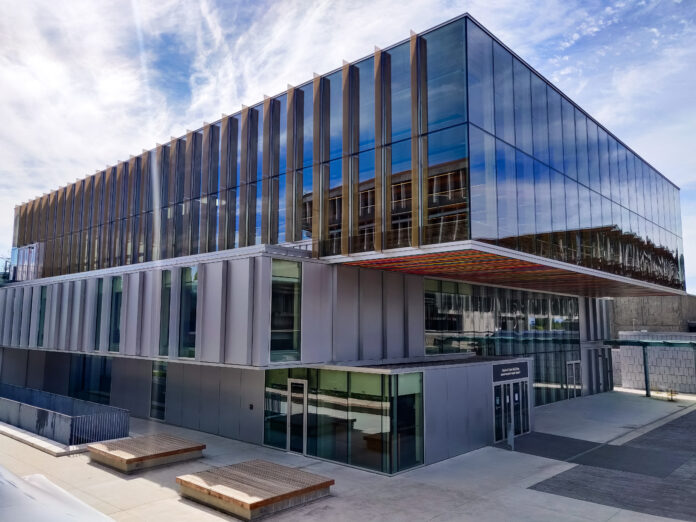
Student union building
Council is now working on ways to secure meetings while ensuring accessibility.

By: Karissa Ketter, News Writer

Editor’s note: The print version of this article states it was science undergraduate society representative Zaid Lari who said “shut up” during the incident. This has now been corrected to political science representative Abhishek Parmar.

Content warning: this article mentions anti-Black and anti-Indigenous topics, and discussion of anti-Black sentiments.

During the March 16 Council meeting, an individual who had joined the meeting unmuted and spread hateful anti-Black sentiments.

One Council member described the content as “absolutely disgusting.” They noted, “I can’t believe somebody would take the time to come to a public forum where students are coming for safety and say such a harmful thing.”

Vice-president equity and sustainability Marie Haddad said to Council the incident was “completely unacceptable.” She added, “We don’t condone that language at all, and we should consider how harmful it is to use that language, especially as it is anti-Black language.”

The individual used violent terms against attendees. Haddad began to make loud noises to drown out their comments. Political science representative Abhishek Parmar yelled for the individual to “shut up.”

The individual was removed from the meeting and the Zoom meeting was locked. The meeting was moved to another Zoom call following the incident.

After the meeting, the executive committee published a statement condemning the incident. “We want to acknowledge how unacceptable, harmful, and/or traumatizing the incident that occured within Council,” the statement writes. The committee further promised to secure future Council meetings while making sure they still remain accessible. 

The statement included a list of resources for the attendees, along with support for Black students specifically:

Resources listed in the statement:

A behind-the-scenes look into an upcoming New West pop-up gallery

0
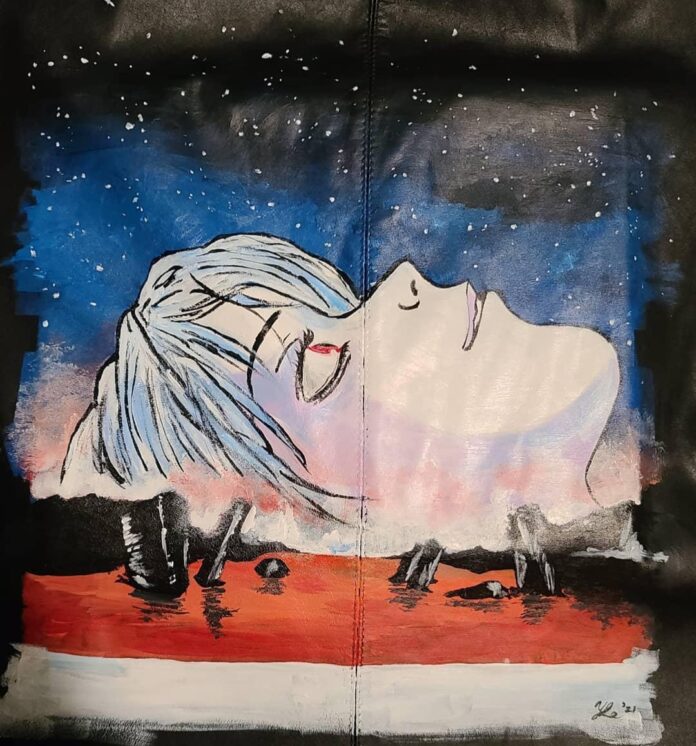
Close up of a black leather jacket with a hand-painted image of a side profile anime bust with white skin, red eyes, and icy blue hair. The person is looking up at a starry sky while red water sits below
For more pieces, check out @gemstoneart_ on Instagram. ILLUSTRATION: Yelin Gemma Lee / The Peak

By: Yelin Gemma Lee, News Writer

Editor’s note: Lee is one of the artists involved in APT POP through the upcoming exhibit, Colossus.

I don’t remember when I started loving art. When I reflect on my childhood, I see finger painting, symphonies playing through the house from morning to night, and my first sketchbook. I see one year old me picking up the pencil at my doljanchi, traditionally symbolizing I will become a scholar. Doljanchi is the first birthday celebration in Korean culture, where the baby chooses an item in front of them to foretell future talents or good fortunes. 

For me, that pencil foreshadowed a future of countless sketches and mountains of eraser shavings, the rise and fall of my mother’s shoulders as she played piano, and my father’s oil paints turned into masterpieces. Most of these early memories of indulging in art are from before I could even articulate what I felt in those moments. 

Art was never meant to be defined by words, anyway.  

I will be showing my work at APT POP’s exhibit Colossus this April, which features many different expressions and definitions of art. I spoke to Ben Pilger, the co-curator and founder of APT POP, to learn more about his vision for the show. 

“More than any other show that we’ve put on, Colossus is going to be spectacle. It is eye-catching. The work that we have exhibited is both vibrant and also muted. It is a contradiction in and of itself, like the word ‘colossus’ — something so large that it eclipses everything smaller than it,” said Pilger. 

Colossus will be Pilger’s first art exhibition in a public space, and the longest time my own art has been displayed in a gallery. In the last few years, I’ve mostly been creating hand-painted leather jackets. I enjoy the process of selecting jackets from thrift stores, cleaning and preparing the leather, and sealing art onto it just like a canvas. I like that I can combine my artistic inclinations with my love for fashion and sustainability. It feels meaningful to give new life and love to something old or unappreciated. 

Although I’ve sold quite a few pieces, received commissions, and been accepted into a handful of art shows throughout my university career, the more I focused on the monetary aspect of art, the less inspired I became. After I signed the artist’s contract with Pilgerand as the submission deadline and the end of my last undergraduate semester quickly approachedI found myself too stressed to create. “Is my art good enough to sell? What if my work doesn’t sell? What does that say about my art?” 

To combat these thoughts, I decided to paint whatever I wanted, for myself first and foremost. I want to make art on my own timeline, without being overwhelmed by the pressures of producing marketable work. In other words, I’ve made up my mind to set my art, and therefore myself, free. 

“As an artist, I don’t believe you need to monetarily make a career out of making art. I feel like you need to make something that you enjoy and that you personally justify on a poetic level,” said Pilger. “Know your history, know the world around you, and know why you made it [ . . . ] Find within yourself the justification; and in doing that, I think you justify someone else buying it.”

Since this shift in mindset, I’ve finished pieces I had sitting around waiting for final touches, and started new ones based entirely off of my own ambitions and inspirations. My justification is that my art is a protest. Joyfully creating, claiming art space, and healing through art as a queer person of colour is a form of protest, in a world trying to subjugate us. 

For the first time, I feel like the values of the curator and where I’m at in my artistic journey align. “We imagine colossus now, the word ‘colossus,’ to be this large moment, which will be the start of something new — it’s where we’re going,” said Pilger. 

This pop-up gallery, which started with big dreams and multi-media art shows in Pilger’s apartment, goes public for the first time with 14–15 participating artists, myself included. Despite a two year delay and barriers to securing a permanent art space due to COVID-19, Pilger storms onward hoping for one thing: that the public sees the show he put together and participates in the magic of this large moment.

APT POP’s pop-up gallery will be held at 431 Front St. April 2–30 from 12:00 p.m.–10:00 p.m. every weekday, with events every weekend. The opening night will feature poetry readings and a band performance. To keep up to date on the gallery, follow @aptpop on Instagram.

New SFU Yogost location wows with its sweet flavours

0
Illustration of three yogurt drinks against a blue background. The drinks from left to right: purple grape with mochi, pink peach with mango and mochi, and matcha with rice topping
A refreshing treat for summer. PHOTO: Alyssa Umbal / The Peak

By: Tamanna T., Staff Writer

The thirst for fresh new drinks has been quenched by a new Yogost location at SFU. Imagine a blistering hot day, and if you hear the words “pink drink” one more time, you’ll cry. Walk down the wide grey steps by the Cornerstone Starbucks, turn left, and let the glow of the Yogost banner guide you. 

With bright lights and multi-coloured walls, Yogost provides a picture perfect atmosphere for spring. The rice drink shop has a sweet mango smell and trendy K-pop music playing from the speakers. They have a menu past the entrance of the store and another one near the counter, which, as an anxious person, I appreciated. There’s a good number of drinks listed, ranging from their popular rice yogurts to yogurt slushes and yogurt probiotics. 

I got the grape mochi yogurt and peach mango mochi yogurt. An exciting part of the experience was that I could choose the sweetness and ice level (each ranging from 0–120%). I like cold drinks, but don’t enjoy the feeling of something extremely icy, so I requested 0% ice. The drinks remained fresh and cool. At 100% sweetness, it was reminiscent of frozen yogurt. I enjoyed the fruit-forward flavours, but the mochi incorporated throughout was probably my favourite part of the drink. It was soft, chewy, and tasted somewhat like marshmallows.

The shop started to fill up by the time I was leaving, a clear indicator of its popularity. With rice yogurt drinks becoming a growing food trend, I wasn’t surprised to see how many people were in line for a taste of the deliciousness that is Yogost. The combination of refreshing flavours and healthy nutrients in a yogurt drink are sure to make people want to come back for more. I sure will!

Comics

0

Top ten reasons SFU is better than UBC

0
SFU
SFU, otherwise known as “The Best.” PHOTO: Chris Ho / The Peak

By: Sara Brinkac, Humour Editor

  1. Our campus isn’t the worst

Separate buildings across a 400 hectare campus? What is that? Who needs that much space? While UBC students are bragging about their “campus culture” SFU students will be happily walking to class under something called a “ceiling.” Have fun in the rain people, we’ll be the ones roasting marshmallows at Convo Mall.


  1. Our president is literally named Joy

What’s more indicative of a happy university than a president with an alliterative name? Nothing. Especially if their first name is the purest form of happiness. Some say it’s overcompensation, but those are just lies spread by UBC saboteurs, jealous of JJ and the superiority of SFU.


  1. We don’t have concerts

You know what I often say is such a nuisance? Fun student events. And don’t even get me started on universities that have a stadium for mildly famous performers to actually have concerts in. Honestly, who would want to bother with meeting new people in a loud environment. Dancing? What is this, West Side Story? Get real UBC.


  1. Mountain

I mean what’s more to say? “Mountain” is the best geographical landform. Mountain puts SFU both figuratively and literally above UBC. You can’t deny it, you can’t argue it, you can only accept it. Face.


  1. We have more expensive parking

UBC students pay $400.80? Per TERM? What a bunch of chumps! According to the supply and demand curves that govern our society, whatever is more expensive is of more quality. And that’s exactly why SFU charges $440.00 per term for parking. Sorry UBC, looks like you have low quality spots that no one wants to park their cars in 🙁


  1. Funnier people

Fact: it has been scientifically proven people at SFU are 420% more funny than people at UBC. Fact: UBC people are all butt-hurt they can’t think of a good comeback to this study because they’re not funny. Fact: I like sandwiches on Sundays after a swim. They’re refreshing, light, and easy on the stomach. You should try it sometime.


  1. We’re more engaged

SFU’s motto: “Engaging the World.” UBC’s motto: “Tuum Est.” Verdict: SFU is actively engaging people and officiating international weddings while UBC still thinks people speak Latin. Extrapolation from verdict: SFU is better than UBC, because . . . international love.


  1. Hackers like us more

Last time I checked, SFU was a total hotspot for hacker activity while UBC’s systems remained completely safe. Looks like whatever data UBC has, the hackers don’t want. Not to be rude, but SFU’s spicy secrets are just another example of how basic, bland, and boring UBC is in comparison.


  1. Our wifi is worse

You know what’s a real problem these days? The youth on their phones. This world is crumbling one instant message at a time. It’s only by some divine grace that SFU is committed to fighting back. With campus wide shoddy wifi and consistently elusive network passwords, SFU makes an impactful commitment to the future. Meanwhile, UBC sits back and watches the world burn in the eternal fires of hotmail.


  1. We’re farther from the ocean

Everyone knows the ocean sucks. That’s why SFU is built on a superior mountain far away from any salty water that would affect the pricing of our luxury parking spots. Honestly, I worry about those poor UBC students that are forced to inhale ocean air during their 45 minute walks to class. May McFogg have mercy on their souls and may SFU continue forever in its superiority. Go mountain.

Horoscopes: March 28–April 1

0
An illustration of a girl with long flowing hair. Astrological signs and stars shine around her.
ILLUSTRATION: Marissa Ouyang / The Peak

By: Charlene Aviles, Staff Writer and prank expert

ARIES 

You love a good sitcom prank. As overdone as the whipping cream-sleep-feather routine might be, it also never fails to get you a laugh (track). Watch out this April Fool’s day though, there’s a warm cup of water with your passed out finger’s name on it. 

TAURUS

You like to go all out with your pranks. Which would be great if you didn’t waste all your time on blueprints. Now you don’t have enough time to set up your materials for April Fool’s and Mercury was so excited to see that one with the windmill . . .

GEMINI

What goes around comes around. And in your case it’ll be the ketchup you (hilariously) switched out for hot sauce last week. Gemini, this would all be avoidable if you just stop getting your prankees to make lunch for you, c’mon.

CANCER 

You’re a newbie when it comes to pranks, but don’t be shy. Just start off with something small, like a whoopie cushion. It’s guaranteed to blow your friends away. It’s an absolute gas! Victory will be  in the air! . . . You know . . . The smell of success . . .

LEO

It’s never enough for you to do a prank. You always have to go about starting a prank war with the most random people and it’s honestly exhausting . . . Take the day off this April Fool’s.

VIRGO 

Instead of doing the pranks, you’re the target. But don’t worry, it’s not too late to turn the tables. Next time you discover that your sugar is salt, bake the most elaborate and least suspect revenge cake your friends have ever tasted. Start working on your victory dance kid, this is going to be an absolute winner. 

LIBRA

You’re going to sleep through April Fool’s this year after pulling a hectic all-nighter. Sucks to suck.

SCORPIO

Scorpio, you’re an absolute expert when it comes to pranks and the stars respect you entirely for it. But as long as we’re being honest, the stars also think that secret prank lair you have is an odd, unnecessary waste of $5,000 dollars.

SAGITTARIUS 

You tend to plan extravagant pranks, but someone always spoils them for you and you can’t figure out who. It’s you, Sagittarius. You and your inability to keep a secret. We get you’re proud and want the credit, but just try playing it cool for like three days this year.

CAPRICORN 

I hate to be the one to break it to you, but, your pranks are pretty predictable. Literally everyone can see those whoopee cushions coming from a mile away . . . Try mixing it up this year! Early bird gets the worm! (And then immediately puts the worm in their roommate’s cereal.) 

AQUARIUS 

Why do your pranks always involve random costumes? And how do you keep losing pieces of your sets? Now you have half of a Buzz Lightyear costume, a unicorn head, and a lot of explaining to do to the person who just opened your secret closet.

PISCES

You got your days mixed up and have all your elaborate jokes prepared for April 2 instead. It looks like poor Pisces is April’s fool this year. 


Find multimedia works by visual arts students all over Burnaby campus

0
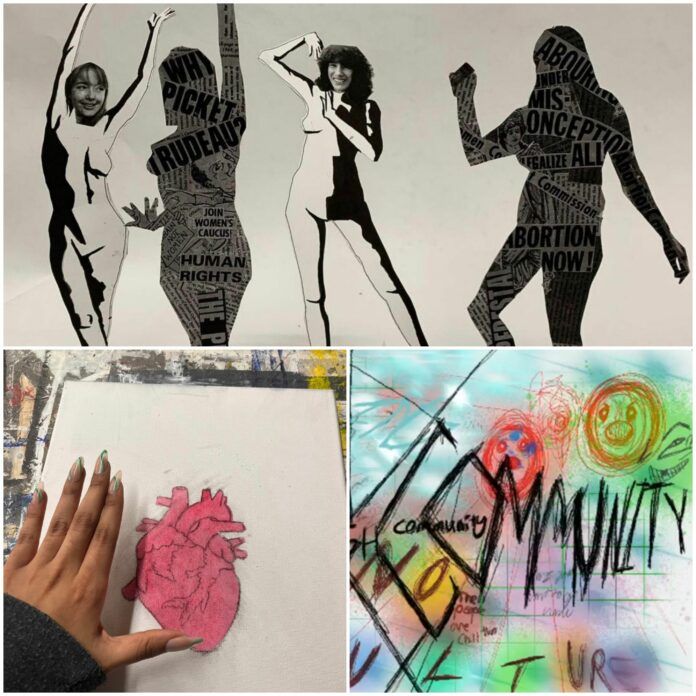
A composite image featuring four newspaper collaged paper figures, a colourful scribbly doodle, and an anatomical heart drawing with a human hand beside it to model the drawing’s scale
A diverse first year art showcase. PHOTO: Sara Wong / The Peak, with photos courtesy of Sana Goel, Julian Injeti, and Lauren Grace-Davies

By: Sara Wong, Arts & Culture Editor

SFU Burnaby’s aesthetic leaves little to be desired. But thanks to this semester’s CA161 class, taught by Sabine Bitter, the campus will be revitalized with interactive art installations. From collages to conceptual sculptures, the work of these visual arts students aims to highlight the relationship between the public and public art. The Peak spoke with four of the artists to learn more about what this entails and where they drew inspiration from.

These and the rest of CA161 class installations will be around SFU Burnaby from now until April 4. See map below.

Zoe Cheng 

Contemporary art galleries can sometimes feel pretentious. Cheng explained some of this disconnect can come from artists making pieces to achieve a level of “sophistication.” According to Cheng, “When the artists say, ‘Oh yes, my art is for the people,’ yet they create something that’s so hard to reach for people, it kills off the purpose.” This is exactly what they want to critique with their sculptural piece, which will be located outside the SFU Gallery. Consisting of multiple plaques and other signs, Cheng is directly questioning the practices of public art institutions by looking at how they present certain artworks. 

Creating such a site-specific piece was something Cheng found daunting at first. Elaborating on site-specificity, they explained how integral location is when contextualizing art. If it “doesn’t match the aura, or doesn’t match the purpose of the piece, it causes a schism.” Nevertheless, Cheng said they were happy to push themself and their creative limits, adding they were “extremely grateful for Sabine” and the guidance she provided.

Sana Goel

After observing the amount of movement on campus, particularly in the AQ, Goel wanted her project to echo that — literally. “What I hope to do is have a motion sensor that, when people pass by, it plays the sound of a heartbeat,” she said. The motion sensor will be placed behind a mirror already installed on the AQ’s main floor. Goel hopes students passing by will stop in front of the mirror and “see themselves as the heart of the university.”

Incorporating sonic elements into art can be challenging, but Goel was excited to do so. “You have to be really willing to open your mind to lots of different perspectives when you’re making art,” she said. “Coming into SFU, this was the first opportunity I got to make art and really showcase it. So the fact that I’m getting to showcase it in a place such as the Burnaby campus is a really big deal for me.”

Julian Injeti

With this piece, viewers will have the opportunity to directly interact with the artist. Injeti, being unfamiliar with the Burnaby campus, wanted to use this opportunity to learn from other students. His work was inspired by tabula rasa, a philosophical idea that knowledge comes simply from experience. “I believe conversation is a very powerful thing,” Injeti said. The installation will have a backdrop with thoughts and messages — provided by friends — about SFU Burnaby. Meanwhile, Injeti will be in front of the frame, interviewing students. 

However, describing himself as an introvert, Injeti noted this project was out of his comfort zone. “But at the same time, this is one of the few things where I’m excited to be challenged,” he said. Injeti credits CA161 for helping him grow as an artist, summarizing his main takeaways as adaptation, acceptance, and confidence in his craft.

Lauren James-Davies

Combining James-Davies’ interest in history with her artistic practices, this life-sized installation commemorates the Vancouver Women’s Caucus, an SFU organization founded in 1968 to fight for accessible birth control, childcare services, and other feminist policies. Four figures from the caucus, made out of paper, will be featured. “I’m using old photographs of them [ . . . ] and then on top of that, I’m going to be collaging some of the old newspapers that they used to make called The Pedestal,” James-Davies said.

The piece will be featured on the front doors of Maggie Benston Centre — a fitting place considering Benston was co-founder of the Vancouver Women’s Caucus. James-Davies shared this will be her first showcase in a public space. Though the process involved “a lot of experimenting,” she is proud of the final result. Further discussing her figures, James-Davies said, “They’re going to be double sided, so people are going to have to see them.”

Six films to celebrate the incredible work of women directors

0
A woman holding a clapboard in front of her face
It’s time to recognize phenomenal talent behind the camera. PHOTO: Jon Tyson / Unsplash

By: Emma Best, Peak Associate

In the history of the Academy Awards, only seven women have received a nomination for Best Director. Of course, the Oscars are merely a flashy awards show and accolades don’t always equate to skill. But it would still be nice to see women receiving the same amount of praise for directing as men so often do. Especially since, in recent years, “more women than ever” are directing feature films. In celebration of Women’s History Month, here are six woman-directed films to check out. 


Zola
Directed by: Janicza Bravo

[image credit: Killer Films]

Based on the iconic 2015 Twitter thread by A’Ziah “Zola” King, this film follows part-time waitress, part-time stripper Zola (Taylour Paige) after she befriends fellow dancer, Stefani (Riley Keough). Zola joins her on a weekend getaway to dance in Florida. However, upon arriving, things are not as they seem. The person Stefani introduced as her “roommate” is actually her pimp, and he has plans for her and Zola that go far beyond dancing in a club. Between the enthralling story and Bravo’s directing, this film is an enjoyable and thrilling ride. 


The Rider

Directed by: Chloé Zhao

[image credit: Caviar]

Brady Blackburn (Brady Jandreau) is a Lakota Sioux cowboy who was once a rodeo star. But, after suffering a traumatic head injury, he now suffers from severe seizures and has been advised to stop riding. This film is based loosely on the true story of the main actor, with the entire cast being made up of his actual family and friends. Zhao spent about a year getting to know Jandreau before filming, and their genuine, collaborative working relationship clearly enhances the storytelling. Much like she did in her Oscar-winning film, Nomadland, Zhao does an amazing job at working with and directing non-actors. The end result is an inherently real, authentic, and cinematic tale. 


Lingua Franca

Directed by: Isabel Sandoval

[image credit: 7107 Entertainment]

Olivia (Isabel Sandoval), an undocumented Filipina trans woman, works as a caretaker for an elderly woman named Olga (Lynn Cohen). She falls into a relationship with Olga’s grandson, Alex (Eamon Farren), in pursuit of a marriage-based green card. However, things get complicated when she starts to develop real feelings for him, and he learns more about her. Though not autobiographical, Sandoval’s own experiences as a trans Filipina immigrant mold this film into a stunning and honest story about identity. 


The Body Remembers When the World Broke Open 

Directed by: Elle-Máijá Tailfeathers and Kathleen Hepburn

[image credit: Experimental Forest Films]

Content warning: mentions of domestic abuse in the following paragraph

Taking place over the course of one evening, this film follows two Indigenous women — Áila (Elle-Máijá Tailfeathers) and Rosie (Violet Nelson). When Áila happens upon Rosie — pregnant, barefoot, and crying in the rain — she offers refuge at her apartment. She soon discovers that Rosie has fled from her abusive boyfriend, and the two embark on a journey to get Rosie to a women’s shelter. Directed by Tailfeathers and SFU instructor and alum Kathleen Hepburn, this movie was filmed to appear as one continuous shot (having 12 hidden cuts throughout its entirety). This technique creates a film that unravels in real time, giving an earnest exploration of Indigenous women’s experiences, particularly around domestic abuse.


Turning Red

Directed by: Domee Shi

[image credit: Pixar Animation Studios]

13 year old Chinese Canadian, Meilin “Mei” Lee (Rosalie Chiang), is starting to go through all the changes that happen when you’re a teenager. It definitely doesn’t help that she also turns into a giant red panda any time she feels strong emotions. Set in Toronto in 2002, Mei is forced to grapple with puberty, her mother’s expectations, and her panda problem. After a historic Oscar win for her animated short Bao, Shi is the first Chinese Canadian woman to helm a feature length Pixar film. By drawing inspiration from her own experiences in Toronto, Shi crafts an immensely relatable, universal, and entertaining film about figuring out who you are. 


Shiva Baby

Directed by: Emma Seligman

[image credit: Dumbo Pictures]

For college student Danielle (Rachel Sennott), family gatherings are already stressful enough. However, when she and her parents attend a shiva — a Jewish memorial service — things immediately get out of hand. There, Danielle finds herself face to face with her sugar daddy and his family, as well as her ex-girlfriend who is far more successful than her. Despite mostly taking place in one setting, Seligman’s writing and directing (and Ariel Marx’s horror-esque score) create a thriller out of a mundane experience. As Seligman’s feature length debut, this film is near agonizing to watch, yet so entertaining you can’t look away.

Skoden Indigenous Film Festival launches fourth year at SFU

0
Illustration poster of one of the films featured at the festival
Angakusajaujuq-Shaman’s Apprentice by Zacharias Kunuk is among the seven films featured at the opening ceremony screening on April 1. PHOTO: Skoden Indigenous Film Festival

By: Karissa Ketter, News Writer

SFU School for Contemporary Arts (SCA) is hosting the Skoden Indigenous Film Festival (SIFF) this April 1–2, 2022. Entering its fourth consecutive year, SIFF was created in 2019 by students Grace Mathisen and Carr Sappier.

In an email statement to The Peak, Carr Sappier, two-spirited Wolastoqew co-founder and co-instructor of SIFF noted, “We wanted to create an Indigenous film festival for a lot of reasons but one of them being to create more space for Indigenous voices at SFU and practice true reconciliation between non-Indigenous members at SFU and the Indigenous community of local filmmakers.”

After the first year of SIFF, it was developed into a course at SFU in the SCA program. The program is taught by Sappier, Kathleen Mullen, and festival intern, Akira (Iahtail Swampy Cree from Attawapiskat and Métis).

According to SIFF’s website, Skoden is a unifying slang word for “let’s go then” that transcends a single language and community. The website notes, “It’s an attitude and a battle cry and we’ve decided to take it to heart.” For Sappier, “Skoden represents a sense of happiness, inclusion, and a space where all filmmakers can feel like they are part of something that holds them up in respect.

“SIFF is one example of how SFU can support Indigenous voices, especially emerging filmmakers who may not have had one of their films play on the big screen,” said Sappier.

Teresa Donck, a co-lead of the programming committee for SIFF told The Peak, “The films shown at Skoden are all made by Indigenous filmmakers and tell Indigenous stories. A lot of the films in the 2022 program share oral traditions and teachings, and often bring them into a contemporary context.”

Sappier added, “We have films about the effects of colonization, intergenerational trauma, reclaiming culture, language, music and all told through many genres such as documentary, narrative, animation, experimental and music videos.” 

“Skoden acts as an avenue to educate and activate a dialogue about reconciliation,” said Donck. “Indigenous folks are often lumped together and the nuances between different Indigenous cultures are not understood. There are many stereotypical representations of Indigenous people that persist today, which is why it is so important for Indigenous folks to tell their own stories.” 

In an interview with The Peak, co-lead of SIFF marketing Maraya Franca said, “It’s always important to listen and learn from Indigenous people, but being a part of this festival has made me truly realize the importance of giving them a space to share their knowledge and stories.”

In the film industry, Indigenous peoples face “tremendous systemic barriers,” said Donck, citing racism, tokenism, and white-supremacy, among others.

Sappier mentions the struggle for rural Indigenous filmmakers. “There are many challenges, especially for more rural Indigenous filmmakers who don’t have access to the same things as filmmakers in the city. However, this creative adaptability to use what you have is evident in a lot of the films at SIFF 2022 and I think that is important to mention. Film is a very reflective art form and uses methods of oral tradition that have been passed on through generations. ” 

Sappier said, “Things are definitely shifting as more Indigenous filmmakers are being recognized and sharing more spaces in the mainstream. The Indigenous arts scene also supports one another and there is a strong sense of community within this circle of peers. It took me a long time to find my people, but once I did, it was refreshing and invigorating to work with like-minded people to create films we all could be proud to show our communities.”

The event will have Indigenous filmmakers on a Q&A panel for guests. “What I hope for the Q&As is to create an opportunity for young and emerging Indigenous filmmakers to ask questions, connect with, and to find encouragement and mentorship from filmmakers in the festival,” said Donck. 

“Indigenous people have something to say. And it’s beautiful, truthful, sometimes painful, but always worthy of listening to and learning from. I hope they leave with open hearts and minds, and are encouraged to take action,” said Franca. “It’s so clear how much Skoden means to Carr, and that love has poured over into all of us,” she added.

“SIFF is all about inclusivity and respect and I hope that shines throughout the weekend of the festival. I hope filmmakers are inspired by all the kinds of films in the programs and how they were carefully curated. I hope attendants leave the theatre with questions and a different way of thinking of the Indigenous experience,” said Sappier.

For more information on purchasing tickets to attend the event in April, visit the SIFF website.

SFU food workers rally for a living wage

0
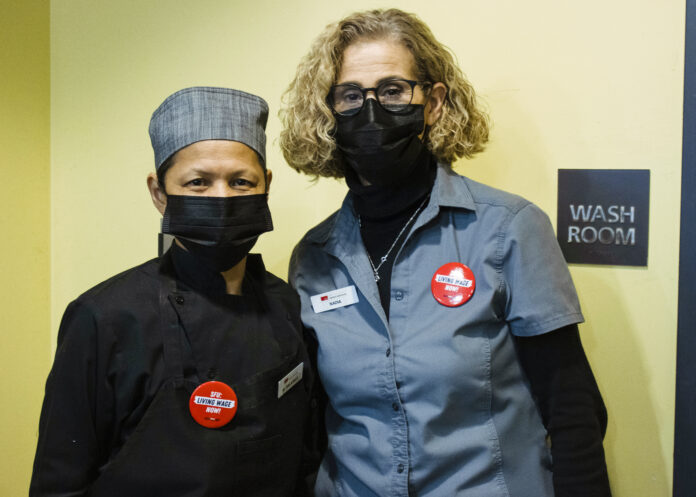
two food service workers standing next to each other, the person on the right has a red “Living Wage” pin on their uniform
An in-person rally will take place on March 31 as workers negotiate for a fair contract with Chartwells. PHOTO: Krystal Chan / The Peak

By: Karissa Ketter, News Writer

The negotiation period for the new SFU food workers contract with Chartwells has begun since their contract ended on October 30, 2021. SFU food workers are wearing red buttons on their uniforms that read “Living Wage,” as part of a campaign to pressure Chartwells for fair wages and better working conditions. 

SFU uses third-party company, Chartwells, to hire their food workers rather than hiring them directly in-house. Despite calls from the community to move the hiring in-house, and precedents set by UBC and the University of Victoria, their contract with Chartwells continues.

As Chartwells and workers at SFU are renewing their contract, the workers are campaigning for fair wages, safer working conditions, and access to the same benefits and amenities as other SFU employees. This includes access to on-campus childcare and university facilities such as the library.

The Peak spoke with UNITE HERE Local 40 communications organizer Stephanie Fung to discuss the campaign. UNITE HERE Local 40 is a hotel and hospitality workers union in BC that represents the food workers at SFU. The union has hosted a series of international rallies for service workers at Vancouver Pan Pacific hotel and other Westmont-owned businesses. 

According to Fung, the negotiations were halted when Chartwells failed to show up to their meeting a few weeks ago. “Workers were really angry. They really wanted to get back to the bargaining table to discuss the contract details, but when that failed to happen, they decided to escalate and take action.”

Fung said the reason for the campaign is to “call out Chartwells and pressure them to meet them back at the table.” 

Fung reported the pressure from wearing the buttons was successful. Chartwells and food service workers met the week of March 10, with Chartwells bringing forth a proposal for a new contract. However, Fung said, “What the management was [offering] them was far below what workers were demanding.” They expect to be back at the bargaining table soon to respond to the proposal. 

“Workers are extremely agitated, they’re feeling angry,” said Fung. “They’ll do whatever it takes to make sure that we keep the pressure up and keep fighting.”

The press release noted workers are making between $17 and $19 an hour. They have not received a raise in over three years. SFU food worker Gursharan Gill noted in the press release, “With the rise of inflation in the past decade, my wage isn’t enough to keep up with the cost of living in Burnaby. It’s extremely offensive how SFU is treating us as second-class citizens when other university employees are earning what they deserve.”

The current living wage for families in Metro Vancouver is $20.52 an hour. 

Fung noted despite the average rate of $18 an hour, seasonal shifts dramatically affect workers’ income. “I think that number would look very [different] if you knew what the annual income these workers make. Most of the food service workers don’t work during the summers when it’s less busy. So annual income is just really, really low.”

The Contract Worker Justice (CWJ)  group at SFU is another community body campaigning for the rights of food and cleaning service workers at SFU. These campaigns are not connected. CWJ is demanding a stop to private contractors for SFU’s food and cleaning workers, while UNITE HERE Local 40 is negotiating for a fair contract with Chartwells in the meantime.

Fung noted they are having a rally on March 31, 2022 at Convocation Mall for their campaign. “This rally is the largest of multiple planned actions we’ll be taking,” said Fung. 

To stay updated on the campaign or for more information on the rally, visit their Facebook, Instagram, or Twitter, @unitehere40.