



Your weekly SFU Horoscopes: March 7-13

By: Tamanna T., Staff Writer, Interspace advisor
Aries
The stars are asking that you take a chill-pill this week. I know you’re deep into midterm season but grades will come and go. Do some sight-seeing, find where they’re filming your favourite TV show, heck, splurge on those deliciously overpriced macarons from Laudreé and eat all 20 of them in one sitting. Just relax and let go.
Taurus
Try keeping your anger in check this week. We get that it’s frustrating Walmart is out of their Flaming Hot Cheetos stock. It definitely wasn’t that 17 year old employee’s fault.
Gemini
Unleash your inner Beyoncé and shower those around you with some sass. Trust me, they’re in desperate need of entertainment: you . . . classes are boring.
Cancer
You’re doing great sweetie. Just keep being you boo <3
Leo
22.2.22 just passed, so you better have manifested the best life possible while you had the chance. Honestly, it was your one chance at a good grade in that class you’re almost failing. Man, for your sake, I really hope you did some considerable manifesting.
Virgo
You thought you were so much better than everyone for not watching TikTok videos, didn’t you? Well too bad, TikTok lingo is so popular now that if you don’t say “Material Girl” or “gorgeous gorgeous girls” twice per conversation, your social credit is toast. Get with the program, Virgo.
Libra
Bad vibes are on your horizon, Libra. That ex you were trying to ignore all year? They’re taking the same summer course as you. That old friend who would always snitch on you in high school? They’re transferring to SFU. Show them who’s boss of this engaged university by not engaging with them at all. Keep those vibes immaculate.
Scorpio
It’s Scorpio Sad Girl Spring. Go consume sad content until you fall asleep from all your crying. Really let those feelings out Scorpio, because if you don’t, we know you’ll take it out on your partner.
Sagittarius
It’s time to scam the scammers back. This week when someone from Winnipeg calls to ask for your credit card information, turn the tables. Say you need money from them instead and that you have their SIN number. What you need to remember, Sagittarius, is that anyone could be committing tax fraud, even the tax fraud frauds. No one is safe.
Capricorn
You need some laughter in your life . . . Good thing you’re reading the humour section.
Aquarius
We see that your diplomatic nature has gotten you into some tricky situations lately. Trying to balance everyone’s emotions has left you in a whirlwind which your anxiety is compounding. It’s high time to take your stance and hold your ground. Stop quivering. Stop shaking. You’re fine, it’ll be fine.
Pisces
It’s time to indulge in your guilty pleasures this week. Buy eight more Squishmallows to add to your 34 ‘mallow collection, order four instead of two Domino’s pizzas and stay up all night playing Cooking Mama 2 (DS). Life’s too short, Pisces, live a little.
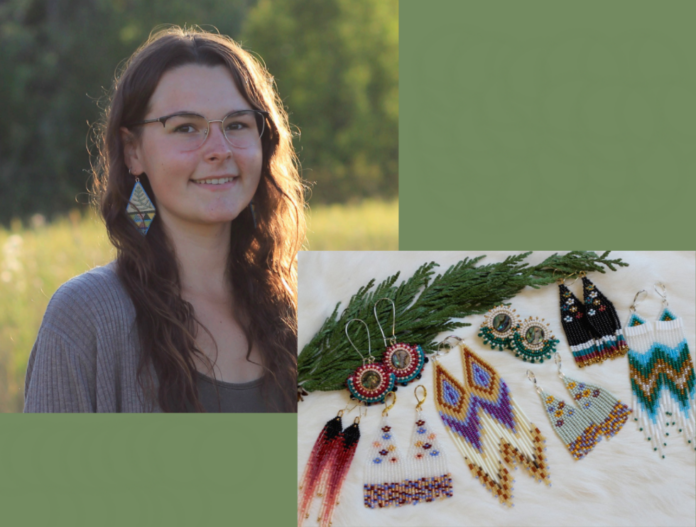
Rebekah Stevens finds healing through traditional Indigenous beadwork
By: Yelin Gemma Lee, News Writer
The relationship between an artist and their art is what makes their work reach people in ways words can’t identify. For Rebekah Stevens, the Indigenous studies and linguistics student behind @beksbeads on Instagram, this relationship is rooted in personal healing and affirmation of identity. In an interview with The Peak, Stevens shared more about her artistic process.
Stevens first learned to bead from an Indigenous elder in her hometown at age 10. After a hiatus, she learned again through friends and staff at SFU’s Indigenous Student Centre in 2019. Since she rediscovered her passion for beading, Stevens has consistently practiced her craft. Her Instagram account has now garnered the attention of over 7,000 followers. Many of the earrings she posts for sale are sold within a few hours.
“I started my Instagram account to document my beading journey and didn’t have any intention of selling things. But someone asked to buy a pair I had posted and I realized I could sell them, which made me motivated to learn other stitches and also allowed me to buy more supplies to continue learning more beading techniques,” said Stevens.
Despite a slow learning process, Stevens said it felt natural and peaceful for her to bead: she was able to find connection, healing, and affirmation of her Métis identity through it. “It gave me a reason to go back to Indigenous spaces. Because of beading, I’ve become comfortable with myself as an Indigenous person, and it has also led me to meeting so many wonderful Indigenous peers across all of Turtle Island, that I wouldn’t have otherwise,” Stevens said. “I’ve learned about my culture, the significance and stories that are told through beadwork, language, and so much more.” Beading is a core component of how she stands proudly Métis today. It also taught Stevens that the discomfort she experienced before was an impact of colonization.
“I often think about the women who came before me who would have beaded as a way of making a living (through trading, gifting), and I feel really connected to them in a weird way. Like all these years later, despite the Canadian agenda of erasing Indigenous cultures, I am here now, beading, and able to bead myself through school,” said Stevens.
Although there was a lot of trial and error, Stevens says this process was formative for her artistic practice.
“Some things work for some people and not others, and it’s taken me a long time to learn what types of needles, thread, beads, stitches, etc. I like and what works best for me. It has also taken me time to learn that not everything I make needs to be perfect, which is part of the beauty of beadwork,” said Stevens. “When I settle on colours, I kind of just go with what my fingers tell me to do and hope that I like the design. I like beading with no expectations.”
When Stevens beads, she focuses on putting good intentions into her pieces. She isn’t worried about anything else. To honour her peaceful beading practice, she currently doesn’t accept commissions and sells what she makes out of pure creative freedom.
“I don’t have to think about assignments, my other jobs, or other stressful things in my life when I’m counting beads onto a thread. I have always had anxiety and beading has really helped me deal with my anxiety in healthier ways,” said Stevens.
Before I made my first order, I asked if it was appropriate for me, a non-Indigenous settler, to wear traditional beadwork earrings. Stevens said as long as you are buying Indigenous-made jewelry from an Indigenous person, this can be a good opportunity for settlers to support decolonization and cultural reclamation.
Stevens explained wearing beadwork by other Indigenous artists has a lot of meaning to her as well. “It’s like a statement of being proud of who I am. I do it for all our ancestors who couldn’t before.”
Rebekah Stevens’ beadwork can be found on her Instagram page @beksbeads, which is also the best way to contact her about purchases. Each pair of earrings range from $70–$160 depending on style, size, and materials used. Shipping is available worldwide.
Peacemaker takes a lesser known DC Comics character to new heights

By: Emma Best, Peak Associate
Content warning: mentions of sexual harrassment in the second to last paragraph.
When James Gunn’s rendition of The Suicide Squad was released in theatres last August, it was surprising to hear that the first DC Extended Universe (DCEU) tie-in show would be about John Cena’s character, Peacemaker. The show was filmed in January 2021, a risky move considering audiences had yet to meet the character. However, it’s clear the risk paid off.
Peacemaker, and the rest of The Suicide Squad, are drenched in Gunn’s signature humour, vulgarity, and violence, now at an all time high with an R-rating and no Disney censors. The film combines an expertly curated soundtrack with a team of deep cut, lesser known comic book characters. Along with some returning fan favourites, The Suicide Squad brought vibrant colours to the typically dark and drab DCEU. The Peacemaker limited series is no different.
Despite the connections to the greater DCEU as a whole, Peacemaker stands boldly on its own. Without relying too heavily on pre-existing knowledge of DC Comics, the show allows new fans to enjoy it as it is: a funny yet heartwarming television show about found family. The fact that it takes place in a world where superheroes exist is merely a plus.
This isn’t all that surprising as Gunn achieved a similar feat when he brought The Guardians of the Galaxy to the screen in the Marvel Cinematic Universe. Gunn is known for taking obscure comic book characters and creating fun, character-driven stories. In Peacemaker, it’s still obvious the story takes place in the DCEU, but the setting and context never steal the focus from the characters and their own conflicts.
Peacemaker places the titular character, Christopher Smith, into a black ops team working to stop an army of parasitic aliens called “butterflies.” Smith must also fight his own personal parasite — his abusive, racist, homophobic father, Auggie Smith (Robert Patrick), who takes on the white supremacist supervillain moniker, White Dragon.
Peacemaker might be an abrasive anti-hero who loves peace so much he’s willing to kill for it, but as we explore his past, we learn more about him. There is a complicated trail of adhering to some of his father’s beliefs. Smith soon comes to realize just how much of his father he has absorbed into his Peacemaker persona, and begins to reject his father, as well as the attitudes that show up in the way he talks to others and himself.
This development of Peacemaker is done primarily through the relationships he develops with his fellow team members. They all grow closer as the series goes on. This is done particularly well through the friendship between Peacemaker and Leota Adebayo. At first glance, she and Peacemaker are opposites. However, as the series goes on, it’s clear they have things in common. Adebayo’s foil to Peacemaker allows both of them to evolve throughout the show’s eight episodes, whether as a result of self-revelations or seeing an eagle hug a human.
While Peacemaker is a silly show that balances dick jokes with heavier, character-driven moments, it’s important to also recognize Gunn’s problematic past. It’s difficult to praise Gunn’s work considering his series of offensive tweets about pedophelia and sexual assault, which were unearthed in 2018.
Though Gunn has apologized, his continual success in filmmaking demonstrates the issue of visibly white men being treated with leniency. Peacemaker’s stellar cast and punchy writing are remarkable, but they shouldn’t distract from the larger conversation about representation in Hollywood.
Celebrating Hong Kong culture and community
By: Sara Wong, Arts & Culture Editor
When it’s pouring rain out, I usually want nothing more than to curl up with a blanket and a good book at home. But on one dreary night near the end of February, I found myself eagerly venturing out to the Dr. Sun Yat-Sen Classical Chinese Garden. The garden was hosting a pop-up event called “Will Travel for Food: Vancouver–Hong Kong.” Local foodies Sam Shem (@thedessertclubca) and Melody Yip (@blackholetummy) promised an immersive culinary experience, and they delivered.
Featuring all local vendors, the garden’s food hall felt simultaneously comforting and electric. I was transported back to summers strolling through night markets. The giddy anticipation of devouring a bunch of street food was palpable throughout the crowd. It was lovely to see so many people come out to celebrate and uplift small businesses.
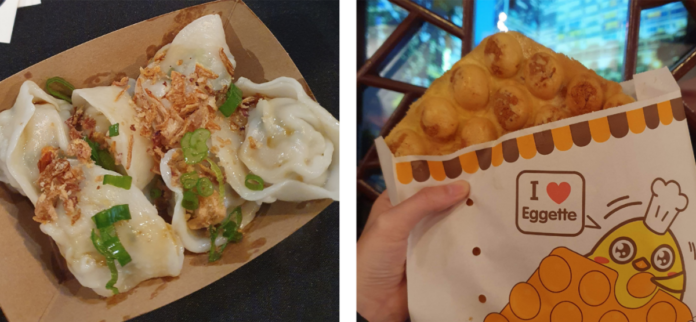
There was a lot to take in, so my friend and I went with the “divide and conquer” strategy when it came to grabbing food. Our haul included pork dumplings from Dicky’s Dumps, ya shi xiang tea from Teakan, a salted egg yolk, pork floss bubble waffle from Eggette House, and more.
The dumplings were as good, if not better, than the ones my family makes (sorry grandma!). They were plump, and the pork filling had just the right amount of seasoning. I also appreciated the bit of textural contrast the green onions and crispy shallots on top provided.
While the bubble waffle was being made fresh, I enjoyed sipping on Teakan’s fruity oolong tea. The strong brew helped distract me from the chilly weather outside. Soon after finishing my tea, the bubble waffle was ready. It was warm, fluffy, and packed with umami — well worth the wait.
At the next stall over, Simply Homayd was distributing samples of popcorn drizzled with their Chiu Chow style chili oil. Despite my mild spice tolerance, I decided to try some. It was a bit too hot for me, but thankfully Passione Gelato was nearby. I was delighted to discover they brought back a limited edition flavour — yuanyang — which was made in collaboration with Yip. Yuanyang is a popular Hong Kong drink that combines coffee and milk tea. The gelato version was just as smooth and creamy, with distinct black tea notes.
Taking our food outdoors, my friend and I walked past the busy courtyard, projecting a rotating series of Hong Kong street scenes, and found a quieter spot to sit and relax. The garden was adorned with red lanterns and fairy lights in celebration of Lunar New Year, and the view became even more mesmerizing as dusk fell.
All in all, it was a wonderful evening filled with good company. Shem and Yip created the kind of event that speaks to my soul — one that was community-driven and focused on bringing people together through food. “Will Travel for Food” brought me so much joy. I look forward to seeing where they take off next.
Club Profile: SFU350
By: Luke Faulks, Staff Writer
350 parts per million (ppm). Scientists suggest this is the maximum number of carbon dioxide particles that should be in the atmosphere. To prevent the earth from reaching several irreversible tipping points that would hasten and worsen climate change, the planet has to keep below 350 ppm. In 2020, the planet reached 412.5ppm.
It doesn’t have to stay that way. 350ppm is a goal — a target that energizes SFU350.
Since 2013, SFU350 has been pushing for climate action on campus. The group is related to the international climate movement, 350.org, founded in the US in 2008. For eight years, SFU350 has been working to get students and faculty engaged in more meaningful climate action. One of the group’s central goals has been to get SFU to divest carbon-intensive holdings in its investment portfolio. In 2016 and 2019, the group achieved victories, with the university agreeing to partial divestments. In 2016, then-SFU president Andrew Petter cited student advocacy as driving partial divestment, highlighting SFU350’s advocacy.
The group also works to raise awareness of the climatic, social, and health consequences of the Trans Mountain Pipeline expansion. SFU350’s “Justice, No Pipeline” committee has an open letter addressed to Prime Minister Justin Trudeau. The letter has been signed by professors, students, and “13 student unions representing 180,000+ students” from around Canada and the US.
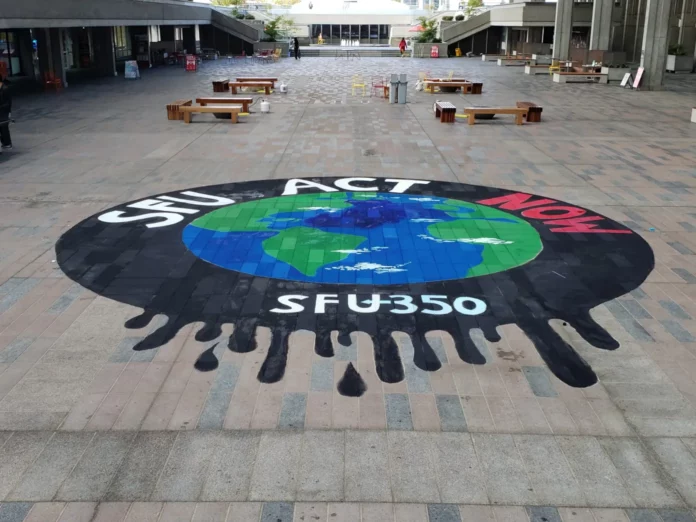
2021 saw a string of rapid successes for SFU350. The Fall semester return to campus saw an awareness-raising mural, an anti-TMX march, a climate emergency declaration campaign, and a commitment from SFU to full divestment by 2025.
The mural, in particular, set off a firestorm about student protests on campus, with the university threatening the students involved with charges of misconduct. The mural depicted a melting earth and called for SFU to adopt more aggressive climate targets. While the mural was ultimately removed without students facing any disciplinary repercussions, co-president Abigail Herd said the club’s spate of events led to a “huge uptick in interest.” Last semester, around 50 students signed on as members.
SFU350 members are aware of the monumental task ahead. WeiChun Kua, a member of SFU350 and the anti-TMX Campaign, said SFU350 offers hope in the form of “seeing young people come together” on a common cause, particularly with young people vying for institutional change. The group’s reach, which stretches from other groups on campus to groups around BC to climate-oriented groups around North America, provides more of the same comfort.
That’s not to say the group is always at work. Last year’s high-profile victories created an opportunity for celebration. This year, the group is planning on attending an art show by the artist who designed last semester’s mural, Jess Stanley. Herd said part of avoiding climate despair is taking the time to “celebrate the wins.”
Thanks in part to eight years of lobbying from the group, SFU acknowledged the climate emergency and agreed to full divestment by 2025. In a Board of Governors meeting on January 27, SFU officially declared that we are in a “climate emergency.”
In November 2021, a month after SFU committed to divestment, SFU350 partnered with Climate Justice UBC and Divest UVic to lobby their respective universities to fill out their investment portfolios with climate-conscious investments.
The new group pushes for universities to “move 10% of their respective endowments and working capital funds — totalling more than $500 million — into community investments to support a vibrant and sustainable local economy.” It’s the next step for SFU350 and a great jumping-on point for new members.
SFU350’s Linktree also lays out a few next steps interested parties can take, including registering for a webinar series on divestment the group has been invited to speak at, and a chance to join the Community Reinvestment Campaign. You can also sign on to their climate emergency declaration open letter.
When it comes to membership, SFU350 says the more the merrier! New members are welcome anytime because the “work is continuous.” They added, “It doesn’t matter what faculty you are, what year you’re in, or how old you are. We need everyone.”
Due to COVID-19, meetings occur primarily on Zoom. SFU350 is also available on Twitter, Facebook, and Instagram. Discussions take place mainly over the club’s Slack workspace. Students interested in signing on can email SFU350 ([email protected]) to be added.
The earth doesn’t have to stay at 412.5ppm. 350ppm is still within reach. If you’re looking for a way to get involved in fighting for 350ppm by pushing for comprehensive climate action, working within a supportive community that understands the rigours of growing up in a warming world, and reminding powerful institutions of their obligations, SFU350 is a great place to start.
Renaming and reconciliation
By: Gurleen Aujla, Peak Associate
Content warning: colonialism, Indian Act, intergenerational trauma, ongoing harm
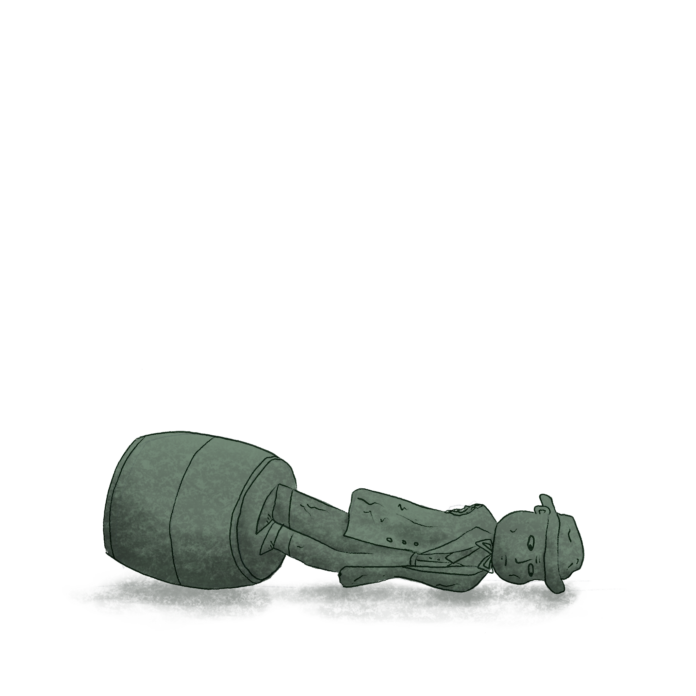
The “Gassy Jack” statue, from which Gastown draws its name, has been pulled down. Unlike the statue, however, colonialism still stands. This is evident in the names of streets, institutions, cities, and even our own school. This leads to the question of whether we ought to rename places like Gastown to reflect a shift away from upholding colonial perspectives, and demonstrate our commitment to reconciliation.
Though I am a non-Indigenous person with a filtered perspective on what reconciliation should look like, I don’t see name changes alone as showing we seriously value commitment to reconciliation.
A name change without further concrete action is not enough to decolonize or reconcile an inherently colonial space. “Canada” was built upon white supremacy, and that carries through to our present-day interactions; we must own up to and live with that. A name change would be a temporary solution that would take a long time to come to fruition and might gloss over — or even attempt to hide — our multi-faceted and shameful history.
I worry that name changes would be performative political moves, shifting focus away from the continuing reality of the Indian Act and the issues that Indigenous peoples face today. Avenues to reconciliation were presented in the 94 calls to action by the Truth and Reconciliation Commission, but only 11 have been completed in seven years, showing the work is most definitely not done. Renaming is not reconciliation; it’s simply a very tiny part of it.
In the words of We Wai Kai Nation member and former Attorney General of Canada Jody Wilson-Raybould: “Symbolism is important, including as a tool of education, but cannot be the core or foundation of our focus if we are at all serious about our society moving forward.”
So what would it mean for us to confront our history and engage in meaningful reconciliation and the redress of intergenerational trauma? This is a much longer and more difficult endeavour that requires ongoing conversations centring Indigenous voices and what they need for healing — likely more than just a new label painted on the side of a building.
If a name is inconsistent with our commitment to equity, diversity, inclusion, justice, and reconciliation, its change should occur in tandem with other actions. In addition, the change must be completed in consultation with (or ideally led by) the Indigenous nations whose land the named entity is on. If we pursue a name change, we must also ensure a space to hear and centre Indigenous stories and oral history.
Everything from our schools, cities, government buildings, and streets show this country’s foundations as being built upon settler colonialism. This legacy is still alive and strong. In response, we must centre what various Indigenous peoples and nations need for healing — perhaps starting at, but not ending with renaming. We must dedicate our time, resources, and energy to long-lasting and sustainable transformations in how we confront our history. The names of places have meaning, but they’re not what define peoples’ experiences in the spaces.
Researchers and Indigenous land stewards create story map of Indigenous seaside habitats

By: Karissa Ketter, News Writer
This year, SFU researchers launched an interactive story map of stewarded sea gardens in the Pacific Ocean. The project consists of Indigenous scholars and knowledge holders, along with academics and artists who wished to “foster learning about sea gardens drawing from traditional and scientific knowledge.”
The story map highlights information about “ancestral mariculture across the Pacific Ocean.” It is rooted in Indigenous stewardship of the oceans, intergenerational knowledge, governance systems, and cultural practices, according to their website. Mariculture is the farming of marine organisms in bodies of water.
The website claims this is not an exhaustive mapping but “represents the start of an effort to document the diversity of sea gardens.”
“This work is the result of a huge collaborative effort involving Indigenous knowledge holders, community practitioners, and university researchers from all over the Pacific,” said Heather Earle in an interview with The Peak.
Earle, a member of the seminar and now-graduated student, worked on the project alongside professor Anne Salomon, Dr. Melissa Poe, and Dr. Dana Lepofsky. Earle co-led the design of the story map and compiled knowledge and Indigenous stories for it.
Salomon first introduced this idea to her graduate seminar class who studied social-ecological resilience. It was the class that created the idea to begin the story map.
Salomon’s graduate class began the project by traveling to Hawai’i and restoring a fish pond. “There was a deep sense of community and energy that flowed from the revitalization of the fish ponds and the reconnection to that ancestral practice. It was clear how important the ceremonies, rituals, and the act of doing the work together are, when it comes to tending a fish pond and taking care of coastal environments,” said Earle.
“These sea garden examples show us a different way of relating to our environment at a time when we are so challenged by issues of climate change, ecological degradation, and food security,” she said.
Earle noted their research “showcases how Pacific coastal ecosystems were sustainably managed for millennia by Indigenous stewards. These practices developed from interactions and relationships with place, over time, and through natural disruptions and changes. [This] is highly relevant today as we are faced with things like more frequent heat waves and storms.”
One contributor to the project is Kii’iljuus Barbara Wilson, an Indigenous scholar from Haida Gwaii. Wilson helped the research team analyze the octopus houses in Haida Gwaii territory and along the Salish Sea.
Wilson has worked with Salomon since 2013 and was the cultural advisor for the story map research. In an interview with The Peak, Wilson stressed the importance of researchers behaving with a level of courtesy and respect when gathering knowledge on Indigenous land.
“I started back then, showing [Salomon] how you would come into a First Nations country, what you have to do for protocol, and what was the chronological way to do it,” said Wilson. “When you go into somebody’s territory, you don’t just go. You ask permission first: you ask for permission if you want to gather things, you talk to the chief and you negotiate,” said Wilson.
Wilson emphasized the importance of conservation. “It was in absolutely everything. It included intellectual property, how we work, the environmental education, all the creatures that we live with and respect. And so that’s why it’s important — you can’t keep taking, you’ve got to find a reciprocal agreement in your heart that says ‘I have a responsibility to pay forward and to pay back.’”
She noted the impact of knowledge preservation for later generations, “So much of our knowledge has gone to sleep; it hasn’t disappeared, it’s gone to sleep [ . . . ] When your nation goes from about 30,000 people to about 600, it’s like having your library burn down.
“Unfortunately most of our books of knowledge have passed away [ . . . ] We seem to be the old ones now. That’s quite terrifying when you think about the knowledge we don’t carry.”
“I’m a residential school survivor,” Wilson added. “We were cut off from the main source of history, which is our grandparents.”
The passing down of knowledge is an integral part of this project. “This work is dedicated to the Ancestors who stewarded the ocean, learned from her rhythms, and passed on their knowledge to today’s stewards who are continuing these practices and reasserting their authority to steward their lands and waters,” the story map website states.
Earle said, “Many of the practices we describe are still in use or are being restored today, and we hope that this synthesis might be a source of momentum and inspiration for those who are interested in doing the same.”
For more information on the story map, visit the Sea Gardens Across the Pacific website.
SFU Public Square presents lecture on the healthcare crisis in India

By: Yelin Gemma Lee, News Writer
Content warning: contains depictions of violence and abuse.
On February 2, Dr. Vaibhav Saria, assistant professor at SFU’s department of gender, sexuality, and women’s studies presented “Care and Crisis in India.” Saria’s lecture focused on the simultaneous celebration and violence that doctors, nurses, and healthcare providers face while working through the COVID-19 pandemic in India. The lecture was largely informed by Saria’s fieldwork on the tuberculosis crisis in India, where they spent seven year studying with a multidisciplinary team.
Saria listed the many forms of violence inflicted upon healthcare workers in India. Many healthcare providers were evicted from their homes due to landlords’ fears that they were infectious carriers. The Indian Medical Association reported over 1,700 doctors who died of COVID-19, and there were many reports of patients and their families attacking practitioners.
“Providers had already started sounding the alarm for the last 10 years, at least in published medical journals, regarding patients, families, and kin attacking them and which was adversely affecting the delivery of care,” said Saria. “Providers had gone on strike across cities, before COVID-19 as well, to ask for interventions to prevent such incidents. Apart from widely covered reports of lynching and grievous injury, doctors reported receiving threats on phone calls, intimidation, and verbal abuse.”
Saria explained there is a common historical precedence of violence throughout outbreaks such as the 1897 plague epidemic in India, but added examples of non-violent narratives are found historically too.
“Historians comparing epidemics and outbreaks across time, place, and diseases have pointed out that not all epidemics resulted in violence. The influenza epidemic of 1918 brought communities together, encouraging charities, and prompting tolerance across class and race,” said Saria.
They said the similarities between the 1897 plague epidemic and COVID-19 pandemic in India are due to negligence of the social aspect of crises. Through Saria’s work studying the tuberculosis crisis in India, they discovered there were many social tensions and complexities around healthcare in India due to constraints of time and resources.
“The constraints under which health is negotiated, the sheer demand that outstrips the supply, renders mistrust a constant presence in the clinic,” said Saria. They believe this outcome, due to a lack of resources, creates an image of “uncaring, disinterested, and corrupt” healthcare providers.
Saria explained the violence towards practitioners during COVID-19 also stems from historical tension still present today between Western colonial biomedicine and Indigenous ayurvedic medicine. Ayurvedic medicine is a “traditional system of medicine” in India and involves the use of herbal remedies and yoga, among other techniques, to heal. Biomedicine, on the other hand, stems from Western medicine and incorporates “research in biology” in its application.
Saria observed that doctors trained in Western biomedicine would use ayurvedic medicine to criticize the “over-medicalization” of health.
“Providers trained in biomedicine would often get irritated by patients asking for medicines and quick symptomatic relief by [snapping] at the patients that they should eat well, do yoga, and would also prescribe ayurvedic supplements, claiming they were better than biomedicine.”
They said due to the constraints of time with each patient, providers would be forced to provide various prescriptions for symptoms based on their medical judgement. This would lead to more accusations that health practitioners were over-prescribing because of financial incentives from pharmaceutical companies.
Saria noted the government’s role in solving these issues. “There is a larger ethical question here of funding health to resolve the structural issues that had resulted in the situation. Issues [include] one of the lowest rates of government spending, expensive private medical school education, lack of professors to fill medical school, posts not being filled in hospitals, shortage of post-graduate training, salaries not paid on time.”
This event was recorded and is available for viewing through SFU Public Square’s Youtube channel. For upcoming events in the President’s Faculty Lecture series, visit the SFU Public Square website.
Rise in crime attributed to COVID-19 insecurity

By: Yelin Gemma Lee, News Writer
Two researchers have published a study on COVID-19’s impacts on Vancouver crime patterns. According to SFU News, the study’s key findings revealed areas with economic disadvantage experienced an increase in crime during the pandemic. The study is a collaboration between SFU’s School of Criminology Dr. Martin Andresen and professor Tarah Hodgkinson of Wilfrid Laurier University.
The Peak interviewed Andresen to learn more about these findings.
According to Andresen, the crime pattern changes examined in the study were tested against “levels of social disorganization.” Social disorganization theory points to how areas with less socio-economic standing have weaker public institutions such as schools and community centres, restricting access of residents to things like income and education. These places of gathering, in turn, are “unable to regulate behaviour of the neighbourhood.”
He explained the significance of the increase in violent crimes in these neighbourhoods. “These areas have been found to be more impacted by COVID-19 (in other studies/news stories) because they have lost more jobs and had more housing instability. Because of this, these areas and their more marginalized populations are being victimized again,” said Andresen.
He emphasized the need for “social support” such as housing and a living wage for areas that experienced instability during the pandemic. According to Andresen, creating stability for those living in marginalized communities can lead to a decrease in crime. He pointed to Insite, a supervised drug injection site as an example of prevention and harm reduction.
“Research, in Vancouver, has shown that if we provide drugs to those who use drugs, their criminal activity is reduced by 80–90%. They do not have to steal in order to support their habit. Moreover, this research also found that these populations were more likely to seek out help for reducing drug use. Harm reduction is a great first step.”
When asked to respond to the recent increased police budget in Vancouver, Andresen suggested the increased budget should be allocated elsewhere.
“Increased police budgets have not been shown to have much [of] an impact on crime. Crime is 20–30% of police work and has been falling in Vancouver for 25 years,” said Andresen. “If we are going to invest more money into social services, it should not be more police, but more housing options, social workers, mental health workers, expansions of Insite, and so on.”
Andresen said he suspects these changes in crime patterns would reflect similarly in other Greater Vancouver cities like Burnaby and Coquitlam, but cannot say for sure without analyzing each city’s data. Andresen said he and Hodgkinson led a similar study in Saskatchewan and found similar results.
Instabilities resulting from poverty, homelessness, unemployment, and drug use are important factors to consider when looking at increased crime rates, according to Andresen.
This study was published in the Journal of Experimental Criminology and is available for open public access through Springer’s website.


