Home Blog Page 261

What’s on the Menu: Weekly reports with your best pal and racoon, Stinks

0
An illustration of a raccoon with a bowtie staring quizzically at the camera
Your trash talker ILLUSTRATION: Megan Yung / The Peak

By: Nercya Kalino, Staff Writer

Welcome back to What’s on the Menu. I am your best pal, Stinks the Raccoon, with the weekly report on what the students are tossing in the trash. Thanks to your readership, this has become the top raccoon newsletter. We have a treat for you. In the past month, a number of students have moved off the SFU residence area, and what was left behind was a feast! Tune into my report to hear more.

The amount of garbage left on the sides of the flooded bins was impeccable. Just prime stuff. I’m talking Cheeto dust, Maruchan ramen packs, and beautiful SPAM. Even some whole packages of spinach! I guess humans buy produce to watch them wilt. so we’ve been lucky lately, but I’m no scientist.

If you missed it, do visit our website where you can buy your favorite snacks and check the countdown clock on when the next treasures will be flooding in the Garbage Disposals of Glory. Of course, you will need to turn your alerts on and pass this information along to your families. 

And now, it is with great sadness to announce that Mr. Slow Paws’ son, Sticky Paws, got himself stuck in the garbage disposal. What pushed him to go this far, we do not know. Our top sources indicate he wanted to find the most priced junk in order to sway the ladies. 

We are deeply saddened by this news. We were not able to recover him because it was garbage pick up day. Goodbye, sweet prince. May you eat lots of garbage, whatever garbage disposal you visit next.

Next on What’s on the Menu is the top five foods the community has voted on. 

At number five is cracked eggs. Whilst these are gems hard to find, the sweet yolk and the crunch of the eggshell makes it worthwhile. At number four is the frogs. Chewy and puffy, the elastic skin is good for a long munch, especially if food is scarce. With the rain coming in and out, these snacks have become rare, so look out, folks. 

At number three and two we have the rotten mangoes and watermelons. If you are lucky you might find tomatoes, too. The humans are definitely getting back on the summer fruit wave. 

At number one is our all time favorite and is still holding its position: the canned and jarred food. We have the old moldy beans, tangy jams, and beef cans. Mushroom soups too, yuck, but it is on the list. While sticking our little paws into the cans is most definitely unsafe, it’s always worth the risk. 

In other news, the president of racoon watch, Mr. Scraps, has announced that the local humans in our area have decided to change the bins. While the bins signify more supply, we ought to watch out for the composite bins with the new locks that trap everything inside. Our composite stealth missions are currently halted until further investigation. 

Thank you for tuning in on What’s on the Menu, I’ve been Stinks, and that is all for the news today. Remember to travel in packs and always hiss if a human thinks you are cute.

Lower mainland Pride events to celebrate queerness

0
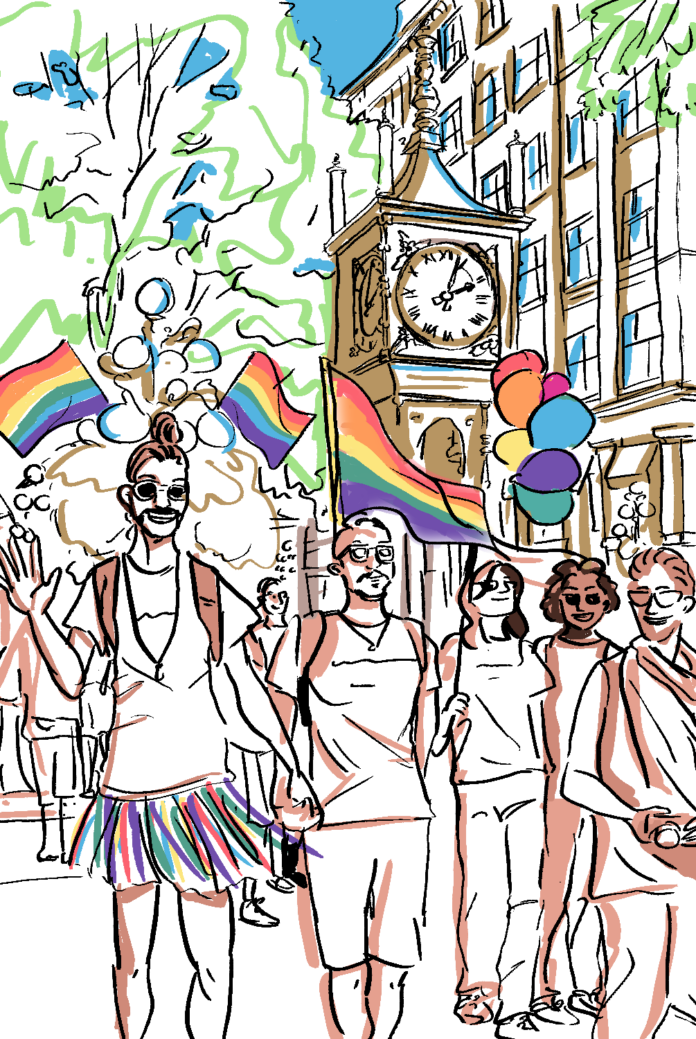
queer folks walking during a Pride-merch adorned street
Image Courtesy of Angela Shen / The Peak

By: Olivia Visser, Staff Writer

Pride month is officially over, but July and August are home to Vancouver Pride Week and a multitude of queer community events. Whether you’re a regular LGBTQIA2S+ event attendee or brand new to the scene, you’re sure to find something you’ll enjoy in this list of Pride festivities!


Movie Screening: Someone Like Me

If you’re unable to attend in-person events, the Co-operative Housing Federation of BC is hosting a free online screening of the documentary film Someone Like Me. Directed by Sean Horlor and Steve J. Adams, Someone Like Me follows the story of a gay asylum seeker from Uganda who finds support from members of Vancouver’s queer community. This is an online event, so it will be live-streamed through a link sent to registered guests. The National Film Board describes the film as “revealing how in a world where one must constantly fight for the right to exist, survival itself becomes a victory.” 

The trailer and film have trigger warnings for homophobia and violence.

When: August 4, 6:00 p.m.–7:45 p.m.

Where: Online, registration via Eventbrite


Sunset Beach Festival

In addition to Vancouver’s iconic annual Pride parade, Vancouver Pride Society is also hosting its sunset beach festival on July 31. Taking place along the beautiful backdrop of Í7iy̓el̓shn Sunset Beach, this is an opportunity to browse an artisan market, listen to live music, watch drag performances, and more. Masks are “strongly encouraged” at the event and will be provided at the Vancouver Pride tent to those who need one. The Sunset Beach Festival page also has a schedule for an accessible shuttle for those with mobility needs, and also offers ASL interpretation, disability seating, and a low-sensory tent. No registration is required. 

When: July 31, 11:00 a.m.–6:00 p.m.

Where: 1204 Beach Avenue, Vancouver


New West Pride and Richmond Pride 

Although some cities like Surrey and Coquitlam have already had their Pride festivals and events in June, other Metro Vancouver cities host their own Pride events in July and August. This year, the New West Pride 2022 Street Festival returns on August 13, taking over Columbia St. from New West Station to Columbia Station. In previous years, they’ve featured a main stage with performances, as well as vendors from Columbia businesses. Richmond Pride Week is happening during the last week of July with a great roster of events including Printmaking for Pride. Hosted by artists Edward Fu-Chen Juan and Jade Balogh-Callow, attendees are encouraged to bring their own art materials to create a “Wall of Pride” that symbolizes “strength, endurance, and perseverance.” No registration is required, but you must show up before 3:30 p.m.

When: August 13, 3:00 p.m.–8:00 p.m. (New West Pride Street Festival), July 23, 11:00 a.m.–4:00p.m. (Printmaking for Pride)

Where: Columbia St. (New West Pride), Richmond Cultural Centre Plaza (Printmaking for Pride) 


Burnaby Pride Festival and Pride BBQ in the Park

Burnaby Pride is hosting its fifth annual pride festival on July 23. This event takes place in Burnaby Civic Square and will feature live music, drag, comedy, and vendor booths. Burnaby Pride gives a few examples from their 2019 Pride events on accessibility such as disability-specific volunteers, digital events, ASL interpretation, and an accessibility table. No registration is required for this community event!

For those looking for a more relaxed experience, Burnaby Pride is also putting together a Pride barbeque at Lobley Park. A choice of meat, vegetarian, or Halal food will be offered to guests, and everything is free! There will also be a live performance from Burnaby-based vocalist Kaya, a queer woman of colour who creates soul, jazz, and indie-pop music. There is a registration page on Eventbrite, but Burnaby Pride says you can also just walk in. 

When: July 23, 12:00 p.m.–5:00 p.m. (Burnaby Pride), July 9, 2:00 p.m.–6:00 p.m. (Pride BBQ)

Where: Civic Square, Burnaby (Burnaby Pride), Lobley Park, Burnaby (Pride BBQ)

Meet the SFU club building electric racing cars from scratch

0
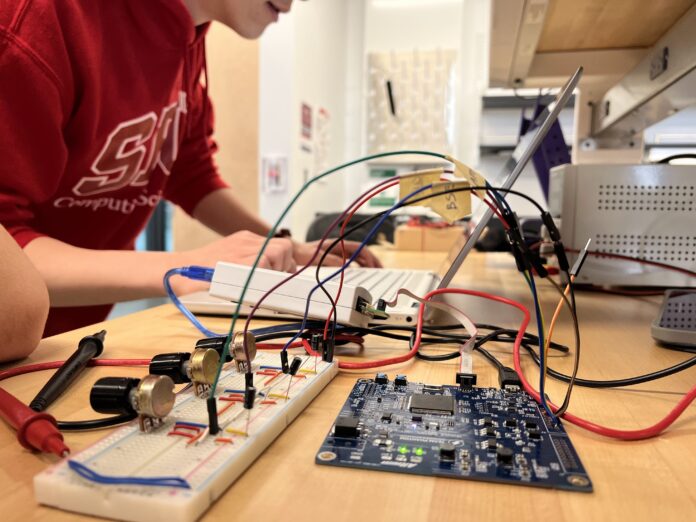
photo of a person working on a laptop with a motherboard in the foreground
The club is already gearing up to start test drives for their 2023 competition car this fall. PHOTO: Andrei Divinagarcia / Team Phantom

By: Isabella Urbani, Staff Writer

Do you have a need for speed? Since 2017, Team Phantom has been designing fully-operational electric vehicles for racing competitions. The club was started by students majoring in mechatronics at SFU — a branch of engineering specialized in mechanical, electrical, and electronic elements of building. The club originally started out building electric go-karts but switched to assembling electric cars from scratch. The team enters their car into electric competitions hosted by the Formula Society of Automotive Engineers (SAE), who also put on other competitions as part of their Collegiate Design Series

The Peak spoke with operations director and mechatronic SFU student Alex Cherniavskii about how the club strives to make their cars as sustainable as possible. Since the cars run on electricity and don’t produce any emissions, they are “cleaner than a traditional combustion-engine.” This helps the team demonstrate that crafting smaller scale electrical vehicles is practical, and helps prospective engineers build the skills necessary to pursue a career in sustainability. 

We already have club alumni that started their own cleantech company, Moment Energy, and we have both current and past club members currently working at industry-leading electric transportation and energy companies,” said Cherniavskii, who currently works as an intern for Tesla. 

As the next generation of engineers, Team Phantom is mindful of what they can do during their projects to limit emissions. “It will be our responsibility to ensure that we do things to ensure the integrity of our future as a collective of people that live on this planet [ . . . ] We all know what’s coming, so it is our job to recognize that we can apply ourselves to improve the outcome as much as we can.”

Part of using greener building methods also means picking and choosing when to use resources. Instead of competing annually, Team Phantom participates in races every other year. In order to design a car from the ground up to race every two years, Team Phantom is split into four sub-team  controls, dynamics, frame/aero, and power and a business team to seek out sponsorships to make their cars. 

The control team is the driver’s right-hand man. They build the communication system the driver uses to remain in control of the vehicle at all times. The dynamics team is the car’s eyes and ears. They make sure integral parts of the car such as the breaking and steering system are good to go. The frame/aero team give a hand to the car’s structural design, including its bodywork. And lastly, the power team is the heart of the system, constructing and managing the electrical system of the car to power the motor. Once a vision for the car has been assembled, the team gathers together to weld and assemble the metal parts. 

Due to the team’s two-year design focus, the team will not be competing at this year’s Formula SAE Electric competition, but is preparing for next year’s. They are close to assembling the car, with plans to test drive in the fall. When ready, the car will be judged in comparison to other entries from schools across the world based on two main categories: static and dynamic. The static category consists of a technical inspection of the car, a presentation by the team to a panel of judges, a cost and manufacturing component to evaluate the team’s business savviness, and a design event. The dynamic portion, on the other hand, looks at the on-track racing abilities of the car in three races: acceleration on a straight path, skidpad event for evaluating turns, and the car’s overall performance. 

Team Phantom relies on a plethora of sponsors to get the resources needed for their car each competition, including support from the Simon Fraser Student Society and companies such as Race Energy Performance. But when the club isn’t bringing their creations to life, they are visiting local middle schools and high schools with building challenges, such as hydrogen-fuel powered mini-cars, to inspire young STEM students. On their website, Team Phantom explains they do this because “to teach is to learn twice.” The club is true to this mantra by accepting all student members, regardless of experience, to partake in the building process. 

“It takes an immense amount of engineering work to engineer a good but safe racing vehicle, so it’s rewarding to see the design once it is built,” said Cherniavskii. “But I think the most important part is the amount of learning that happens during the process, as that is what contributes to long term future career success and builds skills that lead to being able to do even more technical things down the road.”

You can find more information on Team Phantom by heading to their website and checking out their Instagram page for updates on their latest design. 

Authentic ramen connoisseur: Recipes from dormitory expert, Guy Ramsey

0
A photo of a man typing angrily at his computer beside a bowl of ramen noodles
My privilege and my ramen is worthy of a Michelin star, peasants

By: Yasmin Vejs Simsek, Staff Writer

It was the year 2011 and I had just come back from a trip to Japan, and all I wanted was a smooth ramen throwback to take me back to the cherry blossoms of Tokyo. Ramen is a Japanese noodle dish, for those of you who haven’t been lucky enough to go to Japan, like myself. My favorite restaurant for ramen was this authentic cute little place with paintings of geishas adorning the walls and steaming bowls of hot ramen being served in artisanal Japanese bowls. So, longing for my favorite place in the world, I dug up this soup-er (see what I did there?) flavourful spaghetti recipe from my grandmother’s old cookbook, and have adapted it into an authentic collegiate meal for champions.

This recipe has been in my family for generations. My great-great-great-great-great grandmother used to make it for Edgar Allan Poe, and he loved it so much he wrote a poem for her yes, To Helen is about her! I think, nay, KNOW, they would approve my twist to it though, even if they didn’t have hot sauce and instant ramen in the 1800’s. I have perfected this recipe, so of course you won’t be able to make the perfect ramen in the first go, but after 4045 tries, you should be getting closer.

I always make this for myself if I am having a rainy day and I need a little pick-me up. Like that time my Xbox glitched and it hadn’t even saved my game of FIFA!  Or like the time I checked my bank account and hadn’t been transferred the $5,000 promised for my summer vacation to Cuba. I had to use my emergency credit card. All while actually writing a paper about Freud’s homoerotic tendencies. Ugh, relatable, I know. I’ll get em next time, champs, with the best ramen in the world.

HOW TO MAKE DELICIOUS, STEAMING, TASTY RAMEN SPAGHETTI:

This gourmet ramen dish is so fluffy, squiggly, salty, mahogany (I used my essay writing skills, can you tell?) with notes of burned truffle. And best of all, it’s super simple to make and you can basically make it with things you already have in your kitchen. 

First of all, you need galangal. Who doesn’t have that in their cupboard? If you just ran out of galangal, you can substitute for ginger, but I will suggest running to the shop, it really is the best option. Other than that, you just need tapioca flour, spirulina, hot sauce, quail eggs, remoulade, three types of soy sauce and muscovado sugar — NOT BROWN SUGAR — and they’re all staples in most of our homes, right?

Oh, you want more of the recipe? Like and subscribe for part 2/7 on my ramen journey. It’s only the low, low cost of ten Maruchan packets a day!

If you make this ramen, make sure to tag me on Instagram, TikTok, Facebook, Snapchat, Twitter, Pinterest, Tumblr, Flickr, LinkedIn, MySpace, etc. My handle is @EverybodyLovesRamend123. Remember to follow and leave a comment to let me know how much you liked it.

 Love,
Guy Ramsey

The Multicultural Myth: We need to stop celebrating Canada Day

0
Canadian flag against blue sky
You can’t champion your country’s human rights when serious inequalities remain unaddressed. PHOTO: Jp Valery, Unsplash

By: Olivia Visser, Staff Writer

Content warning: anti-Indigenous violence and discrimination, residential schools 

Canada Day is a celebration of national pride. From endless hiking trails, to universal(-ish) healthcare and Tim Horton’s, many Canadians get to celebrate their quality of life. However, not everyone shares this privilege to the same degree. And it’s due to our failure to provide those Canadian privileges to Indigenous peoples that we should cancel Canada Day in favour of a Day for National Reconciliation.

In this country, Indigenous people have historically suffered from and continue to endure systemic injustices that our government both caused and refuses to tangibly address. A celebration of a country’s history that takes place while a large segment of its citizenry is actively suffering isn’t innocent, it’s nationalistic. We’re minimizing the country’s colonial history and continuation of genocide in favour of an artificially positive vision of the country.

Canada’s history, inextricably linked, as it is, to violence and discrimination against Indigenous peoples is nothing to be celebrated particularly when that celebration inevitably turns to talk of how Canada is uniquely multicultural. The treatment of Indigenous peoples makes the country’s claim to multiculturalism ring hollow. 

Beyond having their land violently dispossessed, Indigenous people experienced cultural genocide by being forced into residential schools and forcibly stripped of their Indian Status through the Indian Act’s policy of enfranchisement. The enfranchisement process involved losing “their treaty and statutory rights as Indigenous peoples, and their right to live in the reserve community.” The Act also banned practices like potlatchs and the Sun Dance in a deliberate show of racism. The government was intentionally trying to establish its own eurocentric culture, yet nowadays people praise Canada for its public commitment to diversity. The central Canadian myth that we value multiculturalism is undermined by the history that we choose to celebrate every July 1st

Today, Indigenous people continue to suffer the consequences of Canada’s genocidal past. The last residential school was only closed in 1996, so many survivors are still alive today. New unmarked graves are continuously added to over 1,300 that have been confirmed to be discovered so far at residential schools. For most Canadians, this is a devastating reminder of our history, but for Indigenous people, it’s a traumatic manifestation of the violence that still burdens survivors and their loved ones.

Before we begin to celebrate Canadian culture, we need to address our present-day injustices. The Canadian government still violates Indigenous rights by encroaching on their lands for resource development and denying basic needs like water and healthcare. We also need to seriously address the crisis of missing and murdered Indigenous women by moving away from performative gestures and towards measurable action. Land acknowledgments are essential but don’t generate substantial change on their own. The Canadian government can start by addressing the material well-being of those living on reserves by increasing funds for essential resources and restoring land rights. Reconciliation by our government is performative if many communities still lack access to safe drinking water, and live on land owned and controlled by the Crown.

Reconciliation isn’t as simple as holding hands and pretending everything is all sunshine and rainbows. A step as simple as adding “Reconciliation Day” to the calendar, as the country did last year, isn’t enough. It is performative in the same way Canada claims to care about reconciliation, while still actively harming Indigenous communities — because every Canada Day we still celebrate being on stolen lands

Reconciliation is just a word for the starting point, not the endpoint, in accounting for the trauma that’s been forced onto Indigenous communities. It involves respecting Indigenous land rights, honouring treaties, and recognizing the contributions that Indigenous people have made to our society. It’s time to ditch Canada Day in favour of an alternative that actually accounts for our country’s dark history, and celebrates multiculturalism in a genuine manner. 

We also can’t sit back and expect the government to entirely fix a problem caused in part by civilian complacency. Reconciliation involves individual as well as systemic solidarity. Canadians can donate to Indigenous-run mutual aid organizations as a way to directly support those affected by colonization. Indigenous Mutual Aid is just one organization that offers emergency funds, medicine, and community resources to Indigenous people in need. Because these funds bypass government involvement, independent organizations like this can allocate their resources more effectively, with firsthand knowledge of where support is needed.

Canada is far from meeting the mark on reconciliation, but that doesn’t mean justice is a hopeless feat. The only real way forward is for everyone to recognize their place in this system that has targeted Indigenous communities since it began. Every settler in this country benefits from contributions made by Indigenous people who were subjected to genocide. Because of this, Canada Day should be permanently replaced with a Day for Reconciliation. We should have a holiday that reflects the values our society emptily articulates and should genuinely strive toward.

What Grinds Our Gears: Two+ midterms

0
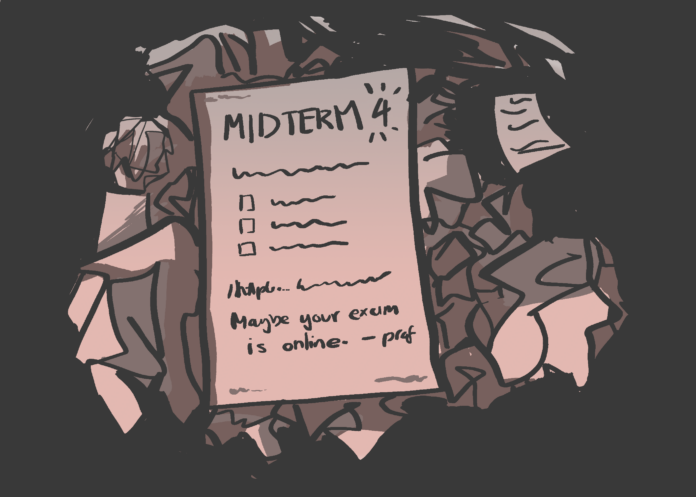
A flurry of midterm exams
On the problem of multiple midterm exams

By: Jerrica Zabala, SFU Student

Course selection week! The best time of the semester when we’re all absolutely drowning in school work. I gloss over prospective course syllabi and suddenly find myself in the shits; I’ve just found out the beloved required course for my degree has midterm exams . . . Plural. This is, of course, absurd. By definition, midterm means halfway. There can’t be more than one halfway point in the term. So then how can there be more than one midterm exam!?

Seeing the course syllabus on the SFU website already gives me anxiety. How are you gonna make me write more than two tests and call it “midterms”? Here, let’s make it easier for you. “Mid” is shorthand for “middle.” “Middle-term” exam. Feeling pretty silly having two or more of them now, aren’t you? 

The only acceptable definition of multiple midterms would have to be in the MIDDLE of TWO terms. Unless I’m pursuing TWO degrees at TWO different universities, I should not be taking TWO MIDDLE term exams.

Do you know how embarrassing it is to have two midterms? Especially during a conversation when your friends ask, “What do you mean you have a midterm? The semester is done in three weeks.” Like what is that about? Oh, and why the hell are you giving out a “midterm” exam two weeks after the semester has started? I digress. 

You want students to take your class with minimal test anxiety? HumDon’t call it a “midterm exam,” just call them unit tests. Midterms are exactly what it describes. Mid. It may be the most insignificant things students complain about during our time at SFU, but don’t fucking push me on it.

Brodie Douglas gives presentation about historical perspectives on Métis health

0
The photo is of the Canadian outdoors. Large mountains are seen in the background. A river runs through a green forest.
The presentation was held in partnership with BC Centre for Disease Control and SFU health sciences. PHOTO: Pixabay / Pexels

By: Chloë Arneson, News Writer

On June 9, BC Centre for Disease Control and SFU faculty of health sciences hosted a virtual presentation by Brodie Douglas on the historical context of Métis health. 

Tanya Davoren, the senior director of health of Métis Nation BC, welcomed the audience by introducing Douglas. “I can think of no one better to address how colonial history of the Métis nation has impacted our nation’s health and well-being,” she said. Douglas is Fraser Health’s Indigenous cultural safety educator and a Métis Nation historian. 

“The social determinants of Métis health are not only social but are primarily and more specifically, political and historical,” he said.

For Métis peoples, current social health determinants of health, such as being a visible minority or unemployed, are stronger health predictors than behavioural factors such as smoking or obesity. Métis health can be determined by the disproportionate health risk that resulted from colonial history and modern institutional racism, such as being poor, owning a car, or living near polluted lands. The United Nations permanent forum on Indigenous Issues has identified the need for culturally specific determinants for Indigenous peoples.

Currently, health funding for Indigenous peoples does not include Métis or those who do not hold status. “The marginalisation of Métis has its origin with the non-recognition of Aboriginality by the Canadian state,” Douglas said.

Douglas explained as the government of Canada historically ignored Métis land rights, many individuals agreed to scrip certificates, which stripped them of their Indigenous title in exchange for land or money. He said these documents were difficult to navigate as most Métis did not know how to read or write. “The scrip regime defrauded Métis of our treaty and Indigenous rights,” Douglas said. “This loss has had a negative impact on Métis culture and continues to impact the health and well-being of the Métis population.”

Douglas went on to explain some of Métis peoples’ rich history and how it has contributed to inequitable access to health services. Through military and political conquest, colonizers displaced Métis peoples, resulting in demographic shifts among their population in 1885. “Métis people found themselves without a landbase. Without a landbase and without an economy, marginalised at the fringes of society,” Douglas noted. 

In the 1900s, this was often still true. “Even though there were public schools in these areas, Métis could not attend because there was such a remarkable amount of racism,” he said. Residential schools were in operation long before and after this period, with attendance becoming mandatory in 1920 under the Indian Act.

In 1936, Métis peoples were still not afforded health benefits and many lived far away from doctors or did not possess the financial means to go see one. Douglas’ presentation featured a quotation by Diedre Desmarais that noted “the colonization of Aboriginal peoples created the circumstance whereby poverty became an inevitable consequence [ . . . ] colonization created the conditions for inequitable access to health care and services.

“I joke sometimes, Métis is the best kept secret in BC, but it’s because our history is not often told,” said Douglas. “We become invisible.”

Migrant Students United hosts town hall on healthcare for international students

0
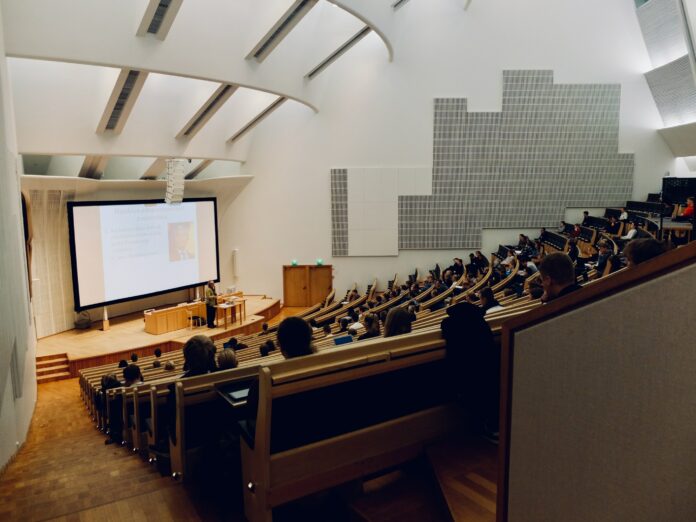
The photo is of the inside of a lecture hall. The lecture hall is full of students, attention turned to the front of the room where the professor is delivering a lecture presentation.
Currently, international student healthcare fees are mandatory. PHOTO: Dom Fou / Unsplash

By: Pranjali J Mann, News Writer

The Migrant Students United (MSU) chapter at SFU organized a hybrid town hall for students on universal healthcare fees on June 23 alongside the Simon Fraser Student Society. International students from SFU, other Designated Learning Institutes in BC, and students from American universities presented their thoughts on the medical healthcare and dental fees international students pay. 

The event was held in collaboration with other on campus groups and community organizations including the Teaching Support Staff Union (TSSU), Graduate Student Society (GSS), Sanctuary City Vancouver, and BC Health Coalition

At SFU, new undergraduate, graduate, and exchange program international students are required to have medical insurance through Guard Me. Additionally, new international, exchange, and study abroad students are also required to apply for BC Medical Services Plan coverage. 

An international student from Kwantlen Polytechnic University opened the discussion by saying he knew the pain and hardships international students faced, in addition to living away from family. He underlined the additional financial burden of any kind “adds up a lot of depression. And so I think this needs to be removed so we can help international students in a much more integrated way and in a positive way.”

A former SFU student also brought out the issue of exploitation of international students. They said, “It’s just getting worse. Immigration, Refugees and Citizenship Canada is being more horrible than ever, in terms of making sure everyone is precarious. Folks mentioned the inflation rates, but really it’s just like [a] mental health crisis — you just don’t have the support you need.”

An undergraduate student at SFU noted, “I realized that I have to get two jobs just to make ends meet, pay my tuition, paying rent, and groceries and everything like that [ . . . ] How I look at it is that migrant students, a lot of the time, subsidize everyone else’s education.” It was mentioned a government mandated 2% cap exists on tuition fee increases for domestic students but not for international students. Hence, for international students, “campuses can actually increase it by 10%. And students can’t do anything.”

The concern was echoed by Eshana Baran, SFSS vice president external and community affairs. Her presentation noted this healthcare fee is an unfair measure which negatively impacts international and migrant students. 

Baran stated the international student health fee as of now is $75 per month, per person. Baran called it a “violation of Canada Health Act.” The Canada Health Act contains a principle of universality, where all residents of Canada are entitled to uniform terms and conditions.

She noted this fee was a double charge, imposed due to the health care switch from Medical Services Plan to the Employer Health Tax (EHT). Explaining further with some statistics, she noted students with families are burdened with as much as “around $150 per month, per family.” 

Baran said, “In 2018, international students contributed $3.9 billion in GDP, $2.45 billion in labour income, and $392.9 billion in income tax.” According to Baran, “Essentially, Canadian universities and colleges are relying on international students to manage the budget shortfalls. 

“The institutions just rely on international students to fund post-seconday education.”

A toolkit was also shared with attendees for those interested in learning more. Follow @msu.at.sfu for campaign updates.

The Pool: The short, sad tale of Pascal Curious

0
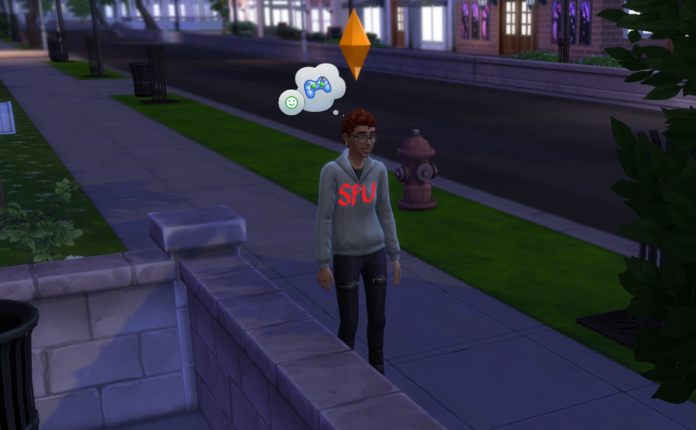
Someone wandering around in the Sims with a red diamond floating above them.
Things get funky in this student’s life! | SCREENSHOT: Kelly Chia / The Peak

By: Yasmin Vejs Simsek, Staff Writer

Pascal Curious walked from the library towards the Recreation Centre with a sluggish walk. Pascal was an ordinary student: they went to class, work, watched for aliens (since you can never be too sure!) And now, they were in the LONGEST library study session. It literally felt like they aged ten years in a day! Just yesterday they felt like a spry toddler. Odd.

Honestly, Pascal was surprised they managed to actually get work done in the library. Pascal was studying with Mortimer, a study buddy they met only a few days ago. Strangely, it felt like they clicked when they met, but not anymore. All Mortimer wanted to do was say, “Sul Sul!” over and over again. Pascal could feel their embarrassment growing, especially as Mortimer peed his pants. The library was sacred and certainly no place for accidents!


So Pascal left Mortimer and his accident, striding along the campus. Proud of their achievements of the day, Pascal decided a late-night swim was well-deserved and they headed towards the pool. They felt so drawn to the pool. Nothing beat the feeling of being completely immersed in a crisp 20℃ pool after a long, stressful day. 

Normally, there would always be a few swimmers, even this late at night and on such an Gleb-forsaken Monday. Not today, though. Maybe there was a strike of some sort. Maybe the student body had decided to close or open the SUB again? Or maybe it’s the research assistants looking for employment rights? 

Huh, wonder where that thought came from. Pascal wasn’t even sure what the SUB was, other than a submarine. Pascal couldn’t keep up anymore, but they had the place all to themselves and a lovely swim was waiting ahead. Pascal decided to change right by the pool. They felt so comfortable in their birthday suit! A simple spin, and they had a sublime swimsuit. 

Pascal was ready to get into the pool, but felt quite icky. Their general needs weren’t met, they were tired, hungry, and needed to pee. A quick pee break before the pool would be wise. But when Pascal went to the washroom, they found the toilet broken. Frustratingly, they had absolutely no clue how to fix it — Pascal was a lover, not a tinker — so they decided to hold it in and walked towards the pool. Finally, Pascal stood in front of the tiny ladder leading down to the water. The lights on the walls of the pool lit up the water from underneath. Head first, they gracefully dove in.

 After a few lanes of swimming, Pascal could feel the tiredness take over. And as it did, so did the need for food, a toilet, and their warm bed. Ahh, to Gleb with it, four lanes is enough for today. Pascal swam towards the tiny ladder by the other end of the pool. The closer they got the more confused they got. 

Where was the tiny ladder? Not in this corner. Not in the other one either. 

Pascal swam along the edge of the entire pool and could not find the tiny ladder! They swore they could hear cackling. How would Pascal get out of the pool? Who took it away? 

Pascal only did what any reasonable person would in that situation: flail their arms as if they were dancing! Pascal swam in circles, trying hopelessly to find the tiny ladder. Finally, they saw themself losing energy by the second as if flying above the pool. Every stroke was a battle at this point as they tried to stay above water, not being able to exit the pool without the suddenly disappeared tiny ladder. Shoo Flee!

Goodbye, cruel world, this is how we part.

“McFogg! Dinner is ready!”

Ctrl-Alt-S. Saved. McFogg would continue this game of Sims™ after mom’s lasagna — they were so proud they had gotten every detail of SFU correctly in their mod. Another successful session of anger management! McFogg thought about what to name their next character.

Opinions in Dialogue: The corporatization of Pride Month

0
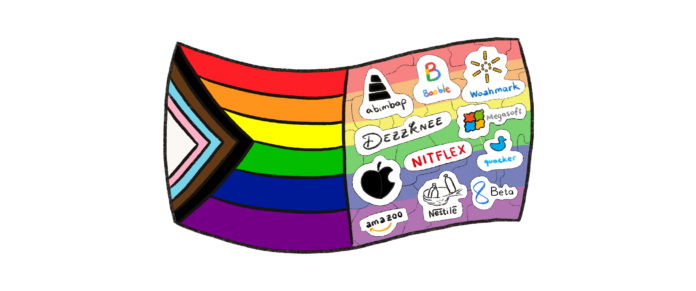
Pride flag crossed with corporate logos
ILLUSTRATION: Stella Nguyen / The Peak

By: Yasmin Vejs Simsek, Staff Writer, & C Icart, SFU Student

Content warning: mentions of homophobia and transphobia 

Pride month merch from faceless, multi-billion-dollar corporations is among the most calculated, yet somehow weirdly personalized marketing schemes ever. Over the course of a month, companies with seemingly no relation to the movement will emblazon their logos with rainbow flags and produce cringy but supportive merchandise. But does a corporate presence at Pride represent a victory lap for a marginalized community, or is it a smokescreen that hides companies’ actual lack of loyalty to the LGBTQIA2S+ community?

Yasmin: I will be the first to admit that companies’ overtly over-the-top attempts to be allies to the LGBTQIA2S+ community are extremely performative and there’s no way the majority of these CEOs actually give a flying fuck for the community’s rights and liberation. That being said, I can’t help but see this is a huge step from where we were 50 years ago, with Stonewall being an example of raiding gay safe places, arresting folks, and police checking people’s orientation. Now, I bet you that many of these organizations have homophobic or transphobic managers who strongly disagree with Pride month messaging. But they’re forced to support the community because waving around the rainbow flag in an attempt to prove allyship has become the corporate norm. And this norm is helping silence those haters.

This is obviously looking at it from a North American point of view unfortunately, there are still places in the world where being LGBTQIA2S+ is a crime, even punishable by death. Corporate support for North American Pride Month doesn’t extend to those countries, which is a problem. 

C: I can’t get behind the idea that this is a victory lap. There is no evidence that queer and trans folks are the people who primarily benefit from the corporatization of Pride. Even today, many people in the LGBTQIA2S+ community don’t feel safe around police, anti-trans legislation isweeping the US, and discrimination against LGBTQIA2S+ individuals still happens in Canada. Companies selling us overpriced rainbow everything doesn’t address any of this. These companies only participate in Pride month because they can benefit financially from doing so. Every June, we see corporate Pride logos, but generally, these same corporations do not display their Pride logos in the Middle East, for example. Only being a visible “ally” in countries where it won’t affect your business is not allyship, it’s bullshit, and we don’t need it. Seeing Pride flags pop up in more spaces makes me smile, but I think as a community, we still need so much more, and we shouldn’t be afraid to demand it just because things could be worse. 

Yasmin: No doubt about needing more. We need everything! And I think generally the white saviour complex stretches into this in terms of doing things to benefit the self, but not actually to benefit the community. Part of the problem is that corporations don’t actually ask the community what they need! As of 2022, only four CEOs in the Fortune 500 were gay, so any seemingly pro-Pride decisions are being made by people outside of the community.

I agree that pride merch shouldn’t only be offered in countries where a display of support won’t affect your business. However, I think shows of support in those regions where homophobia is prevalent, wouldn’t just harm your business, it could actually bring harm to the community. I think we should keep demanding what the community deserves, whilst still celebrating the victories along the way and picking our battles. I won’t fight corporations overcharging and overselling Pride merchandise, but I will fight their support for anti-LGBTQIA2S+ campaigns. I think those two can co-exist. 

C: I don’t believe rainbow capitalism happens because corporations are trying to help anyone. They’re trying to make money. You are right; corporate Pride logos wouldn’t help queer and trans folks in regions that are hostile to gay rights. In the same way, they don’t help anyone here. They are strictly performative. Many corporations are both Pride sponsors and anti-LGBTQIA2S+ campaign donors. This is something that needs to be called out. Companies don’t get to market themselves as an “ally” when they want to sell us things while funding our oppression at the same time. I do believe in celebrating victories along the way, but I can’t think of a single LGBTQIA2S+ victory that was corporate-led. The first Pride was a riot led by Black and brown queer and trans folks, many of whom were sex workers. Pride is about liberation, and corporate visibility does not liberate us. 

Yasmin: See, I think corporations at Pride help folks here; not directly, not financially, but by raising awareness and making the rainbow the norm. On funding anti-LGBTQIA2S+ campaigns, I completely agree, that’s why I pointed it out. It’s a huge issue and they need to be called out! But I think we can do that without stopping corporate Pride awareness, performative as it is, because I think it’s better to have it than not to have it. It can’t be compared to the liberation that Pride itself gave us, but I think there is a level of liberation. I don’t know that it would be possible to make statistics on the decrease in homophobia due to the over-awareness of Pride that corporations contribute to, but I do believe it might be the case. 

We are allowed to be angry and there are a lot of things we need to fight for. I just think we will get further not by fighting the performative rainbows, but by fighting the rest of the shit these companies do. We need to target their support to anti-LGBTQIA2S+ campaigns rather than the flags themselves. As hypocritical as these corporations can be, the corporatization of Pride helps silence homophobes by making Pride the status quo.

C: I think the impact of general “awareness” of the LGBTQIA2S+ community is overrated. I’m concerned that the corporatization of Pride may be normalizing empty acts of allyship. When people use the Pride flag, it should mean something. It should be attached to a real commitment toward queer and trans liberation. Corporations being performative may be better than corporations actively contributing to harm in the community, but I still think corporations being performative while simultaneously harming the community is an extra level of twisted that we should not stand for. 

To be fair, rainbow washing criticism is not new. In response to the charge of “hypocrisy,” some companies contribute to charities with the profits they make from Pride campaigns. Rainbow washing remains an issue for the community issue because it obscures the real needs that LGBTQIA2S+ folks have. I’m not targeting the flag; I’m targeting corporations co-opting an important symbol, diluting its meaning, and selling it back to us. If you want Pride merch, I encourage you to get it from queer and trans folks! Vancouver Pride Society has a helpful list of local LGBTQIA2S+ producers.