Home Blog Page 215

The art of urban leadership with Jonathan Coté

0
This is a photo of the New Westminster port and skyline.
PHOTO: David Stanley / Flickr

By: Saije Rusimovici, Staff Writer

On January 16, urbanist and former mayor of New Westminster Jonathan Coté led a reflective lecture Transforming Urban Leadership, where he outlined some of the key areas of effective urban leadership in addition to challenges in public policy. Presented by SFU’s Morris J. Wosk Centre for Dialogue, Coté provided an insightful look at his experience with 17 years in local government. 

Coté’s final term as mayor of New Westminster ended last November. Since 2014, Coté has served as the chair for regional transportation and the chair of regional planning. As an SFU alum of urban studies, Coté has recently been “appointed an Adjunct Professor in the Urban Studies program.” 

Coté described the feeling of a spotlight shining down on him during his time as mayor. He described a common illusion where the mayor has the ultimate authority when it comes to city building. “There are so many different groups, stakeholders, and people that are involved in good city building that often don’t have the big spotlight that you might shine onto a position like the mayor of a city,” Coté said. “From my perspective, I think the biggest unsung heroes in city-building and in our cities, are actually the people who work for our cities.” Coté went on to say city building is an ongoing, never-ending project that is constantly changing.

Coté spoke on pivotal experiences with urban development and public policy throughout his time as mayor, some of which were initial successes and others that were not. “I think there are lessons to be learned from successes [ . . . ] but also stories where things didn’t quite work out,” Coté said.

In navigating the transformation of downtown New Westminster while maintaining the city’s historical routes, Coté highlighted the triumphs and challenges in an ever-evolving city. “On the one hand we wanted to have a really great conversation about revitalizing downtown New Westminster [ . . . ] but on the other hand, I had a deep concern about the other side of revitalization, which is gentrification,” Coté said. Gentrification happens when the city is reconstructed to encourage wealthier people to move in, displacing people in working class areas. It has been known to primarily impact lower income groups and racialized communities. 

According to Coté, it was important to consider the negative impacts of gentrification on community displacement. “Over my seventeen years, we did a lot in downtown New Westminster [ . . . ] they were kind of flipping back and forth between these two goals of revitalization versus trying to mitigate gentrification,” he added. Coté said this resulted in meaningful developments such as Westminster Pier Park, rather than trying to make “Canada’s newest, trendiest neighbourhood. 

“City-building is important and it is central to all of the biggest issues that we are facing all around the world,” said Coté. He described city-building not as a linear process where success is the result of well-thought out plans, but “messy.” He noted the process of city building is inherently unpredictable as a result. “The reality is, cities are all about people, and people are complicated, complex, and diverse.”


SFU researchers concerned for extinction of sharks and rays

0
This is a photo of multiple sharks swimming in the ocean.
PHOTO: Colton Jones / Unsplash

By: Natalie Cooke, News Writer 

Human activity has threatened extinction for sharks and rays, according to a study published by a team of SFU researchers. The study found that 59% of sharks and rays associated with coral reefs, may be facing extinction. 

Earth.com reported, “This is due to the fact that coral reefs — which harbor over a quarter of all marine animals and plants — are seriously menaced by a variety of human-related threats, including overfishing, pollution, and climate change.”

The study found fishing has the biggest effect on the shark and ray populations. Sharks cannot reproduce as fast as humans are killing them: this makes them an extremely vulnerable species for extinction. 

Sharks and rays are hunted by humans to use in a variety of products. They are commonly used for human consumption, creation of clothing and accessories, and traded internationally for their fins, skins, and meat. They are also used for aquarium display, food for animals, and in medicines.

The SFU researchers emphasized the importance of reducing the amount of shark fishing. To help the shark population recovery, the researchers suggested fishing undertaken by individual fishing households, and industrial fisheries need to be controlled and the management systems need to improve. 

The researchers also explained climate change is a threat to coral reefs and their inhabitants, but it is not the most impactful threat when compared to issues such as overfishing. 

However, the percentage of CO2 in the atmosphere has increased due to human activity and is impacting the underwater ecosystems. The National Oceanic and Atmospheric Administration explained, “Because of human-driven increased levels of carbon dioxide in the atmosphere, there is more CO2 dissolving into the ocean. The ocean’s average pH is now around 8.1 [ . . . ] as the ocean continues to absorb more CO2, the pH decreases and the ocean becomes more acidic.” When pH levels get too high, organisms cannot build and maintain their skeletons, shells, and other bodily structures. 

Ironically, sharks can help make oceans more resilient to climate change. Some shark species can prevent overgrazing from other marine life which allows seagrass to be stronger and denser. This is important as seagrass catches CO2 from the air, preventing ocean water from becoming overly acidic.  There are many ways in which sharks and rays can benefit the ecosystem, which is why their extinction would also threaten our changing climate. 

To learn more about the study, visit the research article published on Nature Communications’ website

Dear Peakie

0
A photo of someone looking prim in an office chair with a thick book in their hands.
PHOTO: Pexels

By: Hannah Kazemi, Staff Writer and Expert Advice Giver

Dear Peakie,

I want to like, go beyond myself this year . . . like, really ascend . . . and you know what they say, the will of the mind guides the will of your path or something. I don’t know who said that, but I do know you can give me some advice on how to be beyond.

Sincerely,

High Up in the Stars

Dear High Up in the Stars,

I think Paris Hilton said that once, and Paris Hilton slays. Sounds like you’re looking for a spiritual experience. I recommend taking some fun gummies and attending a “Starry Nights” event at the Trottier Observatory — lay back and watch the stars dance right in front of your eyes. Try to count the dots in the sky and imagine what it would be like to be floating up there with them. I guarantee you’ll find what you’re looking for.

Good vibes only,

Peakie

Dear Peakie,

Where on earth is my cute, edgy boyfriend with a mysterious past that I must exact all my emotional highs and lows on? It is cuffing season and I am BITTER. I was told this was a school of engagement, no less. Where are people going to seek out their significant others? When will I be a significant other?

Sincerely,

#1 Most Single University Student (NOT Engaged)

Dear #1 Most Single University Student (NOT Engaged),

Uh oh! You must not have gotten the memo: SFU is Canada’s most engaged university. You might have to drop out to preserve your integrity if you don’t find someone ASAP. I suggest sitting next to the cute, edgy guy in your seminar class and introducing yourself by telling him all about your dream wedding. You’re sure to land a bf that way! 

Also, try hanging out around the avocado — it seems to be where lots of your peers get busy, so why not try? Be a hot girl! Actually, maybe don’t try that . . . rumours say you can hear faint cries for “momma and dadda” coming from inside the avocado. I think it might be a good thing you’re NOT engaged. Do NOT tell SFU I said that.

Live, laugh, love,

Peakie

Dear Peakie,

I can feel the hole in my wallet stare into me (metaphorically, of course, I haven’t seen a fifty dollar bill in years). It feels like guilt and bad decisions, but I just need that extra push of comfort every morning from my Renaissance run! HELP.

Sincerely,

My Money Jiggle Jiggles too much

Dear My Money Jiggle Jiggles too much,

Unfortunately (for my wallet), I, too, have fallen victim to Renaissance. The people are too nice and the food is too delicious! Luckily, I think I have the perfect solution to help you feel better every time you tappy-tap your card. Take cash out and use that to fuel your coffee addiction! Instead of hearing the sound of Apple Pay telling you you’re one step closer to bankruptcy every time you need a caffeine boost, pay with cash — it’ll be like you’re not spending any money at all. Because cash isn’t real money . . . right?

Manifesting rich vibes forever,

Peakie

Student Updates

0
"Student Updates" text in SFU red
You’ve already made it farther through the article than 97% of the student population. ILLUSTRATION: Siloam Yeung / The Peak

By: Nathan T.

The Koi from the AQ pond have been removed

After years of entertaining graduating students during convocation and disappearing during winter, the koi fish have been sold to the SFU biological sciences department to help raise money for the molecular biology department. 

All students are to take six courses to help fund the school

In an age of COVID-19 and recession, the administration has mandated that all SFU students are to do six courses per term starting in Summer 2023 to provide additional funding for the university. The administration hopes this will enable students to graduate faster, therefore freeing up space for even more students. Engineering students will still have to take two more courses than other students each term to maintain bragging and complaining rights.

Asbestos discovered in the entire Burnaby campus

After reports of asbestos being found in the Bennett Library, SFU has undergone an extensive check of the Burnaby campus and has found asbestos in the AQ, RCB, Saywell, Blusson, WMC . . . so everywhere, including your food. SFU maintains that as long as the asbestos is undisturbed, everyone is safe. The good news is, you now won’t live long enough to completely pay off your student debt.

Library study rooms are empty

Shortly after the report of asbestos being found in the Bennett Library, SFU Libraries is reporting a 500% decrease in study room usage. Students are encouraged to use study rooms as needed. No need for bookings now!

Soaring to new peaks

The Peak has found out the newspaper has now achieved a circulation of 25 readers. That’s one more than the number of staff at The Peak (who are forced to read the newspaper as part of work). So thank you kind stranger (or mum)!

SFU has received an award for being the highest school

Recent heavy rainfall events has led to SFU receiving an award for its high elevation compared to other schools of similar size, such as UBC and KPU. This means that SFU will be the last place to shut down during any Lower Mainland flood. Representative of SFU, Albert Quatriangle, said in a statement, “Hopefully SFU students will realize how fortunate they are and stop whining about getting to the mountaintop during winter. We will never shut down; come drought, blizzard, flood, or pandemic. We had this all planned out since 1965, believe it or not!”

SFU department of Academic Studies trialing “no readings” policy

The Department of Academic Studies has instituted a policy of no readings for all of its classes. Chair of the department, Dr. Sam Paper said, “Our research shows none of our SFU students do their readings. Therefore we are following the science and evidence and asking our professors and instructors to stop assigning readings for class. Obviously we are in close communication with the other departments in the university to make sure our students will still get the same amount of work overall to maintain the university experience.”

Connect the Lingo

0
Illustration of a character connecting the words “connect the” and “lingo” with a pencil.
ILLUSTRATION: Alyssa Umbal / The Peak

By: Hannah Kazemi, Staff Writer

Word Bank: 20, bullet, pick six, pommel horse, Christine Sinclair, skeleton, Peter Forsberg, football, 10, kiss and cry

  1. This athlete holds the record for most international goals.
  2. What sport is known as a “game of inches?”
  3. There are typically ______ cars in a Formula 1 race.
  4. The running portion of an Olympic triathlon is ______ km long.
  5. After a skating routine, competitors go to the __________ area to wait for their scores.
  6. “I don’t believe it! The football was intercepted and taken all the way down the field for a ________.” 
  7. In _________, athletes slide head first down the track. 
  8. Archers sometimes refer to their arrow as a  _________.
  9. This athlete has a shootout move named after them. 
  10. One apparatus in men’s gymnastics is the  ____________.


Answer Key: 

1) Christine Sinclair 

2) football

3) 20

4) 10

5) kiss and cry 

6) pick six

7) skeleton 

8) bullet

9) Peter Forsberg

10) pommel horse

Two Minute Drill: Owen Gudmundson

0
photo of SFU men’s wrestler Owen Gudmundson taking down his opponent on the mat.
PHOTO: Owen Gudmundson

By: Natalie Cooke, News Writer 

Owen Gudmundson is a sophomore on the SFU wrestling team, where he competes in the 197 lbs weight class. He is a molecular biology and biochemistry student, and was the 2020 Calgary City Champion in the 168 lbs weight class.

Editor’s note: This piece has been edited for clarity and length.

Q: Who is your favorite athlete? 

A: David Taylor, he’s an American wrestler.

Q: What is your walkout song? 

A: Here Comes the Money — it’s Shane McMahon’s walkout song in the WWE.

Q: Which teammate makes you laugh the most? 

A: Ryan Hicks.

Q: If you got a superlative award, what would it be for? 

A: Smartest or nerdiest.

Q: Most memorable wrestling memory? 

A: Canada Summer Games. This summer, I won the bronze medal in the 216 pound individual men’s competition.

Q: Favourite traveling pass-time? 

A: Reading or listening to non-fiction podcasts.

Q: Favourite food place in Burnaby? 

A: Uncle Fatih’s

Located at the finest academic establishment, SFU. 

Q: What’s something that no one knows about you? 

A: I have an enormous sock collection. I have a pair of socks that resemble the layers of the earth. They have dinosaur bones and rocks on them    it’s pretty sick. 

Q: What would you change about wrestling? 

A: I think people need to wrestle more, which means more stalling calls. If you’re not doing anything, the referee can penalize you. Eventually, you start giving up points. 

Q: What sport would you compete in other than wrestling? 

A: Marathon running. Imagine the fastest marathon runners, they can run 42 km in two hours. 

Arguing with a climate denier? Talk to them about global cooling

0
iceberg
PHOTO: Pixabay / Pexels

By: Luke Faulks, Opinions Editor

As of January 18, 2023, the openly climate-denying Canadian Conservative Party is leading the Liberals by 7%. And while the election’s a while off, Pierre Poilievre’s rise leads us to ask, again, how do we talk to a climate denier

Let’s try talking to them about global cooling. It’s a way to reinforce the power of the scientific consensus around warming and teach about the link between atmospheric CO2 and temperature. 

The concept of cooling is often brought up by climate deniers to discredit science, but engaging with them on the issue can actually help underscore the validity of the scientific method. When deniers talk about global cooling, it usually goes like this: “If you look into the 1920s, they were talking about a global freezing, okay?” That’s a quote from former President Trump, and, apart from the year, it’s a classic climate denier line. He’s reflecting a view that’s often repeated by climate deniers, which is that, “back in the day,” usually the 1970s and 1980s, scientists were convinced the world was on a cooling trajectory. If scientists were convinced and wrong back then, the argument goes, maybe their conviction might be wrong on climate change now.

The real story is easy to convey and helps to underscore the validity of the scientific method. The “global cooling” fear stems mostly from just one extremely popular article published by Newsweek in 1975. But the article’s findings weren’t substantiated in academic journals at the time, and the author has since recanted the piece, expressing regret that his work had been used by climate deniers for decades.

A 2008 review of research published between 1965 and 1979 found that, even then, scientists were more concerned about global warming than cooling. Case in point, in 1975, the same year that saw the publication of that Newsweek article, there was no published scholarly research confirming global cooling. But there were around 40 studies on warming. Now, around 99% (or 97%, or 100%) of research published confirms a massive consensus on global warming. Consensus-building using the scientific method works, and it was crushing junk science like global cooling before Newsweek even published its piece.

But there’s another reason to talk about global cooling, and that’s because global warming is making global cooling impossible.

Climate deniers are right about one thing: “the climate is always changing.” It always has, and CO2 has always been a big part of that change. CO2 plays a critical role in regulating temperatures on earth. When there’s a lot of CO2 in the atmosphere, more of the Sun’s energy gets trapped and rebounds to the planet, heating the earth. When CO2 falls, the temperature falls, which contributes to ice ages (though the planet’s orbit is the bigger culprit). A graph from the think-tank Carbon Brief shows the link between temperature and CO2 in action. It shows how CO2 and temperature have risen and fallen in sync over time, but are overall rising. 

High points on the graph correspond with melting periods, and low points match the planet’s ice ages. It’s a fantastic visual way to show the role that CO2 plays in regulating the earth’s atmosphere; it’s also a way to get them on-side. Yes, the climate has always changed, and yes, there are global warming and global cooling periods, but those temperatures are tied to global CO2 levels. That’s the time to notice the right-most part of the graph, better shown by this table from NASA, and the massive spike in CO2 emissions that it shows. That’s due to human activities. If not for that spike, a paper published in 2012 suggests that the next millennium could have seen the next ice age. But we’ve interrupted that natural cycle by pumping too much carbon into the atmosphere. Our hands are on the wheel now. And the notion of global cooling is an effective way to force that realization. 

Arguing with a climate denier can be tedious. It can be enraging. But by raising the idea of global cooling, you can take the wind out of your sparring partner’s sails, help reinforce the validity of climate science in a, maybe, novel way, and tie changes in global temperatures to atmospheric CO2. In short, the concept of global cooling may be one way to emphasize the very real threat of global warming to a skeptic. 

Top ten ways to save your resolutions at the end of January

0
Very calm, very cool. Nothing wrong here. Illustration: Siloam Yeung / The Peak

By: Maya Beninteso, Peak Associate

1. Ctrl + S

For those of you who are tech-savvy, simply type “your resolutions” into the word processor of your choice. Did you do it? Great, now locate the “control” and “s” keys on your keyboard and press them simultaneously. Congratulations! You’ve just saved your resolutions. 

2. Gaslight yourself 

No, you did go on your daily 30-minute walk. Don’t you remember? You zoomed through the halls of the AQ looking for the class you definitely attended in the first few weeks of the semester. Of course that counts! You also jumped to conclusions several times today, what a fit queen. 

3. Embrace your inner editor

Get out your trusty white-out, or your backspace key (if you’re too fancy for a piece of paper), and edit your resolutions to your heart’s content. After all, you can’t fail your resolutions if you constantly edit them to fit your life (or lack thereof, but who am I to judge). 

4. Pretend like they never existed 

What resolution? You most definitely didn’t have a resolution to do all of your readings before lecture because, let’s be honest, no one does that (and for those of you who say you do the readings, shhh! Not so loud!). Shove the memory of making your resolution deep down, just like your memories of last semester. 

5. Start a petition to cancel resolutions 

Assert your conveniently-timed disdain for resolutions and begin a revolution. March to the AQ and proclaim your reasons (fake reasons to hide your failure, of course) for wanting to get rid of resolutions. Claim that resolutions aren’t consistent with a growth-mindset, which you, an intellectual, possess. Get those signatures and vindication.

6. Go back in time

Set your calendar back to January 1, 2023. Boom. Life = HACKED. 

7. Really listen to your resolutions

Do you really want to read 5 self-help books this year . . . OR do you actually need therapy? You should read between the lines of your resolutions instead, they may reveal what you truly need. 

For example, here are my resolutions:

  1. Listen to Taylor Swift at least once a day
  2. Rewatch Gilmore Girls 13 times 
  3. Indulge in therapy . . . retail therapy once a month
  4. Attempt to finish the book I’m writing

As you can see, I, too, need therapy (If you’re my therapist, Randolph, I will never admit this to your face so don’t even think about bringing it up at our next session).  

8. BEDMAS 

Simply make another resolution and stick to it so that your failure cancels out! People will applaud you for adhering to, and remembering, this very complicated math principle. Well, doesn’t that add up . . . not a fan of puns, I see. I’ll just subtract myself from this equation then.

9. Hide

Hiding and avoidance always solves problems, so why not hide from your failed resolution, too? Cower underneath your warm duvet and hope that your resolution doesn’t find you. At least you will be a rested queen, and there will be no consequences from centering yourself in everything!

10. Practice radical acceptance

Why do you need to save your resolution? Because you failed, obviously. That is the reality of the situation and you need to live with it, with the help of some coping mechanisms, of course (healthy ones, no doubt). Maybe you need to make SMART goals like the smart human I know you to be, and have a growth mindset instead. 

This week at SFU

0
photo of the SFU softball team in a huddle.
PHOTO: Garrett James / SFU Athletics

By: Simran Sarai, Sports Writer

Home Games

Thursday, February 2: women’s basketball vs Central Washington at 7:00 p.m. (West Gym)

  • Whiteout T-shirt Giveaway
  • Upset No. 24 ranked Central Washington 65–57 last meeting 

Saturday, February 4: women’s basketball vs Northwest Nazarene (Idaho) at 1:00 p.m. (West Gym)

  • 1–0 against Northwest Nazarene this season

Saturday, February 4: men’s hockey vs UVIC at 3:45 p.m. (Bill Copeland Sports Centre) 

Away Games

Thursday, February 2: men’s basketball vs Montana State Billings at 6:30 p.m. 

  • 0–1 against Montana State this season 

Friday, February 3 until Sunday, February 5: softball at South Central Regional Challenge 

  • First tournament of 2023: games against Western New Mexico, Adams State, New Mexico Highlands, Colorado State Pueblo, and Fort Lewis (Colo.)

Saturday, February 4: men’s basketball vs Seattle Pacific at 2:00 p.m. 

  • Looking to split the season series 1–1 against Seattle Pacific 

Sunday, February 5: women’s wrestling at McKendree (Ill.) Bearcat Open (all day)

How Hannah Cassers brought a softball club to SFU

0
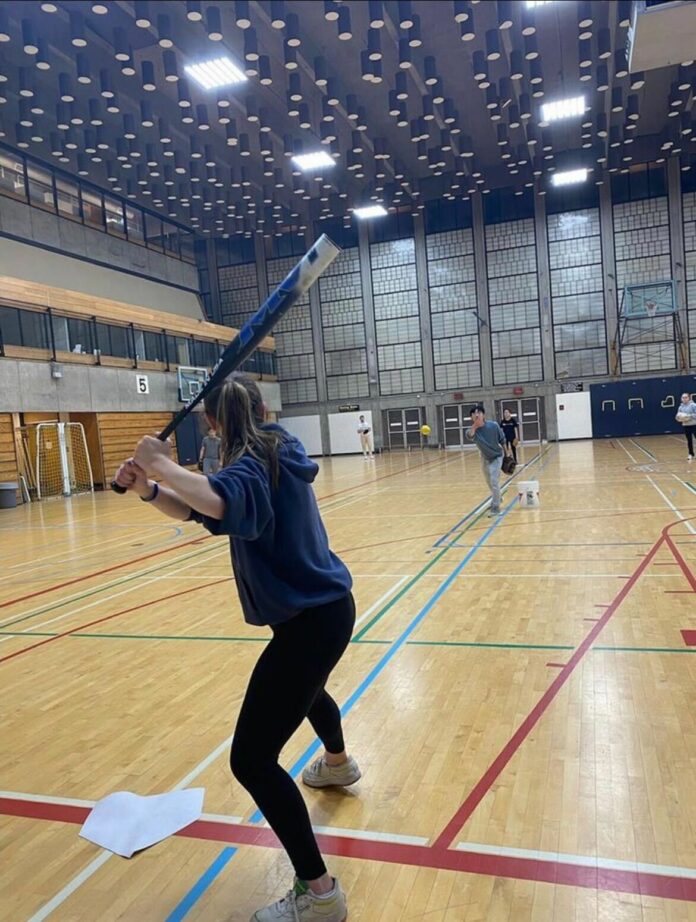
photo of an SFU softball member squaring up for a pitch.
PHOTO: Chloe Legge

By: Saije Rusimovici, Staff Writer

Third-year student Hannah Casseres began the co-ed SFU softball club to rekindle her childhood love for the sport and build a space that inspires “teamwork and collaborative effort.”

Playing both baseball and softball growing up, Casseres was on the hunt for a new softball club after her old team “dissolved” prior to her freshman year at SFU. The only problem was SFU had a varsity softball team, and not a club program. Determined to have the chance to play again, Casseres had one question on her mind: “How do you start a club?” 

Deterred by the beginning of COVID-19, Casseres was able to set her plan in motion a year later, when classes returned to in-person learning. “It was a lot of work,” she explained. “I didn’t realize how much goes into starting a club.” 

Before Casseres could get the club approved, she needed to attract enough members, which was initially a big roadblock. “I needed fifteen signatures — we had no one.” With the help of close-friends turned vice presidents Sunwook Kim, Netanel Orzech, and Chloe Legge, Cassedres received over 90 sign ups at clubs day. “I couldn’t have done it alone,” she said. 

Casseres spent some time talking about the difference between baseball and softball and the misconception some people have about softball being easier than baseball, which she “doesn’t think is necessarily true.” In contrast to baseball, softball is played on a smaller field, the ball is bigger, and pitchers throw underhand. Similar to baseball, nine players on each team take the field in softball. Teams rotate between batting and being in the outfield once they’ve reached three strikes. The aim of the game is to get the most runs — players brought around to home base. 

Practices are currently held indoors on Wednesdays from 5:30 p.m.–7:30 p.m. in the East Gym. A typical practice consists of throwing and hitting drills, and a friendly, yet competitive, scrimmage with teammates. While the softball club is running indoor practices as the varsity team gets priority on the field, Casseres is hoping they’ll be able to get a few games going outdoors, especially as the weather gets warmer.

A little softball experience is preferred to join the team as there’s no coach. While playing experience is not technically necessary, players should know the basic rules of the game and how to throw and hit. Casseres encourages any student intimidated by attending practice by themselves that most of the club’s members first joined the team alone, and had a “great time making friends.”

“I feel like the softball community is super accepting,” said Casseres. 

There’s no formal registration to join the team. Just send the club an email, attend practice, and try to bring your own glove. Once a registration portal is actuated, team members pay a $35 registration fee which goes towards equipment, such as helmets for outdoor practices. In the meantime, if you don’t have a glove, the team usually has enough to lend out during practice. 

“We were really lucky,” said Casseres. “Last year people just brought buckets of balls and tons of bats to help out.” However, the team is always looking for extra equipment as gloves can start at $50. “Any equipment you do have and are willing to bring would be great,” said Casseres. 

To sign up, email [email protected] or find them on Instagram @sfusoftballclub