Home Blog Page 150

SFU’s 2023 fall season sports recap

0
photo of the women’ soccer team clapping as they exit the field.
PHOTO: Wilson Wong / SFU Athletics

By: Kaja Antic, Sports Writer

Cross country

MVPs: Senior Sebastian Brinkman, sophomore Rachael Watkins 

Results: M–3rd, W–4th at the conference championship
              M–9th, W–8th at the regional championship; didn’t qualify for national title 

The men’s and women’s cross-country teams opened the season with two first-place finishes, and didn’t slow down from there. The men’s team finished third or better, while the women’s team finished fourth or better, at each of the three regular season competitions. Both teams maintained this consistency at the conference championship, finishing third and fourth respectively, once more, to advance to the regional championship. 

SFU’s top finishers at the conference championship were senior Sebastian Brinkman, who earned conference honours for finishing fourth, and sophomore Rachael Watkins, who finished 17th. Brinkman has been the fastest runner for the men’s team all season, while Watkins finished ahead of her teammates in all but two of the women’s races, including the regional championship.

Brinkman placed 31st  at the regional championship —  running 10 km in just over 31 minutes, for an average pace of 3:09 minutes per kilometre. However, both the men’s ninth-place finish and the women’s eighth-place finish weren’t enough to qualify them for the national championship, thereby ending their season. The men previously finished 19th  at the national championship after qualifying last season. 

Men’s soccer

MVPs: Forwards Michael Hennessy, Devin O’Hea 

Results: 8–2–1 (against conference opponents), 11–5–2 (overall)
             Eliminated in the first round of playoffs

The men’s soccer team returned to its regular season glory of past years, winning the program’s eighth conference title since joining the NCAA, and automatically advancing to the NCAA Division II Championship. However, in SFU’s first playoff appearance in four seasons, they were unable to make it past the first round, dropping their first and only game of the championship 3–1 against Point Loma Nazarene. 

Despite their elimination, SFU did not walk away from the season empty-handed. The team’s stellar performance against conference competition earned them a trio of awards. SFU’s premier scorer Michael Hennessy won the conference’s Freshman of the Year, team captain Devin O’Hea won Player of the Year, and senior Niko Papakyriakopoulos was selected as Defensive Player of the Year.

Hennessy scored 13 goals, five of which in a single game, to finish the season with 29 points — the second most in the conference, and one point shy of first. O’Hea, who finished behind Hennessy in team scoring, notched a conference-leading nine assists throughout the season, and was the sole conference representative on the 2023 United Soccer Coaches NCAA Division II Men’s All-West Region first-team. Papakyriakopoulos was the only Red Leaf to score at the national championship. 

Women’s soccer

MVP: Goalkeeper Sarah Loewen

Results: 5–5–4 (against conference opponents), 8–5–6 (overall)
             GNAC Champions; first round NCAA championship elimination 

Rather than the team with the best regular season record winning the conference championship, the top four women’s soccer teams battled for the championship. The No.1 team squared off against the No. 4 team, and the No. 2 team competed against the No. 3 team, with the winners advancing to the conference championship. Only then did the winner earn a spot in the NCAA championship.

Sneaking into the playoffs as the fourth and last team, without any national championship experience — SFU was supposed to lose to the No. 1 team — that, they did not. SFU not only beat the No. 1 team, but won their first conference championship in program history by defeating Western Washington. Just a year prior, Western Washington had eliminated SFU from the playoffs, on their way to winning the championship

While SFU didn’t make it past the first round of the NCAA championship, they didn’t make the victory easy for California State, Los Angeles. It took a penalty shootout, following a 0–0 draw, to decide a winner. Goalkeeper Sarah Loewen, who was instrumental in SFU’s history-making run, appeared in all games for the team this season, earning eight clean sheets and leading the conference with 88 saves.

Volleyball

MVPs: Outside hitter Jocelyn Sherman, right side hitter Brooke Dexter

Results: 11–7 (against conference opponents), 16–10 (overall)

The Red Leafs volleyball team placed fourth in the conference standings, knocking themselves out of the playoffs, as only the team with the best regular season record advanced. SFU, however, led the conference in total assists, kills, and digs, and had juniors Jocelyn Sherman and Brooke Dexter selected to the conference first team. Individually, Sherman placed fifth in kills and points for the conference, while Dexter placed 10th. SFU went on three separate three-game win streaks this season — their longest of the year. Including their best win: a three set sweep against the highest-ranked competition of the season, No. 13 Central Washington. 

Hidden Gems: Local online businesses to support

0
An un-lit candle that looks like a piece of cake in green grass.
PHOTO: Courtesy of @candlecornervan on Instagram

By: Saije Rusimovici, Staff Writer

Editor’s note: the article includes a correction from last semester in which we misattributed the ethnic background of the owner of ZANO by Sadj.

ZANO by Sadj
This Vancouver-based designer has a collection of dainty and bold products available on their Etsy shop. The owner, Sadjeda, was born and raised in Reunion Island. ZANO comes from the Creole word for earrings. You can find a beautiful assortment of earrings with abstract shapes, like sharp triangles and half-ovals overlapping, and sizes that make the perfect present for anyone who wants to make a fashion statement. Quality and care is evident in the craftsmanship of every piece, like the pearl-studded, earthy-hued Gaia earrings made from polymer clay. Prices range from $29–79 and shipping is free. Sadjeda recently created a collection inspired by the olive leaves and fishing net patterns on the traditional Palestinian Keffiyeh scarf, and donated all the proceeds to organisations supporting Gaza. Follow them on Instagram at @zanobysadj to find out about new collections and local pop-ups. 

little métis things
With an emphasis on giving back to and empowering the Métis community, this shop has several hand-beaded items on their website. Jennifer White is a mother and family knowledge keeper, and she founded little métis things to “reclaim [her family’s] Métis citizenship and heritage with pride.” The pieces are very detailed and take many different shapes. Her online collection includes beaded earrings, broches, and pins ranging from $45–150. Check out Jennifer’s Instagram, @little_metis_things to see all of the items she currently has available, including a gorgeous pair of floral earrings encased with a gold trim. 

Candle Corner 
Handmade in Vancouver, these candles are unlike any others I have seen before! Inspired by sweet treats, they’re perfect for the baker in your life or anyone with a sweet tooth. Made with a combination of soy and beeswax, they’re crafted to look like desserts. With a range from $17–40, they are so detailed and realistic that they will be well worth it. They really look good enough to eat! Your family and friends will be amazed by how realistic these candle macaroons, cakes, and cupcakes are. What’s even better? The candles smell like the desserts they are modelled after! Find a variety of styles on their website and give them a follow on Instagram (@candlecornervan). 

Neza Coffee
Neza, the Rwandan word for greatness, encompasses Neza Coffee’s mission and purpose. Inspired by the women in their lives who taught them to “cultivate coffee of exceptional quality,” their coffee beans are sourced from their families and neighbours’ farms in Rwanda. A blend of 100% single-origin Arabica/Red Bourbon beans, the online shop offers three variations of roasts in addition to a monthly coffee subscription. A 454g package is only $28. Neza Coffee strives to “support the strength and resilience of [the] Rwandan community.” For every bag that is purchased, a donation is made to “provide mental health support and trauma therapy to genocide survivors,” as these services are costly and scarce. Check out Neza Coffee on Instagram (@nezacoffee), or purchase directly from their website.

Did You Hear About Kitty Karr? delves into a Hollywood history of passing

0
Book cover featuring a bare shoulder and the corner of a face done-up with classic pearls and red lipstick and the title against a black background, Did You Hear About Kitty Karr.
PHOTO: Courtesy of Holt, Henry & Company, Inc.

By: Saije Rusimovici, Staff Writer

I stumbled upon Crystal Smith Paul’s debut novel by accident, the cover featuring a glamorous woman dressed in the picture of old Hollywood elegance. I was instantly intrigued. I decided to download the ebook to escape the pre-holiday fiasco after a long work day. What I didn’t expect was to be instantly hooked, drawn in by the glitz and glamour of the movie business in the mid-1950s. A blend of historical fiction and mystery, the novel follows four generations of Black women over the course of several decades, their lives intertwined by love, trauma, and triumph. 

Nominated for GoodreadsBest Historical Fiction and Best Debut Novel this year, Smith Paul educates readers about the Jim Crow era, where Southern US states were particularly impacted by segregation laws. A young woman born to a Black mother and white father moves to LA and creates the identity of Kitty Karr, “passing” as a white woman in order to begin a career in the filmmaking industry. Despite escaping these laws, racial tensions are high in LA, and racism is rampant. 

Passing as white refers to how non-white people appear or are assumed as white because of their lighter skin tone or certain features. In the context of the book, passing refers to a common practice in which Black people, often women, historically would commit to “leaving their Black identity behind” to pose as white in society, often in order to have better opportunities and escape racial oppression. This often involved moving far away from home, cutting contact with Black family members, and neglecting to tell any children they may have of their true ethnicity. 

The book shows how passing can lead to a loss of one’s family, sense of self and community. Kitty is the biological daughter of a wealthy white man whose family her mother worked for. Since she was a child, Kitty’s mother had her passing as white, with trips to the white-only side of town. When she’s sent to LA as a young adult, she wrestles with the loss of her Black identity and connection with her family back home. She’s forced to leave her fiancé and cut contact with her only living relatives. 

Throughout her journey in her new societal identity, Kitty encounters other Black women also passing as white. Each woman’s experiences are different. Some entirely embrace their new identities as they’re comforted by the security that comes with whiteness, while others desperately seek out asylum in Black communities. Many women who are passing are leading double lives, using their influence and wealth as “white women” to secretly support Black revolutionary movements.

In the present-day storyline, Black actress Elise St. John and her two sisters inherit Kitty’s entire fortune. To this day, no one has any idea Kitty is Black. Elise begins to unravel the mystery of Kitty’s early beginnings, the reasons behind her choices, and trials of the past that still perpetuate systemic barriers for Black women. Did You Hear About Kitty Karr? is a beautifully tragic novel that unpacks the perils of womanhood, racial injustice, and resilience as it intersects with class.

The fictionalized story is based on the author’s family history. “As a writer, it was really interesting for me to take some of the struggles I know to be true in my family and make up the reasons why,” said Smith Paul in an interview with Brown Girl Collective. She dedicated the novel to her great-grandmother and both her maternal and paternal grandmothers. Much of the novel’s storyline is rooted in the impact of mother-daughter relationships, and she admits that it was often “very, very heartbreaking” during the writing process, but she wanted to “show the fierceness in which [she’d] been loved” by the women in her family throughout her life.

I thoroughly enjoyed everything about this novel, from the glimpses at old Hollywood to the modern day storyline where the St. John sisters begin to uncover the secrets of the life of Kitty. Throughout multiple timelines, Smith Paul encourages the reader to consider what life was like as a Black woman in the 1930s to present day. This allowed me to really understand the ways in which the past shapes the future, as the choices and experiences of each woman living in a different period of history directly impact the next generation. 

Top 10 Canadian sports moments of 2023

0
Team Canada basketball member Dillon Brooks celebrating with the Canadian flag after a game.
PHOTO: Courtesy of Canada Basketball's Instagram

By: Kaja Antic, Sports Writer

January 5: Canada wins World Junior gold, Bedard MVP

Arizona Coyote prospect Dylan Guenther lifts Canada to a 3–2 victory in OT against Czechia to win gold at the World Junior Hockey Championship. 17-year-old Connor Bedard of North Vancouver was named tournament MVP after scoring 23 points in 7 games, setting a Canadian record for most points in a single tournament.

April 19: TSS Rovers FC make Canadian Championship history

On November 3, 2022, Canada Soccer announced that the winners of the semi-professional soccer league, League 1 BC, would be allowed to compete in the Canadian Championship. The championship consists of teams from four professional leagues and one other semi-professional league. Five months later, the League 1 BC winners, Richmond’s TSS Rovers FC, beat Valour FC 3–1, making them the tournament’s first semi-professional team to defeat a professional team. 

April 29: Maple Leafs beat the first-round curse

After a game-seven win in April 2004, the Toronto Maple Leafs didn’t win a playoff round until late April 2023. Second in the Atlantic Division, the Leafs were matched with the division’s third seed, the Tampa Bay Lightning, who had eliminated them in seven games the previous post-season. During game six of this first-round series, overtime was needed to break the 1–1 tie, and the Leafs were a win away from moving on to the next round. Captain John Tavares was the hero for Toronto, scoring four minutes and thirty-six seconds into the overtime period, finally breaking the long-standing curse of post-season failure. The Leafs were subsequently knocked out of the next round, though, and pretty fast at that. 

June 11: Nick Taylor wins RBC Canadian Open

Nick Taylor became the first golfer from Canada to win the Canadian Open since 1954, and the first Canadian-born golfer to win since 1914. Taylor, born in Winnipeg and raised in Abbotsford, defeated England’s Tommy Fleetwood on the fourth playoff hole, achieving this with a 72-foot eagle putt

September 10: Canada wins FIBA World Cup bronze, clinch Olympic berth

In a dramatic 127–118 overtime win against the USA, Canada claimed the bronze medal at the 2023 FIBA Men’s Basketball World Cup — the first World Cup medal in national history. Just a week prior, Team Canada defeated the reigning champions, Spain, to secure a spot in the 2024 Paris Olympics — the team’s first Olympic placement in 23 years. 

October 21–25: Maggie Mac Neil, record breaker

Olympic swimmer Maggie Mac Neil made herself known at the 2023 Pan American Games in Santiago, Chile. Mac Neil won seven medals (five gold, one bronze, one silver), setting a Canadian Pan Am record. Along with the national record, Mac Neil set Pan Am Games records in the 100m butterfly and the 100m freestyle, with the latter being her first time racing in that event internationally. 

November 12: Canada wins first Billie Jean King Cup

Canada defeated Italy in a best-of-three tournament, winning the country’s first Billie Jean King Cup — the highest award in international women’s team tennis competition. Leylah Fernandez clinched the trophy for Canada in the second finals match, winning both sets 6–2 and 6–3 respectively. Fernandez also won the Heart Award for most valuable player in the finals, where she remained undefeated.

November 19: Montreal Alouettes win Grey Cup

After a mediocre 11–7 season for Quebec, the Alouettes advanced to the 110th Grey Cup after defeating the defending champions, the Toronto Argonauts, 38–17 in the Eastern Final. Prior to the matchup, the Alouettes had lost all three regular-season matchups against the Argonauts. Talk about winning when it counts. The Alouettes then faced the 14–4 Winnipeg Blue Bombers, who were in the finals for the fourth straight year — having won in 2019 and 2021. Despite Winnipeg being the heavy favourites after beating the Alouettes handsomely, 17–3 and 47–17, in the regular season, the Alouettes persevered. Down by three points late in the fourth quarter, the Alouttes dramatically scored a touchdown in the game’s dying seconds to defeat the Blue Bombers 28–24 winning their first Grey Cup since 2010.

December 5: Canada bids farewell to a legend

After announcing her retirement from international competition, international goal-scoring record holder Christine Sinclair played her final match against the Matildas, Australia’s national women’s team. The match was played at BC Place, which was renamed Christine Sinclair Place specifically for this historic send-off, and marked the largest attendance for a “women’s friendly international match in Canada.” Sinclair factored into the game’s lone goal for Canada, before being subbed off the field in the second half.

December 23: Canucks in first at NHL break

Playing the final game before the annual three-day Christmas break, the Vancouver Canucks defeated the San Jose Sharks 7–4 to hold sole possession of first-place in the league, with a record of 23–9–3. This is the first time a Canadian team has led the NHL standings at Christmas since the Ottawa Senators did on December 23, 2005, with a 24–6–3 record.

This week at SFU

0
SFU basketball player Rachel Loukes preparing to shoot at the free-throw line.
PHOTO: Wilson Wong / SFU Athletics

By: Isabella Urbani, Sports Editor

Home Games 

Thursday, January 11: women’s basketball vs. Northwest Nazarene (Idaho) at West Gym at 7:00 p.m.

  • Won both games against Northwest Nazarene last season. 
  • Northwest Nazarene has the best field goal and three-point shooting percentage in the conference.

Saturday, January 13: women’s basketball vs. Central Washington at West Gym at 7:00 p.m.

  • Central Washington eliminated SFU from the quarterfinals of the conference championship last season.
  • Central Washington has three players leading the conference in an individual stat category versus SFU’s one.

Away Games 

Thursday, January 11: men’s basketball vs. Seattle Pacific at 5:15 p.m. 

  • First of two meetups against Seattle Pacific this season.
  • 0–2 against Seattle Pacific last season.

Friday, January 12: conference hockey team vs. the University of Victoria Vikes at 7:30 p.m.

  • Lost 5–0 in the pre-season and 6–5 in OT against UVIC this season.

Friday, January 12: women’s swimming vs. San José (California) and California State East Bay at 1:00 p.m.

  • First time the program is facing off against either school.
  • Women’s team is embarking on a two-day solo meet on Friday and Saturday against four schools before rejoining the men on Sunday. 

Friday, January 12–Saturday, January 13: track and field at the University of Washington Indoor Preview 

  • First indoor track competition of the season.
  • Returning next week for the University of Washington Invitational.

Friday, January 12: women’s wrestling vs. Providence (Montana)

  • First time the program is facing off against Providence.

Saturday, January 13: men’s basketball vs. Montana State Billings at 12:00 p.m. 

  • Montana State (8–4) is first in the conference; SFU (2–10) is eighth out of 10 teams.
  • 0–2 against Montana State last season.

Saturday, January 13: conference hockey team vs. Vancouver Island Mariners at 7:00 p.m.

  • Lost 10–3 to Vancouver Island earlier this season. 

Saturday, January 13: women’s swimming vs. California, Santa Cruz and Southwestern Oregon CC at 10:00 a.m. 

  • First time the program is facing off against either school.

Saturday, January 12: women’s wrestling at the Alberta Golden Bear Invitational 

Sunday, January 14: swimming vs. Pacific (California)

  • Lost 206–107 against Pacific last season. 

Introducing Rachel Loukes

0
headshot of Rachel Loukes.
PHOTO: SFU Athletics

By: Kaja Antic, Sports Writer

Starting your first year of university is stressful enough, even if you aren’t moving hundreds of kilometres away from your small hometown. But for Red Leafs basketball freshman Rachel Loukes, the biggest adjustment has been the rainy weather since moving from Prince George. “It’s not something we see very often.”

Growing up in an athletic family, Loukes played a variety of sports, including soccer and volleyball, but basketball was her top priority. “I started playing basketball in Grade 2 in Prince George, where I played in a local minor basketball league. My older sister played, and my dad coached, so I was in the gym a lot watching my sister [play] or playing myself.” 

Loukes’ family played a large role in her interest in basketball, especially when pursuing NCAA basketball. Her dad played in university, at professional levels, and was a great inspiration while Loukes was growing up, encouraging her pursuit of post-secondary athletics. 

Loukes took her basketball career to the next level in seventh grade, joining Basketball BC and making the U15 BC Provincial Team. “Over the years, training with older players and seeing them compete at the top level inspired me to do the same.”

Moving through and developing in both the Basketball BC and Prince George circuits, Loukes competed on the U18 Team BC during the 2022 Canada Summer Games in Niagara Falls. “I met athletes from across Canada and played basketball against the top competition in the country,” said Loukes. Despite the team placing fifth in the competition, she maintained it was her favourite basketball experience so far. 

That brings us to more present times. Before committing to the Red Leafs, the talented Loukes participated in the SFU women’s basketball camp the summer going into her senior year of high school. “After that visit, I knew SFU was the right choice. Meeting the current players and spending time on campus — my choice became an easy one.” Loukes would sign with the Red Leafs in November of 2022, choosing a competitive NCAA team that was also closer to home in northern BC.

In preparation for her freshman year with the Red Leafs, Loukes mentioned she was enjoying “playing a fast-paced style of basketball” during her off-season training and her transition was going well. Playing in a Prince George summer league against current and former men’s college basketball players, Loukes has adjusted quickly to the aggressive defence and pace of play present at the NCAA level. 

Adjusting to SFU and Vancouver as a whole? Well, the significant lack of snow is one thing, but so far, BC’s largest city has been exciting for the young freshman. “The campus life has been very fun, meeting new people and exploring new places in Vancouver.” When choosing the Red Leafs, it was not only the basketball prospects that attracted Loukes to Lhuḵw’lhuḵw’áyten (Burnaby Mountain), but the academic opportunities as well. 

Studying in the faculty of arts, Loukes is discovering what courses and programs interest her the most. She, like many university students, worries about time management, commenting that “fitting in schoolwork along with the daily training has been a challenge,” but works around these stressors thanks to the close proximity of the student residences to most campus facilities.

Being far away from home can be difficult at a young age, as Loukes mentions missing family and friends the most. “Growing up and playing on a variety of sports teams in Prince George, I made many connections and friendships that I cherish.” Despite Prince George having a population of over 86,000, Loukes enjoys the small community feel of BC’s largest northern city.

As for the upcoming season, Loukes looks ahead to a bright future in her freshman year. “I am most excited about playing against tough competition, being successful with this talented team, and accomplishing great things on the court. I am looking forward to creating memories and forming friendships, and eager to see what the year has in store for us.”

Problematizing Orientalist art: a glimpse into the past

0
green lillies in a pond

by: Sude Guvendik, Staff Writer


The realm of Orientalist art, which has undergone a significant shift in perception over time, is often criticized for its colonialist tendencies and distorted portrayal of the East. This 19th-century European genre depicted cultures of Asia, North Africa, and the Middle East as exotic and fantastical, often romanticizing them. It’s also been criticized for perpetuating stereotypes and biases. One of the most regrettable aspects of the early Orientalist movement is how it overlooked the vast repertoire of existing Eastern art, all while usurping the agency of the very cultures it claimed to represent. However, it’s experiencing a surprising resurgence and garnering attention, even captivating collectors from the Islamic world.

Picture this: 19th-century Middle East, when Europe was flexing its colonial muscles in the region. Those European artists? They were like the travel bloggers of their time, hitting up spots from the Maghreb to the Levant and sketching everything they laid eyes on. And they weren’t into those fancy art trends — no, they stuck to the good old romantic realism we see in Renaissance paintings. What’s the deal with Orientalist art, you ask? Well, it’s like this portal to the past. Specifically, the 19th-century Middle East. You know, that era when Europe was throwing its weight around at the expense of the self- determination and livelihoods of those living in the region.

Here’s the twist: back in the day, these artworks were like posters for Western imperialism — encroaching on and exploiting Eastern countries by force under Social Darwinism, or “survival of the fittest,” which was used to justify eugenics. You know, pushing that whole idea that Eastern cultures were a bit backwards and in desperate need of Western “enlightenment.” But here’s the kicker — many artists never even set foot in the region. Nope, they were working off travelogues, daydreams, and what they thought the non-Western world looked like — all mysterious and steamy.

Scenes of snake charmers, veiled women, and super devout worshippers captured the attention of British and French artists. But wait, what’s the magic ingredient? It’s how they painted this enchanting picture of North Africa and the Middle East through their literature and art, elevating them in the eyes of the West. But do these Orientalist fantasies created by European artists really give us a peek into the Eastern past, or are they just carrying problematic vibes? More importantly, how should we weigh the consequences of these portrayals? Of course the art produced out of dreams would have no depth. The Met Museum describes early French Orientalist paintings as “depicting the East as a place of backwardness, lawlessness, or barbarism enlightened and tamed by French rule.”

Not taking into consideration European romanticization, the Eastern world has built its own treasure trove of artwork and literature that spans centuries. We’re talking about the Epic of Gilgamesh and The Shahnameh — the rockstars of storytelling and poetry, potentially influencing works like The Odyssey and even entire cultures. The Middle East is like poetry central, with stories passed down like family recipes. Oh, and guess what? This tradition isn’t just in the Middle East — the Indian subcontinent and others are in on it, too. Unlike the organic creativity found in the East, Orientalist art sprung from Western daydreams and often got tangled up with imperial aspirations.

Flash forward to the organized Orientalist frenzy when the French and British decided to hit up Egypt and North Africa in the late 1700s. Suddenly, writers, thinkers, and artists were all about being “Orientalists.” The framing of North Africa and the Middle East by British and French Orientalists, through literature and art, captivated not only Western audiences but also those in the East.

The Islamic world has a unique approach to art, steering clear of portraying the human form primarily due to “aniconism.” This practice strictly prohibits the representation of living beings, especially humans and animals, in any form of visual art or imagery. For them, art wasn’t just art; it was a form of devotion, evident in their intricate calligraphy and those exquisite illuminated manuscripts. And the cool part? Islamic architecture and calligraphy even had an impact on European art.

Take Persia for example: they were the real MVPs of storytelling through art. Their miniature artworks coupled with poetry? Pure gold. It was their way of passing down the stories of rulers and societies. And guess what? Today, those miniatures? Iran’s rightful cultural heritage — they’re like the VIPs of Western auction houses, fetching sky-high prices.

So, when we’re talking about Orientalist artists, there are the realists who actually went out there, saw stuff, and painted it. And then you’ve got the daydreamers, the ones who conjured up scenes right in their studios without so much as stepping out the door. Think Eugène Delacroix and Jean-Léon Gérôme — big names in the Orientalist game. Like Gérôme’s work, The Snake Charmer – totally made up, a scene that’s tailor-made for Western fantasies about the East. These artworks came with some serious biases. They painted the “Oriental man” as this mysterious, worship-obsessed figure. And women? They were often stuck in this submissive and passive stereotype. Yeah, not the most flattering portrayal.

Orientalist art revival is causing a buzz and some heated debates. But here’s the deal: let’s not get swept away by the romance of it all. Orientalism wasn’t some heartwarming cultural exchange. Nope, it was a result of some not-so-equal cultural clashes. So, as we dive into this revival, let’s keep our eyes on the bigger picture — the shifting global dynamics, the rise of new players — and not just treat it like a simple nostalgic trip down history lane.

How to stay informed on COVID-19

0
Illustration of a line graph with rising COVID-19 cases, and a health official saying COVID-19 is no longer a problem

By: Michelle Young, Opinions Editor

BC public health has made it too confusing to keep up on COVID-19 information. With the government changing information about COVID-19 data and obscuring data collection, knowingly downplaying risks about transmission, and overall unclear messaging, it’s no wonder people are misinformed. 

It is difficult to have a sense of the current pandemic when deaths are undercounted and reinfections aren’t counted at all, as reported by CBC. Cases are generally underreported. According to CBC, BC doesn’t want to declare hospital outbreaks due to “negative connotations.” 

This doesn’t mean we should all be forever doomed to ignorance. Just as it’s important to stay informed on climate change, Indigenous sovereignty, and 2SLGBTQIA+ rights — COVID-19 is a disability justice issue that is deeply intersectional. There are steps we can take to improve our understanding of COVID-19. 

What We Already Know

Our understanding of COVID-19 should build on already-established information:

  • COVID-19 is airborne
  • It is neither mild nor seasonal, and can cause serious, long-term effects, also known as Long COVID
  • Previous restrictions and lack of viral exposure do not weaken our immune systems, while COVID-19 infections can cause immune dysregulation  
  • Vaccines alone do not provide sufficient protection against infection or Long COVID
  • Anyone can be affected by Long COVID regardless of age, current health, vaccination status, and whether or not their initial infection was mild
  • The risk of Long COVID increases with each infection
  • Mitigation efforts like masks and ventilation work best when used together, rather than relying solely on one precaution

Being mindful about these basic principles can help you stay informed and identify which claims are not based on evidence. You can find a list of common COVID-19 myths, and why they’re incorrect, on The Peak’s website

Wastewater Data

Wastewater data is collected both provincially and nationally. It tests “wastewater samples for respiratory viruses,” such as COVID-19, RSV (respiratory syncytial virus), and the flu. Wastewater is essentially sewage water that comes from homes and businesses. This data “can help determine if COVID-19 is increasing or decreasing in a community and provides information on the variants circulating.”

The national website is easier to navigate, as it provides key updates listing how many collection sites show an increase or decrease in COVID-19. As of November 24, it reports 27% of sites are experiencing an increase in COVID-19 cases, 53% of sites show no change (this comes after an increase of 40% from November 17), and 19% of sites show a decrease. Overall, “62 sites currently submit sewage samples for processing” which represents about half of Canadians. 

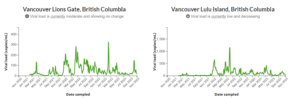
The national website provides a variety of data on different collection sites. However, when you look closely, you will notice the Y-axis scale changing in each graph, which distorts how we view risk. For example, on the national databoard, under “all time,” Vancouver Lulu Island appears to have significantly lower rates of COVID-19, compared to Vancouver Lions Gate. However, Lulu Island’s Y-axis first point of reference starts at 500, going up to 1,500 copies/mL. Conversely, Lion’s Gate’s Y-axis starts from 100 and only reaches 400 copies/mL. 

A line graph that shows COVID-19 wastewater data for Lulu Island and Lion's Gate.
Courtesy of the Government of Canada.

Based on visual analysis alone, it would appear that Lion’s Gate has significantly worse transmission. All of the Y-axes on these graphs are different — the way they are set-up visually gives the impression of “low” transmission. When you compare the overall viral load from 2020, you can see that there’s a general increase in COVID-19 after 2021, where such data is available. 

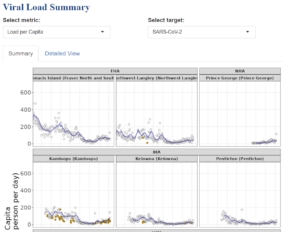
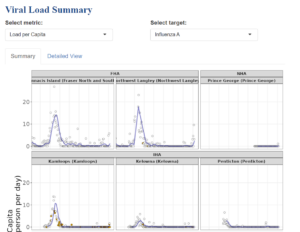
Similarly, on the BC dashboard, the COVID-19 page starts at around 200 and goes up to 600 for viral load per capita. Visually, COVID-19 cases appear low. When compared to influenza A and B, however, their graphs have a 10-point increment, and have a maximum of 30 viral load per capita. This puts into perspective how many more people are infected with COVID-19 versus the flu — the flu is circulating far less.

Line graph data from COVID-19
Courtesy of BC Centre for Disease Control.
Line graph data from influenza A
Courtesy of BC Centre for Disease Control.
Line graph data from influenza B
Courtesy of BC Centre for Disease Control.

It can be exhausting and time consuming to try and interpret all of this data. While wastewater data provides a fairly holistic view of cases, and is the basis for much of what informs current COVID-19 modelling, it can be difficult to navigate. Thankfully, there are other sources who use this data and turn it into information that’s easier to digest — but now you know and understand where their information comes from. 

Hospitalizations 

Typically, hospitalizations are still reported by major news outlets. They can provide context of how COVID-19 affects our healthcare system, and whether it’s being overwhelmed (it is, for many reasons, exacerbated by the pandemic). However, it is not sufficient to rely on this data alone. Hospitalizations typically lag behind cases, are underreported, and do not take into consideration the burden of long-term COVID-19 effects on healthcare or individuals

Peer-reviewed Articles 

Peer-reviewed sources are likely going to be much more thorough and informative on COVID-19 than an average news article. While the media should take information and present it in a digestible way, sometimes studies aren’t picked up or they are misinterpreted. For a source to be peer-reviewed, it means it has gone through an “editorial board of subject experts who review and evaluate submitted articles before accepting them for publication.”

Peer-reviewed sources include:

Remember that while it’s possible to find a source for each claim, it’s important to cross-check the validity of the claim. 

For example, it is well-established that masks work. This was the case even prior to the COVID-19 pandemic, despite the unclear messaging that suggested otherwise. Commonly cited by anti-maskers, there is a study that has been misinterpreted to say they “do not work.” There will always be some random study, somewhere, that will likely contradict well-established information. The key is to read the study itself, identify what is truly being claimed, and whether there are other credible sources that can verify this claim.  

Independent Sources

There are multiple sources who take information and put it into perspective as tangible information. You can follow them on social media to get updates, or browse their websites for information. This is one of the easiest ways to stay informed with all of the above as this information will appear on your newsfeed.

COVID-19 Resources Canada: made up of “a group of Canadian researchers, clinicians, and community members,” this initiative has been active since 2020 to help track COVID-19 data and address vaccine hesitancy. Collecting data on hospitalizations, ICU admissions, and wastewater data, they give estimates of how many people per province are affected, provide recommendations for action, and compare this data to “the lowest point” of the pandemic in Canada. For example, in BC, it’s estimated 1 in 32 people are infected with COVID-19, with 12 times more wastewater infections than the lowest point of the pandemic and seven times as many hospitalizations. It is recommended for everyone to wear high quality masks, such as N95s or KN95s, and avoid non-essential crowded spaces. 

Protect Our Province BC: “a grassroots group of physicians, nurses, health scientists, health policy specialists and community advocates,” who aim to educate the general public about COVID-19. They host information sessions and briefings around specific COVID-19 topics, such as COVID and pregnancy, access to Paxlovid (which aids to prevent serious COVID-19 outcomes), and more. They also publish open letters in response to COVID-19 policies in BC. 

DoNoHarmBC: founded in 2023 in response to the removal of mask protections in BC healthcare settings, they share informative articles and action items on BC’s pandemic response. Primarily situated on social media, you can consult their list of key facts — an open access Google document — to view information on COVID-19 and BC healthcare. You can also click into the sources listed if you’d like to verify this information!  

The Tyee: A BC independent news outlet active since 2003, The Tyee has done some in-depth investigative reporting on the province’s pandemic and BC healthcare. They have covered BC’s “missing COVID-19 data,” pandemic denial, and the lack of trust in public health. They also provide continuous updates on COVID-19. 

Do you still have questions?

COVID-19 Resources Canada hosts weekly sessions “focused on answering questions from the audience about COVID-19, vaccines, boosters” and more, over Zoom. They are “free and open to the Canadian public to attend. All are welcome to join regardless of their background.”

Audrey Heath honours Lax Gibuu spirit through beading

0
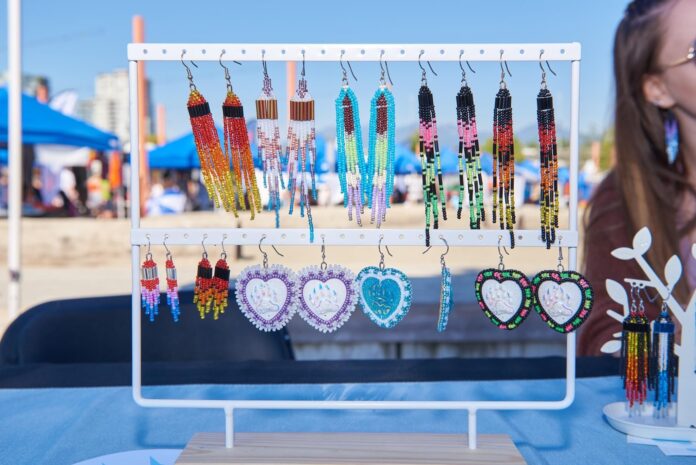
Various beaded fringe earrings of different patterns and colours hang on display at an outdoor vendor market.
PHOTO: Courtesy of Audrey Heath

By: Anna Kazi, Peak Associate

Nestled in the unceded and traditional territories of the Kwikwetlem, Tsleil-Waututh, Stó:lō, Qayqayt and Stz’uminus Peoples resides the beautiful Lax Gibuu beadwork created by Audrey Heath.

Heath comes from the Gitxsan Nation in Northern British Columbia and holds “various European ancestries, such as French and Scottish.” As a fourth-year student at SFU completing a Bachelor of Arts with a double major in communication and Indigenous studies, she also works at the SFU Indigenous Student Centre as Indigenous student life coordinator.

When not studying or working at SFU, Heath creates one-of-a-kind Indigenous beadwork jewellery on her Instagram page, @Laxgibuu.beads. “My family comes from the Lax Gibuu or ‘Wolf Clan,’ and it’s a way of recognizing my ancestors,” she told The Peak.

Heath started her beading journey in 2021. “Lax Gibuu Beads has given me the opportunity to continue to connect with my culture, be a part of an amazing Indigenous community of artists, and truly enjoy the work I am doing.”

Heath was introduced to beading in a workshop hosted by the SFU Indigenous Student Centre and facilitated by Nêhiyaw Métis iskwew artist Rebekah Stevens — a fellow beader on Instagram at @beksbeads. “I feel an amazing sense of accomplishment seeing peers, staff, and faculty wearing earrings that I make,” she said.

Lax Gibuu Beads’ art includes styles ranging from colourful and hand-woven fringe earrings to intricately designed beaded earrings with hummingbirds, and sparkly pop sockets with Czech beads. At my convocation ceremony, I was grateful and honoured to have worn statement blue and white gradient earrings adorned with Czech beads.

One of the jewellery pieces Heath talked about were the delicately handcrafted earrings with a cascading white and black bugle beads base, followed by a vibrant green and pink hummingbird pattern in the beaded fringe. She custom made it as a birthday present for her friend’s mother. “The hummingbird holds cultural significance to my family, so creating these earrings meant a lot to me.”

Heath shared her challenges as a business owner, saying, “This journey has not been easy, especially while working a 9:00–5:00 and going to school. Despite periods of inactivity or long days sitting at markets as a new business and few clients, I have learned a lot.”

Lax Gibuu Beads is also a platform to support communities and meaningful causes. Heath recently participated in a raffle hosted by @oceanloverjen on Instagram to support the aftermath of devastating wildfires in Lahaina, Maui. Additionally, Heath also donated the proceeds from her Orange Shirt Day pins to the Orange Shirt Day Society.

“To me, the goal of Lax Gibuu beads is not just to make money but to share my creativity and give back to my community,” she said.

You can purchase Heath’s beaded accessories via her Instagram page. Commissions are accepted as indicated in the bio. 

What Grinds Our Gears: Unhygienic bed habits

0
A bed in a bedroom
PHOTO: Dmitry Zvolskiy / Unsplash

By: Michelle Young, Opinions Editor

We all love our beds. The bed is a sanctuary for rest and recharging. It is warm, soft, and comfortable. Until you feel a crumb in your bed sheets. That’s right, I’m looking at you nasty people who eat in your beds for all the crumbs, sauces, and oils to drip into the pillowcase! What is going on? The bed is not for eating. It is the perfect set-up for disaster because you are sitting on something soft and unstable. You move one centimetre to the right and your entire meal has spilled onto the blankets. 

While we’re at it, why are you wearing outside clothes on your bed? Yes, I know there is overall little health risk to wearing outside clothes on your bed, but this is what grinds my gears. What is truly disgusting is wearing shoes on the bed. Shoes are full of harmful germs and fecal matter. Guess what? That includes antibiotic resistant bacteria, like C. diff. It’s one thing to wear your shoes in the house (another forbidden behaviour), but it’s even worse to put those nasty germ-magnets where you sleep. Let’s keep the bed clean, please.