Home Blog Page 129

The Taste of Things and Perfect Days find inspiration in the simplicity of everyday life

0
PHOTO: Courtesy of Bitters End

By: Kiara Co, Peak Associate

The Taste of Things and Perfect Days, a French and Japanese film respectively, are two uplifting 2023 releases with simple yet moving stories. Although I watched them both with English subtitles as they were not English films, they exemplified the universal language of cinema, which allows audiences from all cultures to connect on the shared emotional reactions and experiences of characters.

Set in 1889 in a French countryside, The Taste of Things (Le Passion de Dodin Bouffant in French) is about a cook named Eugenie and her boss, Dodin, whose bond grows over many days spent rigorously cooking in the kitchen. Eventually, Eugenie commits to cooking for Dodin, his friends, and family. 

The film takes place almost entirely during one day in the kitchen. Although this seems like a mundane setting, exploring this kitchen in detail and how the characters move through it was anything but. For instance, I noticed when the windows and sometimes doors were open. In these scenes, sunlight hit the right spot inside the kitchen — on a dish, or metallic pot or pan — which looked so naturally scenic. The repertoire of dishes, from the ingredients to the plating, looked so easy to make when whipped up by professional chefs and gave me the urge to make them, such as bone marrow soup.

The film gets into the mindset of the slowness of a pastoral setting in 19th century France, where food is made from scratch, including the preparation of a chicken from outside. It made me think about all the steps involved in preparing food that we often don’t see in today’s society. Food is presented as a love language.

From the comedic moments to watching two people connect over shared passions, this film was heartwarming. A Taste of Things demonstrates how not only eating food but the process and art of cooking brings people together. We see the joint effort involved in cooking the dishes and how each dish requires precision and careful selection of ingredients. Just as the dishes come together with thought and care, Dodin and Eugenie infused their hearts and souls into their food and each other. 

Taking us back to the present day, Perfect Days is a drama about Hirayama, a public toilet cleaner in the city of Tokyo. Hirayama lives a life that is repetitive and simple. He listens to music in his van and reads every night before going to bed. At the beginning of the film, we see him doing his job while people go in and out of the public washrooms. They don’t consider Hirayama’s presence. One man knocks off the caution sign for slippery floors and doesn’t bother to put it back up or apologize. 

In juxtaposition to this, we see Hirayama’s compassionate acts, such as helping a lost young boy find his mom and allowing a young girl to listen to one of his cassette tapes. Seeing the life of Hirayama, we see an often unrepresented and unpleasant side of Tokyo and its treatment of lower class workers. Hirayama also shows us a calming and satisfying way of living in this city, instead of the big bright city life.

The title having the word “perfect” is what stood out to me. When people think of the word “perfect” or “perfect days,” they think of something outstanding and exciting. But for Hirayama, that does not have to be the case at all for having perfect days in his life. Everybody has their own version of a “perfect life.” 

Perfect Days and The Taste of Things reminded me that there is beauty in everyday life, and inspired me to spread positive energy and appreciation toward the people with whom I share the experiences of being human. The settings made me feel comfortable, and taught me that it’s worth looking for beauty everywhere, even in a kitchen or 9-to-5 job. I felt inspired to seek my own version of a happy life immersed in the present moment the way Hirayama, Eugenie, and Dodin do. 

SFU faculty members express support for Palestine

0
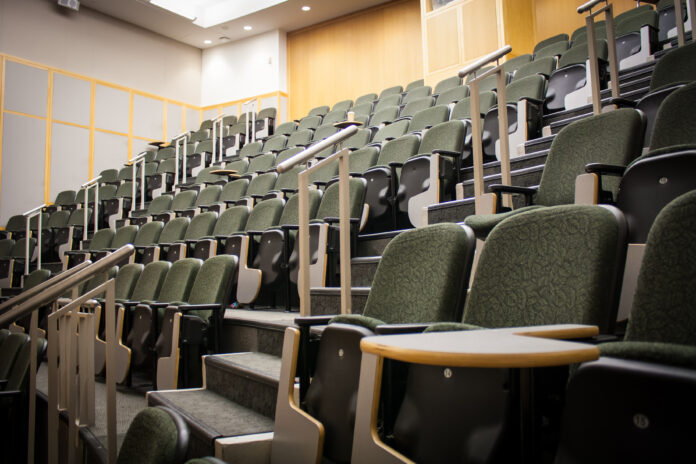
This is a photo of a lecture hall.
PHOTO: Derek Bruff / Flickr

By: Izzy Cheung, staff writer

Content Warning: mentions of antisemitism and genocide. 

From education to history, 140 members of SFU’s faculty have signed a “basis of unity” statement expressing their collective support for Palestine. The statement endorses the Boycott, Divestment, and Sanctions (BDS) movement and denounces antisemitism. The BDS campaign encourages individuals to boycott companies that are involved in violating Palestinian human rights (such as financially backing Israeli forces), divest from current investments in military companies supporting the state of Israel, and apply “pressure [on] local and national governments to end Israeli apartheid.” The included signatures vary from tenured to non-tenured faculty members, and range from instructors to organization coordinators. 

Faculty for Palestine, also known as F4P, can be found at more than just SFU. F4P’s members are part of a large movement found across 130 universities in North America. The organization emerged in the spring of 2008 and has since amassed over 600 faculty members across Canada. This organization “was formed in solidarity with, and endorses, the Palestinian campaign for the academic and cultural boycott of Israel.” 

Individual departments at SFU have also expressed their support for Palestine through statements signed by faculty members. The School of Communication issued their own statement of support, endorsed by both instructors and graduate students. 

“As a community of scholars and public intellectuals, we stand steadfastly in support of Palestinian peoples’ justice and liberation,” noted the statement. “We stand against antisemitism in all of its forms and affirm that it cannot be conflated with criticism of the Israeli state.” 

SFU’s Labour Studies program has also constructed a statement addressing their support for Palestine. “We stand with the Palestinian people. We stand with Israelis and Jews demanding ‘not in our name’ [ . . . ] We stand with working people, academics, scholars, and activists being harassed and criminalized for their support of Palestinian liberation.”

Their statement continues, “Our governments and institutions cannot condemn the Russian attacks on civilian infrastructure in Ukraine while giving Israel unqualified support to cut off access to water, electricity, food, and medicine to the people of Gaza while bombing their homes, schools and hospitals.”   

On March 7, SFU F4P held a university-wide town hall on the Burnaby campus. The event featured faculty members who discussed the reasons why they signed the “basis of unity” statement. This included a poem written by English professor Stephen Collis.  

“Because I saw a kite and knew it was a new ghost whose story we had to tell now more than ever,” he wrote. “Because genocide is actually not that difficult to define.” 

Find out more about SFU Faculty for Palestine on their website and their Instagram page. SFU F4P’s “basis of unity” statement can be found below. 

Who We Are

F4P-SFU is a network of faculty who support the cause of Palestinian liberation. We define faculty broadly to include both tenure and non-tenure track faculty and staff.

Our Values

F4P-SFU understands the struggle for Palestinian freedom to be aligned with struggles for justice, equality, and decolonization in many parts of the world. These include movements for Indigenous land rights, Black liberation, gender and sexual freedom, and struggles for a sustainable planet.

F4P-SFU affirms that human rights are universal and indivisible and should be upheld without exception. 

F4P-SFU abhors and unequivocally rejects all forms of antisemitism. Our commitments as educators compel us to confront antisemitism wherever it appears. 

F4P-SFU rejects the conflation of support for Palestinian liberation with antisemitism. 

Our Support for Palestine

F4P-SFU endorses the non-violent call for Boycott, Divestment, and Sanctions (BDS) to compel Israel to comply with international law and end its occupation of Palestine. We pledge to support BDS initiatives that seek to advance the fundamental rights of Palestinians to equality and self-determination.

F4P-SFU affirms the Palestinian right to education and supports building ties with Palestinian academic institutions, colleagues, students, and staff.

On Our Campus

F4P-SFU supports and amplifies the work of Students for Justice in Palestine and other groups working to advance the rights of the Palestinian people. We organize in solidarity with other social justice groups at SFU, across Canada, and around the world.

F4P-SFU rejects all forms of surveillance, targeting, and criminalization of expressions of support for Palestinian rights and liberation at SFU. We recognize that this targeting, as well as heightened security measures on campus, have disproportionately threatened the Palestinian, Muslim, Arab, Jewish, Indigenous, and Black community members among us who stand in solidarity with Palestinian freedom. The more secure among us will strive to protect the more vulnerable.

This statement has been endorsed by the following tenured and non-tenured faculty members. 

Archaeology 

Catherine D’Andrea. 

Centre for Educational Excellence 

Bee Brigidi. 

Centre for Comparative Muslim Studies 

Kylie Broderick. 

Community Engagement 

Rachel Nelson.  

Computing Science 

Ouldooz Baghban Karimi.  

Contemporary Arts

Joseph Clark, Claudette Lauzon, James Long, Stefan Maier, Laura Marks, Denise Oleksijczuk, Judy Radul, Simone Rapisarda, Nadia Shihab, Suze Shore, Kathy Slade, Daisy Thompson. 

Criminology 

Amanda Butler, Sheri Fabian. 

Education 

Pooja Dharamshi, Maureen Hoskyn, Sharalyn Jordan, Jeannie Kerr, Özlem Sensoy, Suzanne Smythe. 

English  

Hari Alluri, Ronda Arab, Clint Burnham, Stephen Collis, Ed Graham, Joanne Leow, Carolyn Lesjak, Sophie McCall.  

Environmental Science

Rajdeep Dhadwal. 

French 

Giuliano Gullotti. 

Geography 

Rosemary Collard, Sharon Luk, Geoff Mann, Eugene McCann, Magie Ramírez. 

Global Humanities 

Samir Gandesha, Sabrina Higgins, Spyros Sofos. 

Gender, Sexuality, and Women’s Studies 

Nadine Attewell, Carman Fung, Mariam Georgis, Tiffany Muller Myrdahl, A.J. Withers.  

Health Sciences 

John Calvert (retired), Lyana Patrick, Travis Salway, Malcolm Steinberg. 

History 

El Chenier, John-Henry Harter, Janice Hyeju Jeong, Mark Leier, İsmail Noyan, Roxanne Panchasi, Paul Sedra, Sarah Walshaw. 

Indigenous Studies 

Daniel Iwama, Nicholas Reo, Zoe Todd, Natahnee Winder. 

International Studies 

Sumercan Bozkurt Gungen, Darren Byler, Elizabeth Cooper, Josip Dasovic, Megan MacKenzie, Anushay Malik, Tamir Moustafa, Gerardo Otero, Irene Pang, Amyn Sajoo, Nazanin Shahrokni, Rupak Shrestha, Robert Springborg, Jason K. Stearns, Ellen Yap.  

International Services for Students 

Zoreen Nuraney, Wafaa Zaqout.  

Labour Studies 

Kendra Strauss, Cathy Walker. 

Lifelong Learning 

Sama Ghnaim, Leah Wiener. 

Molecular Biology & Biochemistry 

Lynne Quarmby. 

Political Science 

Jérémie Cornut, Genevieve Fuji Johnson. 

Radius SFU 

Humaira Hamid, Veronik Campbell, Nada El Masry, Yara Younis. 

Resource and Environmental Management 

Jonathan Boron, Tammara Soma. 

School of Communication  

Daniel Ahadi, Benjamin Anderson, Davina Bhandar, Enda Brophy, Karrmen Crey, Stephanie Dick, Milena Droumeva, Zoe Druick, Sarah Christina Ganzon, Byron Hauck, Adel Iskandar, Kirsten McAllister, Cait McKinney, Nawal Musleh-Motut, Ahmed Al-Rawi, Alberto Toscano, Siyuan Yin.    

School of Public Policy 

Mohsen Javdani. 

SFU Library 

Megan Crouch, Ashley Edwards, Eiman Elnoshokaty, Leah Hopton, Leanna Jantzi, Julia Lane, Ebony Magnus, Keshav Mukunda, Hazel Plante, Chloe Riley, Sylvia Roberts, Olive Shakur, Andréa Tarnawsky, Baharak Yousefi. 

Sociology and Anthropology 

Yildiz Atasoy, Dara Culhane (retired), Lindsey Freeman, Evelyn Encalada Grez, Michael Hathaway, Maureen Kihika, Dany Lacombe, Kathleen Millar, Cristina Moretti, Stacy Pigg, Pamela Stern, Travers, Amanda Watson, Kyle Willmott.  

Vice President, Research & International

Mary Chen, Urooj Nizami. 

World Languages and Literatures

Azadeh Yamini-Hamedani. 

Council Chats: SFSS president fined for violation of Council policy

0
This is an illustration of a graphic that reads “Council Chats.” The image also has two text boxes to symbolise messages being sent.
ILLUSTRATION: Andrea Choi / The Peak

By: Olivia Sherman, News Writer

On March 13, The Peak attended the Simon Fraser Student Society (SFSS) bi-weekly Council meeting via Zoom. The meeting consisted of topics including a motion to fine president Liam Feng for attempted removal of the Issues Policies and a motion to fund the expansion of the Surrey engineering building space. 

President Feng fined

A motion was passed on March 13 by vice-chair and molecular biology and biochemistry councillor Sam Killawee to fine president Feng “$700, along with a public, written apology” for his violations of Issues Policies (IP) 4 and 7 in the January 3 meeting. IP-4 protects students’ rights to disability justice wherein the SFSS commits to implementing anti-ableist frameworks, providing resources and funding to accessibility initiatives, and preventing barriers for the disabled community. IP-7 protects Indigenous inclusion by ensuring the society respects Indigenous governance, anti-colonial education, reconciliation, and engages in community consultations. During the January 3 meeting, Feng attempted to remove all 12 IPs. The 12 IPs declare the SFSS’ support for reproductive rights, Black History Month, tuition affordability, disability justice, living wages and union rights, climate justice and sustainability, Indigenous inclusion and reconciliation, anti-racism, police and militarization, Palestinian liberation, accessible course materials, and accessible equitable events. 

21 voted in favour of the motion, one voted against, and six abstained, including Feng. 

Surrey Engineering Building space expansion presentation

Sustainable energy engineering student society councillor Andrew Nathan requested funding for Surrey campus’ engineering building. Nathan noted that while the exterior of the building attracts tours of incoming students, they’re left disappointed by the “mostly empty” interior. “It’s like walking around a warehouse sometimes,” he explained. “But I would like to make use of some of these spaces.” Nathan requested $4,089 from the SFSS to improve the space and increase student engagement on the Surrey campus. The funding would go toward items such as speakers and microphones for presentations, a desktop monitor, two refrigerators, board games, and more. 

Nathan mentioned he had attempted contact with SFU administration to inquire for funding for additions and renovations. “There are currently no plans on their end to invest in this space,” he said, noting he had trouble tracking down who manages the space in question, and that SFU directed his request for funding to the SFSS. 

Councillor Sindhu Dharmarajah also noted that the SFSS’ Space Expansion Fund is normally allocated toward “renovations or space improvement of older spaces [ . . . ] so it’s a little interesting it’s been passed off to the Space Expansion Fund.” 

Vice-president events and student affairs Ayooluwa Adigun explained it’s “a discussion about liability, mostly because if we do renovate the space, and the SFU decides they want the space back, since there is no official discussion as to whether or not this is an SFSS or DSU space, that puts us in kind of a hole.” 

Vice-chair Sam Killawee said, “There’s a history of SFU as a university forcing its responsibilities onto the SFSS.” He advocated to see something more “solidified and confirmable, something that can’t be taken away by the university before we invest.” 

Nathan later proposed an amended amount of $2,863 for items in the common room. The motion was approved for this new amount. 

First year engagement committee election

Resource and environmental management association councillor Amos Kang was appointed to the position. This committee coordinates events and activities for first-year students. 

BASS advocates for space in the SUB for business student groups

0
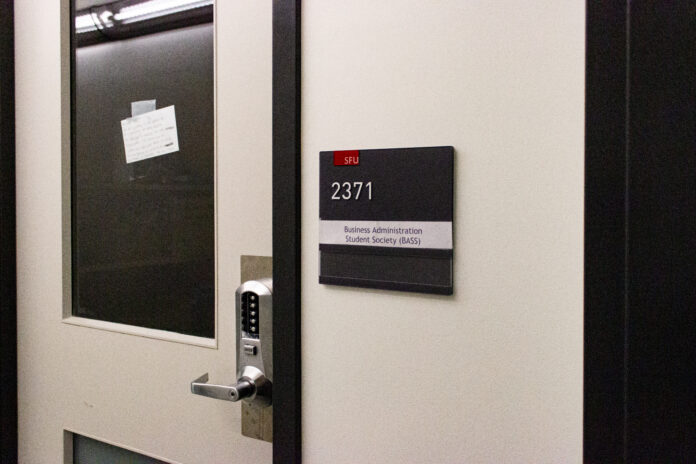
This is a photo of the current B.A.S.S. office space.
PHOTO: Gudrun Wai-Gunnarsson / The Peak

By: Eden Chipperfield, News Writer

On January 31, Business Administration Student Society (BASS) councillor Meha Sidhu requested that the Simon Fraser Student Society (SFSS) Council dedicate BASS a permanent home in the Student Union Building (SUB). Sidhu noted the current space designated for BASS is too small to host their 14 umbrella clubs and accommodate drop-in hours. 

The request was met with questions and concerns from the Council. The SFSS was concerned that approving space for BASS in the SUB would decrease space for accessible student study rooms. 

The Peak spoke to Sidhu about BASS’ need for a space in the SUB and the challenges they have faced.

“One of the keys to being in a business degree is to be able to foster greater community within our Beedie community and with other faculties,” said Sidhu. BASS has 14 affiliated clubs within its reach, including the Student Marketing Association and Young Women in Business

When space in the SUB was being allocated to student groups in 2019, BASS did not have representation on the Council, thereby missing the window for claiming a room. Sidhu said she is “the first one to come back to represent BASS at the Council.” 

The current BASS room is a small space in the West Mall Centre. Sidhu advocated for an open-door policy, which she believes is not possible in the current BASS room. An open-door policy for Sidhu means students can drop by at will to ask questions about their courses and engage with the Beedie community. The current space is also used as storage to hold various items for BASS and other club events. Sidhu reported, “The room is, it’s not suitable to host a whole group — a whole executive team — it’s only suitable to maybe have office hours.”

Sidhu has stressed “BASS is open to any space that can hold a capacity of 10 across campus.” The association prefers the SUB due to its connection with other student unions and groups. The Council has supported the idea of advocating for BASS to find a permanent space on campus, but there has yet to be any update on the progress of this survey. 

During the February 28 Council meeting, when the SFSS first reviewed the motion, SUB building coordinator Cicely A gave a presentation on understanding BASS requests from a staff perspective of room booking. Cicely explained the SUB is the only building on campus that the SFSS and other student unions can acquire free of charge. Through gathered statistics, Cicely explained that out of the 171 active clubs, only 14 are business/Beedie-related. This means that only 8% would benefit from the arrangement. Cicely argued that Beedie has access to rooms through funding but agreed that the organization should have space to host up to two to three people. This space might not be available within the SUB. 

Cicely was also concerned that while BASS currently has an active team, they worried that if the union becomes less engaged, their room won’t be used — when it could be used as bookable study space for students.

Sidhu addressed this comment by arguing that BASS “has been active for a long time” and this can be traced back through the engagement development office, where the organization is held accountable for being connected with the Beedie community. Regarding the claim that BASS only benefits 8% of the student body, Sidhu said, “I don’t think it’s fair to make those comparisons.” She added, “We make maybe 50% of events on campus and contribute to campus culture. We can positively contribute to SFU.”

The Peak contacted the SFSS for a statement on the BASS room, but they declined to give a comment.

Catchphrases and quotes heard around the world

0
Allen Iverson shooting from the free throw line
PHOTO: Allen Iverson / Instagram

By: Kaja Antic, Sports Writer

Content warning: mention of homophobia. 

“Float like a butterfly, sting like a bee.” — Muhammad Ali, c. 1964

Before fighting the “unbeatable” world heavyweight champion Sonny Liston, Ali told the media he would “float like a butterfly, sting like a bee.” This quote remains one of Ali’s most famous, although it’s believed that the phrase was coined by Ali’s former cornerman, Drew “Bundini” Brown. The phrase has been referenced and parodied in many forms, including the 2006 Pixar film Cars, in which Lightning McQueen adapts it to “float like a Cadillac, sting like a beemer.”

“It’s a power play goal!” Sam Rosen, c. 1980s

When Rosen began his career on the New York Rangers’ broadcasts in the early 1980s, his booming voice announcing power play goals captivated television audiences nationwide. Rosen had previously been a radio play-by-play announcer for the New York Cosmos soccer team, where his goal call of “it’s a Cosmos goal! had seemingly inspired his power play call during his multi-decade Rangers career. The call is simple, yet iconic with the scoring player’s name followed by a punctuated, “It’s a power play goal!” This continues to be an iconic hockey play-by-play call, with even current Rangers captain Jacob Trouba copying Rosen’s announcement after scoring a power play goal. 

Let’s get ready to rumble!” Michael Buffer, c. 1984

If you’ve ever watched some sort of sporting event, you’ve likely heard the phrase, “Let’s get ready to rumble!” The phrase was coined by American ring announcer Michael Buffer in 1984, who then gained the statement’s trademark in 1992 — generating over $400 million in revenue for the string of five words. When Buffer was beginning his career in the early 1980s, he was searching for a catchphrase to get the crowd going at boxing matches, yet nothing he tried was working. Buffer then overheard Muhammad Ali say,rumble, young man, rumble,” adapted it for his announcing routine, and the rest was history. Buffer has since earned revenue from various shows and movies using his trademarked phrase, as well as uttering it at sporting events outside of boxing or wrestling rings, such as the 2017 United States Grand Prix and Game 1 of the 2018 Stanley Cup Final.

“We talking about practice, man!” Allen Iverson, May 7, 2002

On May 7, 2002, Iverson entered a press conference shortly after his team — the Philadelphia 76ers — were knocked out in the first round of the NBA playoffs. After a journalist questioned the 2001 MVP about his dedication to team practices, Iverson unleashed on a tangent, repeating the word “practice” 22 times. This rant was one of the first viral press conference clips in the early days of the internet and quickly circulated due to the defensiveness Iverson showed when his dedication to the 76ers was questioned. It circulated as a comedic moment, though many failed to acknowledge that Iverson had been dealing with the October 2001 death of his best friend throughout the season — something Iverson mentioned later on in the press conference. The speech has been referenced in many different pop culture realms, including the highly-acclaimed series Ted Lasso.”

“Iggy!” Sidney Crosby, February 28, 2010

During the 2010 Vancouver Winter Olympics, the men’s hockey final took place at the then-named GM Place between Canada and the United States. Canada held a 2–1 lead in the final minutes until Zach Parise scored to tie the game with less than 30 seconds left. With the Americans forcing overtime, Canada kept pushing in the extra period. Then-22-year-old Sidney Crosby stormed into the American zone, attempting to keep possession of the puck until he noticed then-Calgary Flames captain Jarome Iginla further down along the boards. Crosby left the puck for Iginla, made a beeline to the net, and then called for the puck by yelling “Iggy!” which the ice-level microphones picked up. Iginla passed to Crosby, who then scored the gold medal-winning goal. While Crosby was simply calling out a nickname, this moment just before winning the Olympic championship is a long-standing memory in Canadian sports history.

“A drive into deep left field by Castellanos” Thom Brennaman, August 19, 2020

During the first game of a doubleheader between the Cincinnati Reds and the Kansas City Royals, Reds play-by-play announcer Thom Brennaman uttered a homophobic slur during the live broadcast. This incident was clipped, and then circulated on social media, leading to Brennaman issuing an apology and being replaced during the second game’s broadcast. In the fifth inning, Brennaman began his apology as Reds outfielder Nick Castellanos was stepping up to bat. While Brennaman was in the middle of his lacklustre apology, Castellanos hit the ball far into the left field, earning a home run for the Reds. Brennaman paused his apology to cynically describe the play unfolding, announcing, “As there’s a drive into deep left field by Castellanos, it will be a home run. And so, that will make it a 4–0 ballgame,” before continuing his statement. The incident became a copypasta meme, with social media users adding the phrase as an unexpected twist to the end of seemingly somber statements, such as former US President Richard Nixon’s 1974 resignation speech. Castellanos has also now made it a habit of earning home runs during serious moments in the broadcast — adding to the meme’s legacy. 

Spots for your spring studying sessions

0
A collage of photos from some of the cafes and bakeries mentioned in this piece, including sugar-coated donuts on display and a wall in a cafe with fake grass lining it and a drawing on a tiger.
PHOTOS: Amrit Kamaal / The Peak

By: Izzy Cheung, Staff Writer

Sweet Talk Donuts 
87 Moody St., Port Moody 
Open Monday–Sunday from 8:00 a.m.–4:00 p.m. 

If you’re planning on visiting Sweet Talk Donuts, beware — their delicious delicacies will blow your mind. Their crème brûlée donut is unlike anything else you can find in the Tri-Cities. While they don’t currently have outdoor seating, you can grab a drink and a donut, then skip over to the nearby Rocky Point Park to enjoy spring weather. 

Blacksmith Bakery 
9190 Church St., Langley Twp
Open Monday–Sunday from 7:00 a.m.–10:00 p.m. 

Fort Langley’s Blacksmith Bakery is home to ample outdoor seating and an array of yummy options for long studying sessions. Choose from a variety of pastries, pizzas, and brunch treats (as well as some salads and nourish bowls — yum!). Feeling a little spontaneous? Add a shot of Baileys to your drink to spice up your day. 

Black Tiger Coffee Co.  
19255 Fraser Hwy #110, Surrey 
Open Monday–Friday from 8:00 a.m.–6:00 p.m. and Saturday–Sunday from 9:00 a.m.–6:00 p.m. 

Despite the slightly limited outdoor seating, Black Tiger Coffee Co. is most definitely still a spring studying destination. Their cozy indoor seating is well-lit by the natural light that seeps in through the large-scale, half-shaded windows. Their donut flavours, ranging from maple brownie to cookie monster, rotate every week — you never know what kind of mouth-watering creation you’ll end up with! 

Beach Grove Cafe and Boutique 
1269 Beach Grove Rd., Delta 
Open Monday–Sunday from 9:00 a.m.–5:00 p.m. 

Beach Grove Cafe and Boutique offers a unique experience to partake in this spring. While you could go here to study, you’ll most likely be tempted to shop at their local business-based storefront. They host products from small businesses such as Canvas Candle Co., Surf & Stone Jewellery, and Saltspring Kitchen Co. Shop your heart out while enjoying one of their many flavours of Italian soda. 

Nomad Espresso Bar and Bakery 
1415 Bewicke Ave., North Vancouver 
Open Monday–Sunday from 8:00 a.m.–5:00 p.m. 

Planning a visit to Nomad Espresso Bar and Bakery? Be sure to bring your favourite mug, as they don’t offer single-use cups. Their B.Y.O.C. initiative has resulted in 68,420 cups saved (and counting!). They even offer scones for pups who may want to join their owners on an outdoor study date. Try their refreshing blood orange black tea or a tropical mint smoothie. 

Arbutus Coffee 
2200 Arbutus St., Vancouver 
Open Monday–Friday from 8:00 a.m.–4:00 p.m. and Saturday–Sunday from 8:00 a.m.–4:30 p.m. 

This cute café, located between West 4th Ave and West Broadway, is a great place to hunker down and get some work done inside or outside. From the nearby cherry blossom trees that bloom in the spring to the various chalkboards with cute designs drawn on them, you’ll be sure to have the ultimate spring studying session at Arbutus Coffee. 

Salty scientists team come first place in women’s division for world’s toughest row

0
This is a photo of the rowing team in their boat. The four women are rowing.
PHOTO: Courtesy of Salty Science / Instagram

By: Eden Chipperfield, News Writer

After 38 days at sea, the Salty Scientists team rowed into first place for the women’s class in the Atlantic 2023: The World’s Toughest Row.

The crew of four women marine biologists from across North America, included SFU’s professor of biological science, Isabelle Côté. The team engaged in the challenge of rowing 3,000 miles across the Atlantic Ocean. They began in San Sebastian de la Gomera, Spain and ended in Nelson’s Dockyard in Antigua and Barbuda.  

After their time at sea, The Peak connected with the Salty Science Team to ask about their journey and mission of raising money for ocean conservation. 

“Our three main goals were to complete the crossing safely, have the most fun possible during the challenge, and finish as friends — and row as quickly as we can,” said the team. “Rowing into English Harbour, Antigua (the finish line) was such an amazing feeling. The sense of accomplishment after such a feat is incredible.”

Participating in the row with Côté was Chantale Bégin, professor at the University of South Florida, Lauren Shea, UBC master’s student focusing on Oceans and Fisheries, and Noelle Helder from University of Alaska Fairbanks. Their goal for participating in the row was to raise funds for donations to three marine conservation organizations: ShellBack Expeditions, Bamfield Marine Science Centre, and Greenwave. The team explained the reason for selecting these organizations was the tangible solutions-focused approach that each engages in. They also noted the importance of their research’s support of diversity, equity and inclusion to opportunities within the marine science field. 

The journey was not straightforward; the Salty Scientists encountered many obstacles during their row, from salt sores to exhaustion and morale upkeep. “For the most part, we all agreed on what we needed to do, and there were few instances where we needed to have a purposeful conversation to come to an agreement. But getting the four of us on deck at the same time to discuss options and hear each other out was key to facilitating the communication [we] needed,” explained the team. 

The team described the weather as a continuous challenge, especially within the first week of the row. During this time they faced 25-foot waves crashing on the side of the boat. The boat, nicknamed Emma, had many things break “that weren’t sustainable for the whole crossing. Luckily, things calmed down eventually.”

Among the challenging moments there were many once-in-a-lifetime experiences the women encountered. On their journey they were visited by a school of over 50 dolphins who swam alongside the boat. The team also noted their appreciation for the stunning sunrises at sea, and the feeling of installing a new water maker after the original had been broken for approximately five days. 

“All four of us are marine biologists, and all care deeply about marine conservation, so it took no time to decide what we would support through this adventure. Why should anyone else care about the health of ocean ecosystems? Because it is home to a huge amount of biodiversity, and we humans rely on oceans for food, coastal protection, climate regulation and oxygen production,” said the team. 

The Salty Scientist teams are still accepting donations, which will be split into three ways: ShellBack, Bamfield, and Greenwave. Donations are taken at https://saltyscience.org

Odd sport combinations that just seem to work

0
Players trying to run across the ice in football gear to play american ice football
PHOTO: Courtesy of American Ice Football’s Instagram

By: Kaja Antic, Sports Writer

American Ice Football

In a video circulating various social media platforms recently, there appears to be a form of American football played on ice in Germany. Combining elements from hockey and American football, the Germans seem to have created a perfect concoction of two very popular, yet very different, sports from across the pond. The field mimics a typical American football field, but is completely made of ice. Adding to the entertainment factor, each player is dressed in hockey gear with football helmets and shoes instead of skates, causing them to slip and slide all over the place. 

The tournament took place before Super Bowl LVIII, with four teams competing on the icy adapted field. Teams had eight players a piece, consisting of former athletes and celebrities from across Europe. The game still included the typical American entertainment factors such as cheerleaders and light displays during touchdowns, captivating both German and international audiences. While this may not yet be an official sport by any means — though I wish the International Olympic Committee would consider it — it’s certainly entertaining with its whimsical mix of both popular sports. 

Chess boxing

Yes, this is a real sport. The match begins with a chess board placed in the middle of the boxing ring. The chess portions last four minutes each before switching to a two-minute boxing round. Winners are determined by a knockout, referee decision, checkmate, or an opponent move that lasts over 12 minutes of the allotted chess time. 

Originating in England in the 1970s, chess boxing seems as fictional as can be, but the sport is very much alive and well. Combining the brains associated with chess and the brawn associated with combat sports, the athletes competing in these events seem virtually unstoppable. The sport became official in 2003 when Dutch artist Iepe Rubingh organized its first match after being inspired by Enki Bilal’s 1992 comic book Cold Equator, which heavily featured the then-unofficial sport. 

There are two current governing bodies for the sport — the World Chess Boxing Organization (WCBO), which was founded with the help of Rubingh in 2003, and the World Chessboxing Association (WCBA), which split from the WCBO in 2013 to expedite the growth process for the sport. There are national chess boxing federations on all continents excluding Antarctica, and the sport is continuing to grow internationally.

FootGolf

Probably the least surprising combination sport in this piece, FootGolf combines golf with association football — known as soccer in North America. Formally invented in 2008, FootGolf has garnered attention worldwide since its inception with courses in over 50 countries. There was even a FootGolf World Cup in Orlando which ran from May 27–June 6, 2023, with France taking the men’s team title, Argentina taking the senior men’s team title, and Japan earning the women’s team title. Highlights were broadcasted by the highly popular sports channel ESPN in August 2023. 

The first I had heard of FootGolf was a May 2021 video from the UK YouTube group, the Sidemen, where they played the sport with the winner earning money in this “impossible challenge.” In the scope of the Lower Mainland, there was a designated FootGolf course in Surrey that ran events in the summer of 2014, but the main golf course has since been brought under new ownership, and the new country club does not feature the footgolf adaptation. There are still six courses throughout BC, with three on Vancouver Island and three in the Okanagan, so if you’re interested in this sport, you might want to book a road trip. 

Jules Sherred makes cooking accessible in Crip Up The Kitchen

0
A photo of the hardcover book with the title “Crip Up the Kitchen.”
PHOTO: Jin Song / The Peak

By: Alex Masse, Peak Associate

Jules Sherred’s Crip Up The Kitchen is a debut cookbook with a twist — it’s written by and for disabled people, giving them the tools to prepare food for themselves and others. The book contains dozens of recipes, as well as advice on everything from shopping to kitchen safety. 

Sherred’s love of food goes back to his youth, which he spent in what he calls “a very multicultural environment,” giving him the chance to fall in love with a broad range of food, as well as a wider understanding of food as hospitality. 

“All of these great world cultures were what I grew up with,” Sherred said. “[My] comfort food is very much flavour, and spice, and things that warm you up.” 

His disabilities, though, interfered with his ability to work in the kitchen, which he calls “the most ableist room in the house,” and a “place of beauty” that prioritizes “aesthetics over function.” For example, even though Sherred’s kitchen is up to code, his wheelchair cannot comfortably navigate inside it. Additionally, due to his mobility issues and chronic pain, his days of cooking for “five-plus hours” are now behind him. 

Enter the Instant Pot, an automated multicooker that made cooking accessible again. While initially skeptical, Sherred soon discovered Urvashi Pitre, who lived with rheumatoid arthritis and used the Instant Pot herself. 

“As I was watching her cook, I was like, oh, now I get it,” Sherred said. Presently, he estimates about ninety percent of his cooking is done in his Instant Pot. 

With the disability experience being incredibly varied, encompassing mobility issues, chronic pain, cognitive symptoms such as brain fog, and more, it can be daunting trying to find a solution that is accessible for everyone. Sherred, though, who experiences all three, states that the Instant Pot accommodates him perfectly: “No matter what type of brain day, pain day, or mobility day [ . . . ] I can just throw stuff into a pot, put on a lid, [and] walk away.” 

Additionally, Crip Up The Kitchen builds on the theories and language of disability writers before Sherred: throughout the book, he employs spoon theory to outline how strenuous recipes may be to undertake. Spoon theory, a concept coined by Christine Miserandino in 2003, explores how many disabled people across diagnoses find themselves with less energy than abled people — abled people have “cups” full of energy, while disabled people only have “spoonfuls,” which are easier to spend and harder to replenish. Sherred uses this familiar language in Crip Up The Kitchen, with recipes getting a range of spoon counts, from one to “all your spoons.” 

The cookbook also contains dishes from a range of cultures, which Sherred states was incredibly important for him to represent, citing how the recipes many people of colour grow up making and eating are often mocked and exoticized. To him, everyone deserves accessible approaches to their comfort food, regardless of background. 

“I have a duty to use my white privilege,” Sherred said, “making sure everyone is included . . . I have an intimate understanding of what it’s like to be erased.” 

Currently, Sherred has two new manuscripts in the works. One is a coming-of-age novel about reproductive rights, featuring a transgender protagonist, and the other is a successor to Crip Up The Kitchen, which will focus on baking with an air fryer. To get the latest updates, including future calls for recipe testers, which will be coming “very, very soon,” sign up for Sherred newsletter on his website. Crip Up The Kitchen is available now directly from Torchwood Editions, as well as your local bookstores, including Massy Books, Iron Dog Books, and more.

It shouldn’t be this hard to get fragrance samples in Vancouver

0
Sample fragrance bottles
PHOTO: Scentll co / Unsplash

By: Michelle Young, Opinions Editor

I love fragrances. I spend most of my time working or studying at home, so I primarily wear them for myself to smell throughout the day. However, even a 50ml bottle can cost upwards of $100. You might think that because you like the smell of “cherry blossoms” — and that’s listed on the bottle — you will like this smell in perfume form. Unfortunately, that’s often not the case due to a variety of factors. The same perfume will smell different on different people, and will smell different to different people. You might not end up liking it at all. When bottles are so expensive, and last for multiple years, you want to make sure you like what you’re getting. This is where the importance of “sampling” comes in. 

The idea is you should try a certain fragrance on your skin for a prolonged period of time to really make sure you like it before purchasing the whole bottle. Small samples are occasionally sold individually, but are more often sold as sets. The issue arises when you live in Canada and want to sample anything beyond mainstream fragrances. 

New York and Los Angeles are known to house multiple in-person stores and locations with a wonderful variety of niche fragrances to try out and sample. However, I’ve noticed Vancouver is very limited. Stores like Sephora, The Perfume Shoppe, and Hudson’s Bay do carry some interesting fragrances you can spritz on yourself for a day, but that’s not the same as a sample bottle. It’s better to get a sample to have a better sense of longevity and how the environment might affect the scent. This is especially important when being mindful of scents that can trigger someone’s scent allergies in public. I personally have a hard time smelling anything in the mall due to the constant mixture of perfumes, and you really shouldn’t be spraying yourself more than once or twice. If I can’t venture out to smell these myself, the logical step is to purchase them online. The problem is that online shopping for samples tends to be absurd. 

Usually, sample sets make for a pretty good experience to get a sense of what you like. However, sometimes I’m just not interested in five out of six of these fragrances, and paying $30, or sometimes much more, for one tiny 1.5 mL sample (plus shipping) is unreasonable. When trying to order anything from outside Canada — where the majority of niche perfumeries are — shipping can easily double your $40 order into an $80 order. Part of the blame lies in rising shipping costs, and that’s not the fault of perfumeries. However, at that price, you almost might as well buy a full bottle, which defeats the purpose of sampling altogether. Most sample-based websites like Scentbird are based in the US — which also leads to expensive shipping costs.

The times I’ve snatched a sample set for a reasonable price has shown me how important it is to try it on yourself first. Commodity Milk sounds and smells lovely — until it’s sprayed on my skin and turns sour. I know that fragrance is ultimately a luxury and not a need. Spending $10 on a miniscule sample can at times, also be too expensive to justify. However, especially in Canada, fragrance doesn’t need to be as inaccessible as it is — I just want to purchase a sample!