Home Blog Page 1230

All’s fair in love and art

0

CUTIE-AND-THE-BOXER

It starts as they stick candles into two mini cheesecakes for his 80th birthday. Cutie and the Boxer is a documentary that traces the relationship of husband and wife, Ushio and Noriko Shinohara, who met in SoHo at the respective ages of 41 and 19.

The film begins with Noriko, a young artist recently emigrated from Japan, besotted by Ushio’s immersion in the art world.

Ushio is a Japanese artist who works in sculpture and, primarily, action-painting. His canvases are large and he hangs them against a wall built with a lot of give, like the floors of a gymnastics club. He wails on his canvases, wearing boxing gloves with sponges strung onto them, sopping wet with ink and paint. He wears swimming goggles and the sagging layers of his 80 year-old body ripple with every hit.

The film tells the story of their developing relationship; Noriko recalls Ushio bringing her home to his bed with no sheets and no blankets. She obliges, seeing the barrenness as an emblem for the stingy glamour of the New York she looked forward to knowing. The bed seems fitting for Ushio too, an important player in the Neo-Dadaist movement which founded itself on an aversion to standardized aesthetics of beauty and living.

There is love, but there is loathing too, and she is as detailed about her regrets as a woman on her deathbed.

Noriko initially saw her connection to Ushio as a channel of influence for her own art-making but discovered quickly that their relationship would never be equal; he would always be the one with an established name, and she’d always put him first.

At the beginning, we watch Noriko play the role of Ushio’s assistant; she seems pleasant enough but not enthusiastic.

Later, we see Noriko on a trip to sell some of her own work in Japan; we are invited into Noriko’s own artistic practice, where we discover her discomfort about the amicable subjugation she feels in relation to her husband. There is love, but there is loathing too, and she is as detailed about her regrets as a woman on her deathbed.

We are introduced to her new series of works: a semi-autobiographical comic of sorts wherein she reconfigures her own alter ego, Cutie, to rise above Ushio, Bullie. The work chronicles her youthful ambition, his boisterous, alcoholic behaviour and the things she’s given up and lost over the course of their nearly 40-year relationship.

Using a calligraphic painting technique, the often nude figures of Cutie resemble the plumpish and seductive women drawn by the hand of Titian, the 16th century Italian painter.

Cutie and the Boxer, directed by Zachary Heinzerling, captures Ushio as he works to put together his latest exhibition — one in which the gallery owner has also agreed to showcase Noriko’s new series.

I’ve never seen art manhandled the way it is here. It is clumsy, gorgeous and hilarious, causing us to think about the physical reverence we give to objects according to their perceived value — whether historical, emotional, cultural, and most often economical.

Unlike a lot of visual art documentaries, this film doesn’t feature any interviews about the two main subjects, nor do Ushio or Noriko ever address the camera or the people behind it. They are direct only with each other. It’s at the same time heartwarming and tumultuous — their passion for each other is unfaltering. The narrative blooms out of their everyday life where questions of power, love and success lie somewhere among their collective past and their individual bodies of work.

Newspaper industry “probably going to be okay” reports newspaper CEO

0

VANCOUVER—  As a result of technological innovations and the general advancement of time, the newspaper industry has hit hard times from which it may never recover. However, despite overwhelming evidence to the contrary, Vancouver Times CEO, Warren Isiah, stated in a release last week that the industry was, quote, “Probably going to be okay.”

Isiah cited frankly ridiculous notions such as “good old fashioned hard work” and “customer loyalty” in a document that can only be seen as evidence towards the man’s inability to properly steer a major company.

Even viewed as a desperate appeal to win back customers, this document would surely be used against the aging executive in any talks regarding his future at the helm of the publication.

A long-time friend, who wished to remain anonymous, though admitted that he “didn’t really care if [we] printed his name because who even reads newspapers anymore,” told The Peak that the document’s similarity to the ramblings of a mad man hardly comes as any surprise.

He cited Isaiah’s continued dedication to the failed TV Show Joey and ownership of a Pontiac Aztec as evidence of the aging journalism giant’s failure to attach himself to reality. As of press time, Isiah was unavailable for comment as he had flown to Las Vegas as part of his effort to finally revitalize the XFL.

Suicide rates increase due to super high rope prices

0

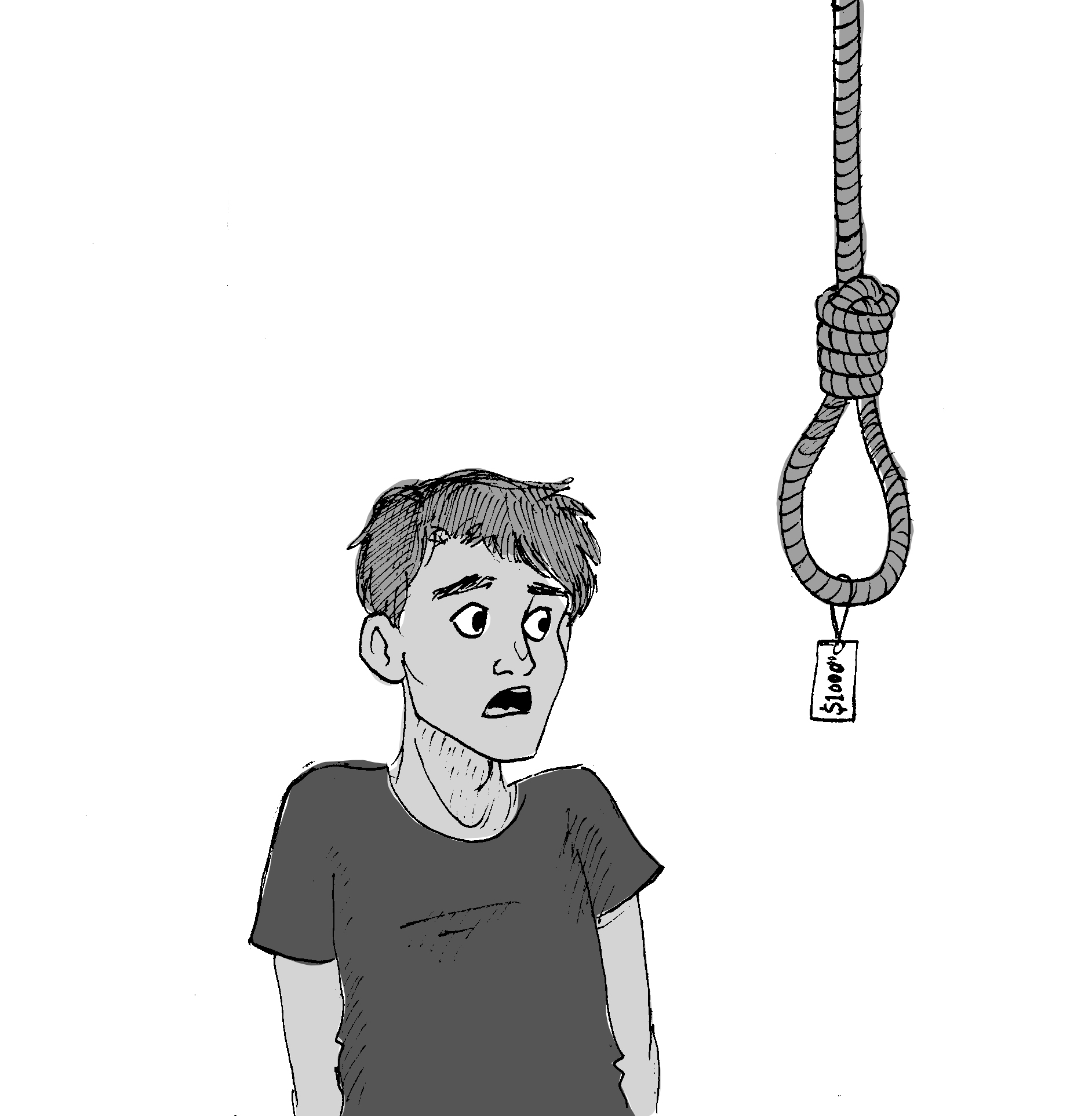
PONTIAC, MI — Suicide rates are on the rise thanks to the increasingly expensive cost of rope experts reported last week. According to new figures, the rates of committing suicide have never been higher, a reality which has led to a significant decrease in the  number of recent suicides.

“With rates like these on nooses, people just can’t afford to end their own lives right now,” explained statistician Linda Carlini, who first noticed the correlation between high rope prices and lack of suicides early last week. “If simple items like rope are eventually made unaffordable I think suicide might end for good.”

Carlini went on to explain that this is not the first time suicide rates have been affected by the economy. The high price of oil has also been credited with saving the lives of many poor, destitute, depressed people.

“Leaving your car running until you passed out and died used to be a lot more popular before gas prices started to skyrocket,” Carlini said, pointing to one her many confusing charts. “Most suicidal people can hardly afford to get enough gas to drive home, let alone have the cash to fill up their entire car with toxic fumes!”

Although Carlini was adamant that the increase in suicide rates was causing a decrease in the number of suicides, she also stated that the numbers are the opposite when you look specifically at the rope-loving community where suicide numbers have exploded as their prices have risen.

SFU hockey wins fifth straight

0

Despite an overall frustrating performance at Bill Copeland Arena, the SFU Clan hockey team did what they had to against the University of Victoria to scrape out a 3–2 victory. The win was SFU’s fifth straight to open the season and put the Burnaby squad in a tie for first place in the BCIHL with Trinity Western and Selkirk College.

The opening twenty minutes featured UVic’s first goal of the season against the SFU when Mark Prest potted a power play tally just 41 seconds into the game. SFU’s Graham Smerek would not allow his team to sit back after surrendering the first goal, as he led by example and began to hit every Victoria player
in sight.

The intensity brought by the grinder seemed to spark SFU as shortly after, Pavlo Zerebecky put his speed on display, shooting right past a Vikes’ defender, and feathering a fantastic saucer pass across ice to Jesse Mysiorek, who tapped it into the yawning cage.

SFU’s frantic pace continued as Smerek did what he does best, and drew a slashing penalty due to his relentless forecheck. The BCIHL’s number one power play could not capitalize because the Clan couldn’t hit the net, firing plenty of shots towards the net, but wide.  SFU was unfortunate to not be leading after one.

Victoria continued to frustrate the Clan in the second period. Neither team could muster any great chances as UVic continued to collapse to their own net resulting inwas countless SFU shots hitting a body in front, never even making their way to Vikes’ netminder, Robert Simmons.

SFU wasn’t playing its best hockey, but still outshot the visitors 8–4 in the period, though none of which were particularly concerning for Victoria.

SFU head coach Mark Coletta rewarded Smerek’s strong play when he moved him up to the first line to play alongside Nick Sandor and Jono Ceci in the third period. Coletta’s move provided almost immediate dividends as Smerek assisted on a Sandor tally just  a minute and three seconds into the final frame to give SFU a 2–1 lead.

SFU’s new look top line added another key goal right after Smerek’s tally when Nick Sandor had the puck bounce right to him for a wide open tap in.

Victoria kept the game interesting by adding a late power play goal, but they would eventually get called for a too many men penalty when trying to pull their goalie late in the third.  The penalty proved costly as SFU controlled the puck with their final man advantage to seal the win.

SFU will now hit the road for games against Eastern Washington and Selkirk College with hopes of continuing their hot start to the season, and to take over sole possession of first place in the BCIHL.

Board Shorts

0

WEB - Board Shorts

Mediator begins working with society

The board discussed the hiring of Paula Boddie of Paula Boddie & Associates Ltd., a human resources and labor relations consulting service, following the Oct. 11 incident between directors Moe Kopahi and Monique Ataei.

President Humza Khan reported that mediation had started that day (last Wednesday), and that Boddie had been given all the resources necessary to investigate the incident, as well as to conduct a full workplace investigation. Khan also stated that the board had decided to hire Boddie directly, instead of through the Society’s lawyers, so that Boddie’s final report will be given directly to all board members, and then potentially made public. Boddie will be spending two half days per week on campus while she conducts the investigation.


Health and Dental plan referendum not finalized

External Relations Officer Chardaye Bueckert brought the board’s attention to the fact that during the society’s AGM on Oct. 23, the presentation given by Kristen Foster, Pacific and Western director of Studentcare, stated that a referendum to raise the current fund ceiling on the health and dental plan would be taking place in March 2014.

Bueckert raised concerns that that statement was inaccurate, and that the referendum had not been finalized, and no referendum question has yet been drafted. The board concluded that more information needs to be gathered about health and dental plans at other institutions before a referendum question is drafted.


IEC CEO upcoming appointment

The SFSS board discussed the appointment of the chief electoral officer of the Independent Electoral Commission (IEC) — the body that regulates the SFSS board of directors elections each year.

It was decided to start the process of appointing the chief electoral officer earlier than usual, beginning the process on the day of the board meeting, with the appointment to be made two weeks later, on Nov. 20. The board also discussed the possibility of the candidate selected consulting with possible candidates on the positions before the election, and being part of the process of training the incoming directors.

Research Roundup

0

080330-A-2932D-056

Study counts half-million deaths in Iraq War

Two SFU researchers have contributed to a US-based study that placed the death toll in Iraq related to the Iraq War at approximately 500,000. The study, conducted without funding, looked at the conflict between 2003 and 2011.

Dr. Tim Takaro, health sciences professor, and doctoral student Lindsay Galway were part of a 12-person team who collaborated on the study, published in PLOS Medicine. The team included researchers from the University of Washington, the Iraqi Ministry of Health, and John’s Hopkins University.

The study aimed to estimate direct and indirect deaths attributable to the war. “Several previous Iraq mortality studies have been conducted but this is the only study to cover the entire conflict,” Galway explained. Data was collected from 2,000 randomly selected households across the country’s 18 governorates.

The methodology of the study was more sophisticated than those done in the past, due to the randomness of the sample households (a measure to avoid introducing bias to the study), and an additional set of questions given to each of the adults in the households about their siblings, which allowed the team to learn about an additional 25,000 people.

The study is also unique in that it was the first to attempt to estimate deaths among the huge portion of the Iraqi population who migrated away from the country during the conflict.

For Galway, visiting Iraq and speaking with the team’s Iraqi members was an experience she won’t soon forget. “This experience was inspiring and certainly an invaluable learning experience for me,” she said. “I left the country in awe of our Iraqi colleagues who literally risked their lives to do this work.”

Galway hopes that the study will remind people “about the health impacts of armed conflicts and the importance of studying these impacts.” She also hopes to continue working in this field, but points to the lack of funding available for the research as an obstacle.

“It is important work that needs to be done, said Galway. “Unfortunately there is very limited funding for this kind of work . . . We call on science funding agencies to invest in research to address this large public health problem.”


WEB-Quarmby-PAMR-flickr copy

Cellular tails tell tales of disease

Molecular biologist, Lynne Quarmby, and doctoral student Laura Hilton, have discovered a mutation that may cause cilia (which exist on all human cells) to grow too long — the result of which can be fatal.

Quarmby and her students have found that CNK2, a regulatory protein, controls the length of cilia, which are microscopic antennae on our cells that communicate signals in our bodies. When these antennae are too long or too short, the signals they capture can be misinterpreted and cause disease or deformities. As these cells determine how we develop, their functionality is vitally important.

Quarmby first became interested in cilia while doing her PhD. “We were investigating whether a certain kind of signal transduction happened in plants, and wanted to know which of the same connections were happening in plants as were happening in animals,” Quarmby told The Peak.

The team was originally looking at trees, but it was Quarmby’s decision to use pond scum, which grows more easily in a lab, that led them to make an important discovery regarding the role that certain proteins play in regulating the cilia.

For Hilton, Quarmby’s doctoral student and lead author on the paper published in Current Biology, one of the most exciting discoveries of the project was that the rate of cilial disassembly is actively regulated. A crucial part of all cells’ lifecycle is their cilia’s assembly, the speed of which scientists have thought affects cilial length; however, Quarmby and Hilton are among the few scientists globally who have discovered important impact of the second part of the process: disassembly.

“Previous research from other labs focused largely on how regulating assembly contributed to setting the correct length for cilia. It was incredibly exciting to find that there’s a whole other side to the coin — it may really open up a whole new avenue of discovery in cilia and disease,” said Hilton.

This study not only opens new fields for investigation, but may provide treatment paths in the future for diseases caused by abnormal cilia length.

“Every time you discover a new player and how it might interact with other players in the pathway, that is a whole new opportunity for approaching therapy,” explained Quarmby. “That’s a new place where you can start to understand PKD, and the more you understand a disease, the more options you have for treatment.”

“Flash Paintball” shockingly much more destructive than standard “Flash Mob”

0

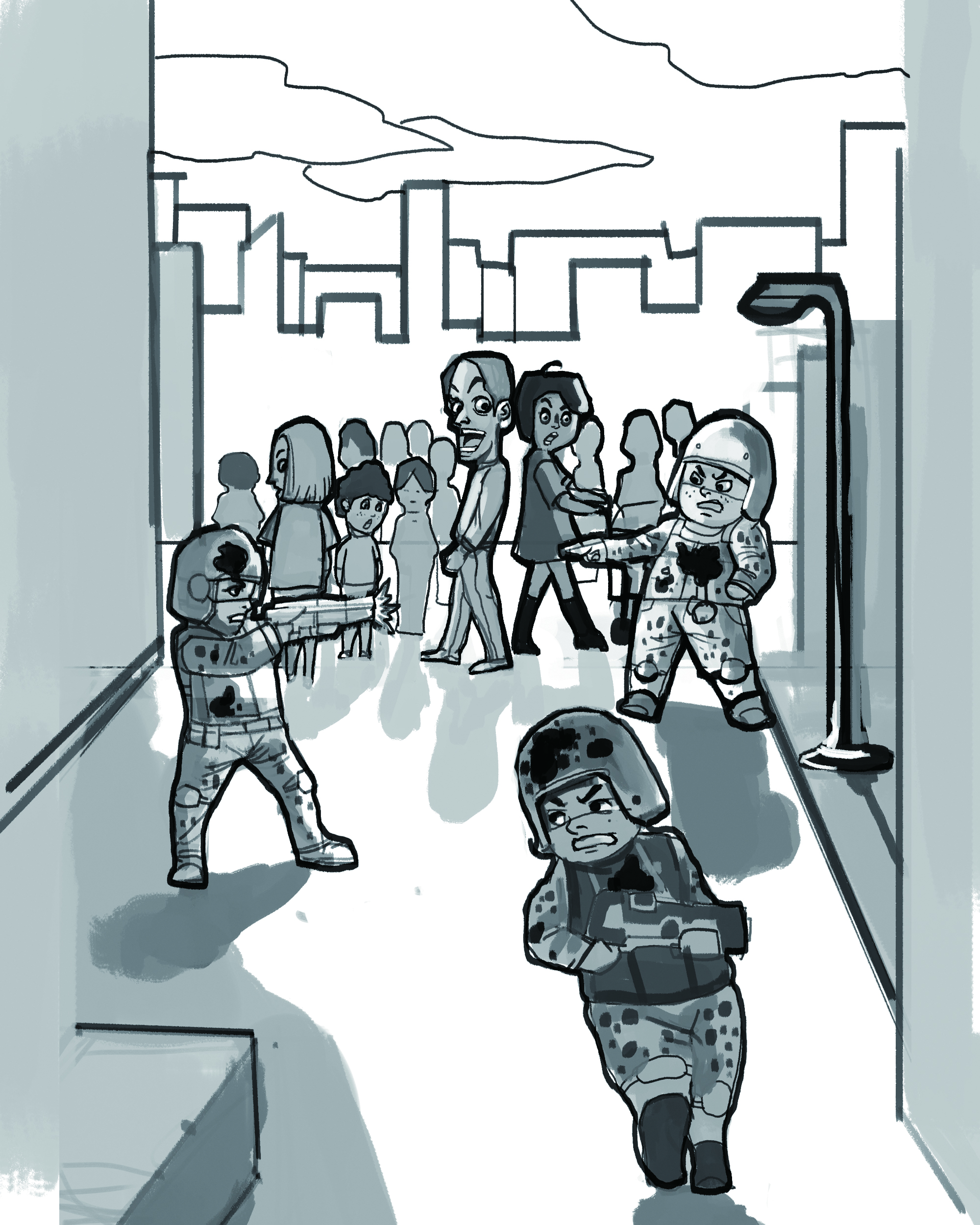
VANCOUVER — Police were called to a home in east Vancouver today after receiving several calls from nearby residents who described a “massive gunfight” that erupted on their block.

According to eyewitness testimonies, the situation was the result of a “Flash Paintball” event organized by local teens, Jason Edmunds and Erik Chen. To their surprise, the plan for a spontaneous paintball battle intended to take onlookers by surprise created more extreme panic than most hit viral videos.

“We just wanted to do, you know, like one of those videos where you see a bunch of people just doing normal stuff and then everybody just starts dancing and everybody’s like, ‘Wooooah!’ But, with paintball” explained a handcuffed Edmunds, after the event.

He explained that it was their friend Carl Smithers’ birthday and since he really likes paintball, the idea came naturally to them. They invited all their friends over, rented more than two dozen paintball guns and waited in Smithers’ driveway after school.

Edmunds said upon Smithers’ arrival home, he was shocked to see so many people sitting in his driveway, apparently just to talk, listen to music and eat sandwiches.

“He seemed excited,” Chen told The Peak recalling that Smithers stated “awww, did you guys throw me a surprise party? I’ve always wanted a surprise party,” seconds before everyone drew paintball guns and began firing at each other.

It was at this point that onlookers say Smithers’ collapsed into a terrified heap on the ground as his friends stampeded around him yelling and shooting paintballs at each other. “They just started shooting,” recalled a shaken Smithers. “No one even gave me a mask or anything, I just had to lie face down on the ground with my hands over my eyes.”

It was only when Edmunds and Chen heard the police sirens that they say it dawned on them that their idea might have been a little inappropriate. When police arrived on the scene they were greeted by what sounded like automatic gunfire and promptly called for backup which soon surrounded the entire neighbourhood.

It wasn’t until they had an entire S.W.A.T team encircling the house and a helicopter overhead that police say they realized it was just a bunch of dumb kids with paintball guns and delayed to open fire.

Edmunds and Chen were charged with disturbing the peace, fined $500 and tasked with cleaning up the now paint soaked neighborhood. Smithers left the scene unscathed except for a few bruises, and a new deep-seated phobia of driveways.

“Carl needs to loosen up, we were just trying to do something really different for his birthday, something that he’d remember,” Edmunds told The Peak, disappointed by his friend’s luke-warm reaction to their surprise, “I mean it wasn’t even that big a deal, we just broke like three windows.”

Smithers isn’t the only one who is less than thrilled about the entire affair. Local resident, Gill McCauley, was stunned upon hearing the news calling the event “truly shocking.”

“The whole incident really shed light on a far greater issue that has been plaguing North America for years . . . kids aren’t allowed to have fun anymore,” McCauley said shaking his head at ‘adults these days’. “I remember when kids all used to play freely in the streets and now they aren’t even allowed to tear up Mrs. Smithers’ flower garden, shower every house within a two block radius in paint and terrify the entire neighborhood . . . what is the world coming to?”

McCauley concluded his statement by saying that, “it was just a crazy day that almost ended in tragedy” but he remained adamant that “it was just a bit of fun” and also agreed that Carl really does need to loosen up.

Ballet: Fumbling Towards Ecstasy

0

fumbling_towards_ecstacy

Presenting Les Grands Ballets Canadiens with their version of Sleeping Beauty, preparing for a four-city BC tour, and dealing with some injuries in the company, it’s no surprise Alberta Ballet’s artistic director, Jean Grand-Maître, had a busy week. We finally managed to connect to talk about the ballet’s new Sarah McLachlan ballet, Fumbling Towards Ecstasy, playing at the Queen Elizabeth Theatre Nov. 14  to 16.

Following their highly successful ballets profiling Joni Mitchell and Elton John, Alberta Ballet has created a ballet inspired by the life and music of Sarah McLachlan. For each of these ballets, Grand-Maître has met with the artist to get a sense of their artistic vision and see what direction and form the ballet might take. “I meet with the singers when they agree to have us do a portrait ballet. I meet with them and talk for a couple of hours.”

These ballets are great for bringing in new audiences and Grand-Maître said that there has been “a wonderful cross-pollination” of dance lovers discovering the music and music lovers discovering the dance.

McLachlan became involved after Grand-Maître choreographed the dance to her song at the 2010 Olympic opening ceremonies. She had also seen the Joni Mitchell ballet and, Grand-Maître recalls, “She said she’d be honoured, and I went to see her in North Vancouver.”

They talked for a couple of hours about life, art, and her journey as an artist. “We really work hard to try to capture the essence of the artist and create a truthful portrait. That’s why the initial conversations are so important,” said Grand-Maître.

Grand-Maître and McLachlan talked about her inspirations, and what each song meant to her. “She is very inspired by the elements . . . she loves exotic cultures, and loves the ocean,” he said. Many of the costumes and sets in the show were inspired by this love of water and the elements, as are the video projections that serve as a backdrop for the show. McLachlan’s ink drawings were also used in the projections.

They also discussed the ethos of women. “They have more choice now and have to find a balance between life and work,” explained Grand-Maître, “I talked to a lot of women I know . . . and the themes of love, betrayal, loss, and death came up a lot.”

This is how the idea to do a psychological portrait of a woman came about, and the ballet became a profile of a woman’s life. There are also metaphors of empowering women and sisterhood in the ballet, which came up a lot in Grand-Maître and McLachlan’s conversations.

McLachlan came to visit the studio often during rehearsals and Grand-Maître says that she was in tears when she saw what they had created. He describes her music as “a balm on pain and suffering” and clearly respects her, saying she is “an extraordinary artist” and an extremely generous person whose career has “survived decades.”

Fumbling Towards Ecstasy is one of McLachlan’s most famous albums, celebrating its 20th anniversary this year, but the title was chosen because, as Grand-Maître explained, “it describes my choreographic style.” He said his choreography is about trying to move from a contraction or a struggle to graceful movement, and sometimes it’s a struggle to find grace.

The songs in the show span McLachlan’s entire career. “I had the opportunity to study her catalogue, and some of my favourite recordings are live versions — some that have never been heard before,” said Grand-Maître.

Looking ahead, he is thinking about which artist they may profile next. “It’s amazing how many Canadians I’d love to work with.” Leonard Cohen and Peter Gabriel are at the top of his list. “I have a chance to meet Peter after Christmas, so I’m excited about that.”

Rapper rumoured to have penned new album in which he discusses his superior merits

0

NEW YORK — Exciting news emerged last weekend as an iMessage leak revealed information on the subject matter of a popular gangsta-rapper’s not-yet-released album. According to sources at The Peak, the new songs carefully describe ways in which the artist is superior to his rivals.

Early reports have also mentioned that the police and the recording industry may also have been said to be deficient in a comparative standing to the artist.

While the news of the braggadocio has been confirmed, the exact qualities the artist will boast about are still in question. Over half of the boastings are rumoured to be related to the confidence the rapper has in his superior ability to rap.

Beyond this, many are speculating that the qualities could be as wide-ranging as his extraordinary accumulation of wealth to how many women were interested in participating in sexual intercourse with him. Experts say the song’s title, [sic] ‘paPUh FLOodd’ is an allusion to the numerous banknotes that the artist has in his possession.

The sexual exploits of the rapper have drawn the most interest from those anticipating the release. An excited fan told The Peak “Well, in one of his last albums we found out that ‘[his] bitch sucked [his] dick on [his] fucking private jet’*, so it’ll be fascinating to get an update on their lifestyle.”

The fan also elaborated on the possible evolution of the rapper’s motifs. Speculating that it is very likely the artist will bring some incredibly groundbreaking improvements to the industry. “That’s this guy’s thing, man, he changes the whole game up — every, single, time.“

He concluded by posturing that the artist may mention which kind of private jet he receives fellatio on, as well as the altitude of the plane or planes on which said fellatio occurred.

When reached for a comment, the rapper only responded with the message ‘4eva’ which was sent to the press in the form of a diamond-encrusted, four-finger ring.

Untold Stories

0

raped man

Who perpetrates sexual assault?

The common archetypal images are of men with greasy moustaches and trenchcoats, waiting to physically overpower their female victims into submission. As for victims, men can’t get raped because they’re too strong to get physically subdued. That’s just science, right?

This logic builds upon the presumed premise that one must be raped by a member of the opposite sex, and that rape can only happen through physical force — neither of which are true. In reality, the majority of sexual offences are intra-familial, or perpetrated by acquaintances, friends, or partners. In these cases, the perpetrator rarely physically overpowers the victim; they’re more likely to rely on coercion or manipulation, using emotions or verbal threats as weapons.

Sexual assault can happen to anyone. It can happen within relationships, amongst acquaintances, or at the hands of a stranger. It can include any range of non-consensual sexual behavior. Really, the only link is that those who experience it are left filled with shame, and suffer a string of consequences — physical, psychological, emotional. If we cannot pinpoint one scenario or one type of perpetrator, then how can we have a clear idea of what a victim looks like?

I recently started watching Mad Men, thinking it would be filled with so much misogyny and gender stereotypes of the time period that I wouldn’t be able to get past the first season. Spoiler alert: I just finished the sixth season and it is revealed that Don Draper, the stoic, hard-drinking, womanizing protagonist, was raped as a boy. Only it’s not said in so many words: it’s presented as an older woman — a prostitute — taking his virginity against his will.

He grows up to have a drinking problem, an inability to commit to one woman (despite being married twice), and a habit of never sharing his feelings or weaknesses. Yet he is successful in business and pleasure, and is seen as mysterious and suave; women want him, and men want to be him.

Sure, it can be argued that it was a different time. It can also be argued that this is fiction. Yet, the Center for Disease Control’s National Intimate Partner and Sexual Violence Survey in 2010 reported that the rate of male victims of sexual assault was much higher than expected — something that’s been corroborated by many similar studies. One study found that 44 per cent of college men in their sample reported being subjected to a sexually coercive tactic, while another reported similar numbers of 43 per cent of college men reporting being a victim of a coercive incident.

In the United States, 10 per cent of reported victims of sexual assault are males.

Now, these numbers are only representative of one small aspect of sexual abuse, and the numbers reported by women are still much higher. Nonetheless, these statistics are shockingly high for an issue where men are solely seen as perpetrators, and never victims.

Not only that, but male victimization is grossly underreported because, simply put, our society does not take male sexual assault seriously. I have heard too many people argue that rape is exclusively a women’s issue or that men can’t be raped, and I have seen too many men refuse to show that they’re hurting simply because they’re “being men.”

Every so often, male survivors of sexual victimization speak out, and the stories are as diverse and complex as the issue of rape itself: some were victimized as children, some for their chosen gender or sexuality, some at the hands of partners (both male and female). According to the Texas Association Against Sexual Assault, 10 per cent of reported victims are males.

Our society maintains an outdated and heteronormative view of sexuality, which is partly where this idea stems from. If, as society dictates, women are coyer and have sex only to please their men, and all men want sex all the time, and people only have sex with the opposite gender, then it would logically follow that only men can perpetrate rape upon women. Given that none of these are facts, it’s insulting to all genders and sexual practices that this is the inherent assumption.

With all this as a framework, there’s no surprise that this is the same society that minimizes the impact that non-consensual sex has on males. There’s a belief that men always want sex, that it’s only a matter of collecting the largest number of (female) partners, and that it’s just part of being a man — whatever that even means.

If there is anything we can take from the recent pro-rape FROSH chants, it’s that all of us — especially boys and men — are in dire need of education. One must wonder whether the enigmatic “Bro Code,” the Holy Bible for misogynists that commands “bros before hos,” has a subsection that deals with a bro getting raped. I’d imagine the answer is no, that this isn’t seen as something that men should talk about — though I’m hardly a Bro Code scholar.

We need to educate boys and men so that they stop perpetuating rape culture and start spreading respect and mindfulness of the impact of their words and actions. But we also need to educate them so that they are not afraid to step forward when they are the ones victimized. Rape culture is not a joke, and it shouldn’t be treated as such by anybody. It is constantly being perpetrated in media, in everyday actions and jokes and on our university campuses. The only way that we can hope that our children will live in a better world is if we are ready to be allies and to hear each other’s stories — regardless of gender.