Home Blog Page 915

Boohoo, Woohoo

0

Boohoo: Netflix and Chill

Is it just me or is this phrase simply everywhere? I log in to Facebook. Netflix and chill. I open chat messages. Netflix and chill. I even search through the news. Netflix and . . . oh, for god’s sake!

How many times must my eyes be stabbed with this ridiculous phrase describing something we clearly don’t have the guts to actually say? These trending words have run long past their course, and they must now be left to shrivel and die. The trend has even gone so far as to be haphazardly spray-painted on the corporate sign at Netflix’s official headquarters. Though, I’ll admit I did see that one coming.

But what bothers me most is that the smug little brats of our generation think we’re geniuses for ‘inventing’ a saying that describes something people have actually been doing since the television was invented. “Hey baby, wanna come back to my place to watch Netflix and chill?” Please. Is it really too rude to just say, “let’s have sex on the couch with a movie in the background, just like my parents probably did to conceive me?”

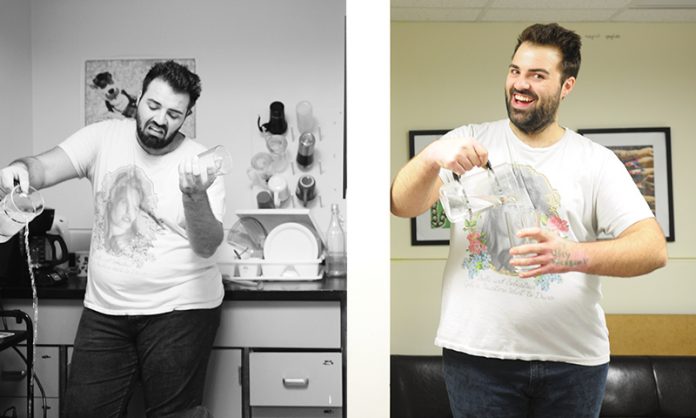
Woohoo: Netflix and Dill

Yesterday, I made a trip to the grocery store. Amongst the abundance of fruits and vegetables I did not buy was an incredibly rare jar of dill pickles. What can I say? Deep down throbbed an unbearable longing I’d harboured for far too long.

Upon stumbling home in the heat of passion, I flung off my shoes, hastily dropped my shopping list to the floor, and threw myself upon the couch. Panting and sweaty, I caressed the remote control in one hand, and my beautiful jar of pickles in the other. I then popped the tin lid and searched up The X-Files, season two.

That night I made sweet love to my pickle jar while Scully complained in the background that aliens don’t exist. At least, I think that’s what happened. As I blissfully crunched and munched, I think I recall Mulder being abducted by a UFO. Or maybe it was the cops; I can’t quite remember.

Being caught up in the ecstasy of Netflix and dill was a pleasure like no other. After polishing off the jar, I exhaled with relief and made a mental note to book a future date with my pickles. Swelling with pride, I had become a man.

So, speaking from experience, if you’re squirming to scratch that itch for pickles, I recommend you relieve yourself by popping open some dill and flipping on the TV. It’ll be a wondrous night filled with excessive dopamine.

“Undoing Stigma” at the Gay Men’s Health Summit

0
The summit drew many young people and had a large focus on gay and bisexual youth issues. - Photo by Jessica Whitesel

The 11th Gay Men’s Health Summit welcomed guests to learn about how sexual minorities cope with stigma. The theme of the event, which washosted at SFU’s Harbour Centre campus, was “Undoing Stigma.”

Over two days, the summit hosted numerous panels, workshops, and keynotes that addressed issues specific to the gay, bisexual, trans, and queer men’s community and their health, which encompassed mental, social, and physical health.

Each part of the program provided insight into how the health of LGBTQ+ men faces three different kinds of stigma: personal, which is psychological; interpersonal, which encompasses micro aggressions and hate crimes; and structural, which is created by broad social norms at the societal level.

One initiative that was presented was Totally Outright, which was created to reduce stigma and create strong youth leaders within the community. The goal of Totally Outright is to educate “young guys who like guys” in all aspects of gay men’s health.

There was a panel discussion that focused both on issues pertaining especially to young gay men, as well as initiatives launched as a result of Totally Outright. One such initiative is “Think Before You Type,” which addresses sexualized racism common in dating apps such as Grindr.

Panelist Vincent Francoeur spoke of the creation of a space for young gay men as a possible initiative: “a place that would be sexy and cool enough to attract all the guys, not just the ones who are living through difficult time. A place that would put education and communication at the top list of its priorities. A place where there [is] no judgement, and that is inclusive.”

The Resist Stigma project, which will launch towards the end of the year,  focuses on “[engaging] gay, bi, queer, and trans men from all across the country to work towards resilience, community, and empowerment — a challenge for many queer guys,” according to Francoeur.

“We’re creating space and conversation about race, colonialism, sexuality, health, and bodies — topics that a lot of queer guys might not feel safe to talk about,” said Brent Saccucci, Education & Research Coordinator for the Gender-Based Violence Prevention Project started by the University of Alberta Students’ Union, on the Resist Stigma project.

The summit also featured the work of numerous SFU-affiliated researchers, such as Ben Klassen and Patrick Aubert. Klassen’s research focused on the effect that Angles — a Vancouver based gay men’s publication — had during the height of the AIDS epidemic in the 1980s in reducing the stigma surrounding people who were HIV positive or living with AIDS.

Aubert’s research focused on end-of-life planning for older gay men, and the negative effects of stigma on their lives. For these men, stigma could represent health care providers neglecting the importance of their partners, or lacking strong familial connections.

Throughout the summit, it became clear that speaking out and sharing your own story — as well as listening to others’ — is a key step they wanted to share for reducing stigma. Sizwe Inkingni, committee member on the Resist Stigma, remarked, “Our stories have power.”

Why you should think twice about porn use

0
Too much porn can hurt your sex life!

In light of Playboy announcing its transition to non-nude imagery, I feel like we should talk about porn use leading to brain damage. Stick with me for a second. There is logic behind this, and I’m not the one with brain damage.

I’m also not writing this to argue the evils of porn (composed of high STI rates and sexual abuse on-set, among other injustices inflicted upon porn actors), but rather about how it damages its users. No joke. This is a practical argument for thinking twice about porn use.

Given that 40 million people in America regularly watch porn, with two thirds being men, we should be aware of the effects it has on us.

Let’s start with understanding addiction as a concept. Drug use overtime leads to higher tolerance of the substance, requiring more to get ‘high’ or even to function normally. Specifically, drugs overload the brain with the pleasure chemical dopamine, and the brain adapts by mitigating the ability to enjoy dopamine.

As tolerance develops, control over drug use degrades and the brain’s neural pathways overwrite previous pleasure pathways. The brain starts changing, addiction forms, and other formerly pleasurable activities become benign.

Changes in the brain occur because of neuroplasticity, the brain’s way of adapting. This adaptation can be taken too far, which can lead to great damage to the brain. For some, healing may take years.

JAMA Psychiatry found that increased porn viewing correlated with less gray matter in the striatum, and a worse connection between this are and the prefontal cortex.

Now, I know what you’re thinking: “But Jean-luc, porn is not a drug.” And while this may be true, porn does have the dopamine-flooding effect of a drug. It’s not a drug, but it can most definitely become an addiction.

If you’re not convinced, then I encourage you to look up scans of a porn-addicted brain compared to a drug-addicted one; you’ll sadly see the same type of brain patterns. And we haven’t even talked about the real-life consequences.

The website High Existence states that as you look at increasing amounts of porn, you rewire your brain to find pleasure in an image on-screen, and not with a living human. Real-life attractive people can lose their luster, or become valued just for their image. The pleasure of real sex and beauty can diminish.

Studies suggest that the increased rate of erectile dysfunction amongst men under 40 is in part because of porn. Guys, if you need to pop pills to sleep with the attractive person next door, you might want to double check your porn intake.

Don’t think it’s a problem for you personally? Maybe it is, maybe it isn’t, but one other statistic should caution those thinking about marriage at some point in life: Psychology Today reports that porn use is cited in 56 per cent of divorce cases. Just some food for thought.

Pulling these facts together, as more of us obtain access to the Internet with time, it seems like we may be heading toward a society rife with greater divorce rates and poorer sex. If guys can’t get aroused or if real-life people aren’t as attractive, overall sexual satisfaction will diminish. I know of one man who can’t sleep with his wife without a porn mag on the pillow. Do we want more instances like this?

Bottom line is that porn isn’t as safe as many think it is. It might be fun, it might be enthralling, but is it safe? I’m doubtful.

I’m only asking you to think twice about porn. Isn’t that worth avoiding a shrinking brain?

SFU prof studies ghost hunters

0
Professor Kingsbury’s project will take place over four years with the help of two graduate students. - Photo courtesy of Canadian Press

“I’m interested in [. . .] the sincerity and the intensity that [of]people who have encountered paranormal phenomena,” said Paul Kingsbury, a geography professor at SFU.

Kingsbury has accepted a grant for $183,000 to conduct research over the next four years that will focus on those who seek out the paranormal. This includes ghost hunters, UFO hunters, and others who seek out cryptids, mythical animals that have not been proven to exist, such as Sasquatch or the Ogopogo.

Two SFU graduate students, Noel Hawkins and Hilda Fernandez, will be helping Kingsbury on the project, with 82 per cent of the grant going towards training them in the field and giving them the opportunity to co-author articles with the professor.

The grant Kingsbury was awarded is called “Situating the growth of paranormal investigation cultures: a critical study of the lived spaces of the organizations and conferences.” He believes the grant is the result of a “trend which many scholars have noticed in the growth of interest of people spending more time, energy, and money on [paranormal] investigations.”

Kingsbury noted that these shows have taken off with television networks such as the History Channel, Space, and National Geographic, picking up shows about aliens, UFOs, Bigfoot, and other paranormal topics.

He added that the West has been seeing the rise of the “esoteric economy,” wherein more people are commodifying the supernatural or the spiritual. “You can go out and buy healing crystals at trades fairs or spiritual events, tarot palm reading, so there’s been an economic shift in the past decade as well,” he said.

Kingsbury’s research will focus on the investigation aspect. Studies show that there were 250 ghost hunter groups in the UK about a decade ago, and now there are 2,500. He says the trend in North America is similar. Although most research regarding ghosts has been in the fine arts and liberal arts, Kingsbury notes that there hasn’t been much work done in the “lived” experience of ghost hunting.

His research will include studying how knowledge is shared amongst investigators, how they represent their knowledge, and the disputes that may arise in conferences. Having already attended the The Mutual UFO Network Symposium (organized by the world’s largest UFO organization) in California, and interviewing two local paranormal investigation groups, Kingsbury already has a bit of an idea of how his research will be conducted. He has immersed himself in the culture to see how ghost hunters conduct their own research first-hand.

“In the focus group interviews we were surprised to learn that none of the groups charge their clients for their services.

“In fact, it’s considered a taboo or uncool if you’re charging for paranormal investigation services,” said Kingsbury.

“Another thing with that is many of these people that spend quite a lot of their spare time doing these investigations noted that a big point is to bring peace of mind, [and] to bring closure for clients.”

Kingsbury says both of his parents have had ghostly experiences, and that he has been open-minded about whether they exist or don’t exist. However, he isn’t sure if this knowledge early in his life is what piqued his interest for this area of research.

“I’ve always liked sci-fi movies and I have, in my order, anxiety about aliens,” Kingsbury laughs, citing the Japanese horror film Ringu as an example, “So I guess that is [a] pre-disposition for the possibilities of the world. I’ll put it that way.”

SFU to offer select courses in Whistler this Spring

0
Come for the courses, stay for the slopes.

Students will be hitting the slopes and hitting the books next semester.

SFU has launched a pilot project in collaboration with a non-profit organization, the Whistler Education Group, in Whistler to offer five different SFU courses up in the small mountain village for Spring 2016.

Courses will be offered in one-day, two-day, and semester-long formats, ranging from social media strategy for businesses, to brewing delicious beers.

The day-long courses, or “boot camps,” tackle some more specific social media and digital skills. These include BOOT 520: Social Media for Small Business, BOOT 555: How to Optimize your LinkedIn for Business, and BOOT 715: Visual Leadership: Building Ownership Using Visuals.

The single two-day course offered is VIVA 201: Visual Analytics Workshop: From Theory to Practice. For those wanting a longer stint in the village, BREW 110: Introduction to Brewing will be regularly scheduled all week for the duration of the semester.

All classes are expected to have a capacity of 25 students.

The Whistler Education Group first approached the university about a year ago to pitch the idea of hosting courses in Whistler. Through conversations with the office of the VP Academic and SFU’s Lifelong Learning department, the group has entered into an official partnership with SFU as well as BCIT to make Whistler a destination for post-secondary education.

SFU’s Lifelong Learning office oversees departments such as Continuing Studies, SFU NOW, and the Centre for Online and Distance Education.

Larry White, director of career and professional programs for SFU Lifelong Learning, explained that these classes are meant to draw students to Whistler “to engage in a learning opportunity that could potentially be connected to an adventure activity,” as well as provide educational opportunities for locals.

“Think in terms of attracting someone to Whistler for BREW 110, that might be scheduled Tuesday to Friday, and someone staying the weekend for a mountain adventure experience, or using the weeknights for that experience,” White suggested.

All courses will be hosted by the soon-to-be launched Whistler Learning Centre. Stephen Milstein, head of the Whistler Education Group, expressed that ‘educational tourism’ is a booming market — one that the group is looking to break into. “Continuing studies is a money-maker,” said Milstein.

The courses will be held in various spaces around Whistler, like the Spruce Grove Field House, or in hotel conference rooms. Milstein explained, “We plan to use existing spaces, indoor and outdoor, as classrooms and learning spaces.”

“[SFU is] very excited about this partnership and about the prospect of bringing our programs to people in their own community,” said White. “We are excited about the concept of helping to support local economic development through increasing tourism as a result of offering our courses and programs.”

He also expressed the hope that the pilot project will be successful enough to continue on beyond next semester, and that SFU remains Whistler’s “education service provider of choice.”

SFU Lifelong Learning sees the project as beneficial for all involved. The courses are meant to attract more visitors to Whistler, improving tourism in non-peak seasons, and to expand SFU’s educational offerings into a new market.

As White put it, the partnership “creates a win-win-win situation for learners, for Whistler businesses, and for SFU.”

Milstein remarked, “All of a sudden, on a rainy day, there’s lots to do in Whistler.”

Keep porn in prison

0

Why are we so obsessed with dehumanizing our inmates in prison if we expect them to come out of prison as changed people?     

As reported by CBC earlier this year, former inmate Haris Naraine and a group of inmates pooled their money together in 2013 to buy a late night, adults-only cable subscription package for the television in Quebec’s Archambault Prison.

However, those channels quickly disappeared when they were taken away by Correctional Services Canada, who requested that all prisons in the country ban X-rated television content. Naraine complained, and became embroiled in a legal battle against the removal of his porn. After seeing the case go all the way to the federal court, a judge ruled in Naraine’s favour and brought back the entertainment.

It was just last month that Quebec’s Public Safety Minister Lise Theriault found out about the case, and she is now on a dedicated mission to install parental controls in prison so that no one will be able to watch porn in prison again.

Now that you’re all caught up, you’ll understand my original question.

Yes, those in prison have made some wrong, potentially incredibly harmful decisions in their lives, and prisons are designed to restrict their freedoms as a punishment for their actions.

However, at some point, many of them are expected to be released. If they show signs of progress, they can even be released early while on parole. It’s a meritocracy based on whether or not a prisoner is deemed able enough to function in society without posing the same risk they did before.

But they won’t get there if we take away all their freedoms and treat them like animals. Porn is one of those freedoms, like it or not.

Prisoners are going to have sexual needs and desires. If they are provided a safe outlet for those needs, it can remind them of what they are trying to get back to on the ‘outside.’ Porn is only going to do so much for them, after all.

On top of that, access to porn could potentially help decrease the amount of sexual assault that occurs in prisons; maybe it would help relieve some sexual tension that leads to these assaults. Canadian prisons have become an increasingly dangerous place for those on the inside, with instances of assault, sexual assault, and suicide attempts having risen dramatically between 2004 and 2012.

Inmates are already locked away from the life they’d presumably rather be living, and are subjected to some incredibly depressing conditions which, because they’ve made mistakes in their lives, seem to suggest they are no longer worthy of being ‘human’ and instead exist as a sub-tier.

Case in point: Saginaw County Jail recently changed their uniforms because they were too similar to those on Orange is the New Black. The sheriff was worried the show made the orange jumpsuits too fashionable, and reverted back to black-and-white stripes to reinforce that they were prisoners above everything else.

Yes, some people will be bothered that prisoners want porn. A lot of people get revolted by the thought of porn, and want it banned outright. But if you would fight for your right to porn, you should also be fighting for porn for inmates as well.

After all, they’re people too.

Why Canada is not the world’s most tolerant country

0

Recently, the Legatum Institute in London published the Prosperity Index ranking the world’s top countries within psychosocial categories. Of these, Canada topped the list as most tolerant toward minorities.

As interesting as the attempt to quantify factors like tolerance may be, I am skeptical of how realistic such measures are. I tend to think that these studies only sugarcoat uncomfortable truths within Western societies and further facilitate a passive attitude towards the issues of oppression that still plague them. In an attempt to uphold the validity of statistics like these, people trick themselves into thinking there isn’t a problem.

The Legatum study mentioned that “92 per cent of polled Canadians [say] Canada is a good place for immigrants.” My question is: Were immigrants asked if Canada is a good place for immigrants? How does such a study account for what is “good” across the masses of immigrant cultures, by asking only certified Canadians?

As a Canadian, wouldn’t it be your duty to paint your country in the most positive light when a poll is conducted?

In addition to this, I have always had a problem with the rhetoric of tolerance. This is due to its propagation of a highly disingenuous and superficial kind of human interaction. People need to work more towards true understanding, rather than to simply tolerate one another.

Precedence is given to the interests of those seeking to undermine the struggles of the oppressed.

Globally, however, researchers and authorities somehow spun tolerance into a badge of honor, especially for Western countries boasting about their open-mindedness.

In an article I wrote earlier this year called “Racism is still a prominent issue in Vancouver,” I aimed to outline that Vancouver and even Canada itself is not exempt from prejudice just because numerous immigrants live here and it is not because a biased study from some institute says so. Microaggression still often rears its ugly head from my experiences here, but due to the subtlety of prejudice in Canada, the country is still often awarded the sought-after ‘tolerance’ label. This strikes me as dishonest.

This is not to say that Canada is a totally racist and bigoted country, because that too would be dishonest. My issue is that precedence is given to a narrative that serves the interests of those seeking to undermine the struggles of the oppressed.

We must acknowledge that just because people are not openly hurling insults at one another left and right, this does not mean that all Canadians are tolerant and accepting. Silence should be just as scary as excessive noise.

What is to be said of the legions of oppressed Indigenous communities all across Canada? Are we to ignore that Canada still has major skeletons in its closet because an arbitrary Index says it is tolerant? I think not.

The Legatum Institute paints a rosy picture that feeds into a preexisting narrative of Canada as a safe haven for minorities, without considering how much effort this take to cover up.

To tolerate something means you keep your mouth shut even if you are uncomfortable or hate the idea that it exists. When it comes to dealing with one another as humans, we ought to seek a deeper and more positive connection than that.

There needs to be a change in the ways well-being is measured. Tolerance can’t be measured in the way that this index tries to.

Nobody can actually ‘quit’ social media

0
Let's be honest, you'll be crawling back soon enough.

Last week’s trending article on CBC featured Essena O’Neill, an Instagram celebrity and model who received widespread praise for her “revolutionary” decision to throw away her Instagram account and say no to the shallow world of social media. This is where I sarcastically slow clap this young lady in mock enthusiasm for her obviously painstaking martyrdom.

Ironically, O’Neill has now gained more popularity on social media than ever. Her countless pictures are not just confined to being plastered on her personal Instagram account, they are now being exponentially blown up in countless news articles, Twitter and Facebook feeds, and all other forms of social media; all full of people discussing her ‘bravery.’

This just goes to show that you simply cannot quit social media. Nobody can. That is, unless you want to be an anachronism, completely irrelevant to our time.

‘Quitting’ social media may feel like a rebellious act, and maybe even an anti-capitalist one. We love to be as critical of social media as we are of capitalism. We argue that it shamelessly reduces the amount of physical contact we have with others; it monitors us, collects our data, and becomes an addiction. We may fundamentally detest it, but it is so ingrained in our everyday life that to effectively withdraw from it is nearly impossible.

Those who try to ‘quit’ social media are usually trying to make a statement by announcing to the world that they are rebelling against the machine. It is clear in the case of Essena O’Neill that ‘quitting’ social media has only further solidified her presence within it. It’s oxymoronic enough to make anyone roll their eyes. And let’s be real, when you leave, you’ll be back.

If you truly quit social media, you only hurt yourself.

Some may argue that they get along just fine without having any social media accounts. However, removing yourself from Facebook and Twitter nowadays is the equivalent of excommunicating yourself from the church in the 18th century. You will no longer be in the center of our community’s news, ideas, information, networking, and relationships with others, personal and professional. The cost of opting out is simply too high. You will only be leveling yourself to an obvious disadvantage, putting yourself below the threshold of today’s advancing society. You’re effectively putting yourself out of the game!

Although it’s good to challenge the social media system, as we find that it sometimes dominates our world a little too much, it is naive to think we can completely detach ourselves from it. Our obsession with technological advances has us eagerly imagining where we will be in the not-so-distant future, and I can promise you that social media will only become more prevalent, whether you try to escape it or not.

Canada isn’t ready for a borderless Commonwealth

0
Canada isn't ready for free movement between the Commonwealth countries.

Applying for a student visa is one of most godawful things I’ve ever done. The process is so bogged down by bureaucracy it’s a miracle anyone ever gets to study abroad. And after my exchange to France, my own personal horror story initially attracted me to James Skinner’s advocacy for free movement between Canada, the United Kingdom, Australia, and New Zealand.

But I just can’t get behind this movement — at least not yet.

At first I was enthralled by Skinner’s proposal. Who wouldn’t be? The idea of free movement between the four countries is particularly attractive to young students. It would let us work, study, or immigrate to foreign lands without constraints. The Commonwealth Freedom of Movement Organization’s (CFMO) website details economic, personal, health, and criminal conditions that make it seem that this plan would be foolproof — but the truth is that the CFMO seems to have a short-sighted, underdeveloped idea that, if implemented as is, might fail the countries involved.

While the stated degree of integration between the countries involved is unclear in the CFMO’s proposal, a further investigation led me to unveil another major problem: colonisation. All of these countries were either colonised by the same empire, or in the case of the United Kingdom, were the country responsible for the colonising.

This left a pretty sour taste in my mouth. We should be focusing our efforts of decolonisation rather than strengthening our colonial ties. Basing a freedom of mobility initiative around a common oppressor is a murky political and ethical area to say the least. So while free mobility sounds great, we may only end up reinforcing a shared but shameful part of our nation’s past.

We may only end up reinforcing a shared, but shameful part of our nation’s past.

I then perused the website to see how they justified selecting only four of the 53 members of the Commonwealth to participate in such an endeavor. Their reasons seemed to focus heavily on a shared language, similar interpretations of the rule of law, and of course, these were the countries in the Commonwealth with ‘strong economies.’

While not stating it outright, they were suggesting that these countries were chosen because they are English-speaking nations whose populations are predominately Caucasian, and who are wealthy. To me, this sounds like prejudice. No matter which way you spin it, other Commonwealth countries such as India and South Africa are getting shafted by such an agreement.

I love the idea of simplifying long and short-term visas between Commonwealth countries. And I wish more people could have the experience of working, living, and studying abroad. But the fact of the matter is that, no matter how appealing the current initiative is, it fails to clearly outline the degree of integration, it uses colonial history to claim a ‘like-minded culture,’ and it discriminates against countries where the dominant ethnic group isn’t white.

I’m not suggesting we say no to a borderless Commonwealth in the future, but the CFMO’s plan, as it stands now, just isn’t ready to be implemented.

Stem cell isolation could help fight tonsil cancer

0
The tonsils trap germs that are breathed in. - Illustration by Zach Chan

A recently discovered method of distinguishing between stem cells and normal cells in one’s tonsils could be key in the fight against tonsil cancer.

Conducted by SFU researchers in conjunction with British Columbia Cancer Agency, the study was published last month in the journal Stem Cell Reports.

Lead author of the study is SFU student Catherine Kang, a PhD student in the Department of Biomedical Physiology and Kinesiology. She said that stem cell markers have been previously discovered in many types of tissue, but until now there was nothing known about tonsil stem cells.

“The reason why we were interested in finding a way to isolate stem cells from the tonsils was because of the rising incidence of tonsil cancer worldwide,” said Kang.

“What is interesting about tonsil cancer is that 90 per cent of tonsil cancers show the sign of human papillomavirus [HPV] infection.”

She elaborated that, since HPV tends to enter into stem cells to spread its cancer-causing genes, the researchers were curious if the increasing incidence of tonsil cancer might have something to do with the stem cells of the tonsil tissues.

It may be too early in the research to help out those who currently are diagnosed with HPV, but the results are promising in regards to eventually understanding HPV-positive tonsil cancer.

Now that researchers are able to further investigate the disease using the new stem cell isolation technique, they can develop and build upon their existing findings. They hope this can translate into improved patient care.

Before that can happen, more work has to be done to understand how exactly HPV causes this abnormality in the tonsil stem cells. Kang said that it would also be important to determine how HPV-associated cancer in the tonsil progresses from the early stages immediately after one is infected with the virus to later on developing into cancer.

“Since the stem cells are located deep inside the crypts of the tonsil, often covered with inflammatory cells, it has been very difficult for scientists to identify histological changes that could be used to identify individuals at early stages of the disease,” said Kang.

“We need ways of visualizing changes in situ [on site] to detect such early change.”

Kang believes these findings are an important step towards preventing tonsil cancer and providing better care for sufferers.