Home Blog Page 768

World News Beat

0

By: Benjamin Mussett and Bernice Puzon

Israel – Trump makes comments on Israeli-Palestinian conflict

President Trump broke with long-standing United States (US) policy after saying he was open to either a one-state or a two-state solution to the Israeli-Palestinian conflict. Trump’s disclosure represented a significant deviation from previous American policy which officially supported the creation of a Palestinian state. “I’m looking at two-state and one-state and I like the one that both parties like. I’m very happy with the one that both parties like,” the president said. The comments were made at a joint press conference with Israel’s president during his visit to Washington. Critics of the one-state solution argue that it is unfeasible if Israel wishes to remain both Jewish and democratic as Arab citizens will eventually outnumber their Jewish countrymen.

With files from The Guardian.

Japan – Know before you go: Japanese app will make using public washrooms easier

Tired of waiting in line for a bathroom stall? Major Japanese telecommunications company KDDI Corporation will soon release a new app that will allow its users to know how many cubicles are occupied. The app will provide this information through sensors that will activate once the doors of the stalls are closed. KDDI is planning to launch this service at office buildings first. They will then introduce the service to facilities such as stadiums, train stations, and shopping malls.

With files from The Japan Times

Ecuador – Ecuador presidential elections

Ecuador went to the polls this week to elect a new president and general assembly. Although observers suggested that the country’s government may shift to the right after a decade of socialist rule, the ruling party’s presidential candidate, Lenín Moreno, appeared close to victory. Nonetheless, Moreno was unable to reach the minimum 40% threshold needed to avoid a run-off election with his nearest competitor, Guillermo Lasso of the centre-right Creating Opportunities party. Moreno received 39.4% of votes while Lasso came in second with 28.1%. The run-off election is scheduled for April 2.  South America’s once-hopeful leftist movement now sits in jeopardy.  

With files from Reuters and The New York Times.

Australia – Health minister fast tracks imports of medical marijuana

Australian Health Minister Greg Hunt has given the green light to international providers of medicinal cannabis. These retailers will provide an interim supply of the substance until domestic production is able to meet Australia’s needs. Hunt said that within eight weeks, and possibly sooner, Australia would have a store of imported cannabis, which would allow for better access to medical marijuana products.

With files from The Guardian

Saudi Arabia – Moving towards greener energy and diversifying its economy

Saudi Arabia, long the world’s greatest exporter of oil, has chosen to diversify its economy by embracing renewable energy. As it stands, the kingdom plans to allocate between $30 billion and $50 billion for solar and wind power investment in an effort to generate nearly 10 gigawatts of sustainable energy by 2023. According to Bloomberg News, Saudi Arabia’s recent move towards greener energy is part of a larger trend amongst Middle Eastern oil-producing states hoping to “either curb their fuel imports or conserve more valuable oil that could otherwise be exported.”

With files from Bloomberg News

Philippines – Cargo ship attack results in one dead and six taken hostage

A Vietnamese cargo ship was attacked by armed pirates as it was sailing off the Philippines’ southernmost province of Tawi-Tawi. The vessel had been transporting 4,500 tons of cement from Indonesia to the Philippines. The gunmen killed a Vietnamese crewman and took six others captive, one of whom was the captain of the ship. While pursuit teams have been dispatched, the current location of the gunmen and their hostages is unknown. The Abu Sayyaf, a Muslim extremist group, was suspected to be behind previous attacks at sea in the area.

With files from The Philippine Star

North Korea – China temporarily banned the import of North Korean coal

Following North Korea’s recent missile test and the suspicious death of Kim Jong-un’s estranged half-brother, China has temporarily banned the import of North Korean coal. The Chinese ban will stay in place until the end of the year at minimum and will undoubtedly hurt the country’s already fragile economy. According to the BBC, coal is North Korea’s greatest export and China, its only ally and primary foreign coal market. In recent years, China has displayed increasing irritation with North Korea’s erratic behaviour. This week’s sanctions suggest that China will continue to struggle with their eastern neighbours.

With files from BBC News.

USA – Trump administration deportation laws get stricter

Undocumented immigrants in the US can now be arrested for infractions such as traffic violations or shoplifting. These measures were taken in order to speed up the removal process of these immigrants according to current US immigration laws. According to Trump administration memos, this will “‘prioritize’ the deportation of almost all undocumented immigrants, everywhere.”

With files from BBC News

cLab research finds a new way to connect long-distance couples

0

Long-distance relationships are about to become a lot more intimate, with the help of some new technologies coming out of SFU.

Carman Neustaedter, associate professor with the School of Interactive Art and Technology (SIAT), has been working with several graduate students at the Connections Lab (cLab) to create new technologies to connect people who are currently separated by distance. Neustaedter, along with the students he is working with, say that their research is primarily motivated by their experience of being separated from the ones they love.

“[Distance] is a universal problem,” Neustaedter told The Peak. “My family lives really far away, so this really came out of personal motivation to connect loved ones together in a better way.”

Currently, many rely on Skype or other video chatting services to allow themselves to see another person face to face. One of the technologies that the cLab has come up with is the Flex-N-Feel glove, which is a pair of gloves that allows people to experience touch, even if they are far apart. Vibrations are sent over wireless connection from the movement of the ‘flex’ glove and are then felt by the person wearing the ‘feel’ glove.

Samarth Singhal, the lead student behind the Flex-N-Feel project, echoed Neustaedter’s sentiments. Currently a Master’s student, Singhal is no stranger to separation from his loved ones. While in his native India, he worked for three years in the Indian software industry, separating him from his family. Now that he is studying in Vancouver, he is separated from his girlfriend, who currently lives in Boston.

“These gloves work to fill the void of touch,” Singhal said. “When you say something, it might not feel like very much. But when you can feel the vibrations and movements along with the words, you can feel another level of emotion.”

Beyond the Flex-N-Feel glove, which is currently in testing at the cLab, Singhal is also working on Be With Me, which he described as “the next level of Skype.” Be With Me uses virtual reality video conferencing to allow partners to see through the other person’s eyes.

“Skype is a medium of conversation, and it misses the main component of allowing couples to see what is going on. . . [Be With Me] allows the other partner to see a view of a person’s day, rather than a narrative version of it.”

Other projects that are currently being researched and worked on in the cLab include Telepresence Robots (under the research of PhD student Lillian Yang), which is a monitor strapped onto a movable robot that allows for a person to move around in the space that they are looking at. Also, My Eyes (under the research of master’s student Rui Pan), is a 360-degree camera that can be attached to a phone, allowing for video to be captured, streamed, and shared with someone else.

Regardless of what new gadget he is working on, Neustaedter considers himself to be “one small piece of a big puzzle.

“The systems that are created wouldn’t be created without the people that are currently using them,” he said. “We take knowledge from interviews that we do with people, and we work on them based on what we learned. It is a collaborative effort.”

SFU alumna, Bhavina Patel, connects the community dots across the globe

0

[dropcap]J[/dropcap]ust a month after graduating with a BA in geography, SFU alumna Bhavina Patel packed her bags and travelled to South Africa to pursue an internship in the economic development sector of the city of Durban.

She found herself in the center of progressive city planning and urban decision-making in the same province where Mahatma Gandhi began his human rights movement and Nelson Mandela began his 27-year-long prison sentence.

A couple months after she returned home and settled into a more typical post-graduate life, The Peak caught up with Patel to learn more about her adventures and future plans.

With a South Africa-shaped pendant around her neck and a smile wide enough to match her aspirations, Patel filled us in on her experiences at school, in volunteering, and with her global internship, and how she hopes to tie it all together as she embarks on her post-graduate journey.

Finding her own path

Patel started her SFU journey as a math major. As she describes it, math was something she knew she was good at, and a path that would lead her to stable jobs following graduation.

But it was an introduction to human geography course in her second term that piqued her interest. “I’m a holistic person, and just the way the course tied everything together from health to infrastructure to migration of people touched me,” she recalled.

After taking more geography electives that summer, Patel decided to make the switch from math to geography. “There’s a difference [between] being good at something and wanting to do it,” she differentiated. “I may not be as good a geographer, but I’m passionate about the realms of it.

“I don’t want to say anything cheesy like ‘geography is my calling,’ but it feels like my calling,” she laughed.

Patel pursued her passions for human geography outside the classroom as she participated in SFU’s Red Cross and UNICEF clubs, as well as the Canadian Mental Health Association. One of Patel’s most impressionable experiences was the three years she spent volunteering at the Surrey Food Bank, for which she was ultimately awarded the Mahatma Gandhi Annual Student Award for her work with the Surrey Food Bank’s Tiny Bundles family packages.

“Volunteering at the food bank was how my interest in food security started,” Patel said. She spoke about the sense of community she experienced at the food bank, how it made her feel closer to her hometown, and about the wide variety of food bank clientele she saw. She remembered a conversation she had once with the director of the food bank: “We spoke about how, ultimately, we don’t want food banks — we want people to be able to support themselves. We need to create that food security.”

Patel’s explorations, both in school and in her local community, helped her pull together a vision of what her future work might look like. “You never really know what you want to do until you do things,” she remarked. This openness, sense of adventure, and newfound passion would lead Patel halfway across the world to South Africa.

South African adventures

Patel got placed in her South African internship by the Sustainable Cities International Internship Program, a program created by collaboration between the Centre for Sustainable Development at SFU and Sustainable Cities International.  

The program sent 40 recent Canadian graduates across the world to cities that were actively working to develop sustainable futures to provide them with hands-on experience in urban development and food security.  

She worked within the economic development department in the municipality of Durban — a city aiming to be the most caring and livable city by 2030. Patel worked closely with the agri-business and waste material recovery programs manager, spending most of her time on projects and attending city meetings and conferences.

She spoke about how she was definitely intimidated by the kinds of situations she often found herself in, but felt her youthful voice mattered. “I’d be sitting in this weekly meeting and we’d be talking about waste management and agriculture programs, and even if I didn’t have anything to say, someone would ask for my opinion [as a Canadian].

“The fact that I just found myself in the midst of all this big city planning — which I never expected right out of graduation — was perfect,” Patel testified.

One of the projects Patel worked on was the Edamame Development Project. Since the poverty-stricken populations of South Africa are unable to afford meat, government research was done over 15 years ago to find a bean or crop to make protein more accessible for small-scale farmers.

The edmame bean — native to Asia — was found to be the ideal crop due to its need for a warm climate, its seedling characteristics, and its low-maintenance growth, as well as its extraordinary nutritional value. In fact, a lot of farming families would be able to grow this crop in their backyard.

“If there isn’t a rooftop garden where there needs to be, maybe it’s my time to create one.” – Bhavina Patel

In line with the promising results of this research, the Edmame Development Project focuses on creating employment opportunities and promoting food security and sustainability through edamame farming. Currently, the project plays the role of the middle-man between large retail companies and small-scale farmers to sell backyard edamame crops, but ultimately they hope to create a farmer-based, independent company that can interact directly with large-scale retailers.

The project provides farmers with edamame seedlings, which the farmers grow and then send to the project’s research farm. At the research farm, staff consisting of local workers and farmers clean and process the beans before sending it off to their large retail clientele. All of the profits are then returned to the farmers.

The majority of the farmers that the project works with are part of the black community and other people of colour who weren’t given the same economic opportunities during apartheid. In addition to socioeconomic inequality, the project tackles gender inequality as a lot of the backyard farmers are women — grandmothers and mothers for whom backyard farming is a way to provide for their families and gain domestic independence, while fulfilling their traditional roles as caretakers.

“It’s all connected,” Patel enthused. “Female empowerment feeds back into the well-being of their family — it aids gender equality, helps children focus better in school, and will form the backbone of any sustainable community.”

Bringing life lessons back home

Patel expressed an abundance of gratitude for her experiences abroad, but when asked where she saw herself in the future, it was clear her hometown won over any global location.

“A lot of young people just want to move,” she noticed. “I’m definitely pro-travelling, but I know my hometown and, after working at the food bank for so many years, I know there’s more that can be done in food security and development.”

In her Sustainable Cities biography, Patel wrote that her ideal job would combine sustainable community development with a focus on aiding vulnerable populations. In person, she expressed passion for specific local areas of development, such as transportation and the Surrey Urban Farmers Market — a three-month-long summer market set up near City Hall and the City Centre Library for local Surrey urban farmers to sell their local produce. “Urban sprawl is happening, but we still need to think about food security and agriculture,” Patel emphasized.

Not many will consider Surrey to be a agriculture hub, but Patel is out to change that.

While her path remains wide open, Patel’s greatest hope for her future is to be useful and make a meaningful difference in her community. She spoke about all the advice she’d been receiving from seniors in her field whom she’s encountered, as they told her to “do what you feel needs to be done.” Her numerous and varied past experiences have also given her the confidence to take her own initiatives when it came to the type of sustainable development she envisioned for Surrey.

“If there isn’t a rooftop garden where there needs to be, maybe it’s my time to create one,” she joked.  

Moving forward

Since returning home, Patel has settled into a post-graduate life with which many are familiar. Currently she’s in the midst of planning a March event for the Sustainable Cities International Internship Program to showcase all 40 of last year’s interns and their projects, which will be held at SFU’s downtown campus.

As she reflects on her previous experiences and helps out with the family retail business, Patel is also job-searching for her next opportunity, applying to various municipal and “green” jobs. She’s not alone — the majority of her friends whom she graduated alongside last April are in the same boat, and they constantly debate the merits of taking the fastest job to come their way versus holding out for a more promising career.

“No one wants to be jobless,” Patel testified, “but when you’re applying for jobs you need to ask, ‘Is this something that will help me grow professionally in a way that I want?’”

Ultimately, Patel is moving forward with the same mantra that has lead her from math to geography, from Surrey to South Africa and back again.

“It’s important to stay open to opportunities,” she said. “You never know where they might lead you.”

To learn about the Sustainable Cities International Internship Program and how you can be part of the next cohort of interns, check out: https://www.sfu.ca/cscd/International-Youth-Internships-Program.html

Cafeteria workers, students, and faculty rally together for safety of workers’ jobs

1

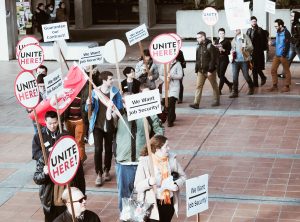
Last Friday, Convocation Mall was filled with roughly 100 cafeteria workers, SFU students, and faculty members. They joined in solidarity to urge SFU to protect the jobs of 160 cafeteria workers currently in contract with Chartwells, a division of Compass Group Canada.

As The Peak reported previously, Chartwells issued termination notices to 160 cafeteria workers as of April 30. This comes after SFU announced it is currently in the process of deciding on a new contract for food suppliers for SFU food services which includes Mackenzie Café, the Dining Hall, and caterers for SFU.

The final decision on new contracts will be made by SFU’s Board of Governors in their board meeting on March 30. Until then, many cafeteria workers have been left in limbo, unsure of the future of their employment. Bruna*, a cafeteria worker who works in SFU’s Mackenzie Café and has worked at SFU for 29 years, expressed her hopes following the rally on Friday. She told The Peak, “I am hoping that the university is listening, and realize we are serious about our jobs and our union contract.”

OLYMPUS DIGITAL CAMERAShe added that SFU has changed food supply companies many times, “but we have never been worried about our jobs. It’s never happened” in previous contract changes.

UNITE HERE Local 40 has been present throughout the uncertainty that workers have been experiencing since SFU announced they would be renegotiating contracts for May 1. Octavian Cadabeschi, a representative for UNITE HERE Local 40, explained that “we were hoping that we would have [a] more concrete sense of whether there was going to be a change in contractors or not by now, but the university continues to push the date back of their announcement.”

The Peak reached out to Martin Pochurko, vice-president finance and administration for SFU, for his input on the rally and concerns received from various cafeteria workers. In an email response he stated, “We understand there are concerns among some of the food services workers at SFU. To start with, SFU is very appreciative of the work the staff of the many dining facilities provides for our students, faculty, staff, and visitors. We believe that the staff are an integral part of our community.”

In regards to the security of SFU’s cafeteria workers and the decision to choose a contractor Pochurko added, “With that in mind, SFU has made the retention of the current hourly food services staff a requirement for the successful proponent, by ensuring that they are offered employment to all existing hourly staff in positions equivalent to their current jobs and at current or better wage and grade rates.

“We know that the people in these roles are vital members of our community and we want to ensure they know how much we value them.”

While SFU has stated that the future contractor will be required to offer equivalent employment to cafeteria workers, Cadabeschi expressed, “We basically continue to send the same message and to press the university to guarantee our members’ contracts and guarantee our members’ jobs, so, so far, the university has basically said that they are requesting the incoming contractor, whoever that is, offers employment to our members. But, in fact, we don’t see that as the same thing as guaranteeing jobs.”

Students are also increasingly concerned over the uncertainty that workers are feeling currently. At the rally, The Peak spoke with Jane* and Monica*, SFU students who have become involved with working with UNITE HERE Local 40 and supporting the cafeteria workers to create awareness among the SFU community on the issues.

Monica explained her satisfaction with the response from the SFU community at the rally: “The past few weeks have mostly been about getting the word out. I am so excited to see so many people out supporting the workers. There’s students, there’s workers, there’s faculty, everyone is coming together to stand up.”

Jane, a member of the Left Alternative student group on campus, added her personal connection to the cause: “This issue is very personal and dear to me. I grew up in a family where my parent also worked very low-wage, precarious food service jobs — actually in worse conditions than these workers here.

“I really know how difficult it is to stand up to your employer when you already rely so much on that employment, so I can just really empathize with these workers,” she added. “You know they have families to feed, they have people to support. They can’t just easily find jobs after this, they rely on these wages and these benefits. I think it’s really important to get the word out there.”

In the same emailed response from Pochurko, he added, “We recognize that some food services workers may be feeling some uncertainty about the possible transition of employers. We understand there may be a rally in the coming days. We are currently trying to do everything in our power to make the transition as smooth and quick as possible. The current contract ends April 30 and the new one begins May 1. We expect an immediate and seamless transition.

“Ultimately, we’re committed to providing a great dining experience for our students, faculty, and staff at our Burnaby campus, and appreciate the continued efforts of the dining services staff to do just that.”

Until then, cafeteria workers will continue to petition students, faculty, and the SFU community to garner great support and raise awareness. Their online petition has already received 400 signatures along with the 1,300 signatures that the hard copy petition had previously received, Jane told The Peak.

*Full names were not published at the request of the interviewees.


Ella Brown goes the distance for triple jump excellence

0
Brown, seen here in a recent outdoor meet, recently won the GNAC indoor championship in the triple jump event, one of a number of SFU athletes who finished first.

Going once, going twice, going three times — it’s a hop, skip, and a jump, and track star Ella Brown is one of SFU’s top connoisseurs and experts on the subject of the deviously difficult triple jump.

Having come from the Okanagan a few years ago, Brown’s been a track and field enthusiast since grade school, taking up triple jump in particular in grade 10. She’s been quite the solid component of the track team since her decision to attend SFU right out of high school.

Ask her who her biggest fan is and there are two answers: her parents, of course, and her old track and field coach back home, Ian Cameron. Brown partially attributes her decision to come to SFU in the first place to him.

“I was really lucky because [Cameron] was a really, really good coach. I started doing well in grade 11, and he sent my results to SFU and he was like, ‘This is what she’s done; are you interested?’ They ended up saying yes  [. . .] and I ended up coming here.”

Though Brown was considering attending the University of Alberta, the deal-breaker for her was the distance and SFU’s well-known status as the only Canadian university tied to the NCAA. The adjustment to living in an unfamiliar city came with some natural fear in the beginning, but Brown was quick to find camaraderie with her teammates.

“[Even now,] all of my friends still are my teammates. [. . .] I think everybody that I’ve met, directly or indirectly, have been because of the track team. All of my friends are from other teams, or [are people that] I’ve met because of people I know on other teams. It’s a really great network to get to know people.”

Her first few track meets were “super intimidating,” Brown says — she notes past events hosted at the University of Washington were particularly worrisome, mentioning the presence of Olympian athletes. Yet the healthy and welcoming environment that she finds consistently surrounding the track and field events she’s attended helps with the nerves.

Fast forward to the present, and Brown’s got an impressive enough record that some might say she has little to be nervous about. At the most recent Great Northwest Athletic Conference (GNAC) indoor championships, Brown scored her first-ever conference title, as did teammates Chantel Desch, Addy Townsend, and Vladislav Tsygankov.

“You do have to work really hard for it. If you want to be great, you have to make yourself great.”

But rather than rest on her well-earned laurels — a glowing 12.14-metre jump, as opposed to the next closest distance of 11.70 metres — the triple jump expert remains vigilant: “Even though there’s such a big gap, […] I’ve been beaten on the last jump so many times that [I know that] the competition is never over until it’s over.”

Nationals are coming up quickly this year, with the final opportunity to qualify to be at this weekend’s meet. The minimum intake of competitors is 16; Brown says she’s currently ranked 10th.

Her success this year makes for a great note to end off on. Having reached her fourth and final year on the track team, Brown’s got some mixed emotions.

“It’s bittersweet. I’ve been doing track for so long that it’s going to be really weird not doing track anymore, and obviously, I really love track. Then again, I’ll be able to get a ski pass for Whistler next year.”

Of course, after so much time, emotion, and effort invested in her primary sport, Brown’s taken things away from her experiences that’ll stay with her long after the conclusion of her time as a Clan triple jumper. She notes that her time management and her ability to stay healthy and in shape have sharpened significantly over time.

“You’re practicing five days a week, and then you have your practice, which is an hour and a half, and then you have to lift [. . .] which is probably another hour at least, separate out of your practice time [. . .] and then once our season starts, we’re gone every weekend.”

As for where Brown sees track and field slotting into her future, she notes that she’d “really like to do track after school and commit fully to it.” On the flipside, she’s studying resource and environmental management right now and expresses interest in working in provincial parks.

Asked what her biggest piece of advice would be for anyone just developing an interest in track, whether that’s before or after enrolling in SFU, Brown places emphasis on the need for dedication and self-discipline.

“You’ve really got to want it. Don’t be afraid, because everyone’s going to be nice, and it’s going to be fine. But you do have to work really hard for it. If you want to be great, you have to make yourself great.”

Brown might finally be coming back down to earth after a four-year-long leap into the apex of track and field excellence, but she’s sticking the landing with poise.  Her recent achievements only cement this; we’re wishing her luck for the rest of her final season.

Fun Fact: As a superhero, what would you want your superpower to be?

“I would fly, 100%. But the thing is, I wouldn’t want to be cold when I fly. I’d have to, you know, be immune to that.”

SFU Institute for the Humanities panel goes beyond the Women’s March

0

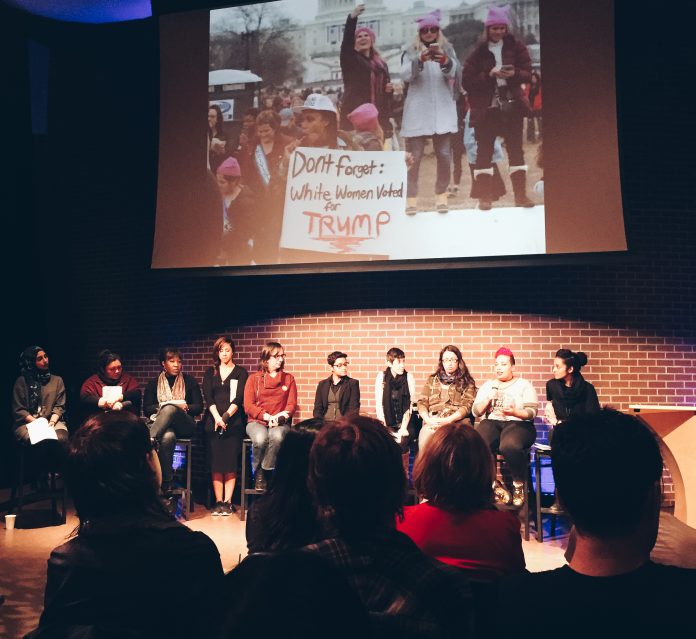
On Monday, January 20, a room in the Woodward’s building was packed with guests to listen to just under a dozen panelists as they discussed and debriefed the Women’s March on Washington – Vancouver which happened just one month ago.

As The Peak previously reported, there were some concerns over the Women’s March on Washington – Vancouver over observations of a lack of inclusivity in regards to the transgender and black communities in Vancouver. This event hosted by the Institute for Humanities and mediated by SFU student Samaah Jaffer intended to unpack the nature behind some of these exclusions, and how further movements, marches, and interventions can move forward from this.

Daniyah Shamsi, a panelist and organizer at the event told The Peak, “We wanted to keep momentum going and the goal was to discuss what happened with the march, what went wrong, what we saw in our own words — and how we, as activists, organizers, and everyday people, could learn and heal, grow, and move forward (as opposed to rhetoric of ‘moving on’ or ‘getting over it’) from such instances.”

The evening began with an address from the Institute for the Humanities director, Samir Gandesha, followed by a welcome from Audrey Siegl, sχɬemtəna:t, St’agid Jaad, acknowledging the space on unceded Coast Salish lands.

Panelists described their role, or lack thereof, within the Women’s March. Each represented various communities, including the black, Latino, Aboriginal, and LGBTQ communities, as well as those with accessibility needs across Vancouver.

During the event, Shamsi explained her experience while volunteering for the stage set-up and sound for the Women’s March. She explained that the Black Lives Matter organization was not included because she quotes “and I quote, ‘there weren’t enough black people in Vancouver to be represented.’” The audience gasped following this statement, as other panelists including members of the black community recalled the lack of diversity present at the march.

“I didn’t really get the impression that enough people saw the problems that I saw. . . it takes more than one voice to speak up and say ‘hey, that doesn’t sound right, can we talk about that?’ It’s an easy way [to] just open dialogue, to really make sure we are doing things the right way.”

Shamsi went on to express her concern over the response that the organisers of the Women’s March exhibited. This was following a Facebook post from some Black Lives Matters members criticising the event which garnered around 100 comments. The comments, which examined the discourse and exclusivity of the march, were deleted from the event page.

Daniella Barreto, an organiser for Black Lives Matter Vancouver, described the reasoning behind the statement that was made on the Black Lives Matter website in regards to the Women’s March. She added, “We just wanted to say, ‘Hey! This is an issue.’

“Throughout the history of feminism, black voices have been erased, and it is so important to centre the voices of those who are most marginalized — this wasn’t happening in Vancouver, so we wanted to open up that conversation about who is at the table, who gets to be at the table.”

“The erasure that we are hearing about right now is hitting me because it’s been ongoing,” stated Stephanie Allen, a real estate developer who is currently working to address the displacement of the black community when the Georgia viaduct was created, working with the black community.

She reflected upon her experience attending the march as a black woman: “I was happy to attend the Women’s March the day that I attended. While I was there with a number of black women, we went together because we wanted to be visible together, because we know what it’s like in Vancouver.” 

While the night focused on exclusivity within social justice movements as a whole, a discussion on the transgender community and under-representation of the Women’s March was another highlight of the night. Morgane Oger, who works as an entrepreneur in the high-tech sector and is also the BC New Democratic Party candidate for Vancouver–False Creek, discussed her position as a transgender individual.

“Throughout the history of feminism, black voices have been erased, and it is so important to centre the voices of those who are most marginalized” – Daniella Barreto, an organiser for Black Lives Matter Vancouver

“The organisers [of the march] clearly had the very best of intentions in mind. . . and it’s obvious that it came from a good place, but it came also from a place that was limited by their lens,” expressed Oger.

Oger addressed the lack of foresight of the organisers by explaining one simple quote by a former minister of defence in the United States, Donald Rumsfeld: “There are known knowns.” She explained that what’s more unstable are the “unknown unknowns, what you don’t know, you don’t know, and that’s the thing that gets you in so much trouble.”

This idea was reiterated by Mia Susan Amir, writer, interdisciplinary performer, curator, cultural organizer, and educator who suffers from chronic illness expressed her concerns over accessibility during most events. But she added the importance of educating others, “When we don’t offer information, we create a wall of exclusion.”

Final thoughts from the panelists in moving forward in creating social change included understanding the gaps created when making events, marches, and initiatives and how we can better understand those missing pieces. As suggested by Shamsi, one way to encourage greater inclusivity was “queer[ing] it up” in order to understand how to break out of binary thinking.

Judi Lewinson added how important technology is in connecting one another, as the conversation wrapped up for the night. To move on from the what was expressed as exclusivity following the Women’s March, she stated, “We are coming together to do something bigger than this immediate moment, and bigger then Jack Poole plaza; but it was a good start. So embrace technology, ask people to show up, and then when they say they are coming, welcome them in.”

Jaffer, moderator for the event, told The Peak following the event that “audience members expressed that they learned a lot,” despite the fact that some panelists didn’t get as much time to speak as others. She added, “I hope that this event has encouraged people to have more of these difficult, yet critical, conversations among their peers.”

New Music Friday

0

Follow The Peak on Spotify to stay up to date on New Music Friday.

“Love” – Lana Del Rey

Jessica Whitesel: Yasssssss. Lana is my white girl queen. This song is typically Lana, with a huge cinematic sound that doesn’t really have that many elements. I’m probably going to listen to this way too many times today, because any day there is new Lana is a good day.

Jessica Pickering: I have just never cared for Lana Del Rey. I wish I knew what it was, but I just don’t get the hype. I’ll let people who give a shit weigh in on this one.

Rita Ovis: I was expecting another Lana song that showcases how damaged she is or her pining over some old-fashioned bad boy, but this song is actually so sweet and just simply about being young and in love. Lana, what made you go so soft??

“Slide” – Calvin Harris feat. Frank Ocean and Migos

JW: I don’t really like this. I mean, I guess it’s OK, there is just something about the vocals that I’m not loving, which is weird since it’s Frank Ocean, and he usually has his shit together. Maybe Calvin Harris can only make mediocre artists sound good (except for RiRi — she always is on point).

JP: The first quarter of this song is just instrumental, which is a choice, I guess. A lot of build up for not much payoff, though. I am true neutral about this.

RO: This playlist is so far, so good — even though this is only the second song. . . Anything with Frank Ocean is a go, though. He’s the golden boy of modern music, let’s be honest here.

“Stay” – Zedd with Alessia Cara

JW: This is going to blow up on the charts because of who it’s by, but both Alessia Cara and Zedd have done better. While it’s still a good song coming from two artists who are capable of greatness, this song is a let-down.

JP: Take a shot every time a top 40 song has the phrase “rising sun” in it. Guaranteed, you’ll be so wrecked you might get alcohol poisoning. Start with this song, you’ll have a great buzz going.

RO: I think I’m gonna leave, but good try.

“Swalla” – Jason Derulo feat. Nicki Minaj and Ty Dolla $ign

JW: Oh boy. This is going to be a club banger. However, I can also feel an awkward boner poking me in the back while I’m just trying to have a good time with my friends so, like, I don’t know how to feel about this. But I can confirm that this will be a banger.

JP: Honestly, this should just be a Nicki Minaj song because that’s the only part that matters. Leave Nicki to save any song she’s on and have the best verse by far. She is too good and we don’t deserve her.

RO: Starting off a song with the single word “drink” is a warning sign. C’mon, glorifying binge drinking is just creepy, I’m not a fan.

“By Your Side” – The 1975

JW: Well, the opening sounds like the dramatic romantic conclusion of a 1980s chick flick. And then the weird scuba-y autotuned vocals that sound like an off-brand 2007 For Emma, Forever Ago Bon Iver. I’m still convinced that the 1975 only have one good song and it’s “Chocolate.”

JP: Weird ’80s jazz music and autotune right off the bat? Bold move, the 1975. Bold and bad. This isn’t even hot trash. This is cold trash. The worst trash.

RO: They straight up ripped off Bon Iver, it’s uncanny! Shocking! Scandalous! Confusing? I mean, it sounds good, but they should know not to mess with Justin Vernon.

“Chasing Colors” – Marshmello feat. Noah Cyrus

JW: The only reason that I know Noah and Miley are two different people. At least I think I know this, since it’s not entirely clear. They sound the same and with this song they even seem to have the same interests — living high. I don’t know, man, maybe I need to be high to actually know that they are different or maybe we are all the same. Either way, I’m out.

JP: Why can’t the Cyrus siblings leave well enough alone? Metro Station is only good for your middle school scene phase and Miley’s best work was, by far, as Hannah Montana. Your whole family is banned from music. Blame your dad.

RO: Noah Cyrus is just riding the Cyrus wagon of fame. I’d probably do that, too, if my whole family was famous and I was feeling left out.

“Selfish” – Future feat. Rihanna  

JW: I guess RiRi and Future are OK together (although RiRi and Drake are perfect recording partners). I’d like this song better if Future just rapped and skipped trying to sing. Sometimes it works when he’s on tracks with other rappers who can’t sing, but this is RiRi, and she makes him sound like a dying animal.

JP: What happened to the Rihanna circa 2006? “SOS” was such a jam and this is just nothing. Bring back the jams! I’ll wait.

RO: We all love us some bad girl RiRi, but I still refuse to enjoy anything Future is involved in. He’s NOT allowed to take over the pop music industry, nope, nuh-uh.

“Vancouver Time” – Leif Vollebekk

JW: I’m not entirely sure what Vancouver time is. Growing up in the same time zone as Calgary, Vancouver time was reserved for the Pacific time zone. But maybe Vancouver time is the weird limbo TransLink puts you in when you are either 133,246 years early or 36,535 years late because of when the buses come.

JP: This does not sound like Vancouver. No mention of bike lanes (negative or otherwise), no annoying SkyTrain noises, no rain; have you ever even been to Vancouver? Judging by the line, “I was wearing jeans,” I’m guessing no. If you had said ‘yoga pants,’ I’d be more convinced.

RO: I’m low-key a huge Leif Vollebekk fan and I’m very honoured that he’s referencing Vancouver in this very chill jam. Leif, next time you’re in Vancouver, let me know though.

“Walk On By” – Thundercat feat. Kendrick Lamar

JW: Well, thank god for Kendrick. He might have not been able to save that dodawful Maroon 5 song, but he saved this one from being some weird ’80s ballad that couldn’t really do ’80s or ballad.

JP: I just finished midterms, why is this song still making me suffer? I’m legitimately mad at the fact that I had to listen this. I’m even madder that someone had the audacity to release this. Unbelievably.

RO: If you haven’t noticed by now, I’m extremely biased towards a song if an artist I like is in it. This is no different, I love Kendrick, I think Kendrick loves me, and he’s killing it in this one. Go Kendrick.

“Lovers Left to Die” – Dope Lemon

JW: So the album cover does not match the feel of this band at all. I looked at the cover and was all well this is going to be some Eurotrash EDM for fake raves and all the kewl kids do pop molly too (I’m old so this could just be culturally out of touch but IDK). But they are a fairly run-of-the-mill modern rock group — not bad, not good, just shockingly average.

JP: Why are you a dope lemon? What’s the story behind that? I am so much more interested in how you got your name than I am in your music. Why a lemon? WHY A LEMON?!

RO: My question is, how’d they come up with their band name? “Damn this lemon is so. . . dope. A dope lemon. I’m a dope lemon. DOPE LEMON!”

“Walk Away” – Rainer + Grimm feat. Gina Kushka

JW: This song told me to walk away so many times, I did. And you should walk on by it too; 85% of the lyrics are walk away, so you’ve pretty much heard it all now.

JP: Am I in an Urban Planet? ‘Cause this is the exact kind of shit music they play in there. It’s a terrible pop song which means it sounds like every other pop song released in recent memory (except: my girl Carly Rae. She is a pop artist).

RO: I’d like to walk away from this song.

“Something Like This” – The Chainsmokers and Coldplay

JW: I honestly wasn’t sure if this would even work as a song, but shockingly it does. Coldplay has explored some more electronic sounds throughout their career and you can definitely hear that experience come through. They work well together and I wouldn’t be opposed to more collaborations between The Chainsmokers and Coldplay in the future.

JP: Fuck, I love Coldplay. This is the best goddamn song that’s been on NMF in MONTHS. Bless.

RO: I’m not so sure if Coldplay and The Chainsmokers belong together. This isn’t “Yellow” and I’m honestly pretty tired of all these alt-rock artists becoming infected with this electro-trap-house trend.

Oscar predictions 2017

0
Emma Stone and Ryan Gosling capture the magic of the classic Hollywood musical as Mia and Sebastian in La La Land.

Best picture – La La Land

La La Land is almost a shoo-in to win. The cinematography is stunning, the dance numbers are magical, and the chemistry between Ryan Gosling and Emma Stone captivates moviegoers from beginning to end. While Moonlight is a competitor for the win, La La Land will be difficult to beat with its 14 nominations, glitzy musical numbers, and stunning on-screen visuals.

Best director – Damien Chazelle (La La Land)

Chazelle creates a magical masterpiece with La La Land and reinvents the meaning of musical. He is able to add fantastical elements to the film without making it cheesy, and creates a cinematic experience that is modern and relatable. A possible competitor is Barry Jenkins for Moonlight, who creates an incredibly important film about identity. However, with the surreal film experience established by Chazelle, this win is his.

Best actor – Denzel Washington (Fences)

Washington delivers a larger-than-life performance in Fences that will earn him an Oscar. While critics claim Casey Affleck (Manchester by the Sea) to be the front-runner, I find Washington’s performance to be the more captivating of the two. Affleck’s performance is reserved while Washington is bold and crass. While both actors deal with the tragedies of their past in different ways, I feel Washington digs deeper and delivers a stronger performance.

Best actress – Emma Stone (La La Land)

Stone will most likely go home with best actress of the year however, it’s not because she is the best. Rather, it’s because La La Land received so much buzz from critics and is the favourite this year. My hope is that Isabelle Huppert of Elle steals the show. Her acting is captivating, twisted, and truly deserved the Golden Globe win. Stone will be difficult to beat, but let’s see if Huppert can do it!

Best supporting actor – Dev Patel (Lion)

Patel will win as he succeeds at following the impressive first act by Sunny Pawar (five-year-old Saroo) and embodies the same mischievous, curious and resilient essence of Saroo. Additionally, Patel completely transforms from the skinny, geeky teenager from Slumdog Millionaire, to a handsome, young man with a mane like a lion. A possible steal is Mahershala Ali of Moonlight — however, Patel’s transformation and depth of emotion outlasts Ali’s brief onscreen appearance.

Best supporting actress – Viola Davis (Fences)

Davis blows the other nominees out of the water, and delivers a heartfelt performance that makes viewers reflect on the importance of choice. She embodies her character and handles everything life throws her way with grace. An unlikely competitor is Michelle Williams (Manchester by the Sea) who delivers an extremely emotionally driven performance. However, Davis supports Washington’s role in a way that is essential to the meaning of Fences, which will win her the Oscar.

Best original song – “City of Stars” (La La Land)

It is only fitting that the Oscar will go to a song from a musical. While either “City of Stars” or “Audition (The Fools Who Dream)” — also from La La Land — could win, “City of Stars” has a simple, yet iconic melody that gets stuck in your head. Moreover, this song is the embodiment of La La Land and is used to represent Sebastian’s (Gosling) love towards Mia (Stone) throughout.


SFU men’s soccer open pre-season with victory over University of the Fraser Valley

0
Adam Jones (#10), seen here in action last season, scored SFU’s first goal of the match.

SFU men’s soccer kicked off their pre-season preparations with a confidence-building victory over a dogged University of the Fraser Valley outfit at Terry Fox Field on Friday night. Goals from Adam Jones and Dzenan Bezdrob were enough to secure a 2–1 victory for the home side, which looked comfortable in possession throughout.

Right from the start, the Clan seemed at ease with the ball at their feet, moving play around the park with patience and waiting for opportunities to arise.

With the visitors also looking to play an expansive style, it was perhaps surprising that it took until the 10th minute for the first real chance of the night. SFU forward Riley Pang took advantage of a defensive error from Fraser Valley, only to see his shot clip the outside of the post on its way wide.

The home side was beginning to control the game, with their possession-based style affording them time on the ball. An eye-catching turn from Mamadi Camara led to a corner for the Clan, from which Pang headed the ball over the crossbar, despite being unmarked in the penalty area.

The chances kept coming for SFU, with Kyle Jones flashing a free kick just wide from 25 yards after as many minutes.

Eventually, the first goal of the game arrived. With five minutes to go until halftime, Erik Morden’s cross was met with a delightful diving header from Adam Jones. His effort beat the Fraser Valley goalkeeper to give SFU a 1–0 lead going into the break.

Almost directly from the restart, the Clan had a great chance to register their second. Camara was found by a sublime diagonal pass from centre-back Magnus Kristensen, but the SFU winger was unable to properly connect with his shot.

Kristensen showed his defensive prowess minutes later, as the Norwegian leapt high to clear away a dangerous corner from the lively Brady Weir.

Momentum was with the home side, though, and only a brilliant save from Fraser Valley replacement goalkeeper Jesse March prevented SFU doubling their lead on 65 minutes. Lucas McIlveen rose high to connect with an in-swinging free kick, and his header would have ended up in the back of the net was it not for March’s save.

There wasn’t long to wait for SFU’s second goal, though. Dzenan Bezdrob latched onto a through-ball on 68 minutes, and his shot was too powerful for March in the Fraser Valley goal. The Clan doubled their advantage.

Fraser Valley, however, showed their resilience, creating a few late chances of their own. With a minute remaining, they were rewarded with a goal. A free kick from out wide evaded everyone in the SFU penalty area, and when the ball came back off the post it was the visitors who reacted the quickest, turning the ball past SFU goalkeeper Victor Gouchee to halve the deficit.

It came too late to make a difference, though, with the final whistle blowing shortly afterward to confirm the victory for the Clan.

SFU head coach Clint Schneider was pleased with his side’s performance, highlighting the contribution of his less experienced players after the match.

“Results are great at this point, but it’s great for our guys to get minutes. The weather hasn’t really cooperated with us this spring, and we haven’t been outside a lot. I was pleased — overall, it was good.

“The younger guys who didn’t play so much in the fall I thought did really well — Dzenan [Bezdrob] got a goal, Erik [Morden] got an assist, — two guys that haven’t had a lot of minutes.”

Next Game: The Clan continue their pre-season preparations next Friday, as they take on the Fraser Valley All-Stars on Terry Fox Field. Giving his thoughts on his team’s next match, Schneider said, “The plan is to play a lot of our young guys, get them the majority of the minutes. It’s another exercise for us before we move on into spring.”

Othniel Spence flies with career-high 29 point game despite loss

0
Spence’s 29 points were the highest recorded in a single game by an SFU player all season.

While he had a couple of good threes in the first half, that was all Othniel Spence had on the board in six minutes of court time in the first 20 minutes. Few would have expected him to explode as he did in the second half.

He finished the game with 29 points. That’s the best individual point total anyone on the team has put up all season. He was just everywhere in the second half, putting up confident and exciting plays. His 23 second-half points came in 18 minutes of playing time, a remarkably efficient performance.

As a freshman straight out of high school, whose minutes can vary game-to-game — maxing out at 24 minutes to sometimes sitting the entire second half — it’s a very promising sign of one of the Clan’s futures.

“Othniel plays with a lot of speed, and in our offence, a guy like Othniel can really succeed. He’s been putting in a lot of time in the gym — a lot of extra time in the gym — in the last month and it’s really paying off,” said head coach Steve Hanson.

In the end, Spence finished the game 11-for-15 (73.3%) from the field and six-for-seven (85.7%) from the three-point line.

Despite the remarkable offensive outburst by the 6’1” point guard, SFU was unable to beat the Saint Martin’s Saints in their penultimate home game, falling 102–78. SFU put up some decent offensive numbers, but were unable to stop the Saints — who were playing for their playoff lives — and unable to go drive-for-drive against the Lacey, Washington-based team.

The lopsided loss is all the more disappointing after a stretch of four relatively close games, including a win, where SFU seemed to make definite progress.

“I said [before the game], ‘We’re playing a desperate team and we’ve got to come out hard,’ and we didn’t. So that’s really disappointing,” said Hanson. “What was tough was when we did get a couple of stops, we just missed. Too many mental mistakes; we looked like the team back in early December tonight, unfortunately. We regressed tonight, for sure.”

Saint Martin’s jumped out to a 10–0 lead before SFU put up their first two points 3:14 in. It didn’t take long for the Saints to further build that lead up to 18–4.

SFU was able to go on a 13–5 run to get the game within six points, but just as quickly as SFU was able to get back into contention, Saint Martin’s was able to pull away.

The half finished 54–36 in the Saints’ favour. Saint Martin’s was shooting at an incredible rate, sinking 69.9% of their shots from the field — a trend that slowed only moderately in the second, as they finished with an overall 66.0%.

Graham Miller got to see some action in the first, putting up 12 points in 10 minutes of play. Despite some mistakes, his offensive performance showed potential.

“[There were] too many mental mistakes; we looked like the team back in early December tonight, unfortunately.”

“Now that his concussion’s gone and he’s just getting back to the swing — it’s really tough when you sit almost a month with an injury — he’s been looking a lot better in practice,” Hanson said about the 6’7” redshirt freshman. “The game speed is not there, his foot speed is not there for games, but we know he is going to be good in a couple of years, so we give him some minutes.”

While he didn’t put up any more points, Miller saw a further seven minutes of action in the second.

In the second half, Saint Martin’s played sloppily at times, and despite their high shooting percentage, left some drives without a shot. SFU looked like they might be able to take advantage of this, at one point reducing the deficit to 12.

However, SFU was unable to sustain the momentum.

Outside of Spence, Miller and Michael Provenzano, who had 11, were the only players with double-digit point totals. Spence also led in rebounds with four, three of them defensive.

The typical big-minute players saw their time on court reduced, with Provenzano playing only 25 minutes and Kedar Wright only 22 minutes. Wright finished with six points and two defensive rebounds. Vinnie Safin, Bowen Bakken, and Bongani Moyo — who have been used sparingly — received minutes.

Next Game: It’s the last game of the year for the men’s basketball team. More importantly, it’s the last game of seniors Hidde Vos’ and Gibran Sewani’s careers.

While they aren’t fighting for anything in the standings, and the win total will still be low, it would be huge to send off Vos and Sewani with one last home win, in front of what’s probably going to be a big, loud crowd.

It won’t be against an easy team. Despite being ninth in the conference, and having lost their last game, Seattle Pacific has won three of their last five games.

“They’re a big physical team. There [are] not a lot of guys on our team physically that can match up with them,” said Hanson. “When we played at SPU, they were in a different world. I mean, a lot of senior leadership, a lot of big, strong kids they have, and they took it to us the first game of the season.

“We’re going to see what we’re made of Saturday, because we’ve got to play with some pride and I told our seniors, ‘You’ve got to go down swinging.’”

Hanson emphasized the importance he stressed to Vos and Sewani about shooting more — even if it means more misses.

“[I told them,] ‘Hidde, if you’re one-for-five, let’s go two-for-ten, take shots, and Gibran same thing,’” he explained. “I’m excited for them Saturday, and we’ll see how we bounce back.

“I just want to see — regardless of the score — how hard we compete against them.”

Seattle Pacific’s Tony Miller is fifth in scoring and third in rebounding in the GNAC.

Tip-off is at 7:30 p.m.