Home Blog Page 646

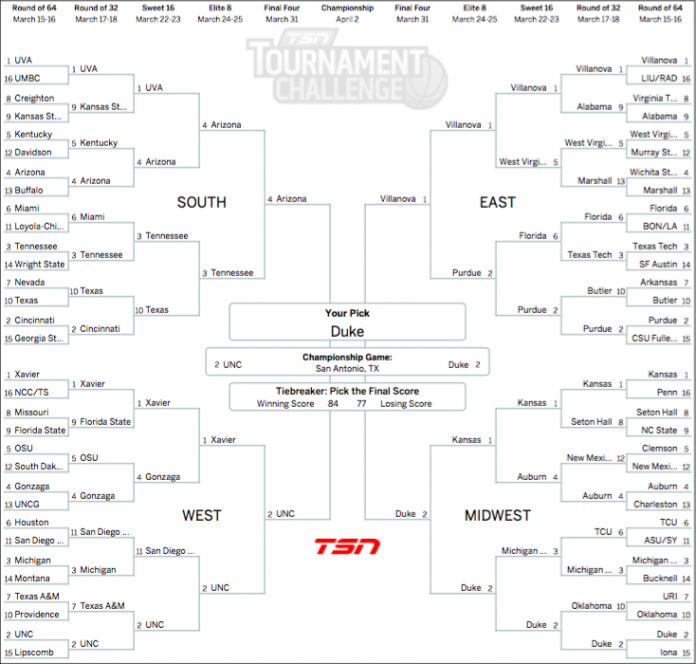
The Peak’s 2018 March Madness Bracket

0

KEY NOTES

Duke winning it all

For me, the most exciting game of the tournament may actually be the potential matchup of Duke vs. Michigan State in the Elite Eight. Whoever wins this game is my favourite to win the tournament. Both teams have experience, great coaching, and perhaps most importantly, talent. However, as is often the case, I think Duke is the most talented team in the nation, and this tournament will be Marvin Bagley’s place to shine. They are the only team ranked in the top seven in both adjusted offence and defence, according to the 2018 Pomeroy College Basketball Ratings. This team is arguably better than the one Mike Krzyzewski coached in 2015, and that team ended up winning it all.

Only one number one seed in the Final Four

This isn’t as rare as it may sound, as it happened as recently as 2016. What it points to, more than anything, is the high number of elite teams we have in this year’s tournament, and the fact that there is no clear favourite. It can certainly be argued that Virginia is the best team in the nation, but this doesn’t always result in tournament success. Ironically, my favourite number one seed this year is actually Kansas, but I can’t bet against Duke in this tournament. I have Villanova making it as the only number one seed, for the simple reason that they are the best team in the East. Sometimes it’s that simple.

#12 New Mexico State over #5 Clemson

The #12 over #5 is a common upset pick, and this year I’m going with New Mexico State over Clemson, although there are cases to be made for both Davidson and South Dakota as potential upsets. New Mexico State have a top 15 defence in the nation, and Clemson is quite unspectacular for a number five seed, ranked 297 in adjusted tempo. I can also see #13 seed College of Charleston Cougars defeating Auburn, and even had New Mexico State making the Sweet 16, but my judgement got the better of me.

#13 Marshall over #4 Wichita State

It seems that every year, Wichita State is a popular upset pick in March Madness. This year, however, they’re a favourite, so naturally I have picked them as a team to be shocked. They have also struggled down the stretch, which typically does not turn into tournament success. Marshall have Jon Elmore, who is averaging 22.8 points per game, 6.9 assists, and 6.0 rebounds, who has the ability to win a game on his own. Mix this in with the pressure that Marshall places on their opponents, and this game has all the makings of a first round upset.

#11 San Diego State making Sweet Sixteen

I know, I know, you don’t like the idea of San Diego State defeating both #6 Houston and #3 Michigan, but here is why I think it could happen. In each of the past four March Madness tournaments, an #11 seed has made the Sweet Sixteen. The last time it didn’t happen, in 2013, #13 seed La Salle got past the first two rounds. In other words, it’s likely that a #11 seed or lower will make the Sweet Sixteen, and I think San Diego State is the best one in this group. They play at a slow pace that can freeze even the best players, and have five players averaging 10 or more points per game. In other words, they’re well-balanced and annoying to play against, which is sometimes enough to win a few games.


Five highlights and five lowlights from the SFSS’s history

0
The 2020 SFSS Election debate was held on Wednesday March 20

By: Jonathan Pabico, Peak Associate 

You’ll hear about it throughout your SFU experience, but what exactly is the Simon Fraser Student Society (SFSS)? Here’s the scoop: according to their website, the SFSS comprises of a group of students who not only represent and advocate on behalf of SFU’s undergraduate student body, but also provide services to that student body to enrich our university experiences. Studying the history of the SFSS revealed that the SFSS’s successes were interwoven with controversial surprises. From athletics stadium issues to Deepak Sharma’s short-lived presidency, the SFSS’s history is layered with startling events, garnering student concern and intrigue. With the SFSS election fast approaching, let’s take a look at five highlights and five lowlights from the SFSS’s extensive history to remind ourselves of why this election matters.


Five highlights

2017: Changes to elections policies

The SFSS implemented new changes to their election policies last year to better address past issues concerning debates, disciplinary policies, and behavioural standards of SFSS candidates, and other aspects of their political affairs. The newly updated elections policies also armed party candidates with better guidelines by imposing a template for their campaigns. These changes even included holding election debates at only one campus instead of multiple campuses to gain better student turnout and better manage the society’s resources. Although the SFSS reformed their election policies, these changes will be monitored this year to determine their effectiveness.

Editor’s note: Despite the change in policy, the SFSS will be hosting debates on both the Burnaby and the Surrey campuses during the 2018 elections.


Turnout for Fall Kickoff concerts

The 2014 Fall Kickoff concert had an enormous turnout of nearly 1,800 people attending and enjoying its festivities. During this event, numerous bands performed, such as Paris & Simo, Luvlyf, BESTiE, and the Faceplants. After the concert ended, multiple DJs kept the event’s energy and night life alive during an after party at the Highland Pub. This turnout is especially impressive since Fall Kickoff 2013 was the first time the event was hosted. Fall Kickoff 2017 broke attendance records with about 2,600 individuals attending.


2014: Returning commemorative plaque to Freedom Square

Back in October 2014, the SFSS returned a plaque that had been missing for years to Freedom Square. The plaque was placed at Freedom Square to honour a 1967 peaceful protest that reinstated TAs that had been fired unfairly. The plaque was stolen a year after this protest by UBC engineering students and was used by a UBC alumnus as a TV stand. Although the plaque was eventually returned to SFU by the same UBC alumnus who previously used it as a TV stand, it spent the better part of 10 years in storage at Convocation Mall after its return and was only re-rediscovered and rededicated in 2000.


2014: The Emergency Food Bank Program’s expansion to all campuses

2014 also saw the SFSS expanding its food bank program to the Vancouver campus. Students from multiple campuses were able to obtain vouchers that they could redeem at local grocery stores, namely Nesters Market and Safeway. The SFSS intended to bring their food bank program to SFU Surrey as well in order to conveniently provide full access to students, regardless of which campus they frequented. In 2017, the SFSS also collaborated with the university to obtain additional funding for its Emergency Food Bank Program.


1974: Creation of the Women’s Centre

The SFSS manages the Women’s Centre. It was created way back in 1974, originally starting out as a Women’s Caucus (run by female students). While the Women’s Centre was created to offer childcare, access to birth control, sexual assault support, and other services to women, it is an open place for anyone who seeks a safe social space on campus. Among the objectives of the Women’s Centre, this group promotes respect for women’s rights and provides resources such as a 24/7 lounge area and education about sexual health. The SFSS also offers services through another Rotunda group, Out on Campus, a safe space for LGBTQ+ folks and allies.


Five lowlights

2017–present: Space issues concerning the SUB

The SFSS surprised Embark, CJSF, and SFPIRG last year by denying them space in the upcoming Student Union Building (SUB). Although these student societies were apparently involved in discussions about reserving space in the SUB, the SFSS prioritized the majority of SUB space to student clubs and unions, catching the societies off guard. With no SUB space and their leases nearly expired, Embark, SFPIRG, and CJSF worry about where they could operate in the future.  


2017: Food and Beverage Services ended, Highland Pub closed

The SFSS continued its surprise streak in 2017 when they closed down the Food and Beverage Services and the Highland Pub, surprising students and employees alike. The SFSS strongly empathized with students’ social concerns, but the pub’s financial losses cost the SFSS an annual half-a-million-dollars deficit. Although the pub was economically infeasible, students were still disappointed in its closure and felt concerned about the SFSS’s apparent lack of transparency during the decision-making process. With the pub gone, students felt deprived, having now lost a place that represented a rich social space to connect with others on campus. (Note: SFU took over the SFSS’s Food and Beverage Services, and the Highland Pub is available for booking and events.)


2007–11: Legal disputes with the Canadian Federation of Students (CFS)

In spring 2007, the SFSS organized a referendum for SFU’s student body, aiming for enough votes to officially leave the CFS, the largest national student association in Canada. Then-president Derrick Harder stipulated that the SFSS wanted to leave due to a staggering $400,000 in annual membership costs and low paybacks. However, the CFS found the SFSS’s referendum was noncompliant with their policies, given that the SFSS facilitated this referendum as opposed to the CFS itself. The SFSS was subsequently held culpable for this noncompliance. The SFSS finally separated from the CFS after spending over $450,000 on a legal dispute that spanned three years from 2008 to 2012.


2011: The temporary lockout of Out on Campus and the Women’s Centre

In 2011, the Women’s Centre and Out on Campus were locked out. Jeff McCann, the SFSS president at the time, revealed that the lockout was due to budget cuts to address the SFSS’s financial constraints. Volunteers and staff working at Out on Campus and the Women’s Centre expressed concerns for the lockout and the negative consequences that would follow, especially for marginalized students who may no longer have access to the safe and social spaces where they normally seeked support. This lockout sparked a labour dispute between the SFSS and its unionized employees, eventually inciting SFU students to protest at the SFSS’s boardroom.


2006: Impeachment of board members

The SFSS experienced a series of impeachments for various members of the Board of Directors who had violated policies and bylaws (including abuses of power) among other actions. In fall 2006, seven board members were impeached including a treasurer, an external relations officer, and even a past SFSS president. Over 1,000 students attended a general meeting that discussed the various unethical acts committed by this group. After they were impeached, the seven board members were replaced by newly elected board members.

Must-see events

0
(Linda Shu / The Peak)

By: Alex Bloom

Vancouver South African Film Festival

This is a non-profit event, presented in partnership with SFU Woodward’s, and all proceeds go towards Education Without Borders. Taking place between March 23 and 25, the Vancouver South African Film Festival (VSAFF) is a fantastic way to learn about the history, politics, and culture of the country.

     While the festival itself is brief, the films are not. There will be features and documentaries on various topics, ranging from 77 to 117 minutes in length. The synopsis for the film An Act of Defiance describes it as a “nail-biting political thriller” taking place during apartheid, The Giant is Falling is an examination of the current political climate in South Africa, and Liyana (a film from Swaziland) is a tale described as “part animated fable, part documentary.” VSAFF’s motto — as displayed on their logo —  is “Inspire, Inform, Entertain,” and each film aims to do just that.

All films will be shown at the Djavad Mowafaghian Cinema at the Goldcorp Centre for the Arts,149 West Hastings Street. Festival passes start at $89 and individual film tickets are $15. For more information, visit the VSAFF website.

Reel Causes: #WorthFightingFor

Presented by Reel Causes, Wilderness Committee, and SFU’s Vancity office for community engagement, #WorthFightingFor is a combination of film and dialogue focused on raising awareness about issues concerning the environment. Taking place on March 29 at 7 p.m., two films will be shown: Hunting Giants and Water Warriors.

     The first film, Hunting Giants (25 minutes), follows a climber searching for the tallest tree in Canada. Its synopsis describes it as “a cinematic adventure into the old-growth rainforests of British Columbia that asks a question faced by resource communities around the world: extract profit until nothing remains or risk everything in pursuit of a more sustainable future?” The second film, Water Warriors (22 minutes), is about a community’s collective resistance against the oil and natural gas industry. Its synopsis describes it as “[inviting] audiences to contemplate and re-imagine their own possibilities for resistance.” After both film screenings there will be a Q&A period with filmmakers and environmental activists participating.

The screening will take place at the Djavad Mowafaghian Cinema at the Goldcorp Centre for the Arts,149 West Hastings Street. The price for membership and ticket is $10. For more information, visit SFU Woodward’s event page.

JFL Northwest Film Festival premieres Canadian and international Comedies

0
(Image courtesy of JFL Northwest)

By: Alex Bloom

Just for Laughs (JFL) Northwest’s Vancouver Film Festival recently came to a close on March 10. During the festival various short and feature length films were shown — for many it was their Canadian premiere. Here are some of the films shown during the festival that you should check out:

Lost in Paris (France/Belgium)

(Image courtesy of Potemkine Films)

Starting off with an unconventional twist, the filmmakers themselves, Dominique Abel and Fiona Gordon, star in this screwball comedy. This will, of course, be familiar to their fans. The duo — who have a long history of working together — have often played versions of themselves in their past films.

     Lost In Paris follows a Canadian librarian (Gordon) who receives a strange message from her aunt in Paris, and decides to go to the French capital to investigate. During her travels she has all sorts of wacky adventures, and meets the strange yet loveable Dom (Abel). The film promises slapstick comedy, a wealth of goofiness, and the odd touching moment.

Room For Rent (Canada)

(Image courtesy of D Films)

Starring late-night comedy veteran Brett Gelman and Mark Little (best known for his role in the CBC’s Mr. D), this films tells the classic — if formulaic — tale of a war between two neighbours.

     Not to be confused with the horror movie of the same name, Room For Rent follows Mitch Baldwin (Little), an adult living with his parents who convinces them to look for a roommate in order to avoid selling their house. Mitch gets more than he bargained for when the somewhat creepy roommate he finds, Carl (Gelman), turns out to be a nightmare to live with. If you’re a fan of Gelman, who has appeared in Stranger Things, then you will likely enjoy            this spin on a comedy trope.

Selfie (Spain)

(Image courtesy of JFL Northwest)

This Spanish language film follows Bosco (Santiago Alverú), the son of an important government minister. After a corruption scandal in which his father is implicated, Bosco’s life takes a turn for the worst, and he is forced to abandon his luxurious lifestyle.

     No longer wealthy, Bosco moves into a working class neighbourhood and learns the struggle of paying rent. What makes this fish-out-of-water comedy unique is the fact that Bosco decides to film himself throughout his experience. This social commentary promises entertainment, as well as a glimpse of Spain’s political landscape.

The Death of Stalin (UK/France/Belgium)

(Image courtesy of Elevation Pictures)

Written by Armando Iannucci, the writer of HBO’s Veep, this film follows the events that transpired in Russia after the death of Joseph Stalin: the political fallout, the confusion, and the violence. Boasting a star-studded cast, The Death of Stalin features actors such as Steve Buscemi, Olga Kurylenko, Jason Isaacs, Michael Palin of Monty Python, and Jeffrey Tambor.

     Iannucci demonstrated his knack for political comedy in Veep, and based on the trailer, this film will not disappoint either. The combination of sharp-witted dialogue, and its slew of talented actors is likely to result in an A+ film about this tumultuous moment in Russian history.

SFU track receive All-American honours at NCAA Championships

0
The Clan finished fourth, but were bumped up to third after Adams State was disqualified. (Photo courtesy of SFU Athletics)

On Saturday, March 10, the SFU track and field team ended their indoor season at the National Collegiate Athletic Association (NCAA) Championships in Pittsburg, Kansas. The team performed admirably, with the third-place finish in the distance medley relay (DMR) by Miryam Basset, Renate Bluschke, Alana Mussatto, and Julia Howley undoubtedly being the highlight. Here’s how it went down:

Bassett got things started for SFU in the first leg, keeping SFU in the mix after 400 m in her first DMR for the Clan. In the second leg, Bluschke ran her personal best 400 m, putting in a dominant performance before getting the baton to Mussatto, who ran in the 800 m just a couple hours earlier. Despite this, Mussatto was able to move the Clan up three spots (from seventh place to fourth) in the 400 m stretch. The pressure was then on Howley, the anchor, who kept the Clan in fourth place to end the race, which matched their number four ranking coming into the race. The team would finish in third, however, as Adams State was disqualified, thus moving the Clan up a spot.

Another highlight was Reta Dobie in the 3,000 m, as she ran a personal best 9:41.24 in the race. This would be good for tenth place, an impressive race for the senior in her last indoor competition for SFU.

Disappointingly, however, Oliver Jorgensen was unable to match his personal best time in the mile. He would finish the race with a time of 4:12.93, good for 13th place for the senior. For comparison’s sake, Jorgensen’s personal best time is 4:06.82. As stated by head coach Brit Townsend, however, “[Jorgensen] has had a fantastic season achieving personal best in the mile, 3k and 5K which I know will bode well for the upcoming outdoor season.”

When asked on her thoughts on the meet as a whole, Townsend responded to The Peak with, “I was happy with the meet overall. We had some solid performances and everybody was close or surpassed their ranking when they came in.”

Overall, it was a solid performance for the Clan, who will certainly be happy with the All-American finish by some of their athletes. The team will now turn their heads towards the outdoor season, as the sun starts to come out. Their first outdoor competition will be on March 17, as the team travels down to California to compete in the Sacramento State Hornet Invitational.

SFU softball go 1–1 in thrilling double header with Concordia University

0
Alia Stachoski picked up the win in game one before pitching a complete game in game two. (Photo courtesy of SFU Athletics)

On Saturday, SFU hosted Concordia University for a double header in a Great Northwest Athletic Conference (GNAC) showdown. Both games went down to the wire, as the Clan won the first game 6–5, while the Cavaliers took the second tilt 3–2.

Things did not start off well for SFU on the afternoon. In game one, Concordia took a 3–0 lead in the first inning after a pair of doubles from Mckenzie Smith and Marisa Stockton. The Clan, however, was able to chip away at the deficit, scoring a run in the second inning from a single from Katherine Murnaghan up the middle. In the third inning, Alex Ogg batted in a run with a single, before Murnaghan got her second run batted in (RBI) of the game, this time on a fielder’s choice. The game was then tied at three heading into the fourth.

In the fifth inning, the Cavaliers took the lead once again, scoring two runs in the top half of the inning. In the bottom of the inning, however, Murnaghan responded in a big way. After Ogg got on base after pulling a single into right field, Murnaghan hit a two-run home run to tie the game back up at five.

The two would then combine again in the bottom of the seventh to bring the Clan to victory. Ogg singled again, this time up the middle, before Murnaghan stepped up to the batter’s box. With four RBIs already and 2–3 from the plate, Murnaghan capped off a terrific game, ripping a double down the left field line and scoring Ogg from first.

Murnaghan finished the game with five RBIs, and a triple away from the cycle. Ogg finished the game with three hits, two runs, and the Clan’s only other RBI. Alia Stachoski got her fifth win of the season already, coming in the top of the seventh to with a one-two-three inning including two strikeouts.

Unfortunately, the Clan was unable to ride the walk off victory to another win in game two.

Stachoski apparently used the game one win as a warm-up, as she pitched a complete game, two earned-run masterpiece in the game two. SFU’s bats, however, cooled off from the game one victory.

Chelsea Hotner got the Clan off to a good start, hitting a homerun in the second inning to take a 1–0 lead. Stachoski got into some trouble in the fourth inning, walking in a run before allowing a second on a passed ball to give a 2–1 lead to the Cavaliers. They would maintain the lead for the rest of the game, scoring a run in the top half of the sixth before SFU could answer with a run of their own in the bottom half off of a Hailey Gearey double. The team had a decent chance to tie the game in the seventh, after Kate Fergusson doubled with two outs, but were unable to capitalize.

With the win and loss, the Clan are now 3–3 in GNAC play this season, and 6–3 overall.

I let my Instagram followers make my decisions for 24 hours

0

By: Victoria Lopatka

A few days ago, I was on YouTube when a video called “Instagram Followers Control Our Lives for 24 Hours” by a channel called Yes Theory popped up. The video features YouTubers getting tattoos and piercings, travelling to Paris and Dublin, sleeping on strangers’ couches, taking the train across new cities, and barely making it onto their last-minute planes — all on the whim of their followers. In other words, I didn’t find it very relatable. With a full course load, a job, and minimal spending money, my daily life was incredibly different than the guys of Yes Theory, but it got me wondering: what kind of choices would my followers make for me? What type of people follow me and are they going to be charitable . . . or cruel? Would they push me out of my comfort zone? I decided to let my followers make my decisions for a day, from what I ate, to what I wore, to what I did with my free time.

 

They say breakfast is the most important meal of the day, so of course, I was going to let my followers pick what I ate. Normally, I’d eat something along the lines of toast, waffles,
eggs, fruit, and if I had time, I’d be extra and make a smoothie bowl. I don’t usually go out for breakfast because I don’t want to put on pants and go outside until at least 10:30. I was thinking that my followers would for sure would pick the Timbits. I know when I vote on other people’s polls, I always vote for the least healthy and most crazy/embarrassing option. With 84% of votes going towards smoothie and toast, apparently karma is not coming for me today. I whipped up a mango banana apple smoothie, and since I didn’t have toast (booooooooo) I had a bowl of Cinnamon TOAST Crunch instead. Overall, a pretty balanced breakfast. I definitely tried harder to follow other poll options to a T after this toast scandal, though.

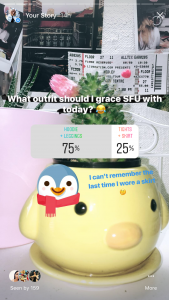
 

As I waited for my followers to vote, I watched the snow twirl downwards outside, as the
temperatures dropped to -5, or something frigid like that. I pictured myself trudging across campus in a skirt. My followers, though, are very kind people, and 75% of them voted for a comfy hoodie and black leggings AKA what I wear every single day of my life.

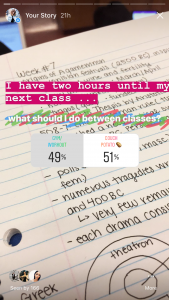
 

THIS POLL WAS SO NERVE-WRACKING. The other two had a clear winner within a few hours in, but this one was neck and neck until the last minute. Couch potato. Gym. Couch potato. Gym. In the end, a mere 49% voted for the gym, so I got to stay home and do absolutely nothing productive or healthy between classes. Normally, I’m equally likely to do either option, but this snow and cold has got me in hibernation mode, so I was perfectly content to stay in my room. On my way to class, I even had time to stop by the fire pits to roast a marshmallow, which I don’t usually do since I’m busy rushing between class/gym/groceries/class.


 

62% of voters urged me to stay home, so I did. I did a face mask. I took a shower. I changed into some sweats and a baggy shirt. I read 50 pages of a novel I’m trying to read for fun. I also started a new show called “End of the F***ing World” on Netflix, which my friends have been recommending for a while. It was nice to chill and take some time to do things I normally don’t have time for. My followers seemed to be on a trend of keeping me comfortable, warm, and content.



I have exactly one class where I don’t know anybody, CRIM 210. I couldn’t find anyone on SFU Facebook groups or in my friend group who was taking it, so I just sit with different people every class. It’s kind of nice to just chill and have my morning Starbucks in peace, but 76% of voters wanted me to talk to someone. I arrived a little late to lecture and then class began, so I didn’t really have an opportunity to speak to anyone. We had a five-minute break which is exactly the amount of time it takes me to walk from my classroom in West Mall Centre to the bathroom and back. Then, in the last five minutes of class, a golden opportunity, a conversation-starter: a few fellow classmates were having a heated debate about the gender difference in youth criminality, and one guy in particular was getting INTENSE. I exchanged looks with the girl beside me, one of those: “This is really uncomfortable for me. Are you feeling the discomfort too? Can we leave?” After class, we joked and talked about it, swapping opinions on the debate and how unnecessarily intense it got. Does that count as making a friend? I’ve sat with her again since that first exchange, so I think it counts.
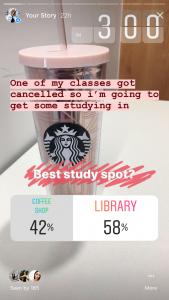


Pretty self-explanatory: I had an extra hour to study since my professor came down with the flu and I wanted a good study spot. 58% of followers suggested the library, so I managed to snag a table in the group study section and studied there. Pros: didn’t have to buy a drink to sit there, volume level wasn’t too noisy, and outlets were plentiful.


 

First of all, I learned that I could deposit a cheque via a picture on the RBC app and that’s really exciting. So, naturally, I’m going to celebrate this discovery by spending my newly earned money. I had an $10 Amazon gift card, so I decided to buy some things off my wishlist there, spending way more than my $10 gift card. I got a blue hand-knit mermaid-tail shaped blanket and the book “The Subtle Art of Not Giving a F*ck” by Mark Manson.




I’m not really a fan of looking like a crazy person in public, generally. Not only was I looking super greasy with an old CRIM FROSH shirt and some weird patterned sweats (they’re comfy, OK?), but I was also now carrying a giant stuffed animal. In university. To class. When my friend saw me, she immediately asked if it was for a Peak article. Another girl who helped me take a picture described the scene as “extra” (but, like, in a nice way) and didn’t ask questions. I’m not sure what my classmates must have thought. Thanks, 70% of my followers.



I’m a sucker for a good back rub and my boyfriend is not only great at it, but he’s patient enough to give me like 12 per week. I’m very tense, OK? I, on the other hand, have zero patience and non-magical hands, but I still thought it would be interesting to switch roles, if my followers saw it fit. TL;DR: they didn’t. Only 23% felt Brendon deserved a sub-par back rub from me. Instead, I got an awesome one from him.


 

“You’re going to regret that,” my boyfriend said, as I published the final poll option.

“Why? It’s fun,” I protested.

“They’re going to vote that you go to bed at 2 a.m., and we both know you’re going to hate that.”

He has a point. If I get any less than eight hours of sleep per night, I function about as well as the undead. I normally go to bed around 10:30 p.m. and get my full eight to nine hours. This was yet another nerve-wracking poll, as the numbers stayed around 50/50 for most of the time I had it up. Was it weird to go to bed so early? A little. I had to sort of abruptly finish my day when I remembered, shut my laptop, get on my PJs, and just head to bed. I did get a really, really good night sleep, though.

So, in the end, I didn’t get a new tattoo or fly to an European city, but I did get some much-needed relaxation time, made a new friend in one of my lectures, and got a great night’s sleep. It might not sound like much, but when you think about it, isn’t that the stuff that we all need a little bit more of?

World News Beats

0

By: Nathaniel Tok, Peak Associate 


Europe colder than the Arctic

Europe is being engulfed by a cold spell, seeing temperatures plummet and leaving cities scrambling to shelter the homeless from the freezing weather, while places north of the Arctic Circle are seeing warm winters. Temperatures in Britain reached lows of negative five degrees Celsius while Northern Greenland had highs of six degrees Celsius. Scientists believe the warmer Arctic winters are part of a trend connected to colder European weather. Storms that increase temperatures in the Arctic by blowing in warm air from the Atlantic in turn weaken the “polar vortex” that keeps cold air in the Arctic, which can blow over Europe, causing the cooling. Scientists fear that future warm weather trends will melt the polar ice caps, flooding coastlines.

With files from The Toronto Star.


Afghan president offers talks to Taliban

Afghan President Ashraf Ghani is seeking dialogue with the Taliban “without preconditions” in exchange for the Taliban recognizing the Afghan government and obeying the law. The group has refused to talk to the Afghan government in the past, seeking only direct talks with the US. Ghani’s previous peace offers with the group did not stop Taliban attacks, but he now offers the possibility of recognizing the Taliban as a legitimate political party. The offer for talks arrive as fighting intensifies and America increases its assistance to the Afghan government. Ten of thousands have died since the war began in 2001.

With files from BBC News.


IOC removes ban from Russia

The International Olympic Committee (IOC) has removed its ban against Russia after the country was prohibited from participating in the 2018 Winter Olympics over doping. The statement from the IOC confirmed that two Russian Olympians tested positive for doping, but after no further failed drug tests, the ban on the Russia Olympic Committee could be lifted. 168 Russian athletes competed in the 2018 Winter Olympics as “neutrals” and could not display national colours or the Russian flag.

With files from The Guardian.


Scientists find huge penguin colony on Antarctic islands


A colony of over 1.5 million Adelie penguins have been found by NASA satellites in the remote Danger Islands on the northern tip of the Antarctic. The area is treacherous for humans to visit even in the summer, and the penguins were only spotted after significant patches of excrement was detected in satellite images. Using drones and Deep Neural Networks, an estimate was produced for the number of penguins. Adelie penguins numbers are falling in the other areas of the Antarctic due to the polar ice melting from climate change. Ecologists are now looking to investigate the reason why the Adelie penguin population has remained uncharacteristically stable.

With files from CTV News.

CJ Rowe talks SVSPO, Sexual Violence Awareness Month, and more

0
Photo courtesy of CJ Rowe

By: Jennifer Low 

Fast facts on CJ Rowe

  • Name: CJ Rowe
  • Pronouns: They/them/theirs
  • Position: Director of the Sexual Violence Support and Prevention Office
  • Education: Doctorate in Education (UBC), a Master of Arts in legal studies (Carleton University), and Bachelor of Arts degrees in sociology (University of New Brunswick) and sociology and women’s studies (Acadia University)
  • Work experience: Ten years of experience as a diversity advisor at UBC, co-leading programming around building education awareness on equity and diversity issues specifically related to students of gender-diverse identities. Policy analyst with Womenspace, a women’s resource centre in Ottawa. Analyst on sexual violence and gender-based violence within Internet communication technologies. Executive director of Qmunity, a queer, trans, and two-spirit resource centre based in Vancouver. Other work for national and Vancouver-based non-profit organizations.
  • Fun fact: When the weather’s warm and they’ve got some time off, one can often find Dr. Rowe rock climbing in Squamish.

Even with my poor sense of direction, I can easily find the cozy Sexual Violence Support and Prevention Office (SVSPO), currently nestled within the Academic Quadrangle in room 3045.

As soon as I enter the office, I am greeted by the SVSPO director Dr. CJ Rowe. With the beginning of what is going to be another heavy snowfall gently descending outside and a space heater keeping our toes warm, Rowe and I sit down to talk about the brand new office.

Rowe describes the Sexual Violence Support and Prevention Office as a community-based service that is “intended to be a hub for the Simon Fraser University communities,” and to provide support and services to faculty, staff, and students on all three campuses.

The SVSPO provides support to all survivors, regardless of how recent or long ago the experience of sexual violence or misconduct occurred. The SVSPO also offers aid to people who are supporting survivors, and backing for faculty, staff, and students when it comes to supporting a disclosure.

Another important service the SVSPO provides is referrals to on-campus support and community partners. Rowe acknowledges that some people may feel more comfortable accessing help in their home communities whether that is within the Lower Mainland, the province, or even other parts of the country or world and that the SVSPO is therefore equipped to help individuals access those services and support systems.

Rowe states that the goal of the SVSPOs’ service to the community is “to help provide the opportunity for someone to have a more positive experience in their day to day life here on campus.”

The SVSPO is the only place through which a survivor of sexual violence or misconduct that is interested in doing so is able to make a formal report, which can be passed through the appropriate channels for an investigation to take place. However, they emphasize that “in order for an individual to access support through our campuses, you do not have to make a report: a disclosure is enough to get the support you need.”

When asked about how confidentiality in these cases is ensured, Rowe explains that the SVSPO operates under a number of different privacy acts and works closely with the university council to ensure that the information that are being collected and the systems used to store it are situated appropriately within privacy law.

According to Rowe, “Education and training is a big piece of what we facilitate through the office and we work with partners across all of our campuses to do that.” The SVSPO provides four free and comprehensive workshops put on by the centre’s educator Ashley Bentley. Bentley works with campus community members to find out what issues are most important to them in order to tailor the workshops specifically to their audiences. Rowe believes that these workshops are key opportunities to help build knowledge and to start or continue conversations surrounding sexual violence in different communities. The SVSPO’s website holds more detailed information about each of the workshops as well as how to sign up. Through education and awareness programs, Rowe hopes that the SVSPO may be able to make a greater impact in “[equipping] all of our campus community members [with the ability] to support somebody who makes a disclosure.”

Having only opened in mid-January and officially launched with the email broadcast on February 1 as SFU moved into the full implementation of the GP 44 sexual violence and misconduct policy, the centre is still fairly new.

“We’re learning new things about the needs of our campus communities every day,” Rowe says with a smile, acknowledging that there are challenges when it comes to learning by doing, while also stressing the advantage getting a more intimate understanding of the needs of the community.

Rowe comments that the reception they have gotten since they began their time as the director of the SVSPO has been a positive experience, recalling that people have been very candid in conversations surrounding some of the “harder edges” of the history of action that has and has not taken place around sexual violence and misconduct on campus. Rowe describes the experiences as “very heartening [. . .] there are many people in this campus community that are past ready for change.” They note a widespread curiosity regarding what kind of impact a centre like the SVSPO will be able to make on campus.

A current barrier of the SVSPO is that the office is physically located on the Burnaby campus, which may leave students at the Surrey and Vancouver campuses with the feeling as if the SVSPO’s services aren’t available to them.

“What I would love for those communities to know is that our case managers and educators and myself are fully mobile, we have cell phones, and we can drive to meet people where they’re at,” Rowe says of the issue.

As a self-described “hopeful optimist,” Rowe states that “while there are pieces we are definitely wrestling with right now, we’re going to find solutions and we can only do that by working closely with our community members.”

When asked about LGBTQ+ issues that come up, Rowe states that in their experience working with and supporting individuals who are part of the LGBTQ+ community, they recognize that these individuals’ experiences are often left out of the narrative. “One of the key pieces I would like to see is everyone sees that this office is for them,” Rowe says. They further stress that at this point in time there is an opportunity to build relationships and systems in order to be better able to support all members of the SFU communities.  

As our interview draws to a close, we talk a little bit more about how one could get involved with the SVSPO. A great opportunity Rowe suggests to students who wish to learn more about what it means to facilitate change in the community through everyday interactions is the Active Bystander Network, which is is a student engagement opportunity that works together with the SVSPO to “create a culture of zero-tolerance for sexual violence at Simon Fraser University.”

This March, the SVSPO will be co-hosting Sexual Assault Awareness Month with a number of partners in order to deliver a series of engagement opportunities for SFU communities.

“The idea of Sexual Assault Awareness Month this year is to build relationships with our campus communities in order to hold a yearly month-long series of events around building awareness about sexual violence intervention and prevention,” Rowe says. In other words, spreading the word and setting down roots in the campus community. This includes using podcasts, a blog, and a new website that will be going up later this month.

When asked why students should be interested in Sexual Assault Awareness Month, Rowe responds that “sexualized violence can happen to any of us at any point in our lives [. . .] this office is here to support those people who experience it first-hand, second-hand, third-hand, and that’s the work that we’re here to do.”

12 years of the Clan in the BCIHL: a history of SFU hockey

0
Selkirk College is the only team in the BCIHL with more championships than SFU. (Photo courtesy of SFU hockey)

By: Dylan Webb

The 2017–18 British Columbia Intercollegiate Hockey League (BCIHL) season is winding down as early in the year as it ever has for the SFU men’s ice hockey team. Therefore, it is an appropriate time to reflect on some of the highs, lows, people, and notable events that comprise the 12-year BCIHL history of what has been a successful organization. With the program having existed in its current form for what is now 12 seasons of highly competitive intercollegiate hockey and having missed the playoffs in just one of those seasons, the team is deserving of some recognition of the variety of factors that have made it one of the strongest organizations in the league year in and year out.

The team plays its home games at the Bill Copeland Sports Centre, just minutes down the hill from the Burnaby SFU campus. Though SFU did field some sort of hockey team in the late 1970s, not much is known or documented about the team at that time and thus for the purposes of this historical review the birth date of the SFU hockey program coincides with the birth of the BCIHL in 2006. Playing in what is now a six-team league that includes cross-town rival Trinity Western University, the team hosts its regular season and playoff BCIHL games at the Bill Copeland Sports Centre as well as special events such as the Great Northwest Showcase and the University Hockey Classic. The Clan hockey team have also travelled to a variety of National Collegiate Athletic Association (NCAA) Division 1 schools for exhibition matches. From Anchorage and Fairbanks Alaska in 2017 to Boston, North Dakota, and Ohio in previous years, the team has crossed much of North America in its storied history. Recently, the organization, in partnership with SFU Athletics, has considered jumping the team into NCAA athletics alongside much of SFU’s other athletic programs. This would mark a significant evolution of the program from its humble beginnings as part of the three team BCIHL were NCAA certification to come to fruition.

As far as personnel is considered, head coach Mark Coletta has been a steady influence on the organization since soon after its inception into the BCIHL. Having been named head coach of the Simon Fraser University men’s hockey team in July 2008, coach Coletta has coached the Clan to two BCIHL Championship victories and five total appearances in the BCIHL Finals and continues to steer the team both on and off the ice with respect to recruiting and management. He has been named the league’s Coach of the Year twice and also holds the distinction as the BCIHL’s all-time wins leader, as a coach, with a regular season record of 130–39–12 over eight seasons. Coletta’s on-ice presence is complimented by the hard work behind the scenes of director of hockey operations Chris Munshaw who is in his first year as league commissioner as well.

Mark Coletta (right) has been SFU hockey’s head coach since 2008. (Photo courtesy of SFU hockey)

Previous to this season in which the Simon Fraser University men’s hockey team have missed out on the playoffs for the first time in the organizations BCIHL history, the Clan had taken part in playoff action in 11 straight seasons. As a founding member of the BCIHL, SFU hockey has consistently been one of the top teams in the league with respect to both regular season and playoff success. The Clan has won the BCIHL championship three times which is second only to the Selkirk College Saints (four titles) and have won the regular season title a total of eight times including in seven straight seasons from 2008–14. Even this season, the Clan has only missed the playoffs due to an internal organizational error with respect to the academic eligibility of one of the players that had been on the roster the entire season. Without a ruling by the player eligibility committee that SFU be forced to forfeit almost half of their games played this season, the team would have clinched a playoff berth for the 12th straight season.

Mak Barden is one of six players that will be retiring from SFU hockey this year. (Photo courtesy of SFU hockey)

The Clan have certainly produced some of the BCIHL’s most legendary talents as current players such as Mathew Berry-Lamontagna, Brandon Tidy, Brendan Lamont, Tyler Basham, Mak Barden, and Lyndon Stanwood complement a powerful Clan alumni class. This class is headlined by Clansmen such as Jono Ceci, Paul Moscone, Graham Smerek, and Nick Sandor among other alumni. Goaltender Stanwood, on the final day of the regular season of his final year as a member of the SFU hockey team, clinched the honour of most winningest SFU goaltender in team history with his 30th BCIHL win. Unfortunately, Stanwood was unable to achieve a BCIHL Championship in his three years with the team, but his individual statistics undoubtedly make him one of SFU’s most memorable goaltenders. The Clan can also boast about having had the highest scoring player in BCIHL history wear the red and white of SFU hockey for five years. Jono Ceci, a 1990-born North Vancouver native, remains the league leader in points scored with an astonishing 177 points in 108 games played. Without a doubt, the Clan’s rich history of regular season and playoff success as a team is complemented by the organization’s demonstrated ability to recruit and develop some of the most dominant players the BCIHL has ever seen.

Lyndon Stanwood is the winningest goalkeeper in SFU history. (Photo courtesy of SFU hockey)

All in all, as SFU hockey staff, coaches, and players begin to process the reality of a long summer without playoff hockey for the first time in the organization’s existence, a broader historical overview of the generally successful history of SFU hockey can help lessen the immediate sting of a lost season this year. What is clear is that the team has become accustomed to a degree of success on the ice that they were unable to achieve this year and therefore the team, with its crop of returning players surely to be complimented by some fresh recruits to replace the six departing seniors, will be hungry to restore its status as perennial playoff contender.