Home Blog Page 585

Disney Roommates: Best and Worst

0
Alice Zhang / The Peak

Written by: Tiffany Chang, Peak Associate

I’m sure all of us Disney lovers wish that the characters were actually real. Come to think, having a Disney character for a roommate would be the ultimate, right? But  before you shamelessly fantasize about an automatic, platonic “happily ever after,” you might need to consider some funny quirks. Here’s a run-down of some who I think would make the best and worst roommates.

Best Roommates

Cinderella

She’s super sweet, not to mention you’ll have a tidy dorm 24/7! I’ve definitely noticed her fantastic wardrobe now that she has the powerful abilities of her fairy godmother at her disposal. Maybe she’ll lend me her cute glass slippers sometime, assuming my feet can fit into them! Imagining myself all gussied up in literally magical attire is beyond awesome!

The only drawback is her rodent-friends. Firstly, the mice do seem nice enough. After all, they did help save the poor thing escape from her stepmother. However, I don’t want people freaking out and calling an exterminator in the middle of the night. Cinderella would go rat-shit crazy!

Belle

Meals with Belle will never be dull. You’ll get dinner and a show every day! Plus, you won’t have to wash anything either; the dishes can clean themselves! A happy-go-lucky, self-operating kitchen sounds like a dream. Eating freshly-made food using fun-loving utensils? Count me in!

But oh, wait. Now that her hideous beast of a boyfriend has turned as drop-dead gorgeous as one of the Greek gods, there is definitely some R-rated action for this G-rated character. Not sure when this transformation took place — I heard through the grapevine that there’s this self-help book he read called From a Monster to a God: How to transform your Ugly Personality and Appearance by Showing Scraps of Kindness to a Young Lady, co-authored by a clock and a candelabra.

Worst Roommates

Shang

Mulan may have fallen for him in the movies, but as a roommate? I’m not so sure. He’ll definitely bust my ass for not being in shape. I don’t feel thrilled about him and his goal to “make a man out of” everyone he meets. I mean, getting down to business doesn’t always mean we’re preparing to defeat the Huns.

That reminds me: his fetish for unnecessary violence could lead to picking fights with the neighbours. I don’t have the manpower to get through this semester, let alone deal with constant visits from our RA concerning my roommates’ “frequent initiations of physical altercations.” Sorry, Shang!

Sleeping Beauty: (AKA “Aurora” to her parents, AKA “Rose” to her three fairy godmothers, AKA I really don’t know anymore, she has way too many different names)

Ah, yes, someone I know who sleeps just as much as I do! Now, I love the girl and her story, but the main concern I have is the fact that Aurora’s easily impressionable. She could be enchanted by some sort of salesman on campus as we speak! I might have to watch out for her like an older sister. Look at how easily she was cast under Maleficent’s spell! Yikes! I already have a black cloud over my head as it is!

Now I need to take care of her, so she doesn’t go around pricking her damn middle-finger on spinning wheels? Thanks, but no thanks.


SFU Beedie School of Business and KPMG co-create a novel education program

0

Written by: Sakina Nazarali, Peak Associate

SFU’s Beedie School of Business (SFU Beedie) has partnered with KPMG, a professional service company that offers auditing and accounting services, for a new graduate program that will teach audit professionals enhanced digital and cognitive analytic skills.

SFU Beedie announced the three-year partnership in December via a press release on their website. SFU Beedie was chosen by KPMG because “the school demonstrated its ability to deliver this forward-looking program through an advanced online interface, alongside in-person teaching sessions,” according to the release.

The program, titled Digital University, “focuses on developing auditors for an era of machine learning, artificial intelligence, and other digital advances” said Will Henderson, manager of communications and public relations of SFU Beedie in an email interview with The Peak. He describes the program as “open to qualified CPAs within KPMG’s Audit practice with 3–6 years of experience.”

Upon successful completion of the Digital University program, auditors will earn a graduate certificate in Accounting with Digital Analytics and they also have the option to continue their training to obtain a Master of Science in Accounting with Cognitive Analytics, according to Henderson.  

The certificate program will be launched in summer 2019 and it will conclude in December 2019, according to Henderson. The MSc program, on the other hand, will be launched in summer 2020, and certain auditors who have earned the certificate will be nominated to enrol in the MSc. The entire program, including the certificate and the MSc, is part-time and will take about two years to complete, he added.

“KPMG’s Digital University program is the first of its kind in Canada and focuses on developing auditors for an era of machine learning, artificial intelligence, and other digital advances,” said Henderson. “The program will offer KPMG professionals the training, practical experience and work environments they need to accelerate their careers in the fast-changing data age.”

The program will not only aim to bolster practical knowledge in data analysis for participants, but also encourage them to “combine these skills with critical thinking to derive meaningful business insights from data,” according to the SFU press release.

Digital University participants can keep working while completing the program’s course requirements. “Around 80 per cent of the course work will be delivered online . . . But students also will attend a limited number of face-to-face classes led by Beedie professors,” said Andrew Gemino, SFU Beedie’s associate dean of graduate programs in an interview with The Globe and Mail.

“The Digital University relationship between SFU Beedie and KPMG in Canada reflects a shared commitment to developing innovative business professionals who will lead the way in their industry across Canada,” said Ali Dastmalchian, SFU Beedie’s Dean, in the university’s press release.

  With files from SFU Beedie School of Business and The Globe and Mail

Into the Spider-Verse is an animation marvel

0
Image courtesy of Sony Pictures Animation

By: Winona Young, Arts Editor

Even though this franchise has created three Spider-Men (and even more films) and counting, Spider-Man: Into the Spider-Verse is hands-down the best Spider-Man movie of all. The story is heartfelt and hilarious, and the animation is so marvellous you can’t help but wonder why more superhero films aren’t animated. Exhilarating and evolutionary, Into the Spider-verse is sure to be anyone’s favourite film.

Set in modern-day Queens, we’re introduced to your friendly neighbourhood Miles Morales. He is a (somewhat struggling) middle-schooler, a son to (almost too) loving parents, a secret spray-paint artist, and recently, a victim to a spider bite. Cue, of course, interdimensional shenanigans and villains, which all culminates in multiple Spider-people arriving in his universe.

Among animation, great voice acting, script writing, et cetera, the most compelling thing about this film is the diversity of the Spider-people. Not only do we have the first Spider-Man of colour (on the big screen at least), but we have a Peter (B.) Parker that for once isn’t such a golden boy, and even a Spider-woman, Gwen Stacy.

Miles’ evolution into his own Spider-Man, through the guidance of his fellow Spider-People, friends, and family, is the true heart of the movie, marking Into the Spider-verse as a one-of-a-kind, genuine, and heartfelt film.

This strong script is supported by even stronger visuals. The animation is vivid, bright, and breathtaking. Comic genres (and animated films for that matter) are infamous for only including white faces and characters — but Sony created a film that seamlessly did justice to the Afro-Latinx protagonist, and they also populated the screen with a crowd as diverse as real-life Queens. Even just the attention to detail when it came to distinguishing universes is fantastic; small references like a poster of Chance the Rapper with a #4 hat breathe even more life into the film.

This film, however, is not without its flaws — even if they may be minor. For example, while Uncle Aaron is a great foil to Miles’ parents in the first 20 or so minutes, his later re-appearance felt more like an afterthought than an organic buildup.

For instance, while I did love seeing an Asian Spider-Girl, Peni Parker, it is exhausting to see the filmmakers went for the too-tired “Japanese anime school girl” trope. (And expanding on that, the filmmakers specifically went for another Asian kid with a giant robot friend trope, but that’s a discussion for another day). More interaction between the two Spider-Girls, aside from a throwaway line about a plan, would’ve also been nice. But while it’s very worthwhile to bring up these flaws, they do not detract whatsoever from how wonderful and how necessary this film is with its young POC superhero protagonist.

Overall, while the superhero genre has been oversaturated for a while now, Into the Spider-verse stands as a unique story that wonderfully inverts the lone superhero trope. With a fresh protagonist, gorgeous animation, and wonderful worldbuilding, it’s clear that this film is now the Spider-Man film all of us will remember.

STRAY OBSERVATIONS:

  • Do you think after saving New York City, that Nike would’ve noticed the new Spider-Man is wearing their merch? Would Spider-Man be brand loyal? Perhaps offer him a Spider-sponsorship? Only time will tell.
  • All of Peter Porker’s lines are killer. Especially the uncensored ones.
  • The after-credits scene was the pièce de resistance of the film. I’d wager even funnier than Deadpool’s.

What Grinds Our Gears: Computer-lab desk-hoggers

0
Photo by Hanyi Jiang/The Peak

Written by Kitty Cheung, Staff Writer

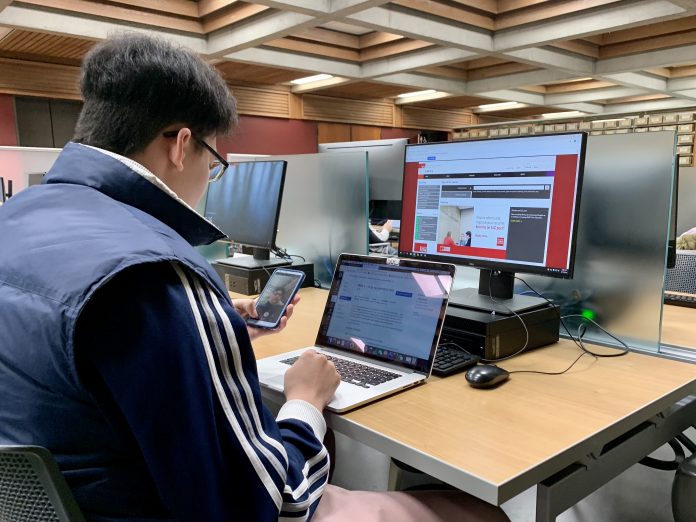
When you’re walking through the library during peak study season, a free desktop computer can be a rare sight. As someone who doesn’t want to lug her brother’s bulky hand-me-down gaming computer out of the house, I revel in the library computers as a great resource.

What irks me, however, is coming across fellow students sitting in front of computers with the keyboard pushed back, with their laptops filling up their space.

Why do students keep doing this? All there is for you at those desks is less room to work: even when pushed away, the mouse and keyboard take up a third of your desk space. That space is already limited considering your pile of notes, splayed open books, and laptop. Combined with a blank monitor just in front of your face, this cannot possibly be a convenient spot for you to study.

Please, if you have your own computer, go sit at a regular desk. Find a cubicle, an open table, a comfy armchair, or any other sort of ideal study furniture. Don’t take up seats in the library computer labs when you already have the benefit of your own portable computer. You’re hindering students who don’t have their own portable computers from getting their shit done.

Bird Box delivers a deeper message that you may have overlooked

0
Image courtesy of IMDb

By: Marco Ovies, SFU Student

At first glance, Netflix’s new original movie Bird Box may seem like your cookie-cutter suspense film, joining A Quiet Place and Don’t Breathe. With flat characters that never venture past their stereotypes, negative depictions of mental health, and an unsatisfying ending that gives no real resolution to the problem at hand, there is not much going for this movie — but Bird Box is still worth checking out.

On the surface, there is not much to Bird Box. The premise is that monsters end up taking over the world, and if you look at them, you end up hearing voices and committing suicide. So to stop themselves from looking at the creatures, all characters wear blindfolds — that is, everyone except the mentally ill. It’s implied in the film that because these people are mentally ill, it makes them immune to committing suicide even after seeing the monsters. These mentally ill people are portrayed as crazy and try to convince others to look at the monsters. They are then deemed as crazy and dangerous beings who threaten the lives of everyone else who has survived this incident. Admittedly, this seems like an overgeneralization and negative stereotype of mentally ill people, depicting them as wildly dangerous. It is very easy to make a quick judgement and accept this negative portrayal of mentally ill people, but there is a deeper meaning hidden below the surface.

The monsters are a physical representation of suicide and mental illness.  The reason why characters cannot see them is because mental illness has no face and can affect anyone — it’s a silent killer that no one can see coming.  Surviving characters in the film are generally shocked when their friends and family commit suicide, saying that they did not see it coming, and that is exactly what anyone would hear in the news from those close to a suicide victim.

The “mentally ill” want to convince others to see the monsters because this is what they have faced every day. They are used to coping with this feeling, and they want others to see exactly what they go through. These people are able to survive because they have been dealing with these monsters forever.

There is definitely still room for improvement for this film. The characters of this story never go through any real development (aside from Sandra Bullock’s character who even then does not grow throughout the story). The ending of the movie really falls flat as well. There is a great buildup which really had me at the edge of my seat, and then it was all over so suddenly. Everything resolved too quickly and there was no explanation as to how things were all of a sudden okay. There could have easily been another half-an-hour to forty-five minutes of this movie to tie everything together.
Overall, Bird Box does have its pitfalls and overgeneralization on the mentally ill, but I still believe you can get some good out of it.

Ashley Brooks is ready to lead Out on Campus through its reopening

0
Chris Ho / The Peak

By: Lauren Wallace, Peak Associate

Fast facts on Ashley

Name: Ashley Brooks

Pronouns: He/him/his

Education: Ashley recently finished his PhD at Anglia Ruskin University on the perception of gay men in the United Kingdom

Hometown: London, England

Hobbies: Ashley loves cooking and travelling, especially when combined

Recent trip highlight: A two-month honeymoon in Europe and a “fantastic” Independence Day fireworks show on the beach in Hawaii


Right now, walking upward from the lower level of the Rotunda implies navigating a maze of caution tape, plastic sheeting, and signs that point out exactly where we’re supposed to walk this day of the week. But amidst all the clutter and clamor of the construction, one brightly coloured clapboard out in the Rotunda’s walkway gives a beacon of light and safety to SFU’s LGBTQ21A+ community.

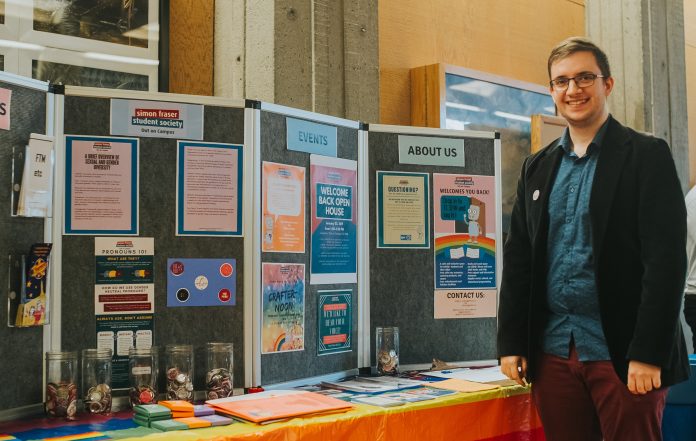
Out on Campus (OOC), reopened since November of 2018, is colourful and inviting as I sit down on the ever-comfortable couches in the resource lounge. I’m here to interview Ashley Brooks, who’s now at this space’s helm as the new OOC coordinator.

Ashley recently emigrated from England, warmly expressing his excitement about working as the new coordinator. Not only was it a way to support the LGBTQ21A+ community, but it’s also a way for Ashley to overcome the barrier of being an immigrant with no Canadian work history. That being said, he’s particularly excited about the change from selling personal loans downtown.

“I was like, yes! Get me out of here! Please let me do something I’m trained to do and that I really love doing!” Ashley jokes.

 Ashley’s history of involvement

Ashley comes to SFU with significant experience in organizing and running groups, starting from getting engaged in the LGBT Society at his previous university, Anglia Ruskin, and going on to become their treasurer for a year.

Then his focus switched to research, concentrating on focus groups on attitudes towards transgender people in the UK. He facilitated research groups, organized surveys, and analyzed data before catching what he called, with a big smile on his face, “the research bug.”

Ashley did his final-year project on the position of being come out to, and “flipping the script” as he described it. Soon after, he pursued his PhD, spending three years researching attitudes towards gay men in the UK and the stereotypes surrounding the community. As if a PhD wasn’t enough of a workload, he also started working at a charity called the Encompass Network.

He described not only how that organization linked a bunch of LGBT groups together within Cambridge County, but also the immense amount of work that was ahead of him.

“I came in at a very tumultuous time … I walked in on a five-month backlog, and everything was on fire!” he remarked, grinning.

Happily, he added, “But we got through it! And I was there for a year. I would have stayed longer, but I was getting married, going off on honeymoon, and then moving to Canada!”

The move to Canada

One of the biggest joys of talking to Ashley was listening to him recount growing up in England. “London is a really interesting place. Obviously, it has a soft spot in my heart.”

However, he did acknowledge that living there was fairly difficult. “I outwardly sound like a posh Brit,” he joked, “but the reality is I grew up in poverty in London.”

He remarked that even after moving away to Cambridge for university, there were still problems, similar to those that certain communities face here in Vancouver, such as homelessness. The rivalry between Ashley’s alma mater and the prestigious Cambridge University it shares the town with might even be likened to SFU and UBC’s relationship.

At the same time, he found there weren’t many big differences between the LGBTQ21A+ communities in Canada and the U.K. Ashley thinks it may have to do with the similar laws and protections both nations offer, which result in similar perceptions of “reverse inequality.”

The challenge of reopening Out on Campus

Considering that his experience with Encompass seemed to beg similarities to joining Out on Campus after a long period of closure, it became clear Ashley had an appropriately realistic grasp of what he was getting into by stepping up to the plate at SFU.

“I was aware coming into the [job interview] that the space had been closed since the end of August until I started. I was aware that I was walking into a situation very similar to Encompass and that everything could be on fire, and I was at peace with that,” he nodded.

“I’ve had to talk to a lot of people and understand the recent history of Out on Campus and those issues like staffing that have really made the service suffer and, by extension, made our communities here suffer.”

Yet he was assured in his ability to get through it all, and “rebuild and restore faith in Out on Campus.” Of course, now that Ashley is here, one of the biggest questions on the table is what the next hurdle is for Ashley to tackle.

“One of the big challenges for us is outreach,” he began. The lack of OOC in September, during Week of Welcome and the fall Clubs Days, really hurt public knowledge that the space even existed. Recently, OOC has been trying to be as visible as possible.

Ashley was happy to mention OOC’s participation in the Spring term’s resource fairs and Clubs Days. “That is a really good opportunity for us to re-engage with students, rebuild that community.”

Fitting in with the Rotunda community

While sitting in the Rotunda, looking out over the sea of plastic-covered construction, it was impossible to ignore the future situation of OOC, and the future of the Rotunda community in general.

Ashley touched on the fact that as OOC is a department of the SFSS, he is in an awkward position for expressing his support of the groups still mired in questions about their future existence. He expressed his gratitude that so many groups currently involved in the Rotunda space concerns seemed appreciative of his position.

“I’ve already networked a lot with SFPIRG,” Ashley noted. “Craig [SFPIRG’s Director of Communications]’s been incredibly helpful, as he used to work here as an administrative assistant.”

He went on to express his wish to engage more closely with SOCA, but was hesitant to distract them from their current efforts. “I’m conscious that they are very, very busy just fighting to exist.”

He is optimistic and excited to move to the SUB building though, despite expressing concerns typical of moving to a new space, such as whether the new building will offer a room “fit for purpose” of the safe space OOC currently stands for. After being able to take a site tour of the new OOC location, he was excited to report not only is the space somewhat larger than the current one, but also that it had side rooms more suitable for private discussions or quiet areas where students and OOC staff can work.

“I’m really excited to see it when it finishes.”

Next steps for OOC

The next step in anchoring OOC to the SFU community, he says, is collaboration with other resources and departments at SFU, such as the Human Rights Office.

When I asked what the community here at SFU can do to help out with the initiative to bring OOC back into the spotlight, he was very clear: “Volunteer.”  Ashley said the inconsistency in keeping the space open really hurt the volunteer initiative in the space, but he is positive that everything is looking up as volunteer orientations are on January 30.

He was happy to report that not only have they developed more materials to train future volunteers, but OOC has been granted the capacity to let students include volunteer time at OOC on their co-curricular records. This, he said, would be a great way to “boost [the] employability” of students who want to contribute.

Ashley also revealed the space has launched a new anonymous messaging service on an app called Lipsi, for students who might find entering the space daunting, or who are worried about outing themselves to peers simply by crossing OOC’s threshold.

“People can anonymously ask us for peer support, we can help signpost them for some on-campus and off-campus resources, they can talk to us about issues they feel embarrassed about, that they don’t want to talk to us about in person….”

The next place you can meet Ashley in person is at Out on Campus’ reopening event, featuring free food and drink, on January 23. “It’ll be a really nice opportunity to rebuild that community,” he says.

“We’ve had a rough time as the space has been closed,” he acknowledges. But Ashley strongly believes that student engagement is the way to rebuild OOC. “Come in. See us. Give the service a reason to exist. Send the message that we are important and valuable to the campus community. Say hi,” he finishes, smiling.

As I leave the space, amidst goodbyes and some waves, it is heartwarming to see more people have joined the room since the start of our interview— getting lunch, talking with staff, working on their own projects. With an accomplished veteran of tricky transitions at the helm, it looks like the Out on Campus space will continue to bring LGBTQ2IA+ students a warm place to call their own.

If you miss chatting with OOC staff during the Clubs Days week, make sure to check out their re-opening event, January 23, or reach out to the coordinator through [email protected].

The anonymous chat service is also available at lipsiapp.com/ooc-admin-assistant. The Lipsi app is available for both iPhone and Android devices. All terms of service for the OOC app can be found on their Facebook page.


Failure shouldn’t be how you learn to be a good student

0
Illustration by Marissa Ouyang/The Peak

Written by: Gene Cole, Opinions Editor

When I first got to SFU, one of the first jokes I heard was that the most relieving thing you could hear from a peer is “I haven’t started either.” It’s not exactly an extreme statement, but it’s far from the only time you’ll hear students here making light about unpreparedness, disorganization, or failure. I’ve seen a lot of things like a TA assuming the tutorial hasn’t done the readings, or mocking a friend’s detailed calendar as “working too hard.”

But once you start really failing — like I nearly did a few years ago — your opinion on academic skills and failure changes quite quickly. It turns from a joke into an absolute disaster.

Most of the time, it’s just a sign you’re lacking something; academic skills like studying and scheduling, and/or the ability to sufficiently handle your personal life. But while students are expected to have these, there is no true guarantee that they will.

As much preparation as some high schools and colleges give, the university workload is incomparable to anything most people do before their 20s. Even with the intended lighter difficulty of first-year classes, there’s still no shared preparation for being capable in a university environment.

The only guaranteed preparation we have is SFU 101, a non-mandatory online course that you’re automatically enrolled in on Canvas in your first semester. The intent is to prepare for this more complicated life, but when you’re fresh into post-secondary or are transferring from another institution, it’s easy to see it and think “eh, I don’t need this” and let it fade in the back of your Canvas account.

A potential solution to this would be for the school to provide a live, mandatory seminar to teach these skills and inform students of resources in-person. Alternately, new students could be required to attend a single mandatory appointment with an advisor in your first semester to make sure you have a plan, check what your skills are, and help you contact resources you might be in need of.

These both would realistically be difficult to implement, given the likely massive cost for the school and time commitment by staff and students, but optional resources just don’t do enough. As it is, it’s far too easy for students in need to miss these resources if they aren’t sat right in front of them.

When academic skills aren’t directly taught, it leaves a lot of students behind. In many cases, it means you end up in Back on Track, SFU’s three-term retention program for students with a Required to Withdraw in place of their academic standing.

But it’s here that a lot of students learn that it’s not just the academic skills they’re lacking; The course focuses on managing everything in life, from personal relationships to mental wellness. Much like academic skills, these are things that make a massive impact on your ability to succeed in school, but very few people have them ready by the time they enter post-secondary.

The importance of these skills are certainly no secret to Back on Track’s advisors and instructors. In an interview with Bernard Ryu, a Back on Track advisor and instructor for one of my terms in the program, he was quick and happy to expand on this value.

“University isn’t about cramming facts and information into your brain, it’s about you evolving and growing as a person. Whether it’s healthy counselling, or student learning commons, or academic advising [. . .] I think the prevailing and consistent theme throughout is to look at the student from a holistic point of view.”

For a lot of students, post-secondary is more than a difficult level of education. They’re growing more independent, they’re responsible for their own needs and social life, and many need to start juggling school with greater responsibilities like work and family. Much like academic skills, these aren’t taught in a mandatory way at SFU, and it’s hard to say where or how a student could be expected to know them by their first semester.

After all, there’s tons of reasons why someone would lack these skills and not even know it. When asked where successful students gain the skills taught in Back on Track, Ryu answered “There’s a group of people — myself definitely included when I was younger — that don’t know how to study, or how to work hard. Maybe you were above average, or you did okay, or things came relatively easy to you.”

These aren’t things that I want to have learned after almost failing. Everything from Health and Counselling to academic advisors are all optional things, but what they provide is so significan. It’s frustrating how many students only end up seeing them in dire situations that aren’t in our control.

For now, though, I’d urge any new students to start seeking these resources themselves the moment something goes wrong. Ryu’s advice to students who may be walking the line of failure was to “Go ask questions [ . . . ]. There’s literally thousands of SFU staff that are non-instructional staff, non-prof or TAs that come to work — like myself — Monday to Friday, sometimes even evenings and weekends.”

The resources to be good at school are here at SFU. But we absolutely need something more than a few helpful reminders in our SFU Mail to get us there when we need.

Pokémon: Let’s Go hits the top percentage of enjoyability

0
Image courtesy of Nintendo

By: Zach Siddiqui, Copy Editor

If you have yet to wander down the nostalgia route that is the first Pokemon games for the Nintendo Switch, let’s go! Two months after their initial drop, Pokemon: Let’s Go, Pikachu! and Let’s Go, Eevee! have held up well post-hype.

The Let’s Go games are an updated, alternate-universe retread of the original Pokemon Red and Blue. The new game blends the rough skeleton offered by the classic Game Boy releases with the updated graphics and capabilities of the Switch alongside a few mechanics of the famed smartphone app, Pokemon Go. Despite these games being base-breakers in some circles, I loved my playthrough of Eevee — and I think you might love yours, too.

For starters, I loved the overworld. Vividly lively, nearly every town and route in the reimagined Kanto region was perfectly adapted from its original low-res, colourless aesthetic from 1998. The designers knew exactly how to balance faithfulness to the old look with restyling for the times, and it made the immersion that much better. That said, I wonder if sticking to the rigid bird’s-eye pseudo-gridded layout was the best choice — it may be a Pokemon staple, but I’m wondering if maybe the Switch would have been a good time to experiment with a different game perspective and overworld layout.

The capture system is something which I know outraged a lot of people. Aside from the fact that many did not want to deal with Pokemon Go-style catching in a handheld game and preferred the traditional battle-to-befriend system, the motion controls used in docked mode are both incredibly finicky and a major lockout against players with certain disabilities.

As far as new game mechanics go, I personally enjoyed the new capture system! I liked that I could actually have a measure of control on whether or not I engaged in a wild encounter. Moreover, seeing Pokemon sprites appear and walk around just felt more realistic than a random die-roll picking whether or not to chuck a battle screen at me every time I stepped on a grassy tile.

Of course, it helped that I played almost my whole run on handheld mode — and my personal happiness means little in light of the disservice to the Pokemon players who can’t use motion controls. In future Switch releases, it’ll be critical that we see friendlier control schemes.

From a story and lore standpoint, the game did what was par for the course in the Pokemon series: a fairly simple and kid-friendly main plot, but many tiny details that weaved a bigger background picture.

For one thing, the immediate clue that this is an alternate history to the original Red and Blue is that the player character and rival (officially named Chase and Trace, but as usual, renamable) are completely separate people from the original PC-rival pair — Red and Blue both appear as their own characters in this game, and it’s clear that they had a very different adventure in this ‘verse from the nostalgic one you relive as Chase. Tying back to the parallel-worlds theorizing present in Pokemon Ultra Sun and Ultra Moon, Pokemon Omega Ruby and Alpha Sapphire, and even earlier if you paid attention, we’re left to speculate on whether Let’s Go connects chronologically to any of the other games or if it’s the beginning of yet another series timeline.

(The history of how Pokemon deals with the concept of parallel worlds and split timelines is a hazy mix of in-game clues, Word of God hints, and fanbase deductions. It’s complex enough to deserve its own literary analysis class in the English department, honestly.)

The subtle, dedicated worldbuilding is also obvious from the number of nods to other Pokemon games, emphasizing the dev’s desire for universal cohesion. Rocket Admin Archer from HeartGold and SoulSilver, who appeared as an unnamed executive in Gold and Silver, gets an early-bird role in this game, which (in theory) happens three years before the Johto games. Silph Co.’s building is full of portraits from iconic sites in other regions, like the consecrated Spear Pillar in Sinnoh. The list goes on and on.

Battles were a mixed bag. On one hand, they were definitely way too easy. All the Trainers were pretty weak level-wise and AI-wise, the starter Eevee you get is way too strong, and the Candy system for boosting Pokemon stats is insane. There’s an emphasis on catching long chains of Pokemon, which, combined with your entire party getting experience points for every capture, means you’ll be way too powerful if you train a single team. That said, if you were angry about this, you missed the point of these games.

In most Pokemon games, you can’t afford to swap around your team too much. Every Pokemon you drop in favour of a new capture is a Pokemon you already invested some experience points in through battling with it, and that experience can’t be transferred to whatever you replaced it with. So once you’ve been using your team for a while, changing it is essentially a waste of resources, and I can guarantee your team will be far too weak to function by the endgame, forcing you to go back and spend a million years grinding.  

By making it incredibly easy to level-up your Pokemon and giving you easy wins against Trainers, Let’s Go gives you far more freedom to change up your team as you come across Pokemon you decide you want to experiment with. You’re not screwed if you drop Pokemon you’ve already started training, because experience-point opportunities crawl about everywhere. This lets you play a much more casual and exploratory run, which is a big part of what the Let’s Go games are designed for.

Overall, I was definitely a big fan of these games. While I don’t know if I see mainline Pokemon games using the same style these did, I would be a major fan of future Let’s Go titles adapting other regions and being their own fun, high-immersion, low-commitment adventures. For students like us, games like that are often all we can make time for responsibly.

Guo Pei makes it clear that fashion is (and always will be) art

0
Image courtesy of the Guardian

By: Winona Young, Arts Editor

Remember the lavish yellow gown Rihanna wore to the Met Gala in 2015? Well, the woman behind one of Riri’s most notable fashion moments was none other than the Chinese fashionista who’s been making waves in the art world: Guo Pei.

The artist’s work was recently showcased in the Vancouver Art Gallery, the exhibition becoming available to the public after the documentary of Pei’s work was shown for the Vancouver International Film Festival. The exhibition was luxurious, awe-inspiring, and opulent as all hell.

Walking into Guo Pei: Couture Beyond, the hall was peppered with dresses from her previous collections. A screening of her previous fashion shows placed by the entrance. To give a visual frame of reference for her pieces, think of a mix between Hunger Games’ Capitol fashion and Alice in Wonderland, but couture. There is nothing muted, nothing bland about Guo Pei’s fashion, and even though her work is lavish as can be, it is complex without bordering on messy.

Particular highlights of the exhibit were Guo Pei’s 2012 collection, Legend of the Dragon, as well as her Spring 2017 collection.

Her Dragon collection is as grand as its inspiring myth. The gowns are bold, intricately embroidered, and most importantly, unique. Each beckons the viewer to look closer — there’s hidden imagery in every gown, and one could easily play a game of “Where’s the hidden dragon?”  

While Pei may be known for her gowns, the shoes from the collection were just as intricate. My favourite were a pair of pale green wedges that had a medal-sized golden metal piece of a Chinese character which was surrounded by complex flower designs. It certainly was an inspiring collection, calling back to her Chinese roots.

Her 2017 collection, though, was the most breathtaking. Her fashion show apparently opened with a model walking down the runway in a glow-in-the-dark dress complete with a candelabra, trying to channel Marie Antoinette — but with the caliber of Pei’s dresses, not even that was the collection’s most memorable moment.

Avant-garde but not outlandish, Guo Pei created breathtaking gowns for this particular collection. Echoing lavish French aristocracy, Guo Pei incorporated cathedral murals into her dresses, making the silk and golden gowns even more elevated in intricate beauty.

However, an honourable shoutout must be given to the 55 pound gold yellow dress that Rihanna wore. Despite the dress being placed in the corner, the dress has such a dominating presence that it absolutely demands attention.

Guests, upon completing the entire exhibit, were met with mostly comfortable seats to a video projection of her various fashion shows — her dresses no longer mere pieces on a mannequin, but in movement. Seeing them worn, you marvel more at the craftsmanship and internally applaud each model at handling the weight of each grand piece.

With gowns like hers, Guo Pei makes it clear that her name belongs in the fashion world — not just in China, but across the globe.

Peak Speak: How Do You Stay Organized?

0