Home Blog Page 483

What Grinds Our Gears: Students who don’t understand the etiquette of a shared laundry room

0
The real horror story is in the residence laundry rooms. Illustration: Sabrina Kedzior/The Peak

By: Paige Riding, News Writer

The shared laundry rooms in the Towers are graveyards for long-lost left socks and the hometown of bacteria colonies. The white-washed walls below fluorescent hospital ward lighting are unavoidable for those practicing basic hygiene — so a solid half of the residents.

With about six washing machines to accommodate an entire building, all those nasty clothing articles thrown in the wash have a tendency to leave a stench. What makes the creeping odour of mildew from these machines so additionally delightful is how easily it could be avoided. If users honoured the “LEAVE DOOR OPEN AFTER USE” sign displayed over each and every machine and on every wall, life doing laundry would be dandy.

Instead, the laundry room is the hotspot for apathetic students. Let’s talk about the ones who ignore built-up lint. This lint is more easily jettisoned than a student during the break of a four-hour lecture. “But Paige, is leaving lint in there really so detrimental to the performance of the dry cycle that costs $1.70?” Yes. It is a fire hazard that places the entire building at risk. But will that stop Brad from grabbing his four Hollister shirts and two pairs of straight jeans without batting an eye at the pound of lint left in the machine? No.

Half of these kids are so used to their moms cleaning their clothes for them that even the concept of buying laundry soap is utterly foriegn. Perhaps basic life skills like following directions and knowing how to keep themselves clean is too much to ask of the students at Canada’s engaged university.


The Politician is a star-spangled and pretentious show with nothing exciting to offer

0
The Politician premiered on Netflix on September 27, 2019. Image courtesy of Netflix.

By: Lubaba Mahmud, Staff Writer

The Politician is a try-hard, muddled mess of a series that painfully falls short of its aim to be an enjoyable satire. Released last month, the Netflix comedy-drama centres around character Payton Hobart’s wildly ambitious dream to become president of the United States, the first step of which (he thinks) is to be elected student body president of Saint Sebastian High School. Although The Politician was created by Ryan Murphy, Brad Falchuk, and Ian Brennan — the same creators of successful teen series Glee — the show had me rolling my eyes at its insincere characters and flat attempts at humour.

Payton Hobart, played by Ben Platt, is constantly shown to be losing his identity in his ambition. The series’ first season revolves around his high school presidential campaign, in which he leaves no stone unturned on his path to victory. He is careful to uphold his public image as an empathetic guy who’s dedicated to improving the high school experience for everyone. But as he lets go of his sense of morality time and time again, it is evident that ambition is the frontrunner in his personal battle of ambition vs. identity. This trope has a lot of potential to be interesting and convincing, but the execution is ultimately disappointing.

For me, the utter lack of authenticity and emotional appeal was what made this show a pretentious mess. One reason for this failure is the acting performances that, for the most part, just don’t sell. Platt’s acting is akin to his character’s unsuccessful attempt at creating a genuine image. The creators’ decision to cast adults to play teenagers is a common mistake of misrepresentation, one that may have cost the show dearly. Personally, I felt that the only noteworthy performance was from actor Gwyneth Paltrow, whose delivery of subtle humour as Georgina Hobart really hit home.

The Politician could have been a fun satire, but frankly, it’s missing the beauty of absurdity. Its hyperbolic tone, clusterfuck of subplots, cheesy dialogues, and shallow characters are far from a good match. Not every character has to be likable, of course, but at the very least, protagonists need some depth to their characters to make viewers want to know their story. Instead, what we got was a couple of privileged and wealthy teenagers who are engrossed in their own little worlds. 

Further, the series deals with social issues in an inadequate and disturbing manner. It sparked a mental health controversy due to its wrongful depiction of suicide and insincere trigger warning for audiences. Throughout season one, suicide is constantly romanticized, which experts say may lead to imitative behaviour in viewers. Another troublesome issue is the hint of misogyny in some episodes, which show a teenager demeaning herself and downplaying her achievements to soothe her boyfriend’s ego. As a show catered towards a young audience, this is a dangerous precedent to set for them. Come on, man. It’s 2019 — why are we still showing such blatant misogyny on screen?

While a lot does happen in each episode of The Politician, I was never on the edge of my seat. Even cliff-hangers and moments of revelation weren’t enticing, as I could see them coming from a mile away. And although the show does feature well-chosen songs, strong singers, and a few examples of smart dialogue, these aren’t enough to compensate for its disastrous execution. The one other positive aspect of the show was the visually pleasing and highly colour-saturated sets, reminiscent of those by Wes Anderson.

Perhaps what best describes the show can be summed up by its own far-from-exceptional dialogue: “It’s a pandemic of overcommunication that’s led to an absence of intimacy.”

Accessibility, environmentalism, and safety are missing from SFU’s transit strike response

0

By: Gabrielle McLaren, Editor-in-Chief

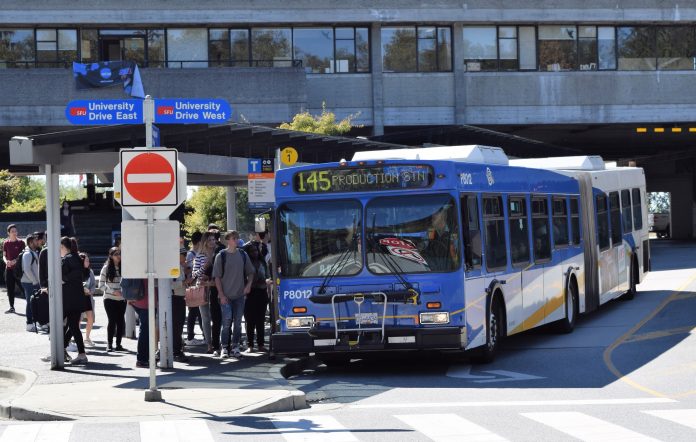
For a school that embraces its multi-campus nature and celebrates environmentalism, SFU’s reaction to the transit strike is remarkably hands-off. No matter how the strike proceeds, it’s important to remember that our university’s first stance was that, “operations at SFU will continue as usual with regards to normal hours of work and class schedules.” 

Online, SFU recommends that anybody not already driving “consider alternative transportation in advance,” as if that wasn’t the first thing on everybody’s mind. The anxious energy around campus only increased as we waited to see what the strike’s first phase would look like. 

SFU has also offered to accommodate extra drivers’ parking and drop-off needs, but this really only helps those with licenses, cars, and the money to run them or use carshare services. In the SFU Carpooling Facebook group, folks seem generous about either loading up or helping each other pay for gas — which is great. But SFU could also pitch in by waiving parking fees for carpoolers or reaching out to ride-hailing and taxi companies to offer discounted rides to the mountain.  

The real kicker is SFU’s proposed alternative transportation page. Here, options are: carpooling, car sharing, ride hailing, cycling, and (my personal favourite) walking — which all come with built-in assumptions about physical or financial ability. It’s also a little ironic, given SFU’s environmentally conscious initiatives, that they support the striking bus operators so little. Where are the press releases acknowledging the importance of transit workers? 

Walking and cycling aren’t great transportation alternatives either, given the mountain’s safety record for cyclists and women. The “walking” subheader informs students that there are “no sidewalks leading to SFU” and that “trails are not on SFU property and we recommend you use caution. These trains [sic] are not lit and we do not recommend using them at night.” This obviously does not help students commuting during one of the darkest times of the year. I’m astounded by the hypocrisy of recommending a mode of transportation and simultaneously providing a disclaimer for it — presumably so my family can’t sue if I get abducted or mauled by a bear on my way up to a test I can’t miss. 

Because, after all, SFU also isn’t giving professors and TAs the obligation or resources to be accommodating to students. They recommend that If you have concerns about your ability to get to campus in the event of strike activity please discuss options with your professor/instructor or supervisor.” This assumes that professors will, out of the goodness of their hearts, make accommodations for students — without SFU providing the obligation, incentive or even the support to facilitate this. How powerful does SFU think students are? We aren’t the ones who can support professors looking to live-stream or record their lectures, invigilate exams in more accessible locations, or incentivize professors to replace in-class exams and participation with digital options.

Striking is all about honouring workers’ rights in the face of institutional failure. Just as the Coast Mountain Bus Company failed its workers and their needs, SFU is poised to fail its students. Expecting financially insecure, differently abled, and/or non-driving students and staff to function normally when crucial infrastructure is yanked out from under our feet with little to no support is unreasonable, and maybe a little callous. Even striking union members were concerned about inconveniencing or incapacitating students and low-wage workers. 

Why can’t our university be more hands-on in providing us the infrastructural support we need and acknowledging just how important transit workers are to this institution?  While I understand that it was never SFU’s job to get me to school, I did not sign up to go here, pay my tuition, and build my schedule with the expectation to walk to class.


Peak Sports Mailbag: Week 10

0
Photo credit / Amazon

By: Bhalinder Oberoi, SFU Student

Hello readers of The Peak sports section,

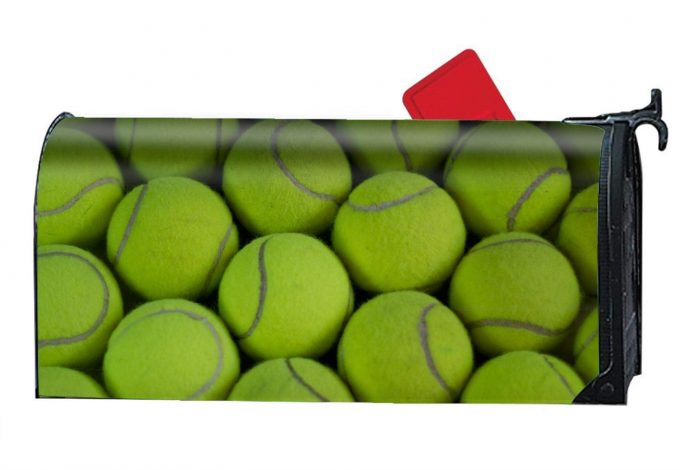
Our Peak Sports Mailbag topic this week is tennis and our host is SFU Tennis Club president Bhalinder Oberoi. 

Thanks so much to all of our readers for submitting their tennis-related questions, and my apologies if your question didn’t make it into this week’s edition. Usually, the Mailbag host will only answer three questions. Don’t worry though, as all questions submitted count for an entry into the raffle draw whether or not they are addressed in the Mailbag. Now, onto the questions!

Question 1: What are the different tennis skills that are emphasized in singles and doubles tennis? – Chris

Answer: Singles and doubles tennis both draw on a similar skill set, but they emphasize certain aspects of this skillset. In singles, players usually focus on their groundstroke, which are shots that are mainly hit from the baseline. These shots are more common in singles because the player has to cover the whole court by themselves and must therefore stay back more often. The key goal for single players is to keep the ball deeper and higher in the court. In doubles, players usually keep their groundstrokes short and lower. 

Players also focus a lot more on volleys, which are shots that are hit by the racquet before the ball bounces on the ground. Though the serve factors in both forms of gameplay, again, there are different elements to its usage. In singles, players tend to serve harder, which makes it difficult for the receiver to either attack or improvise on shot selection on the ball. In doubles, players don’t focus on a hard serve as much as they focus on switching between different strategies, depending on the strengths of the opponent.

Question 2: Can you explain a little bit about the differences in tennis racquets, string tightness, etc.? How much does the quality of the racquet matter to a beginner and what do more advanced players look for in a racquet? – Connor 

Answer: Tennis racquets differ in many areas such as weight, length, head size, materials, and frame stiffness. Beginner players should look for a racquet that is long, relatively lighter, and has an oversized racquet head. This is because beginning players are likely still learning the technique and have not yet developed enough strength and power to take advantage of a stiffer, heavier or smaller racquet. The beginner type of racket helps players hit more aggressive shots with less effort. Because advanced players should have a better grasp on technique, they can leverage the power of a heavier racquet with a smaller head. While advanced players usually look for racquets tailored to their style of gameplay, most prefer a heavier racquet with a medium sized racquet head. 

String tightness refers to the amount of tension applied to the strings of a tennis racquet by the stringing machine. String tension is measured in pounds. Generally, low tension strings would be in the 45–50 pound range, whereas high tension is between 50–60 pounds. Low string tension means the racquet will have more power and less control, which is suitable for players that have accuracy but are struggling with power. High string tension will give more control and reduce the rebound effect of the ball. 

Question 3: Can you tell me a bit about all of the different surfaces tennis is played on, how they vary and impact the game, and which skills are emphasized on each surface? – Pat

Answer: There are three types of surfaces that tennis is played on: hardcourt, clay, and grass. Hardcourts are concrete courts with synthetic material on the top of the surface to give grip to the court. The ball bounces higher and the gameplay is fast. In general, well-rounded players tend to do well on hardcourts. Hardcourts also require the least maintenance cost. On the other hand, clay courts are made of crushed brick. The players have the opportunity to slide on shots instead of coming to a complete stop, as they need to do on hard courts. The ball bounces higher but slower on clay courts. Defensive players do well on clay because of the slower gameplay. Clay courts require basic regular maintenance. Grass courts have the lowest and the fastest bounce and the ball slides on contact with the ground, so these courts require high fitness levels. Players with a strong serve and volley tend to do well on grass courts. These are, by far, the most expensive to maintain.

If you would like to participate in future editions of the Peak Sports Mailbag and be entered in a raffle for an end-of-semester prize, here’s what you can send to [email protected]

  • Sports-related questions that our weekly host will answer
  • Weekly theme ideas to guide our questions

Or: sign up to host the Mailbag (and get paid)!

Thanks to all of you SFU sports fans for blowing up my inbox!

Next week’s theme is: Rowing

Next week’s host is: Katinka Neumann

Send in your questions to [email protected]

Audain Gallery’s latest exhibition is a powerful exploration of the performativity of identity

0
Gabi Dao’s Excerpts from the Domestic Cinema, Ch. 1 is one of the pieces showing in Relations of Responsibility. Image courtesy of Gabi Dao / SFU Galleries.

By: Kim Regala, Peak Associate

08/11/2019: This story has been corrected from an older version. The previous version stated that the Gitxsan Nation drum that Raven Chacon’s piece revolves around was resounded by Chacon. The drum was resounded by Shabnam Honarbakhsh, Collections Coordinator at UBC’s Museum of Anthropology.

22/11/2019: This story has been updated to reflect concerns raised to The Peak by the UBC Museum of Anthropology.      

Hoping to explore the relationship between performance and score, SFU’s Audain Gallery joins the work of three artists in their new exhibition, Relations of Responsibility. The title borrows from the ideas of feminist scholar Karen Barad who, in her essay “Nature’s Queer Performativity,” discusses the materializing effects that a performance has on its corresponding score.

We may think of the two as separate from each other: the score simply holds a set of instructions for executing the art piece, while the performance itself is the aftermath of said instructions. However, contemporary artists Raven Chacon, Gabi Dao, and Lou Sheppard have come together to challenge this very idea, implying that the relationship between the two is actually more dynamic than we think. Their work showcases how it is through interpretation and performativity that the score is brought to life and given new meaning.

Raven Chacon, SFU’s Visual Artist in Residence, gives a fitting introduction to this very complex idea. His sound art installation, Still Life No. 4, explores the performativity of identity as it operates against its given narrative or score. Chacon’s piece revolves around a Gitxsan Nation drum that had been unsounded since 1948. It wasn’t until Shabnam Honarbakhsh, Collections Coordinator at UBC’s Museum of Anthropology, resounded the drum, at the artist’s request and with permission from the Gitxsan community, in August 2019 that it was brought back to life. His artist statement explains that “Still Life No. 4 lets the drum sing, operating against an imposed script of silence and enclosure, and aligning the cultural belonging with its object-lifeforce.” The banging of the drum can be heard in four separate sound stations: one in Burnaby at the SFU Gallery, at the Audain Gallery, in one of SFU’s School for the Contemporary Arts’ main offices, and at Western Front. The further the station is from the location of the drum, the faster the oscillation pattern of the beat sounds within headphones. Chacon intends for this rapid succession to be symbolic of the heavier impact that this silence holds as measured through physical distance.

Continuing this exploration of a score’s relationship to performance, Vancouver artist Gabi Dao transforms written text into a cinematic art form with Excerpts from the Domestic Cinema, Ch. 1 (2018) and Ch. 2 (2019). Having been gifted her father’s autobiography that recounts his experiences at the time of the Vietnam War, Dao’s work addresses the notions of cultural supremacy faced especially by refugees. The narration tosses back and forth between father and daughter, further emphasizing the collaborative yet nurturing nature of the piece. The video is not so much a literal translation of the text; instead, it is fuelled with abstract imagery that paints a delicate portrait of domestic life. This pairs well with the overall design of the gallery space, as the comfortable seating arrangement of couches and pillows evokes feelings of home. 

Bringing the exhibition to a powerful conclusion is Lou Sheppard’s performance piece, A Strong Desire. As a trans person, Sheppard draws from the diagnostic criteria for gender dysphoria to create a piece that allows them to exert their agency over a text that is meant to discriminate on their identity. At the gallery, the diagnostic criteria is printed onto the left-hand side of the wall, in opposition to Sheppard’s text-based performance score displayed on the right-hand side. The choreography itself is a bodily performance meant to replicate movements of looming over and within the gaps of the written text. Sheppard’s performance occurred on October 9, where the public witnessed the laborious series of movements take place. To execute the choreography, Sheppard covered their hands with charcoal and dragged them all over the walls in various shapes, leaving marks on the spaces that were touched. Additionally, they dragged around a riser and climbed up and down these steps, furthering the physical labour that is inherent to the piece. The overall performance lasted for half an hour, leaving Sheppard exhausted and covered in sweat. However, it is the piece’s work-intensive nature that is resonant of the equally burdening experiences that trans people undergo on a daily basis from the institutionalized discrimination of their identity.

Relations of Responsibility is located at the Audain Gallery and is open to the public until December 7. Gabi Dao and her father, Duc Kim Dao, will be holding a workshop for Storytelling in the Domestic Cinema on November 6 at the Audain Gallery.

The week ahead in SFU Sports: November 4–10

0
Photo credit / SFU athletics

By: Dylan Webb, Sports Editor

While SFU’s volleyball, hockey, basketball, and soccer teams are all in action this week, only the men’s and women’s soccer teams have home games scheduled from November 4–10. Here’s a brief breakdown of the SFU sports action lined up for the week. 

Hockey:

SFU Hockey embarks on its first Vancouver Island road trip of the season to visit the Vancouver Island University Mariners and the University of Victoria Vikes. On Friday November 8, after arriving by ferry in Nanaimo, the team will ride the bus down to Victoria to take on the Vikes at 7:30 p.m. The Clan will then travel back up to Nanaimo to take on the Mariners at 8 p.m. the following night.  

Volleyball:

A two-game road trip has SFU Volleyball travelling to Lacey, Washington to take on St. Martins University on November 7 at 7 p.m. Two days later, the team moves to Seattle to take on Seattle Pacific University at 1 p.m. 

Men’s Soccer: 

The SFU Men’s Soccer team will host two games at Terry Fox Field this week. First, Montana State University Billings visits on November 7 at 6:30 p.m. Then, on November 9, Northwest Nazarene University will make the climb up Burnaby Mountain for a 7 p.m. kickoff. 

Women’s Soccer:

After hosting Montana State University Billings at Terry Fox Field on November 7 at 6 p.m., the Clan will head to Portland, Oregon to take on Concordia University on November 9 at 2 p.m. 

Men’s Basketball:

The SFU Men’s Basketball team continues its 2019 season this week with two road games. The Clan will take on the University of California, San Diego on November 8 and California State University, Dominguez Hills on November 9. Both games are in Bellingham, Washington at 5:30 p.m. 

Women’s Basketball:

A light schedule in the early weeks of the season has the SFU Women’s Basketball team visiting Cal State San Marcos on November 8 for a 1 p.m. tip off.  

SFU Football outmatched by high-powered Wildcats

0
The Clan won their first game of the season before the blow out loss to WOU. - Photo credit / SFU Athletics

By: Brandon Braich, Peak Associate

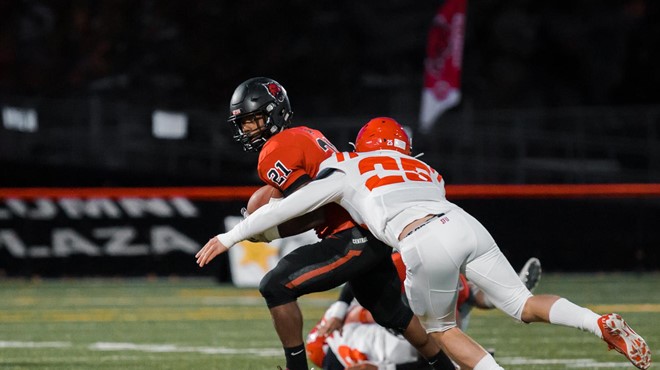
Coming off their first victory in 48 games, SFU Football was unable to maintain their momentum and fell to the Central Washington University (CWU) Wildcats by a score of 62–10. In what was their first matchup of the season, the Wildcats controlled the game from the opening kick and cruised to an easy victory. 

CWU got the scoring started early by quickly striking on the first drive of the game. Michael Roots rumbled 56 yards for the score and had a monster game, rushing for 221 yards and three touchdowns on just 12 carries

After a CWU field goal extended the lead to 10–0, the Clan looked primed to answer back. However, quarterback Brandon Niksich was intercepted by Chaz McKenzie, which handed the ball to the Wildcats deep in SFU territory. It was perhaps the worst game of the freshman quarterbacks young collegiate career, as he completed only 5 of 16 passes for 37 yards and an interception. 

The Wildcats were able to capitalize on the turnover when quarterback Christian Moore connected with wideout Drake Owen for a 21-yard touchdown pass. For the game, Moore completed 15 of 32 passes for 219 yards and four touchdowns.

Again, SFU looked set to respond on their next possession, as a methodical drive finally landed the Clan deep in Wildcat territory. However, on a critical third and goal, running back Mason Glover was tackled for a one-yard loss, which forced the Clan to settle for a short field goal. The running game was a struggle for the Clan all game, as they totalled just 21 yards on the ground. Solomon Hines led the way with 25 total yards on 12 carries. 

CWU, once again, responded quickly by snuffing out any thoughts of a comeback when Roots rushed for his second touchdown of the day from three yards out to increase the lead to 21 points. After another quick three and out on the next possession, a short punt gave Central Washington great field position once again. Moore then completed his second touchdown of the night, this time hitting Tony Archie for an 11-yard score. 

The second half began like the first ended, with Roots rushing for another touchdown, an 82-yard rumble that was his longest run of the day

The first Clan touchdown of the night didn’t come until late in the third quarter when backup quarterback Mihai Lapuste relieved Niksich. Lapuste was able to lead a drive scoring drive, which was capped off by a short 4-yard touchdown run by Hines. While the touchdown brought the score to 48–10, and Lapuste completed 9 of 19 passes for 100 yards, most of this occurred in garbage time with the Wildcats second and third stringers on the field. 

In the fourth quarter, the Wildcats scored twice more to add an exclamation point to their resounding victory. 

Defensively, linebacker Griffin Barrett led the way for SFU with 12 tackles. Overall though, SFU’s defence struggled through out the night and gave up 572 yards in total offence. 

The loss dropped the Clan to 1–3 in conference play as Central Washington moved into a tie with Western Oregon atop the GNAC standings. 

SFU will now return home to face Western Oregon University (WOU) at Swangard stadium on November 2. It will be another tough test for the Clan, as they fell to WOU 51–14 when they met in Oregon last month. 

Slow start costs Clan against rival Spartans

0
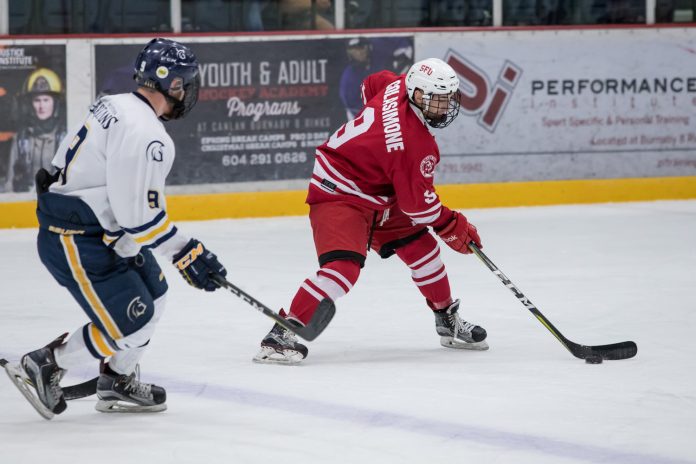
Forward Mac Colasimone had two points in the loss. - Photo credit / SFU Hockey

By: Michael Lenko, Peak Associate

After taking three of four points in their previous two home games, SFU Hockey tried and failed to take down their main rival, the Trinity Western University (TWU) Spartans, at the Langley Events Centre. It was the first 2019–20 BCIHL season meeting between the two squads. The Clan picked up the win in their only preseason matchup.

In the opening frame, the Spartans came out firing on all cylinders. Less than two minutes into the game, an unlucky rebound turned into a Spartan goal after Hayden Guilderson was left untouched in front of the Clan net. The Spartans continued their first period onslaught with Evan Last picking the top corner over SFU goaltender Patrick Zubick’s shoulder. Last would add another on a backdoor pass in the last minute of the period to secure a 3–0 lead for TWU heading into the intermission. The Spartans outshot the Clan 19–13 through 20 minutes.

In the second period, the Clan would begin to fight their way back into the game. Trevor Arye brought the Clan to within two early in the second, and the period saw more back and forth action with no other scoring. 

In the third, the Clan started to dominate the play and their hard work was rewarded with Mac Colasimone’s third goal of the season. This would be as close as the Clan would get though, as the Spartans starter Lucas Mills shut the door the rest of the way.

While the loss and ugly start to the game were disappointing for the Clan, there were some positives to take. The Clan were able to keep pace with, and even outplay, the defending BCIHL champions for the better part of 40 minutes. Mac Colasimone notched his seventh and eighth points of the year, which is a team high in the early stages of the season. Zubick turned in another solid effort between the pipes, stopping 27 Spartan shots on the night. On the critical side, the Clan will have to find a way to play a full 60 minutes, something that has been a problem so far on the season.  

The Clan will not have long to wait for a rematch as they will host the Spartans in their next game. This rematch will start a busy month for the Clan that will see them play seven times within the month.

Cedric Bomford’s Mountain Embassy is a commentary on an embassy’s role as an authority

0
Mountain Embassy is SFU Gallery’s current exhibit, showing off-site on University High Street. Image courtesy of Blaine Campbell / SFU Galleries.

By: Kim Regala, Peak Associate

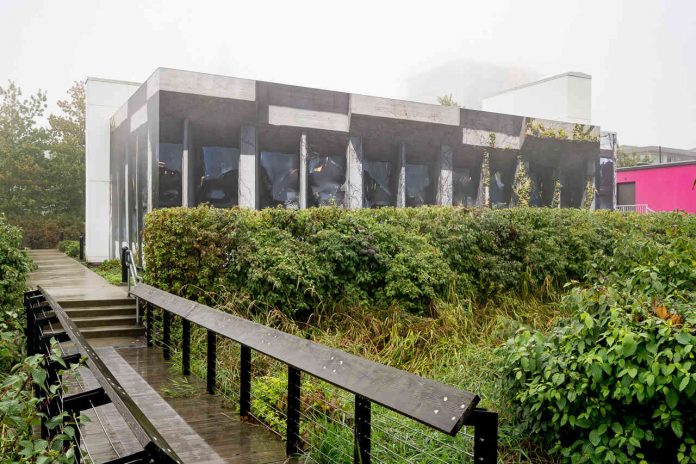
Tucked away near SFU’s upper bus loop and camouflaged by bushes that span the walkway stands a large, mysterious, box-like structure. From afar, it vaguely resembles another familiar SFU building, the W.A.C. Bennett Library, inheriting its architectural design and the vines that surround it. Up close, however, it is not a building at all. Instead, it is a rendered image of the library, but displayed only through a vinyl canvas that wraps around the structure.

This is Cedric Bomford’s Mountain Embassy, the fourth in his series of works that use photography and installation to elucidate on themes of authority. In this piece, Bomford draws from the brutalist architecture of SFU’s campus to create a virtualized representation of a national embassy’s parasitic role within foreign countries.

While the visual appeal of the installation is intriguing on its own, what I find most interesting is Bomford’s process in making the piece. To have created what we see now, the artist utilized a method known as photogrammetry, an artistic and scientific approach to recording physical objects and environments in an attempt to replicate them into virtual reality. This software is similar to that of Google Earth and 3D scanning, but on a much grander scale.

Drawing inspiration from the W.A.C. Bennett Library as a space that is symbolic of information and knowledge, he used this process of scanning over the building to condense it into this mysterious box that we can conceive to be Mountain Embassy. The effect is striking, casting a lifelike image of the building onto this smaller canvas. However, a closer examination of the rendered image reveals the various distortions and pixelated glitches from meshing these two worlds together — the virtual and the real.

Aesthetically, these strange formations are viscerally luring. At the same time, it brings forth ideas regarding what could happen when virtual reality tries to merge with the real world. An additional layer is added onto this theme of virtual space when considering how the installation rests on a condo sales centre — a space that represents a kind of imagined future similar to virtual reality.

Using photography and installation as his primary mediums of art, Bomford has set out to create a large dialogue regarding the power dynamics of authority figures through ambassadorial relations. Casually speaking, we may think of an embassy as a building that holds offices for a group of officials that represent their nation in a foreign country. Through his work, he has deconstructed this definition, seeing the embassy — and, in particular, its physical presence — as instead symbolic of the kind of parasitic nature that this distant authority imposes upon a country. Mountain Embassy, as it is seated on top of a mountain, creates this towering effect due to its high geographical location.

Adding on to this towering effect is how the structure itself appears to be floating above the ground, an architectural style that has grown popular in modern design. In this way, ideas of surveillance become emphasized, alluding to this authoritative nature of the embassy as holding some level of power over the foreign country that it has “preyed upon.”

Bomford’s piece brings forth a crucial conversation that touches on the underlying notions of the physical presence of an embassy within a foreign country. While the piece itself aims to speak specifically on ambassadorial relations, it does hint at the kind of colonialist attitude that is inherent in the way we have come to welcome these systems throughout the world. By opening up the dialogue of what these structures entail, Bomford allows us to consider how the embassy itself may be an extension of this notion of colonialism.

Cedric Bomford’s Mountain Embassy is on display at 8955 University High Street on the Burnaby campus until December 7. More information on the exhibit can be found at SFU Gallery, located in the Academic Quadrangle.

Man pauses to breathe, gives audience fleeting false hope that he’s done talking

0

Written by Kelly Chia, Staff Writer

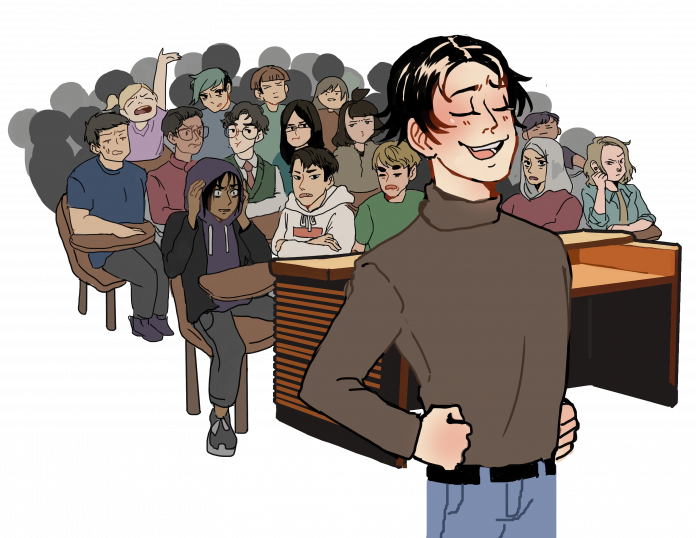
It’s Thursday afternoon, and we have a breaking headline coming in from the conference room in the West Mall Centre. The speaker, a young man, pauses to take a single breath . . . and despite the momentary hope his action telegraphs, he does not stop speaking. 

We go to Janet, a student in the conference room who contacted The Peak with a time-sensitive tip.

“Yes, hi!” Janet meets our eyes before getting shunned by a collective stare from the rest of the listeners. She continues in a hushed tone:

“He just started standing at the podium and speaking . . . we’re not sure who he is, but it felt rude not to listen.” 

Janet suspects that the man is a 20-year-old political science student who has gone off the rails between his midterms and defending his political beliefs. No further information on the man’s background is available at this time, as social mores have held us hostage too tightly for us to interrupt him with questions about his identity. The aforementioned defense of his political beliefs is not actually lucid enough for us to be certain that that is, in fact, what it is. 

The student continues his infernal rant about how his relatives are swayed by Facebook posts. Just when it seemed like the student had all but exhausted the topic, he cruelly continued. 

“Communism works in theory, but. . .”  The man pauses, air passing through his lips and expanding his lungs. He takes a swig of water. He gives the audience a long, meaningful stare. The tension in the room is evident as the listeners lean forward, waiting for him to speak up — or not. 

It’s madness, momentarily. And then he exhales again, speaking up on what he alleges his professor from two semesters ago told him about the flaws in practical communism.

We probe another audience member whose eyes are beginning to droop: “How long has this been going on?”

“For 20 minutes,” they respond tiredly — so tiredly. 

Inevitably, the student has started talking about Freud to sustain his theories on the political state. While his speech has the cadence of academic expertise, the actual content was not worth penning. He seemingly finishes, and a student lets loose a single clap. The student sublimates into the air under the heat of a judgemental hush from the rest of the audience, who by now are invested in suffering the ordeal as a unit. 

At this time, the student still has not stopped. No indications have been given of when the impromptu speech might end, and the situation has gone from mildly inconvenient to truly obnoxious.