Home Blog Page 372

UBC allegedly erases Dr. Amie Wolf’s reports of behaviour among teacher candidates reinforcing white supremacy

0
PHOTO: Gudrun Wai-Gunnarsson / The Peak.

Written by: Vincent Grewal

Dr. Amie Wolf is an adjunct professor at the University of British Columbia (UBC) teaching two sections of a required course in the teacher education program, EDUC 440 Indigenous Education in Canada. In a recent controversy, Dr. Wolf, an SFU alumni and a member of the Mi’kmaq First Nation, made public an allegation that UBC erased interim reports of 12 teacher candidates who were transferred out of her class last fall. In a press release published January 20, soon after the controversy, Dr. Wolf wrote a detailed account of the events from her perspective. 

In the release, she stated that she had “observed that the participants were not ready to teach Indigenous subject matter, citing their unwillingness to critically examine their own biases, attitudes, beliefs, and values to facilitate change, as stipulated in the BC Teacher’s Council, Professional Standards for BC Educators.”

The students were transferred out of the class because they had complaints about Dr. Wolf that they took to the course supervisor for EDUC 440, Dr. Shannon Leddy. On the reddit post regarding this issue, users have alleged that she “wanted to use her power as a UBC instructor to wield political power, shaping the education system according to her own whims” and that “she told her current students that students with conservative political views would fail her course.” The Peak could not get in touch with any of her former students. 

In an interview with The Peak on January 20, Dr. Wolf said that she was not told about these complaints until she went to Dr. Leddy in November of 2020 to discuss what was transpiring in her class. According to Dr. Wolf, after tensions in the class got worse and worse, the director of the Teacher Education Office, John Yamamoto, said, “Let’s just cut bait[,] [. . .] let’s just put them in another Indigenous education course and they can just finish the term.”

Dr. Wolf was then tasked by Yamamoto to write interim reports on the students. According to Matthew Ramsey, Director of University Affairs at UBC Media Relations, “[i]nterim reports are used for a variety of reasons, such as when student[s] move from one section to another, or when instructors have specific concerns pertaining to students enrolled in a pass/fail course. When these matters are addressed and the student has passed the course, the report is considered fulfilled and no longer applicable or part of the student’s file.” Additionally, the policies and guidelines of the teacher education program state that “copies of interim reports will be filed in the Teacher Education office.”

She said that Dr. Leddy, Yamamoto, and herself “all agreed what the report was, and all three of us signed it,” a claim that the university did not comment on. She told The Peak that she agreed to pass the students on the condition “that they continue to try to learn how to teach Indigenous education respectfully because [they’re] not there yet.” 

According to Dr. Wolf’s first press release, she was instructed by Dr. Marianne McTavish, the Associate Dean of the UBC department of educational studies, to delete the interim reports she had written for 12 teacher candidates from her course EDUC 440 — reports signed off by Yamamoto and Dr. Leddy. 

“The fact that they signed-off on my documentation of the students’ push back was meant to make me feel that I had been supported,” said Dr. Wolf. “The intention was to let me slide into quiet oblivion so that I would not resist, thereby helping them solve the Indian problem as conveniently as possible.”

She was told that this decision stemmed from a letter from an anonymous parent of one of the teacher candidates “expressing concern that the interim reports could negatively impact their adult-child’s employment opportunities.” 

The university did not confirm nor deny the existence of the letter.

On January 15, she made it clear that she would not delete the assessments. Five days later on January 20, she took this issue public with her first press release.

In a second press release dated January 24, Dr. Wolf stated that she received an email from the dean of UBC’s department of educational studies, Dr. Frank Blye. According to Dr. Wolf, the email noted that as a part of the Privacy Act included in her contract with UBC, she was “not entitled to speak about identifiable individuals with third parties or the press” and that doing so would expose the university and herself to liability under privacy legislation. In the second press release, Dr. Wolf stated, “[Blye] is pretty much telling me to shut up or I’ll be sued. It’s a threat.”

In 2016, Dr. Wolf was employed by the UBC Sauder School of Business and her first press release alleges her contract was terminated after she stated to the CBC that “a course requirement on First Nations rights and title is needed, campus-wide.”

“I know that speaking out will probably cost me again,” she expressed.

On January 25, Dr. Wolf was placed on administrative leave by Dr. Blye, meaning the remainder of her contract will be paid out but she will have no teaching duties.

Lynnne Tomlinson, Assistant Dean, pro tem, of Professional Development and Community Engagement in the faculty of education, a non-Indigenous person, has now taken over instruction of EDUC 440.

Dr. Wolf calls for the resignation or dismissal of Dr. Leddy, Yamamoto, and Dr. Blye (among others), citing the hire of non-Indigenous person to teach her Indigenous Education course, “citing corruption and incompetence.”

She added, “I did not have the chance to say good-bye to my classes nor was a reason for my disappearance provided to them. My students told me the class without me didn’t pick up from where we left off. I feel terrible for how this situation has impacted them, and I am helpless to make things different. This is everything that should not happen in Indigenous education, which emphasizes relationships of trust and healthy community engagement that is safe for everyone.”

Interim Reports

The nature of the concerns outlined by Dr. Wolf against the teacher candidates included participation, communication, classroom climate, and intolerance. She confirmed that all 12 interim reports were identical, highlighting the same concerns for the 12 students as they had formed a “clique [that] was behaving in ways that created an intimidating classroom environment, [. . . ] compromising [her] instruction and the culture of the classroom in general.”

Regarding communication, the students “demonstrated an unwillingness to communicate openly with [her] and with their peers.” Dr. Wolf stated she made attempts to communicate with them, sharing her cell phone number and encouraging students to contact her. “The choices to avoid speaking with me in good faith, with an intention to resolve issues amicably, appears to be reactive and short-sighted behaviour unbecoming of a teacher candidate.”

The interim reports for the students stated, “At best, choosing to leave [the] class, rather than making an effort to understand what [she is] actually teaching and why, reveals an intolerance for ‘otherness.’ At worst, it points to the possibility of unconscious and unacceptable biases, the reinforcement of white supremacy, and/or Indigenous specific racism and misogyny. This intolerance shows a lack of compassion and thoughtfulness that will not serve Indigenous students in a classroom setting.”

On the reddit post regarding this issue, the comments were riddled with questions of her inclusion of the term white supremacy in the interim reports.

“I talked about the reinforcement of white supremacy,” Dr. Wolf said, placing emphasis on reinforcement. “I was never calling anybody a white supremacist [ . . . ] Our colonial institutions are all white supremacist institutions [ . . . ],” expressed Dr. Wolf.

She did add however that, “I did see white supremacy in spades in their participation and assignments. This is just the biased belief that Euro-centric culture is more true/real [sic] than Indigenous culture. It is a widespread and common attitude in Canada.”

She cited one comment from a student to a class discussion board question, “What are the realities for Indigenous students in the public education system today?”. The student allegedly commented, “How should I know, I’m white?”

“I was one hundred per cent right in my assessments of these students,” stated Dr. Wolf. These are not the kind of people who are going to support the success of Indigenous students in a classroom setting.”

White Supremacy

To understand Dr. Wolf’s comments about the reinforcement of white supremacy, they must be situated in the broader meaning of what white supremacy really is. According to Frances Lee Ansley, a critical-race-theory scholar, “By ‘white supremacy’ I do not mean to allude only to the self-conscious racism of white supremacist hate groups. I refer instead to a political, economic and cultural system in which whites overwhelmingly control power and material resources, conscious and unconscious ideas of white superiority and entitlement are widespread, and relations of white dominance and non-white subordination are daily reenacted across a broad array of institutions and social settings.”

Indigenous Education

“I don’t think that Indigenous pedagogical approaches to education [in a university context] have ever existed. Indigenous cosmology, [ . . . ] the way that our families are, [our] governance, economics, spirituality, relationships, [and our] teaching [ . . . ] [I don’t think] could ever be integrated into a Western mainstream education system,” expressed Dr. Wolf.

If it were to be integrated, however, she mentioned three levels to adapting Western frameworks of education to be more inclusive to Indigenous peoples: system restructuring, the integration of soft content, and the integration of hard content.

“[System restructuring], which is the integration of restrictions, [means] that the Federal government will finally do what it is obligated to do under the United Nations Declaration on the Rights of Indigenous Peoples [UNDRIP] [ . . . ] [and ensure] we have the money to have and run our own schools that are taught in our languages, emphasize our histories and the holidays that are important to us, [helping] us with our goals of self-determination and self-governance,” stated Dr. Wolf. She also mentioned how Indigenous educators should be given “opulent salaries[,] [ . . . ] benefit packages, and [the] status of being teachers.”

Regarding the integration of soft content and hard content, she explained that soft content includes “cultural inclusion, [ . . . ] food, dances, [and] traditions,” while hard content includes, “studying legislation like [UNDRIP] that translates into policies and procedures for restructuring a nation to nation relationship between Indigenous peoples and the state.”

“[Soft] content keeps us in a position of assimilation, [hard content] is about empowerment, self-determination, resource flows, land use, and sovereignty.”

In an email to her students about this conflict, she stated that, “What has happened to me directly relates to the course learning outcomes [and] exactly [ . . . ] where we’re at in the course, which is [the] theme [that] indigenous peoples have distinct ways of seeing and doing things that don’t fit into the institutions of Canada. And one of the sub questions under that is, what are the current educational frameworks in Canada? And how [do] those barriers [ . . . ] make it difficult [for the Indigenous teaching of Indigenous knowledge]? This case is a direct example.”

In her second press release, Dr. Wolf expressed, “The push back I am receiving from the highest levels of the UBC administration is indicative of a problem at all levels of education in the Province of BC. Incompetent administrators are giving lip service to promoting Indigenous [e]ducation while suppressing our voices. They get away with it because there is no accountability and because Indigenous people are usually disempowered, scared, and lacking in supports for recourse. Future classroom teachers will be dealing with this problem as they try to teach Indigenous [e]ducation. I want to prepare them for the real world.”

According to Dr. Wolf, she is no longer residing at her home address because “she and her chosen family fear for her safety.”

System Change at UBC

By talking to The Peak and other news media outlets about this story, Dr. Wolf is hoping that “systemic change will be spurred to actualize at UBC.”

In the 2020 UBC Indigenous Strategic plan, UBC President Dr. Santa Ono, wrote that UBC “can produce system change [ . . . ] by developing and implementing innovative and path-breaking research, teaching, and engagement with Indigenous communities.” However, Dr. Wolf understands these statements to have a different meaning.

“Indigenous people[s] are experts in seeing lip-service. We know when promises like this are put down on paper, they don’t mean anything in terms of how our lives change for the better. It’s the same battle, different piece of paper. We are the one who are stuck with doing all the work, and we meet the same barriers every time. People say they are committed to equity, diversity, and inclusion, but they want to keep their privilege at the same time. It doesn’t work.”

She noted in her third press release that her “greatest wish” is for “resourced bodies [to] be established throughout the university to ensure that the UBC Indigenous Strategic Plan, which focuses entirely on fulfilling the legislation laid out in the UNDRIP, [is] established this year.” She added, “I never want another person, Indigenous or otherwise, to endure the discrimination for teaching the facts about the UNDRIP.”

“In every colonial system in Canada, there are no established policies or procedures to protect Indigenous people[s] from white supremacy. When we are eliminated for trying to create change, the institution can just spit [us] out; there are no avenues within the institutions for recourse or for accountability.” She added, “Indigenous professors who are willing to assimilate are the only one[s] left in all levels of the B.C. education systems.”

According to Dr. Wolf, her personal email has been flooded with support from people around the world.

“People are appalled and outraged by UBC’s attempt to erase me, and they promise that they will not allow me to become a Missing Indigenous Woman. Their activism is glorious. I know change will happen.”

“My goal right now is just to not disappear,” she voiced. “My message matters, and my student assessments are correct. I’m an Indigenous scholar and leader, and I deserve to be paid fairly for what I do and to be protected and helped as I make the changes the President of UBC says it supports. Policies, procedures, and monetary provision to implement these must be adopted at the highest levels of all Canadian institutions.

To stay informed on the current situation, subscribe to Dr. Wolf’s newsletter on her website, www.perceptionwork.com, or follow her on Twitter.

Your weekly SFU Horoscopes: February 1–7

0
An illustration of a girl with long flowing hair. Astrological signs and stars shine around her.
ILLUSTRATION: Marissa Ouyang / The Peak

By: Paige Riding, Humour Editor

ARIES: BARK! BARK! BARK! WOOF WOOF! BARK!

TAURUS: Try split-dyeing your hair, Taurus. All the cool kids are doing it. You’ve never been one to start trends, just snatch them away from every fire sign in your life and claim them as your own. Well, not the new eye bags trend. That’s all you, buddy.

GEMINI: My editors actually told me to dial back on bullying you, Gemini. I thought you could take it. I had faith in you. Well, something something manifest greatness, believe in yourself, oh, uh, your fly is undone.

CANCER: The second you’re faced with simple mathematical problems, your brain seems to shut off completely. 7×13? Come on, you can do it. Don’t open that calculator app, coward. No, wait, don’t tear up, no, I was only kidding—

LEO: Easy, breezy, beautiful . . . well, you have the beautiful part down. Nothing seems easy about your life right now. Nothing. Nothing. Girl.

VIRGO: You can make your wallpaper a live photo! If you press and hold the screen, it plays a video! What emotional support fictional character popped into your head for that suggestion? Hey, you’re the one in charge of pushing your screen and your friends’ buttons with references of your favourite shows.

LIBRA: You may be the scales of the Zodiac, but the only thing you should be worried about is whether your professor will scale that last quiz. You really closed your eyes and clicked the answer your mouse gravitated to each time, huh? Divine intervention or defining inattention?

SCORPIO: Watching ASMR videos until three in the morning does not define you. Well, actually, you’re always tired, and now you’ve started whispering all the time like them. Honestly, you’re just too scared to ask who in our ancestry took the plunge and fucked a monkey.

SAGITTARIUS: Anything I write here you’ll just scoff at, so go eat your seventh baked good this week and leave me alone to talk with the signs I can actually tolerate.

CAPRICORN: It always seems like you’re missing something. A missed discussion post? A missed sale at Superstore? A missed strike in Wii Bowling back in 2010 that haunts your perfectionist ass to this very day? You can still hear the Miis’ sounds of disappointment echoing in your head . . .

AQUARIUS: Treat yourself to a Pepsi this week, Aquarius. You can live out your dream of being everyone’s hero à la Kendall Jenner, and we all know your superiority complex would just love the refreshing taste.

PISCES: Your creative side is screaming for attention this week. And no, acting out fake arguments in the shower doesn’t cut it. Try making potions out of all the shampoos like you did as a kid. That’ll wash away your boredom and the haunting sense that you may never return to what once was.

SFU StreetFest captures the campus feeling we’ve been missing

0
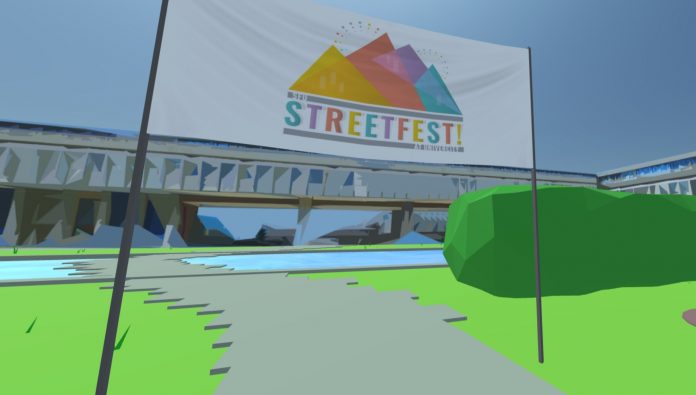
See SFU from a whole new perspective when you visit StreetFest. Image courtesy of Taylor Assion / Ancillary Services

By: Brianna Condilenios, SFU Student

Oh, how I missed you SFU! But thanks to this augmented reality street festival, which partnered with a number of student service groups like Ancillary Services and the SFSS, I felt right back at home. My virtual reality journey began in the academic quadrangle where I chose my avatar and began checking out other locations on campus. One of the first adventures I embarked on was a search for raccoons hidden throughout the event space. I had expected these creatures to have multiplied tenfold with the lack of humans on campus to scare them, but I only spotted two. They are sneaky after all.

Next, I visited some pop-up booths with details on various organizations at SFU. Each had a unique avatar, cartoon presentation, table display, and bowl of candy. A few QR codes later, I had learned about programs like SFU Fair Trade and SFU ChildCare Society, which offer valuable resources and education to the SFU community. These little booths were (virtually) sitting on my desk at home, and as I moved my mobile phone, I came closer to each one. Having this mobile component made my experience feel more personal as opposed to just watching a video posted to a website. 

In another location, there was an SFSS lounge set up where board members were present through their avatars and microphones. They answered any questions that people had about the SFSS and discussed what being a board member entails. While I did not have many questions to ask, it was a great opportunity to learn more about our student government.

Another great feature was the entertainment. First, I got to hear Shina Likasa’s majestic cover of Taylor Swift’s “Lover.” This is one of my favourite Taylor Swift songs and I thought Shina’s beautiful cover really captured the feeling of overflowing love. After her performance, University Highlands Elementary students displayed pictures of their rainbow art, which symbolized connection, optimism, and hope. 

Last, but certainly not least, was a stunning virtual art gallery provided by the SFU Childcare Society. Creative pieces centering on nature, relationships, and colour, made by children in the program, filled my screen. The virtual gallery reminded me how important it is to appreciate the work of others in these trying times. Not only does it help the creator feel appreciated and thus inspired to make more art, but it is a beautiful, happy experience for the viewer. 

SFU StreetFest offered a wonderful space for community engagement, and being in a familiar campus space (albeit in augmented reality) gave me a sense of belongingness again. Visit the SFU StreetFest website to experience all these activities for yourself.

Top Ten reasons I’ve been unable to catch some shuteye

0
Very calm, very cool. Nothing wrong here. Illustration: Siloam Yeung / The Peak

By: Clarence Ndabahwerize, SFU Student

  1. The collapse of liberal western democracy

Imagine waking up to find the Scottish unicorn on your passport in your room helping itself to your SFU acceptance letter. You know, that same one you left in your hastily purchased suitcase. Doesn’t make sense, does it? 

Well to catch you up, a series of recent events, only worthy of appearing on Homeland (they already did a “patriots” vs. government storyline), occurred. A man that could only be described as “dressed like a Viking,” roamed the halls of the United States Capitol. It was simply an attempt to subvert democracy by reminding us all that the first Europeans to set foot on this continent were indeed Vikings. Apparently, he’s now been arrested for this terrible insurrection but has access to a requested all-organic diet. 

On the plus side, now we all know from one famous image, what “Out Of One, Many” is in Latin: E Pluribus Unum. In God We (have to) Trust because, if this is only the start of many unimaginable incidents and escalations, we’re in for a ride.

2. The border is closed, but what about the Peace Arch gates?

I know they are never meant to be closed in a grand gesture of symbolism, but there’s an opportunity here to take symbolism to the next level. Imagine the headlines, the coverage, the buzz. Think of a picture (or Snapchat story) in which two people are on opposite sides of the gate, one an American, another a Canadian. A pictorial representation of these truly unprecedented times! The Peace Arch will be an absolute tourist attraction once the gates reopen. Everyone will want a slice of that history and to say, “I went to the place where it happened.” The pictures, at that moment, will be telling of our current troubles. Where can I buy a commemorative t-shirt?

3. An alternative and totally plausible plot for the second Sicario film

A film that tries to establish a conflict based on a vague and constructed connection between radical Islamic terrorism and the human/drug trafficking at the US-Mexico border only manages to build castles in the air. As the pandemic has many of us watching films for entertainment or passing time when needed, watching the follow-up to the 2015 hit film was not a very sound idea. Could there possibly be a trivialization and misrepresentation of the issues associated with both topics and areas of concern? Wouldn’t be Hollywood’s first foray into such territory . . . Perhaps the writers should watch a bit more news and leave the cultural incompetency to small things like having Tostitos not just with salsa or guac, but hummus, too. They could get chipotle flavoured hummus for an added extra effect to tie that all together very well! Maybe, that is the film . . . ?

4. Robert. C. Brown Hall

I haven’t been, but it’s apparently a rendition of Daedalus’ most famous creation: the labyrinth. Unfortunately, instead of a minotaur, I’ve found myself concerned there’s a really buff kangaroo with boxing gloves that’s going to hop after me late at night to recreate Rocky Balboa vs. Apollo Creed, and against that beast, “there ain’t gonna be no rematch.” On the plus side, the bus loop is nearby, and many fine medical establishments are within reach as soon as I leave the confines of the mountain. Suddenly, the gondola makes a lot of sense in any catastrophic situation that may befall those on Burnaby Mountain — especially with kangaroos.

5. How are snow days going to work this semester?

For obvious reasons, there will sadly be none; however, if you look deep within and channel your inner optimist, you’ll most certainly see the positives in this. First, no perilous trips up the mountain with a significant chance of being stranded atop it. Second, no pushing buses, because my nine year-old Vans really won’t allow it. Third, no having to stress out about your pals at other universities having no classes while you do! Especially with an increased chance of camping in the AQ overnight rather than sleeping in your own bed. Hold on a minute, there’s nothing eager and academic about all that . . . I’ll stick with breakout rooms, unfortunately.

6. Gross income vs. net income

Self-employment (don’t forget being an artist) has never looked so daunting. Hopefully, the whole debacle doesn’t turn into those three infamous R’s. Rethink, Reskill, Reboot; because the pandemic killed your industry, and your next job could be in cyber. Oh, you were thinking of Reduce, Reuse, Recycle? Your customers will be reducing, all right.

7. Is the EU on the brink?

Everyone can’t stop talking about this (not really), but Brexit is official! Is the EU in trouble? No. Everyone’s going to be okay. Referendums are easy to hold and unfortunately effective on that little grey rainy isle if stuff isn’t working as it (inherently) ought to. Given that 2021 really isn’t working too well, either, maybe the UK will hold a referendum on whether to stay in or leave the year!

8. Why on Earth aren’t IKEA and Volvo doing business together?

No, not because they’re both Swedish brands! There’s an opportunity here to convince unsuspecting couch and coffee table shoppers to get a brand-new station wagon or SUV that will most definitely be safe for not only the entire family, but pedestrians too! The catchphrase could be, “you’ve sampled all our most wonderful furniture, our most wonderful cuisine while you were at it, how about also financing a car made with a most wonderful similar (unspecified) ethos!?” Ambiguous instruction manuals included, of course. Now, where’s that Allen key?

9. BC property assessment

How can it be that the Downtown Eastside single room occupancy hotels are as valuable as that? Aren’t such amazing living conditions supposed to drive up the value of real estate? Inflation, property taxation, real estate, oh my!

10. Should we start dropping apples on people’s heads when we’re angry? (gently, of course)

This sounds like a good way to let someone know you aren’t too happy with them. Maybe you could talk about Sir Isaac Newton after sorting out your beef? Maybe, gravity was discovered because one apple tree couldn’t stand this budding young physicist in its shade. Do we owe one of humanity’s greatest discoveries to anger? What else (both good and bad) has humanity discovered out of anger? Air conditioning? Drive-thrus? Aforementioned property assessments? The microwave? One explosive atom-splitting apparatus of doom?

Senate Report: January 11, 2021

0
Photo from Peak archives

Written by: Kyla Dowling, Staff Writer 

Pass/credit/no credit grading implemented for elective courses 

The SFU Senate agreed to allow the option of pass/credit/no credit (P/CR/NC) grading for courses outside of a student’s major. This system is a pilot program to be put in place for the Spring, Summer, and Fall 2021 terms in order to accommodate the challenges students are facing during the ongoing COVID-19 pandemic. The motion was previously endorsed by the Senate Committee on Undergraduate Studies (SCUS) with the help of senator Wade Parkhouse and student senator Gabe Liosis. 

Concerns were voiced about students with GPA requirements for scholarships, students with prior academic integrity offenses, and how faculty might be held accountable given the lack of biannual reviews due to the pandemic. 

Senator Lyn Bartram brought up the issue of how the program affects students’ GPA in terms of “scholarships externally granted, co-op [ . . . ] and grad school admissions” as P/CR/NC does not count towards a student’s GPA. 

The matter of academic integrity was brought up by senator Eric Gedajlovic, who voiced concerns regarding students who may have failed a component of a course due to academic integrity and questioned whether these students should be permitted the option of P/CR/NC grading. These concerns were not resolved during the meeting, however, Vice-President, Academic and Provost Catherine Dauvergne noted that these issues had been considered during preliminary meetings. 

The benefits of P/CR/NC grading for electives were also discussed, with senator Daniel Leznoff noting that the program would be “an exceptionally healthy thing in normal times” as it allows students to take courses outside of their major without fear of dropping their GPA. The pilot program will be reassessed in a year and may continue beyond the pandemic.

The system set to be implemented for the 2021 year is referred to as P/CR/NC rather than pass/fail. Students with a grade of C- or higher may choose to have a “pass” grade, whereas students with a D will get a “credit” grade, and failing students will receive no credit. Pass/credit/no credit grades will not count toward GPA calculations. 

The motion passed with 91% of Senate members voted in favour of implementing P/CR/NC grading, with 5% opposed and 4% abstaining. 


Pass/credit/no credit grading rejected for core classes

The Senate moved on to consider an amendment to the motion that would allow all courses — both core and elective classes — to use the P/CR/NC system. 

Senator Matt Martell proposed that departments should be able to decide individually, stating that “core courses are not all created equally.” This compromise was backed by Parkhouse and senator Daniel Laitsch. 

Liosis had earlier spoken to the compromises that had to be made in order to bring the initial motion to the senate. Initially, the idea was to implement the same pass/fail grading that was put in place as an emergency response to the pandemic while “[tackling] some of the initial concerns that the original pass/fail system proposed.” However, after discussion with SCUS, Parkhouse, and Academic Vice-President Catherine Dauvergne, many of the components of the original system — including allowing all courses to have pass/fail as an option — were forfeited. 

The amendment requesting that the P/CR/NC system would be applied to all classes was voted via secret ballot, as requested by senator Stephen Spector. The motion was not passed, with 70% opposed, 29% in favour, and 2% abstaining. 


Convocation and summer semester dates moved 

Two motions were passed, shifting the dates of both the 2021 convocation ceremony and the start of the Summer 2021 semester.

The first day of classes for the Summer 2021 term was moved from Monday May 17, 2021 to Wednesday May 12, 2021. The date was initially shifted when it was decided that the Spring semester would start a week later. Spector stated that “moving the start date back to May 12 allows us to have the appropriate number of days in the semester without creating too small of a gap [between semesters].” 

The convocation ceremony was moved from June 811 to June 24–29. This change occurred because the Spring term ends later than it normally would. 


Changes made to English undergraduate curriculum 

During the meeting, the Undergraduate/Associate Chair of the English department David Coley discussed how the department has undergone external review over the past year and has been reassessing undergraduate course offerings. Additionally, course requirements, particularly for upper division courses, have been reviewed in order to make the courses more accessible for students outside of the major.

The reason for the reassessment, according to Coley, is because the “English [department] has undergone a great deal of change, methodologically, and culturally within the past 15 or 20 years since our curriculum was last revised.” The plan for the new curriculum is for it to be more culturally relevant, with courses in race and diaspora, gender and sexuality, and environmental literature. 

With 12 new courses added and 30 removed in the upper division, there were some concerns from senator Colin Percival. He noted that FASS students have previously struggled with getting certain courses in certain terms, extending their time at SFU or making their schedules more difficult to manage.

In response, Coley explained that this issue was one that the new revision is attempting to address. Due to the small number of faculty members, courses could not be offered in regular rotation. The new courses are more broadly conceived in order to attract students towards them so they can be offered more regularly and in multiple iterations. 

SFU professor Dr. Manolis Savva appointed as Tier 2 Canada Research Chair

0
Habitat: A Platform for Embodied AI Research [Savva et al. 2019]

Written by: Charlene Aviles, Peak Associate

Two years after starting as an assistant professor at SFU’s School of Computing Science, Dr. Manolis Savva was selected as a Tier 2 Canada Research Chair in computer graphics. The position increases funding and networking opportunities for his research on computer graphics and artificial intelligence (AI).

The Canada Research Chairs Program (CRCP) is administered by the Tri-agency Institutional Programs Secretariat and annually invests approximately $295 million to various research projects. 

In an email interview with The Peak, Saava expressed his gratitude for the appointment and the opportunity to further his research on “analysis, organization, and generation of 3D representations of objects, scenes, and people.” This reflects his teaching philosophy that visual representations best clarify concepts. 

Savva’s interest in computer graphics developed during his time at Cornell University, majoring in physics. He took a computer graphics class that incorporated physics and was intrigued by algorithms’ application in entertainment and simulations. He then became interested in pursuing further education in computer science. Acknowledging computer software’s increasing role in communication and knowledge, Savva recognized that his role as a researcher entailed great responsibility. 

By expanding the use of algorithms beyond simple simulations to incorporate 3D structures into 3D environments, Savva’s research intends to “teach AI how to dream in 3D.” His work addresses the lack of research on 3D simulations in AI and their applications by expanding the use of algorithms to build 3D environments.

Savva noted that “there is much knowledge about the world that we cannot yet represent well digitally and we therefore can’t understand or generate using algorithms [ . . . ] My work asks the question, ‘What data and algorithms do we need to understand and generate 3D scenes like these?’”

According to Savva, further improvements for AI in the post-pandemic world could include enhancing video-conferencing applications to incorporate high-quality 3D graphics. He envisions technology, “where two or more people can see each other in a rich 3D interactive way and be co-present in a virtual space, [allowing] us to work together more effectively while still being physically far apart.

“Software can allow us to create many new things, discover new knowledge, and help to connect us [ . . . ] That’s why I feel there is great power in a computer scientist’s role within society, and we should feel a great deal of responsibility as well.”

SFU Stadium Project expected to be ready by February 2021

0
PHOTO: Ahmed Ali / The Peak

by Jaymee Salisi, News Writer

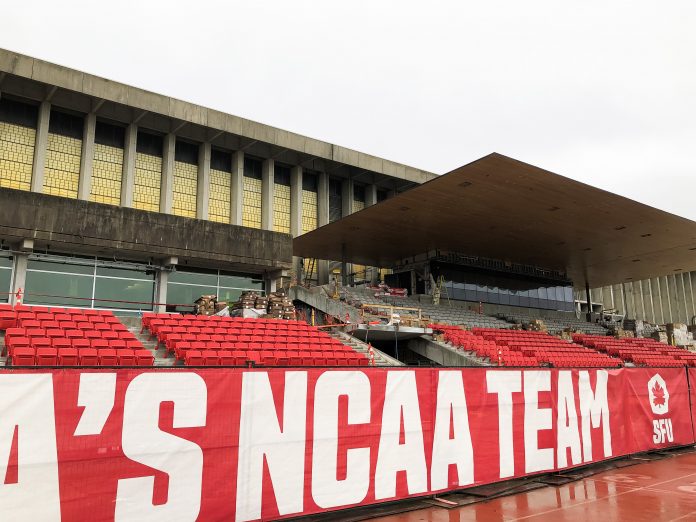
Originally scheduled for completion in August 2020, the SFU Stadium Project is expected to be “substantially complete” by February 2021, according to SFSS Vice-President of Finance Corbett Gildersleve. 

Completion of the stadium had been postponed from September 2020 to November 2020, and then until early 2021 due to delays related to COVID-19. 

In an interview with The Peak, Gildersleeve explained that safety precautions for the pandemic have impacted the ability for different trades to work on the project. Tasks that once required the collaboration of multiple workers for efficiency have now been slowed down in order to comply with social distancing measures.

“The pandemic brought upon a worldwide supply crisis that led to difficulty in attaining some key materials and components for the project,” Gildersleve explained.

In addition, he stated that “the risk of COVID-19 impacting the project further is still present” and he is “confident that the SFU project management team will take the corrective action necessary to address any delay if one was to arise.”

Estimated to cost between $18–⁠$20 million, SFU students will contribute $10 million to fund the project with the university covering additional costs. Gildersleve stated that “the payments for the stadium commence at the point of substantial completion.” He added that “delays will only impact the payment date but will not cause any increases in [ . . . ] contributions.”

The stadium will function as the “home stadium on campus for Canada’s NCAA teams,” with features such as 1,800 seats, a canopy roof, and amenities including “[an] accessible concourse, washroom, broadcast and media facilities, integrated sound system, fully accessible VIP/Sponsor box and coaches booths.’”

Regarding SFU Athletics sports teams and training activities as the stadium nears completion, The Peak reached out to Theresa Hanson, director of Athletics & Recreation for more information but did not receive a response by the publication deadline.

A live webcam is available on the SFU website showcasing updates on the stadium’s progress. 

Roger Linington Advances to Tier 1 Canada Research Chair for work in natural chemistry

0
Photo courtesy of SFU News

Written by: Karissa Ketter, News Writer 

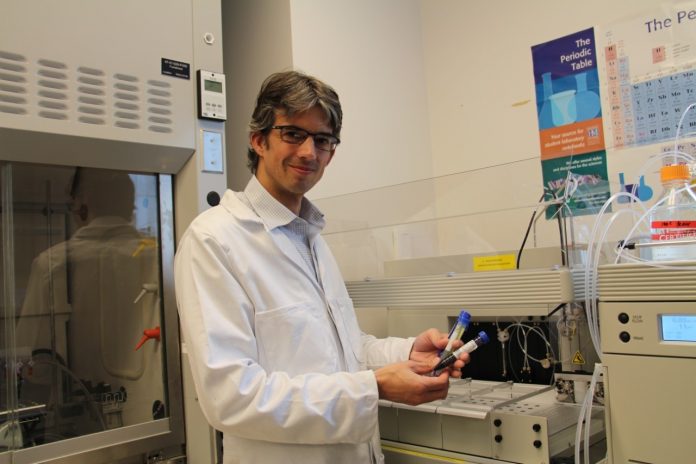
SFU professor and researcher Dr. Roger Linington said in an interview with The Peak that his selection as Tier 1 Canada Research Chair (CRC) will allow him and his research team to “to tackle questions that would have otherwise [ . . . ]  been impractical.” 

With the CRC advancement, he is currently working on inverting the process of how natural chemistry is studied. According to Linington, “There is a long history of studying chemistry from nature,” such as looking at molecules to create pharmaceuticals or antibiotics for diseases (such as diabetes and COVID-19). 

“Those projects have historically been done on a case-by-case basis. So the way that that research was usually performed was that you might make a set of samples from the environment and test all those samples against your target item.” He added that if a sample showed promise, it would be studied “to figure out why it [was] active and which molecule [was] responsible. That’s the way in which many of our current drugs have been found.” 

His research is now looking to correct systematic flaws. “The problem with that approach is that there is an increasingly high rate of redundancy [ . . . ] [people] are finding the same things over and over.”

Linington explained that the “research program is really looking at developing methods to look broadly at all of chemical space at the outset.” He aims to “ask at the very beginning, ‘What is the full chemical landscape of this set of samples?’ and ‘What do all these samples do against some target of choice?’” With this information, his team can determine how each sample behaves and “can start making predictions about which molecules are causing which effects.”

According to Linington, “It completely inverts the discovery model for investigating natural chemistry and [can] hopefully lead to a whole realm of discoveries.”  

Linington noted that he felt it to be a great personal honour to be selected for part of the program. He said “the CRC is really a spectacular program” that allows researchers to dive into more subject areas and has a “substantive impact on the way research is performed in Canada.”

Before beginning his career at SFU in 2015 during his time in Tier 2 of CRC, Linington was working with chemical biology in Santa Cruz, California. Linington credits his ability to learn more about data science and programming to his advancement to Tier 1 of CRC.  

In December of 2019, Linington published the Natural Products Atlas which he describes as “an open atlas, that is open access, [ . . . ] of all of the natural products, or molecules of nature, produced by microorganisms. So, it’s supposed to be a comprehensive database and resource for the wider chemical community which describes everything that’s being found in the literature today from microorganisms.”

Dr. Linington was selected for the CRC program this year along with eight other SFU researchers that are working in an array of research fields. More information on the work of Dr. Linington can be found on Linington Lab’s website

There are too many online platforms

0
Hopin? More like Hopout. PHOTO: Marvin Meyer / Unsplash

by Madeleine Chan, Opinions Editor

Remember the good ol’ days of the Internet, back when there weren’t 50 million different video-posting websites, social media apps, and messaging platforms? I do, but just barely. It seems like the growth of the Internet, and subsequently the commercialization of it, has spurred the need for multiple methods to communicate, entertain, and live online. SFU has even adopted some of these excessive methods for classes and events. However, this exorbitant number of electronic channels shouldn’t be celebrated, but seen as unnecessary and potentially harmful for those who delve into their excessivity. 

To preface, I’m the type of person that really would just do away with all digital platforms if I could. But I know that I’ve signed up for countless accounts for websites that I’ve only used once, messaged the same people on different apps, and consumed entertainment media in more than one place. It’s not a bad thing to use multiple digital networks because socializing, work, entertainment, and other facets of life are so intrinsically filtered through them. But does that mean we should be forced to use them, or that more video calls apps than I can count should exist? For the sake of proficiency and privacy, no.

Other than the electronic overload that the sheer number of these platforms impose, they also bring up privacy concerns. Every website isn’t out to get a user’s information, but they do retain their information in some manner, and there’s always the risk of it being stolen by external parties. We shouldn’t have to make accounts and unnecessarily share data with multitudes of companies when it’s enough of a risk with just a couple. 

One example of a platform that doesn’t need to exist is Hopin, a video event website that was used for the SFSS’ Clubs Days. To start, the website didn’t even function well. There were constant connection drop-outs from multiple participants, confusing interface controls, and the website kicked everyone out the second the event was scheduled to end. It would have served students better if the already-familiar, already-tested Zoom was utilized so that they didn’t have to wrestle with a completely new interface. 

The SFSS likely used Hopin because the school apparently recommends avoiding Zoom whenever possible as they store their data outside of Canada. These data concerns are valid, but when students are already so used to other platforms like Zoom, switching doesn’t seem worth the hassle. Not to mention the fact that students have to give their data to a website that they will use at most three times a year at SFU. 

It’s not just Hopin that students have to use to participate in events and classes at SFU. I’ve heard of annotation websites and voice communication apps being mandatory for classes. While online interaction requires increased use of digital platforms, students shouldn’t be forced to create extra accounts and put their information at risk to learn and socialize. 

This doesn’t mean that there should only be one all-encompassing website, like Facebook is trying to be, or that there can’t be economic competition on the Internet. It’s just that if there are already thousands of instant messaging apps, people shouldn’t need more, and SFU shouldn’t be forcing us to use new platforms if we don’t have to. The majority of students’ lives are lived through screens now anyway, we don’t need any extra hassle of navigating the labyrinths and pitfalls they may bring.

SFU’s CARES program provides students in isolation with accommodation and food at a discount

1
PHOTO: Andrew Neel / Unsplash

Written by: Charlene Aviles, Peak Associate 

Upon arrival to Canada, the Quarantine Act mandates that international travellers isolate for 14 days, regardless of the new requirement of a negative COVID-19 test before travelling. For SFU or Fraser International College (FIC) students following these requirements, SFU is now offering several packages to support their accommodation and food needs through the CARES pilot program, which is in effect from December 7, 2020 until March 31, 2021 — with the possibility of an extension.

The CARES packages include a subsidized 14-day hotel booking at Accent Inns Burnaby and optional hot meals, meal delivery, and grocery gift cards. The accommodation-only package is $768.50, and the package with meals costs $1472.62. Both packages include a SFU CARES Kit consisting of snacks and health products. Without the student discounts, the accommodation-only package would cost $1368.50 and the accommodation and meals package would cost $2072.62. 

CARES program also offers check-ins to students who have their own accommodation and meals but still desire support during self-isolation. Based on the volume of applications, priority for the packages may be limited to students who must arrive for their program or research.

In an interview with The Peak, Tracey Mason-Innes, Executive Director of Student Affairs, and Micaela Roughton, Associate Director of Community and Belonging, explained that check-ins for the program are flexible.

“The Self-Isolation Support Team is here as a starting place to help connect students [to] all other resources, information, and support they need across SFU as they prepare to travel and during self-isolation. Support is delivered over email, virtual meetings, and phone calls.”

Through the My Place at SFU portal, applicants are required to apply a minimum of 10 days before their flight. Students who will arrive in less than 10 days should email student support to expedite the application process.

According to Mason-Innes and Roughton, CARES Emergency Assistance funding applicants who require funding to secure a CARES package are considered priority. The one-time, emergency $1000 payment is for full or part-time SFU or FIC students, either graduate or undergraduate, who are CARES program applicants with higher financial needs.  

Mason-Innes and Roughton noted that the program’s objective acknowledges common student concerns when travelling.

“Frequent initial questions and concerns have focused on travel regulations and documentation, self-isolation options and resources, and how to access supplies like groceries and meals. We knew these common questions and concerns would arise, and the program has been designed to support students as best we can.”

Visit SFU’s website to read a guide for international students arriving in Canada and online resources for students in self-isolation.