Home Blog Page 35

What Grinds Our Gears: Friend who guesses the movie’s plot

0
a photo of two people sitting on a couch, watching a movie. One person appears to have figured out the plot, while the other is annoyed.
PHOTO: Emily Le / The Peak

By: Rusham Verma, SFU Student

Never have I ever had a friend guess the plot twist of the movie I was showing them in the first 20 minutes. Oh wait, yes I have. And I’m guessing you have too. 

There’s always that one person in your friend group or family who just knows what’s going to happen in a movie or a show. It’s like they have some kind of psychic superpower. Not just that, you end up bending over backwards to convince them they’re wrong. About everything. And all you’re thinking is, “This is supposed to be my leisure time. Why am I working overtime to help someone else experience this show properly?” Isn’t showing someone else something you’re obsessed with, all about the experience? Not for them, I guess! 

Look, I get it. You’re smart and you know all about how movies work. But please don’t bring that type of energy into this house; maybe don’t catch the foreshadowing. We like to go with the flow and vibe. We want a bowl of popcorn, a soda in hand, and a movie plot simple enough that we don’t have to pause and dissect the literary devices. And hey, maybe we’ll even throw a five-star rating their way afterwards.

Avengers, assemble . . . for the Pentagon and its allies

0
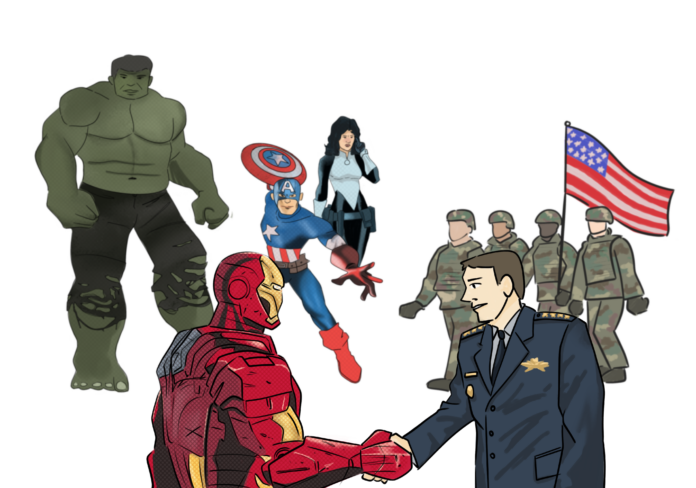
An illustration of an American military officer shaking hands with Iron Man in the foreground, in the background are a group of MCU heroes one one side and American soldiers on the other
ILLUSTRATION: VIctoria Lo / The Peak

By: Zainab Salam, Opinions Editor

The Marvel Cinematic Universe (MCU) has become one of the most dominant forces in modern cinema. Yet beneath the visual grandeur and pop-culture appeal lies a subtler narrative thread — one that blends the art of filmmaking with ideological messaging. The MCU pushes out pro-military propaganda, leveraging its immense cultural reach to reinforce particular narratives about American power and militarism

The root of this relationship runs deep. Since the inception of the MCU with Iron Man (2008), Marvel Studios has collaborated with the United States department of defence on several projects. These collaborations manifested as military personnel consults, and vehicles and locations supplemented by the Pentagon. However, they are not without strings attached — the Pentagon frequently influences scripts and portrayals. This symbiotic relationship results in films that often glorify the military while glossing over the role of the US in global geopolitics and the involvement of its military in controversial military operations around the world. 

Marvel operates as a covert outpost for the American military recruitment propaganda. With their movies, they regularly criticize the government and military, only to rely on and find a necessity in both. Take the Iron Man movies: Tony Stark’s storyline is that he realizes that arms manufacturing causes immense harm, prompting him to shut down Stark Industries’ weapons division. However, by Iron Man 2 (2010), Stark begins working more closely with military and intelligence officials. This encourages viewers to support more nuanced forms of militarism

“The inclusion of Sabra in Captain America: Brave New World (2025) is not a neutral creative decision — it also functions as a pro-settler colonialism and pro-genocide statement cloaked in the aesthetics of superheroism.”

Another example of this propaganda is Captain Marvel (2019), a film developed in close partnership with the US Air Force. Marketed as a feminist milestone, the movie follows Carol Danvers’ transformation from pilot to intergalactic superhero. However, the movie glamorizes the life of military personnel, suggesting that heroism and nationalism go hand in hand. This brand of storytelling actively works to rehabilitate the image of US military power. It also paints an image of a gender-inclusive military life. Unfortunately, that is an inaccurate depiction of the reality of women in the military. The US military remains riddled with sexism, gendered violence, inaction against said violence, and an institutional culture of antagonism towards not only women, particularly women of colour, but also soldiers identified as transgender and queer.

This pattern of aligning heroism with state power doesn’t stop at American militarism — Marvel’s latest decision to include the character of Sabra in Captain America: Brave New World (2025) posits a willingness to extend that narrative to its close ally, Israel. It functions as a pro-settler colonialism and pro-genocide statement cloaked in the aesthetics of superheroism. Sabra, a Mossad agent in the comics, represents an arm of the Israeli state that has been deeply involved in the violent displacement, surveillance, and genocide of the Palestinian people. By incorporating this character into a mainstream, globally beloved franchise, Marvel effectively normalizes and valorizes the Israeli occupation of Palestinian land. It recasts agents of a violent apartheid regime as defenders of justice, thereby erasing the lived realities of ongoing ethnic cleansing and settler violence

Furthermore, this inclusion reflects a broader ideological alignment within the Marvel franchise, one that is deeply entangled with settler colonial values. The MCU, in many ways, is a product of the US, a settler colony built on the ongoing dispossession and erasure of Indigenous Peoples across Turtle Island. Most of its films are shot on Indigenous lands without acknowledgement given towards their communities, notably in Atlanta, Georgia, and Australia. This is against the backdrop of the systematic violence, resource theft, and cultural suppression that Indigenous communities continue to face every day. When a franchise produced in a colonial context so readily uplifts a figure like Sabra, it reveals a troubling consistency: a willingness to erase the brutal foundations of state imperialism if it fits neatly into a heroic narrative. As viewers, especially in settler-colonial states, we must question what it means to consume this content uncritically. Who gets framed as a hero? Who is absent from the screen, or reduced to a threat? When pop culture normalizes settler colonialism both at home and outside, it doesn’t just reflect our political values — it shapes them. 

It’s worth scrutinizing the MCU’s values and ideologies it perpetuates. In blending high production value with pro-military and pro-settler colonialism narratives, the MCU illustrates how popular art, as a form of soft power, serves to shape public sentiment and political views in powerful ways.

Five subtle recession indicators you NEED to know

0
a photo of a television set with the island from Lost on it. The words “Lost” are on the screen.
ILLUSTRATION: Stella Laurino / The Peak

By: Petra Chase, Peak Associate

Recession indicators are all the rage. We took a Buzzfeed “What recession indicator are you?” quiz, and apparently, we’re Lady Gaga (ra-ra-ra-rad!). Lipstick sales, Mariah Carey going grocery shopping, and flash mobs are also on the list

The Peak contacted an SFU economics professor to speak on this phenomenon, to which they responded, “You can request a statement through Cameo for $10. I also do birthdays. You can pre-book me for Christmas carols,” — to which we responded, “Recession indicator!” 

Here are five more gentle reminders our economy is nearing collapse.

Decline in oat beverage sales
Milk Statistics Canada reported that oat “myllke” sales are in decline. Sorry, for legal reasons, we can’t use the word “milk” (AKA the dairy industry will sue). Even bisexuals are ordering it less (yeah, Milk Statistics Canada is thorough about demographic data). Do you know what it means when bisexuals are sacrificing their daily oat m**k lattes during Pride month? Things are BAD.

Labubus
With their mischievous grins and versatile eyes (open, closed, and winking), Labubus are the collectible plushies everyone wants hung from their Stanley cup. An article called “Labubu Dolls, Economy Falls: A Symbiotic Analysis” in the Journal of Radical Marxism explains that collecting dolls and trinkets during tough times signifies a longing to return to childhood. Also, in season five episode 83 of the workplace sitcom The Office, business-minded assistant to the regional manager Dwight Schrute bought the town’s stock of Princess Unicorn dolls and sold them to desperate parents to make a profit. 15 years later, Schrute’s resourcefulness continues to inspire side-hustling Marketplace Labubu resellers who are making bank. And who can blame them in this economy?

Increase in three kids stacked on top of each other in trench coats
Investigative journalists at The Peak have concluded there’s been an increase in parents stacking three small children on top of each other, draping them in a trench coat, and plopping them into corporate jobs so they can get an early pension. Many of these kids have gone undetected, even in leadership roles, due to the rise of anti-intellectualism and the smartest kid being strategically placed on top. While it’s unclear how many are currently disguised as grifters, we’re also investigating under one Jordan Peterson’s trenchcoat after the personality was flummoxed during a Jubilee debate. He asked his opponent to clarify what conjunctions and interrogative words mean, leading some experts to propose he is actually a six-year-old on another six-year-old’s shoulders. 

Hobbyhorsing is a thing
Remember when horseback riding was affordable? JK, it’s always been a rich people sport, BUT you know things are bad when even upper-income equitarian enthusiasts (AKA horse girls) from Philadelphia are resorting to galloping through obstacle courses on wooden toy horses. Apparently the sport originated when a child asked their mom for horseback lessons and was told, “We have horses at home.” Though hobbyhorsing has been around since the early 2000s, said Philadelphians organized the first school competition last month, showing that it’s gaining popularity.

Everyone’s watching or rewatching Lost
Aren’t we all a little bit lost during an economic recession? Comparing egg prices in the supermarket, tattooing our toenails. It’s no wonder we’d want to get lost in six seasons of Lost, the hauntological action mystery that revolutionized the early 2000s. The show explores questions of destiny versus free will through the morally complicated survivors of a plane crash as they unlock the mysteries of an island and a curious number sequence. During an economic recession, the fluctuating prices are also confusing numbers that make us question faith and science, so we can relate.

Brighter Side: When a song finds you

0
A photo of a person holding a phone with a music app playing “Sally, When the Wine Runs Out” by ROLE MODEL
PHOTO: Emily Le / The Peak

By: Rusham Verma, SFU Student

Imagine you’re on a road trip wi your playlist on shuffle. Then, that song comes on. Yes, the one that seems like it was made for this exact moment on the road. The windows are down, the wind’s flowing in your hair, and it’s just you and the open road. The day suddenly feels brighter. More promising. 

Now imagine a different scene: you’ve just been through a breakup and are sulking in bed. A generic playlist plays on shuffle. Your eyes are puffy, and your chest feels heavy; you’re not quite sure how to process such pain. Then, “You’re Losing Me” by Taylor Swift starts playing. Listening to the lyrics, you realize how deeply they echo your feelings. A small smile tugs at your lips. At least someone gets it, you think. 

For someone else, the perfect song may play when they get to know their crush’s name is Sally, and the song “Sally, When the Wine Runs Out” by ROLE MODEL starts playing in their earphones. Now, that might be too on-the-nose, sure. But for them? It feels like a sign. 

So, when the perfect song finds you at the right time, whether it’s a coincidence or cosmic timing, just take the hint. Roll the windows down, feel it, and be the main character.

From capitalism to colonialism, how do structures of power control the way we think?

0
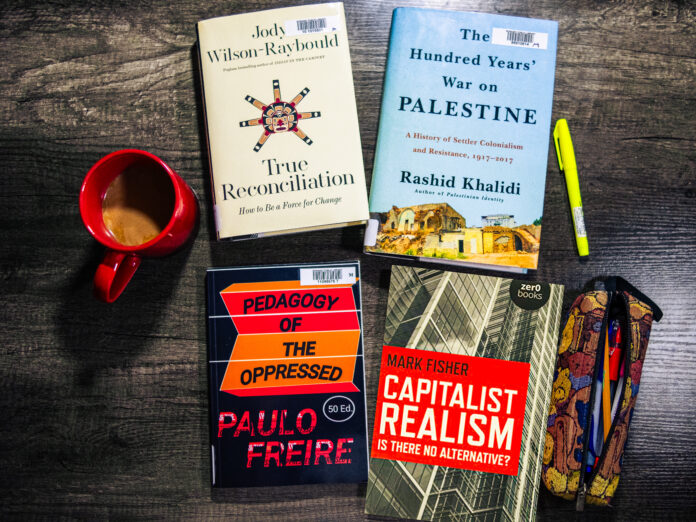
This is a photo of the four books mentioned in the article neatly laid out on a table
PHOTO: Emily Le / The Peak

By: Yildiz Subuk, Staff Writer

The Hundred Years War on Palestine by Rashid Khalidi

Rashid Khalidi’s account of the oppression faced by Palestinians is the perfect place to start for those who have limited knowledge of Palestinian history. Khalidi covers the Israeli occupation of Palestine before the Nakba (which took place in 1947 and led to the dispossession of many Palestinians). He traces the root of Zionism by analyzing the colonizers’ gaze and language when the question of Palestine was present.

Khalidi, who is also Palestinian, weaves in his own lineage, expanding on how he is deeply tied to the land he writes about. As the book progresses, the writing becomes more personal; the reality of the situation begins to set in with the reader.

Tracing three eras of the Israeli occupation, The Hundred Years War on Palestine, reminds us that the oppression Palestinians face began nearly a century before October 7th. Khalidi’s work outlines oppression, resistance, and the failures of the international community.

Pedagogy of the Oppressed by Paulo Freire

Freire’s work covers the relationship between power and education. He argues that for oppressed people to truly find freedom, the education they receive must focus on doing so. However, the power structures that influence the curriculum tend to uphold the status quo.

Freire’s own experiences as an educator in Brazil and his travels educating in places like Guinea Bissau are woven into the book. This personal touch shapes the thinking behind this book, as Freire is not merely investigating power and education but exposing the deeper nature of his own journey. While Pedagogy of the Oppressed is fairly short in length, the book is a dense work of philosophy with four chapters, all requiring the readers’ focus, and constant critical engagement. The heart of the book is this solution proposed by Friere, as he investigates how the latter can play a role in the liberation of the oppressed.

Capitalist Realism by Mark Fisher 

Capitalism is not just an economic system, but an ideological motif that dominates the western mind. Mark Fisher argues that capitalism’s influence has become so significant it’s difficult to think of any other probable system outside of capitalism. Fisher draws on the famous quote by Fredric Jameson and Slavoj Žižek: “It is easier to imagine the end of the world than the end of capitalism.”

Capitalist Realism is short and concise. Under 100 pages, Fisher manages to cover topics such as how capitalism is depicted in dystopian stories, how capitalism affects mental health, and contributes to  environmental degradation. All these issues are tied to the fact that market supremacy has made life transactional, and difficult for our psyche to break free from this mode of thinking. 

One of the key takeaways from this book is that it covers how mental illness is viewed in a capitalist mindset. It is often subjugated to be a “chemico-biological problem,” placing the blame on someone’s brain chemistry instead of considering the possibility that capitalism has had an effect on the person.

True Reconciliation by Jody Wilson-Raybould

Jody Wilson-Raybould (Kwakwaka’wakw) served as a member of parliament in the Canadian government and has written this book drawing from the cultural and diplomatic experience she had in that capacity. True Reconciliation sets the record straight about colonial history in Canada and the existing structures within government that continue to affect Indigenous People today

Wilson-Raybould explains the significance of Indigenous cultures and highlights the various perspectives that are present within the communities, then progresses the narrative towards understanding the past. The reader will be given a straightforward account of Indigenous history from a political angle, presented with oppressive accounts of Canadian policy-making, as well as thoroughly researched evidence of colonial thinking and Indigenous rebuttal. Wilson-Raybould ensures that the analysis she provides is thoroughly supported by evidence, and no corner seems unturned with her research in the book.

Excerpts from a blogging mom: Cancel culture cookies

0
A middle-aged woman wearing a black sunhat and a oversized white dress shirt. Her nails are black and she is in a field of some sorts.
PHOTO: Yana Tsybrovska / Unsplash

By: Sheela McGummery, Peak Columnist

Hello, world! My name is Sheela McGummery
and I blog about my life as a mommy of five kiddos!
I am a proud conservative woman of the suburbs and I
bake to fill my life with the sort of sweetness
I used to find in my marriage. LOL.
For any serious baking inquiries, please email 

[email protected]

MY YUMMY CANCEL CULTURE COOKIE RECIPE

Hey momacitas! Today, we are making some delish cancel culture cookies! My favourite recipe! Let’s get on with our ingredients. :))

But first, way back in 2019, I was invited to write a guest column for The Peark about my fabulous lemon bars. Since then, I have been behind CANCELLED BARS. I was (what the communist millennials call) #Cancelled over me admitting to “accidentally” (wink wink, girlfriends) putting an insurance salesperson into a coma!!!!!!!

I used to be very polite, timid, and respectful in my blog. After spending years being CENSORED by editors, I am back, more passionate and god-fearing than ever. This is my evolution. This is the new Sheela.  

The Peark ruined my life. All of a sudden Sheela was the bad gal.

My CHURCH reassigned me to napkin duty, 

My frosted bars were BANNED from PAC meetings,

The AI robot bot self-checkout machine at Thrifty’s started beeping at me more than normal. 

The Peark and WorldWideWeb.THE-PEAKPeriodCA didn’t want good old Sheela writing for them. They say Sheela is an aggressive person  and is “funky.” Well guess what? NOPE. Not true. 

So now they gave me back my blog!!!!!

Otherwise I threatened to enroll in SFU courses and make their lives a living heck. To my haters I say: put down your oat milk and live a little. To my wonderfully loyal fan base of two readers, four of which are named Doreen, thanks for reading an empty blog for six years. 

This blog is officially once again open for business, so long as I have WiFi in my prayer pantry — where the router shares a shelf with my holy water and pic of Andrew Scheer’s abs. So tell a friend to tell a friend that (she)EEELA’s BAAAAAACK!

Now, let’s get on to the recipe. 

Cancel culture cookies hold a very close and dear place next to my heart. I guess you can say they are heart healthy! Bahahahahhahahaha! 

But speaking of cancel culture cookies reminds me of the time I got BANNED from Facenovel Marketplace for trying to trade a batch of my cancel culture cookies for a second-hand and ethically-sourced quinoa-filled boxing bag with that crook David Eby’s face on it, hand-made by that snake in the grass Rebecca (a Libertarian pagan). I said EXCUSE YOU? Who do you think you are to BAN me from Facenovel Marketplace? And for what?? I only had like 300 warnings from previous incidents. That’s like nothing!! Remember what I did to the insurance salesperson? DO YOU REMEMBER? Do you want to mess with Sheela? 

SO I got my little Johnathonoah (who just turned 10) to hack into Rebecca’s mother board and find where her router was. We had to attack her router. She probably doesn’t have her router in a prayer closet — it’s probably inside of some woke smoothie bar (omg, eyeroll). 

Johnathonoah turned to me and he said, “Mother, this lady has messed with the WRONG baked-goods religious matriarch.” Don’t mess with momma bear. Raaaawwwr.  

So I found her router, found her address in my personal yellow pages, walked up to her, and punched her with another yellow pages book (old habits don’t die), and dragged her into her backyard  where I hoped she and the router would be mauled by a passing bear. But no bears were in sight. The router and Rebecca lived (ugh). One restraining order later and another night in jail, all in the name of promoting good faith-based habits and to make our country cancel free. 

So, who’s ready to make some cancel culture cookies? 

RECIPE ON PAGE 2 >

Peak Speaks

0
Chad Kroeger, lead singer of Nickelback, strumming his guitar at a concert.
PHOTO: Courtesy of Moshville Times

By: Lucaiah Smith-Miodownik, News Writer

The Peak hits Reddit to ask SFU students some serious and thought-provoking questions!

Q: Would you rather get a dollar for every raccoon you see on campus but you can only listen to Nickelback for the rest of your life, or $1 million if the gondola ever gets built but you can never eat at Tim’s again? Why?

u/ManyMilesLongAway:: “$1 million but no Tim’s. Once its grilled cheese died, my love for Tim’s followed.”

u/powerclipper780:: “Nickelback is sick. You’re telling me I could be wealthy and musically fulfilled? Sign me up.”

u/rebeccarightnow:: “The gondola being built is more likely than me ever not regretting Tim’s. So sure, I’ll take a chance on getting paid for it instead of condemning myself to a life of misery with the first option.”

u/manOmanytendies42:“$1 million if the gondola ever gets built. Nickelback is a fate worse than death.”

u/FierceCat5020: “$1 million, and start my own coffee shop right away.”

u/stopruining: “$1 million and free my guts from the tyranny of the farmers wrap & iced cap combo? Sign me up.”

u/masterugway: “I don’t think Nickelback themselves would pick the first option.”

Your cashier is not your therapist

0
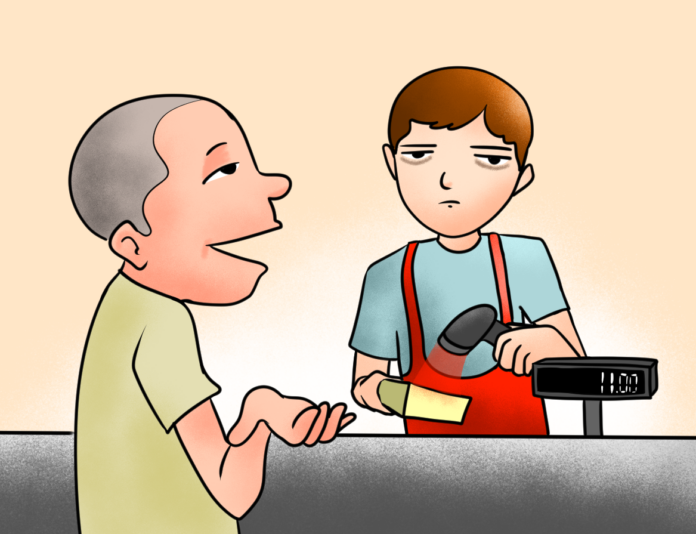
An illustration that depicts a grocery store associate, talking to a customer during checkout
ILLUSTRATION: Cliff Ebora / The Peak

By: Yulissa Huamani, Peak Associate and Zainab Salam, Opinions Editor

The checkout line at the local grocery store might seem like a pleasant opportunity for a friendly conversation. Chatting with the cashier at the register while going grocery shopping can be a great moment of connection. However, this is only true if both parties feel comfortable. Being kind to customers is part of the job for the person behind the register. Though essential to the customer experience, these conversations are a labour that remain invisible. As customers, we need to extend kindness to workers by understanding the inherent power dynamics that are present in these interactions. 

A common, yet overlooked, display of unequal power dynamics is when a customer finishes paying but continues to engage the cashier in conversation — even as the next person is waiting to be attended to. Not only is it important to be respectful and considerate of other customers, some grocery stores time their cashiers to monitor their efficiency. 

There’s also an emotional toll to being forced to be friendly with people frequently. Being a regular is not the same as being friends with service workers. Venting to your cashier can create a very uncomfortable situation. In a 2019 article published on Medium, Cassidy Scanlon expressed that customers oversharing with her as a barista caused her to wonder: “What is my role in these situations? Am I a counselor? Or a friend? Am I a shoulder to cry on? Why does this dynamic even exist?

“For the person behind the register, it’s not just another interaction, it’s work”

The phrase “the customer is always right,” is another well-known way this uncomfortable dynamic manifests itself. In instances when dissatisfaction is expressed by customers, the manager might side with the customer, even if the worker is right. This can extend to situations when customers are being demeaning, and supervisors would sweep the impact of that disrespectful behaviour under the rug. 

That being said, the power dynamic can get inverted. This happens when a person is a customer in one store and a worker in another. In many ways, this reflects that we should treat others the same way we want to be treated, without expecting something in return. 

Emotional labour isn’t just warm feelings — it’s mental and emotional energy that cashiers contribute daily. Recognizing this added labour is a step towards more equitable treatment of those in the customer service industry. Those who share unprompted details about their family issues, relationships, political beliefs, and personal finances place an unexpected emotional burden on the worker and could increase burnout. There are some serious consequences to listening to other people’s problems, which can include higher levels of anxiety and depression. What it really boils down to is that it is inappropriate to have an invasive conversation with someone who is only getting paid to bag your groceries. Being respectful towards others is a fundamental value that many people have forgotten to implement. So, let’s be kind individuals; we have to be more caring and understand that some environments are more conducive to long conversations than others.

A celebration of Indigenous cultures at SFU Burnaby

0
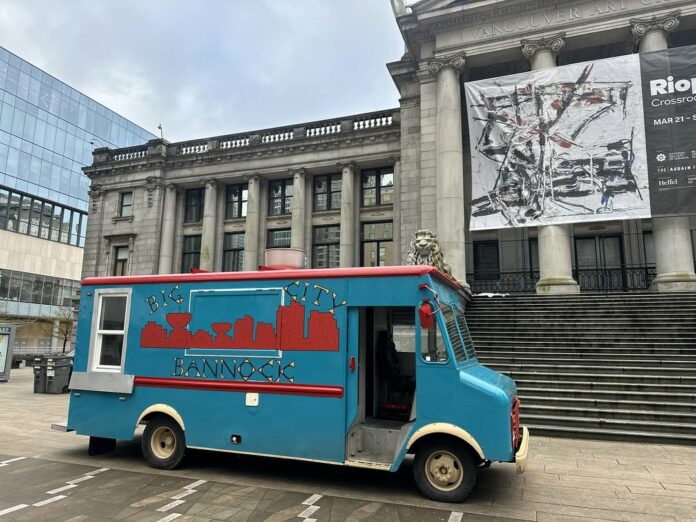
Photo of Big City Bannock Food Truck
PHOTO: Courtesy of @museumofvan / Instagram

By: Noeka Nimmervoll, Staff Writer

On Tuesday June 17, SFU’s Town and Gown Square will be filled with a bustling Indigenous Market. From 10:00 a.m. to 4:30 p.m., the square will be lined with 25 vendors showcasing their Indigenous goods and art. Hosted in the middle of National Indigenous History Month, the market is organized by SFU Campus Services and the Indigenous Student Centre (ISC). The market is set to be a vibrant display of the cultures of various Indigenous Nations, and a wonderful opportunity for all community members to engage in the local Indigenous goods and art scene. 

A top vendor for the market is Big City Bannock Food Truck, which is both Indigenous and family-owned. Their menu includes elk bannock tacos and bannock burgers. This menu centers its culinary delights around bannock, which “has a smoky, almost nutty flavour blended with a buttery taste,” according to Spectacular Northwest Territories. It will be served at the market as a deep fried delight as both traditional bannock and as the more modern staple, bannock tacos. In a statement to The Peak, the vendor, Raymond said, “We love to showcase a piece of Indigenous culture and bring people together with every dish we serve.”

SFU Campus Services and the ISC have organized this event to engage the SFU community at large to explore and enjoy the market. Ayumi Orgar, of SFU Campus Services, said, “People can browse a diverse selection of handcrafted goods, jewelry, artwork, beadwork, textiles, traditional foods, and more — all created by 25 talented Indigenous artists and makers from local communities. This event is a meaningful opportunity to support Indigenous businesses, learn about cultural practices, and connect with community members in a vibrant, welcoming space.” Anyone who wishes to attend the market is invited. The market will be full of these hand-selected vendors with a large diversity of artwork and meticulously hand-crafted items. There will be items for all to explore and enjoy. Orgar adds that the event “is being held in the Town and Gown Square to better include the wider SFU community.” So come one, come all!

All month long, there are ways to support and research Indigenous history and culture. SFU’s Campus Services and ISC are committed to the honouring of this month beyond hosting the market. There are several ways to share your support, as listed on the ISC page: Donate to local Indigenous community initiatives, read the Truth and Reconciliation Commission of Canada: Calls to Action report, and engage with and share Indigenous content online. According to the ISC, a key way to show up this month is to support Indigenous artists, by buying their pieces and learning about the item. What better way to do this than to show up to the market and ask the artists themselves?

So now that you know what you’re doing on Tuesday June 17, make sure to come early enough to grab some delicious bannock and have the first pick of beautifully crafted items! Come out and bring your friends to support Indigenous artists, eat delicious food, and have fun!

Shafira Vidyamaharani’s intuitive path to design

0
This is a picture showing some of Vidyamaharani’s artistic work on a wall of white wallpaper
PHOTO: Donnell Garcia

By: Ashima Shukla, Staff Writer

A graphic designer, photographer, videographer, painter, writer, and textile artist, Shafira Vidyamaharani’s practice resists definition — and that’s the point. Now a graduate student in SFU’s communication program, they are building a career that merges intuition with intellect, art with community, and personal memories with collective futures. 

Even as a child, art was the language Vidyamaharani best understood. Their mother enrolled them in art competitions, and their father used drawing to explain complex ideas. “[Art] has always been in me, and passed down through me,” they told The Peak, smiling under the summer sun on Burnaby campus. 

Vidyamaharani was never formally trained in graphic design. They remember first making One Direction graphics on Tumblr, which evolved into designing for their school and the district student council. In fact, they never expected to build a creative career in Vancouver, which “forces out talented creatives” due to high rent, few opportunities, and a difficult grant system

Still, their practice grew through connections. Volunteering to design for a friend’s show led to more paid work, word-of-mouth recognition, and a steady presence within the DIY music and cultural production scene. In this, social media became their de facto agent, their portfolio, and their stage. 

Understanding graphic design as also a service, they find themselves frequently negotiating between their artistic vision and the client’s needs. At this point in their practice, they reflect, they are able to be more selective with the work they take on. “Even just two years ago, this isn’t something I would be able to do,” they shared. Yet, they remain mindful of what it means to commodify something so personal. 

“The ethics of representation, of an idea, of a concept, of a spirit, and how it can be expressed through the graphic form” fascinates Shafira Vidyamaharani

“My mum had a point. You should leave your art as your hobby because it is something that can be sacred,” they reflected. “I am really glad I don’t solely depend on art to survive, that I have other skills that I can sell my labour with.” Still, their eyes lit up as they realized, “it feels so good knowing I was able to navigate my difficult relationship with commodifying my graphic practice.” 

Preferring not to follow trends, Vidyamaharani instead finds inspiration from nature and the everyday. Living by the water, running, biking, and photographing landscapes all help them reset. “I take a lot of retreats into nature to gain inspiration,” Vidyamaharani said, pointing to the asymmetries and quantitative reasoning in nature that guides their designs. Collaging, for instance, allows them to lean into the unknown, where the value lies not in the final product but in the interaction with materials, in the process itself. In this way, they find graphic design to be deeply intuitive.

Placing themselves in their work has been at the heart of Vidyamaharani’s practice. “So much of the graphic design literature that is taught to us is so eurocentric,” they reflected, pointing to the absence of designers like W.E.B. Du Bois or Emory Douglas in the canon. In contrast, their own visual world was shaped by Islamic calligraphic art — a sacred form of typography rooted in nature and design principles like the golden ratio and modularity around Islamic architecture. “I love typography so much, I make sure I am focusing on it,” they said.

“I don’t think that my practice would exist without the opportunities that community has presented to me,” they said. Working with local producers, DJs, and musicians, mediating and co-creating culture is part of how they see themselves instilling a cultural heritage in Metro Vancouver, “to build a cultural heritage that hasn’t been written about.” In this, they give a heartfelt shoutout, for example, to their friends at Made by We, who brought them into designing for a festival, and their ongoing collaborations with iDream library that continue to challenge and inspire them. 

Now in their fourth year as a freelance graphic designer, Vidyamaharani is also merging their creative practice with academic inquiry in their graduate research project. “The ethics of representation, of an idea, of a concept, of a spirit, and how it can be expressed through the graphic form” fascinates them. 

To young artists, and to their 18-year-old self, Vidyamaharani offers love and encouragement. “Don’t worry as much, everything truly does fall into place. I have fallen into some of the best parts of my life by accident.” Vidyamaharani continued, “The less stress you go through life with, the easier things get.” They concluded by reflecting, “Easier said than done, I know. Still, follow your dreams! Follow your heart. Follow your passion. Laugh more.”