
Home Blog Page 312

Breaks from academia can do a world of good

0
School supplies and backpacks lie strewn about on a desk. A whiteboard is in the centre of the photo, and it is blank. Notebooks are open, but it looks like the students have walked off to do other things.
There’s more to life than what we can find in a textbook. PHOTO: Katerina Holmes, Pexels

By: Alex Masse

University is a commitment — if you’re looking to complete a Bachelor’s degree, you can expect at least four years spent in an academic institution. If you pursue a second major, a minor, or take anything less than a full course-load, you add time to your degree.  

In those four-or-more years, you are a student before you are anything else. It becomes a part of your identity. That isn’t always a bad thing — I for one enjoy the assortment of discounts we receive on everything from museums to Spotify memberships — but while some of us may devote our whole lives to scholarly pursuits, for most of us, academia is temporary. 

The transition out of university, known as post-grad depression, is the cause of a worsened mental state in nearly 50% of recent university graduates. This change, among others, is why it’s important in those years to occasionally take breaks from academia. Beyond preparing yourself to better prevent a depressive episode, there are many other advantages to the academic break — and many kinds of academic breaks.

If you still want to work on your degree but need a break from the classroom, a great thing to try is co-op. After all, if you’re aiming for a specific career post-graduation, taking a semester or two to work in that field can be super eye-opening — you might love it as much as you thought, or you might realize it’s not what you were imagining it to be. As well as getting you out of academia, it offers a glance at what your future might hold and could steel your resolve for when you go back to your studies. The best part? Co-op can pad up your resume with relevant experience. If you’re looking for a way to still be a student but step back from your studies, co-op is a great opportunity. 

Another direction is to explore other potential paths and skill sets. This can look like just about anything and it can be a great way to add depth to what you’ve learned in university. Personally, I used what I’d learned in my Communication degree to take on freelance writing and design. I wrote for various platforms, performed at festivals, and had the time of my life being someone other than a student.

Of course, you can also approach something completely unrelated — maybe you’re in STEM, but you’ve always wanted to make and sell jewelry. Maybe you’re in FASS and want to try crocheting. Unlike co-op, you have complete control over where you aim to work. It’s also nice to be someone besides who your degree makes you out to be, and a good way to remind yourself you have other skills and talents. 

Finally, and perhaps most importantly, you can have a break from academia for the sake of having a break. It’s one thing to remember how you like to dedicate your energies outside of your studies, but how about who you are outside of your hustle? Who are you when you’re not productive, be that studying, working, or saving up? 

During the pandemic, grind mentality has been through the roof, and it’s important to remember you’re more than how much you get done in a day. No matter how much you love school or how excited you are for your career goals, you can’t forget to give love to who you are — when you’re off the clock, when you’re having fun, and when you’re with your friends. 

In short: take that break! Whichever break works best for what you need. 

Alternatively, take a break. Any break. Your body and mind will thank you.
Power rankings heading into the Spring 2022 athletic season

0
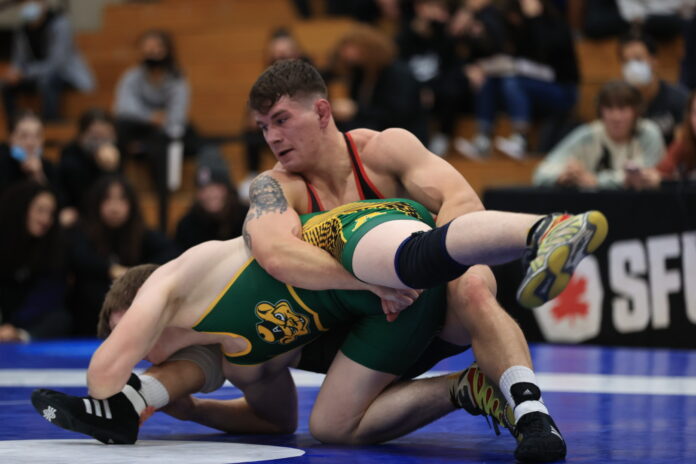
Logan Nelson grapples an opponent on the floor, with his arms locked around their leg.
SFU wrestler Logan Nelson looks to become SFU’s first NCAA Champion. PHOTO: Paul Yates

By: Simran Sarai, SFU Student

Although the spread of the Omicron COVID-19  variant has shed some uncertainty on the Spring 2022 athletic calendar, several SFU teams are still scheduled to play. With that said, The Peak takes a look at which SFU teams you should keep your eyes peeled for. 

Wrestling — #1

SFU’s wrestling team kicked off their season in November 2021, marking their first competition in over a year.

On the men’s side, fans should keep their eyes on senior Logan Nelson. Nelson qualified for the National Collegiate Athletic Association (NCAA) Championships back in 2020 and is striving to become an NCAA champion. He is ranked 10ᵗʰ in his weight class this season. Heavyweight class wrestler Taniela Feliciano-Takafua and teammate Riley Prough were among SFU wrestlers who were unbeaten at the Desert Duals meet on December 19, 2021, and will also be key pieces for SFU men’s wrestling.

SFU women’s wrestling was ranked fourth in the NCAA Preseason Coaches Poll. Teammates Karla Godinez-Gonzalez and Alex Hedrick are ranked number one in their respective weight classes. Godinez-Gonzalez (13–0) and teammate Maddie Mackenzie (11–0) remain unbeaten

Although SFU’s wrestling program has never had an NCAA champion, a roster with this many accolades is sure to go far this season. Men’s and women’s wrestling championships are scheduled to begin in late February. Expect to see teammates Nelson, Feliciano-Takafua, Godinez-Gonzalez, and Hedrick as top contenders for playoff spots.

Hockey — #2

SFU’s men’s hockey team currently sits at the top of the British Columbia Intercollegiate Hockey League (BCIHL) with an impressive 6–0 record. Forwards Garrett Hilton and rookie Logan Bromhead lead the team in points, and goaltender Cale Dolan was awarded BCIHL goaltender of the month for November 2021. 

During the 2019–20 season, SFU finished second in regular-season play. With SFU’s dominance out of the gate, the team is in the driver’s seat to come out as champions if they can keep their winning streak going.

Swimming — #3

Both the men’s and women’s teams have continuously set records meet after meet. At October’s Logger Relays, SFU’s first meet of the season, both teams placed first overall. At the Winter Collegiate Invitational, SFU swimmers won 28 out of 38 races, set four school records, and 14 meet records. 

On the men’s side, junior Collyn Gagne has impressed, winning two medals at the 2021 Toyota US Open Championships. Junior Kennedy Loewen has led the women’s team, collecting victories and setting records. Preseason swimming and diving polls conducted by the College Swimming Coaches Association of America have SFU’s men’s team ranked 15ᵗʰ and the women’s team 19ᵗʰ. 

Students should continue to expect strong performances from the swim team. However, SFU faces a difficult path in their quest to qualify for NCAA Championships in March. The men’s and women’s teams have never finished better than ninth. Under new coach Demone Tissira, will SFU swimming be able to improve their finishes?

Track and Field — #4

SFU’s track and field team is set to open their season at the UW Indoor Preview on January 15. Track and field has not competed since the 2020 season.

Headed by GNAC head coach of the year for cross country, Britt Townsend, SFU’s track team is expected to reach new heights this season. Building upon fourth place finishes at the 2019–20 GNAC Championships, SFU track and field athletes will be toeing the line all season in anticipation of qualifying for the 2022 DII Indoor Track and Field Championships, set to take place March 11–12.

Golf — #5

SFU men’s and women’s golf have boasted impressive finishes since their season began in September. Freshman Bailey Bjornson’s third place finish during the Dennis Rose Intercollegiate tournament led the men’s team to a fourth place finish in the tournament. Team captain Ryan Stolys will continue to be a leading force when the golf season resumes in the Spring, based on his fall performances that saw him tied for 30ᵗʰ at the South Central-West Regional Preview tournament. 

The women’s golf team opened the 2021–22 season at the Saint Martin’s Invitational, where team captain Shirin Anjarwalla led teammates to a second place finish at the tournament. 

Competition is tough amongst NCAA Div II schools — SFU’s men’s team is ranked 59ᵗʰ, while the women’s team is ranked 115ᵗʰ. NCAA West Regional Championships are scheduled to occur May 5–7.

Basketball — #6

Heading into the season, the men finished seventh in the Great Northwest Atlantic Conference (GNAC) Basketball Preseason Coaches Poll, while the women ranked fourth.

The men’s basketball team has had several highlights this season, including victories over UBC for the Buchanan Cup in front of a sold-out crowd, and conference opponents Western Washington University in a nail-biting 82–80 finish. 

Players to watch include senior forward Jasdeep Singh, who was selected to this season’s GNAC Men’s Basketball Preseason All-Conference Team, and fellow senior Julian Roche (centre), who leads the team, averaging 15.1 points per game. 

Despite a slow start to the season, the women’s team is poised for a turnaround with sophomore Jessica Wisotzki (guard/forward), who has had multiple career-best games already this season. Alongside the forward is senior guard Jessica Jones, who was named GNAC’s Preseason Player of the Year.

Men’s basketball hasn’t qualified for the GNAC championships since the 2013–14 season, while the women’s team qualified more recently, making it to the first round of the 2018–19 championships. After almost two years of no competition, both the men’s and women’s teams have considerable depth heading into the Spring season. With GNAC championships scheduled to take place March 3–5, expect both teams to be strong contenders for a championship spot.

Softball — #7

SFU softball is gearing up for what should be a strong season despite missing two seasons during the COVID-19 pandemic and losing key players, such as catcher Amanda Janes and outfielder Kate Fergusson, to graduation. With the return of seasoned players such as sophomore Anissa Zacharczuk, juniors Hanna Finkelstein and Alex Ogg, and seniors Chelsea Hotner and Courtney De Adder, SFU softball should be able to hold their own this season. 

The last time SFU softball punched a ticket to the GNAC Championships was during the 2018 season when they finished second to number one ranked Northwest Nazarene. After the hiring of head coach Tina Andreana in 2019, the team saw a revitalization that led them to the top of the GNAC standings, with a 7–1 record in 2020. SFU’s GNAC games are scheduled to start on February 18.

Examining the challenges women face after leaving the workforce

0
Illustration of a food service worker (left) and caretaker (right), both with concerned expressions
Give this podcast a listen for intersectional feminist insight on labour-related issues. ILLUSTRATION: Alyssa Umbal / The Peak

By: Gurleen Aujla, Peak Associate

Women, Work, More is a four-episode podcast series hosted by SFU sociology and labour studies student Alyha Bardi. The series eloquently shines a light on women in different stages and positions of the working world. In episode four, “Senior Women & Economic Insecurity,” Bardi focuses on issues surrounding pensions and retirement. I was intrigued to hear the last episode because the subject is rarely discussed in media. 

The episode features Sheila Block, senior economist at the Canadian Centre for Policy Alternatives, and Jo-Ann Hannah, retired director of Pensions and Benefits at Unifor. Alongside anonymous snippets of lived experiences, the episode spotlights intersectional impacts on retirement incomes. “As a single parent, you’re just, you’re in the moment. Just doing your daily stuff [ . . . ] If you struggled all through those years and don’t have a high income and a high pension and own property, it’s concerning to be older,” one interviewee shared.

Speaking about a recent report published by the Canadian Centre for Policy Alternatives, Block and Hannah explained since pension earnings are based on contributions made to collective funds during employment, systemic factors experienced by women during their time in the workforce follow them into retirement. This includes gendered pay gaps and jobs that don’t provide pensions, such as caregiving. If someone takes time away from the workforce, as women are more likely to do, that also impacts their pension. As a young woman in the working world, I realized this could significantly impact my livelihood decades from now.

A recurring theme was the importance of intersectionality. However, pensions, either public or private, don’t have different lenses through which they operate. “Today, only 25% of workers in the private sector have a pension plan. So employers are showing they don’t want to provide pensions,” Hannah said. Hearing womens’ lived experiences powerfully solidified this fact. 

Another interviewee explained they will receive three pensions after they retire, but “those three pensions are way too low to live.” How can we account for systemic issues impacting the livelihood of seniors? We’re no longer talking about these issues as a theory or relic of the past. The oldest interviewee in this episode was 82 and still working. This speaks volumes about the failures of our current system. 

Block explained pension income is “a reflection of both your privilege and your marginalization throughout your working life.” This made me wonder how pensions, meant to support an individual’s standard of living after decades of contribution to the labour force, come as a byproduct of capitalism. Is it possible to have an adequate and equitable pension under a system designed to maximize profit over people? 

Lastly, Block highlighted people are no longer spending decades working at the same company. They’re moving from job to job, being self-employed, freelancing, and experiencing “precarious work patterns.” Our pension system is not reflective of the current labour market and trends. 

While not a typical conversation I have with friends over coffee, this episode exemplified the need to keep a careful eye on your pension contributions and future financial situation. Young adults shouldn’t sit out of these conversations just because we aren’t currently impacted by pensions. Hearing the stories in this podcast was a wake-up call. It’s important that we have a pension system in this country that equitably serves our needs. 

Women, Work, More is part of the Below the Radar series from SFU’s Vancity Office of Community Engagement (SFU VOCE). Podcast episodes and transcripts can be found on the SFU VOCE website.

Dr. Yabome Gilpin-Jackson announced as new vice-president, people, equity, and inclusion

0
Picture of Dr. Yabome Gilpin-Jackson
Dr. Gilpin-Jackson will take on her new role in April 2022. Photo courtesy of SFU

By: Karissa Ketter, News Writer

On January 5, 2022, SFU announced the hiring of Dr. Yabome Gilpin-Jackson as the first vice-president, people, equity, and inclusion (VPPEI). Gilpin-Jackson is currently an adjunct faculty member for the Beedie School of Business and has previously worked as the executive director of organizational development for Fraser Health. She will begin her work on April 15, 2022.

The creation of this new administration position led to extensive online consultation between SFU, SFSS, and student groups on campus. SFU Students of Caribbean and African Ancestry (SOCA) and SFSS members advertised the consultation to the SFU community to ensure diverse input was submitted.  

The VPPEI aims to “represent the diversity of people, ideas, and cultures to the fullest of ways throughout our institution.” It is part of SFU’s work towards reconciliation, anti-oppression, and the inclusion of BIPOC leaders at the institution. 

This announcement comes after SFU recently signed onto the Scarborough Charter on Anti-Black Racism and Black Inclusion in Higher Education in November 2021. This charter commits post-secondary institutions to creating leadership that is equitable across all areas of the institution for Black students, faculty, and staff. 

Balqees Jama, president of SOCA, said to The Peak,This is thrilling news to welcome Dr. Yabome Gilpin-Jackson as the Inaugural VPPEI!

“We thank the community and allies for supporting the campaign for SFU to establish this new VPPEI role and ensuring proper consultations centering Black, Indigenous, People of Colour, and the voices of the various equity-seeking groups were heard during the process,” she said.

Former SFSS president and SOCA member Osob Mohamed participated in the hiring committee and “ensured the voices of students were heard during the process, commitment to meaningful equity, and centering the voices of marginalized students,” according to Jama. 

In a statement to The Peak, SFU president Joy Johnson said, “Since I began my role as president, I have had many conversations about how we can make SFU a more equitable and inclusive community.

“In recent years, several reports and recommendations, including the recent Diversity Meter survey, have called for a senior leadership role to guide our institutional approach to equity, diversity and inclusion (EDI). 

“This position, and the hiring of Dr. Gilpin-Jackson, are important steps in our journey. The vice president, people, equity, and inclusion will oversee a number of [departments], including faculty relations, human resources, and an EDI support unit,” said Johnson. 

This will allow “SFU to create a more strategic approach for the development of our organization and employees,” according to Johnson. The VPPEI will​​ “ensure that EDI values are embedded in decision-making and institutional strategies.”

Gilpin-Jackson has worked with the United Nations Development Programme to create a program in South Africa aimed at repairing and building a relationship between white settler communities and Black South African Indigenous communities. 

On January 8, Gilpin-Jackson tweeted, “Thank you for all the show of support and congratulatory messages! With this level of support I know we can work together to turn every challenge into solutions and possibilities. Onward . . . ”

Start Dry January with a locally-made drink from OPUS

0
A white tablecloth covered in flowers, dried fruit, and spices. Standing upright is a glass filled with aperitivo spritz, next to an opened OPUS can
OPUS offers zero-proof aperitivo spritz and gin and tonic. PHOTO: Katja Martin

By: Charlene Aviles, Staff Writer

Since I started drinking a few years ago, I’ve yet to find my drink of choice. I’ve tried numerous suggestions, but all were too bitter for me. Recently, I’ve found the non-alcoholic versions of classic cocktails appeal to me more. Noticing this was a growing trend among consumers — and not just during Dry January — award-winning mixologist Christos Kalaitzis founded OPUS Cocktails. In an interview with The Peak, he described his passion for mixology and further inspiration behind OPUS.

Wanting a change of scenery, Kalaitzis left his barista job to pursue mixology, eager to experiment with new flavours and techniques.

“There is always room for putting your own touch and [taking] things to the next step,” said Kalaitzis.

OPUS’ new line of drinks features both alcoholic and non-alcoholic versions. According to Kalaitzis, “We are one of the very few companies globally that do both.

“The mission of OPUS is to create 100% handcrafted cocktails at a safe and sustainable environment for both drinkers and non-drinkers,” said Kalaitzis. With OPUS, consumers can have an enjoyable drinking experience, whether they want something alcoholic or not.

Their innovative approach to cocktails earned them two silver medals at the 2021 San Diego Spirits Festival. The brand gained widespread support from coast to coast and quickly expanded out of BC. It is now available in grocery stores and liquor stores across Canada.

It’s OPUS’ quality ingredients that set their drinks apart from other cocktail brands. Instead of preservatives and artificial flavours, they use plant-based products like stevia and grains.

From their recyclable packaging to their tree planting initiatives, OPUS’ commitment to sustainability is central to the brand’s operations. In response to BC’s recent devastating wildfire season, OPUS began planting a tree with every alcohol-free box sold. By October 2021, they had planted 323 trees, and plan to continue this initiative.

“We need to make sure that we leave the world a better place than we take it,” he said.

After speaking to Kalaitzis, I was even more interested in trying their non-alcoholic aperitivo spritz and gin and tonic. Here were my first impressions:

Alcohol-free aperitivo spritz  

Score: 5/5

Have a sweet tooth? This is the drink for you! As soon as I opened the can, the grapefruit smell caught my attention. Since the ingredients also included rhubarb and orange, I expected a tart cocktail, but this drink was a pleasant surprise. The citrus fruits complemented each other. It made me forget about Vancouver’s dreary weather.

Alcohol-free gin and tonic 

Score: 4.5/5

The cucumber and mint was a refreshing combination. Artificial mint flavours tend to be overwhelming, but the natural mint here blended well with the gin and tonic nicely. The hint of lime was a nice touch to complete the drink. I preferred the spritz more, because of its sweet and fruity flavour. In comparison, the flavours in this drink were rather mild. I still give it 4.5 though because mint is one of my favourite flavours.

You can stay updated with OPUS’ upcoming products by following them on Facebook, Instagram, TikTok, and Twitter, @drinkopus. Visit their website to find OPUS cocktails at a liquor store near you.

SFSS announces election dates

0
Glass windows at the SUB building
Kriti Monga / The Peak

By: Yelin Gemma Lee, News Writer

Editor’s Note: Previously, this article mentioned constituency groups as clubs. Constituency groups represent marginalized student communities and are different from clubs. This article is updated to reflect this clarification. Clarification for non-executive councilors and their nomination, along with definitions of referendum and survey are added. 

The SFSS has confirmed the upcoming dates for the Spring 2022 general elections and referenda. Council will be giving notice of the election and referendum period from January 10–16 and collecting candidate nominations and referendum responses from January 17–30. For the following two weeks, candidates running for positions in the executive committee will be campaigning starting January 31. 

 These dates concern the executive Council general election, the referendum, and the non-executive Council general elections for the 2022–23 year. 

The executive committee is formed of seven executive officers elected by the student body: the SFSS president and six vice-presidents who each oversee different departments of Council affairs. According to the SFSS website, they have the “powers and duties to implement motions approved at Council meetings.” Motions are requests voted on during Council meetings. The non-executive committee is formed with representatives from “every faculty and departmental student group across all three campuses,” along with representatives from constituency groups of marginalized communities, and affiliated student groups such as Residence and Athletics. The representatives are elected by their respective faculties, student unions, constituency groups, and affiliated student groups. 

The voting periods are as follows:

  • February 15–17: voting period for executive committee general election and referenda 
  • February 21–March 20: non-executive Council general elections called

The referendum will occur during the executive committee general elections and be prompted by an email. Referendums are student votes binding on the SFSS. The questions will be regarding changes to the health and dental plan fee and implementing dedicated fees for constituency groups. Additionally, there will be a survey question asking for students’ opinions on whether SFSS should take on another big project. Survey questions are non-binding on the SFSS. Students can vote for the SFSS to plan for a Surrey Student Union Building, focus on affordable housing, or neither. 

The Peak spoke to Corbett Gildersleve, vice-president internal and organizational development, for more information

Gildersleve said students will be sent the means to vote electronically to their SFU emails. He explained the SFSS were initially willing to try in-person voting stations this year.

“I wanted to try and set up physical polling stations with a tablet or laptop to log into vote, but with COVID-19 and such [it’s] probably best to try that next year,” said Gildersleve. 

On January 12, SFSS sent out a notification email calling for candidates to begin their application for the general elections. Interested parties have until January 31 to complete and submit their nomination package.  

For more information, students can follow SFSS on Instagram, Facebook, and Twitter.

Heartbreak is inevitable and invaluable

0
A person is holding a red heart-shaped neon light. The neon is the only light in the photo, and the person is mostly obscured by the darkness.
Heartbreak sucks, but it’s not all glum. PHOTO: Designecologist, Pexels

By: Maya Beninteso, SFU Student

Heartbreak sucks — there’s no way to sugarcoat it. It can manifest in not being able to stomach food, hours spent at the gym (physical soreness is decidedly better than emotional turmoil), or days spent in bed. In short — heartbreak is pretty similar to depression. I wish heartbreak was a preventable experience, but it’s inevitable: relationships require vulnerability, and vulnerability leaves us open to harm. Learning what we want from a relationship or a potential love interest often requires a few iterations, and each one of these leaves us susceptible to getting hurt. But this is exactly where the value lies — heartbreak is as constructive as it is painful.

Of course, there’s no one form of heartache. Whether from breakups, unrequited love, or a myriad of other ways, heartbreak comes in many shapes. It need not even be romantic.

As someone who has experienced her fair share of heartache, I can attest to the perspective I’ve gained by having to work through the post-heartbreak difficulties. Although I would not want to relive the emotional pain I have felt in the past, it’s helped me develop a good reference of things not to do, and now have better foundations on which to build future relationships. I can avoid certain behaviours, like ghosting, or accentuate others, like communication, because I can recall the effects they had on the relationship. It’s because of my prior heartbreaks that I’ve adopted the habit of being open, honest, and setting boundaries. The strengthened communication this entails has led to more solid relationships, be they personal or romantic.

The most profound impact of heartbreak is the training in resilience. The experience of getting hurt is — almost paradoxically — a dehumanizing, but profoundly human experience. The way days can blend into one another, it’s easy to feel lost in a haze of misery. But the sincerity of the sadness, and the eventual recovery, can feel incredibly empowering. 

In a particularly rough time, I thought I was living through the end of the world as I knew it. It was — but not in the way I was expecting. I grew, and the world I knew changed with it. I came to realize that the person I was under the dynamics of the relationship was not the person I had to continue to be. As the days passed, my perspective changed, and heartache — while no less painful — grew to be a smaller and smaller part of my life until it was small enough to be outweighed by other forms of happiness.

To those who are currently heartbroken, there is no easy cure. It’s going to suck. But you’ll be fine, you’ll recover, and most likely you’ll do it all over again. The vulnerability. The loving. The hurting. Because we know there is someone out there that will make all of the tears, all of the pain, worth it in the end. 

Mastering the Basics: the history and roles of equipment in hockey

0
A shot of a goalie at the top of his crease with blue equipment, ready to face a shot.
A standard NHL set of goalie equipment can cost up to $10,000. Andy Hall / Unsplash


By: Greg Makarov, Sports Writer

One might think defensive equipment has existed in hockey since its beginnings, but that would be wrong.

The first-ever sticks were made from “a single piece of wood,” while skates were simply shoes with a blade added to the bottom, offering players little support. The quality of the ice did not make things any better. With artificial ice not having been invented yet, ice rinks were just rectangular frozen puddles. Until the 1900s, sticks, padding, and skates were all that was offered for hockey players. Before the introduction of the National Hockey League in 1917, hockey was a hobby that ran on commitment and passion. 

As technology continued to improve, however, so did equipment — padded hockey gloves, elbow pads, and shoulder pads — with improvements added reactively as star players got hurt. A thumb reinforcement was added to hockey gloves after an injury in the 1930s. Alongside helmets, elbow pads, made out of leather, were designed to soften falls as the physicality of games increased. After World War II, leather was phased out by fibreglass and plastic manufacturing.

By the 1950s, equipment changed the face of the game. Players began to bend their sticks, creating a curve, known as a banana blade. In doing so, players could easily raise the puck off the ice, moving away from the typical slap shot across the ice, and introducing elevated shots, known as wrist shots. In the modern NHL, many star players have their own signature curve

The most dramatic change occurred for goalie gear. In the beginning, there were no protective masks, and goalie pads, filled with furniture stuffing, became extremely heavy as they got wet. One of the first changes was the widening of the goalie stick to stop pucks shot at the bottom of the net. A blocker piece was later added in combination with a trap glove in 1948

However, implementing these changes came slower for goalies as team owners refused to allow their netminders to wear protective masks. Jacque Plante was the first goalie to wear a mask in the NHL in 1959 — refusing to play otherwise. However, he was not the first one to wear a mask, as Elizabeth Graham used one in a women’s university league in 1927. 

With new hockey equipment came discussions regarding what was necessary to wear and for whom. For example, the “cat-eye” goalie mask, which increases visibility, is illegal to wear in Canada due to its failure to provide enough protection from sticks and pucks. In order to minimize skate cuts, neck guards were invented; however, currently, only goalies in the USA have to wear them. They are not mandated in the NHL, though the Canadian minor leagues require them. 

Overall, while equipment is still a work in progress, it continues to improve the safety of players and their performance. Better padding has allowed for cleaner hits and helmets offer protection against errant sticks. Fibreglass, carbon fibre, graphite, and kevlar have redefined stick construction, directly impacting the game with lighter and more flexible sticks. In conjunction with improved injury protocols, the NHL has become a much safer league than it was in its early days.

Romanticise life with Lovebird Magazine

0
Portrait of Jaymee, a woman with long brown hair wearing a black crop top and leather jacket. Above, in stylized purple letters, text reads “Lovebird Magazine.”
Passion and creativity shine in Lovebird. Courtesy of Jaymee Salisi

By: Tamanna T., Staff Writer

I have loved romance since I knew how to read. Noticing the romance in everything around you can be magical and can make you appreciate the little things. This is what Lovebird Magazine focuses on capturing. In an interview with The Peak, creator and SFU student Jaymee Salisi talked about the inspiration behind this upcoming publication, and what it will entail. 

The first few issues will feature fashion trends, interviews with local musicians, and other artists’ work. Lovebird is currently accepting submissions for articles, poetry, visual art, and more.

Salisi and I instantly connected over our love for fashion and the world of publishing. She, like me, is also a romantic. “I’ve always romanticised life. Ever since I was little, I would romanticise everything, even going to the grocery store,” said Salisi. “It’s honestly been the secret to my happiness.” This mindset is the main inspiration behind Lovebird Magazine

“There was one day where my boyfriend and I were on the phone with his mom, and she was like ‘oh, everything’s better when you’re in love,’ and when she said that I was like ‘oh gosh, that’s so true.’ Everything is better when you’re in love, but not even necessarily in a romantic way. I think the world is just better when you love everything around you,” Salisi explained. 

After that conversation, Lovebird took shape. Salisi aims to showcase her passions and those of others, especially within the BIPOC community. She emphasized designing a space to exhibit the creative joys of marginalized groups, who deserve more attention than they currently receive. The intention is not to ignore sociopolitical issues, but rather to provide a platform that prioritizes joy.

Lovebird will also portray a generation that wears their heart on their sleeve. Along with being a magazine of the 2020s, it will feature a 90s/2000s vibe. At the same time, Salisi hopes to incorporate timeless elements. It will include fun activities for the readers, like a horoscope column and crossword puzzles.

Salisi’s experiences as a publishing minor helped her design the magazine and brought her vision to life. She also discussed her time working for The Peak. “I was just a news writer but I still gained a solid understanding of information hierarchy and how to effectively communicate the message in a way that can be clearly understood by everyone reading,” she said. 

“Once I started branching out of the news section [I realized] how much I enjoyed writing about arts-related subjects, which is now basically what Lovebird Magazine is all about.” Salisi said her SFU experiences showed her “students can make publications,” empowering her to kickstart Lovebird!

For updates on Lovebird Magazine, check out their website — lovebirdmagazine.com — and Instagram @lovebirdmagazine. If you’re interested in contributing, email [email protected]

Accepting my disability has been an empowering experience

0
A girl with long black hair is sitting at a wooden desk writing on a piece of paper with a pencil. She is wearing a wrist-brace on her wrist while writing.
There was no going back to “normal,” I had to readjust my life around my disability. ILLUSTRATION: Maple Sukontasukkul / The Peak

By: Michelle Young, Copy Editor

Writing this piece from my desk, a wrist brace hugs my forearm. My elbows are at a 90° angle, and I’m trying to remember to stretch my fingers every once in a while. Among many others, these are habits I’ve integrated into my daily life to ease chronic pain and take care of my well-being. 

I came to understand my disability through an extremely long and exhausting journey. Once I accepted disability as a part of my identity, I’ve been much kinder to myself. It forced me to reframe my expectations and habits, and I have never been more grateful to have a word that accurately describes my experiences. 

The first time I realized I had an issue with my hands was when I brought an ice pack to a college English exam. For weeks before that, I had ignored flare-ups and it was now painful to write my final essays — I messily scrawled out the paragraphs on the page and ran out of time before I could finish. Practising piano was also a disaster — I spent around 15 minutes on the piano bench but didn’t progress at all because my wrists would quickly feel swollen. I quit shortly after to heal, and that was nearly five years ago. 

The doctor I saw gave me a wrist brace which provided temporary relief. I wore it when I was in pain, and once the pain went away I took it off. It was like this for years and I couldn’t help but start to wonder when I was going to get better. I didn’t get better, and I only got worse. 

Since my doctor only offered to provide pain injections, I tried to search for more sustainable treatment. I eventually went to physiotherapy when I could barely use my hands anymore. Everything was achey: brushing my teeth, washing my hair, and doing dishes. My hands would shake if I tried to pluck my eyebrows. My physiotherapist told me I’d relied on my brace so much over the past few years that I’d lost most of the strength in my wrist and fingers. Not only that, but I was also using my hands beyond their capacity. 

I diligently did my physio exercises and tried to build the strength back in my hands with rubber bands. Placing the bands between my thumb and index finger, I stretched them out as far as I could as a form of resistance training. But I always fell back into the same problems when I tried to go back to my previous lifestyle. Society, in general, is not accommodating towards those with disabilities and I felt pressured to return to my “normal” lifestyle. 

One day, I stumbled upon something called spoon theory which uses spoons as a metaphor for energy. The idea is to start with 12 spoons, and remove one “every time an activity like taking a shower or getting dressed was mentioned.” The theory shows that basic daily tasks can require much more effort from those with disabilities. 

When I read about this, something clicked inside me. All my daily habits were laid out in a way I felt I could explain to others. I can’t clean on the same day I have a heavy workload: I need to spread out my hand use throughout the day and week. 

My focus was always on getting better and getting back to where I was before. The moment I was feeling good about my condition, I hunkered down and got back to my old habits. What helped me the most, though, was severely shifting the way I thought about myself, my actions, and my definition of productivity. 

Once I began to realize and accept that I have a disability — a condition that can restrict the way I live — I was able to acknowledge I needed rest. Not only rest, but I needed my lifestyle to be sustainable for my body.

I’ve been going to physiotherapy for over a year now. I see a professional who specialises in hand therapy. She loosens the tightness in my wrist and forearm and goes over how to reduce my pain. She also explains why I’m more high-risk — my small frame and hyper-flexibility make me more prone to these issues than others. Switching my dominant hand from right to left just means the same issues will arise there, too. 

Understanding this is just a part of me and loving myself regardless of whether I feel better has been an act of care. I’m restricted in the things I do, not because I’m inadequate, but because I’m disabled. Describing myself as such has helped me explain this to others and accept that, as I’m taking care of myself, I need more time to rest. 

Constant reminders asking me when I’m getting better and being told that I shouldn’t “give up” are deep misunderstandings of chronic pain. Rather than beating myself up for not being able to do as much as I could before, recognizing my disability has allowed me to shamelessly ask for help from others. For those who’ve helped me chop veggies, carry pots, and open bottles without complaining, I am always grateful. 

Regardless of whether I have chronic pain over the next few years or for the rest of my life, my worth isn’t tied to being able to perform tasks as efficiently as possible. Of course, I miss many hobbies like piano, painting, and scrapbooking — and will gladly take them up again if I have the capacity to do so. Ultimately, however, learning about my disability and how to manage it has been an exercise in self-love.