Home Blog Page 309

What’s it like to fence?

0
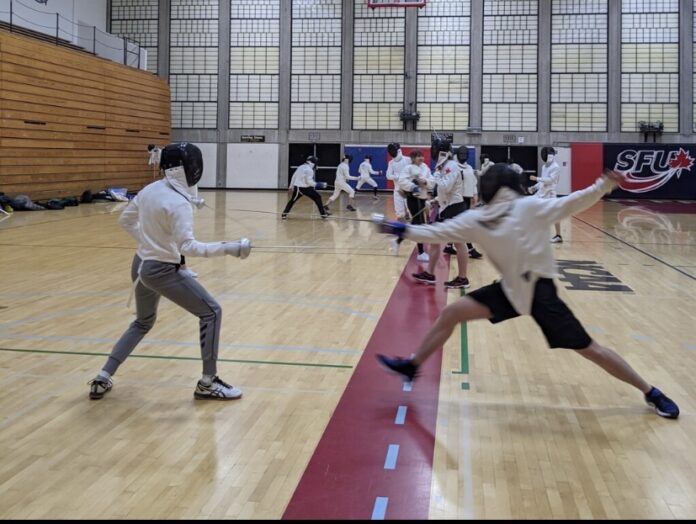
A photo of a member of the SFU fencing team lunging at the other with a foil (sword) in hand.
Fencing explores the power of teamwork. Photo: Jacob Mattie / The Peak

By: Jacob Mattie, Peak Associate  

Marie-Rose Bruskiewicz, head coach of the SFU fencing team emphasized our en garde stance on Tuesday’s practice. She assigned 10 pushups to anyone out of line. Notorious for challenging workouts, the training regime is in line with the team’s aspirations to compete at the highest levels. 

The first training session of the semester ended with a ten-minute plank, wherein groups of seven were only allowed to have two people resting at a time. It’s a team-building exercise to help us learn to cover for each others’ weaknesses. It’s the camaraderie within the team that separates the experience of fencing from what many might perceive to be a solitary sport. 

When fencing, you need to be entirely self-sufficient, but rather than isolating teammates, this serves as a great way to bring the team together. In each bout, you get to know your opponent intimately — how they react when they’re startled, the types of situations they fence best in, and the strengths they try to play on. You need to fence everyone differently, and after a few bouts with a team member, you get a really in-depth perspective of who they are. 

“Although matches are played by individual players, their performance is a culmination of individual and team work,” said Jonathan Hui, member of the SFU fencing team. “We spar, advise, and encourage as a means of learning from one another.”

The diversity of members’ athletic backgrounds range from martial arts, dance, running, and soccer mean there are many different approaches to fencing. 

Matthew Cheng, a team member who practices karate as well, said, “Karate helps my fencing, and fencing helps my karate, especially if we start looking at [similarities in] footwork.” While fencing is somewhat linear as a sport — an athlete’s movement is limited on a piste (runway-like strip) about a meter wide — this places a heavier focus on details. “Fencing can be severely more precise,” he said.

Drawing on nationally-recognized fencers from India and Canada, the coaching body of the fencing team is no stranger to the world stage, nor does it lack the experience to support its fencers in their endeavours. The core of this, says coach Bruskiewicz, is in the training. “We [aim to] live in the pressure, so that when the pressure of competition finally comes, it doesn’t surprise us.” 

For this reason, many of the exercises carry a mental component as well. Whether that be reacting under pressure, or learning to push your body through mind-numbing quantities of repetitions, practices are designed to build fencers with the “confidence [that] comes from a belief in your ability to handle tough situations.”

Because more than training athletes, the team pushes its members to be the best people they can be — both on and off the piste.

 

Your fix for the week of SFU’s athletic teams

0
Photo of cross country runners Olivia Willett and Aaron Ahl standing in front of text that reads "Men and Women's Cross Country Champions."
Setter Julia Tays and cross country runners Olivia Willett and Aaron Ahl continue to make their presence felt for SFU athletics. Image Courtesy of SFU Athletics Facebook

By: Isabella Urbani, Sports Editor 

Welcome to the Rundown — your source for athletic news and upcoming games at SFU. We will be looking at results from this week’s fall 2021–22 athletic campaign.

SFU is the only Canadian school to be associated with the NCAA — an American based collegiate program — since the 2011–12 athletic season. SFU was previously associated with the Canadian Interuniversity Sport (CIS), now known as U Sports. SFU has varsity programs in ten sports. 

Editor’s Note: This article was written on Tuesday, October 26, and may not be a current reflection of a team’s performance. 

Volleyball 

Head Coach: Gina Schmidt (2013–present)

Best Record: (21–8) (2016)

Accomplishments: six game win streak

The women’s volleyball team continued their winning streak last weekend, adding two more victories to move to (14–4) on the season. Despite being up two sets to one against Northwest Nazarene University (5–14), their two game lead was erased. Northwest Nazarene rallied back to win the next two games before SFU would win the fifth and deciding game. 

For a second straight week, Setter Julia Tays was recognized as one of Great Northwest Athletic Conference’s (GNAC) Volleyball Top Performers of the week for her season high 62 assists against Northwest Nazarene. She also picked up GNAC’s Volleyball Offensive Player of the Week. With only a handful of games left in the season, the women will look to beat their best record, set in 2016, by going 21–4. To do so, they will have to take on two teams they’ve previously lost to: the University of Alaska Anchorage and Western Washington University. You can cheer on SFU at their last two home games on November 4 and 6 (senior night).

Cross Country

Head Coach: Brit Townsend (1998–present)

Ranked 2nd in Preseason Coaches Polls

Recent Wins: GNAC Championship (October 23, 2021)

The women’s and men’s cross country teams won the GNAC Championships this past week in Lacey, Washington. This marked the first championship for the men and an end to a perfect season for the women. Once more, the work of runners Olivia Willett and Aaron Ahl propelled their teams forward with two first place finishes respectively, also earning them GNAC Athlete of the Year. Willett clocked in at 21:27.3 in her last GNAC championship race, six seconds before the second place finisher. Freshman Katie Cameron, senior Alision Andrews-Paul, junior Megan Roxby and Emily Chilton, all finished within the top 10

It was a different story for the men’s team, who earned redemption after placing second in the 2019 GNAC Championships. Two additional SFU runners were able to finish among the top 10 for the men, beating the reigning champions, Western Washington — “the third-closest in history.”

GNAC’s Team of the Week are competing in the NCAA Championships this Saturday in Oregon. Stay tuned for an interview with junior Aaron Ahl next week on finally being able to turn the tide and claim a championship with SFU. 

Football

Head Coach: Mike Rigell (2020–present)

202122 Overall Record: (1–5)

The men’s team were downed by Angelo State University (6–2) last weekend by a score of 51–10. SFU was held scoreless in the first and fourth quarter, with only a field goal and a touchdown on the night. Kristie Elliot was able to hit a 30 yard field goal in the second quarter after Justin Seiber brought the team to field goal range after 40 yards in 11 plays. Junior wide receiver Robert Meadors went long for the 13 yard pass from Seiber in the third quarter for his second touchdown of the year. SFU will finish their season on November 13 against Central Washington University (5–2)

Soccer: Women

Head Coach: Annie Hamel (2014–present)

202122 Overall Record: (481)

The women finished last week 1–1 at home. They started the week with a 1–0 win against Montana State Billings (6–7–3) before surrounding three goals against the 4ᵗʰ ranked Seattle Pacific University (11–1–1) in a 3–0 loss. Freshman Raegan Mackenzie recorded the lone goal of the game in the 81ˢᵗ minute off a pass from teammate Annika Gross. SFU goalkeeper Nicole Anderson earned her second shutout of the season, turning away the four shots she faced. SFU fell behind early against Seattle Pacific University, conceding two goals in the first half, before giving up a late goal. You can support the women’s team at their last game of the season this Saturday against Western Oregon (5–8–2).

Drafting sports teams: fictional characters edition

0
Illustration of fictional characters Loki from the Avengers fencing, Forrest Gump running, and Draco Malfoy from Harry Potter in a formula 1 track suit and helmet in hand.
These fictional characters are about to come to life. Maple Sukontasukkul / The Peak

By: Tamanna T., Staff Writer

Winter is right around the corner, which means it’s time for hot cocoa and Netflix marathons. We all have our favourite characters across pop culture, but have you ever wondered how well they would play sports? Well look no further, because I’ve got some answers for you.

Loki Laufeyson (Avengers) —  Fencing

Strength: magically gifted with sword-fighting 

Weakness: asks the opponent to “kneel” every 2 minutes

Fencing is a highly technical sport that involves swordsmanship and precision, two things Loki is great at. Although the sport is played in a controlled setting for safety, Loki will probably get carried away with the swordplay. He is determined to do what he wants and does not care for other people’s feelings. With his tendency to be fluid as a snake (quite literally) and the habit of stabbing his brother Thor, fencing would be the perfect sport for him. Smart, cunning, and vigilant he has all the makings of a great fencer. He might even already know how to fence as the sport traces back to ancient civilizations and Loki is a Norse god whose “glorious purposeis to rule over everyone else. 

Gollum (The Lord of the Rings) — Rugby

Strength: keeps a keen eye on the ball at all times

Weakness: becomes enchantingly obsessed with the ball and refuses to let it go

Gollum, or Sméagol, is a character from The Lord of the Rings who is famous for the line, “My precious!” in reference to the Ring he guards to protect his immortality. His determination and zest to keep the Ring to himself is a trait that most rugby players need to have with the ball. In Rugby, possession is key as players pass the ball back and forth to move down the field while being tackled and taken down. Gollum is bound to be the star of his rugby team with his unrelentless defense; nevertheless, he would have no interest in scoring and would simply walk off the field with the ball in hand. 

Draco Malfoy (Harry Potter) —  Formula 1

Strength: willing to win at any cost

Weakness: most likely to recklessly crash his car 

We all know Draco is obsessed with being the centre of attention. With a father like Lucius Malfoy, who can get him anything his heart desires, Draco seems like the character who would enjoy Formula 1 the most. Formula 1 (or F1) is a high-class auto-racing sport meant for those who like to live on the edge, or the world’s elite, who own their own racing teams like Mercedes. Perhaps the Malfoys can even buy a team, like Lans Stroll’s father Lawrence Stroll did for his son. Without caring about the consequences or the safety of the other racers, Draco is most likely to drive carelessly and without dedication. For some, this sport is their entire life, but for our favourite Malfoy, it’s just another way to pass time and spend daddy’s money. He would have the best-looking car, tuned up with all the latest technologies. And what would happen if his crew refused to comply with his endless and unsafe demands? Well, his father would certainly hear about this! Malfoy would make headlines as the star of Formula 1 racing, like Lewis Hamilton who had the most expensive debut in history. Best of all, he would enjoy every bit of the fame that comes along with the sport.

Forrest Gump (Forrest Gump) – Cross Country Running

Strength: can run for days without getting tired

Weakness: zoning out while running, ignoring those around him

Forrest Gump’s adventures know no bounds as he believes “life [is] like a box of chocolates. You never know what you’re gonna get.” He joins the military, obsesses over chocolate (of course), becomes a ping pong master, grows out a fantastic beard . . . the list is endless. Being the all-round athlete that he is, I would love to see him try his hand at cross-country running.  Cross country training requires running long and difficult distances which seems like child’s play to this running extraordinaire who ran miles upon miles, for days on end, in the film. Cross country running also involves tackling mother nature and its various surfaces puddles, mud, grass, and even asphalt. What makes cross-country running stand out is the effort it takes to preserve nature and the run itself, which Gump demonstrates in the movie as he overcomes challenge after challenge put in his path. 

Test your SFU Athletics knowledge with this quiz

0
Photo of SFU mascot McFogg the DOg standing with his hands on his hips.
Do you know the history behind SFU’s mascot McFogg the Dog? Image courtsey of @SFU twitter account

By: Victoria Lopatka, Staff Writer

QUESTION: Which of the following is NOT an athletic club at SFU? A) Quidditch B) Kendo C) Grappling D) Gymnastics 

ANSWER: D) SFU does not have a Gymnastics Club. The Quidditch, Kendo, and Grappling Clubs all exist, as well as some other interesting clubs, like the Board Games Club and the Esports Association. 


QUESTION: True or False: SFU was the first Canadian university to offer athletic scholarships, before others like UBC and UVic?

ANSWER: True! “In 1965, SFU became the first university in Canada to offer athletic scholarships.” 


QUESTION: Who is SFU’s mascot, McFogg the Dog, named after? 

ANSWER: McFogg is named after SFU’s inaugural president, Patrick McTaggart-Cowan. McTaggart-Cowan’s nickname was “McFog” during his time as a “chief meteorologist” in World War II. 


QUESTION: When did SFU join the National Collegiate Athletic Association? A) 1999 B) 2001 C) 2009 D) 2016 

ANSWER: C) 2009. SFU is the “only Canadian university” in the NCAA — a major accomplishment! 


QUESTION: How many varsity sports does SFU have? 

ANSWERSFU has NCAA programs in 10 sports: basketball, cross country, football, golf, soccer, softball, swimming, track & field, volleyball, and wrestling. 


QUESTION: What images make up the SFU Athletics & Recreation logo? A) a maple leaf and a circle B) a maple leaf and an octagon C) the letters “SFU” and a circle D) the letters “SFU” and a square

ANSWER: B) A maple leaf and an octagon. This new logo was introduced in 2019, paying tribute to both SFU history and Canadian origins. 


QUESTION: True or False: The Shrum Bowl is a competition between current SFU football players and alumni SFU football players?

ANSWER: False! The Shrum Bowl was an ongoing competition between SFU and UBC’s football teams between 1967 and 2010. SFU won the last game in October 2010, by a score of 27–20. SFU is considered the reigning champions of the Shrum Bowl, winning 17 of 33 matches.


QUESTION: Who currently holds the men’s all-time record for the 100m event at SFU? A) Murray Delorme B) Kevin Tyler C) Ian Gordon D) John Kaay

ANSWER: A) Murray Delorme. Delorme ran the 100m in 10.4 seconds in 1978, a record almost beaten by Kevin Tyler’s 10.65 seconds in 1989. Ian Gordon ran the 200m in 21.2 seconds in 1972 and John Kaay ran the 400m in 46.8 seconds in 1983


QUESTION: Who was the first Canadian woman to play and score in a National Collegiate Athletic Association football game? (hint: she goes to SFU!)

ANSWER: Kristie Elliott, SFU football kicker, became the first Canadian woman to do so on September 11, 2021 against Linfield University. Elliott’s entrance into football was a bet with an SFU football player that she could kick a 40-yard field goal a bet she won.


QUESTION: When did SFU stop using the “Clan” team name? A) 1999 B) 2016 C) 2020 D) 2021

ANSWER: C) SFU retired the “Clan” team name in 2020, due to its negative connotations associated with white-supremacy group, the Klu Klux Klan.


Take a hike! Here are some of our favourites

0
A photo of the University Dr. trail divulging into two paths.
Your boots are going to be made for walking this winter on the University Dr. path. Photo: Jacob Mattie / The Peak

By: Jacob Mattie, Peak Associate

SFU’s Burnaby campus is set at the top of Burnaby Mountain. This is the source of much grief in the winter months for students who need to walk up or down if buses fail (if this is your first semester, prepare yourself). However, the hike itself is not entirely unpleasant, and whether walking to a specific destination, or taking a stroll to enjoy the breathtaking scenery, Burnaby Mountain has some terrific trails. 

Before we get started, keep in mind Burnaby Mountain is a conservation area, and is home to a variety of wildlife. Animals will avoid people in general, but it’s good to know how to deal with encounters: stay calm and confident. A slip or fall can also be the source of problems, so make sure to stay on the trail and have a way to contact help if you need. 

Among the most accessible trails are those that are paved. The walk down University High Street and up around University Dr. East makes for a great way to stretch out your legs after a long day studying. A longer paved trail, the recently-upgraded walkway along Burnaby Mountain Parkway, offers a chance to pit yourself against the incline of Burnaby Mountain. Expect this to take about an hour’s walk. Well-lit at night, and rarely frequented in general, you can take the R5 or 144 bus up or down again afterwards.

If you’re into longer hikes and being surrounded by a more rugged nature, the Burnaby Mountain Conservation Area has you covered. The Trans-Canada Trail runs just a few steps North of West Mall Centre, and can be accessed by a handful of other tributary trails. While the Trans-Canada Trail does range from the Arctic Circle in the Yukon to the Easternmost tip of Newfoundland and Labrador, you’re not obligated to walk the whole thing. Take a stroll west to the city views of Burnaby Mountain Park, or hike east to see one of my favourite views in the Lower Mainland — a particular section of the trail opens up to the Burrard Inlet, offering a view that’s hard to rival.

The Trans-Canada Trail also serves as a great way to access the network of paths that cover the mountain. Test your mettle on the Velodrome trail — boasting over 500 stairs, it is known to some as the mini-grind, in reference to Grouse Mountain’s infamous tourist trap hike — or take the Power Line Trail and the Barnet Trail for an easy (if not a little monotonous) stroll. The Gear Jammer & Nicole’s Trail are steep and rocky, and openly declare their hostility for the knees of anyone descending them.

The other trails, well marked on the maps and signposts scattered around the mountain, are full of treasures of their own. While they’re certainly good to read about, the best way to experience them is to strap on a pair of hiking boots or runners, and get out there.

Maps of each trail can be found at the following website: https://www.alltrails.com/trail/canada/british-columbia/power-line-trail


The Sports Peakbox: quidditch

0
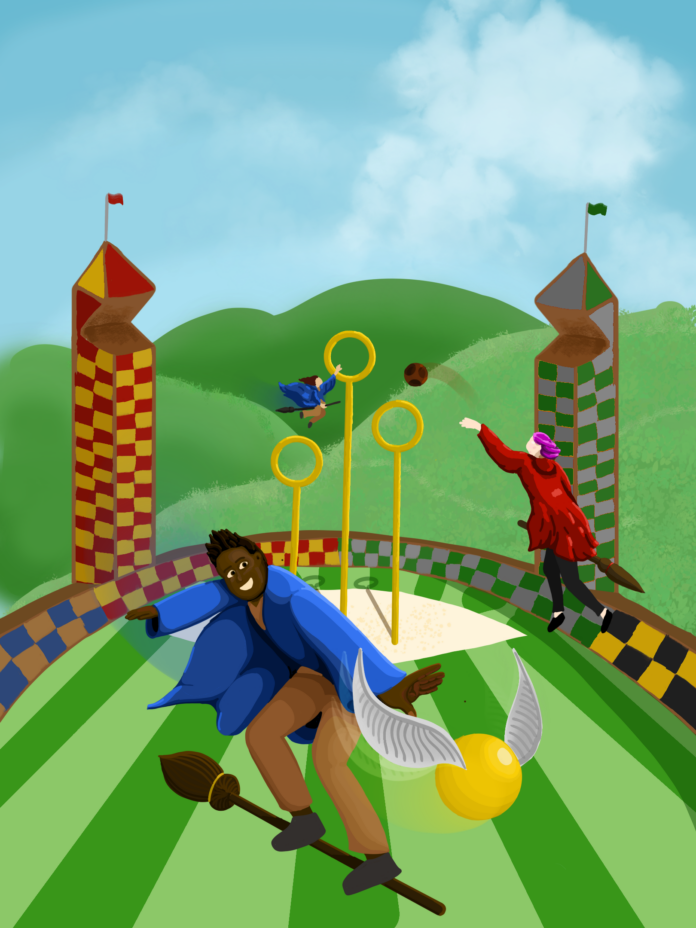
Illustration of a quidditch game with two players in the background and one in the forefront standing on top of his broom to chase the golden snitch.
Put your broom down and open your mail. Illustration: Amanda Eng / The Peak

By: Isabella Urbani, Sports Editor 

Welcome to The PeakBox. I am your host, and resident Ravenclaw, Isabella Urbani. Each week The Peak will answer student submitted questions about sports at SFU. This week, we focused on quidditch.

What is quidditch? 

Quidditch was invented in the Harry Potter novels. It has since been adapted into a full-contact competitive sport with its own professional league and non-profit federations. Quidditch is gender-inclusive and incorporates skills from many disciplines, such as rugby (physicality), soccer (speed), dodgeball (agility), and basketball (shot). Players are required to play with a broomstick in between their legs. 

What are the positions in quidditch?

The four positions in quidditch are the chasers, seekers, beaters, and keepers. Seven members of each team take the field. The three chasers on the team try to score points by throwing the quaffle (deflated volleyball) through one of the three hoops, each with 10 points. The defenders are the beaters — they try to knock opposing players off their brooms by hitting them with a bludger (dodgeball). If you are knocked off of your broom, you must tag up (by running back and touching your team’s hoop) to rejoin the game. 

While all of this is happening, a seeker (snitch runner) from each team is responsible for capturing the gold snitch, worth 30 points, to end the game. The team with the most points at this time wins. 

How does a game begin?

All players begin the game by lining up with their eyes closed, at their keeper’s end,  while the referee hides the golden snitch. The referee will then say “brooms up” to signify the start of the game. Players must remain on their brooms at all times. If they become dislodged, they must tag back up at their keeper’s end. There is no time limit in matches. Typically, the golden snitch is found in an hour.

When did quidditch begin at SFU?

SFU’s team was founded in 2013 by its first club president, Christine Konrad, becoming the third team established in BC. Quidditch was adapted to be a competitive full-contact sport 10 years prior. In the past, the SFU quidditch season consisted of multiple tournaments, the Dobby Cup, an official event sponsored by the United States Quidditch federation, and the National Canadian Quidditch Championship. In the 2014‒15 season, the SFU team finished fourth. The team has even competed against Stanford University. 

We will see you next week for the newest edition of the Peakbox. Until then, open the letters from your friends that your family have been hiding from you. 

Email [email protected] with your water polo questions to have them featured in next week’s article or to respond to sports questions and get paid for it!


The SFU Athletics x Halloween crossover you’ve been waiting for

0
A photo of the moon in the middle of the night breaking through the clouds.
Who knew fictional Halloween characters could make such terrific athletes? Photo: Vino Li / Unsplash

By: Isabella Urbani, Sports Editor

Have you ever watched Jack Torrance in The Shining smash a door with an axe and think, “Wow, he could hit some sweet home runs with that swing?” If not for his athletic prowess, think of the entertainment, the filled stadiums, the overpriced merch! Think of all the fictional characters that would bring more oomph to SFU’s athletic teams. 

Nominee 1: Chowder, Monster House 

Strength: latches on to his opponents and refuses to let go

Weakness: physical strength and size

Who else but Chowder could be the secret weapon for the men’s wrestling team? Lacking no gusto, Chowder, when provoked by his teammates, will fight men twice his size and almost twice his age. Given that he has been 12-years-old for the last 15 years, Chowder takes advantage of his stocky stature to get low to the ground and lock in a hold around his opponents’ hips, wrangling them around like an alligator. What Chowder lacks in speed and size is easily made up for with a grip that holds up two people. Seriously, he held two other characters up on splintering floorboards in Monster House. If SFU can somehow find a loophole for his age, he is a shoo-in on the team. 

Nominee 2: Dracula, Hotel Transylvania

Strength: committed to being on the team forever

Weakness: may try to attack a player mid-game

SFU’s newest small forward is none other than Dracula from Hotel Transylvania, even though he is adamant he’s just a normal college student who happens to be allergic to the sun and can only afford red Gatorade. A small forward needs to be able to use their body to drive hard to the net and make space to lay the ball in or draw a foul. Dracula draws his opponent in and turns into a bat to move around his opponent before laying the ball in gently — after all, he is 1,000 years old. Boy, does he really shine on defence when he flashes his opponent a smile with his teeth. They just seem to hand the ball right over to them, it’s a shame more players don’t use this technique. 

Nominee 3: Coraline, Coraline 

Strength: can outrun anyone in any condition

Weakness: believes her opponents are trying to steal her eyes 

Coraline earned her spot as the anchor on the women’s team in the 4 x 400m relay race after she spent the last bit of her movie running away from her other mother. Athletic, opportunistic, and speedy, Coraline is able to outrun her opponents, even if they turn into replicas of her mother and can turn into arachnids on command. Her accuracy in passing the baton is evident in her ability to throw her cat smack in the middle of her other mom’s face. Once she understands the baton is not a weapon, she might be able to become the starting runner.

Nominee 4: Emily, Corpse Bride

Strength: can save any ball 

Weakness: may lose limbs 

Her human teammates may have a beating heart, but they do not have a detachable hand that can jump to spike the ball. Emily wandered onto campus after a business student was crafting a business proposal that she somehow interpreted as a wedding proposal. She joined the team once she realized there is no feeling better than spiking down a ball that looks like the head of your late fiance. Nevertheless, her hand has the tendency to wander off the court after it detaches to dig a ball about to hit the floor. 

The newest in fall athletics at SFU

0
A photo of a soccer ball hitting the back of the net.
The SFU men’s soccer team earned GNAC Team of the Week after shutting down the 7ᵗʰ ranked Seattle Pacific University. Photo: Choas Soccer Gear / Unsplash

By: Isabella Urbani, Sports Editor 

Welcome to the Rundown — your source for athletic news and upcoming games at SFU.  We will be looking at results from this week’s fall 2021–22 athletic campaign. 

SFU is the only Canadian school to be associated with the NCAA — an American based collegiate program — since the 2011–12 athletic season. SFU was previously associated with the Canadian Interuniversity Sport (CIS), now known as U Sports. SFU has varsity programs in ten sports. 

Editor’s Note: This article was written on Sunday, October 17, and may not be a current reflection of a team’s performance. 

Volleyball 

Head Coach: Gina Schmidt (2013–present)

Best Record: (21–8) (2016)

Accomplishments: Four game win streak

The women’s volleyball team extended their winning streak to four games with two home victories against the Montana State Billings (8–11) and Seattle Pacific University (9–7). Setter Julia Tays was recognized as one of Great Northwest Athletic Conference’s (GNAC) Volleyball Top Performers for the week with her 46 assists against Seattle. The women will be at home next on November 4 after they complete their hardest tests of the season in Alaska against the University of Alaska Anchorage (15–5) and the University of Alaska Fairbanks (13–9) on October 28 and 30. 

Football

Head Coach: Mike Rigell (2020–present)

202122 Overall Record: (1–4)

The men’s team earned their first win since October 19, 2019, with a commanding 30–3 victory over Montana State University-Northern (0–7). They limited their opponent to just three points from a 38-yard field kick in the first half. Offensive wide receiver Riley Morrison, defensive linebacker Griffin Barrett, and linebacker Isaac Muckian were named the GNAC’s Football Players of the Week. The men’s team will need to build off of this momentum if they want to close out the season on November 13 with three more victories. 

Soccer: Women

Head Coach: Annie Hamel (2014–present)

202122 Overall Record: (471)

The women’s soccer team were 1–1 on the road last week with a 3–0 win against Western Oregon (4–7–2) and a 2–0 loss against the 23ʳᵈ ranked Western Washington (10–2–2).  Forward Giuliana Zaurrini dominated the game with her first goal of the season. Her two additional assists earned her a spot on the GNAC Women’s Soccer Top Performer list for the week. Freshman Emma Ferraro also recorded her first goal with a header off Zaurrini’s corner kick in the first half. The women’s team will be at home next on November 6.

Soccer: Men 

Head Coach: Clint Schneider (2015–present)

202122 Official Record: (65)

The men’s team earned GNAC Team of the Week for two much-needed wins, one coming against the 7ᵗʰ ranked Seattle Pacific (10–2) team. SFU wore down the Montana State Billings (3–7–1) with an early goal by freshman Justus Meier three minutes into the game. Goalkeeper and GNAC Defensive Player of the Week Aidan Bain rose to the occasion with back-to-back shutouts, propelling teammates like Offensive Player of the Week Ali Zohar to score the lone goal against Seattle. The men will kick off a two-game homestand on October 28


The Sports Peakbox: cross country and track and field

0
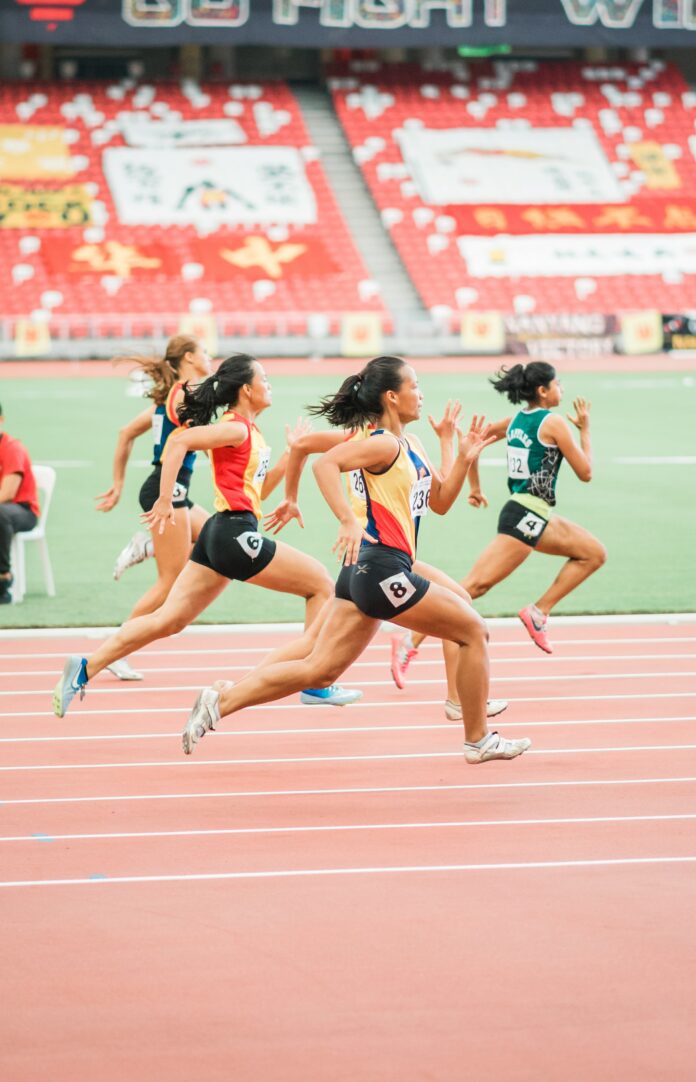
Shot of runners sprinting during a race. One runner has a clear advantage.
Your inbox is filled to the brim with this week’s questions and answers. Photo: Jonathan Chng / Unsplash

By: Isabella Urbani, Sports Editor 

Welcome to The PeakBox. I am your host, Isabella Urbani. Each week The Peak will answer student submitted questions about sports at SFU. This week, we asked students to pose questions about cross country and track and field. 

When did track and field and cross country originate?

Track and field is a term used to describe “running, jumping for height, and throwing for distance.” Disciplines outside of running are referred to as field events. The sport of track and field has been practised for centuries. The ancient Olympic games, first recorded in 776 B.C.,  including running events, were held “in conjunction with religious festivals” and were only available for men. A federation for women in track and field would not be established until 1921. 

Nevertheless, track and field practically ceased to exist for a large period of time as it was banned by Emperor Theodosius I in A.D. 394. Finally, in Britain, the sport was rejuvenated with its first organized track meet in 1849. After that, various track organizations and clubs were established before the sport premiered at the first Olympics in 1896

Cross country began in Britain and was a training method for runners in the offseason. Originally referred to as “the paper chase,” a group of runners would drop pieces of paper along the track for a second group to chase and follow. In 1838, it became a practice across all private schools and was referred to as the Crick Run — now known as cross country.

When does the track and cross country season start at SFU?

The cross country season begins at the start of the school year in September and ends in November. The women’s cross country team were undefeated in their three regular-season meets this year, and the men have placed second in their first two meets, and third in their last. Both teams will compete in the Conference and NCAA championships to complete the season.

The track and field indoor season wont begin at SFU until January. When it concludes in March, the outdoor season will commence and be completed in May. 

How are points awarded in cross country?

Like golf, the fewer points the better! Points in cross country meets are awarded to a team based on the placement of its runners; however, only the first five runners for a team will be counted. If a player finishes first in a race, they will be awarded one point. The lowest score a team can earn is 15 points, if all five of their racers make up the top five. Nevertheless, during meets, only two races are run 6km for the women and 10km for the men. So athletes only have one opportunity to receive a perfect 15. 

Have any of SFU’s track and field athletes competed in the Olympics?

Yes! There have been many SFU track alumni that have competed in the Olympics. Most recently at the Toyko 2020 Summer Olympic Games, SFU alumni Lindsey Butterworth and Natasha Wodak represented Canada.

From Burnaby, Butterworth, won the indoor and outdoor 800m NCAA Division II titles in 2015 and won bronze in the 1500m as a freshman. At her first Olympic games, she placed 32ⁿᵈ in the 800m event. 

Wodak, hailing from Surrey, is the “second-fastest female marathoner in Canadian history.” Shes a seasoned veteran, representing Team Canada 16 times in various games, including the Olympics in Rio and Tokyo. Wodak placed 22ⁿᵈ in the 10,000m in Rio and improved to 13ᵗʰ in the marathon event in Tokyo. 

We will see you next week for the Halloween edition of our Peakbox. Until then, go clean your mailbox out. 

Email [email protected] with your quidditch questions to have them featured in next week’s article or to respond to sports questions and get paid for it!


Get caught up on fall athletics at SFU

0
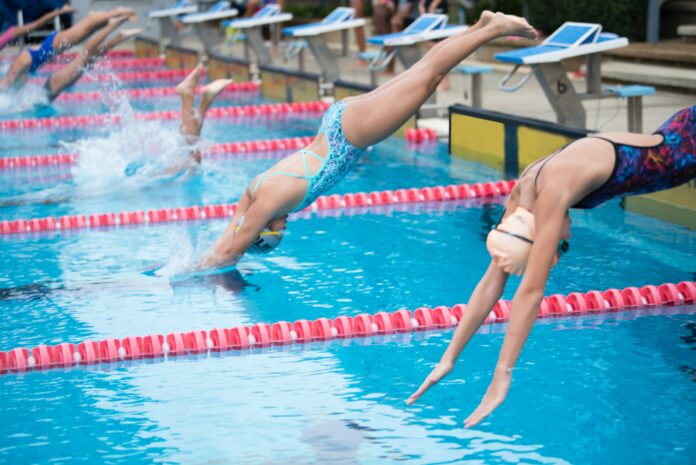
Photo of swimmers diving into the pool for their blocks.
The women’s swim team cruised to first in all of their races to steal the thunder from the Division I Seattle team. Photo: Arisa Chattasa / Unsplash

By: Isabella Urbani, Sports Editor

Welcome to the Rundown — your source for athletic news and upcoming games at SFU. This week we will be looking at results from this week’s fall 2021–22 athletic campaign. 

SFU is the only Canadian school to be associated with the NCAA — an American based collegiate program — since the 2011–12 athletic season. SFU was previously associated with the Canadian Interuniversity Sport (CIS), now known as U Sports. SFU has varsity programs in ten sports. 

Editor’s Note: This article was written on Saturday, October 9 and may not be a current reflection of a team’s performance. 

Swimming and Diving 

Head Coach: Demone Tissira (2021)

Recent Wins: Logger Relays (October 9, 2021)

Accomplishments: NCAA Division II record for 100-yard breaststroke (Mariya Chekanovych)

The swim teams saw a phenomenal start to their 2021–22 fall campaign with two first-place finishes. This also marked the first win for head coach Demone Tissira at SFU. The women’s team swept the meet, winning all nine of their events, while the men placed first in five. In their win, the women’s team defeated the Division I Seattle team who finished the day behind them with 92 points. The men and women will be in action next on November 6 at the UBC Aquatic Centre. 

Volleyball 

Head Coach: Gina Schmidt (2013–present)

Best Record: (21–8) (2015)

Accomplishments: First NCAA Division II Championship Appearance (2016)

The women’s volleyball team has continued right where they left off in 2019, opening this year’s season with a (10–4) record and a .714 winning percentage. The women began the season with a four-game sweep at their first invitational tournament in San Diego, California. This included a victory against the 2018 and 2019 PacWest Conference champions, the Azusa Pacific Cougars (12–4). You can watch the team take on their Great NorthWest Conference opponent, Central Washington University (8–5), at 1:00 p.m. on Thursday, October 21, in the West Gym

Cross Country

Head Coach: Brit Townsend (1998–present)

Ranked 2nd in Preseason Coaches Polls

Recent Wins: WWU Bill Roe Classic (October 9, 2021)

The women’s cross country team have yet to lose a meet this year, as they three-peated at the WWU Bill Roe Classic this past week. Once more, Olivia Willet led the 11ᵗʰ ranked women’s team to a win, finishing just nine seconds back from first place. An incredible additional five SFU runners were able to place in the top 15. Aaron Ahl’s third-place finish led the 19ᵗʰ ranked men’s team.  His teammates finished the course among the top 30. The cross country teams will be challenged at the GNAC Conference Championship on Saturday, October 23, in Lacey, Washington. 

Soccer: Women

Head Coach: Annie Hamel (2014–present)

202122 Overall Record: (261)

The women’s soccer team suffered two losses last week against two conference members: Seattle Pacific University (81) and Montana State University Billings (45).  SFU was unable to generate any offence as they were shutout against the 25ᵗʰ ranked Seattle team by a score of 20. In their 2–1 overtime loss against the Billings, Kiara Buono tied the game 53 minutes in with her first goal of the season. The women’s team will be in action at home on October 21 and 23

Soccer: Men 

Head Coach: Clint Schneider (2015–present)

202122 Official Record: (45)

The men’s team lost their last matchup at home by a score of 1–0 in overtime against Western Washington University (46) on October 9. SFU outshot their opponent in the first half, 7–0 before Washington gained the momentum late in the game and scored on their first shot in the extra frame. The team will look to bounce back at the next home game on October 28 at 7:00 p.m. against Northwest Nazarene University (64).