Home Blog Page 160

Autumnal films and series

0
An illustration of a pumpkin wearing 3D glasses smiling.
ILLUSTRATION: Kristin Lee / The Peak

By: Kiara Co, SFU Student

The chilly, warm-toned season calls for watching something chilling in the comfort of your own home, with a hot drink and thick blanket on your couch. Here are some films and a mini series that are perfect options!

Wolfwalkers (2020) 
Wolfwalkers is an animated film about a young apprentice hunter, Robyn (Honor Kneafsey), who comes to Ireland with her father to wipe out the last pack of demonic wolves. When Robyn meets Mebh (Eva Whittaker), a young girl who’s part of a tribe that turns to wolves at night, Robyn learns the wolfwalkers are not what her father makes them out to be. The film is fitting not only for Halloween with its werewolf themes, but all throughout fall, with its atmospheric foliage: it features detailed, striking illustrations in mainly oranges, yellows, browns, and greens. The film’s folklore and fantasy elements, plus a heartwarming story of friendship, make it cozy and uplifting.

Stream Wolfwalkers on Apple TV+.

Practical Magic (1998)
If you’re a fan of Hocus Pocus and Ella Enchanted, Practical Magic is for you! The film is more on the comedic side for people who don’t want to be too scared. Sister witches Sally (Sandra Bullock) and Gillian Owens (Nicole Kidman) have mostly avoided witchcraft growing up. Their mom conjured a curse that if a man ever mistreats an Owens, they die. When Gillian’s boyfriend, Jimmy Angelov, dies unexpectedly, the Owens sisters learn about witchcraft and magic to try to resurrect him. Indulge in magical, witchy energy, with festive black, purples, browns, and oranges! 

Stream Practical Magic on Hulu or Amazon Prime Video.

The Witches of Eastwick (1987) 
For a film that was released in the summer, this film captured a haunted and eerie tone. The Witches of Eastwick is about three friends, Alexandra (Cher), Jane (Susan Sarandon), and Sukie (Michelle Pfeiffer), who don’t know they’re witches until they meet a stranger named Daryl (Jack Nicholson) who reveals it to them. As the film progresses, these witches learn through their powers that Daryl is not who he really claims to be. Daryl eventually shows his true colours, as he has the power to use dark magic and shape shift, with a skill for seducing women and manipulating anybody. Overall, it’s an epic film about friendship with fantasy elements.

Stream The Witches of Eastwick on Amazon Prime Video, Crave, or YouTube.

Over the Garden Wall (2014)
Over the Garden Wall is a short and soothing animated miniseries with 10 bite-sized episodes, each 10 minutes long. It’s cute and enchanting to watch the main characters, brothers Wirt (Elijah Wood) and Greg (Collin Dean), get lost and navigate their way through a peculiar forest. The journey unravels many mysteries and encounters with interesting characters, as you root for Wirt and Greg to find their way back home. The animation captures a chilling tone, especially in the muted colours of the forest, with lots of browns, faded greens and reds. 

Over the Garden Wall can be streamed on Cartoon Network’s official YouTube channel and on Amazon Prime Video.

Halloween doesn’t excuse violence or prejudice

0
A scary-looking carved pumpkin on a bed of fall leaves
PHOTO: Ksenia Yakovleva / Unsplash

By: Michelle Young, Opinions Editor

Content warning: mentions of racialized violence, Missing and Murdered Indigenous Women and Girls, sexual harassment, and Islamophobia.

The season of ghosts, pumpkins, and candy is upon us. While its roots are quite different from what we know today, Halloween is associated with dressing up and indulging in “scary” things — witches, spirits, and horror films. However, there are specific prejudices and insensitivities that seem to show up during Halloween under the guise of being frightening, and therefore, in the spirit of the holiday. Just because it’s Halloween, doesn’t mean you get to break out the racism, sexism, and ableism. 

A few years ago, there was a violent residential display in Maple Ridge accused of being “reminiscent of lynchings.” The residents who put up the display were shocked it was being accused of racism and being “too gruesome for children.” Others pointed out the area the display was put up wasn’t far from where Louie Sam, a young Indigenous man, was lynched. Without going into much detail, the family claimed it was a medieval display that they added to every year. Despite the critique, they refused to take the display down as they “didn’t intend” to be racist and plan to continue their display every year. Their response entirely ignores the historical context of oppression and puts comfort above a genuine care for how racialized children are affected by violence. 

This year, a Vancouver Island landfill has “been ordered to remove and destroy a Halloween decoration amid complaints that it is cruel and distasteful, particularly towards Indigenous women.” The sign displayed a cheap price where you could supposedly pay to bury a body. This is entirely inappropriate considering the “discovery of human remains in a Manitoba landfill last year” and the belief that there are other Missing and Murdered Indigenous Women and Girls in landfills. While the sign was removed, it comes off as anti-Indigenous because there was little regard here for those who have been violently targeted here, too.

In both cases, these people claimed they didn’t mean harm, but the reality is they did. We cannot ignore the historical context of racialized violence during Halloween just because others put up these decorations “for fun.” There are real people who have suffered, and that shouldn’t be swept under the rug.

If there is a true commitment to equity, there needs to be an understanding of the historical events that have disproportionately affected marginalized groups, and we should make an effort to avoid making light of them. This doesn’t only apply to displays or decorations. There are also a variety of costumes that either rely on prejudiced tropes or stereotypes or downplay serious issues. Costumes of “terrorists” stigmatize Muslims while costumes of flashers make fun of sexual harassment. For similar reasons, there shouldn’t be costumes of real serial killers — or even worse, their victims. This is scary in all the wrong ways.

Halloween is supposed to be fun. Recreating violence or stigmatizing others is not fun. You should not ruin someone’s day because you decided people who are offended are “too sensitive.” This silences genuine concerns about the messages people send when they dress as confederate soldiers or use cultures as costumes. These things wouldn’t be OK at any other time of the year — Halloween doesn’t give you a free pass. There are countless ways to decorate and dress-up for Halloween that don’t involve prejudice and insensitivity. 

Halloween isn’t supposed to be something grotesque. While costumes like witches and Frankenstein aren’t free of prejudice either, we should be moving further away from this direction, not closer towards it. If you need to rely on violence and stereotypes for a “scary” Halloween, you are boring and unoriginal. Get creative, there are so many interesting characters and styles that can be incorporated into a costume. Don’t perpetuate bigotry. 

Attorney Neri Colmenares speaks on the growing fascism in the Philippines

0
This is an image of the Filipino flag. Their flag is blue and red, with a sun image in the centre. The flag is blowing in the wind on a flagpole outside.
PHOTO: iSawRed / Unsplash

By: Izzy Cheung, staff writer

On October 17, SFU Harbour Centre set the stage for “Defending Human Rights: Resistance Against the Growing Fascism in the Philippines,” an event that explained the political and economic climate of the Philippines. Headlining the event was a talk by Attorney Neri Colmenares, whose official titles include “vice-president of confederation of lawyers in Asia Pacific (COLAP), the national adviser of the national union of people’s lawyers (NUPL) and a Council member of the IBA Human Rights Institute (IBAHRI).” 

This event was hosted by Sulong UBC, in partnership with the SFU department of geography, SFU department of global Asia, SFU David Lam Centre, and SFU Filipino students association

Colmenares began his talk by introducing a term he calls “geographical injustice,” which shows how committing a specific act in two different countries may yield different results. To prove this, he used the example of using cannabis. Cannabis usage is legal in Canada, but if an individual in the Philippines is caught using it, they could be killed. The difference between what people can and can’t do is thus dictated by the government inside a country’s borders. In a 2016 press conferences with the president of the Philippines, he was quoted as saying “But if you would smoke [cannabis] like a cigarette, I will not allow it ever. It remains to be a prohibited item and there’s always a threat of being arrested, or if you choose to fight the law enforcement agency, you die.” However, Amnesty International opposes the death threat as “in clear violation of international law and standards.” The borders of where one lives should not justify the violation of human rights. 

Next, Colmenares went on to highlight // Highlighting statistics of the Filipino economy, specifically rates of unemployment (4.3%) and inflation (5.4%). He noted how the instability of this economy has contributed to the “forcible eviction of Filipinos” from the Philippines due to “political repression, instability, and economic conditions.” Because of the unstable economy and political scene, many Filipinos will flee the Philippines in favour of finding stability in other countries such as Canada. 

“Filipinos sacrificed leaving their family and their country and their friends because their family needs to survive,” Colmenares said. “That is why many Canadian youth are asking, ‘Maybe I should go back to the Philippines and find out what forced my parents or grandparents to leave the country decades ago.’” 

The instability in the country, Colmenares informed, is due to those who hold power. He noted that during the current president Ferdinand Marcos Jr.’s first year in office, it was discovered that there were “61 [cases of extrajudicial killings] and eight cases of enforced disappearance.” Moreover, during former president Rodrigo Duterte’s tenure, the president could claim “presidential immunity” and have any and all charges against him dropped as long as they were filed in the Philippines.  

“Human rights transcends politics,” Colmenares argued. “You have to condemn human rights violations.” 

As a way of healing the growing instability in the Philippines, Colmenares outlined some possible solutions. First, he argued that developing the countryside and “distribut[ing] lands to the farmers” would help them contribute to the economy. Colmenares “propose[s] industrialization” for the country’s economy. He urged that the Philippines is poor because they “do not produce what [they] need [but] produce what other countries need” such as clothing, produce, and other materials.  

After Colmenares’ talk, there was a brief break that included cultural performances put on by Isa Carlin, Kai Fenix, and one of the event’s hosts, Lovely Ranges. The three of them performed poems that spoke to the bittersweet experience of immigration, the beauty of the motherland, and the oppression that comes with imperialism. Following the poems was a performance of two songs delivered by Miguel Maravilla, a first generation Filipino immigrant and self-taught musician. 

“Because you trust, therefore you hope, and because you hope, therefore you struggle,” Colmenares said. “Thank you so much for being concerned with the conditions [in the Philippines] and not forgetting the Filipino people, because we in the Philippines continue to consider you all as part of the Filipino people — part of our struggle and part of our hope.” 

CJSF hosts annual Fundrive to support the station

0
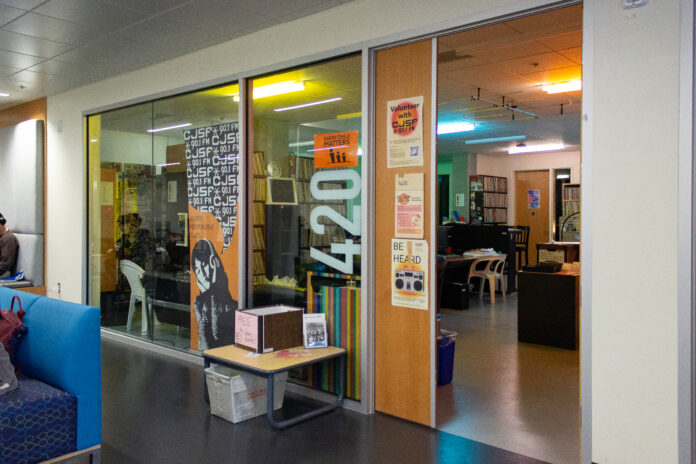
This is a photo of the outside of the CJSF radio station office. Their office is in the SUB at SFU Burnaby Mountain. The outside of their door has a large image of a person listening to music with headphones.
PHOTO: Gudrun Wai-Gunnarsson / The Peak

By: Saije Rusimovici, Staff Writer

From October 30–November 5, CJSF 90.1 FM will be hosting their annual Fundrive. The on-air fundraiser will support the independent radio station that has been operating since 1965. CJSF is a non-profit radio station located at SFU Burnaby, with a signal that reaches as far as Vancouver Island. Thousands of listeners tune into the CJSF online stream regularly. The Peak interviewed multiple CJSF members to learn more

The Fundrive will contribute to “the ongoing renewal and replacement of equipment,” including the tower and antenna located on the roof of the W.A.C. Bennett library. The rest of their operating budget comes from a portion of the tuition fees SFU students pay at the beginning of each semester. “Our stakeholders are members of our community,” said Robin Eriksson, CJSF programming coordinator. This community participation is embedded in everything we do, and results in a broadcast schedule that is independent of what is trending in mainstream spaces,” they continued. 

“Campus-community radio stations like CJSF are really like community centres that just happen to exist over the airwaves, as well as in physical spaces,” said Chris Yee, public relations coordinator. Broadcasts are uninterrupted by commercial advertising. In turn, CJSF airs free public service announcements via social media, as well as interviews that promote student-led initiatives. “This service is often under-utilized by students,” noted Eriksson.

CJSF provides “an alternative to commercial radio and the CBC, holding space for voices that are underrepresented elsewhere on the dial,” according to Eriksson.

The content featured on CJSF is almost entirely “produced by a member of the public on their own time,” according to Yee. The programmers “come from all walks of life — some have been producing their shows at CJSF for years, and some have returned to our station after long hiatuses, but there are also other folks starting brand-new shows here as well, many of whom are actual SFU students.  

“We intend to continue to deepen our culture of collaboration with community groups both on and off campus,” said Yee. “I’d like to see us build more of our online community outside of the corporate social media and streaming sites, especially considering what’s happened in the online world over the past year,” in reference to the implications of Bill C-18 across Google and Meta platforms

“In 20 years, terrestrial radio may or may not be on its way out, but hopefully there will always be folks interested in being part of spaces that foster organized communities,” said Yee. Station manager Magnus Thyvold agreed, “Technological change is a constant these days and we have to constantly adapt. Our future will be in growing our other media channels: our website, social media, our new smartphone app to complement our radio broadcast.”

CJSF has a significant impact on the SFU community and beyond. CJSF provides students with the opportunity to gain “critical skills that students can apply to their academic career and working lives” through a variety of volunteer experiences, according to Eriksson. “CJSF has changed my life in more ways than one,” said Pariya Zabihi, CJSF board member. “I feel closer to my community and brave enough to try new things and talk to new people because of the positivity I’ve received at CJSF. These opportunities ultimately guided me to becoming an associate producer at CBC Radio, and that is a journey I wouldn’t have pursued if it hadn’t been for this station and the people in it.”

The Fundrive plays a pivotal role in providing fulfilling experiences to people like Zabihi, who hope to pursue careers in broadcasting. CJSF is more than just a radio station. By amplifying and uplifting voices, CJSF is an integral part of the SFU community. 

You can support CJSF by visiting their website at www.cjsf.ca/donate. Alternatively, you can call into a CJSF program or mail a cheque to the radio station.
Follow @cjsf on X or @cjsfradio on TikTok. Find CJSF on terrestrial radio at 90.1 FM, on and off campus. Live streams are available on the CJSF Radio app. 

Horror in Seconds centres BIPOC filmmakers decolonizing the genre

0
Photo of Doaa Magdy, a Black woman with a red afro wearing a T-shirt that reads “horror in seconds” in a red, gothic font. She is smiling wide with peace hand signs. She is standing in front of a TV screen that reads “60 second horror filmmaking, by Doaa Magdy, Jordan Peele’s Future Competitition.
PHOTO: Petra Chase / The Peak

By: Petra Chase, Arts & Culture Editor

On a dark and stormy night, horror enthusiasts packed the Vancouver Public Library’s (VPL) inspiration lab. Doaa Magdy is the founder of Vancouver’s first BIPOC horror film festival, Horror in Seconds. Magdy led a workshop open for the public to create 60-second horror films, and the turnout was tremendous. Magdy introduces herself as “Jordan Peele’s future competition,” referring to the Black filmmaker known for his iconic horror and poignant racial commentary film, Get Out. She has the same enthusiastic assurance in others’ abilities to be amazing horror filmmakers, and told everyone they’d walk out of the session having made a 60-second film. By the end of the workshop, there was a mini film screening of spine-chilling and comedic clips shot by the participants around VPL that proved it. 

Horror in Seconds, with its first annual events happening November 22–26 around Vancouver, is geared toward BIPOC filmmakers. Magdy’s mission is to decolonize horror, a genre which has traditionally underrepresented and tokenized marginalized identities.

“From my own experience as a Black person, it means, for example, not making the Black person die first,” she said, chatting with me after the event. Decolonizing horror means “sharing our stories from our own perspective. It means making the horror genre accessible to us.” There is no application fee, the process is straightforward and simple, and the only equipment needed to participate is a phone.

Magdy praised free public workshops like this one for further removing barriers, saying, “People leave feeling like ‘yeah, I’m a filmmaker.’ Boom. The most important part is having fun.” 

Submissions “must be 60 seconds or less, shot on a smartphone and with no dialogue.” 60-second films can be edited on Instagram or TikTok, and this allows many people to participate, so different perspectives can be platformed. Short clips are also “mindful of folks with lower attention spans” and having no dialogue allows people who are deaf or hard of hearing to have the same viewing experience.

We watched a few 60-second muted clips from horror movies to see how suspenseful short clips can be, because there’s more context that’s left up to your imagination.

“[Horror] could be a very relatable experience for folks that experience some form of discrimination for being different, or outcast. This is a genre where people can unite and share their experiences,” Magdy said. People of diverse ages and backgrounds turned up, brought together by a love of horror. Horror “tackles sociopolitical issues that are very current by using different metaphors.” 

Horror in Seconds’ theme this year is holidays, and that can range from Christmas to Ramadan to International Yoga Day. As long as there’s a horror spin, Magdy encourages people to be wacky and creative. They shared a short film they made that imagined what a film would look like if it were directed by her cats. She also joked about her favourite horror tropes: “Characters following the noise. Why do you always follow the noise? If I hear a noise, I’m not going there.” Horror can be hilarious!

Halloween doesn’t need to end when November starts. Magdy encourages you to hold onto your Halloween costumes an extra month to wear them to the festival. It will include screenings, live performances, a Halloween burlesque show, and a horror-themed DJ dance party.

In the meantime, here are some of Magdy’s film recommendations: Talk to Me (2022) is a horror thriller about friends conjuring spirits, which Horror in Seconds is screening with Vancouver Black Library on Halloween. She also recommends Horror Noire (2021), a compilation of six films by Black directors. Finally, XX (2017) is an anthology of four short horror films written and directed by women. She noted how horror has many subgenres, and how indie horror was a motivation for the festival, because “low budget doesn’t mean low quality.”

There will be a festival teaser on October 30 at VPL featuring a discussion on the filmmaking process and clips of footage they have prepared for the festival. The Talk to Me movie night screening will take place at Vancouver Black Library on Halloween, October 31. Follow Horror in Seconds on instagram at @horrorinseconds, and check out the event page for more information on what’s to come. Consider donating to their fundraiser via gofundme.

The multifaceted problem of Gentrification

0
An illustration of a group of people holding signs in protest of gentrification
ILLUSTRATION: Andrea Choi / The Peak

By: Daniel Salcedo Rubio

Gentrification is a seemingly unstoppable phenomenon taking place in cities across the world, from North American cities like Vancouver or my home, Mexico City, to East Asian cities like Tokyo and Seoul. Gentrification is a complex sociocultural and economic process where “wealthy, college-educated individuals begin to move into poor or working-class communities, often originally occupied by communities of color.” In theory, investing in communities and neighbourhoods that have been historically neglected resource-wise sounds like a fantastic initiative. More often than not, it will actually cause displacement of marginalized groups, furthering their economic and social disenfranchisement. There is a complex interplay of issues at the heart of gentrification, where perhaps well-intentioned revitalization initiatives perpetuate inequality and cultural erasure. 

In Mexico City, gentrification took an exponential rise due to the COVID-19 pandemic. Remote workers from all over the world, especially from the US, moved into the city — primarily into the neighbourhoods of La Condesa and La Roma Norte, looking for cheap rent and an affordable everyday life. Displacement quickly came to the city and for its citizens. Rents for apartments in these neighbourhoods rose to $1,500 USD ($2,051 CAD) a month, with a one-bedroom apartment averaging $632 USD ($872 CAD) throughout the entire city. This is in a city where the average monthly income is only $4,600 MXN ($346 CAD). Displacement is not just an outcome of unreasonably high rent, but also forceful evictions. The rental model that platforms like Airbnb offer has pushed renters out of their homes, as it’s far more profitable to rent a property to so-called digital nomads for $6,400 CAD than it is to keep renting it to its current residents for $750 CAD. Not only have locals been displaced, but Mexico City is now so culturally different to the point where last time I went to those neighbourhoods, the majority of people in restaurants were American customers. 

Don’t misconstrue the sentiment of the locals when they tell someone to “go back to your country” — their sentiment does not arise from xenophobia, but from rage toward the loss of their spaces and erasure of their culture — from rage at gentrification. Unfortunately, gentrification hasn’t only impacted big cities. Smaller communities like Ixil and Kinchil in Yucatan are facing similar, if not worse, problems. Mayan communities have been battling land theft at the hands of real estate conglomerates looking to build luxury developments for outsiders, because stealing Indigenous lands apparently never went out of fashion for the ultra-wealthy

In the US, historically Black neighbourhoods like The Central District, a “hub for Black culture for over 100 years,” have been deeply affected by gentrification. Ron Daniels, president of the Institute of the Black World 21st Century, described gentrification of historically Black communities as an “insidious onslaught.” Vine City, Atlanta, where American minister and civil rights activist Dr. Martin Luther King Jr. lived, has been wiped by sports stadium projects. The Bronx and Harlem in New York City — predominantly Black and Latinx neighbourhoods — are integral to history. Malcolm X addressed the Black communities of the world with his famous speech at the Harlem Freedom Rally in the 60s. The Apollo Theater in Harlem saw the debut of legendary Stevie Wonder and was a staple for icon Aretha Franklin. Who wouldn’t call gentrification an onslaught? When Black-owned businesses are under threat of displacement for the sake of “progress,” one can only ask — progress for whom? To whom is it beneficial that culturally significant neighbourhoods are systematically losing their identity, their culture, and most importantly, their people? 

Here in Vancouver, gentrification is an ongoing threat for many cultures. Chinatown, a historically and culturally rich neighbourhood that has been a vital community for Chinese migrants, continues fighting the dangers of gentrification. The now-obscured Lao Tzu mural in the Lee Association Building has been replaced by an incredibly bland-looking condo complex. The proposed Beedie apartment complex on 105 Keefer is also a harmful proposal for the neighbourhood. The board approved the condo under the condition of giving it a “welcoming” façade fitting the emblematic neighbourhood, while actively ignoring the calls of protestors for low-income housing. This shows just how superficial the city’s concern for its citizens really is.

The displacement of Downtown Eastside residents is another well-known and documented case of gentrification in the city, where developers are actively trying to “upscale” a neighbourhood of predominantly low-income residents. The Waldorf Hotel, which was originally a working-class hangout, slowly became a centre for local artists and upscale restaurants offering a lifestyle beyond the reach of the neighbourhood’s residents. Even Kitsilano and the West End underwent gentrification in the 60s and 70s, with student and family housing being replaced by luxury condo buildings. The façade of progress and economic development are merely masking the city’s deeper issues, lacking the intent required for positive change.

Progress and development may be inevitable processes in society, yet gentrification isn’t. Policies and guidelines can be, and must be, put in place to avoid the displacement and erasure of entire communities. This involves actions like building affordable housing and allocating a portion of developments for low income individuals, as well as significantly considering community input in decision-making processes. Thankfully, several government agencies, Vancouver included, have heard the pleas of the people; platforms like Airbnb, which have been responsible for driving up housing costs, are now being regulated more heavily. It’s necessary to take into consideration the historical, cultural, economic, and, most importantly, human factors of progress. While we might be taking a step in the right direction to offset the rental crisis, gentrification is a multi-faceted issue and this is just one step with miles yet to traverse. Progress for the betterment of the few, who actively and purposefully exclude and marginalize, can’t be called progress at all.

Women in the workforce are still not equal

0
An illustration of multiple women, working multiple jobs
ILLUSTRATION: Alyssa Umbal / The Peak

By: Izzy Cheung, staff writer

Most of us remember walking through toy stores as kids and seeing various toys sectioned off based on gender. Mini kitchens, dress-up kits, and dolls were kept in one area, while toolbelts, race cars, and science kits were kept in another. The idea that girls should grow up gently “playing house” while boys should build and play with action figures can carry over to beliefs about gender roles. Cues like these — hinting at the futures of boys and girls — have sadly become common indicators of how sexist many societies can truly be toward women in the workforce. 

Science, technology, engineering, and mathematics (STEM) fields in particular are often highly demonstrative of divides between men and women; age-old stories about the lack of women in STEM dominate online conversation. Specific industries are known for being dominated by men or women, which is the result of sexist, patriarchal systems that rely on misogyny as a means of power. When we consider gaps in wages between men and women, disparities are often attributed to each gender’s choice of occupations rather than systemic issues that should be further examined.  

Industries such as STEM are often dominated by men. While these fields benefit from traits such as assertiveness and leadership, outspoken and opinionated women are often shunned for speaking their minds, while men who do the same are celebrated. Leadership is not defined by gender, but company culture dominated by men can be a very difficult environment for women to break into. Because of these beliefs, career choices can become manipulated by the patriarchal systems that still exist in society.

The way we value work between men and women reflects biases in the workforce. The Pay Equity Office of Ontario reports that women currently make 87 cents compared to every dollar men make in an hour’s worth of pay. Many may assume this disparity in pay is due to the career choices that women make. For example, data from the US Department of Labor show that the three most common occupations for women are registered nurses, elementary or middle school teachers, and secretaries or administrative assistants. Interestingly enough, these positions were previously dominated by men, until perceptions about womens’ domestic skills being “advantageous” for this kind of work arose. However, despite 87.9% of nurses being women, men reported making an average of $7,300 more than their coworkers in the US. Women in CEO positions also see themselves making less than men, as men make almost $1 million more per year. The issue clearly isn’t just people’s choice of career.

Building a bridge toward equality in the workforce, especially regarding the wage gap, first requires small pieces to be put in place. On August 31, 2021, the government of Canada implemented the Pay Equity Act in an attempt to lessen, and eventually eliminate, the gender wage gap. This act is a small step toward change, but more still needs to be done. As a society, we should consider the subtle ways in which the system we operate within seeks to oppress certain groups. Women of colour, trans and queer women, and women with disabilities are often further marginalized in the workforce due to systemic barriers. Next time you walk into a toy section, think about which children get to play with what. Patriarchal beliefs have led us to believe that womens’ work should be confined to certain practices, making for an unfair, unequal workforce. 

TSSU members discuss the end of the strike

0
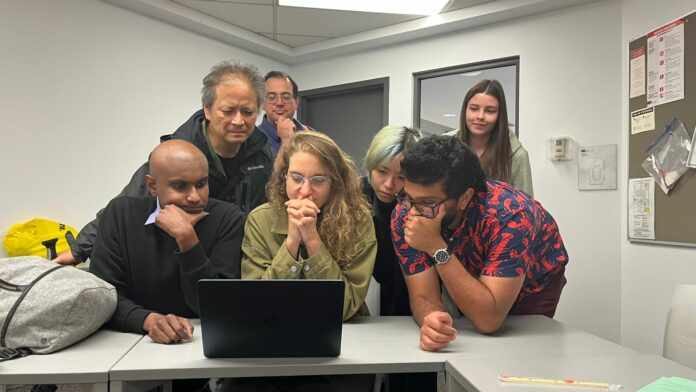
This image is of a small group of TSSU members. They are all leaning over a laptop, and appear deep in thought while looking at the screen.
PHOTO: Courtesy of Reese Muntean

By: Olivia Sherman, News Writer

The Teaching Support Staff Union (TSSU) announced their weeks-long work stoppage has ceased after a tentative agreement was reached with SFU in the early hours of October 19. The work stoppage started on September 28. It was an escalation of the larger strike that started in June, and saw teaching assistants (TA) stopping all work and picketing outside all three SFU campuses. Despite the work stoppage ending, there are still loose ends to tie up, such as SFU’s controversial hiring of a private investigation service to surveil students and staff. The Peak reached out to TSSU organizer, Kelvin Gawley, and TSSU media spokesperson and bargaining committee member, Dalton Kamish, to learn more. 

A tentative agreement occurs when the employer and the union have settled on an agreement, but it has not yet been approved by union leaders. As the tentative agreement with SFU is still being approved, the details of the agreement remain confidential. In a statement on October 19, the day of the tentative agreement, the TSSU said the collective agreement for 2022 through 2025 would be renewed, and more details would arrive as they develop. Kamish told CBC News the agreement was “monumental.” 

The Peak received a media statement from SFU regarding the tentative agreement, thanking “the entire university community for their patience and understanding during this time.

“The tentative agreement supports TSSU members with a wage increase, and other compensation and benefit enhancements, while delivering on the Province’s 2022 Shared Recovery Mandate,” which promises to offer inflation protection. 

Lions Gate Risk Management (LGRM) is a private investigation service located in the Lower Mainland. Through eyewitness reports at all three SFU campuses, picketers reported unnamed persons “following [them] around, taking pictures of [them], watching [them], following [them] from campus to campus,” Gawley said. “We started noticing them pretty much right away.” 

According to witnesses, there were at least three confirmed LGRM employees present at the pickets. Kamish confirmed LGRM employees were present at all pickets on all three SFU campuses, spanning September 28–October 10, and “were working at least 12-hour days recording TSSU members and others on the picket line.” 

With these numbers, The Peak confirmed SFU paid LGRM up to $35,000 to surveil students and staff for the 10 confirmed days they were employed by the university. SFU did not comment on this inquiry. 

After severe backlash, the university retracted their contract with LGRM on October 11. In a statement that day, SFU said they hired LGRM to “help [them] to monitor picket line activity,” and the company was hired solely to record protesters in case of “behaviour escalation at the picket line that could constitute bullying or harassment or physical safety or assault.” The university said they “will reassess how [they] support safety on [their] picket lines going forward.” Kamish also described a “revolving door” of employment between SFU and LGRM. Andrea Ringrose, SFU’s Senior Director of Campus Public Safety, was formerly the Director of Security Intelligence at LGRM. Mark Lalonde was the Chief Safety and Risk Officer at SFU and currently acts as the senior vice-president of strategic initiatives at LGRM. 

Gawley said it’s “absolutely galling,” and “so concerning to know this is who SFU chooses to bring onto our campus to surveil us and to watch us.” 

Despite SFU saying LGRM did not engage with or approach picketers on campus, Gawley said this isn’t true. He described one man, later identified as an employee of LGRM, who “just kind of [inserted] himself into a conversation with some people on the picket, and didn’t identify himself” to ask questions about the protestors. 

“We don’t know beyond the very obvious what these people were doing on behalf of the school, who they were giving information to, and what information they were collecting on us,” Gawley said. “Those are questions we still don’t have answers to [ . . . ] this is how they choose to treat members of their own community, who have the audacity to demand a fair contract. I don’t think that’s something any of us will ever forget.”

Logging company Teal-Jones hired LGRM to surveil environmental activists at Fairy Creek, Vancouver Island, where LGRM employee Ram Sandhu reported information on protestors back to the RCMP. The Indigenous studies faculty, the SFU Black Caucus, and the SFU faculty association (SFUFA) all wrote letters of condemnation against SFU’s choice to hire LGRM, now known for its work infiltrating peaceful protests and surveilling activists. 

“SFU’s engagement of private security to surveil students, employees, and community members should cause all of us to question how the administration in fact sees us,” said SFUFA’s executive committee in their letter of condemnation. 

SFU’s Black Caucus wrote an open letter to the university over concerns regarding this surveillance: “This action creates a risk for all picketers but especially for racialized people, given the known disproportionate impact of surveillance and policing on Black, Indigenous and racialized individuals, including within the SFU community [ . . . ] It is important that the university not only acknowledges the harm that was produced by utilizing surveillance tactics, but also reconciles these harms.” 

Toward the end of the strike, SFU and TSSU agreed on a private mediator, Ken Saunders. Kamish explained both parties can agree on a mediator. While there is generally a split between the cost for the mediator from each party, Kamish said SFU is “footing the bill, in this case,” which TSSU took as a sign of good faith and a willingness to bargain meaningfully. “As soon as we started the mediation process, we saw that this was not the case.” Kamish recounts more acts of time wasting and nitpicking minute details, wasting the time of both TSSU and the mediator.

SFU also hired a retired lawyer, Steve Gorham, a human resources consultant located in Victoria. Despite being retired from his previous job at the University of Victoria, and his employment status being “self employed,” Gorham was hired to consult SFU starting January 2023, and Kamish noted, “They’re paying him a ton of money to do it.” According to an FOI obtained from TSSU, SFU paid Gorham $192,000 in expenses alone, such as plane flights and ferry tickets from Victoria to Vancouver, food, and hotel rooms. “He’s been helping the employer waste our time by slowing down the bargaining process to a grinding halt.” 

Kamish explained TSSU and SFU both had much to lose by delaying bargaining, but “Gorham, as an external contractor, has nothing at stake. He’s already in retirement [ . . . ] He has no incentive to get us to a deal. He gets paid more the longer this goes on.” 

Many student bodies and student unions declared their solidarity with TSSU over the course of the stoppage. TSSU’s picket at the Burnaby campus on October 13 saw workers from unions across Vancouver, such as the Canadian Union of Public Employees (CUPE) and the International Longshore and Warehouse Union (ILWU), showing solidarity and picketing alongside TSSU. At a picket at SFU’s Vancouver campus, Toronto Raptors player and National Basketball Players Association (NBPA) vice-president, Garrett Temple, spoke on behalf of Canada’s only National Basketball Association team (NBA) in support of the strike. Temple announced the NBPA was donating $10,000 to TSSU’s strike fund. 

In recognition of academic difficulties undergraduate and graduate students faced over the work stoppage, including GPAs being affected, SFU recently approved the motion to allow students to use a new grading system after viewing their final grades at the end of the semester. Students can decide to keep their final course letter grade, or accept a pass, credit, or no credit grade. A “pass” will be substituted for grades equivalent to a C- or higher. A “credit” grade is offered for grades equivalent to D. A “no credit” is offered for grades equivalent to a fail. However, none of the options in this grading system will impact the student’s GPA. 

There is also an ongoing petition amongst undergraduates for tuition reimbursement. The petition, created by Undergraduate Strike Solidarity (USS) stated, “SFU’s administration has not only failed to address the entirely valid and necessary demands of TSSU, but has also recklessly jeopardized the educational experiences and financial stability of SFU students.” USS noted the 42 bargaining sessions were proof the university is unable to “prioritize the educational well-being of its students,” adding “education should not be held hostage to the failures of the university’s administration in addressing the needs of their workers and their disregard for our academic pursuits.” Despite SFU’s policy against tuition refunds for uncontrollable circumstances, the petition has gained 2,712 signatures at the time of writing

The Peak recaps: Red Leafs vs. Okanagan Lakers

0
photo of the SFU Hockey Team
PHOTO: Maurice DT / Unsplash

By: Izzy Cheung, Staff Writer

Green lights streaking from the inside of the player’s tunnel flash across the rink as the sound of skates slash against the ice. Red jerseys square off against black and orange, battling for the puck against the boards. Fans cheer from the stands as goals are scored back and forth. Family, friends, and students alike have all gathered for one reason — to watch the SFU Red Leafs take on the Okanagan Lakers

The Red Leafs have two hockey rosters: the roster that plays against the rest of the teams within the British Columbia Intercollegiate Hockey League (BCIHL), and the non-conference roster that travels to take on National Collegiate Athletic Association teams. Previously, the non-conference team made stops at the University of Michigan and Colorado College to play the Wolverines and the Tigers.  

Coming off a 4–2 win against the Lakers on the road, the BCHIL Red Leafs returned to Bill Copeland Sports Centre to hold their regular-season home opener against the Lakers on October 14.

For a university hockey game, there were quite a few young kids. Most of the crowd was made up of groups of students, who can get into any SFU games for free with a school ID. A few families brought homemade signs and stood by the tunnel, waiting to get high-fives from players as they walked out to start their season at home. 

In traditional opening game fashion, SFU players were introduced one-by-one, emerging on the ice to the cheers of fans welcoming a new season. As the Canadian national anthem began to play, fans and players stood looking toward the banners hanging from the rafters. Another championship this year would make it the third-straight title for SFU.

The puck dropped, and the game began. Okanagan opened the scoring with a goal five minutes into the period and one with 21 seconds left, making the score 2–0 before the end of the first period. Fans left during the first intermission to grab snacks from the concession stand on the lower level, but came back when a girls minor team took to the ice. The girls played a small scrimmage game for about five minutes, with the crowd cheering each team on after they scored against one another. 

A slew of goals and penalties took place in the second period. SFU started the middle frame with a goal by forward Nick Wagner, 30 seconds into the period. However, the two-goal deficit was quickly re-established when the Lakers scored off of a power play caused by a tripping penalty. The Red Leafs scored again with three minutes left in the period to bring the score to 3–2 for the second intermission. 

12-minutes into the final period, Red Leafs forward Max Lightfoot scored, tying the game up at three apiece. Sweet Caroline— a hockey game karaoke classic — blared throughout the rink as the team eagerly tried to finish their opening-night comeback. But after peppering goaltender Cooper Giesbrecht with a grand total of 44 shots throughout the game, the Lakers scored to make it 4–3 with eight minutes left in the period. 

The final few minutes were intense as SFU attempted to claw back and tie the game yet again. However, the siren signalling the end of the game came too soon, and the Red Leafs finished the game with a 5–3 loss after the Lakers scored a goal with seconds left to seal the deal. Despite the score, the players showed grit and determination — two traits that any fan can rally around. 

The Red Leafs BCIHL roster is 1–1 to start the year. They’ll take on the UVIC Vikes in game one of a two-game road trip on Friday, October 27. 

This week at SFU

0
photo of SFU women's soccer game
PHOTO: Wilson Wong / SFU Athletics

By: Isabella Urbani, Sports Editor

Home Games

Thursday, October 26: men’s soccer vs. Seattle Pacific at 4:30 p.m. 

  • SFU currently holds a 7–2–2 record and a three game win streak. The men’s soccer team has scored three goals in each of their last three matches while only giving up two goals. SFU’s last loss was on September 9. 

Thursday, October 26: women’s soccer vs. Saint Martin’s at Terry Fox Field at 7:00 p.m. 

  • The women’s team are 4–4–2 this season and have lost their last two games. Their game against Saint Martin’s marks the beginning of a three-game homestand. 

Saturday, Oct 28: women’s basketball vs. Langara (BC) at the West Gym at 9:00 a.m. 

  • Final exhibition game before the regular season. The women’s team was 10–13 last year.

Saturday, October 28: women’s soccer vs. Western Oregon at Terry Fox Field at 1:00 p.m. 

  • The women’s team was 1–0–1 against Western Oregon last season. 

Away Games

Monday, October 23–Tuesday, October 24: women’s golf at Hawaiʻi Pacific Shark Shootout 

  • Day two and three of the invitational. The women’s team finished third out of seven teams at their last competition. Freshman Dana Smith’s third place finish was SFU’s best performance. 

Thursday, October 26–Saturday, October 28: women’s golf at Dennis Rose Intercollegiate in Hawaiʻi 

  • Final invitational of the season until the divisional championships in April

Saturday, October 28: men’s basketball vs. Idaho State at 5:00 p.m. 

  • First game of the season. The men’s team was 6–22 last year. 

Saturday, October 28: volleyball vs. Western Washington at 7:00 p.m. 

  • The volleyball team was swept in three sets earlier this season against Western Washington.