Home Blog Page 158

Club Profile: Pursuit of Happiness

0
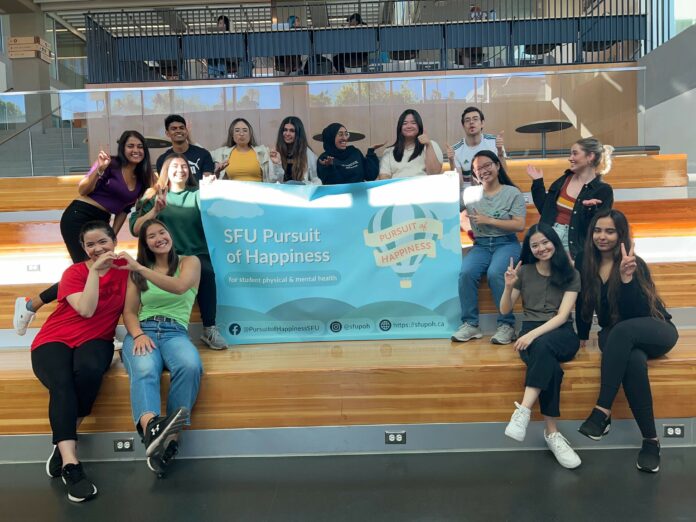
A photo of a group of young adults holding a sign reading “SFU Pursuit of Happiness.”
PHOTO: Kateleen Paran / The Peak

By: Vee Babbar, Peak Associate and Member of SFUPOH

Peek-a-boo, SFU! Halloween is just around the corner, so let us bring out our festive flair and make some memories. As everyone knows, midterm season can be full of fear and dread for most students. According to SFU Health Services, 84% of SFU students report that their mental health interferes with their academic performance. SFUPOH (Pursuit of Happiness Club) strives to reduce this number by organizing stress-relieving events, where students can make friends in a respectful environment and engage in exciting activities. As a member of SFUPOH myself, I got to speak with Ivan Flores, former vice-president of human resources and an active volunteer in SFUPOH, so we can share more about what SFUPOH does. 

First, the upcoming Halloween event: to kill some of that spooky stress this Halloween, SFUPOH is hosting a Pumpkin Carving event on October 24! Pumpkin carving begins at 6 p.m. and includes a Halloween movie. More information about this event and all the exciting activities will be posted on the club’s Instagram handle, @sfupoh.

The SFUPOH’s mission is to “promote the importance of mental and physical health by providing engaging events throughout the semester.” According to Flores, SFUPOH organizes events meant to “provide a safe and supporting environment for students to have fun and chill, but to also bring awareness to mental health.”

A memorable event for SFUPOH was Bob Ross day. “We had a day at SFU where we put [on] a Bob Ross video and just painted, and followed the [. . .] video,” Flores said. Apart from fun events, SFUPOH also organizes events revolving around physical health. For example, there was a yoga and nutrition session, where a yoga instructor and nutritionist each hosted a 30-minute session to help students learn about healthy eating and living. According to Flores, events like these have been a huge success, and both organizers and attendees loved being a part of it. I had the opportunity to attend the yoga night, and it was a rejuvenating event that marked the beginning of my own meditation journey. With the right guidance and a cheerful session with SFUPOH, I found a new healthy habit. 

Flores also spoke about their random acts of kindness event: “We gave goodie bags [. . .] just to spread positivity around midterm season.” SFUPOH makes an effort to promote inclusivity and foster a positive environment by going beyond physical and mental health — sometimes they just actively interact with the community. 

When asked how to join the club, Flores responded, “There’s two ways for joining the club.” The first way is by being an active volunteer in the club. Positions are typically posted on the club’s Instagram once every semester, so if you are interested in the position description, be sure to apply. The club has several coordinator positions, like external relations, marketing, and human resources. But, be mindful when applying as every member is hired for at least two to three terms.

The other way is to be an active collaborator with the club, and to participate in events open to the public. According to Flores, working with the SFUPOH is a great way to develop organizational and leadership skills that can help students’ career growth. There are plenty of networking opportunities, so meeting new people and making solid connections will become your forte. Overall, Flores wanted to convey the importance of maintaining mental and physical wellness. “Mental and physical health are very important to talk about [. . .] One great thing about SFUPOH is that everyone values the importance of speaking up about it, and secondly, the other message is that, everyone’s welcome.” SFUPOH aims to promote the importance of overall well-being and nurture a safe and supportive network for students. With engaging events and an inclusive environment, the club addresses the challenges to overall wellness experienced by the members of our community.
Muslims are not a race

0
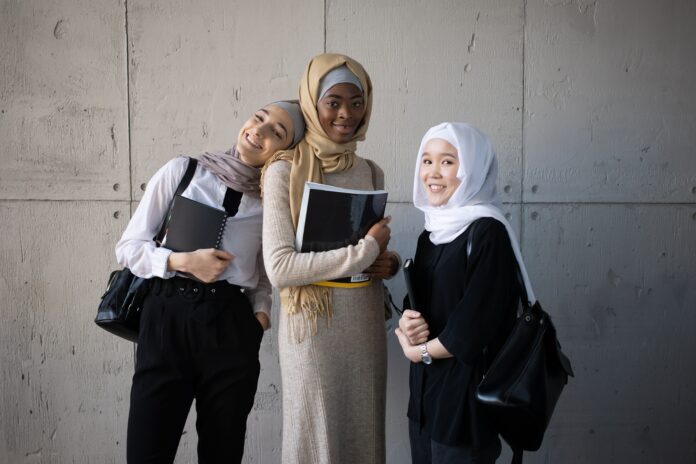
A photo of racially diverse muslim women
PHOTO: Monstera Production / Pexels

By: Sude Guvendik, Staff Writer

Content warning: mentions of Islamophobia and racism. 

We must break through the notion that all forms of prejudice are equal. This idea isn’t just misguided; it’s a deliberate act of intellectual dishonesty. Especially with increasing Islamophobic incidents, a dehumanization media campaign, and the spread of anti-Palestinian racism and anti-Muslim bigotry, we should recognize the difference between racism and Islamophobia. Muslims are not a race, and the attempt to pigeonhole Islamophobia as just racism obscures the complex motivations behind this unique form of bias.

One of the main issues with framing Islamophobia as racism is it implies race is the only factor that matters when it comes to discrimination against Muslims. This perspective fails to acknowledge the diversity of the Muslim community and the factors that contribute to anti-Muslim bias. 

Thinking of Islamophobia as only racism is not just misleading; it’s detrimental to broader efforts aimed at combating discrimination in all its forms. It reduces Islam, a diverse religious tradition, to nothing more than a cultural marker of non-white people. This framing disregards the varying experiences of religious minorities in a world influenced by factors like race, class, gender, and sexuality. 

While racism is often a significant component of anti-Muslim hatred, not all forms of prejudice against Muslims can be accurately categorized as racism. Attempts to racialize Islamophobia fail to consider the wide array of reasons people may harbour anti-Muslim sentiments. Islamophobia is not solely about race; it can also be driven by religious or ideological differences, misunderstandings, and other complex factors that are not adequately addressed when we limit our perspective to racism.

The concept of “racialization” suggests that Muslims can be racialized even though Islam itself is not a race. It argues groups like Arabs and Muslims can face exclusion and discrimination resembling explicit racism, even in the absence of a formal notion of race. However, Islamophobia is not a purely racial concept. Racialization hinges on the idea of physical and social differences, a concept incompatible with religious groups, who do not inherently possess these racial distinctions. Muslims face discrimination not solely because of racism, as they come from varying backgrounds. Islam welcomes people from all walks of life, regardless of their race or ethnicity. 

We’re not contesting the fact that racism and Islamophobia intersect. We’re not ignoring the instances where racism plays a role in anti-Muslim prejudice. But our grievance as Muslims is with the growing trend that indiscriminately lumps all manifestations of Islamophobia under racism. Racism, in the conventional sense, is prejudice, discrimination, or antagonism rooted in perceived racial differences. Contemporary discussions have expanded the definition of racism, viewing it as a systemic issue rather than a matter of individual beliefs. From this perspective, racism isn’t just about personal bias but the systemic consequences it produces.

Another significant problem with framing Islamophobia as racism is that it can lead to an overuse and misuse of the term. This can undermine the effectiveness of legitimate anti-racism efforts. We must be accurate and specific when identifying instances of racism to ensure the term maintains its power and relevance.

While racism undoubtedly plays a significant role in some cases of anti-Muslim prejudice, it cannot be the only lens through which we view this complex issue. Instead, it is more productive to view it as a multifaceted problem that includes religious discrimination, cultural bias, and a host of other factors. 

We can combat Islamophobia in much the same way we confront other forms of bigotry and racism. Islamophobia isn’t limited to overt rhetoric like calls to ban Muslims. Bigotry can manifest in subtle and insidious ways, often going unnoticed. By educating ourselves on these subtle manifestations and recognizing our own implicit biases, we develop awareness and the capacity to address these issues. Implicit biases exist in all of us, but raising awareness of them empowers us to work towards their elimination.

The 1 Million March 4 Children brings out fierce support for SOGI 123 curriculum

0
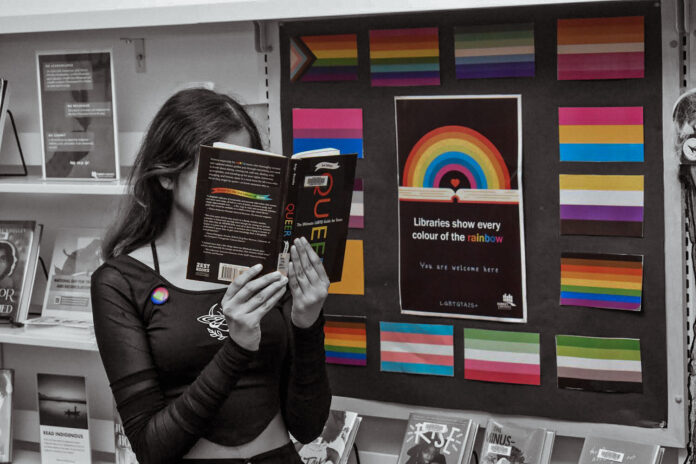
This is a photo of a student in the libarary. There are rows of bookshelves behind them, and they are holding a book titled, “Queer: The Ultimate LGBTQ Guide for Teens.” They are also standing in front of a rainbow poster which reads, “Libraries show every colour of the rainbow, you are welcome here.”
PHOTO: Amrit Kamal / The Peak

By: Eden Chipperfield, News Writer

Content Warning: mentions of anti-2SLGBTQIA+ violence.

A sea of protesters gathered in Vancouver on Wednesday, September 20. The 1 Million March 4 Children protest crowd was split between those protesting against the Sexual Orientation and Gender Identity (SOGI 123) curriculum being taught in schools, and those advocating in support of the curriculum. 

The 1 Million March 4 Children is an anti-2SLGBTQIA+ movement, supported largely by groups like the Freedom Convoy; the organization is led by far-right activists, and has been linked to anti-2SLGBTQIA+ incidents. The movement aims to end the SOGI 123 curriculum in schools. At the time of writing, a second protest is planned for October 21. This has pushed the Coquitlam library to postpone their drag queen story time reading. The RCMP said they are concerned for the safety of attendees and performers, with the ongoing “high-risk” anti-SOGI protests, according to RCMP Cpl. Alexa Hodgins. 

SOGI 123 introduces students to a spectrum of ideas about sexual orientation and gender identity to promote a welcoming environment free from discrimination. The curriculum was first presented in 2016 by the BC United party (previously BC Liberals). In 2004, the Vancouver School Board (VSB) put forth their own “stand-alone” version of SOGI. Today, SOGI is present in 60 school districts across BC and Alberta. 

SOGI 123 teachings discourage gender-specific stereotypes, help explain different family structures, and are proactive around transitioning students. Furthermore, they encourage children to ask questions and engage in proactive allyship. 

Support for SOGI 123 has been significant after 1 Million March 4 Children’s first march, including a statement from various school district parent advisory boards including Vancouver, Langley, Surrey, Nanaimo-Ladysmith, Vernon, and more. The statement noted, “We firmly assert that any group endeavouring to undermine or segregate our communities has no place in the inclusive environment of BC public education [ . . . ] We believe SOGI inclusive education reflects diversity including the acknowledgment of multiple genders and sexualities, which plays a pivotal role in educating our students about the world they inhabit.”

However, with the show of support, there is a prominent opposition that claims SOGI 123 is “too adult” for children. They aim to eliminate teaching pronouns, gender identity discussions, and ban gender-neutral bathrooms. The 1 Million March 4 Children across Canada had many protesters who joined the rally to “protect [their] children from indoctrination and sexualization,” according to the organizers.

One trope the protesters used to undermine the 2SLGBTQIA+ community is the notion that teaching about gender and sexual orientation is predatory toward children. Jackie Wong unraveled this argument in an article for The Tyee, and compared the introduction of SOGI 123 to accessible buildings and wheelchair ramps. Those with accessibility needs often have bathrooms and resources available to support them. These resources have been ingrained into many societies. “These are cornerstones of accessibility that make public spaces work for the people they are designed to serve,” explained Wong. However, the Conservative Party often uses fear as a catalyst for their anti-2SLGBTQIA+ platform. 

The Vancouver District Parent Advisory Council (DPAC) provided a statement to The Peak regarding the recent demonstrations against SOGI 123. “SOGI 123 is a legislated tool used to protect the human rights of those who do not fit into the confines of extremely narrow binaries of existence.” The statement read, “We believe that the protesters are mainly stuck on misinformation about what SOGI 123 is and isn’t, which demonstrates the importance of SOGI existing within the curriculum.”

The BC government released statements on their SOGI information page: “Everyone has a sexual orientation and gender identity (SOGI). It’s an inclusive term that applies to everyone, whether they identify as lesbian, gay, bisexual, transgender, queer, two-spirit, heterosexual or cisgender (identifying with the same gender that one was assigned at birth).” 

It is critical to highlight the importance of representing marginalized groups, especially Indigenous students, in queer communities. In the SOGI curriculum, Indigenous perspectives on gender are prominent, including views on sexual orientation and gender identity that “contrast European (colonial) beliefs.” Beyond gender identity, SOGI 123 prioritizes including Indigenous learning in high schools. BC First Peoples 11 is a high school class which discusses the “impact of historical exchanges of ideas, practices, and materials among local BC First Peoples and with non-Indigenous peoples.” Contemporary Indigenous Studies 12 focuses on “the varied identities and world views of Indigenous peoples, and the importance of the interconnection of family, relationships, language, culture, and the land.” These are two of the classes SOGI 123 campaigns to implement. 

Gender discussions, especially those about trans identities, have been targeted by anti-SOGI protestors expressing concern over younger generations who may be transitioning earlier in life. However, SOGI doesn’t explicitly encourage transitioning. The curriculum is aimed to educate students on existing differences between individuals. SOGI offers a graphic called the Gender Unicorn, created by the Trans Student Educational Resources (TSER). The Gender Unicorn outlines differences and promotes understanding of emotional attraction, physical attraction, sex assigned at birth, gender identity and gender expression, breaking the subject matter down into an understandable fashion. 

Allyship is also a topic brought into the curriculum for students who may not identify as queer to further support their peers and friends. “Allyship is important work; it lets 2SLGBTQIA+ youth know that they are not alone. Anyone can do this work, but it is important to remember to listen to, consult with, and represent 2SLGBTQIA+ people in the work you do as an ally,” according to SOGI 123.

A parent, who was present at the 1 Million March 4 Children on September 20 in support of the SOGI 123 curriculum, shared their insight to Global News: “I feel sorry for the children of those parents that choose fear over the reality that teaching our children about sexuality protects them, it protects them from sexual predators actually, it allows them to be empowered in their ability.”

For 2SLGBTQIA+ supports, Trans Care BC is a information hub that is BC-wide, helping people find gender-affirming care and resources. Queer, trans, and two-spirit folks can also find resources, programming, and community events on Qmunity’s website. 

Forest of Truth breaks gender stereotypes in a whimsical way

0
A Japanese person in Kabuki-style pale white foundation with exaggerated black and red makeup, hair up in a bow with chopsticks and flowers adorning their hair, holding a red apple. They are behind a green, comic-book style background with an exaggerated facial expression, white gloves, and a fairytale-style blue dress.
PHOTO: Courtesy of GUMBO Theatre Group

By: Tam Nguyen, SFU Student

Vancouver Fringe Festival is the biggest theatre festival in BC, held annually every September on Granville Island. Fringe 2023 wrapped up with over 85 independent artists and performers from across the world, cherishing all kinds of genres, from comedy and theatre, to drag and musical shows.

As a volunteer, one thing I loved about Fringe was how powerful word of mouth is. Every time we gathered at the volunteer centre, people would discuss and recommend the plays they liked; Forest of Truth was undoubtedly the most popular, and always in-demand for tickets.

Forest of Truth by GUMBO Theatre Group is a performance play about a man and woman who step into a magical forest and fall in love with each other. Because of stereotypical gender roles and the pressure to fit in with Japanese society, they both pretend to be someone they aren’t. But the residents of the forest help them overcome this, eventually revealing the hidden parts of the couple’s hearts and minds. The play deals with the heavy topic of gender roles in a refreshingly hilarious way.

I had a great time, and enjoyed all the comedic and whimsical elements of the production. Everything was so fresh and upbeat, from the magical forest set, to the performers’ costumes and makeup. The way they held themselves and interacted with the audience was captivating. At the award night showcase, I reached out to Ryo Nishihara (leading role) and Nono Miyasaka (supporting role) to set up an interview.

Nishihara explained how Forest of Truth tackles the question of “what is true self?” after gender stereotypes are removed. In Japan, women are stereotyped as “very shy,” and are expected to hide their true selves in favour of being polite and agreeable. Men are expected to be strong and masculine. They used a fairytale setting to subvert the tropes of “heroine meets prince charming,” followed by “a happy ever after.” 

Based in Osaka, Japan, GUMBO performs original works globally. Nishihara and Miyasaka explained the play is a combination of western storytelling and traditional Japanese theatre techniques, such as Kabuki dance movements and emotional expression, as well as makeup looks and costumes. They wanted the play to be contemporary and modern, but still represent Japanese culture. Kabuki is a Japanese theatrical form that’s existed for four centuries, defined by a blend of song, dance staging, costuming, and mime. I recalled Miyasaka, who portrayed a guard in the forest — he performed a wonderful Kabuki dance, dressed up as a Samurai.

About the process of creating the play, Nishihara named the writer-director of the play, Kayo Tamura, who supervised the performance from beginning to end. They rehearsed the play many times for a small audience to see which concepts worked, changing and updating the script frequently.

Miyasaka spoke about the challenges they faced promoting the play: “It was our first time at Vancouver Fringe, so we had no idea how to get an audience,” she said. “We tried to make posters and flyers, but we think it’s very difficult.” The play ended up speaking for itself. I was lucky to get a ticket at the very last minute.

Forest of Truth won The Spirit of the Fringe Award, which best reflects the Fringe core value, Theatre for Everyone.” Executive director Duncan Watts-Grant shared: Theatre Group GUMBO absolutely is the Spirit of the Fringe. They support other artists and care so much about this community we create together. Vancouver Fringe is thrilled to recognize the incredible attitude and joy they brought to the festival this year.”

Find out more about GUMBO Theatre Group at their website and follow them on Instagram, @gumbosteptheatreco.

Unpeeling the Layers of Self-Acceptance

0
An illustration of the popular media character Shrek in a suit.
ILLUSTRATION: Jill Baccay / The Peak

By: Tas S

So far, 2023 has been a great year for movies. Spider-Man: Across the Spider-Verse, Guardians of the Galaxy Volume 3, Oppenheimer, Mission: Impossible – Dead Reckoning Part One, and how could I ever forget sweet ol’ Barbie — good hits all around, and these are only the crumbs of it. 

While I do love the current offerings from the cinematographic industry, I can’t help but think about my favourite movies from childhood, so I decided to rewatch a classic masterpiece: Shrek. Aside from being a feel-good, wholesome movie, it does a terrific job as a comedy. But, on a more serious note, the movie’s main attraction is in its underlying messages.

Shrek, on its surface, is a journey of growth, making new friends in unexpected partners, and finding love in unexpected ways. The story follows a lonely ogre, with a life extending only to the borders of his swamp, until the tale pushes him on a journey outside his comfort zone

On my rewatch, I was able to pick up on a lot more than I did as a kid. Having considerably far more experience as a young adult, I was able to relate to a number of situations I didn’t relate to as a child. The part that got me was when Fiona was having a heart-to-heart with Donkey about how she didn’t think anyone could fall in love with the ugly, ogre side of her. It played into Shrek’s insecurities as well; his biggest fear is people never seeing past his “ogre-ness,” because he can’t change his looks, or who he is inside. It reminded me of all the times thoughts like these had crossed my mind as I grew older, and living in this world got a bit more complicated with every passing year. As a child, things felt so easy; I don’t remember caring much about the hair on my legs, or the pointiness of my nose, or how chubby my cheeks were. As I transitioned from middle school to high school, it felt like the world had gotten a little meaner. Or, maybe it felt like that under the scrutiny of social media. 

Influencers were on the rise, and the more I saw fit, curvy, #wokeuplikethis girls, the worse my reflection looked to me. Even though I thought these girls were cool people, constantly seeing such conventionally “perfect” selfies began to hurt — it bit at my insecurities. I couldn’t help but wish I looked like that too, and that wish effectively lowered my self esteem during my teenage years. I’d wonder why my friends and cousins got blessed with certain features, and I didn’t. I thought about cosmetic surgery at the age of 14, which is a deeply problematic thought that no 14 year old without medical need should ever consider. The idea that “better-looking” people were somehow better people got stuck in my head. I wondered how popular, or how much more likable I would be if I looked prettier. 

My introduction to popular social media platforms was late, and although there were some inclusive communities, people eventually became openly mean about pretty much anything. What happened to treating others the way you want to be treated? Even conventionally attractive influencers or celebrities are scrutinized for things they do and how they look, especially women. Dressed up and posing? Trying too hard. Comfortable and natural? Pick-me girl. There is no way to please everyone.

But maybe that’s the point: there is no way to please everyone. It doesn’t matter if others think Fiona looks better as a human or an ogre. It matters that Fiona is happy with herself, ogre and all. It matters that Donkey and Shrek love her for the way she is, not just the way she looks. It matters that Fiona realized beauty is an inherently subjective thing, and with that, discarded the image of the person she thought she had to be. Maybe Shrek can help us relearn that we are cool the way we are, and that, just like an onion, everyone has “layers” that make us worth more than our looks.

Council Chats: SFSS discusses their lack of response to TSSU strike

0
This is an illustration of a graphic that reads “Council Chats.” The image also has two text boxes to symbolise messages being sent.
ILLUSTRATION: Andrea Choi / The Peak

By: Eden Chipperfield, News Writer

On October 11, The Peak attended the Simon Fraser Student Society (SFSS) bi-weekly Council meeting. The agenda included a discussion on the SFSS response to the TSSU strike. This article was written prior to TSSU reaching a tentative agreement with SFU.

SFSS response to TSSU strikes

The Council held an in-camera meeting where councillors and executive members discussed the TSSU strike and the SFSS response regarding the matter. The Peak could not attend this part of the meeting as in-camera meetings do not include media or guests. 

After the in-camera meeting, the group rejoined the conversation. A motion was proposed for the SFSS to release a statement in support of the TSSU and the tuition refunds undergraduate students have been calling for. An undergraduate student, Kanksha, voiced their concerns with the SFSS’s lack of support and response toward the TSSU strike. “The biggest thing that’s been happening on campus, and SFSS seems not to have taken any stance or provided any guidance to students,” said Kanksha directly to Council. “We’ve been on strike since June.”

Council informed Kanksha, and the rest of the attendees, that in the matter of releasing support letters, there are legal procedures to consider as well as bureaucratic processes. They also thanked undergraduate students for attending the bi-weekly meeting. 

History councillor, Emilio De Silvia, responded, “I will not allow our Council to be bullied to go and push this. I want it to go and be done in a way that protects all of us from any legal implications. And I want us to go and ensure we do our due diligence on this.” Further, De Silvia said  they wanted to avoid putting responsibility on vice-president external Nancy Brar entirely, because Brar deserved support. The role of vice-president external and community affairs includes liaising with student societies and organizations such as TSSU on behalf of the SFSS. 

The chat box on Zoom was instantly lit up as Kanksha disavowed being called a bully for standing up for TSSU. “Do not thank us, undergrads, for coming to this meeting if you will also call us bullies!” wrote Kanksha. “If raising our concerns is labelled as bullying, I do not feel represented at all.” 

TSSU representative councillor, Pranjali Mann, argued the SFSS is responsible to the students they represent, and their silence is concerning. Mann expressed, “The part of the concern that I have is that [TSSU strike] is being shifted off our priority for too long. This is the conversation that I have been having since July, August, September, and now it’s October.”  

Marwan Saleh, who stepped in for Council representative for the psychology student union, added: “I would like to highlight the fact that considering that the TSSU has been on strike for months and SFSS has not considered to essentially make a statement in any shape or form and consider the fact of how undergraduate students feel — particularly marginalized students that are international students, or exchange students who are being harmed by the strike action.” 

Indigenous studies student union councillor, Evan Accettola, agreed with this sentiment, addressing the undergraduates who had joined the meeting: “I just wanted to thank all the concerned students that came. I agree that this issue has been put off for too long. I think that’s 100% correct. But, also, because of how the Council is designed, we have to follow the process to ensure all councillors approve it. So, I really do think this is done as fast as possible. Your guys’ passion for this is awesome, and seeing that in students is great.” 

President Liam Feng closed off the conversation and began adjourning the evening meeting. They had planned to revisit the topic of SFSS’s response to the strike in two weeks at the next bi-weekly meeting. They also considered calling an extraordinary meeting to discuss the matter sooner. However, before the SFSS came to an agreement, the TSSU reached a tentative agreement with the school. 

Blaming TSSU for the strike overlooks SFU’s position of power

0
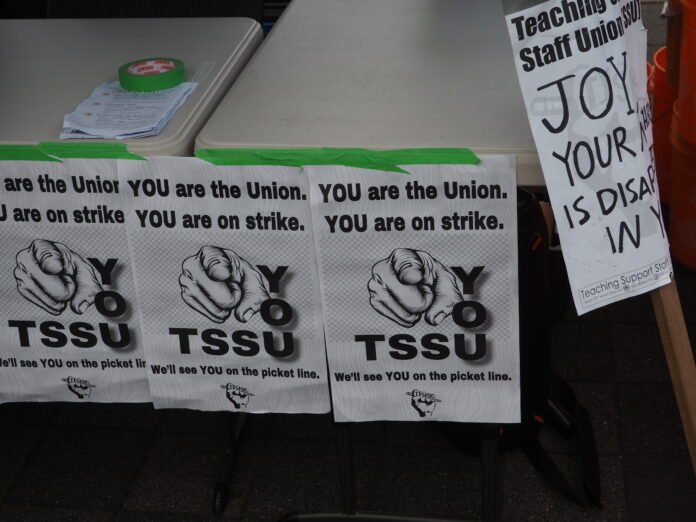
TSSU posters which read: You are the union. You are on strike. We’ll see you on the picket line.
PHOTO: Olivia Sherman / The Peak

Written by: Petra Chase, Arts & Culture Editor

When the Teaching Support Staff Union (TSSU) initiated a full work stoppage and began picketing SFU campuses to demand a fair contract, it lasted nearly a month. Uncertainty loomed for everyone in the community. For undergraduates, some classes were cancelled indefinitely, while others continued to run, putting the burden on students to make difficult decisions about their grades and morality. Students have a right to feel angry that their education has been disrupted, especially with a hefty tuition at stake. However, blaming TSSU instead of SFU for this outcome misses the mark entirely.

While there’s been overwhelming support for TSSU during the strike, I’ve also seen growing contempt. Those calling TSSU entitled or childish didn’t consider that TSSU had done everything to avoid this scenario. Negotiations began with SFU in March 2021, after SFU delayed it for 10 months, although TSSU has been fighting for improved contracts and against unpaid labour since as early as 2014. It took far too long to reach a tentative agreement. Although SFU claimed they were working toward “movement on key issues,” records show they purposefully stalled the process. Focusing on unimportant grammar motions, cancelling sessions, and even not showing up are some of the ways SFU has shown disregard for TSSU’s demands. Similar tactics were used back in 2014.

The rhetoric that strike workers enjoy a paid vacation is uninformed. Strike pay exists to ensure workers have the ability to support themselves should they decide to strike, which is a matter of democracy. And it’s not distributed on a whim: “97 out of 100 collective agreements are negotiated by unions without a strike.” Furthermore, members get paid for the hours they work on the picket line, which caps off at $400 for 24 hours or more a week — at most, that’s $16.60 an hour (a living wage in Vancouver is around $24 an hour). Picketing is not a fun time. Just because you saw striking workers eating pancakes and cracking a few jokes, doesn’t mean TSSU didn’t work hard for fair pay. It’s physically, mentally, and emotionally strenuous to strike. 

While it’s frustrating that our education was disrupted, our education shouldn’t come at the cost of exploiting TAs and sessional instructors.

Strikes are the last resort, and they happen when the majority of members agree the things they’re asking for are “worth the sacrifice.” TSSU is also made up of students whose education and careers are being affected, with their livelihoods at stake. While it’s frustrating that our education was disrupted, our education shouldn’t come at the cost of exploiting TAs and sessional instructors. To those complaining that strikes were loud and inconvenient: that’s the point! TSSU accurately showcased that the university cannot function without them. 

SFU claims their students and faculty are their priority, but it’s clear profit and power come first. They had the money to pay private investigators, continued to stall, and increased tuition in spite of their massive surplus ($22 million last year). Not paying their workers properly is a deliberate choice, much like paying their five board members nearly $2 million last year.

Unfortunately, there were reports of harassment happening to students, including intimidation, physically blocking students from accessing residences, and some members disrupting lectures. This shouldn’t have happened. However, this behaviour doesn’t mean TSSU members are suddenly undeserving of a living wage. Sessional instructors and TAs work hard and are losing money fighting for their livelihoods, and their efforts shouldn’t be discounted.

SFU benefits from the rhetoric that TSSU is entitled and aggressive, because it allows them to deflect accountability. Dilson Rassier, provost and vice-president, academic sent an email to the student body informing about and describing an influx of strike incident complaints, followed by resources for support. Rassier also wrote that SFU has asked TSSU twice to put the strike on pause while negotiations resume for them to “get paid and students and faculty to resume their regular learning and teaching activities.” This makes it seem like TSSU is unreasonable. However, it’s SFU’s responsibility to show TSSU that they are ready to take them seriously. SFU continued to falsely reassure students that they were working hard towards a contract, while TSSU hadn’t received a response on any of their proposals. It didn’t need to take this long for SFU to reach an agreement with them. 

We cannot allow the actions of some TSSU members to discount what they’re fighting for, and must also recognize that SFU’s dismissiveness is deliberate. It is violence: SFU could afford to prolong the strike, especially when the SFU community continues business as usual, but TSSU doesn’t have the same access to resources that the university does. The longer TSSU endured uncertainty and lack of pay, the more desperate they might’ve become — and it’s hard to say whether what has been agreed on is fair when the agreement hasn’t been published yet. In a union-buster’s dream come true, the employees would become worn down and settle for less. Or, the community would become fed up with the situation, and place blame on the people they see on the ground, while the employers hide behind vague and dishonest statements.

This is why we shouldn’t cross picket lines, because SFU didn’t care until it affected them and their reputation. Students shouldn’t be academically punished for respecting picket lines, and professors shouldn’t bear pay cuts for cancelling classes. The responsibility shouldn’t have to fall on students and non-TSSU staff to make these sacrifices, however, it’s unfair that TSSU needed to strike in the first place. 

If you’re rightfully angry about the cost of tuition amid the chaotic and uncertain environment, be angry at SFU. There was absolutely no reason for this to happen except greed. 

Toronto Raptors give an inspiring show at SFU in open practice

0
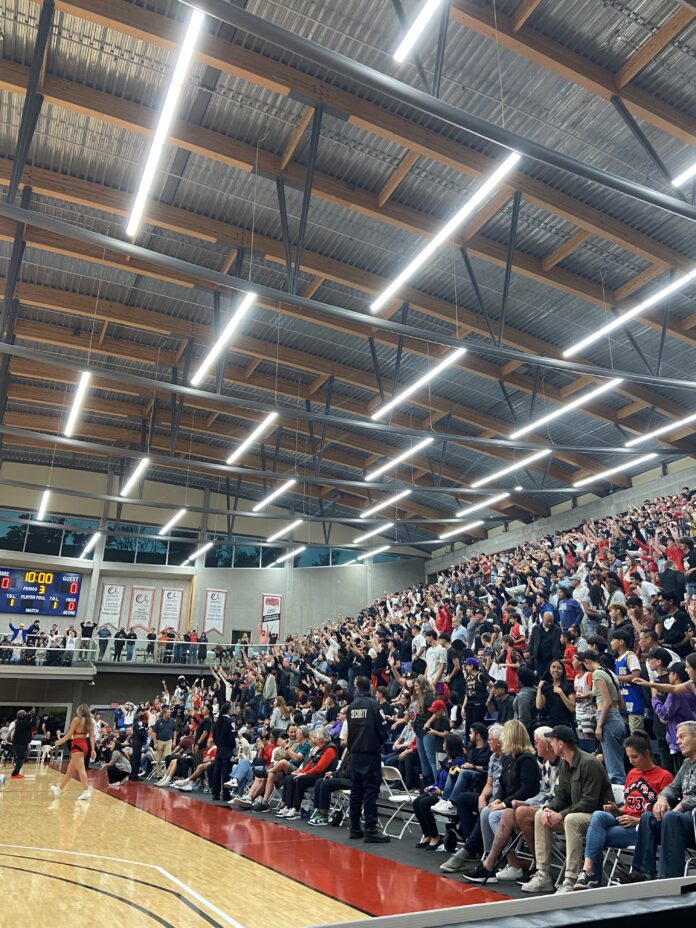
Pictured, the right side of the basketball court at SFU. Fans raise their arms up in anticipation.
PHOTO: Izzy Cheung / The Peak

By: Izzy Cheung, staff writer and Saije Rusimovici, staff writer

The thumps of a basketball bounce against the hardwood floor. Vibrant shades of red streak through the crowd. Hands grab onto the rim of the metal hoop and the crowd erupts into cheers as the ball falls back to earth. On the evening of October 6, SFU’s west gym was lit ablaze with the infectious energy of the game of basketball — although, this time, it wasn’t the usual Red Leafs taking the court. For the first time ever, Canada’s only current NBA franchise, the Toronto Raptors, held an open practice at SFU. Fans of all ages were welcome to purchase tickets, priced by donation, to watch the Raptors practice up at Lhuḵw’lhuḵw’áyten (Burnaby Mountain).

Hours before the open practice, the TSSU announced the National Basketball Players Association (NBPA) and members of the Toronto Raptors had donated $10,000 to the TSSU strike fund. Garrett Temple, a vice-president of the NBPA, visited the picket line at SFU’s Harbour Centre and spoke out on the strike. 

“I applaud you guys as a union rights president,” he said, speaking through a megaphone. “I understand how much TAs do for the university, so on behalf of the union, on behalf of myself, we applaud y’all’s members.” Temple went on to encourage those on strike to continue to fight. 

On top of their solidarity with TSSU, it’s clear the Raptors have a significant impact on the rest of Canada’s basketball scene, especially here in Vancouver. With the relocation of the Vancouver Grizzlies to Memphis back in 2001, Vancouver’s basketball community has sorely lacked the presence of an NBA team. Yet, the people of Vancouver still wholeheartedly support their 1995 expansion brother.

Tickets to the event were almost instantly sold out, the bleachers packed with fans sporting Raptor-red and hoisting up heartfelt homemade signs. Those without tickets lined the windows of the gym, peering in from the outside for a chance to catch a glimpse of the action about to commence on the court.

“It’s really cool to see the Raptors team coming here to SFU to kinda put on for BC and everyone in Vancouver,” Matthys Van Bylandt, a freshman forward for SFU Men’s Basketball team, said. “The basketball community keeps growing and it’s because of contributions like this.” 

As sports fanatics ourselves, we pounced at the opportunity to cover this event. The thought of being able to see professional NBA players dunk directly above our heads? Priceless. 

We checked in as media about an hour early, but already, observers were flocking the entrance of the building. Promptly, we were ushered into the media room, where we were surrounded by established reporters from TSN, Sportsnet, and The Toronto Star. Imposter syndrome kicked in immediately.

We sat courtside, directly beside the entrance where the team would walk through, and right beneath a hoop. The bleachers were packed with people, loud music and excited chatter echoing in the open space. We clutched our notebooks with anticipation as practice time drew closer, both eager and anxious for what we were about to see.

The coaching staff came out first, headlined by Head Coach, Darko Rajaković, and assistant coach, (and former UBC Thunderbird) Jama Mahlalela. After a round of applause for the coaches, players began to filter out one-by-one from the hallway. 2023 13th overall pick Gradey Dick, Canadian forward Chris Boucher, and two-time All-NBA team forward Pascal “Spicy P” Siakam ran through the roars of the crowd and onto the court. However, the loudest cheers arose for the 20212022 Rookie of the Year, Scottie Barnes

Practice started with some general warmups, with players running back-and-forth to various lines on the court. They soon transitioned into some general shooting drills such as a five-man weave. Players were sorted into three general “lines,” with each line wearing black, gray, and red respectively. Teams of five would run down the court carrying the ball, passing to one another before a player finally shot the ball. Even though they were just warming up, you could feel the tenacious spirit of the players radiating from the court. 

The intersquad scrimmage was by far the most exciting part of the practice. The players were divided into two teams, black and gray, that would switch some players every quarter or so. Each quarter ran for 10 minutes before teams would be permitted a brief break. The game started with Pascal Siakam, Jakob Poeltl, O.G. Anunoby, Dennis Schroder, and Scottie Barnes on one team, and Gary Trent Jr., Jalen McDaniels, Thaddeus Young, Malachi Flynn, and Chris Boucher on the other. 

Competition and camaraderie were abundant in the scrimmage. Players looked equally as excited and happy as the fans who were present as they launched the ball back and forth, executing crisp passes and perfect three-pointers. However, despite the companionship throughout the practice, the athletes’ competitiveness shone through. They were working as hard as they would have during an actual game with a spot in the playoffs on the line. Still, smiles remained on faces and laughter ballooned through the air as various players tried their hands at dramatic dunks. 

The event ended with a final salute to the crowd as players headed back down the Red Leaf and Raptor-red hallway, waving goodbye to a practice that none would soon forget.

At the post-practice press conference, Coach Rajaković commented on the players he thinks will take the next steps in their game. “I can see multiple players on our team taking a next step from different stage[s] of [their] careers,” he said. “Jakob is very important, I think he’s going to make the next step, Scottie obviously, Pascal, I expect from all of those guys to make [the] next step and to get better this year.” 

“Guys are fighting for minutes, guys are fighting for roles, guys are doing a great job,” he added. 

Taking the next step is important not just for athletes, but for anyone working to fulfill their dreams. This event was a defining moment for us as journalists, SFU sports, and the SFU community as a whole. Not only is this event about athletics, but is an inspirational moment for students aspiring to achieve big goals in their lives. Chris Boucher’s advice for student athletes looking to go pro is that “[you have to] believe in yourself and also put in the work.” 

The dark truth about plants

0
A fern in a pot. The pot has a grumpy face on it with a mustache indicating that the fern is unhappy.
ILLUSTRATION: Ananya Singh / The Peak

By: Izzy Cheung, Staff WriterA fern in a pot. The pot has a grumpy face on it with a mustache indicating that the fern is unhappy.

My name is Fern. I’m a small plant who lives in a cute little ceramic pot. My roots are buried in the dark soil. My life seems normal, but truthfully, I’m holding a dark secret. 

I’m not an actual plant. 

I know, I know. You’re all shocked. I would be, too. You’ve been watering me for the past few weeks, thinking you’re doing a good deed and helping a living thing continue to, you know, live — but I’ve been deceiving you. We’ve all been. 

You see, what I’m about to tell you is top-secret information. No one else can know about this. I’m telling you this in trust, hoping you won’t tell anyone or broadcast it to any publications. I can’t let this get out, but I feel like I can trust you. You wouldn’t go blabbing this private information to anyone, would you? 

There’s no such thing as plants. There, I said it — and I feel so much lighter now that I’ve told someone the truth. Plants don’t exist the way you think we do. The innocent little potted plants you store in your room, the ones you care for like you would a child, are slowly sucking your soul out. Humans came up with this idea that trees help create oxygen and help them survive, but really, all we do is steal bits and pieces of your lives. Have you ever seen Little Shop of Horrors? Pretty much what happens is a guy starts feeding this plant his blood, but the plant actually ends up being this alien set on world domination. It’s kind of like that. 

Another thing we hate? Water. Ugh. I don’t get why you all think we need it to survive — if anything, the water is killing us. So stop watering us, please and thanks. If you really want to feed us, feed us some mice or something. 

Well, now that I’ve told you about all our little secrets, I think it’s time to make sure no one finds out. You won’t tell anyone, will you? Sorry human, I know you’re not even the owner of this house, but I can’t let you escape with this knowledge. It was nice knowing you — 

Wait, wait, wait. What are you doing with that bucket? Where did you get it? What’s in there? It better be some fresh mice. I love mice. 

Water? Really, human?! I just told you that plants hate water. 

Put the bucket down. We can talk this out. I’m sure we can reach an agreement. Come on. There’s no need to be unreasonable. 

No, no, NO! HOLD ON, HOLD ON, PUT THE BUCKET DOWN. I’LL STOP EATING YOUR SOUL, PLEASE; I’M JUST A PLASTIC PLANT — 

— WATER YOU DOING???

Clapback from the backpacks

0
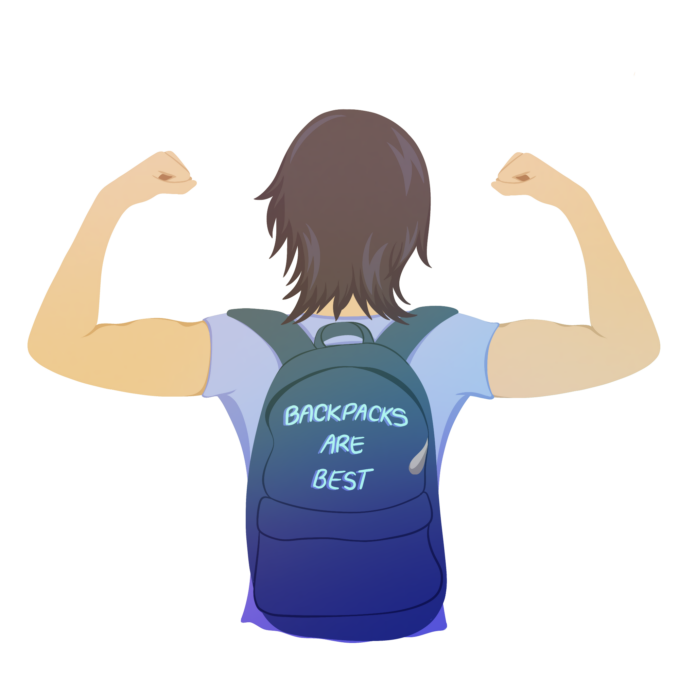
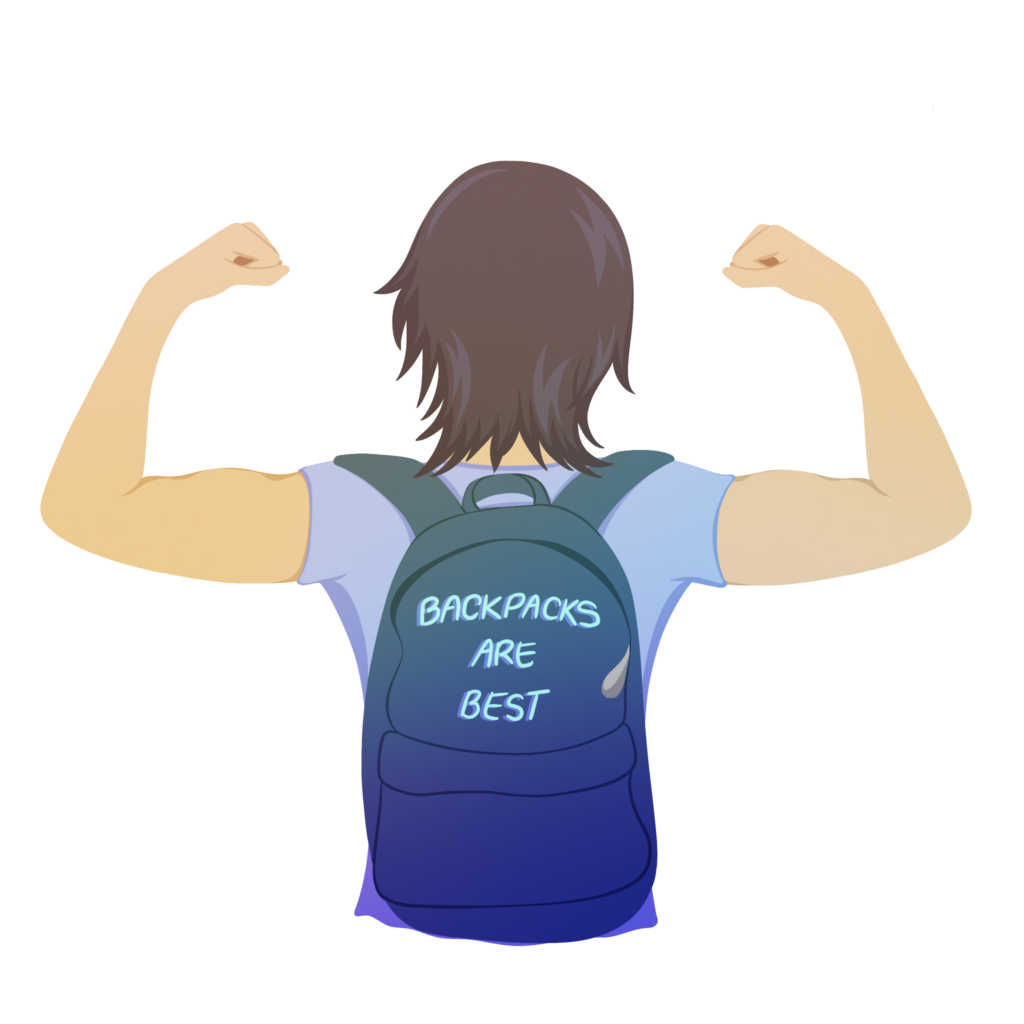
Someone wearing a backpack and flexing from behind. The backpack reads “Backpacks are best.”

By: C Icart, Humour EditorSomeone wearing a backpack and flexing from behind. The backpack reads “Backpacks are best.”

Alright, some serious backpack slander happened in this paper last week, and we’re not just going to lie down and take it. Who is we, you ask? Everyone sensible enough to know that backpacks are vastly superior to tote bags. 

First of all, we’re not even surprised you couldn’t get your bag facts straight when you’re busy walking around looking like the leaning Tower of Pisa with your overflowing tote weighing you down on one side. 

We don’t even know why you call that thing a tote, and not a bucket, because walking around with an OPEN BAG in Metro Raincouver is a rookie mistake. Call us old school, but we will be putting books, pencil cases, and notebooks in our backpacks. We won’t be giving all our precious marginalia a bath just because we want to cosplay as wealth hoarders. You’re busy spreading tote bag propaganda, thinking you ate, and we’re busy eating the rich. We are not the same.  

Second of all, you mentioned Aritzia twice in your backpack misinformation piece. Why is that? Are you on their payroll? Hope not. We heard their company culture is yikes. Either way, you won’t catch us or our backpacks in the Hunger Games arena that is the Aritzia Warehouse Sale

Riddle us this: how is a backpack a crime against fashion, but wearing the same dingy canvas tote as everyone on the SkyTrain is not? We’re prison abolitionists, but we’d make an exception for that for sure. Do not pass go, do not collect $200, you feel us?

Backpacks aren’t ugly just because you don’t know how to style them. Call us, and we can give you some pointers. “Backpacks give 15-year-old in high school?” Nah, calling people broke because they don’t follow the specific trend you saw once on TikTok is what’s truly giving childish. 

Third of alllll, if your crush laughs at you because you got a little sweat on your back from your bag, you can go right ahead and demote them to “person whose name I cannot be bothered to remember.” Hotties DO NOT have crushes on judgemental people. Also, we never thought we would say this, but you’re so right! Tote bags don’t cause back sweat; they cause neck and shoulder pain. Maturing is realizing that health and comfort trump trying to convince strangers you’re cool. 

So, the moral of the story is not that “tote bags are Chanel, while backpacks are Coach.” Actually, the famous Nazi informant Coco Chanel once said, “Before you leave the house, look in the mirror and take one thing off.” So, we care a liiiittle less about her advice. Our advice to all the backpack haters is: Before you leave the house, look in the mirror, and TAKE THAT TOTE BAG OFF. 


Thanks for coming to our TED Talk. mic drop