Home Blog Page 157

Before They Cut Down Our Tree ponders growing out of friendship

0
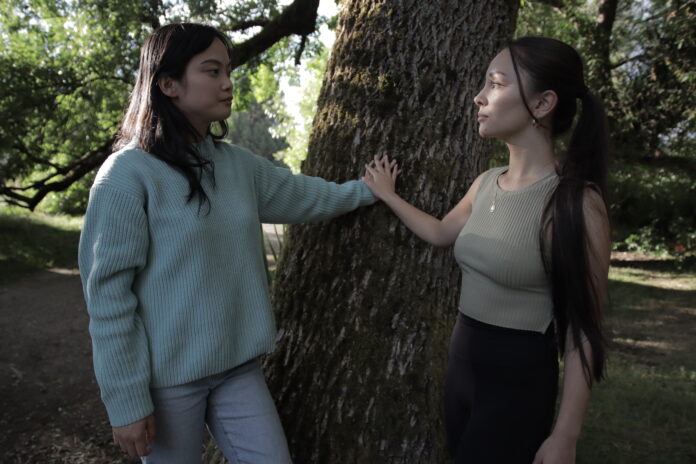
Two Asian women look at each other with their hands touching on a tree branch between them. They’re both wearing neutral colored shirts and they’re in a forest surrounded by trees.
PHOTO: Courtesy of Danny Guay

By: Petra Chase, Arts & Culture Editor

An almost universal experience of adulthood is learning to accept that friendships change over time. For playwright Karter Masuhara, this unspoken realization occurred at an old friend’s bridal shower. “When I went, it was awkward and I realized I didn’t know this person anymore and we probably wouldn’t be friends if we met in the present,” they told The Peak. Following this experience, their cathartic first play, premiering on stage at the Vancouver Fringe Festival on September 7, “flowed out” of them. Before They Cut Down Our Tree features a team of eight SFU alumni, including Masuhara.

The script was written in 2020–21, when they took part in the Vancouver Canadian Asian Theatre’s MSG Lab’s playwriting program. It “follows two ex-friends as they reunite after the death of a loved one and are forced to reconcile why they broke apart.” The play moves through a decade of time, flashing back to the event that ended their relationship, the secrets they’ve kept, and what’s changed since then.

Standing in the middle of this emotional storyline, and a central design element in the play, is a magical tree. This is the tree where the two friends, Sam and Cal (Jessica Wong and Emily Ma) “met up to hang out, do their homework, and have fun” during childhood. It’s also where they have their incalculable reunion.

Masuhara emphasized what it means to put on a stage-based story featuring their intersecting identities: As a “queer Asian non-binary person,” Masuhara shared, “I have not often seen [my identities] on stage, so I wanted to create a story that filled in that gap.

“It’s important to be able to have authentic representation as it helps people feel seen and also understood.”

After two public readings of the script and grant funding, Masuhara set out to assemble a team to bring the play to life, hosting a design workshop and auditions. The response was overwhelmingly positive — auditioners shared how excited they were to audition for a half-Japanese character, an identity not often represented on stage.

“What I have found from feedback from readings is that most people have been able to find something that they can relate to in this play,” Masuhara said. “Storywise, I think people who like character-driven emotional stories that feel authentic but have a touch of wonder/magical realism will enjoy this play.”

“I think people who like character-driven emotional stories that feel authentic but have a touch of wonder/magical realism will enjoy this play.”

The tree itself is “a character in its own right,” they continued. “It allows the characters to see past versions of themselves, so it changes a bit throughout the play.” Visual and sound design are a huge part of this play, mirroring the passage of time and emotions that occur within the characters. The childhood tree, which is afflicted with “heart rot,” clues audiences to the state of the relationship with the growing and shrinking of this rot, and adds a tinge of mysticism to a strikingly real situation.

As you can tell, the tree is a metaphor to Sam and Cal’s relationship with one another and we will see how the present versions of themselves have to confront the broken mess that became their friendship and if they can fix it before the tree gets cut down for good,” they said.

Masuhara assures there is also “joy and hope” to this story, pointing out how “each ending is the start of something new.”

Watch Before They Cut Down Our Tree at Performance Works at a show from September 7–17. Purchase a $16 ticket and find more information about show times on the Vancouver Fringe Festival website. Content warning: descriptions of “non-consensual acts and teen dating abuse.

Vancouver Fringe Festival is an alternative theatre festival that’s been running since 1985. This year’s festival features over 85 emerging acts. According to their website, “this year will see more theatre, comedy, dance, drag, spoken word and music descend on our doorstep than ever before!”
Done is better than perfect

0
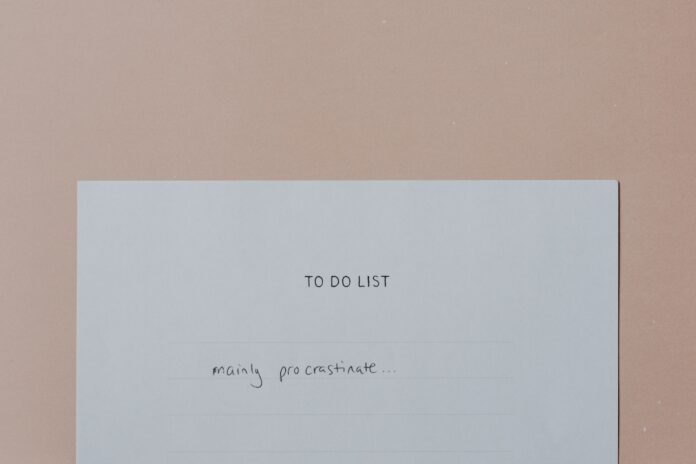
A piece of white paper with a heading saying “To Do List” and one item stating “Mainly procrastinate”
PHOTO: Annie Spratt / Unsplash

By: Hayleigh Giesbrecht, SFU student

My 12th grade geography teacher once told me I’d be a great college student because I was so good at procrastinating. I laughed at what I assumed was a tongue-in-cheek remark because a) I hadn’t done the assignment that day, and b) I had a lifetime’s worth of school counsellors telling me the opposite. Then he said, “No, I’m being serious.” I didn’t give it much thought at the time, but when I began university a few years later, his words regularly came back to me. The truth is, I was really good at procrastinating, and I was a really good college student.

I went on to graduate with an honours degree in history, a gamut of extra-curriculars on my CV, as well as a never-ending, chronic sense of productivity fatigue. As proud and impressed as I am with myself, I know I only pulled this off through the sheer force of willpower, Zoloft, and unachievable expectations. I am the student that starts every semester naïvely holding a binder full of crisp dividers and a meticulously planned week-at-a-glance schedule — yet, I’m also the student who by week three, descends into a deep fatigue. But, dividers be damned, I almost always pulled an A.

The person who procrastinates because they’re a perfectionist suffers more than most people give them credit for. They know that once they begin doing whatever it is that’s giving them anxiety, the mental noise eventually fades away and the work does itself. Those familiar with the feeling of paralysis at the thought of starting even the most basic assignment know that sitting down at your desk and booting up Microsoft Word is always the hardest part. But writer E.B. White said it best: “A writer who waits for ideal conditions under which to work will die without putting a word on paper.” I too often came close to skipping assignments entirely, opting to receive a barely passing grade, because my inner perfectionist was deafeningly loud. But there really is nothing like the last 24-hours before a paper is due (or two weeks after an extension and numerous emails from the professor) to force words onto the page, coherent or not.

It was in these moments of panic-driven efficiency that I knew I was my own worst critic, and my routine of setting outrageously high expectations for myself was based on an idealistic notion of my own capacity for productivity. They were moments of clarity that I always forgot about after the dopamine crash that followed the last exam or paper of the semester. All over again, I would vow to get a new planner, to try some other variation of the Cornell method — to be better. But I am not a naturally productive person; I am a procrastinator.

For a long time, I refused to believe that I could be both a procrastinator and a successful student, and in a sense I still don’t, because it’s an unsustainable way to live. But I came to realize that all the “study with me” style Instagram influencers who peddle their own custom Notion templates and a Squarespace discount code were battling the same perfectionist demon that I was. It wasn’t until my last semester, during an honours seminar of all places, that my professor gave me the most straightforward piece of advice I’d ever received: “Done is better than perfect.” Perfectionist-procrastinators will be hard-pressed to admit there really is no world in which an assignment is both perfect and complete. There is no optimal way to take notes for retention or time-block your calendar, because at the end of the day, the job is done — ideally to the best of your abilities, but most importantly to the best that your mental health and capacity will allow. Yes, there are strategies that can help, but they aren’t fix-all solutions for an issue that comes from the psychological crisis of needing to do things perfectly or not at all.

I struggled with procrastination throughout my entire degree. The 3.9 GPA I graduated with might seem like evidence to the contrary, but I would rather have taken the hit to my GPA than months later be suffering from the constant feeling of not doing enough while never really having the motivation or the discipline to do even a little. What the school counsellors don’t tell you is that, even if you can get by with abysmal time management and still pull off an A, the suffering increases tenfold when the thing you procrastinate is also the thing you love the most. Your hobbies become work and your guts become liquid at the thought of being bad at something. On my worst days, writing — something that typically fulfills me — feels akin to mopping the floor. I have to do it, part of me even craves it, and I generally enjoy the finished product, but starting is truly torturous.

All I can say is that the best technique I’ve found for combatting procrastination is to create something I vehemently hate, and, through enough time and frustration, make it something I love. Or, just go to grad school. Either way, stop listening to people who tell you that the only thing standing between you and a more productive lifestyle is a shiny new app or a 50-dollar planner, because all they’re doing is selling you a new way to hate yourself. The only real way to get something done is to be content with failure and to know that the world is a better place with your ideas and your art in it, imperfect as they may be.

Opinions in Dialogue: Strategies for advocacy work

0
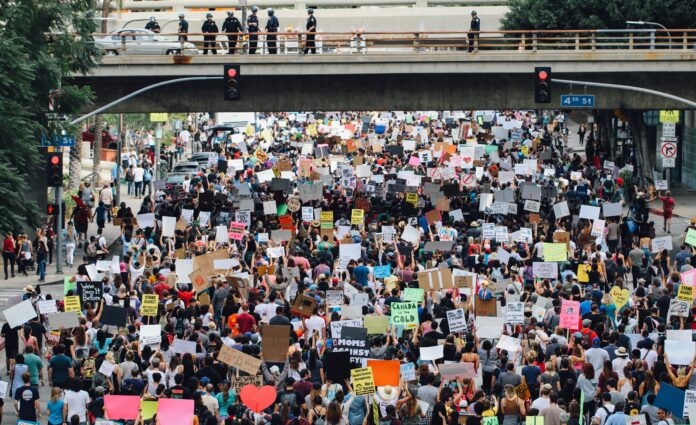
Photo of protestors blocking a road and holding signs against racism
PHOTO: Khalid Alshehri / Unsplash

By: Nushaiba Nanjiba, SFU Student and Michelle Young, Opinions Editor

From climate change and gender inequality, to 2SLGBTQIA+ rights, there are countless issues that could use more of our attention. However, time is limited for all of us. Common forms of advocacy include protests and awareness campaigns on social media — though not all of us can commit to every form of advocacy all the time. What are the best ways to advocate for a cause? Where should we turn our energy when we have the capacity to make change?

Nushaiba: I think when we want to advocate for a cause, the best way to go about it is through collective action. This is when people come together to improve the conditions of people who are disadvantaged. Collective action can be done through protests, riots, or even campaigns.  

Collective action brings attention to a cause because of the sheer number of people involved in the process. That attention forces those in power to create changes. I believe the best way for people to come together is through protest. Protests are a great way to advocate because there is an audience present to witness what’s happening. It’s harder to ignore a protest than any other form of activism. 

Protests are disruptive: that’s the point. If a road is blocked due to a protest, it forces people to pay attention, rather than being able to look away. It’s much easier for someone to put their phone down than to get out of traffic. Workers going on strike press employers to change their actions because people coming together disrupts their plans to oppress and exploit. Social media campaigns don’t have the same effect when striving for change because advocating through these mediums has fewer consequences for most people involved with a cause. 

Michelle: I do think social media campaigns can sometimes turn into “slacktivism,” where people are sharing information and raising awareness about causes online — but doing little else in their lives to create change. It’s a huge issue when people are posting #SignalBoost and signing off, doing nothing else to promote their cause. However, social media activism does have some unique qualities, namely the speed of communication for time sensitive causes and allowing people to organize in spaces that are accessible to them, if in-person protests aren’t an option. 

Historically, some protests have created tangible change: Stonewall and even Vancouver’s “earliest pride protestwere very important to advancing 2SLGBTQIA+ rights. The fall of the Berlin Wall was an extraordinary example of the power of protest. However, not all protests have been entirely successful, and they tend to take continuous advocacy to advance their causes, which can be exhausting. The Black Lives Matter protests of 2020 were some of the largest in history. Yet, a 2021 poll showed decreasing support for the cause. Black folks hired in direct response to these protests to “diversify” workplaces have been let go three years later. Police violence rates in America also remain at similar numbers compared to 2020. 

Protests can sometimes turn people away from causes because they dislike inconvenience — whether they are justified in thinking that is another issue, since inconvenience is often the point. However, I find that sometimes having a conversation with someone and answering their questions can change their opinion. The discomfort in approaching someone directly (when it’s safe to do so) tends to force us to sit with whether we’re OK letting something slip by, or if we’re willing to open a conversation around it. Of course, they have to be open to change, and educating folks is a very labourious process — but if that can change one person’s behaviour or attitude towards something, I think it’s worth it. 

Nushaiba: I think social media is a good starting point in one’s activism journey. It can be a place to share knowledge and communicate logistical plans. However, we must avoid “slacktivism” or performative activism, and not let social media be the only place we engage in activism. 

For any type of activism we engage in, our actions need to match our words. If we’re tweeting or sharing hashtags on Instagram, we have to make sure we are also supporting local businesses who may be affected by racism or gentrification. We have to make sure we’re voting for the people who are going to create the change we want to see. I don’t think there is any one way we can engage in activism. It has to be present in every aspect of our lives. Whatever platform we decide to engage in activism, the first place to start should be ourselves. I think on an individual level, we have to behave and lead our lives the way we want the world to be. 

I remember ranting about how important it is to me that wealth is redistributed in our society because capitalism allows the rich to get richer and the poor to stay poor. It is extremely important to me that I donate a percentage of my income to causes I feel strongly about. Seeing how passionate I was led my friends to do more research about wealth inequality and think more critically about their own socio-economic statuses. Recently, one friend called me excitedly to let me know they donated some money to a children’s hospital after saving money for months. The easiest way to engage in activism might be to lead by example. If we all behave intentionally and make a choice to support marginalized groups, it can have a ripple effect and create change. This might sound idealistic, but it is only a first step. 

Michelle: I love what you’re saying about change coming from within and leading by example. It’s so important, especially when particular movements are seen as “unimportant” or “too radical” to mainstream thought. If you’re going to talk about equity and diversity, for example, people need to have their actions match their words. And not only when it’s easy or convenient for them. Folks needed to take charge to start something — and eventually those things grow over time. Feminist movements, anti-racism movements, and labour movements have eventually created a huge impact, and those started from within. 

TSSU holds vote to unionize research assistants

0
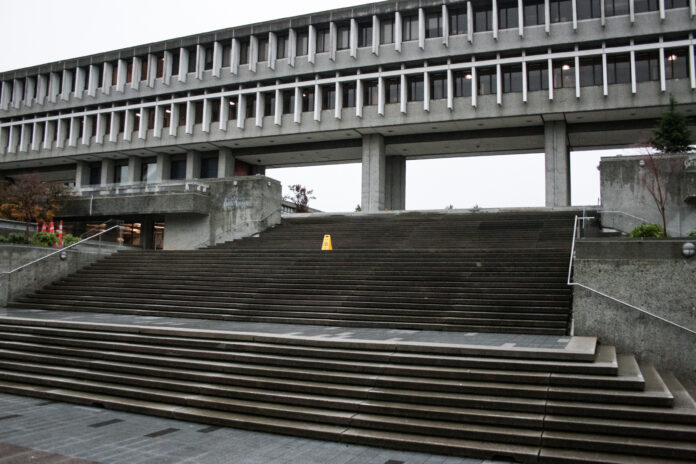
This is a photo of the outside of the academic quadrangle building at the SFU Burnaby campus. The square building is concrete with many large windows.
PHOTO: Gudrun Wai-Gunnarsson / The Peak

By: Olivia Sherman, News Writer

One of the initiatives the Teaching Support Staff Union (TSSU) has been campaigning for is unionizing SFU’s research assistants (RA). The SFU administration claims RAs are not considered employees, and are therefore unable to unionize. TSSU has since engaged in a card signing campaign for RAs. Each signed card represents a declaration from an RA that they are willing to be a member of the union. Over 1,350 cards have been signed and submitted to the Labour Board, where the vote is still pending.

The Peak interviewed TSSU organizers, Catherine Dubé and Yameena Zaidi, who explained the significance of the card signing campaign. “The card signing campaign is a way to ensure that SFU recognizes all research assistants as workers,” Zaidi explained. She noted the SFU administration signed a voluntary recognition agreement in 2019 “where they agreed to recognize the union,” but this was violated when the administration retracted their recognition of RAs as workers. 

“They don’t agree that these people are employees, even though they agreed in 2019,” said Dubé. “SFU has no shame in violating any agreement, arbitration decision, or any orders given from arbitrators,” Dubé added. Besides not being considered employees, RAs have been at risk of losing their health benefits, healthcare for international students, and job protections. Dubé continued, saying, “It’s really disheartening to see that an employer would go to such lengths to refuse basic rights and basic wages for such a large group of workers on campus.” 

In order to gain automatic certification, cards must be signed by 55% of the RAs. Despite achieving the necessary percentage of RAs willing to be unionized, the administrators have “put a roadblock” in the path to unionizing. The Labour Board requires a hearing from both parties — TSSU and SFU — where “the employer can raise any objections to the application for membership,” Dubé explained. At the hearing on August 17, SFU objected. “We knew that would happen, obviously, we knew they’d object.” 

The results of the vote from the Labour Board have not been revealed yet. “It’s a huge win if we get it, it’s a devastating loss if we don’t,” Dubé said. 

The organizers said bargaining is far from over, and has become lengthier than is necessary. “As a TA this summer, I attended the open bargaining sessions between TSSU and the employer and I was surprised to see how little work the employer’s bargaining team puts in,” Zaidi said. “They spend hours fixing typos and refuse to talk about our bargaining priorities.” 

As well as spending time on housekeeping and typos, Dubé noted the administration has been unprepared to bargain. “They’ll show up having not even read our proposals, despite having them for months. They’ll debate petty little changes to our proposals.” Dubé said administration has come to the bargaining table “and the only amendment was a 0.1% increase. It’s insulting.” 

“They’d rather pay a lawyer to fight us in arbitration, which is a very costly process,” Dubé said. Zaidi and Dubé have also noticed the lawyers hired by the administration are unfamiliar with the ongoing arbitration, TSSU, or the university at all. 

“SFU pays hundreds of dollars to a spokesperson to fly in from Victoria and he plainly said at one of the bargaining sessions we had this summer that he doesn’t know SFU that well. The question is why is the university paying all this money to an external spokesperson,” meanwhile the SFU administration “refuses to come to the bargaining table and do what’s necessary?” asked Zaidi. 

Although a vote for union membership has not been reached, both organizers agree that TSSU has no plans of stopping the fight for equality. “SFU would rather fight a case they seemingly know that they’re going to lose [ . . . ]  but they’d rather keep it going and hope that we tire ourselves out, but we’re not going to tire ourselves out,” Dubé said.

This is a developing story that The Peak will continue to cover. To learn more about the ongoing strike, check out the official TSSU website at https://www.tssu.ca/

I Saw You: Chance encounters

0
Someone hiding in the avocado/egg using binoculars. (basically acting like a spy)
ILLUSTRATION: Andrea Choi / The Peak

By: Petra Chase, Arts & Culture Editor

Head ogre heels

You sit in the front row of my psychology course and I know the back of your mullet like a party I’d never forget. I sit quietly in the back and admire the way you’re able to relate every course concept to Shrek. I’d like to know more about why Donkey and Shrek modeled an anxious-avoidant attachment style, and don’t understand why the professor is always interrupting your insights. I’d like to unravel your layers like an onion, and be your noble stud.

— Donkey looking for his Shrek

Need for speed

I met you at a speed dating event, and the chemistry was immediate. As the five minute mark approached, I pulled my business card out from my wallet and handed it to you with a smooth “holla for a colla.” You beamed and said it was just what you needed. I later realized I’d accidentally given you my buy-one-get-one McDonalds McGriddle coupon card. If you’re reading this, please don’t use it. I’ll give you my address so you can mail it back to me — express shipping please.

— Hansel looking for his Griddle

Juicy encounter

You were wearing red lipstick and a tweed overcoat at Superstore. We were hitting watermelons to listen for the ripest one, drumming up a symphony in the produce aisle as “Me” by Taylor Swift ft. Brendon Urie played softly. You thumped the most hollow melon I have ever heard and our hands brushed together. I told you it must be a really juicy melon and you kindly said I could have it, and walked away. I devoured that melon when I got home, but all I could think about was how much sweeter it would have been to share with you.

— I’ll be waiting for you by the melons next week

Films that are perfect for this bright season

0
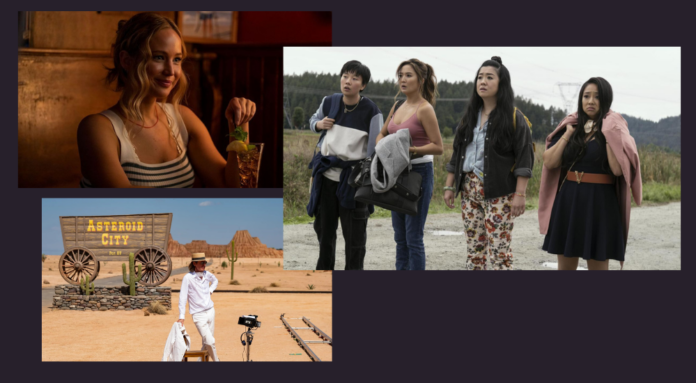
Collage of three film stills.
PHOTOS: Courtesy of American Empirical Pictures and Indian Paintbrush, Courtesy of Sony Pictures, and Courtesy of Lions Gate Films

By: Kiara Co, SFU Student

Asteroid City directed by Wes Anderson 

A charming film that balances both comedy and drama, Anderson does it again with his brilliantly distinct style. From its bright colour palette, camera techniques, and big ensemble cast, the film is broken down into three acts. It follows a writer and his world-famous stageplay set in a 1955 American desert town that feels uncertain and exudes loneliness. With this film in particular, Anderson was able to bring in elements from his past films such as Moonrise Kingdom, The Life Aquatic of Steve Zissou, and The French Dispatch, bringing in cheers and happiness. 

No Hard Feelings directed by Gene Stupnitsky

There’s been recent internet discourse about the lack of comedies in cinema. While true to an extent, No Hard Feelings recently came out, with Jennifer Lawrence is making a comedic comeback in mainstream cinema. Lawrence’s character, Maddie, decides to date a high school graduate (Andrew Barth Feldman) for the summer, in return for money to earn back her childhood home. An up-and-coming actor, Feldman had amazing chemistry with Lawrence. The movie was naturally hilarious, especially in the first act. It’s the perfect comedy for when you want to relax and have that “feel good” viewing experience. After watching the movie, I realized Lawrence needs to do more comedies, as she’s primarily known for drama. 

Joy Ride directed by Adele Lim

Known for writing Crazy Rich Asians, Joy Ride is Adele Lim’s directorial debut. The film is not only filled with scenes that’ll make you laugh out loud, but it celebrates great friendship and embracing yourself unapologetically. The film follows Audrey (Ashley Park), who goes to China for a business trip and visits her college roommate (Stephanie Hsu). Accompanying her is her best friend, Lolo (Chloe Pun), who encourages them to reconnect with their Asian roots together. Lolo also decides to bring her cousin, nicknamed “Deadeye” (Sabrina Wu), who leads them to a wild adventure. Shot in Vancouver, there are very noticeable settings for locals, as parts were filmed in the YVR airport!

Dear Peakie

0
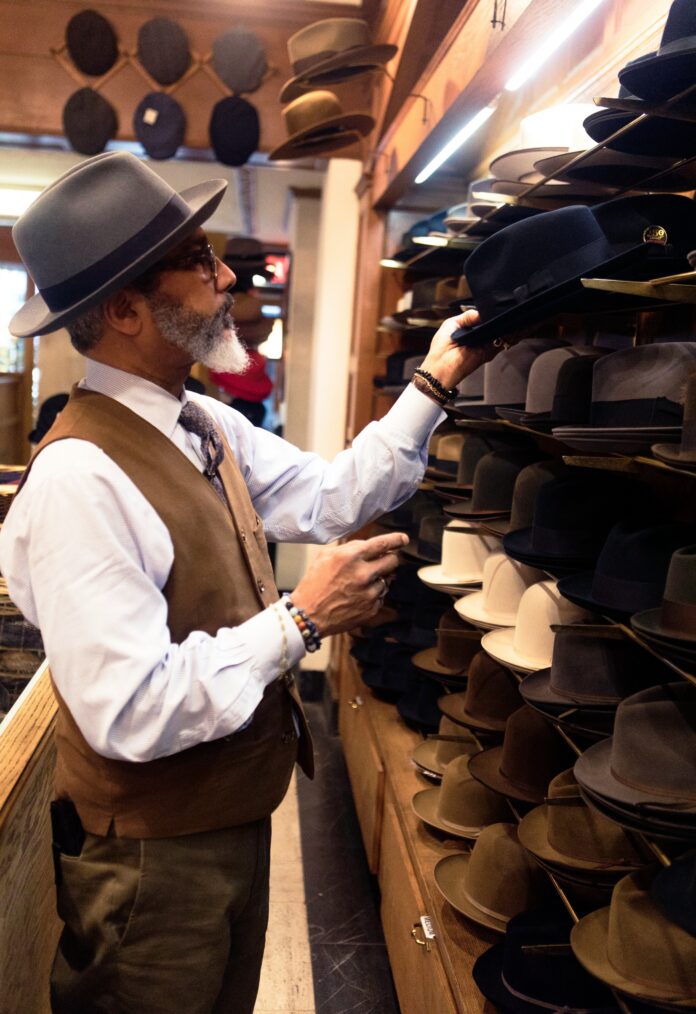
Man picking hats on a store’s shelf.
PHOTO: nappy / Pexels

By: Jared Wilson, SFU Student, Kelly Chia, Editor-in-Chief

Dear Peakie,

I’m on a brave and arduous quest to find the outfit and accessory that will best convey to my classmates that I am not to be tussled with. I have the best discussion answers, and it’s about time everyone recognizes that from my aura alone. I’ve gotten into a few, how you say, kerfuffles as I’ve delivered a swift and just “well, actually,” and it’d be easier for everyone involved if they just know I’m always right. So what can I wear to say that?

Sincerely,
Sherlock Always-Right-Holmes


Dear Sherlock Always-Right-Holmes,

As I’m sure an esteemed individual such as yourself would know, fashion trends change overnight, and are as fleeting as the misspent summer days of youth. The garments of today which warn onlookers that you are not an individual to be trifled with in the lecture hall, may tomorrow give off an air of someone who calls the city to complain about their neighbour’s lawns. As such, the only way you can ensure  your peers perceive you as always being right about everything is to invest in a wide variety of hats. The kind of hat is irrelevant, but the key is that every single one MUST be too small for your head. There is no greater indication of human intelligence than the size of one’s brain, and when passersby see how tightly that hat is squeezing your forehead, they will inevitably conclude that you possess such a burgeoning intellect that renders even the most spacious of headwear massively uncomfortable, and that they are simply no match for you on the mental battlefield.

For all time,
Peakie


Dear Peakie,

I’ve just realized that I haven’t perfected my dad-sona yet. It’s summer: I’m meant to be out with my brethren, grilling hot dogs and making puns. I want to know how to best live out my dad life. But in this economy, I can’t even afford a grill (or a child, but dad energy is about belief.) How, oh, how can I be my own Dream Daddy?

Sincerely,
Dream(less) Daddy


Dear Dream(less) Daddy,

You need to understand that dads come in all shapes and sizes. For every Randy flipping burgers on the grill, there are three Kevins discussing last night’s game. You see, there’s much more to being a dad than being able to turn frozen beef pucks into the perfectly charred, juicy meat patties that we all know and love. In fact, looking for things to do on a budget is peak dad-core, so you’re already making great progress. Tomorrow morning you’re going to get up early, tuck your short sleeved plaid shirt into your cargo pants, slip on your sneakers, and go out on the town. See a construction site? Place your hands firmly on your hips and make sure everything is proceeding to your standards. If you pass by someone cleaning, be sure to let them know they missed a spot. Start a chat with a stranger about the weather, and express your dismay or relief depending on the day’s humidity. Your hairline will start to recede and you’ll harken back to your high school football glory days in no time.

Goodbye hungry, I’m dad,
Peakie


Dear Peakie, 

Please. I can’t stop saying “rizz” and “pogchamp” as though I’m some 14-year-old Fortnite player. I used to say it was ironic, but I think it’s seriously sunk into my vocabulary. It’s a serious condition! What am I going to do . . .

Sincerely,
So Unpog


Dear So Unpog,

The answer to your question is simple. You see, by adopting the lingo of a younger generation, you have allowed your vocabulary to evolve past that of your peers. While it may not seem like it, you are actually speaking a more advanced dialect of English than the rest of us. While you may regret leaving everyone else in the dust, linguistically speaking, the only solution to your problem is to continue this forward momentum. From this point on, you shall exclusively use ChatGPT to communicate. If you wish to initiate a conversation, ask ChatGPT what to say. If someone speaks to you, simply enter what they said into ChatGPT, and repeat ChatGPT’s response verbatim. Do this, and you will be entirely incomprehensible in no time. That won’t be an issue, though, because at that point everyone will probably be avoiding you. While this might not be the ideal result, it’s what you deserve for trying to play God.

Regrettably,
Peakie

WGOG: Concert prices are a joke

0
A pair of music concert tickets
ILLUSTRATION: Jill Baccay / The Peak

By: Isabella Urbani, Staff Writer

Who are concerts meant for anymore? They sure aren’t meant for full-time college students who work several jobs just to pay for tuition and rent. I’m not pocketing a cent towards savings. I can’t spend hundreds of dollars to sit in the nosebleeds, when for the first time in years, my favourite musician performs somewhere that isn’t Toronto. 

It’s way too much stress to even get a ticket: you sit like a duck waiting for Ticketmaster to distribute codes to even be let into the website to purchase the tickets, and there’s no guarantee you’ll make it off the waitlist. I don’t know much about the expenses of putting on a show, but Taylor Swift does not need her fans to shell out hundreds of dollars to keep the arena’s lights running — not even for a three-hour show. Worse, scalpers are able to upsell concert tickets over 200 times their original price, making it even more unreasonable to try and cop a show ticket. 

What’s the point of concerts if fans, most of whom are just making ends meet, can’t even afford to see their favourite musicians in person? How can you enjoy a second of the concert when all you can think about is how thin the grocery budget is going to be next month? 

Between waiting in line and the opening act, by the time the artist I’m actually here to see comes out, I probably have them for two hours tops. Can I just pay by the hour? Or better yet, by song? 

I’m not paying just to brag I got to see my favourite artist in person. Because I didn’t, I watched them from the arena’s screen all night. I’d have a better view and audio waiting for someone to upload the concert footage. 

If I’m paying strictly for experience, I’m going to need a better markdown on the tickets. We can work something out, can’t we, Taylor? 

World listening day explores nature and human activity

0
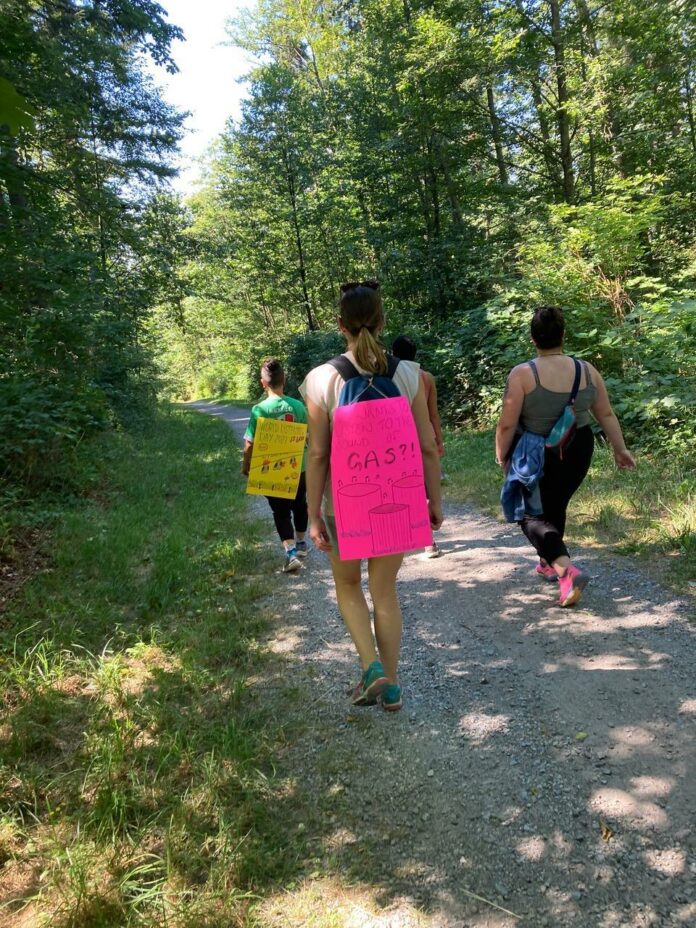
This is a photo taken on the World Listening Day Walk. People are walking down a Burnaby Mountain trail while wearing signs that read “Who wants to listen to the sound of gas” and “World Listening Day 2023.”
PHOTO: Milena Droumeva

By: Eden Chipperfield, News Writer

On July 18, World Listening Day was observed in memory of Canadian composer R. Murray Schafer, who helped found the Acoustic Ecology movement. This movement examines the relationship between humans and their environment. For example, marine species like whales and dolphins who use echolocation have to communicate louder to one another due to noise pollution caused by shipping boats in the ocean. Acoustic Ecology showcases how human activity impacts the physical environment in often unconsidered ways.

For 2023’s World Listening Day, professors of communication, Milena Droumeva and Julie Andreyev, organized a soundwalk through trails on Burnaby Mountain. The soundwalk was an opportunity to observe habitat loss, the noise pollution from deforestation, and disruption from the Trans Mountain pipeline to engage with understanding the ecological crisis. 

The Peak interviewed Droumeva to discuss the motives of the soundwalk and how Schafer’s studies on acoustic ecology tie into the event. 

Listening and sounding/speaking are two parts of communicative exchange that can be in or out of balance,” said Droumeva. In fact, listening is an evolutionary necessity.” According to Droumeva, non-humans’ ability to survive has been interfered with, due to human interruptions, leading some species toward preventable extinction. 

Professor Droumeva noted the reason for selecting Burnaby Mountain was because there is a route from the SFU Burnaby campus to the Trans Mountain pipeline site. Attendees of the event could note a decrease in natural environmental sounds, such as bird songs being replaced by mechanical humming of human-made machines, reflecting an invasion of the natural ecosystem. 

Listening alone reveals the existence and politics of fossil fuel economies, inference management, and economic preservation,” said Droumeva. Listening, we could hear the tensions between these ever-competing interests.” 

Not only was the soundscape of Burnaby Mountain’s natural environment a point to observe, but Droumeva pointed out how even the sight of nature has been tainted by human activity. She described how the ancient Douglas Fir and Red Cedar trees remind her that many hectares of forest were logged for the pipeline expansion in 2020. Even the hum from water pump stations may be faint to the human ear but are detrimental to wildlife. Droumeva suggested this may explain the absence of creatures around the area. 

The Peak asked how students can use their sense of listening to enact change in an increasingly noisy world: Over the years communication students in CMNS 359 (The Culture and Politics of Sound) have explored many aspects of the campus and Burnaby Mountain.” The course includes discussions of “environmental policy, through sound maps of bird life, through exploration of noise issues in campus study areas, as well as links between excessive construction noise and effective learning.”

Serpents and gargoyles and bears, oh my!

0
People eating at a 50s-themed diner.
PHOTO: Lorenzo Nafissi / Unsplash

By: Saije Rusimovici, Staff Writer

I don’t know what’s harder to believe — the fact that the first episode of Riverdale aired in 2017 (grade 10 me is screaming) or that it continued for six more years. The plots have gotten wilder and more unbelievable than anyone ever thought possible. For all of the former or secretly-still-watching viewers of the infamous mystery/horror/comedy/drama, here is a compilation of the most epic highs and lows ever derived from the Netflix original. 

  1. 16-year-old Veronica Lodge running her own speakeasy 

In what world is this legal? I get the fact that her dad had tons of money (what his business was other than running trafficking illegal substances, I’ll never know), but there had to have been some sort of regulations. Mind you, a lot of things went unnoticed in the town of Riverdale. Did law enforcement simply not exist or did they just overlook every single crime until they decided Archie should go to prison? Not that 17-year-old me didn’t aspire to be like Veronica one day — who wouldn’t want a lavish, fully stocked bar to hang out with your friends after cheerleading practice? Sometimes we just have to girlboss, illegally. Did I mention one of the best-looking, underage football players would be running the bar? I mean, I guess it’s fine considering the actor is closer to 30 than he is 16 . . .

2. “Alternate universe” fanfiction 

Because apparently not enough was going down in the small town, a crack opened up in the multiverse. Most of these alternate universes set the scene for steamy moments between Betty and Jughead, including a photographer-model dynamic, a college meet-cute (at least the cast would look closer to their age), and the iconic friends to lovers trope. As long as they don’t decide to give the characters super powers, they don’t sound half bad. 

3. The one where the show decides to steal from Endgame

Oh, you know: this is a regular high school drama, with regular people deciding that they can look through a million different timelines à la Doctor Strange. At this point in the show, you’re used to Riverdale’s shenanigans, but are we ever really used to it? Maybe I’ll find out in a different universe . . .

  1. Jughead and Veronica fanfics

Okay, this subgenre may just be a little bit of a guilty pleasure of mine. Not only because I wanted to be Veronica Lodge, but because Jughead was so completely my type in high school. At 16, I may or may not have debated buying a replica of a Southside Serpent’s jacket. There’s something about the moody beanie boy getting together with a pearl-strung rich girl that reminds me of the plot of a John Hughes movie. Sometimes all we need is a little opposites attract romance.

  1. Archie getting mauled by a bear

Just plain unnecessary. I’m convinced this was just another excuse for Archie to be shirtless on screen (not that I’m complaining), because this little detail added absolutely nothing to the plot itself. Trying to give him a hero complex? I think the fact that he pleaded guilty to a crime he didn’t commit was enough to make him a good guy, don’t you think?

  1. The Gargoyle King

A part of me was actually terrified of watching this season because this costume was so freaking scary I could barely watch the show during the day, let alone at night. The other part of me wanted to laugh because this was such a ridiculous addition to the show, I began to question why I was still watching. When they finally unmasked him to reveal a Dave Franco lookalike, I was utterly astounded.