Home Blog Page 147

How to stay informed on COVID-19

0
Illustration of a line graph with rising COVID-19 cases, and a health official saying COVID-19 is no longer a problem

By: Michelle Young, Opinions Editor

BC public health has made it too confusing to keep up on COVID-19 information. With the government changing information about COVID-19 data and obscuring data collection, knowingly downplaying risks about transmission, and overall unclear messaging, it’s no wonder people are misinformed. 

It is difficult to have a sense of the current pandemic when deaths are undercounted and reinfections aren’t counted at all, as reported by CBC. Cases are generally underreported. According to CBC, BC doesn’t want to declare hospital outbreaks due to “negative connotations.” 

This doesn’t mean we should all be forever doomed to ignorance. Just as it’s important to stay informed on climate change, Indigenous sovereignty, and 2SLGBTQIA+ rights — COVID-19 is a disability justice issue that is deeply intersectional. There are steps we can take to improve our understanding of COVID-19. 

What We Already Know

Our understanding of COVID-19 should build on already-established information:

  • COVID-19 is airborne
  • It is neither mild nor seasonal, and can cause serious, long-term effects, also known as Long COVID
  • Previous restrictions and lack of viral exposure do not weaken our immune systems, while COVID-19 infections can cause immune dysregulation  
  • Vaccines alone do not provide sufficient protection against infection or Long COVID
  • Anyone can be affected by Long COVID regardless of age, current health, vaccination status, and whether or not their initial infection was mild
  • The risk of Long COVID increases with each infection
  • Mitigation efforts like masks and ventilation work best when used together, rather than relying solely on one precaution

Being mindful about these basic principles can help you stay informed and identify which claims are not based on evidence. You can find a list of common COVID-19 myths, and why they’re incorrect, on The Peak’s website

Wastewater Data

Wastewater data is collected both provincially and nationally. It tests “wastewater samples for respiratory viruses,” such as COVID-19, RSV (respiratory syncytial virus), and the flu. Wastewater is essentially sewage water that comes from homes and businesses. This data “can help determine if COVID-19 is increasing or decreasing in a community and provides information on the variants circulating.”

The national website is easier to navigate, as it provides key updates listing how many collection sites show an increase or decrease in COVID-19. As of November 24, it reports 27% of sites are experiencing an increase in COVID-19 cases, 53% of sites show no change (this comes after an increase of 40% from November 17), and 19% of sites show a decrease. Overall, “62 sites currently submit sewage samples for processing” which represents about half of Canadians. 

The national website provides a variety of data on different collection sites. However, when you look closely, you will notice the Y-axis scale changing in each graph, which distorts how we view risk. For example, on the national databoard, under “all time,” Vancouver Lulu Island appears to have significantly lower rates of COVID-19, compared to Vancouver Lions Gate. However, Lulu Island’s Y-axis first point of reference starts at 500, going up to 1,500 copies/mL. Conversely, Lion’s Gate’s Y-axis starts from 100 and only reaches 400 copies/mL. 

A line graph that shows COVID-19 wastewater data for Lulu Island and Lion's Gate.
Courtesy of the Government of Canada.

Based on visual analysis alone, it would appear that Lion’s Gate has significantly worse transmission. All of the Y-axes on these graphs are different — the way they are set-up visually gives the impression of “low” transmission. When you compare the overall viral load from 2020, you can see that there’s a general increase in COVID-19 after 2021, where such data is available. 

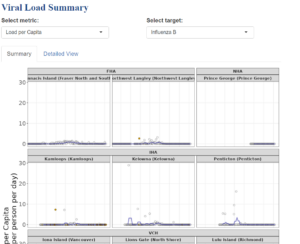
Similarly, on the BC dashboard, the COVID-19 page starts at around 200 and goes up to 600 for viral load per capita. Visually, COVID-19 cases appear low. When compared to influenza A and B, however, their graphs have a 10-point increment, and have a maximum of 30 viral load per capita. This puts into perspective how many more people are infected with COVID-19 versus the flu — the flu is circulating far less.
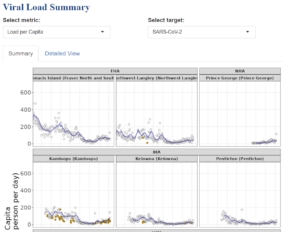
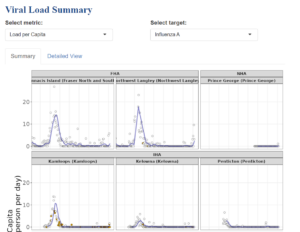
Line graph data from COVID-19
Courtesy of BC Centre for Disease Control.
Line graph data from influenza A
Courtesy of BC Centre for Disease Control.
Line graph data from influenza B
Courtesy of BC Centre for Disease Control.

It can be exhausting and time consuming to try and interpret all of this data. While wastewater data provides a fairly holistic view of cases, and is the basis for much of what informs current COVID-19 modelling, it can be difficult to navigate. Thankfully, there are other sources who use this data and turn it into information that’s easier to digest — but now you know and understand where their information comes from. 

Hospitalizations 

Typically, hospitalizations are still reported by major news outlets. They can provide context of how COVID-19 affects our healthcare system, and whether it’s being overwhelmed (it is, for many reasons, exacerbated by the pandemic). However, it is not sufficient to rely on this data alone. Hospitalizations typically lag behind cases, are underreported, and do not take into consideration the burden of long-term COVID-19 effects on healthcare or individuals

Peer-reviewed Articles 

Peer-reviewed sources are likely going to be much more thorough and informative on COVID-19 than an average news article. While the media should take information and present it in a digestible way, sometimes studies aren’t picked up or they are misinterpreted. For a source to be peer-reviewed, it means it has gone through an “editorial board of subject experts who review and evaluate submitted articles before accepting them for publication.”

Peer-reviewed sources include:

Remember that while it’s possible to find a source for each claim, it’s important to cross-check the validity of the claim. 

For example, it is well-established that masks work. This was the case even prior to the COVID-19 pandemic, despite the unclear messaging that suggested otherwise. Commonly cited by anti-maskers, there is a study that has been misinterpreted to say they “do not work.” There will always be some random study, somewhere, that will likely contradict well-established information. The key is to read the study itself, identify what is truly being claimed, and whether there are other credible sources that can verify this claim.  

Independent Sources

There are multiple sources who take information and put it into perspective as tangible information. You can follow them on social media to get updates, or browse their websites for information. This is one of the easiest ways to stay informed with all of the above as this information will appear on your newsfeed.

COVID-19 Resources Canada: made up of “a group of Canadian researchers, clinicians, and community members,” this initiative has been active since 2020 to help track COVID-19 data and address vaccine hesitancy. Collecting data on hospitalizations, ICU admissions, and wastewater data, they give estimates of how many people per province are affected, provide recommendations for action, and compare this data to “the lowest point” of the pandemic in Canada. For example, in BC, it’s estimated 1 in 32 people are infected with COVID-19, with 12 times more wastewater infections than the lowest point of the pandemic and seven times as many hospitalizations. It is recommended for everyone to wear high quality masks, such as N95s or KN95s, and avoid non-essential crowded spaces. 

Protect Our Province BC: “a grassroots group of physicians, nurses, health scientists, health policy specialists and community advocates,” who aim to educate the general public about COVID-19. They host information sessions and briefings around specific COVID-19 topics, such as COVID and pregnancy, access to Paxlovid (which aids to prevent serious COVID-19 outcomes), and more. They also publish open letters in response to COVID-19 policies in BC. 

DoNoHarmBC: founded in 2023 in response to the removal of mask protections in BC healthcare settings, they share informative articles and action items on BC’s pandemic response. Primarily situated on social media, you can consult their list of key facts — an open access Google document — to view information on COVID-19 and BC healthcare. You can also click into the sources listed if you’d like to verify this information!  

The Tyee: A BC independent news outlet active since 2003, The Tyee has done some in-depth investigative reporting on the province’s pandemic and BC healthcare. They have covered BC’s “missing COVID-19 data,” pandemic denial, and the lack of trust in public health. They also provide continuous updates on COVID-19. 

Do you still have questions?

COVID-19 Resources Canada hosts weekly sessions “focused on answering questions from the audience about COVID-19, vaccines, boosters” and more, over Zoom. They are “free and open to the Canadian public to attend. All are welcome to join regardless of their background.”


Audrey Heath honours Lax Gibuu spirit through beading

0
Various beaded fringe earrings of different patterns and colours hang on display at an outdoor vendor market.
PHOTO: Courtesy of Audrey Heath

By: Anna Kazi, Peak Associate

Nestled in the unceded and traditional territories of the Kwikwetlem, Tsleil-Waututh, Stó:lō, Qayqayt and Stz’uminus Peoples resides the beautiful Lax Gibuu beadwork created by Audrey Heath.

Heath comes from the Gitxsan Nation in Northern British Columbia and holds “various European ancestries, such as French and Scottish.” As a fourth-year student at SFU completing a Bachelor of Arts with a double major in communication and Indigenous studies, she also works at the SFU Indigenous Student Centre as Indigenous student life coordinator.

When not studying or working at SFU, Heath creates one-of-a-kind Indigenous beadwork jewellery on her Instagram page, @Laxgibuu.beads. “My family comes from the Lax Gibuu or ‘Wolf Clan,’ and it’s a way of recognizing my ancestors,” she told The Peak.

Heath started her beading journey in 2021. “Lax Gibuu Beads has given me the opportunity to continue to connect with my culture, be a part of an amazing Indigenous community of artists, and truly enjoy the work I am doing.”

Heath was introduced to beading in a workshop hosted by the SFU Indigenous Student Centre and facilitated by Nêhiyaw Métis iskwew artist Rebekah Stevens — a fellow beader on Instagram at @beksbeads. “I feel an amazing sense of accomplishment seeing peers, staff, and faculty wearing earrings that I make,” she said.

Lax Gibuu Beads’ art includes styles ranging from colourful and hand-woven fringe earrings to intricately designed beaded earrings with hummingbirds, and sparkly pop sockets with Czech beads. At my convocation ceremony, I was grateful and honoured to have worn statement blue and white gradient earrings adorned with Czech beads.

One of the jewellery pieces Heath talked about were the delicately handcrafted earrings with a cascading white and black bugle beads base, followed by a vibrant green and pink hummingbird pattern in the beaded fringe. She custom made it as a birthday present for her friend’s mother. “The hummingbird holds cultural significance to my family, so creating these earrings meant a lot to me.”

Heath shared her challenges as a business owner, saying, “This journey has not been easy, especially while working a 9:00–5:00 and going to school. Despite periods of inactivity or long days sitting at markets as a new business and few clients, I have learned a lot.”

Lax Gibuu Beads is also a platform to support communities and meaningful causes. Heath recently participated in a raffle hosted by @oceanloverjen on Instagram to support the aftermath of devastating wildfires in Lahaina, Maui. Additionally, Heath also donated the proceeds from her Orange Shirt Day pins to the Orange Shirt Day Society.

“To me, the goal of Lax Gibuu beads is not just to make money but to share my creativity and give back to my community,” she said.

You can purchase Heath’s beaded accessories via her Instagram page. Commissions are accepted as indicated in the bio. 

What Grinds Our Gears: Unhygienic bed habits

0
A bed in a bedroom
PHOTO: Dmitry Zvolskiy / Unsplash

By: Michelle Young, Opinions Editor

We all love our beds. The bed is a sanctuary for rest and recharging. It is warm, soft, and comfortable. Until you feel a crumb in your bed sheets. That’s right, I’m looking at you nasty people who eat in your beds for all the crumbs, sauces, and oils to drip into the pillowcase! What is going on? The bed is not for eating. It is the perfect set-up for disaster because you are sitting on something soft and unstable. You move one centimetre to the right and your entire meal has spilled onto the blankets. 

While we’re at it, why are you wearing outside clothes on your bed? Yes, I know there is overall little health risk to wearing outside clothes on your bed, but this is what grinds my gears. What is truly disgusting is wearing shoes on the bed. Shoes are full of harmful germs and fecal matter. Guess what? That includes antibiotic resistant bacteria, like C. diff. It’s one thing to wear your shoes in the house (another forbidden behaviour), but it’s even worse to put those nasty germ-magnets where you sleep. Let’s keep the bed clean, please. 

Spaces you don’t think about cleaning — but should

0
A cleaning spray bottle
PHOTO: Clay Banks / Unsplash

By: Saije Rusimovici, Staff Writer

Cleaning is not limited to visible spaces. Dust resides in dark corners, people, and you won’t know until one day you decide to lift your blinds to find a strip of dirt on your windowsill. Is it dirt? Is it mold? Can you tell? Of course you can’t, you don’t know how long it’s been there! 

Baseboards are another story. Call me excessive, but I can’t stand that grey film of dust that can only be disguised as a shadow for so long. All it takes is a swipe of a Swiffer to get it off. What are you procrastinating for? Another thing: make it a habit to move your large appliances and get behind them with a mop every once in a while. You don’t want to know how many gross things will have fallen into those crevices over the years (a julienned slice of pepper here, a popcorn kernel there). Just because you can’t see the dirt, it doesn’t mean it isn’t there!

Sick of [and in] school

0
A box of tissues, hot tea, and glasses on a bedside table
PHOTO: Kelly Sikkema / Unsplash

By: Izzy Cheung, Staff Writer

As I sit here writing this, my throat begs me to clear it, my skin sweats and chills in five-minute intervals, and my voice scratches like a penny rattling in a jar. I have three papers due next week, and, to my utmost surprise and delight, sickness has once again decided to strike me at the most inopportune time. I tested negative for COVID-19 multiple times — but whatever I have is still ruining the end of my term.  

As if the earlier difficulties of the fall semester are somehow not enough. No, I just had to be blessed by a bout of sickness that knocked me out for five days, the symptoms of which I’m still recovering from. I’ve missed enough school this term thanks to illness, but to my delight, apparently I’ll be missing some more! Let’s hope the two presentations I have next Tuesday aren’t impacted by my lingering froggy throat! 

Halls cough drops and honey-lemon tea can only do so much for me. Neither of these will supply me with the energy it takes to compile enough research to make up a 15-page paper, nor will they give me the motivation to peck away at my keyboard for as long as it takes to write out a presentation script. I have enough going on in my life right now — there’s not enough room for illness.

What Grinds our Gears: A hate letter to my Wi-Fi stick

0
The wi-fi symbol
PHOTO: Dreamlike Street / Unsplash

By: Kelly Chia, Editor-in-Chief

Have you ever wanted to play a game, only to realize it would take you three whole days to download said game? Hopefully not. My Wi-Fi stick does, though. And I don’t want to hear that I can just try and figure out how to wire ethernet up from the living room to my bedroom, because, frankly, I am not a woman of solutions. I just want to complain that it takes me two days to download an update to Genshin Impact. How can I live, laugh, love in these trying times when I keep getting spoiler fanart for the latest storyline?! It takes so long for my computer to load games that usually I just give up and go to sleep. I know this is fixable, but I’m too afraid to open up my computer to replace the ancient Wi-Fi stick in there. Really, this is a complaint more of my own hubris, but for this brief article, please give me (1) sympathy.

What Grinds our Gears: Poorly constructed scientific papers

0
Bacteria on a petri dish
PHOTO: Michael Schiffer / Unsplash

By: Daniel Salcedo Rubio, Features Editor

I’m a grad student in STEM. I know — it’s my own doing, and there’s no one to blame but myself for having to read overly complicated scientific papers every week. What annoys me is not the act of reading, nor the extra mental resources I invest in understanding complex analysis, but how frequently I come across poorly constructed papers.

I’ll begin with a bit of clarification: the complexity of the analysis or methods does not equal poor construction. Unless you have some experience in that paper’s specific knowledge area, it’s likely you’re going to find some hard-to-understand terms or relatively complicated concepts here and there. By poorly constructed papers, I mean papers with three very pretty figures that are the equivalent of wedding centrepieces — pretty, but completely useless. I’m talking about papers so poorly constructed you have to re-read them time and time again because there’s no cohesion or order to them.

A little tip to my dear scientist et al.: if your “supplemental” information is so essential to the core understanding of your paper — to the point where you reference it more than the actual figures in your paper — it really isn’t supplemental at all, is it? I know fitting all your research into a single paper is hard, and it’s even harder to determine what to keep in the paper itself and what to leave as supplemental information, but some of you really need to hire an editor.

Broadway Across Canada’s Hadestown masterfully delivers its cyclical love story

0
Will Mann Amaya Braganza J. Antonio Rodriguez and Company in Hadestown North American Tour 2023.
Photo courtesy of T-Charles-Erickson

By: Kelly Chia, Editor-in-Chief

You might know the Greek myth of Orpheus: the talented musician who journeys to rescue his wife, Eurydice, from the underworld. Hades promises Orpheus he can have Eurydice only if he walks out of the underworld without looking back. Famously, his doubt overtakes him, and he looks back at the last moment, losing Eurydice forever. This myth seems like a simple story of naïvete — and yet, it still captures the imagination. In Anaïs Mitchell’s Hadestown, audiences reckon with the love story of Orpheus and Eurydice in the cozy setting of a New Orleans speakeasy. Mitchell tackles themes of industrialism and climate change through the gods Hades and Persephone’s fraught relationship with each other, brilliantly grounding Greek mythos into a jazzy, hopeful performance for modern audiences. 

The talented cast at Broadway Across Canada just put on Hadestown at the Queen Elizabeth Theatre, and The Peak attended their opening performance. Although the seats around me were filled with hundreds of attendees, the intimate atmosphere of the stage drew me right in. 

The musical is narrated by the spirited and charismatic messenger god, Hermes (Will Mann), who acts as Orpheus’ guide. Hermes tells us that Orpheus (J. Antonio Rodriguez) is touched by the gods, and indeed, Rodriguez’s performance brings you into the mind of a naïve yet inspired boy with hopes to better the world. His first lines immediately charm the audience. After being told by Hermes to “take it easy” on his crush, Orpheus blurts, “Come home with me,” to Eurydice (Amaya Braganza.) The audience laughs, and their mythic story starts.

It’s also Hermes who introduces us to the brilliant performers playing the gods, Hades and Persephone, whose relationship brings the very seasons of the world. The two are dynamically opposed — the goddess of spring, played by Lana Gordon, dances onto the stage, bringing it to life with the pep of a live firecracker. Meanwhile, industrial, thrumming instrumentals back Hades (Matthew Patrick Quinn), god of the underworld. I found Quinn’s bass voice and his gravitas ideal for a god who commands the underworld, where Eurydice finds herself. Hades and Persephone have a terrible quarrel, manifesting as a storm on the surface. Braganza’s performance here stuns; she belts heartfelt notes, begging for mercy under the deadly storm, and she is impossible to look away from. 

It takes some brilliant acting from Rodriguez to have left Eurydice to die alone, and still feel like a believable hero. We empathize with his struggles through the underworld to find Eurydice in one of the strongest numbers of the show, “Wait for Me,” where the stage and chorus morph from smalltown speakeasy to the looming industrial walls of the titular Hadestown, where the dead toil. 

Although I’ve praised the impressive vocal performances of this cast, one moment in the play really struck me. As Hades hesitantly sings his courting song to Persephoneone he hasn’t sung in a very, very long timethe two embrace. The band softens to gentle lulls. Hermes breathlessly says, “And brother, you know what they did? They danced!” And they do, to a rousing instrumental of strings, playing to a world that has woken up. Tears pricked my eyes as Quinn and Gordon held each other like old lovers learning to laugh again.

Hadestown ends the same way Orpheus’ tale does, after Mitchell makes you see how love drives gods and men, and how that, in turn, empowers the world. But Hadestown certainly doesn’t end pessimistically. Instead, the central theme of the musical is Orpheus’ unending hope that love is enough to save his Eurydice, and even the world. Even though we know his tale ends, the cast will sing their stories again and again, hoping one day, the two will have a happy ending, and our world in turn will look as hopeful as Orpheus envisioned. Hadestown is one of my favourite musicals, and the divinely touched cast at Broadway Across Canada nailed it. 

Catch more musicals from Broadway Across Canada at Queen Elizabeth Theatre as they grace the stage for Mean Girls January 23–28, 2024. 

Why am I paying for parking when there are no spots

0
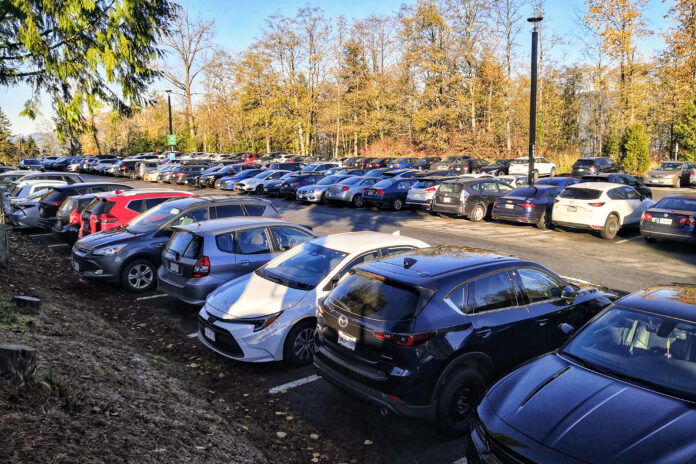
A very crowded parking lot at SFU
PHOTO: Afsaneh Keivanshekouh / The Peak

By: Kaja Antic, Sports Writer

I am not a fan of parking lots in the slightest, but especially when it comes to the stress of SFU parking lots.

Why is it nearly impossible to find parking anywhere on campus? The East Lot is MASSIVE, the North Lot is decently sized, and we have big parkades, but not one free spot in sight? 

Yes, I know it does get less crowded as the semester goes on. Yes, I know some hours and days are busier than others. But every year I’ve attended SFU, I’ve noticed a worrying amount of people circling the parking lots like sharks, trying to find the last remaining spots. 

One time, I got to campus at a reasonable time, and was unable to park my car ANYWHERE upon arriving. I searched every tier of the North Lot, circled the East Lot, went through every parkade level, and finally, FINALLY, found parking in the Residence West Lot — a 20 minute walk from where my class was.

It’s ridiculous a commuter school can barely provide parking for commuting students. I am very pro-transit, but it is very unreliable in my area and I prefer to, y’know, attend the classes I pay for on time. 

Also, on the topic of paying for stuff, why do I pay for parking in the first place? I already pay thousands in tuition and additional fees, so why do I have to pay for expensive daily parking or a semesterly permit that costs hundreds of dollars? I’m a college student, not Jeff Bezos — cut me some slack. 

What Grinds Our Gears: Forgetting Leftovers in the fridge

0

A batch of leftovers in the fridge
PHOTO: Amirul Anirban / The Peak

By: Hailey Miller, Staff Writer

I absolutely adore leftovers. The exquisite joy of eating the same delicious meal more than once and not having to make anything is the ultimate win. I love leftovers so much, I look forward to eating them even more the second time around. If I’m thinking ahead, I make enough to have leftovers multiple times. It’s like the optimal food prep that wasn’t planned.

There’s really nothing bad about leftovers — until you forget them in the back of your fridge. The mouth-watering flavours of rot behind jars of fermented pickles and jugs of sour milk slipped your mind — what an absolute waste of a delicious meal. Are you really going to designate your favourite drool-worthy comfort food to the forgotten food graveyard alongside all the other funky fixings in your fridge? 

I know you’ll say you never intended to leave such an appetizing meal right on the top shelf where you’ve been staring at it for the past week. Let’s be real: you’ve been contemplating eating your poor meal for at least a few days, but decided to bite into something else instead. Not your finest moment. You could’ve avoided having to make a whole new meal, saved energy by not having to chop, cook, and kick the oven into overdrive, but instead, you had to turf those poor leftovers into your compost where they could’ve been easily enjoyed. So, let this be a lesson — don’t let your delectable leftovers go to waste!