Home Blog Page 1000

Emojis that iPhone users are sick of not having

0
Photo courtesy of Mic

It’s been a little over a month since Apple unleashed their latest wave of emojis — just enough time for people to forget about the good and return to complaining about the bad. While users can appreciate the increased diversity in skin colours and the addition of several same-sex couple emojis, can we please address some of the noticeable gaps still existent in the emoji spectrum? Take note, Apple.

A taco emoji: If you browse any survey about the world’s most popular foods, you’ll undoubtedly find tacos/Mexican food somewhere on that list. Taco Tuesdays have been without proper emoji representation for long enough, as well as Cinco de Mayo. At this point, it just feels like Apple are trolling us more than anything.

A cupcake emoji: Nothing would be sweeter than for the next set of emojis to include a cupcake emoji. I’m not even asking for a range of cupcakes — although that would certainly be ideal — but at least one type so I can effectively text someone the next time I see the Criminology students holding a bake sale fundraiser in Blusson Hall.

A laughing nun emoji: We have a chapel emoji, we have an angel emoji, and yet we still don’t have an emoji of a nun laughing because you cracked a delightful yet appropriate joke in Sunday school. Where are the priorities?

A Klingon battle sword (also known as a Bat’leth) emoji: How awkward is it when you’re texting a friend about Klingon death rituals and you realize there’s no Bat’leth emoji? If Apple’s going to promote diversity with dozens of more country flags, the least they could do is remain inclusive to all cultures. It would make me very happy — or as they say in Klingon, “It would make me very happy.

Your sassy Aunt Sally emoji: Not all middle-aged sassy aunts are created the same, so why does my iPhone represent them as such? The only sassy aunt emoji available now is a brunette that sort of resembles your Aunt Cheryl, so where’s the blonde one that could stand in for your Aunt Sally?!

A customer who’s never satisfied emoji: How hard would it be to create an emoji that looks like a consumer that fails to ever be satisfied with what he or she has, always wanting more? After the most recent update I spent a solid five minutes scanning the emoji keyboard, just hoping I’d find an image of a customer who’s as thankless as I am, but no such luck.

A noose emoji: I mean, come on, Apple! I’m sick of having to type out the word noose when an emoji of rope tied into one would be so much more convenient. I think it could even prove to be one of the most popular emojis of all time, if you gave it a chance.

Stephen Harper to launch new line of dad-friendly denims

0
Illustration by Janis McMath

With support for the Conservative party waning across Canada, the prime minister is again under fire for a new Conservative initiative: during a press conference last Wednesday, Stephen Harper revealed that he had been using the last nine years as leader of the country to help establish a new line of casual, heavy-duty jeans for men who are over 50 and have children.

For months, several political analysts have speculated that Harper’s nonsensical, seeming tyrannical actions had an ulterior motive behind them, but no one could have predicted that his secret agenda involved denims that are made surprisingly comfortable, without sacrificing style.

“He’s truly found his calling with DadJeans,” Bill McMasters, a spokesperson for the new clothing line, said at a press conference immediately following the prime minister’s announcement. “Harper’s really put everything else on the backburner these last couple of years and it shows. The jean world will never be the same again.”

According to McMasters, Harper was largely inspired by fabrics he encountered during diplomatic trips to Syria and Egypt, which at the time drew scrutiny for their lack of transparency and tactfulness.

“Harper’s decisions to visit these countries may have been controversial at the time,” continued McMasters, “but you know what isn’t controversial? Denims that are two per cent Egyptian cotton. They feel smoother than a Herb Alpert album.”

Aside from the diplomatic trips, McMasters has also confirmed for Harper that the recent Bill C-51 was less about protecting Canadian citizens and more about preventing jean-hating terrorists from hindering potential sales in the near future. As well, the muzzling of Canadian scientists in recent years has been part of a larger plan to keep Harper’s patented cross-stitching and leg-length-to-waist ratio ahead of the industry curve.

Following his initial announcement, Harper said that he hoped Canadians would understand why the actions were necessary, and promised that the global fashion market “would be all the better for it.”

The launch of DadJeans couldn’t come at a better time for the Prime Minister, as the country’s citizens prepare to head to the polls this October for a federal election. Early reports show that Harper will likely join the 6.6 per cent of Canadians who are currently jobless, but the line of denims could be just the life preserver Harper needs to stay afloat after the inevitable crushing defeat.

“I think we should all be happy for Mr. Harper and his undying efforts to remain employed,” McMasters concluded the press conference, “much like a pair of boot-cut DadJeans, Mr. Harper is sturdy, reliable, and made up of 100 per cent Canadian materials.

“I think the moral of this story is  that sometimes, we have to overlook a bit of political misinformation if the end result is a garment as trustworthy as this.”

Netflix to begin streaming all of Steph Millers’ family home videos

0
Photo courtesy of Cord Cutter News

Fans and all current members of Steph Miller’s family, rejoice! As of June 1, the on-demand entertainment juggernaut Netflix is adding all of the Millers’ personal home movies to its already-teeming viewing library.

“Our subscribers have spoken and what they want is quality programming that’s enjoyable for viewers of all ages,” read a press release distributed yesterday morning. “Nostalgia is a powerful thing and we’re excited to be a part of that wonderful emotion. Hopefully this is just the first in many acquisitions to bring every family in North America closer to the Millers.”

Following in the footsteps of classic late ‘90s/early 2000s television shows like Gilmore Girls, Ally McBeal, and Friends, all of the Millers’ home videos will be made available in their entirety and exclusively to Netflix users.

If 19-year-old Stephanie Miller’s name doesn’t ring a bell, here’s what you need to know: the Millers are a quirky suburban family from Mission, BC, where the pace of life moves just a bit slower. Throughout the home videos’ duration, viewers get to experience the ups and downs of modern family life, as well as watch the Millers try to balance their lives outside of the house with their responsibilities at home. Comedy, drama, and coming-of-age lessons combine effortlessly in this heartwarming series of videos taken directly from a box in the Millers’ attic.

News of the streaming service’s interest in every last clip of Steph’s embarrassing childhood surfaced late last year, but a question of copyright ownership reportedly prevented Netflix from closing any deals. However, because the Miller clan operates under the strict guidelines of Mr. Miller’s “my house, my rules” policy, it was ultimately decided that because his money paid for the video camera, the device — and all footage recorded on it — belonged to him, he was free to make the deal.

At the start of next month, all of the Millers’ favourite home videos will be available for instant viewing, including “Baby’s first steps,” “Piano recital (Stephy),” and “Mexico vacation ’99.” Even home movies from the family’s less popular/critically successful years, like “New Years 2010,” will be streaming on Netflix.

“Sorry weeknd plans w/ friends #netflix #millermania,” one Twitter user tweeted following the announcement, using the hashtag millermania to imply his excitement over Netflix’s latest addition.

“Jus finishd daredevil,” another user tweeted, “almost had 2 go outside but crisis avertd #millermania.”

Netflix has yet to comment on how much the exclusive streaming rights to the Millers’ personal videos cost, but rivals like Hulu and Amazon Prime are surely kicking themselves at the lost opportunity.

In the meantime, HBO GO has announced that they will begin streaming all of Korban Daniels from Barkerville’s family videos as early as this summer.

“It certainly seems like this is where the market is heading,” said Tony Stanfield, an expert in marketing and technology at SFU. “First streaming services were focused on current shows, then on older shows, followed by debuting original content. It wouldn’t surprise me if in five or 10 years, home video footage occupied a large chunk of the world’s streaming content.”

This week in comics

0

CMYK_Peers #2Peers (Leslie Lu)

CMYK_Seagull Square #2Seagull Square (Jill Mandrake)

Agoraphobia Man #2 copyThe Adventures of Agoraphobia Man: World Defender (Jacey Gibb)

Online Pun 2 3
Pun 2 3 (Sarah Walker)

SFU gives Aboriginal entrepreneurs a head start

0
Photo courtesy of SFU Beedie

A $1 million donation has enabled SFU’s Beedie School of Business to launch a program geared towards supporting Aboriginal entrepreneurs.

The First Peoples Enterprise Accelerator (FPEA) was made possible by a contribution made from the RBC foundation. It has also funded several scholarships for Aboriginal students interested in entrepreneurship.

The accelerator, which will be run out of RADIUS (RADical Ideas, Useful to Society), a business incubator within the Beedie School, will help fledgling ventures get off their feet and assist in the growth of more mature enterprises.

The FPEA was originally conceived to be part of the First Peoples House, which was proposed in 2012 as a centre for Aboriginal students, faculty, and staff on Burnaby Campus. Once the First Peoples House project is complete, the two ventures will be linked.

Donovan Woollard, ventures director at RADIUS, spoke to the origin of FPEA: “SFU and the RBC Foundation were in conversation around how to have a lasting impact and the concept of supporting entrepreneurship in First Nations communities came up as an exciting prospect.”

This winter, the Enterprise Accelerator will welcome its first cohort. Over the next six months, RADIUS will be “figuring out what do Aboriginal entrepreneurs need and what are the places where we can help them with those needs.” Woollard added, “[There] are lots of ways to waste $1 million and only a few ways to actually add some real value.”

RADIUS is currently assessing how this particular enterprise accelerator will function. “One of the key questions we’re still grappling with is, ‘are we going to work in individual geographic communities, or are we going to focus on certain sectors that serve a number of different Aboriginal communities?’” said Woollard. He suggested renewable energy as a possible sector on which to focus.

The scholarships are being offered through the Executive MBA in Aboriginal Business and Leadership program. RBC will fund $30,000 in financial awards each year to four students for the next 10 years.

Mark Selman, program director for this EMBA, explained the benefits of such financial support: “The EMBA program costs over $50,000 to take and so for most people, finding sources of support is important.”

Selman noted that since SFU launched the EMBA program forty years ago, in each cohort there has only been on average half a dozen Aboriginal students. The enrolment for the EMBA in Aboriginal Business has risen to 25 Aboriginal students out of 30 in the second cohort of the program. “It’s probably the largest number of Aboriginal students studying business together in North America.”

A large number of First Nations communities have pioneered economic development including the Stó:lō nation in the Fraser Valley and the West Bank nation in the Okanagan, the latter of which has 400 businesses located in its reserve territory. Selman commented, “Each of those areas and many other communities have programs of one sort or another, but I think it will add to the mix to be able to provide certain university level programs.”

Woollard acknowledged that an integral part of the success of the initiative as a whole will be “recognizing that, historically, Aboriginal communities in Canada have been quite purposely marginalized by the settler communities.

“A program like this is very much just one step in coming to a place where we’re starting to undo some of the very gross injustices of the past.”

Environmental exposure during infancy linked to asthma development

0
Image courtesy of The Telegraph

New research by an SFU professor has shed light on previously overlooked links between environmental exposure and asthma in children.

In the largest study conducted of its kind, SFU’s health science department’s Timothy Takaro, along with AllerGen research centre, published the first year of data examining the pre-birth and young environmental exposures of over 3,600 babies.

The study spanned from 2008 to 2012 across four major Canadian cities, including Vancouver, to search for the link between developmental diseases like asthma and an infant’s environmental exposures.

Despite it being the most common chronic childhood disease, the causes of asthma remain unknown. Takaro’s research is driven by the question: “What about the early life environment and the interaction between the child’s genes sets up risk for [the development] of asthma?”

Takaro is a physician and scientist with degrees in epidemiology and toxicology, with a residency in internal medicine. He is part of AllerGen’s CHILD (Canadian Healthy Infant Longitudinal Development) study, which attempts to find a link between an infant’s exposure to numerous substances — including mould, dust, pollutants, and chemicals — and the development of asthma and other childhood developmental diseases.

By finding the root cause of asthma, researchers are looking for a way to eliminate the condition, thus eliminating the need for costly and emotionally draining physician visits, medication, hospitalization, and loss of work time. “If we could prevent asthma, we wouldn’t have to treat it — that’s the goal,” said Takaro.

For the CHILD study, numerous environmental exposures, ranging from cleaning products to traffic-related air pollution, were measured in the homes of the infants. Both physical samples and questionnaires were used in surveying the 3600 households. The survey asked questions regarding any potential leaks in the household, as well as when and of what material the house was built.

As the study is only in its preliminary stages, Takaro and AllerGen have not found any definitive links between the environment and these developmental diseases.

However, a paper Takaro worked on, published in the peer-reviewed journal Environmental Health Perspectives, offers data that suggests that air pollutants have an adverse effect. Household pets, long believed to be irritants of asthma and allergies, may actually prepare infants for future exposures and even make them less susceptible to asthma.

The ultimate goal of his numerous research projects, according to Takaro, is to “design a house that would be allergen free, [by using] carefully monitored moisture [and air pollution levels through filtration].”

He continued, saying that future studies “would test babies who lived in those homes, compared to babies who were born in standard homes.” This sort of “intervention trial” would bring researchers closer to developing a home that prevents asthma.

Takaro asserted, “The government needs to fund intervention trials and needs to stop subsidizing drug company trials. Big [pharmaceutical companies] receive a lot of government money to test all their drugs, but [scientists that try] to prevent disease do not.”

Hungry for an all-inclusive Canadian Food Guide

0
Photo credit: Phoebe Lim

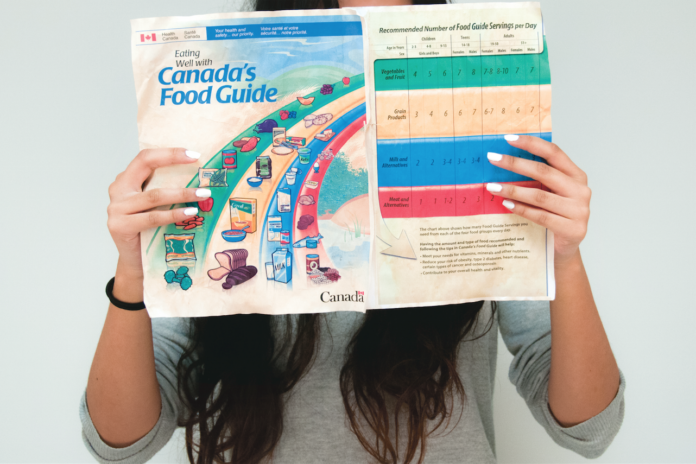
Canada’s Food Guide is a document most people in this country are familiar with. After having first been introduced to this guide in elementary or middle school, many students learn about it as if it were the sole source of nutritional information. Students are taught that it should not be disputed, as it is the foundation of a healthy life.

However, this document has been greatly neglected. It hasn’t been updated since 2007, and since 1992 before that. It no longer represents, if it ever did, the nutritional needs of the Canadian population, and is only a small glimpse into requirements for a healthy lifestyle. Moreover, it gives no options for the many people who cannot abide by its unrealistic and often unnecessary standards.

First of all, by lumping foods into four extremely broad categories — vegetables and fruit, grain products, milk and alternatives, and meat and alternatives — the Food Guide actually provides little nutritional guidance. Just because we read that we “require” two servings of milk and alternatives doesn’t mean we understand the amount of calcium or calcium sources our bodies require on a daily basis. Furthermore, it doesn’t take into account the disputing information over whether or not dairy is the healthiest source of calcium.

Canada’s Food Guide needs to adapt to the people it was supposed to represent.

Additionally, many groups of people are ignored from the equation when it comes to the food guide. It offers little to no alternatives for people who have different dietary needs and constrictions — from celiac disease to the prominent dairy intolerance, from people whose bodies require less calories to people who choose to be vegetarian or vegan, many are excluded from the discussion. If we were to base our eating habits solely on what the Food Guide recommends, there would be few choices for many people.

Likely, there will never be a perfect solution to creating a food guide that can work for everyone. Does that mean we should scrap the idea altogether and instead educate our children on how to make healthy decisions based on their individual choices and circumstances? That might be a better alternative. A basic infographic such as this Guide cannot accommodate the diversity of the Canadian population, and it’s time for us to stop pretending that it can.

Canada’s Food Guide needs to adapt to the people it was supposed to represent. If it is going to be used and respected, it needs to be a realistic representation of the nutrition the Canadian people should consume, and take into account the many other ways in which Canadians can contribute to their own physical and mental well-being.

Sea lice are getting local sockeye down

0
Sockeye with higher levels of sea lice eat 20 per cent less than others. - Momo Lin
Sockeye with higher levels of sea lice eat 20 per cent less than others. – Momo Lin

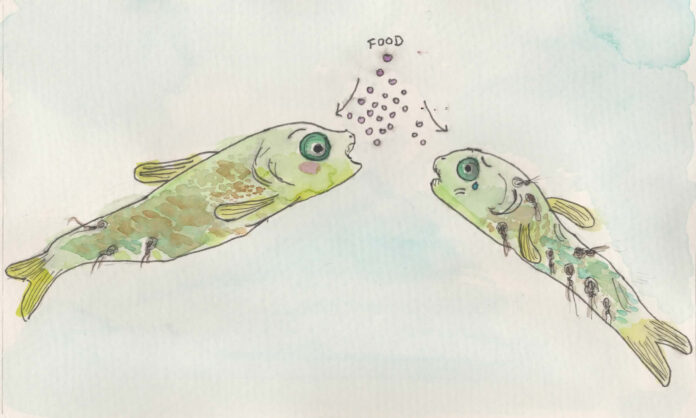
A study led by SFU researchers has found that sea lice infections are more common among juvenile sockeye salmon than previously thought, and infections caused by the parasites are negatively impacting the survival of the fish.

Sean Godwin, a PhD student in SFU’s department of biological sciences, explained: “Juvenile sockeye salmon that are migrating from the Fraser river, that are highly infected with sea lice, are less able to compete for food.”

Godwin explained, “sea lice are a type of parasite that attach to the outside of fish and feed on the surface tissue.” Although the species found on the sockeye during the study are native to BC, there has been rising concern over the past couple decades since the amount of lice on juvenile salmon is much higher than expected.

The study was based at the Salmon Coast Field Station in Port McNeill, and researchers collected the fish from the Johnstone Strait — a corridor along the east side of Vancouver Island used by migrating juvenile salmon to reach their winter feeding grounds as they travel from the Fraser River to the open ocean.

After collecting the juvenile sockeye, Godwin originally planned on separating the uninfected fish from the highly infected fish, but they were hard pressed to find uninfected fish. “Almost every single fish that we caught had sea lice on them,” he said.

Instead, the study focused on comparing the competitive abilities of lightly infected fish versus highly infected fish. Their results found that the highly infected fish were 20 per cent less successful at consuming food compared to the lightly infected fish. Each group was fed the same limited amount of food and contained fish of the same sizes.

Fish farms found along migratory routes seem to have played a role in the increase of sea lice found on salmon. These fish farms are “high-density environments for young Atlantic salmon in net pens, and the net pens do not have any barriers,” according to Godwin. Because of this, they serve as reservoirs for sea lice to grow and spread to wild salmon populations.

Godwin hopes that his research will help inform parasite management on fish farms, because the majority of sea lice species found on the juvenile sockeye he studied were different from the species that fish farmers treat for.

The next step is working towards forming a fuller understanding of the impact that sea-lice infection levels have on the young fish as they continue on their migratory route and age into adults.

“I hope other people can build on my results, we really need to do more research to figure out how and whether the sea lice levels will affect adult return stock,” said Godwin.

Philosophy doesn’t suck

0
Photo Credit: Phoebe Lim

Like many a real-life love affair, I never meant to fall for philosophy.

We got off to a rocky start. Wasn’t this the discipline for pretentious neckbeards who would rather stare blankly at a ceiling than write a research essay? I had heard the jokes — philosophy graduates make great bus drivers — and my half-hearted high school philosophy teacher had done little to convince me otherwise.

By the time I began at SFU, I was convinced that philosophy was a dusty and worn-out discipline, a pseudoscience that mainly consisted of mindlessly subjective speculation over questions that science would have a much better chance of answering.

This is the part of the romantic comedy where the two leads hate each other. But you know where it’s going to end up, right?

I’m not sure when exactly philosophy clicked for me. Maybe it was Lewis and his batshit crazy idea that possible worlds are actually real. Or maybe it was Thompson’s scathing defense of abortion, Baudrillard’s proto-Matrix simulacrum, or Wittgenstein’s near-impenetrable theories on language and representation. Whatever my gateway drug was, I suddenly found myself head over heels for the witty, wonderful, and unapologetically weird world of western philosophy.

Of course, not everyone else shared my sudden passion for the canon. Vacant stares are still par for the course when I announce that, no, my minor isn’t in Publishing or English. I never knew how much people hated philosophy until I decided to study it: everyone seems to have a horror story of that one kid in class who won’t stop referencing Deleuze or Kierkegaard.

I never knew how much people hated philosophy until I decided to study it.

To be fair, I understand the hesitation. Philosophy is difficult, and not in the way most of us are accustomed to — it forces you to challenge your most deeply held beliefs, to question each and every way that the world is. It’s led me, a passionate atheist, to seriously consider the idea of God’s existence, and it’s forced me to come up with convincing arguments for ideas I never thought I would have to defend: equality, rationality, empathy.

But here’s the thing: That’s what I love about philosophy. It’s tough as nails and takes no prisoners. I mean, it’s graded on a fucking curve. That’s hardcore.

Studying topics like ethics, epistemology, and metaphysics forces me to constantly reevaluate myself and my opinions, and to make damn well sure I can defend them. It’s the same reason that I love journalism: it encourages me to fight for what I believe is right, and to make sure I really understand and believe what I believe is right.

As I study philosophy, I see more of it everywhere. It’s in every book I’ve read, or at least all the really good ones. It’s behind every political decision and every activist march; in every work of art, from Guernica to Dance Moms. It traces the history of our civilization to the present day, and it offers us a vision of our future.

And whether or not scientists like to admit it — I’m looking at you, Neil DeGrasse Tyson — it forms the backbone of modern science. After all, it wasn’t so long ago that “science” was just another word for “philosophy.”

I doubt that philosophy will ever be as popular as it once was. That’s probably a good thing: honestly, a society of philosophers probably wouldn’t get too much done. But I’m proud to study something that gives me confidence in my beliefs and the tools to defend them, and I challenge anyone to give me a valid argument against that.

Viral online trends are not to blame, the participants are

0
Photo courtesy of TIME (Flickr)

The concept of ‘going viral’ has evolved from being a result of chance to a goal to aim for. As a result, more and more irresponsible Internet users aim to garner as many views and likes as possible by creating shocking content. I find that social media, be it online or through mobile applications, perpetuates viral challenges that gain a bad reputation for promoting irresponsibility.

However, more focus must be placed on the individuals misusing the Internet rather than on the technology itself.

In the Digital Age, many people posting content online are under pressure to get as many hits as possible, fearing their content will be considered unimportant or virtually non-existent. Nowhere is this concept more salient than when young people participate in viral challenges for attention — an attention that poses a great threat to society.

Most recently, warnings about the “Game of 72” have emerged in Canada regarding the potential for a new online craze. This game, or challenge, involves young people deliberately disappearing from home for 72 hours. The first case was recorded in France, but with the boundless nature of the Internet, Canadian authorities preferred not to take any chances.

“Attacks around [the] US probed for link to knockout game,” reads another case of the atrocities caused by viral challenges. In 2013, the knockout game, which challenges users to render others unconscious in public, has caused at least two deaths in the US, as a result of young people who followed the calling to go viral. Other deadly challenges like the recent ‘Fire Challenge,’ which pressures youngsters to light themselves on fire, have also gained popularity on social media.

To heavily regulate apps and social media defeats their democratic purpose and takes away user agency.

At this point, some may be quick to proclaim that social media is to blame for all our problems. However, this thinking is flawed.

Young people tend to negotiate their identity through risk-taking, which is characteristic of growing up. Combined with the endless pursuit of views, likes, upvotes, and shares, the flame of irresponsibility thereafter thickens. But the issue here is psychological, not technological.

The current younger generation seems to be going through a crisis in which it looks toward a screen for an identity, and this is where the problem lies. Young people are already irresponsible in general. It does not help that so much importance is now attached to social media and the identities created therein — an attachment that is destructive.

Some may believe that the social media and other apps, such as Vine, where a culture of competitive showmanship is prevalent, should be heavily regulated. However, this also misses the point. To heavily regulate apps and social media defeats their democratic purpose and takes away user agency.

Destructive online behaviour therefore calls for more responsible users and not necessarily the strict policing of the technology itself. It is up to the people to evaluate why we feel the need to participate in absurd challengesantiques to fit in, and that begins with the individual. There needs to be an overall re-evaluation of our relationship with technology as a whole.

Like anything else in life, the freedom offered via the Internet is a two-sided coin, and can do as much good as bad. It is up to the user to be responsible with the power offered to them via technology.