Home Blog Page 999

TransLink promises voters “things will be different this time, baby”

0
Photo courtesy of Wikimedia Commons

With a May 29 deadline fast approaching for the regional transit referendum, TransLink has again reached out to people who use their services, vowing to change for the better and treat riders with the respect they deserve.

The promise of self-improvement and a better tomorrow were part of several announcements made last Friday between 1 and 3 a.m. on Metro Vancouver’s voicemail.

“Listen, listen,” TransLink slurred at the start of the first message, left at 1:05 a.m., “I know things have been a little [hiccup] rocky between us but we’re so [hiccup] good together. I think I deserve another [hiccup] shot at this.”

Citing a renewed interest in public approval and a few too many Smirnoff Ices at the bar, TransLink vowed to win the public back — even if it means leaving a hundred voicemails, each more pleading than the last.

“I know you’re [hiccup] listening to this,” another message left at 2:17 a.m. declared. “Pick up the phone. What, you think you’re too good for me? Huh? Is that [hiccup] it?!

“I just miss you so much,” said the final voicemail, left at 2:52, followed by weeping sounds.

The Peak has also learned that most of the other messages were full of indecipherable one-sided dialogue, with one source claiming that TransLink went as far as to drunkenly serenade Metro Vancouver’s voicemail with a slurred rendition of Player’s 1977 soft-rock classic “Baby Come Back.” The performance, according to the source, was “lukewarm at best.”

For the past two months, residents of Metro Vancouver have been submitting ballots on whether or not they’re in favour of a new Congestion Improvement Tax of 0.5 per cent; funds collected from the tax will be used for the Mayors’ Transportation and Transit Plan, which includes increasing bus frequency, building rapid transit to cities such as Langley, and constructing a new Pattullo Bridge.

At this time, it’s unclear if the series of voicemails left was effective in changing Greater Vancouver’s mind — which was slanted towards the “no” side before voting commenced — but the incessant pleading just might be enough for Metro Vancouver to consider giving TransLink another shot at this.

“Just because I’m not in love with TransLink doesn’t mean I don’t love TransLink at all anymore,” Metro Vancouver said back in February, leading up to the mail-in referendum. “We’ve been together for almost 20 years now; we have a lot of history. But with that said, I think it might be time to try something new. As they say, there are plenty of regional transportation networks in the sea.”

Mad Max: Fury Road starts out promising, but confuses itself for a feminist manifesto

0
Photo courtesy of Orlando Weekly

It’s been three decades since the last movie in the Mad Max franchise (the third film, Mad Max Beyond Thunderdome) came out in 1985, but director George Miller has finally treated us to a fresh installment — and what an installment it is!

The new film, titled Mad Max: Fury Road, is a two-hour long thrill ride that gives us some of the most exciting and creative action scenes possibly in cinematic history. In fact, if it weren’t for the painfully blatant tones of feminist propaganda and insufferably independent female characters confusedly not clad in desert bikinis, I might’ve said Fury Road is one of the best films of the past decade.

Starring Tom Hardy (The Dark Knight Rises, Inception) as the titular protagonist, viewers are again transported to a post-apocalyptic world where resources like water are now a rarity, and women have somehow wormed their way into a position where not all of them can be pigeonholed to love interest status. In a nutshell, the world has gone to hell.

The movie opens with Mad Max (Hardy) surveying the mostly-desert world, but there’s hardly a moment of plot before our hero is forced on the run by a cast of brutal villains. Most of the film’s plot occurs in the first 20 minutes, before giving way to an extensive and inventive chase scene that basically lasts the rest of the running time. However, viewers should be aware that most of the action in this film is of the explosion and violence type, with very little female nudity to complement. It’s an odd mixture of adrenaline and clothed female characters — and it doesn’t always pay off.

The film also stars Nicholas Hoult (X-Men: First Class, Skins) as Max’s newfound ally and Hugh Keays-Byrne (from the original Mad Max) as the heinous Immortan Joe. Charlize Theron is also in the movie as some girl (I can’t remember if she even had a name), but she’s not really important. In fact, Theron’s portrayal of a girl who just can’t seem to get herself a boyfriend is what prevents Fury Road from ever really gelling.

Her character proves problematic in that she doesn’t spend the whole movie chained up or being forced to be a man’s sex slave of some kind. Perhaps the biggest misstep of the movie: not once does she get captured by the bad guys and locked in a dungeon somewhere, forced to await Max’s rescue or maybe use her body in a sexual way to outmaneuver the guards. It’s a total disregard to Mad Max loyalists, clearly pandering to a demographic of whiny feminists who just don’t understand what makes a great film great.

I can’t agree with the rave reviews that Fury Road seems to be reaping, but I can say that it feels good to be back in the Mad Max universe. A fifth installment has already been alluded to (Miller tweeted “there’s more Max to come” and Hardy is reportedly signed on for multiple sequels) so there’s still a chance we could get the film we want — we just have to trust that George Miller doesn’t let any more smelly girls ruin it.

SFU over the moon for Astronomy Day

0
The event featured a Northern Lights slideshow set to music. - Wendy Johnson

SFU opened its doors to the public last Saturday, May 9 and once again celebrated Astronomy Day, with a day of free fun for space enthusiasts of all ages.

The annual event was hosted by the Royal Astronomical Society of Canada (RASC) in conjunction with SFU’s Science Rendezvous. Over 5000 visitors passed through the campus to take part in the day’s happenings.

Tables with exhibits lined the halls of the AQ from late morning well into the afternoon. There were plenty of crafts and activities for the younger astronomy fans, including a station for making oreo’s that depicted different phases of the moon and two well-attended science shows in one of SFU’s science theatres.

Guest lecturers gave free talks throughout the day and people lined up all afternoon for tours of SFU’s new observatory. Attendees could also take a look through one of the solar telescopes stationed outside.

One of the first free lectures of the day featured a slideshow of the Northern Lights — the phenomenon that involves charged solar particles hitting the earth’s magnetic field, creating displays of colourful lights around the North and South Poles.

While the Aurora Borealis that is typically seen is green, photographer and long time amateur astronomer Ed Hanlon explained that stronger solar storms result in yellow and red colours. Hanlon’s photos showed the varying range of lights he witnessed over the years while he was stationed as a paramedic in northern Canada.

Another talk explored the seemingly infinite multitude of galaxies in the universe, how they are identified, and all the interesting and unexpected shapes they take.

A retired physics and astronomy professor from Capilano University, Stanley Greenspoon, gave a talk on the search for extraterrestrial life. He explained that in this search NASA bases their evaluations for habitability primarily off of the presence of liquid water. “We always expect other solar systems to be like ours. We always do,” he said. “We’re wrong.”

SFU’s own professor of physics, Howard Trottier — also known as Mr. Starry Nights — assisted with the event. The Trottier observatory opened on April 17, bringing the stars closer than ever to SFU’s mountaintop campus.

Trottier was quoted in The Peak, commenting on the significance of astronomy as a focus for scientific outreach. “People can look at the sky with their eyeballs and see what’s out there without there being anything between them in that experience,” he said. “That makes it very accessible to people.”

Another of the day’s attractions was a session on the Apollo missions given by astronomer Ted Stroman. He demonstrated the Apollo 11 moon landing with a scaled model of the Saturn V rocket that launched the first humans to the moon in 1969.

Stroman noted the importance of engaging people in learning the facts that science-fiction box office hits don’t provide. “I think that there’s a lot of silly public information that’s hyped and distorted out there,” he said.

“These events [bring] people to the ground and they get to hear it from people who know what they’re saying, who aren’t here to hype things.

“I think they learn a heck of a lot more from an event like this or from sitting down with a good book and actually reading.”

The Happy Show is the cure Vancouver needs

0
Photo courtesy of Katherine Holland.

The Vancouver Foundation has recently reported that Lower Mainland residents feel lonely and isolated, resulting in lower happiness overall. In order to address this topic, the Museum of Vancouver is displaying Stefan Sagmeister: The Happy Show, a vibrant exploration into happiness, from April 23–September 7.

The Happy Show is curated by Stefan Sagmeister, a designer known for his unique blend of typography and imagery. “It’s the perfect time and perfect place to engage Vancouver in terms of exploring happiness,” says Gregory Dreicer, Director of Curatorial and Engagement at the Museum of Vancouver. He adds, “It’s a really unique exhibition because it’s based on Sagmeister’s ten-year exploration of what makes him happy and [what] he learned from it.”

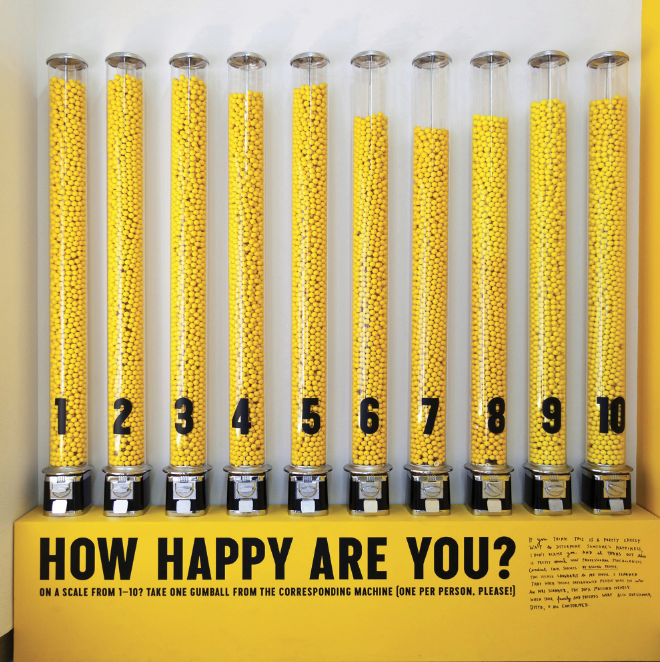
As for the exhibit, Dreicer claims that it really needs to be personally experienced. However, he divulges his favourite pieces in the exhibit. “There are a series of gumball machines that are very tall, and they are in a series of 10. Everyone who comes here has to take one gumball according to their level of happiness. So already [. . .], it is forming a kind of [infographic] that lets you see the level of happiness of Vancouverites.”

Other than engaging infographics, the exhibit also boasts an array of video projections and interactive installations. For one interactive sculpture, Dreicer explains, “when you walk up to it and smile, it causes the projection to create all these beautiful colours.” The exhibit also displays a preview of Sagmeister’s soon-to-be-released documentary, The Happy Film, which depicts his own attempts to increase his happiness through meditation, cognitive therapy, and mood-altering pharmaceuticals.

Central to the exploration of happiness, Dreicer advocates the exhibit’s ability to promote self-exploration into individual happiness. “I think it will encourage people to think about their own individual happiness,” he says. “Everyone knows whether they are happy or not, but most of us don’t really know [. . .] what really makes us happy.”

He explains that the exhibit itself is a response to how people are going about their pursuit of happiness all wrong. “Most people think that making more and more money makes them happier. But in fact, once you have your basic necessities taken care of [. . .] making more money doesn’t increase happiness.” People are striving for things they think will make them happy, Dreicer says, which “are not succeeding. [. . .] On the other hand, the things that do make people happy are sharing, collaborating with others, being generous and giving to others [which] actually helps to enhance happiness,” and helps the community in general, he says.

Truly, the key theme through this exhibit is the relationship between personal happiness and social connection. “The key to [individual] happiness,” explains Dreicer, “is social connection. And on the community level, urban happiness or well-being is also related connection between people.” Thus, he says, the relationship between happiness and connection is integral.

In order to continue the conversation and foster social interaction, the Museum of Vancouver will continue to focus on social connection and happiness. “We will be hosting Happy Hours where people can come, have a few drinks, and interact and mingle with an expert in one area of happiness,” says Dreicer. The group will also be holding a Family Day on May 23,  “to encourage families to come and interact and learn a little bit about happiness,” he adds.

Dreicer hopes that people begin their own self-exploration into their personal happiness after visiting the exhibition. “If people come, I think it will be good if they understood better what, as individuals, makes them happy and then what would make their communities happier. On a bigger level, I think it will help us think about how we are connected to others — since that is one of the big keys to happiness — how we relate to others, and what that means for ourselves and for our communities,” Dreicer concludes.

“Once people learn a little [and] think a little bit about it, I think it’s possible to make some change.”

Is there such a thing as a Good Kill?

0
Photo courtesy of IFC Films.

Someone playing Call of Duty or Halo presses the trigger, and bang, a character dies. But they’re not actually dead — they can respawn and get shot again, and again, and again. Victims of American drone strikes, though, don’t respawn.

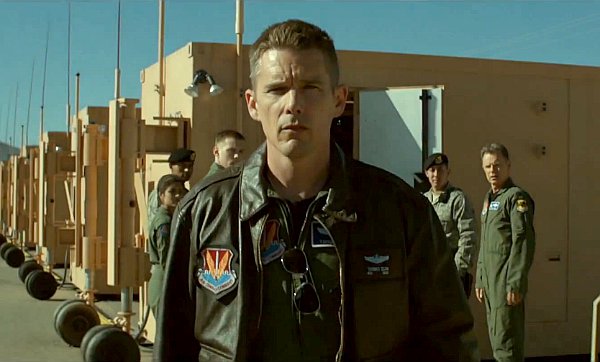
Andrew Niccol’s Good Kill concerns one of these grave-piling gamers, Tom Egan (Ethan Hawke), who spends his days working in an air-conditioned room in Las Vegas handling a joystick with the ability to blow-up almost anything anywhere in the world. After numerous tours to Iraq, he now serves from his home country and sleeps at home with his family. However, if he were playing Call of Duty there would be little reason for him to struggle with PTSD, or for his boss to recommend “I and I” (intoxication and intercourse) during his downtime.

For Tom and his coworkers, there is enough distance from the victims through the screen and the silence of his office to ignore what they are actually doing. But Tom tires of being in front of a screen and longs to jump back in a real plane where he will fight outside of the comfort and safety of a cubicle.

The subtext of America’s war policies (which seem uncompromisingly close to that of the terrorists) is what gives the film its cerebral and visceral vigour. The film centers on this question: Is there such a thing as a good kill?

Tom is unsure. He follows the orders given to him by his commander, but he’s lost the eagerness and enthusiasm to kill displayed by younger soldiers around him. Niccol captures the horrors of this attitude by juxtaposing it with Tom’s turmoil.

This theme is what gives the “action scenes” — all done through the poetic distance of a drone surveillance feed — their power. We are never given any perspective from the ground where the people are being bombed; Niccol keeps a chilly distance from the attacks that makes them all the more terrifying. There are no screams or cries, just pixilated dust on a computer screen, as virtual as Halo.

Niccol’s most recent efforts, The Host and In Time, demonstrate his ability to infuse his films with thoughtful themes, but, unfortunately, he fails to create engaging plots or characters. Similarly, Good Kill has some very powerful moments, such as when Tom is commanded to kill innocent people; however, his strife away from the military seems clichéd and forced.

We’ve seen soldiers in movies struggle with their relationships at home between tours, and we’ve seen the strain in marriages because of PTSD, but using such common themes isn’t the major problem with this story; instead, it’s that every character other than Tom is entirely one-dimensional. They are simply present for exposition, spewing out social criticism, or adding conflict to the plot. Although American Sniper lacked Good Kill’s ambiguity, at least it had strong performances that captured the insides of all its characters. Other than Tom, I’m not sure if the characters even have insides. Andrew Niccol is a filmmaker with strong ideas, but he cannot seem to express them through characters and plot.

First person shooters are gratuitous and unreal in their gun violence. These video games can be enjoyed like interactive puzzles, but the horror of Good Kill is that similar activity may be used for mass killings by the American military. They are not blowing up pixels, but the flesh of human beings.

The Lumberjanes are on the case

0
Photo courtesy of Boom! Studios.

For those at Miss Quinzella Thiskwin Penniquiqul Thistle Crumpet’s Camp for Hardcore Lady Types, strange supernatural creatures have been afoot. Three-eyed foxes are lurking in the night, serpent monsters have been spotted in the river, and a Yeti has been seen wearing a Walkman. But fear not; the Lumberjanes are on the case.

Lumberjanes follows the hilarious and action-packed misadventures of five best friends at an all-girls summer camp. Taken aback by unexplainable happenings in their campsite, this gang of feisty butt-kickers decides to investigate, much to the displeasure of their incessantly irate scout leader. Jo, April, Mal, Molly, and Ripley set out on a magical quest tackling everything from secret caves to arm-wrestling stone golems, all whilst accumulating scout badges as they go.

Noelle Stevenson and Grace Ellis weave an enjoyable tale packed with non-stop hilarity. Every page is bursting at the seams with jokes and gags, enough to keep a perpetual smile on your face.

This lovable gang of misfits is a riot from start to finish. While the characters have eccentric personalities, they are also jam-packed with heart and soul. Each of theLumberjanes is strong on their own, but together this ensemble succeeds where most fail. At its core,Lumberjanes is a story about friendship and comradery, and thankfully this is never forgotten amidst the many calamities they face together.

Brooke Allen knocks it out of the park and plays perfectly off the creative energy of both Stevenson and Ellis. Her bright and colorful panels are a treat for the eyes. The cartoon style rendering of the world of Lumberjanes is reminiscent of old school Saturday morning cartoons. What the artworks lack in intricate detail, they make up for with a vibrant panel layout. Rest assured, no page in this series is ever boring to look at or rendered the same twice.

In a time where the outcry for strong female characters has never been louder, Lumberjanes succeeds in introducing audiences to a new cast of leading ladies for the next generation. They have the potential to be strong figures in the pantheon of graphic novels, and I sincerely hope they continue to stock the stands for years to come. 

Lumberjanes is a graphic novel that can be enjoyed by people of all ages. It’s a wonderful homage to the old school Saturday morning cartoons of the ‘90s and ‘00s. So take a seat and get acquainted with the genre’s new leading ladies. Kick off the summer with a read that packs a hell of a supernatural wallop.

Scientology is exposed in Going Clear

0
Photo courtesy of Jigsaw Productions.

Everyone has a need to find a sense of purpose in what can sometimes seem a meaningless world. Alex Gibney’s Going Clear: Scientology and the Prison of Belief, an exposé of the sins of the Church of Scientology, displays this point in almost every moment — whether that be through the founder L. Ron Hubbard’s search for wealth in creating a religion or the fact that Dianetics (a set of ideas and practices regarding the metaphysical relationship between the mind and body) caught on with so many baby boomers so fast at the time of Scientology’s inception.

For all his wacko ideas, Hubbard, a pulp sci-fi writer, understood the human condition and how he could cash in on our fears and anxieties. The problem is, the film suggests, that no matter how much time and money Scientologists give to the church, they still remain broken and depressed.

Going Clear has an amazingly ironic title. For Scientologists, the term “Clear” is assigned to the highest members of the church who have walked their way all the way up “The Bridge to Total Freedom” to become an  “operating thetan” (OT). At these superlative stages of OT, one is supposed to be free of any engrams — reoccurring bad memories from the past that are the cause of depression and the reason we can’t realize our full potential. 

Gibney’s title is impeccably clever because he shows that the more people go up the ladder, the more dysfunctional and less clear they actually become. The irony is that the only way to fully go clear is to break free from the restrictions of the church entirely.

If you found these last paragraphs dense with lingo, you have little idea what you’re in for. Going Clear is an emotionally powered composition that compactly chronicles Scientology’s origin in the science-fiction of its founder L. Ron Hubbard all the way to the current corruption under Ben Miscavige’s leadership.

High-profile members who have left the church like Crash director Paul Haggis and senior executive Mike Rinder are interviewed and poignantly share the deplorable actions that were done to them and that they did to others. What makes this film more than just cold visual journalism, though, is the regret expressed by the interviewees, and the pain they now experience, as many of them have been disowned and alienated from their families.

Going Clear is not nearly as artful as the recent Kurt Cobain: Montage of Heck in its use of documentary form, but what this film offers is more of an emotionally-charged journalism. There is nothing inventive with regards to how the film is put together — an assemblage of talking heads, old interviews, news footage, and simplistic visual reenactments — but it serves the educational purpose as it neatly and concisely expresses Gibney’s messages.

What makes the film exceptional is how coherently it teaches an enormous amount of information in two very short hours to an audience that could know very little about Scientology.

Before seeing Going Clear: Scientology and the Prison of Belief, I had little knowledge of Scientology. I came out with an understanding of why Hubbard created the religion and why so many people joined him, but I still don’t understand how any Scientologists will be able to leave the film still devout.

Let’s face it

0

Let's Face It (by Hans Jungmann)

Muppet films and specials you may have forgotten about

0
Photo courtesy of Cultjer

With everybody’s favourite felted hooligans returning to television this fall on ABC — and a new trailer just released last week — we’re looking back at some of the Muppets’ wackiest adventures. Do you remember watching any of these hilarious Jim Henson productions when you were younger?

Marvel’s The Muppets

The Muppets Take on Global Warming

The Muppets Present the Internet

The Muppets’ Animal Farm

2 Fast 2 Muppets

Andy Warhol and the Muppets’ Holiday Special

The Muppets: The New Class

The Great Muppet Depression

Muppet Classic Improv Theatre

The Muppets Go to North Korea

Muppets from Under the Crawlspace

The Great Gonzo Gatsby

Muppets Treasure Pacific Trash Vortex

The Muppets Learn How to Evenly Split a Tip

The Muppets vs. Capcom

It’s a Very Merry Muppet Victoria Day

A Muppets Christmas: Letters to
Their Local MLAs

Kermit Saves the Canucks’ Playoff Series

The Muppets: SVU

Non-humans of SFU

0

ONLINE_Let's Face It